Shannon Miller celebrates his win at the Olerud’s hot dog eating contest Saturday afternoon. Miller won the contest with eight hotdogs consumed in four minutes. July 4, 2026. (Will Steinfeld/Chilkat Valley News)
Twelve contestants stepped up to the table positioned outside of Olerud’s after the Fourth of July parade, ready to participate in a hot-dog-eating contest. Olerud’s employees Tyler Swinton and Bryce Wortman prepared 160 hot dogs for the 17 people who initially signed up.
As it was their first time hosting a hot-dog-eating contest, the duo were unsure how many hot dogs people would consume, so they estimated each would eat a max of 10 hot dogs. This resulted in an excess of hot dogs. Swinton and Wortman cooked and packaged each tray shortly before the contest.
“It turned out to be more of a hit than we could have imagined for the first year,” Swinton said. More than 300 spectators gathered to watch as contestants competed for the grand prize of $250.
The rules were simple: contestants had to fully finish as many hot dogs as possible in 250 seconds, or four minutes and 10 seconds. Contestants could not dunk their hot dogs or buns.
They hatched the idea in May and June, when Swinton and Wortman were thinking about how Olerud’s could celebrate the 250th Independence Day. Wortman follows hot-dog-eating contests nationally and was advocating for Haines to have its very own.
The winner, eating eight hot dogs, was Shannon Miller. Jesse Benham, Michael Dillinger and Kris Fisher tied for second place, each eating six hot dogs. Other contestants included: Aurora Alten-Huber, Chuck Jones, Kayla Yeoman, Kevin Smith, Marc Lapeyri, Maxman Sullivan, Cory Zembower and Sonny Willard.
Looking at next year’s contest, Swinton said they are working on finding a way to have everyone see the event more easily, potentially by renting a flatbed trailer.
Community members watch the Olerud’s hot dog eating contest Saturday afternoon. July 4, 2026. (Will Steinfeld/Chilkat Valley News)
Community members watch the Olerud’s hot dog eating contest Saturday afternoon. July 4, 2026. (Will Steinfeld/Chilkat Valley News)
Dan Mahoney checks the timer for the hot dog eating contest as contenstents get their final hot dog pieces down on July 4, 2026, in Haines, Alaska. (Lizzy Hahn/ Chilkat Valley News)
Chuck Jones downs a hotdog during the Olerud’s hot dog eating contest Saturday afternoon. July 4, 2026. (Will Steinfeld/Chilkat Valley News)
Shannon Miller won Haines’ first hot dog eating contest after eating eight hot dogs in 250 seconds on July 4, 2026 in Haines, Alaska. (Lizzy Hahn/ Chilkat Valley News)
Competitors down hotdogs during the Olerud’s hot dog eating contest Saturday afternoon. July 4, 2026. (Will Steinfeld/Chilkat Valley News)
Shannon Miller celebrates his win at the Olerud’s hot dog eating contest Saturday afternoon. Miller won the contest with eight hotdogs consumed in four minutes. July 4, 2026. (Will Steinfeld/Chilkat Valley News)
Michael Dillinger downs a hotdog during the Olerud’s hot dog eating contest Saturday afternoon. July 4, 2026. (Will Steinfeld/Chilkat Valley News)
Community members watch the Olerud’s hot dog eating contest Saturday afternoon. July 4, 2026. (Will Steinfeld/Chilkat Valley News)
Voters in Alaska have until July 19 to register to vote in the upcoming August primary election.
The August primary includes the U.S. Senate seat, currently held by Republican Dan Sullivan, the state’s House seat, currently held by Republican Representative Nick Begich and 50 seats in the state legislature. The Governor’s office is also up for grabs and 17 candidates are in the running to replace Mike Dunleavy who has termed out.
The state’s August 18 primary is open, so all candidates will appear on the same ballot no matter their party affiliation. Voters will pick one candidate in each race and the top four vote-getters advance to the general election.
There will also be a ballot measure on the August primary ballot. If approved, it would limit some political contributions.
You can register online at voterregistration.alaska.gov, in person at a Division of Elections office or by mailing, faxing or emailing a voter registration. Voters can check their registration status online at myvoterportal.alaska.gov.
The mid-remodel chapel at the Episcopal Church’s 1-Mile property. Wednesday, June 17, 2026. (Will Steinfeld/Chilkat Valley News)
The Haines Borough has dropped its controversial effort to tax the 1 Mile Haines Highway Episcopal Church property.
The assembly voted unanimously Tuesday to end a borough appeal in Superior Court seeking to overturn a Board of Equalization decision from May. In that decision, the citizen board ruled the church property be exempt from property tax under a religious-use exemption. That had reversed an initial decision by the borough assessor that the property be taxed.
The exemption, which is written in state statute, exempts properties used exclusively for non-profit religious purposes. The debate regarding the Episcopal Church property centered around that “exclusive use” element, with borough staff and its contract assessor arguing that after six years without a church service at the property, it was no longer being used for religious purposes. Church members, meanwhile, argued both that the property was open to members for meditation and private prayer, and that there was no stipulation in state law regarding frequency of religious use to qualify for the exemption.
Borough manager Alekka Fullerton filed the appeal to Superior Court in early June without assembly input. On Tuesday, assembly members criticized that decision, including Cheryl Stickler, who cast the appeal as a First Amendment infringement.
The borough’s exemption decision did not dictate the church’s use of the property, only that some uses would incur taxation. But Stickler seemed to argue that taxation functionally acted as government intervention in worship.
“The First Amendment… to me prohibits a government body from going in and saying, this is how frequently you worship, this is how your property looks, this is how you have to prove to us you’re using this as a church property,” Stickler said.
“There’s fair and then there’s right,” she said after. “In my opinion, it is not right to levy taxes on our churches no matter what denomination, what faith. We, as Americans, get the right to freely exercise how we believe and what we believe.”
Fullerton and assessor Martins Onskulis, however, stood by their argument that the church property, according to “the letter of the law,” as Fullerton put it, had to be taxed.
“This is about treating taxpayers equally and following the letter of the law with respect to mandatory tax exemptions,” Fullerton said.
“We’re setting some sort of precedent,” Onskulis argued. “What if a church buys 100 properties in Haines. Are we going to exempt half the borough because it’s now owned by a church?”
Onskulis, as evidence that the church was not being singled out unfairly, said other vacant church lots in the borough were made taxable this year. That type of process, as well municipalities appealing board of equalization decisions, are something assessors in the state “see every year,” he said.
Other assembly members disagreed with Onskulis and Fullerton, but on different grounds than Stickler.
“I personally do see possible cases where it would be appropriate to tax church-owned property not used for religious purposes, but I don’t think that’s what we’re looking at here tonight,” assembly member Eben Sargent said. “We don’t have explicit standards for what current use means. I think in this case, the church has asserted they are using it, and the [Board of Equalization] agreed with them.”
“In the absence of a clear explicit standard, I think we should rely on [the Board of Equalization] and church’s own description of their use,” Sargent said later.
Assembly member Craig Loomis opposed the appeal as a waste of money, given the legal fees and minimal possible return.
“I think we would probably lose this lawsuit anyway,” Loomis said. “Representing the taxpayers, as a taxpayer, I think this is a waste of money.”
The assembly voted unanimously to have borough staff withdraw the pending appeal from Superior Court.
The whole issue will likely be moot going forward, at least for the Episcopal Church property, given that the church has begun holding services there in recent weeks.
As for other church properties around town, there looks to still be some grey area. Because the exemption is written into state statute, the borough cannot change the wording of the law, borough attorney Max Holmquist said. The assembly may still be able to set policy regarding interpretation or application of the exemption law, and at one point during Tuesday’s meeting Fullerton asked if they intended to do so.
But assembly members opted to keep their decision limited to the specific question of the Episcopal Church, and questions about requirements surrounding frequency of use remain unanswered.
Joe Parnell drives a lawnmower at Valley of the Eagles in Haines on Friday, July 3, 2026. (Will Steinfeld/Chilkat Valley News)
The Valley of the Eagles Golf Course, near 1 Mile Haines Highway, is, and always has been, an operation that demands constant labor and produces no revenue. For 20 years, it has been owned by people with no interest in playing golf.
It’s counterintuitive, but all true – except for the statement that the course doesn’t produce any revenue. It did once, when longtime area doctor Stan Jones and his wife Kathy Pardee-Jones sold it in 2021. That was after it sat on the market for five years, no one willing to pay the $1.6 million asking price.
Jones wasn’t worried during that time, at least as he remembers it now. “I had said, when the good lord wants me to sell it, he’ll sell it for me,” the 94-year old Jones said in an interview this summer. “One day he sold it for me.”
It happened on a Sunday. There were two men interested in the property, they walked the course, and within a week they made an offer. Their offer was below the asking price, but still, for Jones, “very, very satisfactory.”
Soon after the first offer, a second came in – a cash offer – this one above the original asking price. Jones won’t say who that second offer came from. But it eventually lost out to the two men with the Sunday offer, one of them current golf course owner Clayton Jones (no relation to Stan and Kathy): a much younger man and a successful businessman.
The younger Jones wasn’t happy about the competing offer, Stan Jones remembers.
“Clayton could not believe it,” he said. “He called our realtor, and after, she told us, ‘I’ve never been talked to like that before.’ Clayton’s partner, he said, ‘well, he’s just a young buck. He’ll get over it.’ And he said we’ll top that offer by $100,000 and we’ll top subsequent offers up to a maximum of a certain amount.”
The bidding continued up to the maximum and Clayton Jones eventually won. In large part because of that sale, Stan Jones says he’s made more post-retirement than he did in his 26-year career as Haines’ doctor and clinic owner.
When asked about the windfall recently, Jones responded first by singing a hymn: “Praise God from whom all blessings flow, praise him all creatures here below.”
“When I sold the golf course I gave a nice contribution to the Salvation Army,” he said. “I gave some other nice contributions. I’m not a big spender. But every day I thank the lord for my family, for my health, for my wealth, and I ask the good lord to help me know how to spend it.”
In some sense, Jones’ windfall came for free: well over a million dollars of land created out of submerged silt.
A couple thousand years ago, the Chilkat Valley was covered by glaciers, weighing down the land. When they receded the land began to lift, inch by inch, until about 30 years ago, the golf course rose out from the river.
At least, that’s the rough idea. Before the golf course existed as such, Jones purchased the property in 1965, without any grand plans of laying claim to rising land. Five years later, while building his medical clinic in town, he dug down and found an old bed of clams in the dry dirt.
That all became relevant around a decade later, when the Alaska Supreme Court decided land created from post-glacial rebound could become the private property of adjacent landowners.
In the wake of that ruling, Jones resurveyed his land, adding 93.4 acres of former wetlands — the substrate that would become the golf course. Today, he recalls the acreage down to the decimal point.
Through it all, the now-golf course remained unvegetated drainage. At one point a friend’s father visited town and hit golf balls into the area. They stuck and sank.
In 1989, Jones’ first wife died. “We were married for 33 and a half years,” Jones said. “And she got up one morning getting ready to go to church and dropped dead.”
On the last day of that year, he retired from his practice and sold the clinic, citing rising costs and poor insurance reimbursement rates for rural physicians. Two weeks into retirement, he left town to spend half a year working in mission hospitals across Africa.
Jones is so closely identified with his former practice in Haines that today, he’s still Doctor Jones to the people who stand to greet him everywhere he goes. When he returned from his mission work, however, he was no longer the town’s doctor, though, according to the newspaper at the time, he wasn’t retired either. “I don’t really look at myself as being so much retired as shifting gears to use my talents in another direction,” he told the Chilkat Valley News reporter.
About a year and a half later he married Kathy Pardee-Jones, and a few years after that came the resurvey that added his 93.4 acres of new land.
He considered a number of business ideas for the land, things he thought wouldn’t be environmentally harmful. At one point he considered a salmon-rearing habitat, but a fisheries biologist told him it would be challenging.
“He said it would be very expensive,” Jones remembers. “So I said, well, maybe we could have a golf course.”
Jones had never golfed. He would swing a club for the first time only years later, when some of his employees brought him out onto the course after the day to play a few holes. (Asked what he thought about the game of golf, Jones responded, “it’s fine.”)
He had, however, seen a study by the Anchorage market research firm McKinley Research Group, then known as the McDowell Group, that, according to Jones, said 2% of cruise passengers wanted to play a round of golf in Alaska. If 2% of Haines’ cruise tourists came to the course, he reasoned, the course would have a hard time even accommodating everyone.
Stan Jones holds a tadpole from a pond at Valley of the Eagles in Haines on Friday, July 3, 2026. Jones says he has been watching the tadpoles at the pond ever since the course was built. (Will Steinfeld/Chilkat Valley News)
Jones showed up one day in the Seattle office of Mark Miller, a golf course designer. They had never met and Miller had just moved from Hawaii, where he was designing courses for a major firm. Generally, he said, he was contracted by large development outfits, not individual small-town landowners in Alaska. He invited Jones in, and Jones showed him the aerial photos of the wetlands. Miller remembers telling Jones his idea for a course would be basically impossible. Jones remembers it differently, Miller saying the permitting would be very difficult. But the course? Not necessarily impossible.
“I kind of told him, you can’t design a golf course in a floodplain where you’re putting down fertilizer and grass and chemicals. But he just kept going, and kept calling me,” Miller said. “Finally, he said, what if I flew you up here and you could see the site.”
Soon after, Miller was in Haines, sitting in a canoe with Jones. (Miller remembers it as the middle of the night at a high high tide; Jones calls that impossible, saying it was during the day, based on his recall of a specific 6 p.m. tournament tee time the day before.) Whatever the hour, they agree that they were in a canoe, and that as they were paddling, Jones was pointing out submerged fairways which existed at that point only in his mind.
“We got big rubber boots on, you know, up above our knees,” Miller remembers. “And he’s paddling around and pointing at the water going, ‘this is where the first green is gonna be,’ and it’s underwater. We get out and we’re trudging around in knee-deep water and he’s pointing out the layout of the course, and I’m kind of thinking, man, this is the wildest thing I’ve ever seen in my life.”
By the next morning the tide was down. Seeing it dried out made it more plausible for Miller, along with the beauty of the site in the daylight. With Jones, they hatched a plan for a pesticide-, herbicide-, and irrigation-free golf course — something that could be permitted in the wetland area. They would plant it with a blend of grasses to find something that would survive the tidal inundation.
“I think when he got it in his head he wanted to do that, there was nobody that was going to hold him back, and if I wouldn’t have helped him, he probably would’ve found someone else,” Miller said.
Permitting took seven and a half years and, Jones said, $25,000 worth of design work. By summer 2003 they had the permits and Turner Construction was hired to drag the land level and put the course in. They waited for the winter freeze to truck in fill for the greens (“I don’t know what you call them on a golf course — the places where the holes are at,” as Donnie Turner called them). Stan Jones had pounds and pounds of copper slag brought in and brushed into the turf at those greens to weigh them down.
“I said, geez Stan this seems like a bad place for a golf course, there’s not enough people,” the elder Turner, Don Turner Jr., said, also calling Stan a “real good man” — in his estimation “honest as the day is long.”
“His wife wasn’t real happy about it for a bit, but it was something he wanted to do for some reason,” Turner Jr. said.
After three years of work, in summer 2006, the course officially opened. As a business venture, it was tied into a deal with the cruise ships and Alaska Mountain Guides to send a tour over to the golf course — that 2% of passengers Jones had read about. But there was a gap between what the McDowell Group study suggested would happen and what did happen.
“Yes I was disappointed,” Pardee-Jones said, of seeing only small groups trickle in. “No, we weren’t a groomed course. But the scenery was incredible, our blood, sweat and tears were out there. Sure, there were some that were expecting more than we had, but most people that came loved it.”
The margins were nonexistent after the cruise ships took their cut, which meant the couple couldn’t pay themselves a salary. Jones says after the cruise lines and tour company were paid out, the golf course got around $25 for each person on the tour.
It took some of the shine off the course as a business proposition. And yet, even in hindsight, both Jones and Pardee-Jones are big supporters of the cruise industry in Haines, for the economic activity it brings, but also for the idea that there’s something worth seeing in the Chilkat Valley — golf course or otherwise.
“We need an economy,” Pardee-Jones said on a recent afternoon, next to their big picture window overlooking the cruise-ship dock. “The cruise ship people are in and they’re out, and they get to see the beauty we live with. We have an awful lot to offer.”
Stan Jones searches for a survey marker at Valley of the Eagles in Haines on Friday, July 3, 2026. Jones’ decision to have the land resurveyed delivered him over 90 acres of new property. (Will Steinfeld/Chilkat Valley News)
Even as the cruise ship gambit petered out, the couple kept the course running. They ran charity events and veterans’ fundraisers and gave money to the Uglies Cancer Fund, and still they took no salary.
There were some differences between the Haines version of what a golf course would look like and what Pardee-Jones refers to as the “high buck” ones down south.
Golf pros who came in later would note the differences, too. Like high schoolers and families allowed to roam around at the course, playing holes out of order and at their own speeds.
“Families are important,” Pardee-Jones maintains now, even after the course-as-business-venture failed and the property eventually sold. “The memories you make doing the fun things you do as a youth or teenager, that’s what’s going to stick with you. Not a tour of Disneyland. Where else were kids going to learn the right way to golf? At another course, you could do four people at a time. Here we had whole families get together out there.”
Jones, the man who took retirement as an opportunity to work, did constant physical labor at the course. Today, at 94, he still works on fixing things even without owning the golf course. On a recent afternoon, he sat in his living room annotating design drawings of the Lutak Dock. In his doctor’s script, he wrote his calculations and explanations for why one type of construction put forward by engineers would be clearly better for the tax-paying public than another. The triangle proofs in his notes are drawn with straightedges.
“The good lord has put us here to help people, whether it’s practicing medicine, or doing a golf course,” he said, the drawings stacked in front of him on the table.
For years, the couple practically lived out on the course. But eventually, they put it up for sale, because Jones says now, deadpan, he was “old and decrepit.”
So arrived the other Jones. Clayton, who bid so much to buy the course, is neither old nor decrepit. The Montana native first came to the state rappelling out of helicopters in North Pole for the U.S. Forest Service, a bush pilot who shuttles friends to ski in the backcountry and describes himself as an “avid tinkerer.”
He also founded a company, Alaska Power and Engineering, in Haines 10 years ago. It’s headquartered in a small office on the golf course. Last year, Clayton Jones said, they managed $10 billion of energy infrastructure construction.
According to the company website, it does a range of work, including construction oversight, inspections, and site management. There’s a solar project in Puerto Rico, solar in northern Indiana, solar outside Reno, four wind projects in Japan, battery storage in Glendale, battery storage in Saratoga Springs; the list goes on and on, from town to town.
Despite the big business, he keeps a low profile. Earlier this summer, mayor and longtime resident Tom Morphet was sitting at the bar in Deerheart, talking loudly about Clayton Jones landing his private plane on the golf course. Morphet later said he hadn’t known what the younger Jones looked like; if he did, he would’ve realized Jones was sitting a few tables away from him in the room.
Right now, Morphet is focused on the plane, but he’s long had an interest in public use of the golf course land. He had hoped, when the property was for sale, for public ownership.
Though he doesn’t much know Clayton Jones, the mayor describes him as “a type we’ve seen before.” In his decades in Haines, Morphet said, he’s seen a long string of private pilots at the heart of neighborly disputes:
“I think those two things: expendable income, money for recreational aircraft, and kind of that wild west mentality, that anyone can do anything in Alaska. Those two forces keep returning in one form or another to our community,” Morphet said.
In a general sense, there’s a logic behind questioning why a successful businessman would pour so much into a golf course that, in a business sense, is an abject failure. The course continues to bring in no money, and it’s currently unadvertised to tourists and free to play for locals.
While course manager Joe Parnell in particular, as well as Stan Jones, do plenty of work, Clayton Jones handles much of the land himself. He bought two greens mowers this year from a club in Montana his parents belong to and had them shipped to Haines. The formerly artificial turf greens are now natural grass, demanding more regular upkeep.
Joe Parnell and Stan Jones between fairways at Valley of the Eagles in Haines. Friday, July 3, 2026. (Will Steinfeld/Chilkat Valley News)
Meanwhile, Clayton Jones, like the previous owner, hadn’t owned a golf club until he bought a clubhouse full of them. He still doesn’t play, and when walking out on one of the fairways recently, he hesitated when asked which one he was on.
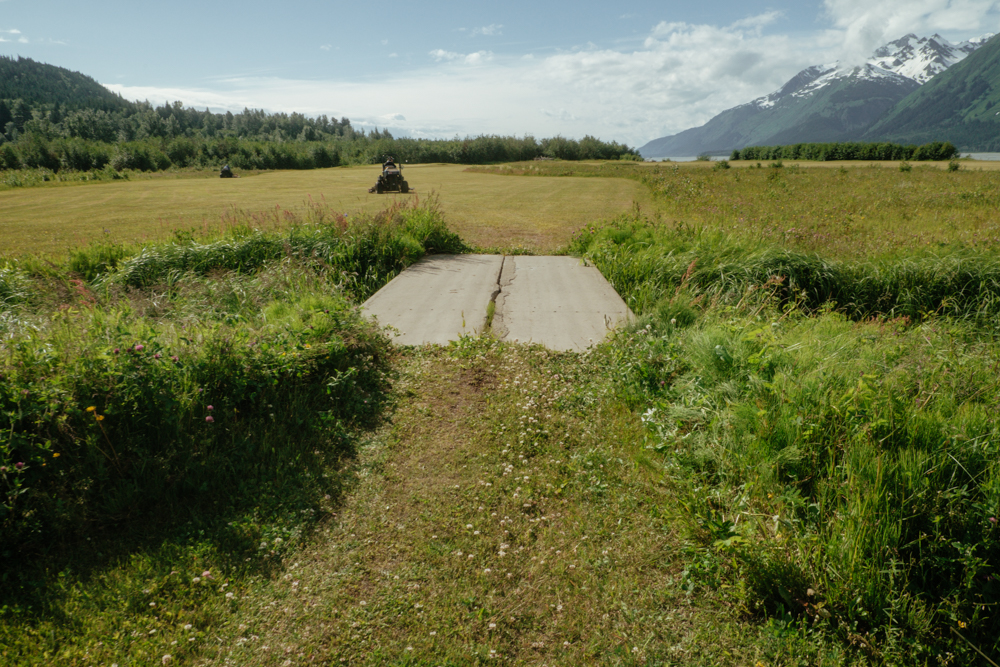
Like the elder Jones, part of the value he sees in the land is that it continues to rise, continues to shake off the water. When he bought it, he figured it was getting to the point of fully drying out, and he was right. It’s vegetating now, with alders coming up in thickets, and there are no longer island greens by default at high high tides. That’s given him a huge stretch of waterfront acreage looking out at the mountains – the greatest untouched wilderness left, as he describes it.
Nevertheless, he doesn’t have any plans to subdivide the property, or develop it into anything else. There’s no “higher purpose” for it all, other than as a golf course, he says.
But a golf course for who?
Clayton Jones argues against the kind of characterization Morphet raises. The course, he insists, is about tying himself into the community, not separating himself from it. He only has a home in one place, and that’s in Haines, he makes sure to note.
“I’m a big believer in a local, year-round economy, so those are the people I take care of,” he said. “We built a successful company here in this community. This is our way of giving back.”
“Those people in the dead of winter you see in the brewery?” he added. “That’s who I want to serve.”
It’s not the most dramatic possible answer for why he has the land and the golf course in his backyard. But he’s delivering on his promise, with the course open Thursday through Saturday this summer, plus Wednesday afternoons.
The other Joneses, Stan and Kathy, are glad to see the golf course still open to the public, still standing after their years of work. But when asked if he considers the course a major accomplishment, Stan Jones demurs.
“Does it make any difference?” he asks, followed by a long pause. “It’s there if people want to use it and if the ownership wants it to be used. But I’m not going to lose any sleep either way. It would be nice if it was readily available to the community on a full-time basis but I wouldn’t care if there was a different interest to it.”
Stan Jones and Pardee-Jones now winter at a condo in Leisure World, a community in Mesa, Arizona. They have friends there and they dodge winter.
But when they’re home in the summer, the self-described “old and decrepit” Jones is still out alongside Parnell putting in hours on the mower, in all sorts of weather. Parnell once joked that when he’s mowing the fairway with the rain whipping off the river, he imagines himself as a sort of Ernest Shackleton figure, the explorer who escaped Antarctica on an open wooden skiff.
On a Friday morning earlier this month, the two of them went out to the course, and Stan Jones did donuts on the mower in the parking lot. He waited until someone looked up and saw before racing off toward the fairway by the river.
“Being born is a fatal condition,” Jones said. “I can die anytime. I’m happy for the things that I’ve been able to do, the life I’ve been able to live.”
And even though he claims he won’t lose any sleep anymore over the golf course, Jones sure lingers at the property even after the work is done. “This is my baby,” he said.
The view from a back fairway at Valley of the Eagles in Haines on Friday, July 3, 2026. (Will Steinfeld/Chilkat Valley News)
The Alaska State Capitol is seen on the last day of the legislative session on May 20, 2026. (Photo by Claire Stremple/Alaska Beacon)
Legislative leaders say they will introduce a final compromise tax bill for the proposed AKLNG gasline on Thursday, which is then scheduled to be taken up for a vote by the full House and Senate.
A six-member multipartisan conference committee of lawmakers from the House and Senate has been working throughout a second special session called by Gov. Mike Dunleavy on a compromise tax cut bill for the multibillion dollar project. Senate and House lawmakers did not come to an agreement on tax break legislation during the regular session.
The proposed project would include construction of a 807-mile pipeline for transporting natural gas from the North Slope to Cook Inlet, as well as gas treatment facilities in the North Slope and on the Kenai Peninsula to export gas internationally. The state owns 25% of the project, while the remaining 75% is owned by a private developer, Glenfarne, who has said the multibillion dollar tax break is essential to the project’s economic viability and attracting investors.
Rep. Calvin Schrage, I-Anchorage and chair of the conference committee, on Wednesday called the forthcoming tax bill “a true compromise piece of legislation” that he believes is workable for the gasline project.
“We’ve had productive conversations with all parties,” he said. “We’ve worked hard to, again, try and resolve differences where we can, come up with compromise language where we can, and put forward a product that we think will be a workable product that, in theory, should be able to help advance the project.”
“Whether or not we have something that’ll ultimately end up passing, we will have to see,” Schrage added.
The committee was expected to release the final compromise bill on Wednesday afternoon, but that hearing was canceled for further review of technical changes, Schrage said. The revised bill is set to be introduced publicly on Thursday morning at 8 a.m.
Lawmakers are flying in from their home districts around the state for a yes-or-no vote on the bill, scheduled for Thursday.
Amid debate on taxes, potential revenues, labor agreements and other issues, lawmakers have until Sunday at midnight before the second special session expires.
Whether the compromise version is agreeable to the majority of members of the Senate, House, Dunleavy and project developers is uncertain.
One of the most intensely debated provisions in the bill is a proposal to apply the state’s corporate income tax to privately-owned oil and gas companies that currently do not pay them. It’s commonly called the “S-corp provision.” The scope of implementing the tax is uncertain, but the Alaska Department of Revenue has estimated that Hilcorp and similar companies would pay somewhere between $0 and $100 million per year if the exemption is eliminated.
The final compromise bill will include the proposal, sought by many legislators but opposed by Dunleavy and others.
House Speaker Bryce Edgmon, I-Dillingham, said Wednesday the compromise bill is one he can support but he expects further revisions will be needed and taken up by the next Legislature in January and future years. He emphasized a tax bill of this size, scope and complexity would usually take legislators several years to negotiate.
“I would fully expect that if we did get a bill across, we did get a bill to the governor, and he was able to sign it, that the potential for coming back for additional fixes is very real, and almost I can tell you probably a certainty for the 35th Legislature,” he said. “But you know it all hinges on the S Corp (tax) tomorrow, and whether the votes are there in the Senate and certainly in the House.”
Schrage said the bill will include a modified version of the provision. “We’ve heard consistently from members of the Senate that that’s an important provision that they need to see in order to be able to support this bill,” he said.
He said that message is also coming from the public:. “I think one of the things I’ve seen over the last few weeks is a steady and increasing call from constituents to address this tax loophole that exists in our state law.”
Members of the House Republican minority caucus issued a statement on Wednesday urging focus on Alaska’s need for reliable energy, amid a looming natural gas shortage, particularly in the Railbelt region. They criticized Senate provisions in the bill as “threatening to derail the project in favor of heavy government taxes.”
“We cannot lose sight of why we are here,” said Rep. Justin Ruffridge, R-Soldotna, a member of the conference committee. “This isn’t about state government squeezing every last penny out of a pipeline that hasn’t even been built yet.”
Dunleavy was in the Capitol on Wednesday, and said in brief comments — after taking a photo with tourists on the third floor — that he couldn’t comment until he sees the final compromise bill.
Gov. Mike Dunleavy poses for a photo with tourists visiting the Capitol on July 15, 2026. (Photo by Corinne Smith/Alaska Beacon)
“I’ve got to see the bill. I haven’t seen the bill yet,” he said.
Dunleavy said he wasn’t surprised to hear the tax provision was included. “I’m sure it’s in there,” he said. “We’ll know tomorrow.”
“I hope it’s a bill that works and gets us a gasline and doesn’t stick it to other industry members,” he added.
Asked whether he would call another special session to require the Legislature to continue work on the tax bill, Dunleavy said it’s likely.
“If this doesn’t work out, our chances are pretty good,” he said.
But Edgmon and Schrage said there is very little appetite among lawmakers for a third 30-day special session this year, particularly as many legislators are running for re-election and the primary election is August 18.
“I think people are pretty exhausted. There’s campaigns they need to run. They’ve got their own personal affairs to manage after a very long five-month session. And my view is that there’s very little appetite to continue this process. I think this is our opportunity to pass a bill,” Schrage said. “And if this bill does not pass or is vetoed, I think that will be the end of the discussion for this year, and we’ll be looking at taking this back up in January.”
The Michelin Guide announced this spring that it would begin reviewing restaurants across six Great Lakes cities, a roster that has since grown to seven … Read moreThe post American cities are paying millions for Michelin stars; who’s paying for…
Luxury rail is entering one of its busiest periods in years, with new routes launching across North America, Europe and the Middle East. The Canadian … Read moreThe post Flights are faster and cheaper. Travelers are choosing the train anyway…
One in seven Americans say they secretly judge people based on their phone background, according to new research. The survey of 2,000 Americans found that 14% of respondents say they think someone’s phone background image says something about their personality.…