Jelly Roll is stepping into the ring in a whole new way. Continue reading…The Boot – Country Music News, Music Videos and Songs











Jelly Roll is stepping into the ring in a whole new way. Continue reading…The Boot – Country Music News, Music Videos and Songs
Reading Time: 2 minutes
We have tragic news to report from the world of television.
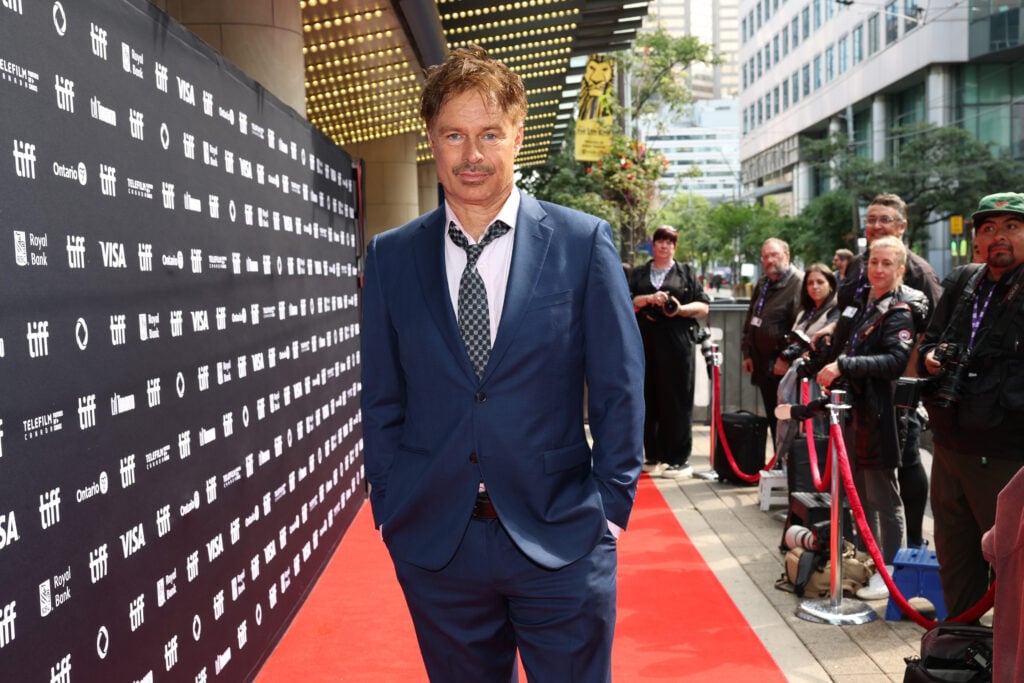
Patrick Muldoon — the beloved star who was best known for his work on Days of Our Lives — has passed away.
News of his death comes courtesy of a statement from his sister, Shana Muldoon-Zappa.
According to Shana, Muldoon took a shower after drinking coffee with his girlfriend at their Beverly Hills home on Sunday morning.
After noticing that he’d been in longer than usual, the girlfriend went to check on Patrick and found him unconscious on the floor.
She called 911, but paramedics announced Muldoon dead at the scene.
Friends described Muldoon as “endlessly generous — with his poetry, his humor, and his unmistakable presence,” according to Page Six.
Though he racked up dozens of credits over the course of his career, Muldoon is likely best known for his work as Austin Reed on “Days of Our Lives” from 1992 to 1995, and then again from 2011 to 2012.
Muldoon also had recurring roles on the iconic 1990s sitcoms Who’s the Boss? and Saved By the Bell, where he played Jeff, the Max manager who briefly came between Zack Morris and Kelly Kapowski.
On the bid screen, Mudoon had roles in films like Deadlock (2021), Vanquish (2021), Dakota (2022), Marlowe (2022), and Murder At Hollow Creek (2023).
He also appeared in the movie Dirty Hands, which will be released later this year.
Muldoon was also an executive producer on a movie that’s currently in production, Kockroach, which will star Chris Hemsworth, Taron Egerton, and Zazie Beetz.
The film is set for release in 2027.
Our thoughts are with Patrick Muldoon’s loved ones during this incredibly difficult time.
Patrick Muldoon Cause of Death: ‘Days of Our Lives’ Star Was 57 was originally published on The Hollywood Gossip.
The Hollywood Gossip

Reading Time: 4 minutes
The arrest of Joseph Duggar almost feels inevitable, given the family’s history and the cult’s extreme beliefs.
We do not know the identity of the 9-year-old victim whom he allegedly molested in 2020. But she was likely a family friend, if not closer.
Cousin Amy Duggar is speaking up about the steps that she’s taking to keep her own young child safe.
And she doesn’t have to name-drop either of her disgraced cousins to bring them to mind.
On Sunday, April 19, Amy took to her Instagram page to share a message about the safety of her 6-year-old son, Daxton.
“We can’t shield you from the whole world,” she began, “but we will protect your world fiercely.”
Amy continued: “Your safety, your steadiness, and the life we’re building around you.”
Referring to her husband, Dillon King, she wrote: “Dad and I will never be passive about who we allow near you.”
In the post’s conclusion, Amy acknowledged: “Not everyone deserves a place in your story.”

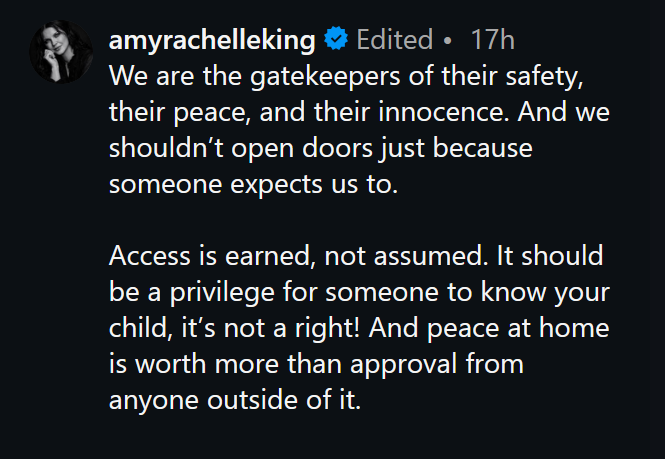
“We are the gatekeepers of their safety, their peace, and their innocence,” Amy wrote in the Instagram post’s caption.
“And we shouldn’t open doors just because someone expects us to,” she acknowledged.
“Access is earned,” Amy affirmed, “not assumed.”
She advised: “It should be a privilege for someone to know your child, it’s not a right!”
Amy concluded: “And peace at home is worth more than approval from anyone outside of it.”
We all know that, for decades, a public campaign to warn children about predators arguably backfired.
“Stranger danger” can be real. But children are much more likely to run afoul of physical abuse, sexual abuse, or both at the hands of family — especially close family — and other “trusted adult” caretakers.
That said, we think that Amy knows this. Perhaps even better than most.
She is the cousin of Josh Duggar. She is the cousin of Joseph Duggar.
Additionally, Amy describes her own grandfather as a “predator.” Josh was not the first monster in the family.
Amy appears to simply be saying that no one is entitled to spend one-on-one time with her son.
(It’s true that the accused Duggar men all allegedly pursued little girls, which is the most common form of predation. But some predators target boys or are simply indiscriminate, seeking a victim above all else.)
That doesn’t just mean that she’s careful about babysitters.
Clearly, Amy and her husband are also making it clear that they’re not just going to drop off the kids with the main Duggar clan and head off for a weekend getaway.
(Truth be told, dropping off your child with members of an abusive cult would be ill-advised, even if there were zero sexual predators in the mix. CSA is not the only harm that can befall a child.)

Obviously, it is common sense to go to great lengths to protect one’s child, especially from opportunists and abusers.
But there are ways in which “protecting” a child can also cause home. Hopefully, Amy understands this.
Not allowing a child to meet any other adults (instead of introducing them to adults but ensuring that they remain safe) is poor socialization. Even worse is keeping a child isolated from meeting random, age-appropriate peers.
In fact, we see this in the Duggar cult. Much of the family subjects their children to homeschooling. Even if they were qualified teachers teaching a real curriculum (which is not what’s happening), their kids are missing out on meeting other children and experiencing the real world.
The most important step in safeguarding a child against predators is making sure that they have the language to explain what happens to them, and the context that a predator is doing wrong.
Amy Duggar Shades Creepy Cousins, Vows to Protect Her Child was originally published on The Hollywood Gossip.
The Hollywood Gossip
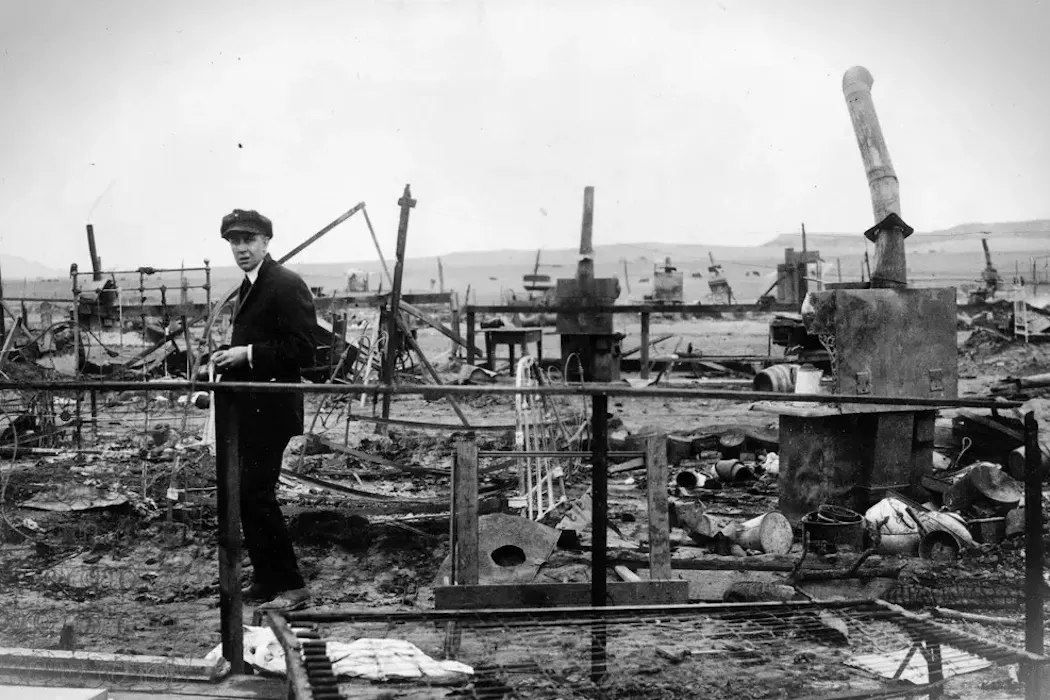
On a spring morning in 1914, miners in Ludlow, Colorado, were celebrating Greek Easter when the Colorado National Guard and a private security agency opened fire on their camp with a machine-gun-equipped armored car called the Death Special.
The miners waged a pitched battle with the National Guard for 10 days before President Woodrow Wilson ordered federal soldiers to intervene. An estimated 69 to 199 people were killed. It was the end of one of the most bitter and violent miner strikes in U.S. labor history, which had begun in September 1913. The strike and massacre prompted Congress to take a hard look at labor reform. But significant changes in labor relations and unionization didn’t come until the mid-1930s.
Some state labor laws were on the books, but in 1914 the U.S. House Committee on Mines and Mining reported: “Colorado has good mining laws and such that ought to afford protection to the miners as to safety in the mine if they were enforced, yet in this State the percentage of fatalities is larger than any other, showing there is undoubtedly something wrong in reference to the management of its coal mines.”
Once the initial shock of the violence wore off, the Ludlow strike received little public attention outside of the immediate families affected and some Colorado residents until late in the 20th century. In “Where Are the Workers,” Mary Anne Trasciatti, a professor at Hofstra University, and I edited a collection of essays written by labor historians and archivists that explore nationwide efforts to bring the history of labor and working people into mainstream narratives of U.S. history.
The Ludlow Massacre is one of the most dramatic and deadly of those stories. It rivals the West Virginia Mine Wars of the 1920s.
In September 1913, roughly 10,000 mostly immigrant miners who worked for the Colorado Fuel & Iron Co. went on strike. The miners were represented by the United Mine Workers of America, which submitted a list of demands when the strike began, including implementing the eight-hour workday, being compensated for the time miners spent in the shafts, and the right to select their own housing and doctors.
Since national strikes were called in the 1880s demanding the eight-hour day, this had been a goal for workers throughout the U.S. In Colorado, voters had endorsed such an amendment to the state constitution in 1902, but it was not uniformly enforced.
Coal mining in the early 1900s was labor intensive and dangerous. Death rates were high. Workers had no say in how the mines operated. From 1884 to 1912, more than 1,708 men died in the state’s coal mines, a rate twice the national average. In 1910, explosions at two Colorado Fuel & Iron mines killed 131 people. In 1912, 125 workers lost their lives in mine accidents across Colorado. That year, the annual death rate in Colorado’s mines was 7.06 per 1,000 employees, compared to a national rate of 3.15. Every trip down a shaft was fraught, with workers paid only for the weight of the coal they mined, not for their travel time.
John D. Rockefeller, the nation’s wealthiest man at the time of the strike, was the main owner of the fuel and iron company. With about 10,000 workers and nearly 70,000 acres of land under control, Colorado Fuel and Iron was one of the most powerful mining companies of that era.
Coal companies often owned entire towns, including miners’ homes, which was the case in Ludlow. Worker protests often led to widespread evictions. As a result of the Ludlow strike, 1,200 coal miners and their families were evicted and took refuge in tent colonies around the mines during the winter of 1913-14.
Colorado Fuel & Iron hired and armed 300 members of a private security agency known as Baldwin-Felts when the strike began. The agency was founded in the early 1890s by William Gibbony Baldwin and employed by mining companies in West Virginia and Colorado to repress strikes. Their job was to keep order and – if possible – break the walkout and reopen the mines.
Members of the United Mine Workers of America armed themselves as conflicts with the mining company’s private security force intensified.
Eventually, the Colorado governor, Elias M. Ammons, ordered the Colorado National Guard to join the fray on the corporation’s side, with the Rockefellers paying their wages. The Guard arrested hundreds of strikers.
Then, on April 20, 1914, the National Guard and the private company opened fire on the tent colonies where the miners lived. After several hours of gunfire, with miners defending their camp, 25 people were dead, including two women and eleven children trapped when the camp was intentionally set ablaze.

Months earlier, miners had dug foxholes under tents so women and children could avoid bullets randomly fired through the camps. When the armored vehicle opened fire, everyone in the camps ducked into the holes. Later, women and children were found by miners huddled together at the bottoms of their burned-out tents.
Many miners’ family members were saved when the engineer on a passing train witnessed what was happening and stopped on the track to shield them from the gunfire.
This violence led to 10 more days of conflict before President Wilson finally ordered federal troops to disarm both sides.
In Congress, the House Committee on Mines and Mining conducted an investigation into the events and released a report in 1915. John D. Rockefeller Jr. was summoned before the committee, where he was questioned for several hours on May 20, 1914. There, he admitted that he had not visited the site since the incidents that led to the deaths of workers and their families.
According to a New York Times report, when asked whether he knew that thousands of his employees had been evicted from their homes and were living in tent colonies, and that the striking workers and their families were suffering without work or food, Rockefeller replied that he could not say, but that company officials could provide the facts. None were forthcoming.
A federal Commission on Industrial Relations also held hearings, determined to quell the upsurge in early 20th-century labor violence.
In 1912, the immigrant- and women-led Bread and Roses strike in Lawrence, Massachusetts, also led to a congressional investigation. In its report on the 1914 miners’ strike, the commission described the strike by workers as “against arbitrary power.” It summarized that miners “passionately felt” that they were denied “a voice in fixing working conditions in the mines” and that political democracy had been “repudiated by the owners.”
The commission determined that the strike raised a fundamental question about whether workers had a right to a voice at work. This question would animate labor struggles into the 1930s.
In 1935, Congress passed and President Franklin Roosevelt signed into law the National Labor Relations Act, which provided federal guidelines for labor union formation and stated that workers had a federal right to bargain over wages, hours and conditions of employment, the very things Colorado coal miners sought when they went on strike in 1913.
In 1915, officers of the United Mine Workers of America purchased 40 acres of land north of the Ludlow, Colorado, train depot, on the site where the tent colony had sheltered coal miners and their families during the 1913-14 strike.
Three years later, United Mine Workers officials dedicated a granite monument at the site where the women and children were killed. Labor historian James Green noted that of all the violence against workers at the time, none shocked the nation or troubled its collective conscience more than the Ludlow massacre because of the deaths of children. However, even incidents like the Ludlow Massacre did not become a significant part of the public discourse. This has changed some in the recent past.
Today, the tent colony site is a National Historic Landmark.
The labor movement in the United States remains a bulwark of democracy, and workers have often been a driving force for social and economic equality in their communities. Yet its stories are not widely known, even one so dramatic as this battle in the Colorado coalfields.
The recognition of the Ludlow site as a National Historic Landmark and the recent release of a Library of Congress research guide propel the history of labor and working people into the mainstream. Such place-based labor history promotes our understanding of how and why things we sometimes take for granted – such as the eight-hour workday, paid holidays or workplace safety laws – came about only because people were willing to risk their lives fighting for these rights.
Read more of our stories about Colorado.

Robert Forrant does not work for, consult, own shares in or receive funding from any company or organization that would benefit from this article, and has disclosed no relevant affiliations beyond their academic appointment.
Politics + Society – The Conversation

For the past 13 years, Maricopa County in Arizona has attempted to reform its sheriff’s department after Joe Arpaio made it into a national flash point for extreme immigration tactics. After a legal immigrant sued Arpaio and the county Sheriff’s Office, a federal district court ruled in 2015 that Arpaio and his deputies relied on racial profiling to target Latinos.
Arpaio was at the center of that suit. From 2006 to 2017, he implemented his own immigration detention program, instructing deputies to detain anyone who did not carry a valid identification and did not speak English. One U.S. Department of Justice attorney characterized Arpaio as overseeing “the worst pattern of racial profiling by a law enforcement agency in U.S. history.”
Federal oversight has since aimed to reform the sheriff’s department and improve trust with the county’s Latino residents, which had been destroyed under Arpaio’s tenure.
As a historian of U.S. immigration, I believe Arpaio’s immigration detention methods are clearly echoed in the hardline immigration policies devised by presidential aide Stephen Miller. That’s evident in actions by immigration agents with Immigration and Customs Enforcement and Customs and Border Protection that have been described as inhumane by some lawmakers and civil rights groups.
From his election to sheriff in 1993 until 2017, Arpaio made constant headlines for his creation of a tent jail and his heavy-handed immigration enforcement tactics.
Using surplus army tents from the Korean War to house up to 1,700 inmates, Arpaio built Tent City in August 1993 to address overcrowding in Phoenix jails. By the time the jail closed in 2017, Sheriff Paul Penzone estimated that running Tent City cost taxpayers US$8.5 million annually.
Tent City was initially used for detaining criminals, but after 2009, Arpaio used the facility for housing detained immigrants.
News reports said Arpaio forced inmates to wear pink underwear and often fed them expired food and undrinkable water. The tents did little to shield inmates from the Arizona desert, where temperatures rose to 130 degrees Fahrenheit, (54 degrees celsius) at times. Tent City stirred a national uproar.

Starting in 2006, Arpaio and Maricopa County sheriffs engaged in a pattern of “unlawful discriminatory police conduct directed at Hispanic persons,” according to Deputy Assistant Attorney General Mark Kappelhoff. During these operations, he directed deputies to detain people suspected as being undocumented immigrants without legal immigration authorization.
Arpaio’s deputies explicitly targeted Latino drivers in their traffic stops. A Department of Justice investigation concluded that Arpaio used race as a criteria for stopping and detaining Latino drivers. Legal U.S. residents and U.S. citizens were occasionally arrested in these sweeps.
Phoenix News-Times journalist Stephen Lemons in January 2009 noted that, during operations, some Maricopa County sheriff’s deputies wore ski masks and carried assault rifles while conducting immigration sweeps.
Tent City appears to be an early version of the detention facilities used by ICE today, where detainees have complained of squalid conditions and poor food.
ICE currently detains some 70,000 people in 224 detention centers nationwide. Of those, two camps, Camp East Montana near El Paso, Texas, and Alligator Alcatraz in Florida, are eerily similar to Tent City.
Camp East Montana is the most recent of these new facilities. Opened in August 2025, the 60-acre detention center has become one of the largest ICE facilities in the U.S., holding 5,000 detainees.

Like Tent City, Camp East Montana was constructed using tents that do little to shield inmates from the elements. The Washington Post reported in September that the facility’s poor food, shoddy living quarters and exposure to the desert sun violated 60 federal regulations.
During Arpaio’s tenure, his office faced 6,000 federal lawsuits.
Those included a $9 million payout to the parents of Charles Agster III, after a federal jury found Arpaio and jailhouse nurses negligent in his death. And they included a $2 million payout to the parents of Brian Crenshaw after the disabled man died following an altercation with a sheriff’s detention officer.
The most costly, though, was the 2013 ruling in Melendres v. Arpaio. U.S. District Judge Murray Snow found Arpaio guilty of racial profiling. The ruling placed Arpaio’s office under federal monitoring with orders to overhaul the department. As a result, Maricopa County residents have paid $323 million to reform the department.
Arpaio left office in January 2017. Months later, Tent City closed. After a failed attempt to run for U.S. Senate in 2018, Arpaio retired from politics.
But I believe that the resemblance between Arpaio’s fixation on immigration and Trump’s deportation campaign remains.
Since Trump’s second election, ICE and CBP agents have followed Arpaio’s playbook. Along with erecting tent jails for detaining immigrants, agents have used racial profiling during immigration raids. Consequently, hundreds of U.S. citizens have been detained during raids and protests.
On April 2, 2026, Judge Jennifer Thurston ruled that CBP agents violated court orders and “again detained people without reasonable suspicion” – tactics similar to those used by Arpaio.
Arpaio’s policies foreshadowed Trump’s deportation policy: one that uses racial profiling and shows little regard for human rights.
As U.S. Supreme Court Justice Sonia Sotomayor noted in her dissent in Noem v. Vazquez-Perdomo in 2025, many Latinos now carry proof of citizenship out of fear of racial profiling.
In July 2017, a federal court found Arpaio guilty of criminal contempt for violating a 2011 federal order to stop detaining people solely on suspicion of illegal immigration status.
A month later, before Arpaio’s sentencing, Trump pardoned Arpaio. He described the sheriff as a “great American patriot” who had “done a lot in the fight against illegal immigration.”

Jonathan van Harmelen does not work for, consult, own shares in or receive funding from any company or organization that would benefit from this article, and has disclosed no relevant affiliations beyond their academic appointment.
Politics + Society – The Conversation

While you’ll generally find the cheapest breakfast sandwiches at one particular fast food chain, the portion you receive for that low price is hardly a meal.

Food Republic – Restaurants, Reviews, Recipes, Cooking Tips

At the height of his drinking, Mark Chesnutt was consuming seven times more alcohol per day than the amount that qualifies as heavy daily drinking. Continue reading…Country Music News – Taste of Country
At the height of his drinking, Mark Chesnutt was consuming seven times more alcohol per day than the amount that qualifies as heavy daily drinking. Continue reading…The Boot – Country Music News, Music Videos and Songs
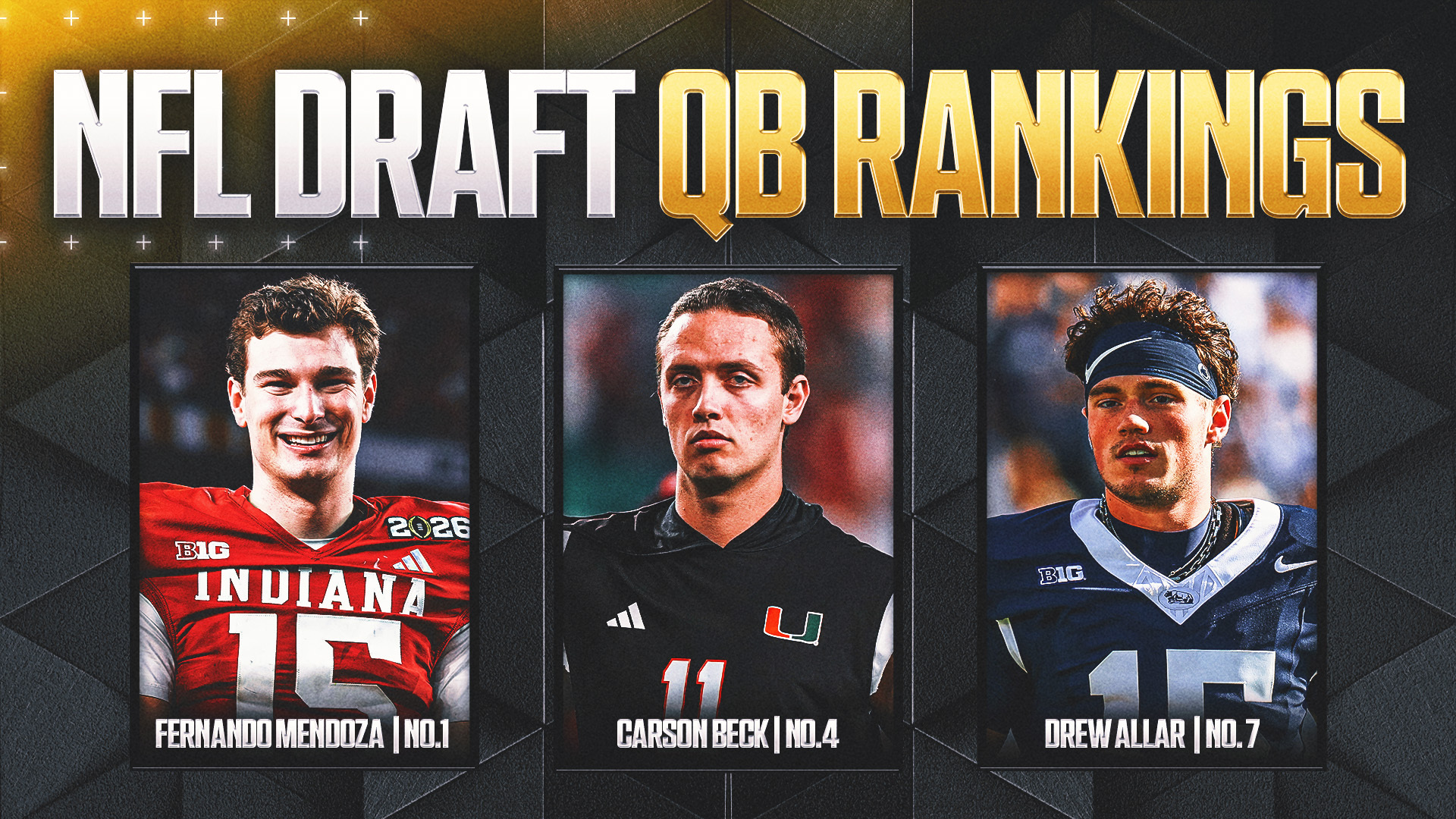
Of the top 150 NFL prospects on my final Big Board, you’ll see only eight quarterbacks included, with just three among the first 100. If the draft falls that way, it will be the first since 2000 in which there weren’t at least four QBs among the first 100 players selected. Most years, the first round is the round to watch for quarterbacks. And this year is no exception, as where (and when) Ty Simpson is selected will generate huge ripple effects in this draft. But I expect the biggest run on QBs to transpire in the fourth round. We’ve documented the ups and downs of this year’s class since the beginning and end of the season. Now, with the draft finally upon us, I have grades on the top 12 draftable quarterbacks. Here is how I rank them and why. 12. Mark Gronowski, Iowa Projected round: 7/UDFAPro comp: Jaren HallBest team fits: San Francisco 49ers, Dallas Cowboys With an NCAA-record 58 career wins, including two national championships at South Dakota State prior to finishing his collegiate career at Iowa, Gronowski certainly is a winner. And he possesses NFL size, athleticism and toughness, as well. Despite what his career 103-27 touchdown to interception rate and 63% competition percentage suggest, however, Gronowski lacks ideal accuracy. He has the dual-threat ability and intangibles to stick as a backup and developmental project, warranting late-round consideration. 11. Joe Fagnano, Connecticut Projected round: 6-7Pro comp: Bailey ZappeBest team fits: New England Patriots, Tennessee Titans, New Orleans Saints A traditional pocket passer with good anticipation, zip and accuracy to attack short and intermediate zones, Fagnano’s game translates better to the NFL than some of the other Day 3 candidates. However, he’s an older prospect (he turns 25 this month) and one who faced limited competition over his career, playing four seasons at Maine (an FCS school) before transferring to UConn, where his production was boosted by the presence of speedy wideout Skyler Bell. But make no mistake, Fagnano’s production was eye-popping at Connecticut: a 48:6 TD-INT ratio over two seasons as a starter. He varies his release nicely and takes care of the football, rarely putting it in harms way. Fagnano further helped his stock at the East-West Shrine Bowl. 10. Diego Pavia, Vanderbilt Projected round: 6-7Pro comp: Max DugganBest team fits: Tampa Bay Buccaneers, Cincinnati Bengals, New York Jets Padilla is the underdog that draws so many to sports in the first place. He’s a 5-foot-10, 207-pound former zero-star recruit who built himself into a Heisman Trophy finalist and four-time team captain with victories over both Alabama and Auburn in his career. He’s best-suited for an RPO attack, showing courage and craftiness as a runner (31 rushing TDs over his career), as well as good accuracy on the move. However, that accuracy wanes as the passes get deeper, and I think he’ll struggle with the tighter windows in the NFL. He’s at his best playing off script, and not every team will be comfortable with his improvisational style and personality. That said, I love his competitiveness and creativity. 9. Haynes King, Georgia Tech Projected round: 6Pro comp: Tyrod TaylorBest team fits: Buffalo Bills, New York Giants, Denver Broncos It isn’t often that a quarterback leads a Power Four conference in rushing touchdowns, but that was the case with King, whose 15 scores on the ground was one more than he threw last season. Those numbers belie King’s intriguing accuracy (and willingness to test tight windows) on short to intermediate throws. He can throw the ball with zip and touch alike. He lacks the arm strength of some of this year’s other draftable quarterbacks, however, and, as such, is a bit scheme dependent. As his rushing totals suggest, King is a dynamic athlete for the quarterback position, clocking in at 4.46 seconds in the 40-yard dash. He began his college career as a four-star prospect for Texas A&M but struggled with injuries there before transferring to Georgia Tech, where he steadily developed into one of the most productive quarterbacks in school history. His work ethic, competitiveness and dual-threat abilities could help him find a niche in the NFL, though likely as a backup. 8. Cade Klubnik, Clemson Projected round: 5 (No. 145 prospect rank)Pro comp: Brett HundleyBest team fits: Denver Broncos, San Francisco 49ers, Minnesota Vikings Quarterbacks often get too much of the praise when things go wrong and Klubnik is a perfect example of how they can get too much of the blame when a team struggles. He was far from faultless for the Tigers’ disappointing 2025 campaign, watching his passing touchdowns plummet from 36 as a junior to just 16 (in 12 games), despite his completion percentage jumping to a career-high 66%. At 6-foot-2, 207 pounds, Klubnik lacks ideal size and possesses only average arm strength. But he’s a quality athlete with good accuracy on short to intermediate passes, including on the move. Like a lot of athletic passers, he has a tendency to stick too long on his initial read, then skip too quickly through secondary progressions and then start to drift out of the pocket, dropping his eyes and looking for an escape route. He got into some bad habits trying to put a Clemson offense that didn’t have the dynamic playmakers it once had onto his back. I still see starter-level potential, but Klubnik needs some refining and a better supporting cast to get back to his prior playmaking self. 7. Drew Allar, Penn State Projected round: 4 (No. 120 prospect rank)Pro comp: Landry JonesBest team fits: Pittsburgh Steelers, Cleveland Browns, Los Angeles Chargers If one were to draw up the prototypical NFL quarterback, it might look a lot like Allar. He checks in at a solid 6-foot-5, 228 pounds, and he has an absolute bazooka of a right arm. He can make every throw in an NFL playbook and enters the league as a three-year starter with a sterling 61:13 TD-INT ratio. But as I told FOX’s Eric Williams in his piece on this year’s Most Underhyped and Overhyped Prospects, I’ve yet to see Allar show the requisite instincts to translate his talent into consistent high-level play. He gets frazzled when his initial read is taken away and too often resorts to checkdowns, rather than trusting his arm (or teammates) to make critical plays. He looked like a future first-round pick back in 2023 but he’s regressed since, and his senior campaign was abruptly cut short due to a broken ankle that kept him from participating in the All-Star games and pre-draft workouts. There is no denying Allar’s allure. No one should be surprised if he is drafted earlier than my ranking. But I think he’s further away than his traits and stats suggest. 6. Cole Payton, North Dakota State Projected round: 4 (No. 116 prospect rank) Pro comp: Jake LockerBest team fits: Green Bay Packers, Pittsburgh Steelers Payton is similar in many ways to the aforementioned Taylen Green in that he is a classic dual-threat quarterback whose ability as a runner is every bit as valuable as his current passing skills. His first start at the collegiate level, in fact, came at running back, not quarterback. He is a left-handed power thrower still learning the nuances of passing the ball with timing and precision. But there are some “wow” throws on tape — and an intriguing variety of them — including the standard verticals that require vision and arm strength, but also post-corners needing touch and rollouts that show off his ability to throw accurately on the move. A physical, determined runner, Payton gives off some Taysom Hill vibes, but I think he has more upside as a passer. He’ll require patience, but he is arguably the most intriguing developmental quarterback of this class. 5. Taylen Green, Arkansas Projected round: 4 (No. 113 prospect rank) Pro comp: A mix of Randall Cunningham and Anthony RichardsonBest team fits: Indianapolis Colts, Baltimore Ravens, Philadelphia Eagles There are few players in this draft at any position with more highlight reel plays than Green, a remarkable 6-foot-6, 227-pounder who enters the NFL with a staggering 94 overall touchdowns scored over four seasons spread between Arkansas and Boise State. His explosive playmaking ability was obvious on tape, but the numbers he produced at the Combine were stunning nontheless — including a 4.36 40-yard dash and 43.5-inch vertical jump. Teams looking for a true dual-threat quarterback could see Green as a potential superstar. The concern is that Green remains quite raw as a pocket passer given his 46 career starts. He typically waits for his receivers to get open, rather than anticipating windows, staring down his primary targets and allowing defensive linemen opportunities to bat down more balls than you’d expect for a quarterback of his height. He is too quick to drift out of the pocket and drop his eyes to scramble rather than stepping up against pressure to allow pass-catchers time. Green is a lottery ticket that could pay off big, but he requires an offense catered to his skill set and there are only so many of those in the NFL. 4. Carson Beck, Miami Projected round: 4 (No. 107 prospect rank)Pro comp: Mason RudolphBest team fits: Miami Dolphins, Washington Commanders Beck personifies the philosophical divide about this year’s quarterback class. Critics are quick to point out that Beck struggled in big moments. Optimists can easily counter that his cerebral play and precision passing out of pro-style offenses are why his teams consistently played in big games in the first place. Those who believe in “QB wins” as a metric note that Beck was 37-6 as a starter over his career at Georgia and Miami. Beck looks the part at nearly 6-foot-5, 233 pounds, with a snappy over-the-top delivery and good accuracy to all levels of the field. He is as good throwing the ball off play-action as any quarterback in this class, showing the pre-snap recognition that comes with facing elite competition (in games and practices) over his career. Beck is a classic rhythm passer who is fantastic when he feels comfortable in the pocket, but hasn’t consistently shown the “ice in his veins” poise to project as a frontline NFL starter. 3. Garrett Nussmeier, LSU Projected round: 2-3 (No. 70 prospect rank)Pro comp: Drew LockBest team fits: New York Jets, Pittsburgh Steelers Given where he is likely to be drafted, Nussmeier could very well prove the best value of this year’s quarterback class. That is a bold statement, indeed, given that he was benched for the final month of his final campaign. But similar to Ty Simpson, Nussmeier wasn’t surrounded by the typical LSU supporting cast — the Tigers struggled with drops, inconsistent blocking and a poor running game. An abdominal strain suffered early on limited Nussmeier’s arm strength, but that didn’t stop him from taking the risky throws into coverage that had earned him a first-round grade in my initial QB Tiers article entering the season. Nussmeier lacks ideal size at just under 6-foot-2, 203 pounds, and his gunslinger mentality is as likely to get him into trouble as it is to help him succeed, but I want that kind of “let it rip” confidence at quarterback. The son of an NFL (and CFL) quarterback and current offensive coordinator of the New Orleans Saints, Nussmeier enters the league as mentally prepared for the complexities of the pro game as anyone on this list. At worst, I see a longtime quality backup with a chance to “surprise” as much more. 2. Ty Simpson, Alabama Projected round: 2 (No. 33 prospect rank) Pro comp: Jimmy GaroppoloBest team fits: Arizona Cardinals, Los Angeles Rams Undersized and entering the NFL with just one season as a starter, Simpson’s faults are easy to see. But so too are his strengths, including the quick mental processing that comes from being a coach’s son, as well as impressive accuracy both in the pocket and on the move. He is a talented passer with as many “big-time throws” in 2025 as any quarterback in this class. And while Alabama is perennially loaded with talent, Simpson wasn’t blessed with the same caliber of a supporting cast as his recent Crimson Tide predecessors, often throwing his receivers open rather than having them break off the huge plays on their own that can pad a QB’s statistics. The track record for quarterbacks entering the NFL with less than 20 collegiate starts is frightening, and the 6-foot-1, 212-pound Simpson (15 starts, all in 2025) was beaten up by the end of this season. It takes some faith to project him as a future franchise quarterback — but the passing ability and moxie are there. 1. Fernando Mendoza, Indiana Projected round: 1 (No. 4 prospect rank) Pro comp: A mix of Jared Goff and Andrew LuckBest team fit: Las Vegas Raiders At nearly 6-foot-5, 236 pounds, Mendoza certainly looks the part of an NFL quarterback, and he possesses the arm strength and accuracy to star at the highest level, as well. It is his intangibles, however, that have me most excited. The composure he showed in guiding Indiana to its first national championship project well to handling the mental rigors he’ll face at the next level. There is no denying that Mendoza was aided by a relatively simple RPO-based Hoosiers offense, but too often his critics fail to mention how quickly he adapted to this scheme after beginning his career at Cal, where he also showed future NFL starter ability. No one should expect Mendoza to be a franchise savior — he lacks the elite physical traits of No. 1 overall candidates of prior years. But he’s smart, tough, determined and poised. If he’s given a quality supporting cast, the Mendoza magic can continue in the NFL.Latest Sports News from FOX Sports
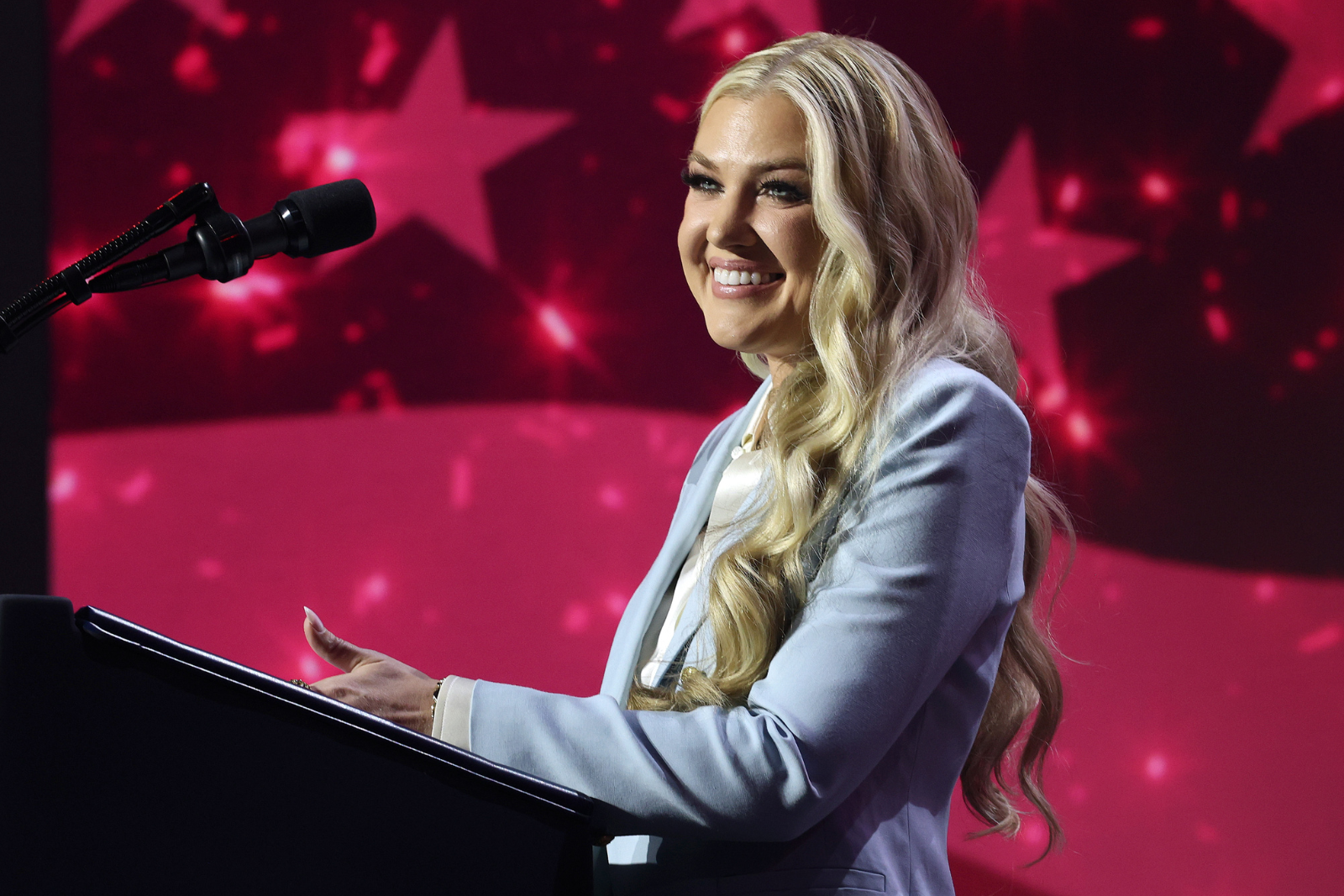
New details are emerging about the alleged threats that led to Erika Kirk’s last-minute cancellation of a recent TPUSA event. Continue reading…The Boot – Country Music News, Music Videos and Songs