Gordon Ramsay is a world-famous chef but also a world traveler who knows his way around international eats, so it’s little surprise he grabs this in Miami.
Food Republic – Restaurants, Reviews, Recipes, Cooking Tips










Gordon Ramsay is a world-famous chef but also a world traveler who knows his way around international eats, so it’s little surprise he grabs this in Miami.
Food Republic – Restaurants, Reviews, Recipes, Cooking Tips
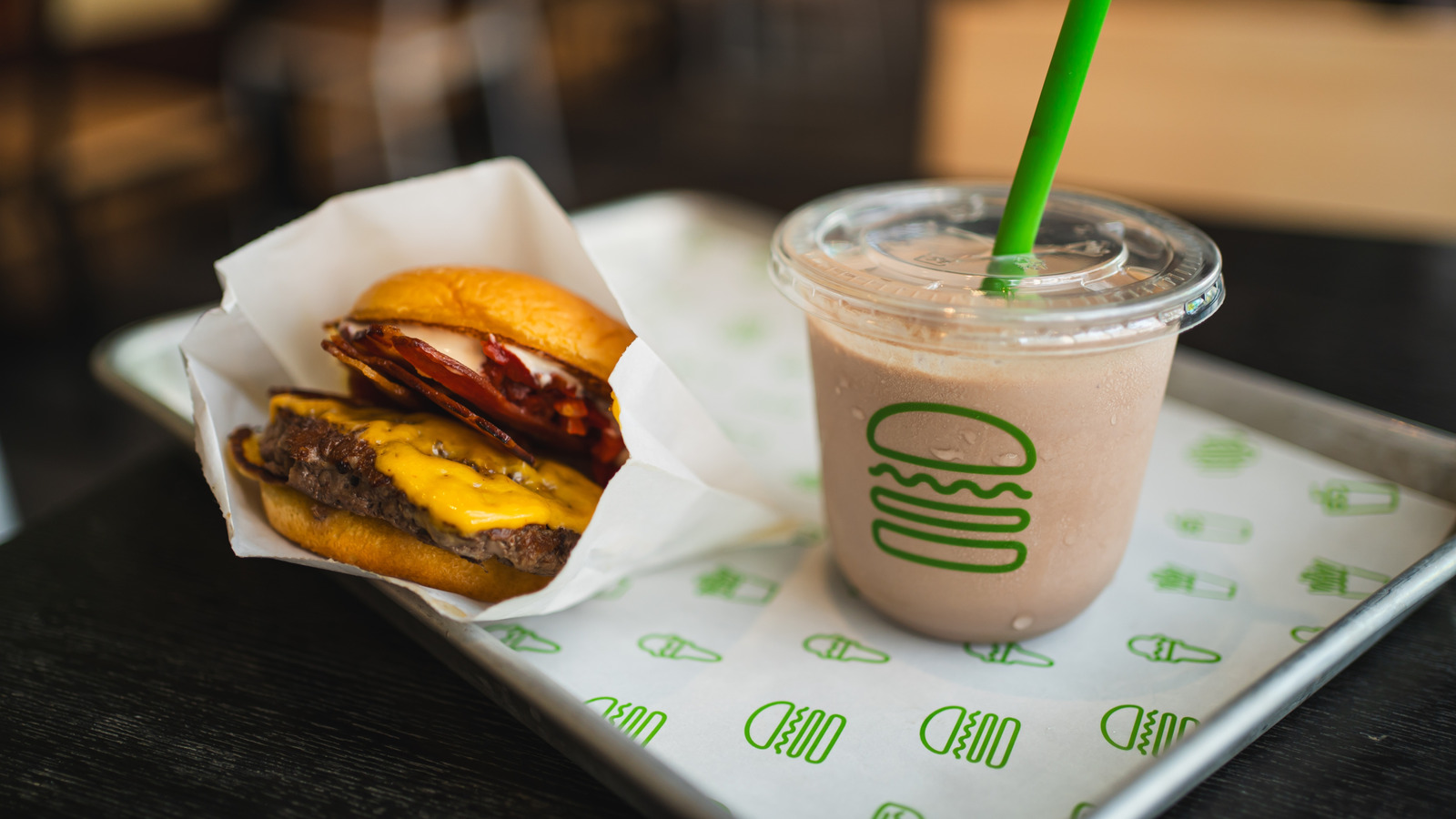
Every chain has different practices when it comes to leftover food. For Shake Shack, company-wide strategies like these help prevent excessive food waste.
Mashed – Fast Food, Celebrity Chefs, Grocery, Reviews
Grindr’s in bed with strange fellows.
The LGBTQ+ dating app has expanded its political presence in both Washington and California as it seeks to flex its influence muscles on a range of policy priorities. The app’s ambitions have grown since President Donald Trump’s return to office — and much of that is due to the registered Republican running the shop.
Since April 2025, Joe Hack has navigated a GOP-controlled Washington as he pushes forward Grindr’s biggest legislative priorities. Out in California, George Arison, Grindr’s self-described “conservative” CEO, has waded into primary politics, pushing moderate San Jose Mayor Matt Mahan as the next governor.
Even amid Trump’s anti-DEI and LGBTQ+ crackdown, Hack told POLITICO he’s found room for bipartisan agreement in Washington. And the scale of Grindr’s influence will be on full display Friday, when the app hosts its inaugural White House Correspondents Dinner weekend party — for which Democrats and Republicans alike have been clamoring to get an invite.
“We’re planting a flag,” Hack, Grindr’s head of global government affairs, said in an interview. “We’ve been doing policy work here now for a year, and the issues we care about are important not just to us, but to our community.”
The glitzy bash — held in a $9 million, 10-bedroom Georgetown mansion — is one of the buzziest fetes of the upcoming weekend, and the guest list has been closed for more than a week. “The interest level has been insane,” Hack said. Though he declined to provide a preview of expected attendees, he teased that “very high level people from both sides” had RSVP’d. “We’ll see if they come,” he said.
Before taking over Grindr’s lobbying, Hack spent more than a decade as an aide to Republicans on Capitol Hill. That included six years as chief of staff to Sen. Deb Fischer (R-Neb.), who voted against codifying gay marriage about a year after Hack transitioned to the private sector.
Now, Hack is leading a lobbying blitz at Grindr. The app has poured $1.6 million into its influence operation since it registered to lobby federal lawmakers in April 2025. In the first three months of 2026, Grindr spent $432,500 on its in-house lobbying operation, as well as an additional $120,000 across two large lobbying firms working on its behalf, according to disclosures published this week. The legislation Grindr is targeting includes issues related to “surrogacy and IVF access for same-sex couples,” as well as two bills — one sponsored by Rep. John James (R-Mich.) and one by Rep. Jake Auchincloss (D-Mass.) — that would make it more difficult for minors to download the 18+ app.
“One area that might be surprising is we’ve had very productive conversations with some House Republicans on online safety and working to keep kids safe, but also do it in a way that’s privacy-forward,” Hack said.
But its main focus has been on HIV prevention funding. Grindr partners with the Centers for Disease Control to distribute HIV self-test kits in the U.S. through its app, Hack said, and partners with other organizations globally to use its platform to increase access to health care.
Last year, Trump demanded that Congress authorize more than $400 million in spending cuts to PEPFAR, the global HIV-AIDS program started under former President George W. Bush. Senate Appropriations Chair Susan Collins (R-Maine) vocally criticized the cuts, and the White House ultimately relented.
Lobbying disclosures show that Grindr specifically targeted that rescissions bill. A spokesperson for Collins confirmed that her team had met with Grindr, writing in a statement that “Senator Collins has a strong record of supporting the LGBTQ community.”
“Most recently, Senator Collins has been recognized as a leading advocate for PEPFAR and continuing the U.S.’s important role in the fight against HIV/AIDs,” Collins spokesperson Blake Kernen said in a statement. “She appreciates this recognition of her leadership.”
Hack also personally contributed $3,500 to Collins, which he told POLITICO came through a donation at a Sept. 25 fundraiser. He also said he expected to give $3,500 to Sen. Tammy Baldwin (D-Wis.), another partner in HIV prevention, in June.
“As the administration is contemplating PEPFAR 2.0 and what that looks like, we would like to step up in a more meaningful way as a public-private partner,” he said. “We’re not looking for tax money. What we’re looking for is really to leverage the power of our platform and our unique and unparalleled reach that no other company has, and to use that on behalf of our community to grow health care access.”
Grindr’s focus on health care, Hack said, is part of what he called Arison’s goal of expanding the platform beyond just a relationship app and into a “global gayborhood” at the intersection of telehealth, travel and leisure.
Since taking over as CEO in 2022, Arison has pushed to implement AI into the app and has been a supporter of Trump’s light-touch AI regulation policies. Despite dipping his toes into the California gubernatorial race, don’t expect Arison to become a new political player.
“In general, I don’t get involved in politics,” Arison told POLITICO in an interview last week. “I don’t want Grindr involved in politics at all.”
As for this weekend’s party, the expectations are high among the D.C. chattering class.
Jon Levine, a reporter for the Washington Free Beacon who calls himself an “infamous conservative hatchet man,” told POLITICO he would certainly be at the event.
Asked why, he responded with just two words: “Hard news.”
Christine Mui contributed to this report.
Like this content? Consider signing up for POLITICO’s Playbook newsletter.
Politics

After a narrow loss in Virginia, Republicans are pointing fingers as President Donald Trump’s national gerrymandering fight slips into a stalemate.
Multiple Republicans say the party should’ve spent much more, much earlier to have a better shot at blocking Democrats’ Virginia map, which could give the party as many as four more House seats. And pressure is now growing on Florida Gov. Ron DeSantis to make up for Democrats’ gains with a GOP-led redistricting effort in his state, as soon as next week.
“You’d be hard pressed to find a single Republican tonight who doesn’t think the GOP should’ve done more in Virginia. It actually hurts more that it was so close,” said a GOP operative, granted anonymity to speak candidly, like others in this article.
There are mounting signs that Trump and the GOP have used valuable time and political capital on an arduous tit-for-tat that is so far looking like it will be close to a draw. Even if Republicans squeeze out gains in a new Florida map, their total gains are likely to be modest at best.
“I just don’t think that Republicans looked at the map and said, ‘Okay, what’s the worst case scenario, what could happen if all the Democrat-controlled legislators rebel against this?’” said one Virginia Republican. “We’re seeing a thing that felt really good at the moment erase gains that we fought for elsewhere.”
Tuesday’s results in Virginia, combined with gains in California and a new court-drawn seat in Utah, have effectively erased the advantage Republicans built off new maps in Texas, North Carolina, Ohio and Missouri. It’s a stark reversal nearly nine months after Trump first urged Republicans in the Lone Star State to redraw maps, upending the midterm battlefield.
“Just so you get the truth and not the partisan spin here, Republicans came up with the idea of the mid-decade redistricting fight and started in Texas,” Erick Erickson, a conservative radio host and an influential voice with evangelical voters central to the MAGA base, wrote on X after the amendment passed in Virginia.
“Now, as drawn, the Democrats have an advantage from the redistricting fight,” he said.
The RNC and the White House did not immediately respond to requests for comment.
National Republican Congressional Committee chair Rep. Richard Hudson is holding out hope that the state’s Supreme Court, which reserved the right to weigh in on the new map after the election, voids Democrats’ effort.
“This close margin reinforces that Virginia is a purple state that shouldn’t be represented by a severe partisan gerrymander,” Hudson said in a statement. “That’s exactly why the courts, who have already ruled twice to block this egregious power grab, should uphold Virginia law.”
Still, several Virginia Republicans said their party could have done more to prevent Democrats from edging out a victory Tuesday. Democrats outspent Republicans by a roughly three-to-one margin, putting Republicans at a disadvantage on the airwaves until the late stages of the race. Virginians for Fair Elections — which led the “yes” effort — raised $64 million, according to Virginia Department of Elections data, boosted by nearly $38 million in support from House Majority Forward, a political nonprofit aligned with House Democratic leadership.
Even though Republicans have far more money stacked up in outside groups — including $297 million brought in by the Trump-aligned MAGA Inc. since the start of last year alone — they ultimately never matched Democrats’ investment.
“If they had spent some money, they could have won tonight and someone’s got to own that and explain why that decision was made,” said a second Virginia-based GOP strategist.
Some Republicans turned their ire to the Indiana Legislature, where GOP lawmakers rejected the White House’s push to draw a new map that would give them two additional red-leaning seats. Chris LaCivita, Trump’s former campaign co-manager and a longtime Virginia-based GOP strategist, shared a social media post on Tuesday calling out Republicans in Indiana for not being more aggressive.
It’s now too late for the state to redraw its lines, and Trump allies have spent time and millions of dollars to defeat the GOP legislators who opposed the effort.
With most states off the table, Republicans are now looking to DeSantis as one of their last and best chances to win back the upper hand ahead of November. The Florida governor delayed a special session to take up redistricting in the state until after Virginia’s election, and he has yet to release a new map proposal.
Former Trump White House spokesperson Harrison Fields urged Republicans in Florida to respond to the Virginia outcome with an aggressive gerrymander.
“To my friends in Tallahassee: in a state that is ruby red, it’s time to respond to what we saw tonight in Virginia with a redistricting plan that reflects Florida’s true partisan lean — and adds 3–4 GOP seats to our supermajority,” Fields said in a social media post. “Virginia is a purple state being drawn as deep blue. Florida should draw a map that’s even redder — and get it passed ASAP.”
Not everyone is on board with escalating the redistricting arms race. Rep. Kevin Kiley, a Republican-turned-independent who was targeted by California Democrats’ gerrymander, said the result was further proof that the redistricting war never should have been started.
“It’s very unfortunate that it’s happened in Texas. I think it’s very unfortunate that it happened in California and Virginia and everywhere else where it’s happened,” Kiley told POLITICO after the Virginia race was called Tuesday evening. “Now that this whole thing has just gotten completely out of hand, there have been no winners, and it’s created such instability, maybe this is the time that we can come together and say, ‘Alright, enough is enough.’”
Yet for all the recriminations over Republicans losing ground in the president’s redistricting campaign, one person escaped largely unscathed: Trump himself.
The president mostly stayed on the sidelines until he hosted a tele-rally alongside Speaker Mike Johnson to urge people to vote “no” in the race’s final hours.
Some Republicans in the state were glad he stayed away, given his flagging national standing, particularly in a light blue state. Thirty-three percent of adults approve of Trump’s job performance, according to an AP-NORC poll released Tuesday.
“If I was the Democrats, I’d want Trump on the stump every day,” Virginia-based Republican strategist Brian Kirwin said.
Blake Jones contributed to this report.
Politics

Tossing your used coffee grounds into the trash would be a real waste if you happen to have a green thumb. It turns out that they could benefit plants.

Mashed – Fast Food, Celebrity Chefs, Grocery, Reviews

While headlining names like Fernando Mendoza, Jeremiyah Love and Carnell Tate will steal the spotlight in the first round of the NFL Draft, Days 2 and 3 should still bring plenty of excitement, as teams look to find hidden gems in the later rounds. This is where rosters are built, depth is strengthened and diamonds in the rough are found. Over the last decade, some of the NFL’s most valuable and impactful players have come from outside the first round, going on to win Super Bowls, break records, and earn major awards. In Rounds 2 and 3, players like quarterback Jalen Hurts have led their teams to multiple Super Bowl appearances and won Super Bowl MVP. Wide receiver Cooper Kupp delivered a historic season, setting the single-season record for total receiving yards and winning both Offensive Player of the Year and Super Bowl MVP in 2021. In Rounds 4-7, the list of impact players is even more impressive. Puka Nacua, a fifth-round pick in 2023, has quickly developed into one of the top wide receivers in the league. Tyreek Hill and George Kittle are other marquee names that were selected on Day 3. At quarterback, Dak Prescott has been a franchise cornerstone for nearly a decade after being drafted in the fourth round, and Brock Purdy went from Mr. Irrelevant to the San Francisco 49ers’ $265 million franchise quarterback. Strong organizations don’t just hit on their first pick; they consistently find contributors throughout the rest of the draft. With that in mind, here are the top-five sleeper prospects in the 2026 NFL Draft. Keionte Scott, DB, Miami Keionte Scott checks all the boxes as a modern nickel defender in the NFL. In his last season at Miami, he had 64 tackles, 13 tackles for loss, five sacks, two interceptions and two forced fumbles, showcasing rare production from the slot and a very explosive profile. Scott backed up his tape with an elite Pro Day performance. He posted a 4.33-second 40-yard dash, a 44-inch vertical and a 10-foot-3 broad jump. His vertical would have led all defensive backs at the 2026 NFL Combine. Add in Scott’s physicality against the run and strong football IQ, and he projects as a true three-down impact player who could come off the board earlier than expected. Taylen Green, QB, Arkansas Taylen Green is one of the most intriguing high-upside quarterback sleepers in the 2026 NFL Draft. After transferring to Arkansas, he showcased a rare blend of size, athleticism and production, throwing for 2,714 yards with 19 touchdowns while adding 777 rushing yards and eight scores on the ground. At 6-foot-6 and 227 pounds, Green pairs that dual-threat production with amazing testing numbers, including a 4.36-second 40-yard dash, a 43.5-inch vertical and an 11-foot-2 broad jump. Those marks place him among the most athletic quarterbacks ever tested, backed by a near-perfect 9.99 Relative Athletic Score. He remains a raw passer with inconsistencies, but his physical tools and playmaking ability give him a very high ceiling. Jonah Coleman, RB, Washington After following Jedd Fisch from Arizona to Washington, Jonah Coleman had 1,053 rushing yards and 10 touchdowns in 2024 before adding 758 yards and 15 scores in 2025 despite battling a late-season knee injury. Built at 5-foot-9 with a powerful frame, Coleman thrives on finishing through contact, often requiring multiple defenders to bring him down. Even more impressive is his ball security. In 552 career rushing attempts, he fumbled just twice. While he lacks elite breakaway speed at the NFL level, his vision, contact balance and power make him a strong candidate to outperform his draft slot. Teams looking for a physical, three-down back could target him on Day 2 or early Day 3. Gabe Jacas, EDGE, Illinois Gabe Jacas is one of the more underrated edge defenders in this class and a strong Day 2 sleeper. As a four-year starter at Illinois, he was asked to do far more than just rush the passer, consistently setting the edge, dropping into coverage and handling multiple responsibilities within the defense. At 6-foot-4 and 260 pounds, Jacas brings a powerful, physical style of play that’s rooted in his wrestling background. Despite taking on that all-around role with the Fighting Illini, he still produced at a high level in 2025 with 11 sacks, 34 pressures and 13.5 tackles for loss, while finishing his career with 26 sacks and 35.5 tackles for loss. He may not have the flashiest pass-rush arsenal, but his strength, versatility and consistency give him a high floor as a reliable three-down edge. Teams looking for a complete defensive end could value him higher than expected, making him a likely Round 2 selection with a floor in Round 3. Bryce Lance, WR, North Dakota State Bryce Lance, the brother of Los Angeles Chargers quarterback Trey Lance, is one of the top FCS prospects in the 2026 NFL Draft and a high-upside sleeper with legit vertical ability. The North Dakota State standout put together two straight 1,000-yard seasons, including a breakout 2024 campaign with 75 receptions for 1,053 yards and a school-record 17 touchdowns. He followed that up in 2025 with 51 catches for 1,079 yards and eight touchdowns, averaging an unbelievable 21.2 yards per reception. At 6-foot-3 and 204 pounds, Lance pairs that production with a 4.34 40-yard dash and a 41.5-inch vertical, making him one of the more explosive receivers in the class. With his size, speed and downfield tracking ability, Lance profiles as a true deep-threat weapon at the next level, drawing comparisons to players like Alec Pierce and Christian Watson.Latest Sports News from FOX Sports

Whether your state is actually part of Tornado Alley comes down to the time of year. Continue reading…The Boot – Country Music News, Music Videos and Songs

Rep. Andy Josephson, D-Anchorage and co-chair of the House Finance Committee which drafted the operating budget, speaks to what’s included in the budget on the House floor on Apr. 13, 2026. (Photo by Corinne Smith/Alaska Beacon)
The Alaska House of Representatives passed a bill Wednesday banning restaurants from providing food in polystyrene foam containers.
Representative Andy Josephson, D-Anchorage, introduced the bill to address what he called an “alarming problem” of plastic pollution.
Josephson cited a statistic from the Ocean Conservancy, an environmental advocacy nonprofit, that found polystyrene foam is found in 22% of food takeout containers in the U.S.
Polystyrene foam is a non-biodegradable plastic that is used to make insulated and disposable plates, cups and takeout containers. It contains chemicals that can be harmful when heated and contributes to environmental pollution. Styrofoam is a form of expanded polystyrene foam.
The Ocean Conservancy estimates that Americans use 5.6 billion pieces of plastic foam annually.
“There’s enough foam produced every year to fill the Dallas Cowboys stadium five times. That’s what’s at issue here,” Josephson said.
If the bill makes it into law, Alaska will become the thirteenth state to ban polystyrene containers. The Alaska municipalities of Bethel, Cordova and Seward enacted bans on polystyrene food containers.
The proposed restrictions would not apply to food prepared outside of Alaska or to areas affected by a disaster emergency. Restaurants would be able to apply to the state’s Department of Environmental Conservation for exemptions.
The bill would prohibit the state from using or purchasing polystyrene foam disposable food service ware and instructs the Alaska Department of Environmental Conservation to recommend that restaurants reuse food service ware instead of using disposable containers.
Green Alaska Solutions LLC, Alaska Community Action on Toxics and Oceana, an advocacy organization focused on ocean conservation, supported the bill.
Opponents of the bill included the Foodservice Packaging Institute, the Alaska Chamber, the Plastics Industry Association and the Alaska Cabaret, Hotel, Restaurant, and Retailers Association, or CHARR.
Kati Capozzi, president and CEO of the Alaska Chamber, wrote that the bill would impose financial burdens on Alaska’s businesses and Sarah Oates Harlow, president and CEO of Alaska CHARR, said that the bill would decrease restaurant profit margins, with both expressing concerns that the bill would negatively impact small businesses.
“By requiring restaurants to use more expensive alternatives that may not perform as well—especially for hot or cold foods—this bill threatens to increase operating costs for businesses already struggling with narrow margins. The unintended consequence could be higher costs for consumers and additional strain on small businesses,” Capozzi stated in a letter to legislators.
The bill passed with 25 yes votes and 15 no votes in the House of Representatives.
Rep. Dan Saddler, R-Eagle River, said that he opposed the bill vehemently.
“This is using the power of government to force people to do things that the government believes are best for you…the government seldom knows best on these kinds of things.”
Rep. Sara Hannan, D-Juneau, supported the bill and spoke to its environmental impact.
“It (polystyrene foam) never goes away. It just breaks down into smaller and smaller and smaller particles and finds its way into our diverse ecosystem, primarily waterways.”
She also said that legislators should not only consider the cost of alternative disposable food service ware, but the cost of landfills and Alaskans’ health.
Rep. Ashley Carrick, D-Fairbanks, voted in support of the bill and compared the ban to seat belt laws and the establishment of smoke free workplaces. She told legislators that the long term benefits to public health and the environment outweigh the short term costs.
Lawmakers’ efforts to expand the bill failed in a lengthy amendment process. There were attempts to ban paper straws, to ban polystyrene packaged outside the state, to allow municipalities to allow restaurants to provide prepared food in polystyrene foam disposable food service ware, and to create a telephone line to report violations.
SUBSCRIBE: GET THE MORNING HEADLINES DELIVERED TO YOUR INBOX
The state agency leading some of Alaska’s most polarizing development projects has approved a new communications budget, saying it needs to do a better job telling its own story amid attacks from critics.
The state-owned Alaska Industrial Development and Export Authority is run by a former chief of staff to Gov. Mike Dunleavy and is charged with promoting economic growth and expanding natural resource extraction and exports.

It is leading work to develop state-owned oil leases in the Arctic National Wildlife Refuge and also hopes to build two controversial new roads to access mining prospects in Northwest Alaska and outside of Anchorage.

Those projects have drawn sharp opposition from conservation organizations and other critics, including lawsuits, critical op-eds and campaigns that have labeled the agency “Bad AIDEA” and caricatured its leaders.
At a meeting in Ketchikan this month, board members, with no public discussion, authorized AIDEA’s staff to spend up to $700,000 a year on a new communications budget — formalizing a plan that the agency says was previously budgeted inconsistently through spending on individual projects.
The new communications plan, the agency said in its formal resolution authorizing the spending, will “ensure proper public engagement, transparency, and stewardship of the authority’s mission.” The money could go toward trade shows and conferences, responding to media inquiries and “other communications-related needs,” according to the resolution.
The agency’s executive director, Randy Ruaro, referred questions about the plan to Dave Stieren, an AIDEA employee who ran an advertising agency and hosted a conservative talk radio show before joining the Dunleavy administration.
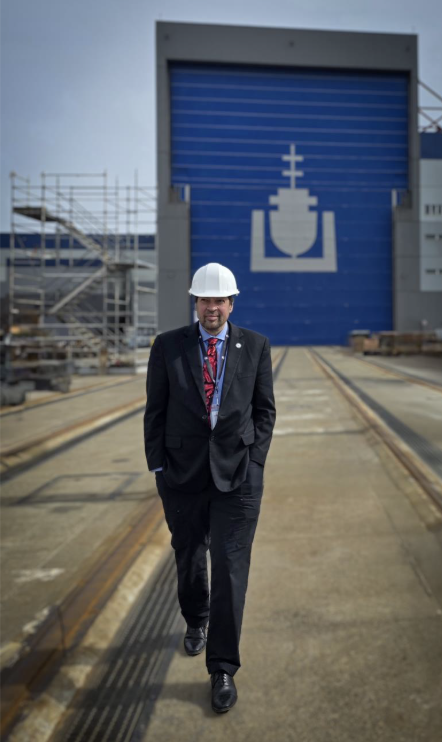
Stieren said he could not provide exact figures on AIDEA’s past communications spending, but he acknowledged that the new plan should allow the agency to meaningfully boost its public profile.
The $700,000 a year, he added, is a limit, and the agency will set a final budget through a request for proposals process.
“Mothership AIDEA has done, frankly, little to nothing on a consistent basis to tell our story,” Stieren said in an email — particularly when it comes to its loan programs that have helped finance tourism and hospitality businesses, like the Alaska Club fitness chain and Anchorage’s Bear Tooth pizza restaurant and theater.
“We’re far more than roads,” Stieren said. “But since we’ve really not promoted or showcased our efforts in traditional finance areas, I understand the narrative or lack thereof that folks may have.”
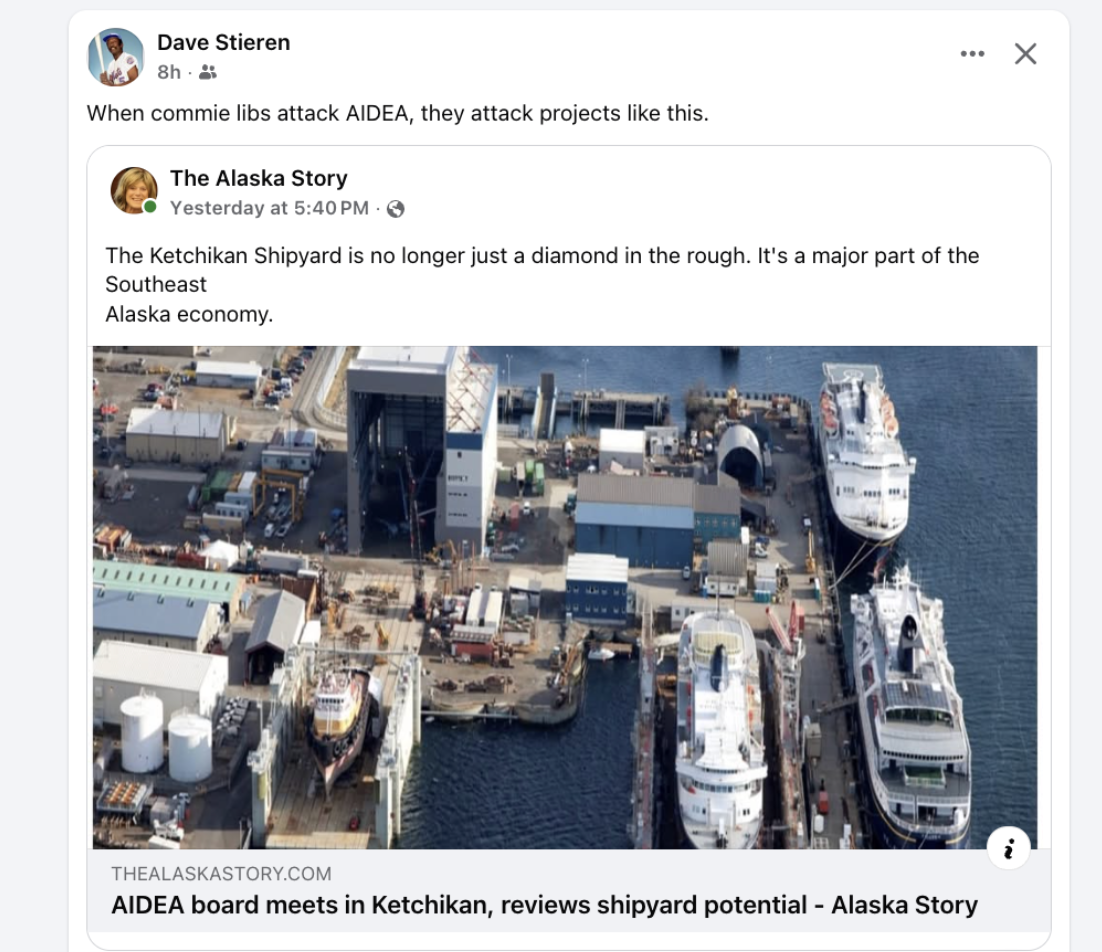
Stieren has also personally defended AIDEA on social media, including over the weekend — when he posted a conservative news website’s positive story about an agency-owned shipyard and said that “when commie libs attack AIDEA, they attack projects like this.”
AIDEA’s board chair, Bill Kendig, declined to answer questions about approval of the new communications budget when reached by phone.
At the Ketchikan meeting, one AIDEA critic, Melis Coady, credited the agency with formalizing communications spending as a “step toward accountability.” But she said that the plan doesn’t “deliver the transparency it describes” because it gives Ruaro, the executive director, authority to approve communications spending, and only requires that he report it to the board if asked.
“The authorization is broad, the dollar amount is undefined, and expenditures are approved solely by the executive director,” said Coady, who leads a conservation group called the Susitna River Coalition.
Ruaro, in an email, said AIDEA will issue reports on communications to board members “whether requested or not.”
AIDEA’s board chair, Bill Kendig, declined to answer questions about approval of the new communications budget when reached by phone.
At the Ketchikan meeting, one AIDEA critic, Melis Coady, credited the agency with formalizing communications spending as a “step toward accountability.” But she said that the plan doesn’t “deliver the transparency it describes” because it gives Ruaro, the executive director, authority to approve communications spending, and only requires that he report it to the board if asked.
“The authorization is broad, the dollar amount is undefined, and expenditures are approved solely by the executive director,” said Coady, who leads a conservation group called the Susitna River Coalition.
Ruaro, in an email, said AIDEA will issue reports on communications to board members “whether requested or not.”
Reporting like this takes time and money. Northern Journal’s primary revenue source is contributions from readers. If you’re already a member, thank you. If not, we’d be grateful if you’d consider a voluntary subscription.
The post Alaska’s embattled economic development agency approves $700,000 PR budget appeared first on Chilkat Valley News.

 All’s fair in Kim Kardashian and Lewis Hamilton’s relationship.
In fact, the couple didn’t hold back on the PDA when they hit the beach in Malibu, Calif., April 20, making out as they swam in the…
E! Online (US) – Top Stories