During a recent appearance on The Jamie Kern Lima Show, Meghan Markle made a passing remark about Prince Harry’s military service.
And because everything she does is subject to intense scrutiny and criticism, the Duchess of Sussex might be regretting those remarks today.
The topic came up when Meghan reflected on getting through life’s difficult moments by recalling advice her husband once shared with her.
Meghan, Duchess of Sussex, during a forum about digital responsibility at EAN University during a visit around Colombia on August 15, 2024 in Bogota, Colombia. (Photo by Diego Cuevas/Getty Images)
“But you know, he was a helicopter pilot in the British Army for 10 years,” Meghan said (via Radar Online).
“And sometimes, on really hard days, he said, ‘Hey, but my love, you know, even if there’s a storm happening, above the storm the sun’s always shining.’”
The remark quickly caught the attention of royal watchers, who argued that Meghan’s description blurred the line between Harry’s overall military service and the years he actually spent flying helicopters.
To be clear, there is no dispute that Harry served in the British Army for roughly a decade.
He entered the Royal Military Academy Sandhurst in 2005 and remained in military service until 2015, eventually leaving with the rank of Captain.
However, his aviation career began several years after he enlisted.
Harry started formal helicopter flight training in 2009, earned his wings in 2010, qualified as an Apache co-pilot gunner in 2012, and later became an Apache Aircraft Commander in 2013.
He flew operational missions during his second deployment to Afghanistan before transitioning to a desk assignment in 2014.
Critics therefore argued that describing him as a helicopter pilot for the entirety of his 10-year military career was inaccurate.
The interview sparked debate online, with several commenters insisting Meghan had exaggerated Harry’s credentials.
One Reddit user wrote, “He did not serve as a pilot for 10 years because in his earlier years of service he hadn’t done that training.”
Another added that Harry “served for 10 years in the Army, not as a helicopter pilot.”
One commenter even went so far as to accuse Meghan of “stolen valor.”
Another person claimed, “Suspicious. I don’t think he was allowed to fly on his own, only as a co-pilot. And he doesn’t seem to have a license now. We never heard of him flying after the military like William,”
Others suggested the statement was likely a simple mix-up between the length of Harry’s military service and the years he spent flying military helicopters.
Harry has long described his decade in the Army as one of the most meaningful periods of his life.
The Duke of Sussex completed two deployments to Afghanistan, although only the second came after he had qualified to fly Apache helicopters. His military experience has remained central to much of his charitable work since leaving royal duties, including his continued involvement with the Invictus Games.
Neither Meghan nor Harry has publicly addressed the criticism surrounding her remarks.
American faith in news is at an all-time low, aided by a president hostile to the press. But presidents have long attacked journalists as biased. What does objectivity really mean?
A surprising amount of what feels like farmers market etiquette is actually the law. A market can turn away a golden retriever at the gate … Read moreThe post Farmers markets are booming, and shoppers still don’t know the rules…
Taylor Swift has said that as she became an adult her hair lost its curls, but is that even possible? Science provides an explanation for her texture change.
Health Digest – Health News, Wellness, Expert Insights
Almost exactly six months ago, Nancy Guthrie was kidnapped and held for ransom.
It is widely believed that she died shortly after her abduction.
DNA evidence thus far seems to be a dead end.
A man is preparing to sue authorities for his wrongful detention and the ransacking of his family home. More than anything, he wants them to publicly clear his name.
Local police instituted a no-parking policy in front of Nancy Guthrie’s property in February 2026. (Photo Credit: Joe Raedle/Getty Images)
DNA evidence is a bust so far
On Thursday, July 30, investigators for the Pima County Sheriff’s Department (PCSD) confirmed that the hair sample found at Nancy’s abode did not lead to a suspect.
Authorities did not disclose much about the hair sample, including where in Nancy’s home they may have found it.
It is possible that the hair is suspicious but did not turn up any matches in their search, almost exactly six months after the fact.
Alternatively, it seems possible that the PCSD did determine whose hair it was — only to find that the individual is not a suspect.
Remember, we all leave epithelial cells, hair samples, and fingerprints just about everywhere. Most crime scenes, especially residential ones, are home to countless samples from friends and loved ones.
Just over a week after Nancy vanished, police detained Carlos Palazuelos.
An attorney representing Palazuelos and two family members filed a notice of claim on Monday, July 27. This is the formal precursor to a lawsuit against the PCSD.
According to his filing, Palazuelos was held “without probable cause” for seven to eight hours after being pulled over. Meanwhile, news of his seizure was spread far and wide.
“Carlos’ arrest was made in a public fashion that was intended to damage Carlos’ reputation and subject him to humiliation and suspicion by implicating Carlos in the kidnapping of Nancy Guthrie,” the notice of claim describes.
Palazuelos is not the only member of his family highlighting the outrageous behavior by the PCSD.
Carlos Palazuelos wants his name publicly cleared
The notice also describes how men in military gear pointed guns at family member Daniel Maddox and “ransacked” the home.
Maddox was removed from the residence, forced to the ground, and handcuffed.
The fruitless raid resulted in “significant property damage” including breaking the front door, the door frame, ceiling tiles, the attic entrance, and more.
In addition to not turning up any evidence, the lawsuit notes that the detention and home search were based upon “false and baseless evidence.”
Family attorney Jesse Showalter affirmed: “Whatever this purported evidence was that the sheriff’s department used to obtain the search warrant, it’s wrong. It’s not good evidence.”
Additionally, the PCSD has refused to clear Palazuelos’ name. There are, obviously, paranoid conspiracy theorists who are convinced that he is a suspect.
The family will file a lawsuit, seeking $2.5 million for Palazuelos, $500,000 for Maddox, and $250,000 for Josefina Maddox, who owns the house.
Additionally, they want Palazuelos’ name cleared publicly.
Many of us can imagine the horror of our homes being ransacked for no apparent reason, our loved ones manhandled or handcuffed without any clear cause, and all for nothing.
Unless investigators are holding onto some secret belief that Palazuelos is involved, it’s unclear why they would not seek to clear his name. (Also, it’s generally the municipality, not the department, that pays to settle these cases — taxpayers pay while officers sued for wrongdoing often face no repercussions.)
They have 60 days to respond to the notice. The clock is ticking.
North West is pressing pause.
While the 13-year-old—the oldest of Kim Kardashian and Kanye “Ye” West’s four kids—has been stepping further into her music career with the release of her debut EP… E! Online (US) – Top Stories
Such ongoing extreme hostility from the president has contributed to Americans’ loss of faith in the news media, which has plummeted to an all-time low.
While the situation is in many ways unique to this moment, a perceived crisis around the very notion of “objective reporting” – and presidential use of that idea to denigrate and delegitimize the press – has a long history.
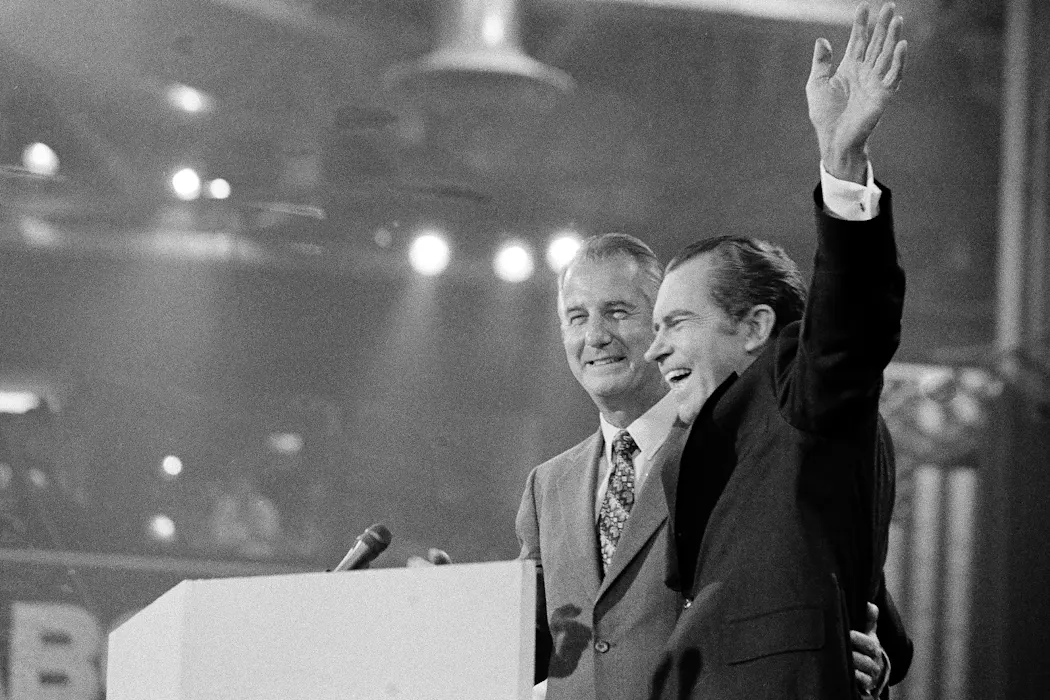
In an infamous 1969 speech, Agnew denounced TV newsmen – they were, indeed, mostly men – as “an effete corps of impudent snobs,” hostile to the president and therefore out of touch with average Americans. Agnew singled out NBC anchorman David Brinkley for his claim that “objectivity is impossible” and that “fairness” was a more reasonable objective. Like many journalists, Brinkley understood “objectivity” as implying an almost mechanical delivery of pure facts, while “fairness” was more realistic, an earnest effort to be judicious.
Vice President Spiro Agnew gave a speech in 1969 in which he called reporters ‘an effete core of impudent snobs.’
Brinkley’s statement was not impudent. It was realistic: an acknowledgment that journalists are humans with preconceptions and values, but that their professional mandate is to strive for impartiality.
Carefully balanced reporting was not only the baseline of journalists’ training but also a business imperative. There were only three national nightly news shows, all seeking the widest possible audience. Moderation was more profitable than swinging hard left or right.
Although frustrated with journalism in general, Agnew zeroed in on TV in his speech because it had displaced print as Americans’ leading news source. And the reality of Federal Communications Commission licensing, whereby a federal agency determined who could use publicly owned airwaves, made broadcasters vulnerable to the actions of a vengeful president.
The licensing issue still resonates. Comedian Jimmy Kimmel, a frequent Trump critic, had his show briefly suspended by ABC after angering the president’s supporters.
“We can do this the easy way or the hard way,” FCC chair Brandon Carr said. “These companies can find ways to change conduct to take action on Kimmel or, you know, there’s going to be additional work for the FCC ahead.”
Struggling to compete, newspapers in the 1960s and ’70s could have easily downplayed Agnew’s criticisms of a rival medium.
Instead, they stood up for TV. In the course of my research, I’ve found that not only in publicly accessible material but also in unpublished archival papers both broadcasters and newspapers consistently understood an attack on one media outlet as an attack on all, a lesson that holds true in 2026.
One of Agnew’s “snobs” was the liberal New York Times columnist Tom Wicker. Wicker was on Nixon’s “enemies list,” and he voiced concerns about not just Nixon and Agnew but also more generally about the very notion of objectivity.
Agnew raised hackles across the American journalism community. But Wicker’s reactions stand out in particular, because he was employed by what was then known as “the paper of record,” whose grandiose credo had long been “To Give the News Impartially, Without Fear or Favor.”
The New York Times columnist Tom Wicker raised questions about both the objectivity and independence of journalists. Diana Walker/Getty Images
In a column published on Nov. 16, 1969, Wicker granted that it was legitimate for Agnew to ask “how the power of that extraordinary medium (TV) can be most equitably controlled and exercised in the general public interest.”
But Wicker underscored that Agnew “couched his argument in direct political attack on those who differed with Mr. Nixon” and “came close to claiming immunity from criticism for Presidential utterance.”
Taking on ‘objectivity’
Two years after Agnew’s “effete snobs” speech, Wicker wrote an essay for Columbia Journalism Review objecting to journalism’s “tradition of objectivity” and “orientation toward nationalism in politics and toward establishmentarianism in other areas of society.”
The consequence, he wrote, was a heavy and generally uncritical reliance on official sources, all in the name of a spurious notion of objectivity.
“In essence,” Rosenthal wrote, “what Tom’s piece adds up to is a public statement by … a well-known columnist of the Times … that objectivity and comprehensiveness, the journalistic foundations of this paper, are no longer valid and that the kind of paper the Times is now is no longer meaningful.”
Rosenthal said Wicker’s public expression of these thoughts was “bad for the paper” externally and “bad for morale” internally.
Regardless, such disputes at The New York Times were always waged behind the scenes. The gold standard for journalism was – and remains, whenever possible – to tell the story, not be the story.
Denouncing bias as deflection
Today, by contrast, it is widely known that the CBS News division “is on fire,” as longtime “60 Minutes” correspondent Scott Pelley said, shortly after he was sacked.
Like Agnew, in other words, Weiss appears to cloak uncritical acceptance of presidential positions as a battle against “bias.”
Denouncing “bias” is usually an attempt by those in power to deflect from what reporters have uncovered – from Vietnam to Watergate to Iraq. It is thus startling for someone within journalism to use the establishment’s word – bias – to self-censor.
In his speech at the 2026 White House Correspondents’ Association dinner on July 24, 2026, President Donald Trump did not celebrate the First Amendment. Mandel Ngan/AFP via Getty Images
Holding government accountable
In 1971, for example, the Army and the Nixon administration attacked “The Selling of the Pentagon,” a CBS documentary about military public relations activities. Officials charged that the editing had been misleading and malicious, and the U.S. House of Representatives subpoenaed CBS journalists’ raw footage.
In his column, Wicker declared the documentary excellent, and he correctly painted the subpoena of CBS materials as resulting from White House pressure.
Wicker argued that “no statute exists that says government officials must be protected from the exposure of their follies or misdeeds,” and that the Pentagon Papers’ culprit was the government, not the newspapers.
Here, Wicker made a fair, if not strictly objective, evaluation.
Such opinionated defenses of the press still ring true today. Agnew repeatedly attacked naysayers as “nattering nabobs of negativism,” but journalism serves a positive function in particular when its stories are negative.
Heather Hendershot does not work for, consult, own shares in or receive funding from any company or organization that would benefit from this article, and has disclosed no relevant affiliations beyond their academic appointment.













 North West is pressing pause.