Gary Neville has criticised the government’s national insurance (NI) rise this year, saying it could deter companies from employing people and “probably could have been held back”.The Latest News from the UK and Around the World | Sky News









Gary Neville has criticised the government’s national insurance (NI) rise this year, saying it could deter companies from employing people and “probably could have been held back”.The Latest News from the UK and Around the World | Sky News

The population of England and Wales has grown by more than 700,000 in the year to June 2024 – the second-largest increase in over 75 years.The Latest News from the UK and Around the World | Sky News

A blanket of thick fog covers Lesotho’s capital, Maseru.The Latest News from the UK and Around the World | Sky News

In Altrincham near Manchester, two opposing groups have gathered to throw insults at each other across the A56.The Latest News from the UK and Around the World | Sky News


In a packed meeting Monday night, the Juneau Assembly approved key measures, including a proposed seasonal sales tax structure and the city’s Hazard Mitigation Plan, while deferring several bond issues and continuing deliberation on ranked-choice voting.
Deputy City Manager Robert Barr said one of the most significant decisions was the approval of a revised seasonal sales tax ordinance, which will now head to the October ballot for voter consideration.
“The idea is to have a lower sales tax in winter months and a higher sales tax in summer months.” Barr explained, “and the Assembly did, ultimately pass the ordinance with some amendments.”
One amendment, introduced by Deputy Mayor Greg Smith, lowers the winter sales tax rate further, from 2.5% to 2%. Including the existing temporary 1% tax, which is renewed by voters every five years, the total off-season rate would be 3%.
The Assembly also passed the final draft of the All-Hazard Mitigation Plan, following public testimony, much of it centered on landslide risk.
“At the end of the day, the Assembly did pass the resolution.” Said Barr “So the next steps for that plan is that it will go on to the state and then to FEMA for adoption, and we’re hopeful that that will happen in time for us to be able to apply for grant opportunities that are coming down the line.”
The plan is key to unlocking federal funding opportunities, including hazard mitigation grants.
Deliberations also continued on ranked-choice voting, with the Assembly choosing to send the matter back to the Committee of the Whole for further discussion.
“There’s three or so ranked choice voting options that they’ve been working their way through. They’re all pretty complex.” Said Barr “And again, my general sense of the body last night is they just wanted more time to think, discuss and hear public input on those three options before deciding what to do.”
Barr encouraged residents to stay engaged and informed by signing up for Juneau’s emergency alert and notification system, which also offers general civic updates.
“Beyond that, looking at our agendas when they come out, usually on Thursdays before the next week’s meetings.” He said, “People can find those on juneau.org.”
This article has been corrected to adjust the winter sales tax from from 2.5% to 2%, rather than 3.5% as previously written.


NOTN- Juneau for Democracy, a local organization formed in January, says its intention is to mobilize Alaskans to protect civil rights through peaceful protests and direct civic engagement.
The group, founded by concerned citizens, focuses on holding elected officials accountable and addressing issues ranging from healthcare access to immigration policies.
They are also responsible for the June ‘No Kings’ protest held in Juneau, which had over 1500 participants in the capital city alone.
The organization regularly hosts rallies, and encourages constituents to contact their representatives. Members also maintain a weekly presence with U.S. Sen. Lisa Murkowski’s office staff and hold “Stand for Staff” events every Thursday to support federal employees affected by recent mass firings.
“It is really rewarding to have these conversations, because people feel heard.” Said Juneau for Democracy’s Ariel Hasse-Zamudio, “That’s a huge way that we can make a difference, if we’re not building relationships, if we’re not having conversations, then we’re not able to move forward and elevate our issues.”
Juneau for Democracy is focusing on a few key issues in their activism, including budget allocations that affect Medicaid.
“Just a little under 40% of Alaskans are on Medicaid, and that’s a huge number, because we’re only a state of 741,000 people.” Said Hasse-Zamudio, “that’s your neighbor, that’s your friend, that’s the people you might have seen at the hospital, and because so many people are going to lose their health care because of the requirements of the bill, that’s going to cause medical facilities to shut down.”
The tax and spending bill President Donald Trump signed into law July 4 enacts wide-ranging changes to public policy, including major revisions to Medicaid, the Supplemental Nutrition Assistance Program (SNAP), and federal tax laws.
A provision in the bill will require the 40 states that have expanded Medicaid, to check paperwork at least twice a year to ensure those enrollees are volunteering or working at least 80 hours a month or attending school at least half-time.
The new law provides states $200 million for fiscal year 2026 to get their systems up and running. But some experts say states will have difficulty meeting the deadline with that funding and worry enrollees might lose their health benefits as a result.
“It’s actually more important now that the bill has passed that we continue to elevate the decisions that our federal delegation made that are against Alaskan interests.” Hass-Zamudio said.
The group also spotlights protecting public lands, and opposing what they describe as overreach by Immigration and Customs Enforcement (ICE).
The group argues ICE can currently arrest individuals without warrants or clear cause.
“We need accountability for this organization, if this organization is to exist and be funded.” Said Hasse-Zamudio, “there’s really no oversight right now.”
Recently, the Alaska Department of Corrections has held dozens of immigration detainees in Anchorage under conditions that violate federal standards for humane treatment.
According to Alaska Public Media, three immigration lawyers said the men were denied phone access to their attorneys and consulates, held in lockdown for long periods and, in one incident, subjected to pepper spray.
ICE teams are continuing to carry out enforcement operations, and officials have said targeting criminals is a priority, but a key issue to watch is how the term “criminal” is defined. White House spokeswoman Karoline Leavitt said that the administration sees all undocumented immigrants as criminals.
Megan Lingle from Juneau for Democracy added” I know that my Tlingit ancestors sacrificed a great deal, and we are still living with the trauma of those sacrifices. I mean, boarding schools were not that long ago, many of my grandparents generations were abducted and forced into them, and that hits really close to home when we hear ice might be in town.”
Lingle also emphasized the collective effort of Juneau for Democracy, “It’s crucial not only to use my voice, but also to encourage others to do the same, because fear grows in silence.”
The organization is planning another protest at the Capitol building on August 2 in Juneau, advocating for education funding as a part of a national day of protest, “Rage Against the Regime.”
“Juneau may seem small, but every voice matters.” Said Lingle “”We are the leaders we are waiting for.”

As the United States edges up to the 250th anniversary of the Declaration of Independence in 2026, one of the core principles the founders sought to advance – that the government must act with accountability and in accordance with the rule of law – is being strongly tested.
In their deliberations leading up to the declaration, the founders would not just raise deep concerns that the government of King George III was violating the Colonists’ rights, which they described in the declaration. They would also enshrine these principles in the U.S. Constitution over a decade later through the concept of “due process.”
What did the framers likely mean when they did so? That’s no longer simply an academic question for legal scholars like me. The meaning and application of due process has become a crucial issue in the U.S., most often with respect to the Trump administration’s migrant deportation efforts.
Over the past several months, the U.S. Supreme Court has made several rulings in deportation-related cases with respect to what’s called the due process clause of the Constitution.
In April 2025, in the case Trump v. J.G.G., the court seemed to state quite clearly that deportations could not take place without due process. More recently, however, in D.H.S. v. D.V.D., the Supreme Court prevented a lower court from providing due process protections to a group of men the administration wanted to deport to South Sudan, where they are at risk of facing torture and even death.
These seemingly contradictory rulings not only make it unclear when due process applies but probably leave many asking what the term “due process of law” even means and how it works.

The American concept of due process can be traced from medieval England to its modern formulation by the U.S. Supreme Court. Doing so allows the meaning of due process to come into focus. It also calls into question the court’s most recent ruling on this issue.
The concepts of due process and the rule of law largely emerged in the 13th century in the Magna Carta, a formal, written agreement between King John of England and the rebel aristocracy that effectively established legal constraints on government.
One key passage from the Magna Carta provided that “No Freeman shall be taken, or any otherwise imprisoned, or be disseised of his Freehold, or Liberties, or free Customs, or be outlawed, or exiled, or destroyed; nor we will not pass upon him, nor condemn him, but by lawful Judgment of his Peers, or by the Law of the Land.”
This accord established formal constraints on a previously unrestrained regent, setting English law on the course that would prioritize rule of law over the whims of the monarch.
Over a century later, Parliament would pass the English statute of 1354 that said “That no Man of what Estate or Condition that he be, shall he put out of Land or Tenement, nor taken nor imprisoned, nor disinherited, nor put to death, without being brought in Answer by due Process of the Law.”
These principlesd evolve over time in British law and then informed the emerging revolutionary spirit in the American Colonies.
Released in January 1776, Thomas Paine’s pamphlet Common Sense would help galvanize and steel many Colonists for the revolutionary conflict to come. The work shifted the focus of Colonists’ anger from trying to force the king to treat them better to more radical change: independence and a country governed by the rule of law.

What the Colonists wanted, Paine wrote, was not a monarch: “So far as we approve of monarchy, that in America THE LAW IS KING. For as in absolute governments the King is law, so in free countries the law ought to be King; and there ought to be no other.”
After independence, many of the original 13 states adopted their own constitutions that would enshrine principles akin to due process to protect their constituents from government overreach, such as that government was to be bound, as it was in Virginia’s Declaration of Rights in 1776, by “the law of the land.”
But it was not until the nation adopted the Bill of Rights – the first 10 amendments to the Constitution – in 1791 that the federal government could not act in a way that deprived the populace of life, liberty or property without due process of law. After the Civil War, the 14th Amendment would apply these same protections to all government action, state and federal.
The contemporary and most comprehensive formulation of what due process requires can be found in the Supreme Court’s ruling in the 1970 case Goldberg v. Kelly, brought by welfare recipients challenging their loss of such benefits without a hearing.
In that case, the court determined that when governments attempt to deprive someone of their life, liberty or property, the target of those attempts must receive fair notice of the charges or claims against them that would justify that loss; be given an opportunity to defend against those claims; and possess the right to have such defenses considered by an impartial adjudicator.
The Supreme Court in 1976 would accept that due process protections in different settings will vary based on a number of variables. Those include what is at stake in the case, the likelihood that government might make a mistake in a particular setting, and the benefits and burdens of providing certain forms of process in a given situation.
When someone’s life is literally on the line, for example, more exacting procedures are required. At the same time, regardless of how important the interest that is subject to due process – whether it is one’s life, one’s home, one’s liberty, or something else – the components of fair notice, an opportunity to be heard, and to have one’s case decided by an impartial adjudicator must be meaningful.
As the court said in Mullane vs. Central Hanover Bank & Trust Co. in 1950: “Process which is a mere gesture is not due process.”

Ray Brescia does not work for, consult, own shares in or receive funding from any company or organization that would benefit from this article, and has disclosed no relevant affiliations beyond their academic appointment.
Politics + Society – The Conversation

Reading Time: 2 minutes
As they say, a picture is sometimes worth 1,000 words.
When it comes to Elsie Hewitt as the premiere of the film The Pickup, however, the following picture can be summed up with two (exciting!) words:
I’m pregnant.
In news broken about a week ago, Pete Davidson and his girlfriend confirmed this month that they’re expecting their first child together.
“Welp now everyone knows we had sex,” Elsie captioned a carousel that included a photo of an ultrasound and many cute pictures of her and her funny lover.
As we previously detailed, Elsie Hewitt is a London-born model and actress.
She and the Saturday Night Live alum went public with their relationship back in March when they packed on the PDA during a trip to Florida.
The relationship comes on the heels of Davidson and his reportedly large penis having been engaged to Ariana Grande in 2018 and being in a serious relationship afterward with Kim Kardashian.

While speaking to People Magazine at this event, which was held at Regal LA Live, Davidson said of becoming a father:
“I’m just excited to take care of the little one. The second I found out the news, I was like, ‘Oh wow, what I do is just a job.’
“I realized I was kind of basing my happiness on work, which is ridiculously unhealthy. So it gave me this weird sense of calmness, where this is just a job and now I have someone to do it for.”
As you can tell, Davidson isn’t shy about talking about the work his sperm has done and what it will mean for him moving forward.
“It’s been my dream since I was little, which is cool,” he told E! News’ Nikki Novak about entering parenthood.
“When you have dreams when you’re little and then you get older, sometimes those feelings change — that didn’t change for me. I’m mostly just excited. I don’t have time to think about myself as much anymore or be in my head. I just realized this is kind of just a job, and now I have something to do it for.”

The couple has started to talk about baby names, but has not yet revealed if they know the gender for their impending boy or girl.
“I know my dad wanted to name my sister Harley for Harley Davidson, and that didn’t go well,” he joked on the red carpet before making it clear:
“It’s not going to be Harley.”
Elsie Hewitt Pregnant, Baby Bumpin on First Red Carpet with Pete Davidson! was originally published on The Hollywood Gossip.
The Hollywood Gossip
Reading Time: 3 minutes
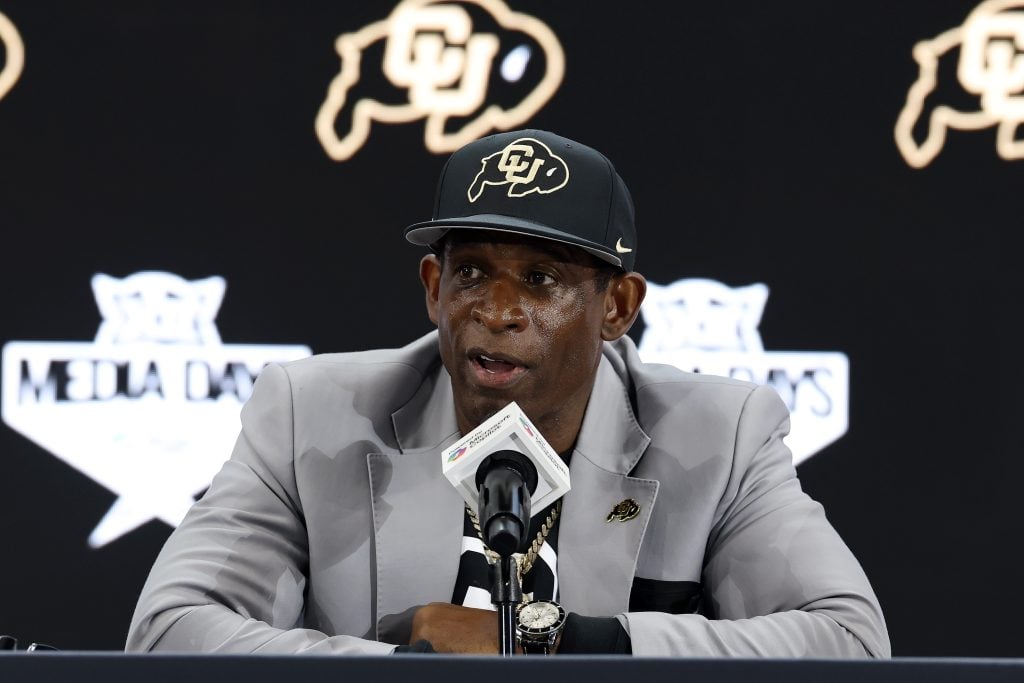
NFL legend and Colorado Buffaloes coach Deion Sanders made a surprising revelation during a press conference today.
The 57-year-old explained that he’d been keeping a low profile in recent months because he was battling bladder cancer.
One of the most common cancers in men, bladder cancer has a high survival rate if detected early, but the most effective treatments tend to be painful and invasive.
But the good news is that Sanders is now in remission and ready to resume full-time coaching duties ahead of the Buffaloes’ 2025 season.
“It’s been a tremendous journey,” Sanders told reporters during a press conference today. “It’s been tough.”
Sanders went on to reveal that he had lost 25 pounds and “can’t pee like I used to pee. But he appeared to be in good spirits despite his ongoing ailments.
“I depend on Depends,” Deion joked at one point, before encouraging men of all ages to get screened for cancer.
Sanders was joined at the press conference by Dr. Janet Kukreja, who confirmed that Coach Prime is officially cancer-free.

“I am pleased to report that the results from the surgery are that he is cured from the cancer,” Dr. Kukreja remarked at one point.
Sanders first revealed he was dealing with health issues during a podcast interview with fellow NFL legend Asante Samuel.
“What I’m dealing with right now is at a whole ‘nother level,” Deion said back in the spring, declining to go into further detail.
Sanders has dealt with numerous health issues in the past, including surgeries in 2022 and 2023 that resulted in the amputation of two toes.
But he’s had lots of support along the way, and TMZ is reporting that Karrueche Tran was by Deion’s side in the hospital.
Karrueche is a model and actress who is perhaps best known for her tumultuous relationship with Chris Brown, whom she dated from 2011 to 2015.

Deion hasn’t confirmed that he and Karrueche are dating, but many believe that to be the case.
Anyway, despite his recent setbacks, Sanders says he never doubted that he would return to coaching.
“I always knew I was going to coach again,” he told reporters today.
The 2025 football season promises to be an exciting one for the Sanders family.
In addition to Deion’s third season as Buffaloes head coach, son Shedeur Sanders is poised to make his debut at quarterback for the Cleveland Browns.
Meanwhile, Deion’s eldest son, Shiloh Sanders, was just signed to the Tampa Bay Buccaneers as an undrafted free agent.
The Sanders are one of football’s most entertaining families, and we couldn’t be happier to hear that their patriarch is on the mend!
Deion Sanders Reveals Bladder Cancer Diagnosis (and Possible Romance With Karrueche Tran) was originally published on The Hollywood Gossip.
The Hollywood Gossip

Reading Time: 3 minutes
Cruz Beckham has had it.
The youngest of the Beckham brothers has been vagueposting up a storm in recent months.
Considering the barrage of family feud reports during this same period, people aren’t really scratching their heads over the targets of the 20-year-old’s ire.
Cruz seems thoroughly at odds with brother Brooklyn and sister-in-law Nicola … unless he’s angry with Romeo and his parents. Or both sides? Let’s take a look.
In recent months, Cruz Beckham’s followers have been getting an earful on his Instagram Notes.
The Meta-owned platform’s “Notes” feature is only a few years old and is easily overlooked.
It is essentially a status update feature.
And Cruz’s deeply hostile and at times obscenity-laden posts have made his status loud and clear.

Page Six reports that Cruz’s blistering Instagram Notes posts have included: “You’re a fraud.” Ouch!
“Ur a d–k now,” another read. “Instant karma gonna get you.”
Others read: “F–king hell,” “It had to be difficult,” “People notice,” and “Ur dead to me.”

“Oh its stockholm syndrome,” Cruz Beckham wrote in another update. “Bloody inbreds.”
He also wrote: “Etiquette,” “Whole family o’ c–ts,” and “How can 2 people make so many ugly c–ts.”
We have to point out that the C-word has a much more casual usage in non-American English-speaking countries. It’s still rude, but not gasp-inducing. Also?
That last line raises questions about the target of Cruz’s ire.

These messages do not have context. You know back in, like, 2010 if someone might make a Facebook status of “super annoyed right now” or something like that? Or they might have done something similar on Twitter?
All of that is vagueposting. They’re not naming the people getting on their nerves. Well, neither is Cruz.
And Cruz has chosen an overlooked feature to lay into … clearly, several people, some of whom seem to be related.

Cruz could have said many things to single out Brooklyn Beckham and Nicola Peltz.
He could have said many things to identify Romeo Beckham and parents David and Victoria. He did not.
Maybe he’s mad at one brother or the other. He could also be angry with both brothers for this ugly reported feud. If he feels that they’re tearing apart the family, his anger is understandable.
That said … it is entirely possible that Cruz is talking about something else.
He’s a 20-year-old and just because most of what we know about his life is his family doesn’t mean that he doesn’t have more going on.
Cruz Beckham Speaks Up Amidst Bitter Family Feud: Is He ‘Team Brooklyn’ or … was originally published on The Hollywood Gossip.
The Hollywood Gossip