Fifteen people have been killed in Sri Lanka after a passenger bus veered off a 1,000ft cliff.The Latest News from the UK and Around the World | Sky News
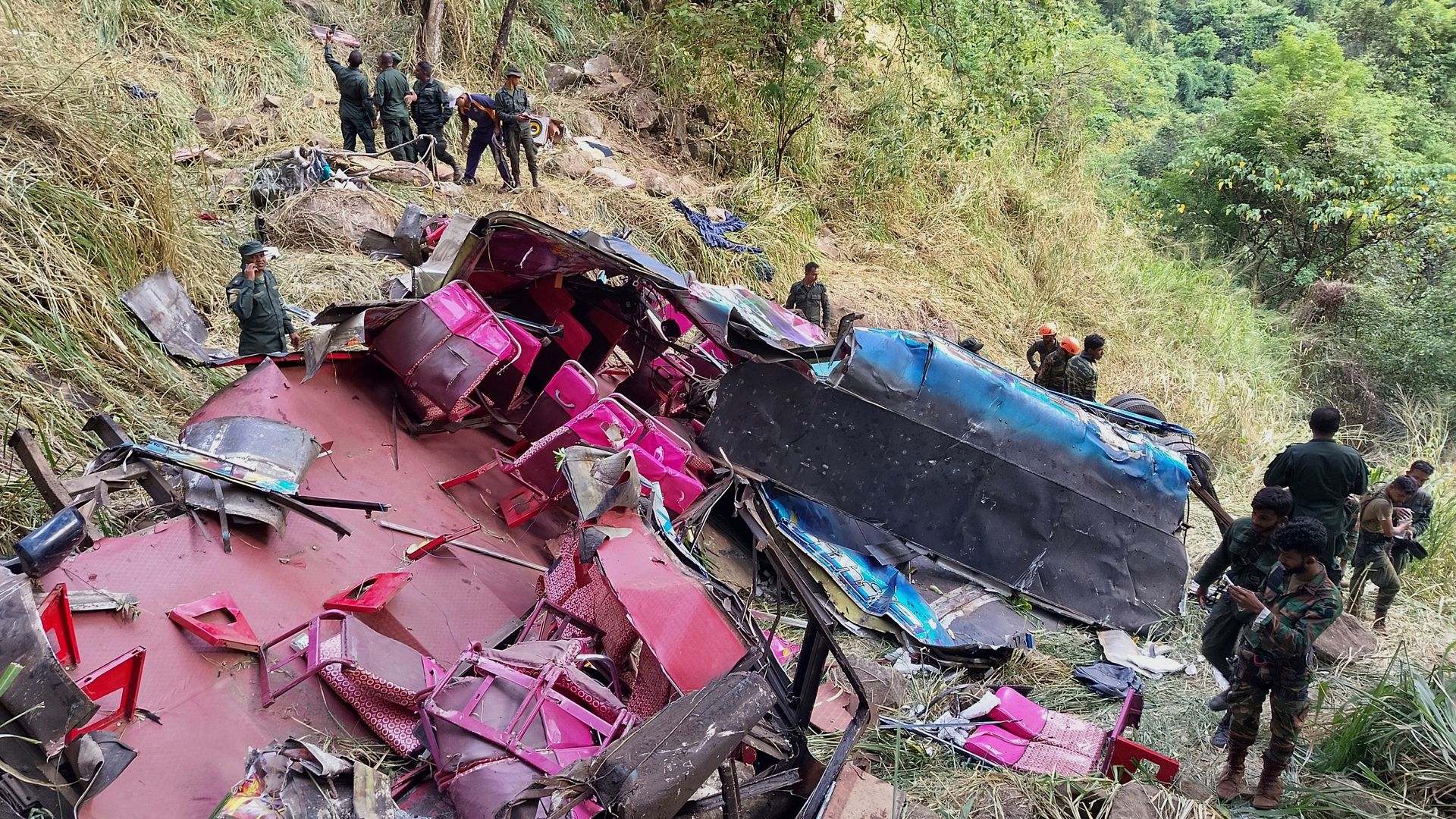











Fifteen people have been killed in Sri Lanka after a passenger bus veered off a 1,000ft cliff.The Latest News from the UK and Around the World | Sky News

Donald Trump is to rebrand the US Department of Defense as the Department of War, according to the White House.The Latest News from the UK and Around the World | Sky News

Former US president Joe Biden has had surgery for skin cancer, his spokesperson has said.The Latest News from the UK and Around the World | Sky News

Victims are calling for stiffer sentencing guidelines for those convicted of violence against women in Northern Ireland as it grapples with a femicide record described as an “epidemic”.The Latest News from the UK and Around the World | Sky News

A major new study of vapes seized from schools has found that more than 10% contain the synthetic drug spice – and Sky News can reveal the liquids are being openly advertised on social media.The Latest News from the UK and Around the World | Sky News

Three British nationals are among the 16 who died after the iconic Gloria funicular in Lisbon derailed and crashed, authorities have said.The Latest News from the UK and Around the World | Sky News
By: James Brooks, Alaska Beacon

The U.S. Coast Guard announced Tuesday that it has awarded a $137 million contract for the first phase of a project intended to allow its Seattle base to host two new heavy icebreakers.
The contract, awarded to The Whiting-Turner Contracting Company, covers dredging of the Coast Guard’s Slip 36 and construction of two ship berths capable of hosting the new icebreakers, formally known as Polar Security Cutters.
The first of those ships, the Polar Sentinel, is expected to be complete in 2030. When accepted into the Coast Guard, it will be the service’s first new heavy icebreaker since the Polar Star was commissioned in 1977.
The Coast Guard operates the federal government’s icebreaker fleet, and the Polar Star is key to supplying American research bases in Antarctica from its Seattle home port.
A second and third heavy icebreaker were fully funded with $4.3 billion included as part of the Republican budget package approved by Congress and President Donald Trump earlier this year.
The budget package also included $300 million for port construction in Juneau to support the newly commissioned Coast Guard icebreaker Storis, a converted oilfield services ship. Until that work is complete, the Storis will be homeported in Seattle.
The Republican budget package, known as the “Big Beautiful Bill Act,” includes billions of dollars for shoreside port facilities like those in Juneau and Seattle.
Additional phases of work are expected in Seattle, which is expected to be the home port of four new major Coast Guard cutters, the service said in a written statement.

NOTN- After two recent deaths on trails near the Mendenhall Glacier, Juneau police are urging hikers to take precautions and understand the challenges search-and-rescue teams face in southeast Alaska.
Juneau Police Chief Derek Bos said such cases fall into one of two categories, people who vanish in the wilderness, often requiring search-and-rescue efforts, and those whose disappearances are suspicious or criminal in nature.
“Alaska State Troopers actually have jurisdiction over search and rescues in all of Alaska.” said Bos, “When we get those calls in, initially, it’s deferred to AST for them to conduct search and rescue operations and begin the initial stages of that investigation, we also are privileged in Juneau to have Juneau mountain rescue, which is a very professional, wonderful entity that does a great job of search and rescues. And so they work in collaboration with AST on those initial stages of a missing person who’s gone hiking and just not come back.”
JPD supports both groups and shadows their work in case the missing person case later becomes a criminal investigation.
Bos also noted that southeast Alaska poses difficulties for search teams. Dense vegetation, steep mountainsides and shifting winds complicate efforts by ground crews and even trained search dogs.
“It doesn’t take much to look around and see that we are in a very densely vegetated area, and it’s very vertical. So it’s not like looking for somebody in the plains of Kansas.” Bos said, “There’s a lot of visual obstructions, there’s altitude challenges, there are different wind patterns. So even using search and rescue dogs, if you’re above a scent and the scent is below you, it might blow up on the wind, but if the dog is below the scent and the scent is going up, you might miss it. There’s significant challenges through every aspect of a search and rescue in Southeast Alaska.”
Community members often play an important role, he added, since hikers can help narrow down search areas if they remember where they saw someone.
“A huge thing for us with the public is, if you see this individual on a trail, call us and tell us, let us know where you saw them and when you saw them, that helps us narrow down the search area, and gives a better point of where that person was last seen, so that we can start search efforts in a more specific location.”
Police are urging residents and visitors to share their plans before heading out on local trails.
“If you don’t communicate that, it could be days before anybody identifies that you’re missing, and it just delays search efforts.” Bos said, “And if you’re hurt in the woods or have an illness in the woods, you want help as quickly as possible, self induced accountability is pivotal for any kind of hiking or adventures in Southeast Alaska.”
By: James Brooks, Alaska Beacon

Claire Stremple, a former Alaska Beacon reporter and the current managing editor of public radio station KTOO-FM in Juneau, has been named the Beacon’s new editor.
Stremple, who will start Oct. 20, will replace the Beacon’s founding editor, Andrew Kitchenman. He resigned last month in order to take an editor role at the Philadelphia Inquirer.
The Beacon is an affiliate of the national nonprofit States Newsroom, which conducted the hiring process.
“We are thrilled to welcome Claire back to the Beacon as editor and look forward to more great reporting from our talented team under her leadership,” said Chris Fitzsimon, publisher and CEO of States Newsroom, in a written statement.
Stremple worked at the Beacon from spring 2023 through fall 2024 after prior work as a reporter for KTOO and KHNS-FM public radio in Haines.
While at KTOO, she won the Alaska Press Club’s 2022 Public Service Award for reporting that exposed a large backlog at Alaska’s Division of Public Assistance. After leaving the Beacon in 2024, she returned to KTOO as its editor.
Fitzsimon said he selected Stremple from among many applicants based on her leadership at KTOO, her prior experience at the Beacon, and her commitment to Alaska journalism.
By phone, Stremple said she wants to return to the Beacon because she enjoyed working with its reporters, “and I think that the capitol is a really exciting place to be doing state politics news reporting. I think there’s a lot of opportunity for investigative work there, and that prospect is really exciting to me. So it’s really exciting to be back with the team and be back in the capitol.”
She added, “I do want to continue Andrew Kitchenman’s work, because I think his work and vision have been pretty exemplary and impactful in the state and for other media networks.”
Alaska Beacon reporting is donation funded and can be reprinted for free by newspapers, radio stations, TV stations and news websites.
Stremple intends to work from Juneau, her current location, but said she could change locations if needs warrant.
Across Pennsylvania, an estimated 65,459 children have a parent in jail or prison. That’s according to a recent email inquiry to the Pennsylvania Department of Corrections. Nationwide, nearly half of adults have experienced a close family member being in jail or prison, and 1 in 14 children have lost a parent who was living with them to incarceration.
In May 2025, state Rep. Andre Carroll, whose district covers parts of northwest Philadelphia, and whose own father was incarcerated when Carroll was a child, introduced PA House Bill 1506. The proposed law “focuses on improving communication between incarcerated individuals and their families” by making phone calls and other communication with incarcerated individuals free. It would also prohibit the replacement of in-person visits with other forms of communication such as video calls.
I’m a psychologist and professor of human development and family studies who has studied children with incarcerated parents for more than 25 years.
In 2020, when in-person visits were stopped at jails and prisons due to the COVID-19 pandemic, my colleagues and I interviewed 71 jailed parents in Wisconsin to understand the strengths and challenges of remote video visits with their children.
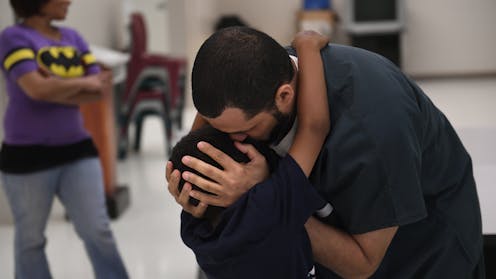
The parents we spoke with strongly preferred in-person visits, where they are allowed to touch and hug, over virtual ones.
“Contact means a lot,” one parent told us. “This type of stuff breaks families apart, not being able to see a person face to face or touch a person.”
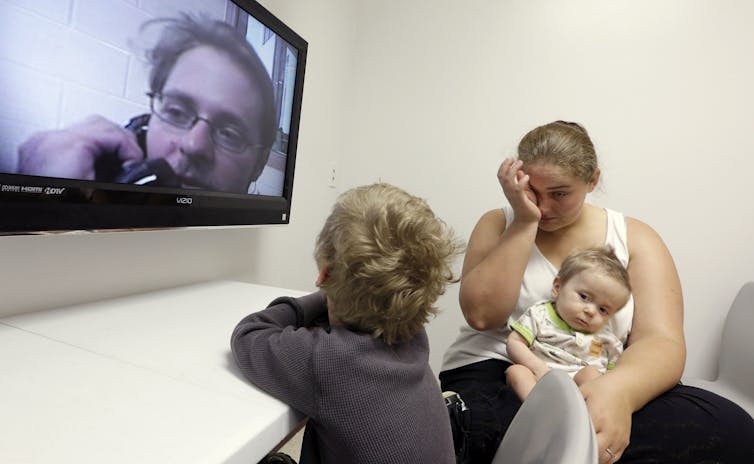
Another parent said, “Video visits are good as it fits into their schedule, but they are not the same. … Giving your child a hug is worth a hundred video visits.”
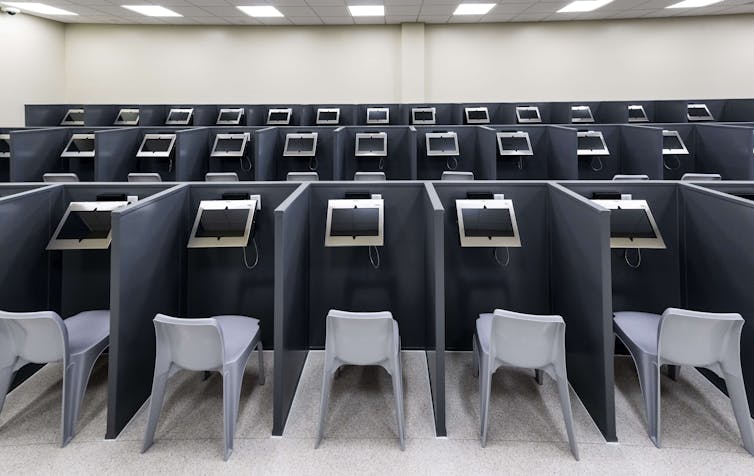
These findings are still relevant today because many local jails across the country are using video visits as a replacement for in-person visits. For example, an analysis of 40 county jails in Michigan found that 33 of them banned in-person visits.
State and federal prisons generally have in-person visits, with video visits sometimes offered as a supplement.
Kids whose parents are in jail or prison are more likely to experience problems in health and well-being compared to their peers, though a growing body of research shows that many children with incarcerated parents are resilient. Resilience refers to the development of competence despite experiencing significant hardship or stress.
In-person visits in particular have been shown to strengthen parent-child relationships, which are a key resilience factor.
In addition, research has shown that children benefit from visiting with their incarcerated parents when such visits are part of an intervention program that includes, for example, mentoring programs or child-friendly visits.
During child-friendly visits, children see their incarcerated parents face to face and can hug them, hold hands, be carried, or sit on their lap. They engage in meaningful activities together – such as playing games, reading together, doing art projects, or taking photos of themselves – that are designed to strengthen their relationship. They can also eat together, are free to move around the space, and are supported by trained staff.
In-person contact visits that allow touch are more developmentally appropriate for children than noncontact visits. For young children who are not part of an intervention, visits with incarcerated parents behind plexiglass can be confusing. The kids can see but not touch their parent, and they can only hear and speak to them through a device that looks like an old-fashioned telephone.
Incarcerated parents say that separation from their children is the most difficult part about being in prison or jail. They frequently report symptoms of distress and depression, especially when they have little contact with their children.
More frequent parent-child contact during parental incarceration – and visiting in particular – is associated with better mental health, fewer behavioral infractions, better relationships with the child’s at-home caregiver and more parent-child contact and better adjustment after release.
Other studies have found links between more visits with children and less recidivism, which also benefits society as a whole.
Furthermore, a study of 507 adults incarcerated because of felony charges in a county jail in Virginia found that more frequent contact with family members during incarceration related to more family connectedness, which in turn predicted better mental health during the first year after release.
Despite the benefits of visiting and other forms of contact, barriers can prevent communication from occurring regularly or at all.
Some of these barriers are economic. Supporting a loved one in prison or jail can be a major financial strain on family members, and children in families experiencing more economic hardship are less likely to visit their incarcerated parents.
Some prisons charge exorbitant fees for video and phone calls. The Prison Policy Initiative tracks the prices of phone calls from prisons in each state. In 2021, the average cost of a 15-minute in-state phone call from a Pennsylvania prison was more than $3.
The racial disparities in who is incarcerated mean that Black and Latino families disproportionately carry the financial load of incarceration-related expenses.
Other barriers involve distance that families live from the prison or jail, time and scheduling conflicts, and strict mail policies that allow incarcerated people to receive only postcards or scanned copies of their mail. Strained relationships between incarcerated parents and family members can further limit contact.
Transportation programs offered by the Pennsylvania Prison Society, an advocacy organization for people who are incarcerated and their families, and other groups can help when family finances are tight. PPS currently provides rides from Philadelphia to four state correctional institutions. A round-trip bus ticket, which is usually $20, is free for children under 18.
In addition, some jails and prisons offer a limited number of free video visits or phone calls. The Pennsylvania Department of Corrections’ website indicates that incarcerated individuals can receive up to four in-person visits per month in addition to six no-cost video visits.
Other organizations are trying to make sure that children and other family members have a chance to stay connected to their incarcerated loved ones in positive ways. Earlier this year, nonprofit legal advocacy organizations helped children in two Michigan counties file landmark civil rights lawsuits that asserted a constitutional right to visit their parents in jail.
As an expert witness in these cases, I hope that they help more children get the “right to hug” their incarcerated parents and raise awareness of the positive impacts that visits play in the current and future well-being of incarcerated individuals and their families.
Read more of our stories about Philadelphia.

Julie Poehlmann receives funding from the National Institutes of Health; the content of this article is solely the responsibility of the author and does not necessarily represent the official views of the National Institutes of Health. Dr. Poehlmann is also currently serving as an expert witness in several legal cases that involve incarcerated parents and their children.
Politics + Society – The Conversation