Categories
Uncategorized

US foreign policy leaders say America should take an active role in world affairs – but no consensus on whether Trump’s policies are working

President Donald Trump and Secretary of Defense Pete Hegseth salute as U.S. Army members move a transfer case containing the remains of Pvt. Isabella Gonzales, killed in Iranian strike on Jordan, on July 22, 2026, at Dover Air Force Base, Del. AP Photo/Matt Rourke

In the wake of the U.S. midterms, Vice President JD Vance blamed the Iran war for the election result. Affordability, Vance pointed out, appeared to be central to voters’ choices, with foreign policy decisions such as the Iran war generating higher fuel prices and rates of inflation. Polling before the election confirmed voters’ concerns – nearly two-thirds of Americans disapproved of President Donald Trump’s foreign policy.

But do foreign policy experts share Americans’ concerns?

To answer that question, the University of Texas at Austin, in partnership with the the Chicago Council on Global Affairs, recently surveyed 449 U.S. foreign policy leaders from the executive branch, Congress, think tanks, interest groups, media and academia.

Their responses matter because as the United States struggles to end the Iran war and navigate the fallout of tariff policies, these experts will be tasked with finding solutions to those pressing problems. These foreign policy experts are also likely to be advising presidential candidates in the run-up to the 2028 elections.

Areas of consensus and disagreement

On some issues, there is a consensus.

We found strong bipartisan agreement on the need for the U.S. to take an active role in the world, the importance of supporting NATO, and the use of force to support European allies if they are attacked.

Ninety-three percent of experts want the United States to take an active part in the world. That includes 83% of Republican experts, 98% of Democrats and 90% of independents. More than 70% of Democrats and more than 80% of Republicans and independents among foreign policy experts we surveyed agree that military power has been very important to American influence in the world. And more than 90% of experts of all partisan stripes agree that economic power has been very important.

However, these points of agreement mask key differences.

On the Iran war, 98% of Democrats and 73% of independent experts say war was the wrong decision, while 58% of Republican leaders say it was correct. While experts of all stripes recognized that tariffs would raise costs for Americans, there were stronger splits on whether tariffs were good for the U.S. economy. One hundred percent of Democrats and 81% of independents say they were bad, while 53% of Republicans say they were good.

America First

These answers largely rally around partisan identities, but responses to philosophical questions about how the U.S. should pursue its interests proved more varied.

The Trump administration has challenged the foundations of U.S. foreign policy through its America First agenda, which favors U.S. domestic and economic interests over international agreements and global alliances.

Protestors with placards walk on a city street.
A South Korean protester takes part in a protest against President Donald Trump’s tariff policy on South Korea near the U.S. Embassy in Seoul on Oct. 7, 2026.
AP Photo/Ahn Young-joon

On tariffs, efforts to expand U.S. territory and the use of force, the Trump administration used coercion to achieve its ends, including with close allies.

The Biden administration used tariffs to counter China’s dominance in areas such as critical minerals and batteries. The Trump administration has applied tariffs to rivals such as China and traditional allies alike, including in Europe and Asia.

The Trump administration also expressed interest in territorial expansion through the acquisition of Greenland and even Canada as a possible 51st state.

Besides military operations to depose and capture the Venezuelan president and war with Iran, the Trump administration has struck boats in the Caribbean suspected of running drugs.

The downsides of coercion

We asked foreign policy leaders to assess the sources of U.S. power and whether there are downsides to a coercive strategy of American dominance. Specifically, we asked them: “In order to achieve U.S. foreign policy goals internationally, do you think it is more important for the U.S. to be feared or admired around the world?”

Sixty-two percent of Republican leaders suggested it is more important to be feared, while 97% of Democrats said it’s more important to be admired. Independents were closer to Democrats, with 81% saying it’s better to be admired.

We also asked whether countries have options to oppose U.S. coercion: “The Trump administration has used coercion, tariffs, punitive sanctions, and threats against many other countries, including traditional allies,” we said. Then we asked, “Which of these best captures your view?”

The respondents had three options to choose from. Thirty-nine percent of Republican experts agreed that “Other countries largely have to accept what the U.S. dictates.” No Democrats and 11% of independents agreed with that sentiment.

Fifty-five percent of Democrats and 54% of independents chose the second option: “Other countries will accept what the U.S. dictates in the short run but will distance themselves from United States order in the longer run.” A large percentage of Republicans – 48% – agreed with that sentiment. This suggests a recognition by Republicans that coercive power alone may have its limits.

A further 44% of Democrats and 35% of independents chose option three, “Other countries have viable options in the short and long run to resist U.S. coercion,” compared to only 13% of Republicans.

These partisan gaps suggest some strong cleavages about the foundations of U.S. power in the world. They also raise questions about how best the U.S. can achieve its interests on the world stage.

A subsequent U.S. president may have to engage in more vigorous dialogue with the American public about the sources of U.S. influence and power. The Trump administration’s coercive turn has some adherents, but many leaders see major costs to that approach and may be open to a new approach to U.S. foreign policy.

Enough damage to the existing world order has been done by the Trump administration, we believe, that a return to establishment internationalism of old is not an option.

Our survey suggests a ripe moment for new ideas and wide-ranging conversation about the U.S. role in the world.

The Conversation

Joshua Busby received funding from the University of Texas-Austin for this project. He is a senior nonresident fellow with the Chicago Council on Global Affairs.

Jonathan Monten and Jordan Tama do not work for, consult, own shares in or receive funding from any company or organization that would benefit from this article, and have disclosed no relevant affiliations beyond their academic appointment.

​Politics + Society – The Conversation

Categories
Uncategorized

Forms, phone calls and portals: The hidden work that keeps American institutions functioning burdens parents most

Life administration hits some groups harder than others. sturti/E+ via Getty Images

As a working mom of three kids, I spend a lot of time parenting. I also spend a lot of time coordinating insurance, physician and school forms and remembering passwords to six different school and sports portals. None of that is really parenting, and it’s not paid work either, but it takes time away from both.

I’m also a political theorist who studies how institutional design affects people’s daily lives. What many people characterize as unavoidable aspects of modern life actually provide important lessons about how various institutions are set up and who does the work to keep them functional.

Which institutions?

Most American families deal with multiple complex institutions every week: a personalized mix of health insurers and medical providers, schools, tax authorities, Social Security and benefits agencies, daycares and camps and other kid activities, and state and federal programs such as Medicaid or SNAP.

Each of these programs has its own logic, including specific rules, portals, databases, forms, deadlines and definitions. This variation creates subtle misalignments across programs that compound over time. The physician needs prior authorization from the insurer, but the insurer claims the doctor needs a specific form. Meanwhile, the school needs the doctor’s document, and a benefits office might need proof that another agency already has in its system.

The people working to align all these systems are parents, often people with the least time and cognitive availability to handle the burden.

pen lying on permission slip
Parents especially can feel they’re drowning in portals and permission forms as they coordinate family needs.
alexskopje/iStock via Getty Images Plus

Political scientists Pamela Herd and Donald Moynihan of the Better Government Lab call this load administrative burden; that burden includes learning all the rules, figuring out how to comply with them, and then handling all the rippling demands that each individual task creates.

These burdens are not natural or inevitable. Instead, they’re the result of the way people have designed our institutions. The good news is that it’s possible to do things differently.

How did we get here?

Most institutions weren’t intentionally designed with the user experience in mind. Instead, they’re the result of piecemeal decisions over decades, often the result of a complex interplay of interest-group lobbying, political jockeying and public demands.

Employer-based health insurance resulted, in part, from fear of socialized medicine during World War II. Public schools grew out of local communities and then had layers of state and federal regulations piled on top. Bureaucracies at different levels and of different types rarely talk to each other or bother coordinating their rules and processes.

And most of these rules and processes aren’t usually nefarious in intent. Documentation can prevent fraud, eligibility rules help allocate scarce resources, regulations can protect patients, and institutions have a vested interest in protecting themselves from mistakes and liability.

But each operates in isolation. The cracks are visible only to the person who has to navigate these silos – and that’s often an overextended parent.

Who pays (more)?

It might seem like everyone bears the same administrative burdens, but they don’t. Life administration hits some groups harder than others; women, people with disabilities and lower-income people all interact more frequently with these fragmented systems and are less able to absorb the costs of those interactions.

For a middle-class American on salary, an hour on hold is a nuisance. For a waitress working for tips, it’s lost earnings or even lost employment. For many Americans, the administrative burden of applying for and proving eligibility for benefits is dramatic; the people who need these programs the most struggle to access them.

This is what researchers call a regressive effect in public policy, meaning that the costs hit hardest for those who can least afford it. Many institutions are effectively means-tested in reverse: The most vulnerable pay the most in terms of time, energy and money.

exterior facade of a multistory building with American flag flying on pole
Institutions can feel set in stone, but people can design them in more accessible and logical ways.
Nico Raddatz/iStock via Getty Images Plus

How to align fragmented systems

While there is no easy fix with institutions as complex as healthcare, education or public benefits, there are some options.

One useful model is universal design: the idea that we should build our environments – in this case, institutions – for people of different abilities from the start.

On the institutional front, this would mean more flexible hours to accommodate a range of users; a combination of email, phone and platform access; automatic enrollment or renewal when eligibility is already known; various plain language rules; and agencies sharing information, with permission, and working together to resolve conflicts between policies and rules so families aren’t forced into the role of unpaid institutional coordinators. Much of this will require not just language rewrites but significant investment in new systems.

Michigan provides an example of reform working at scale. In 2018 the state consolidated benefit application forms across five programs, reducing length and complexity. The original combined application packet was an overwhelming 1,000 questions and over 64 pages long.

The streamlined application process, which could be completed in about 20 minutes, not only improved the process for those applying. It reduced errors, cut down worker processing time and saved caseworkers 200,000 hours per year, presumably saving tax dollars along the way. Reducing administrative burden across programs is one of the few policy reforms with almost no downside.

For now, many Americans are like fish swimming in polluted water. We know something’s wrong, but we can’t see the cause. The next time you’re stuck on hold trying to fix a paperwork error with one agency before you can submit additional paperwork to another, it’s worthwhile to remember that this experience isn’t an inevitability of modern life. It’s the result of design choices – or failure to make choices – that can be changed.

The Conversation

Lauren Hall is a Distinguished Fellow with the Institute for Humane Studies.

​Politics + Society – The Conversation

Categories
Uncategorized

Massive super PAC spending did not secure Republican victories in 2026, but it remains a pernicious influence – in both parties

A lot of money is spent to get you to vote a certain way. cmannphoto/iStock Getty Images Plus

It was almost as if all the money didn’t matter.

Republican super PACs substantially outspent Democratic ones in the 2026 midterm elections – particularly in Texas, where Elon Musk spent an astounding US$224 million on behalf of Republican Ken Paxton’s Senate campaign.

Yet Republicans lost across the board – regardless of whether they had super PAC support.

Not only did they lose, but the swing toward Democrats was remarkably consistent across the entire country, regardless of how much money was spent or what the fundraising imbalance was.

So, do the 2026 election results mean that super PAC spending, which represents the single-largest category of campaign spending in competitive races, doesn’t matter as much as we thought? Do they mean that Americans should worry less about the effect of these super PACs on politics?

As a political scientist who studies campaign spending, I would say no. Here’s why.

A person wearing a mask of another person, standing in front of a large inflatable person wearing a tuxedo, carry a fake check.
A protester mocks Elon Musk’s massive donations to the U.S. Senate campaign of Texas Attorney General Ken Paxton on Nov. 2, 2026, in Austin, Texas.
Brandon Bell/Getty Images

The limited effects of super PACs in general elections

Super PACs are political committees that engage in political advocacy but do not donate money to candidates or directly coordinate their strategies with them. Because of this, there are no limits on what super PACs can spend or on the size of the contributions they can receive.

They have limited effects on general elections. In competitive general election races for the House and Senate, it is usually the case that both candidates have significant funding, so the incremental value of each dollar declines as spending increases.

In each election cycle, approximately 90% of voters vote for the same party they did in the previous election. Voters such as these are unlikely to be moved by super PAC advertising.

Most importantly, super PAC spending is less efficient than spending by candidates or parties. By law, candidates and parties receive the “lowest unit charge,” or LUC, from television networks – that is, they pay the lowest permissible rate for advertising in a particular time slot. Super PACs do not receive the LUC, and thus they can pay two or three times as much per advertisement.

In a broader sense, however, the fact that super PACs cannot legally coordinate with candidates means that they are not able to spend money as wisely as candidates do. Usually, candidates and parties have access to the top consultants, they are likely to have information about what worked in the last election in their state or district, and they often have targeting information about voters.

A super PAC could acquire these things, but it cannot acquire them from the candidates themselves. In addition, many super PACs are ephemeral – they are organized to advocate for one particular candidate or set of candidates, and they do not last more than a few months. As a consequence, they do not have the ability to learn from their past efforts.

This may have been a particular problem in Texas. The sheer volume of spending by Musk in such a short time frame meant that there was little infrastructure to support his spending – all his super PAC could do was buy a lot of relatively untargeted advertisements.

Yet despite their often crudely targeted efforts to help candidates, super PACs still are a pernicious influence in politics for four reasons.

1. Super PACs spend a tremendous amount of money

Nearly two-thirds of super PAC spending in 2026 can be traced to only 100 people. These 100 people have very narrow business interests, but few of them are as controversial as Musk.
One reason Musk’s massive spending was not helpful was that Paxton’s opponent, James Talarico, made his criticism of Musk a part of his campaign. Most super PAC donors are not as likely to provoke the sort of backlash that may have blunted Musk’s effectiveness in Texas.

Without public pushback based on an awareness of a donor’s agenda, this spending can reorient campaigns to be about the idiosyncratic ideas of an unrepresentative group of billionaires. It makes campaigns about something other than what parties, candidates and voters want them to be about. Parties and candidates, in turn, must raise more money than before just to be heard.

2. Super PACs shape elections long before November

An image of the U.S. Capitol dome, tipping sideways with paper currency floating into the inside of the building.
Most politicians, regardless of party, have become dependent on super PAC money.
iStock/Getty Images Plus

Super PACs play a major role in primary elections, where voters are choosing among candidates of the same party and cannot simply use a candidate’s party label to choose whom to vote for. Some of the most expensive elections in 2024 and 2026 were primary elections in safe districts where one party was overwhelmingly favored to win the general election.

In the 9th District of Illinois, for instance, super PACs spent $9.1 million in the Democratic primary in support of six candidates. Few voters in the 9th District knew how much had been spent, who the groups were, or even what issues motivated these groups until after the election.

Super PACs have also increased their spending in nonpartisan municipal elections, where there is little advertising or media coverage and therefore voters often have even less information about the candidates or their policies.

3. Super PACs can be a vehicle for nefarious schemes

During the 2026 midterm campaign, conservative super PACs in Ohio and Massachusetts sent out deliberately deceptive mailings highlighting obscure socialist candidates, aiming to siphon votes away from the Democrats these groups were really concerned about.

While politics can often be dirty and these mailings were not illegal, they enable the candidates these groups supported to claim they have nothing to do with them. A candidate, a party or an established interest group has a reputation to protect, and voters can hold them accountable for the quality of their campaigns. Super PACs do not have to worry about this because they do not appear on the ballot, and they do not have members or stockholders who can put pressure on them.

4. Super PAC spending can affect how legislators behave

Even legislators with very safe seats must constantly worry about whether one vote, or one statement, might cause someone to spend a large sum of money against them. Many legislators cast votes they know their constituents will dislike in order to avoid antagonizing groups that might spend against them in their primary.

It’s legal, if deplored, by the public

Most Americans want limits on super PAC spending.

Many Democratic candidates in 2026 called for campaign finance reforms. It is tempting to believe that the new Democratic majorities in Congress will do something to rein in super PACs. There are many obstacles to doing so, however.

For one, the Supreme Court is unlikely to change its views on the legality of independent spending. The justices have decreed it is speech, and they see no constitutional restraint on this kind of speech.

While voters support campaign finance reform, they rarely list it as their top priority. And although Republicans benefited more from super PAC spending in 2026 than Democrats, many Democratic candidates have been dependent on it as well. The Democrats’ comfortable majority may make it easier than before for Democrats to receive more super PAC support.

Although super PAC support did not propel Republicans to victory in 2026, the real danger of super PACs is that most politicians, regardless of party, have become dependent upon them.

The Conversation

Robert Boatright does not work for, consult, own shares in or receive funding from any company or organization that would benefit from this article, and has disclosed no relevant affiliations beyond their academic appointment.

​Politics + Society – The Conversation

Categories
Entertainment

Donald Trump Accused of Racism After ‘Broken Windows’ Jab at Black Reporter

Reading Time: 3 minutes

Donald Trump is facing accusations of racism after telling NBC News White House correspondent Yamiche Alcindor that she would never notice broken windows “from where you come from” during an exchange outside the White House.

Alcindor, a Black journalist of Haitian descent, had asked the president about his priorities. Trump answered with a remark about her background, and a clip of the moment spread quickly online.

The exchange started with a question about the nationwide ground stop that disrupted air travel days earlier.

President Donald Trump speaks in the James S. Brady Press Briefing Room of the White House on November 09, 2026 in Washington, DC.
President Donald Trump speaks in the James S. Brady Press Briefing Room of the White House on November 09, 2026 in Washington, DC. (Photo by Chip Somodevilla/Getty Images)

According to The Blast, Alcindor asked what Trump would say to critics who think he has been too focused on construction projects in Washington, D.C., while the country’s aviation system was struggling.

Trump had already weighed in on the travel meltdown over the weekend, when Donald Trump blamed the flight chaos on a ‘bunch of old broken stuff’ and pointed to aging air traffic control equipment.

On Monday, he brushed off the criticism of his renovation projects and insisted they barely take up his time. He also stressed that some of the work is privately funded.

“This doesn’t cost money. This is peanuts. And I pay for it,” Trump said.

He pointed to upgrades around the White House grounds, including the helipad, as examples of the work being done. Then he turned the conversation toward the condition of the building itself.

“Well, if you take a look at the White House, it’s flawless,” Trump said.

“Listen to me. I know you don’t see dirt,” he continued, “but if you’d take a look at the White House, you’d never notice broken windows, obviously, from where you come from.”

Trump did not explain what he meant by the reference to where Alcindor came from.

As Alcindor kept pressing him, the president got more personal. “You’re so pathetic. You don’t have talent,” Trump told her. Some reports say he also called her a “loser.”

A clip of the exchange was shared on X by journalist Aaron Rupar, where it circulated widely and drew a wave of criticism from journalists and political commentators.

Critics took the remark as a suggestion that Alcindor came from a place where dirt and damaged buildings are normal. Many also questioned why her background came up at all in a conversation about the administration’s priorities.

Journalist Mehdi Hasan was among the most blunt. “So @Yamiche is from Florida. Her parents are from Haiti. Trump is a racist and white supremacist and there is simply no debate about that,” Hasan wrote.

Investigative journalist Christo Grozev zeroed in on the phrase “broken windows” itself, which shares its name with a controversial policing theory.

“Of all the racist things he’s said, invoking the racist ‘broken windows’ theory while talking to a Black journalist must be one of the worst,” Grozev wrote.

Legal analyst Jeffrey Evan Gold made a similar point. “Trump implying award winning Black reporter is used to living with dirt and broken windows,” he commented.

Alcindor addressed the encounter on social media, where she shared the question she had asked the president along with his response, including the lines about dirt, broken windows and where she came from.

Her post kept the focus on what she had actually asked, which was about the administration’s priorities in the wake of the aviation disruptions.

Fellow journalists rallied around her. Former CNN correspondent Jim Acosta praised her reporting, writing, “Nice work as always Yamiche.”

The blowup has also renewed attention on how Trump treats female journalists who challenge him in public. The president has previously gone after reporters in personal terms when questioned about his administration, including disputes over their questions, their demeanor and their reporting.

It’s been a busy stretch for Trump’s feuds with the press. On the same day as the Alcindor exchange, Trump raged at 60 Minutes over its Iran drone report, writing on Truth Social that “the new people running 60 Minutes are even worse than their predecessors.”

The White House renovation projects at the center of Alcindor’s question have sparked their own debate over the administration’s spending and how much of the president’s attention goes to improvements around the executive residence.

Trump has defended the projects as worthwhile and has argued that they don’t distract him from his responsibilities as president.

Donald Trump Accused of Racism After ‘Broken Windows’ Jab at Black Reporter was originally published on The Hollywood Gossip.

​The Hollywood Gossip

Categories
Entertainment

Janelle Brown: The Mormon Church Excommunicated Me for Marrying Kody!

Reading Time: 3 minutes

Marrying Kody Brown costs more than just a person’s dignity and sense of self-worth.

For Janelle, becoming a polygamist meant going against the Mormon church.

She opened up about her excommunication — even as she vocally defended polygamy itself.

Speaking to both Christine and to Sister Wives viewers, Janelle grew downright defensive.

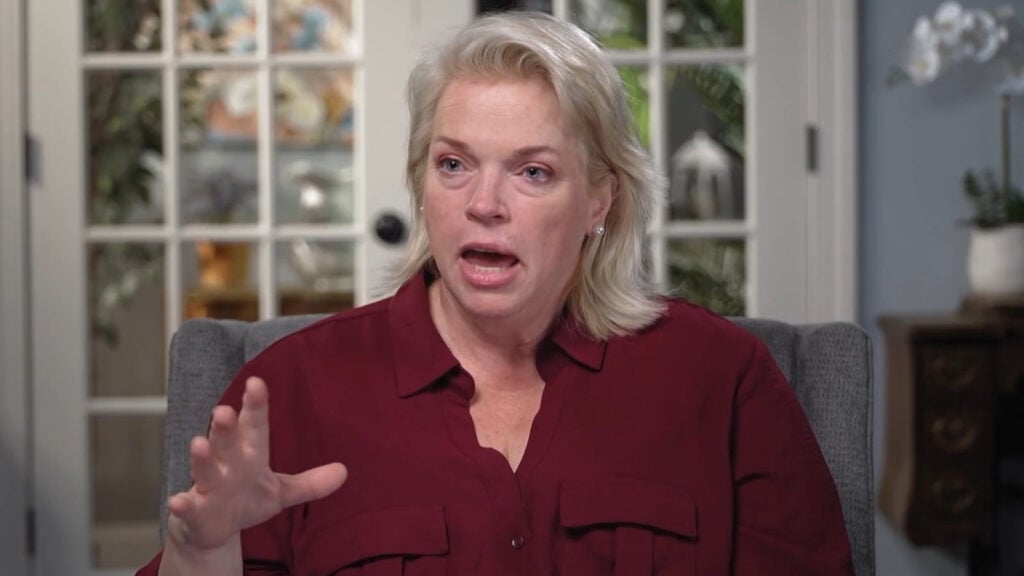
Janelle Brown on Sister Wives in November 2026.
Janelle grew defensive at times while discussing her journey into Mormon fundamentalism and polygamy. (Image Credit: YouTube)

‘They excommunicated me’

On the Sunday, November 15 episode of Sister Wives, Janelle delved into her past (and why she gets defensive when she feels that polygamy is “stereotyped”).

She told viewers that the Church of Jesus Christ of Latter-day Saints, known to most as the Mormon church, had “excommunicated” her shortly after she married Kody as his second wife and thus became part of polygamy.

In 1994, around the time that she welcomed her first child, Logan, the church reached out to her with the news.

“I was, like, 24 and I remember the letter coming to our house,” Janelle recalled.

“Kody was not involved, it was just me,” she described. “Yeah, they excommunicated me.”

There is sometimes a mistaken belief that polygamy is commonplace among Mormons. This is not the truth.

Though famous LDS figures such as Brigham Young practiced polygamy (he had 56 wives — the only things that he loved more than slavery and violently warring against the United States government, it seems, was marrying girls as young as 15), the mainstream Mormon church now disavows the practice.

The Browns, however, were members of a fundamentalist Mormon group called the Apostolic United Brethren (UAB).

This group both practices and encourages polygamy, sometimes branding it as “plural marriage” to avoid polygamy’s connotations.

Plural marriage can take many forms, but UAB’s is decidedly polygamous — one husband with multiple wives, with all of the inherent inequalities and problems that go with that.

‘I felt like it was a calling’

During Sunday’s episode, Janelle spoke to Christine about why she had personally “felt a spiritual calling” to fundamentalism.

“I made this decision, it wasn’t because I thought I was less than, I didn’t think it was because I only deserved this,” she recalled.

“I chose it because I felt like it was a calling,” Janelle continued.

“And,” she defended, “it wasn’t anything to do with my perception of what I was worth or what I was entitled to or what I deserved.”

In addition to that defensive statement, Janelle shared how knowing Meri had exposed her to polygamy — leading to her eventual joining of both marriage to Kody and polygamy itself.

The inherent issue with polygamy, as Christine pointed out during the episode, is that it is unequal.

This isn’t a polycule enshrined in a marriage with legal rights or for religious reasons. This is a group of wives all sharing the same husband — and some issues, including favoritism, seem almost inevitable.

Historically, polygamy has had other issues, including abuse and (famously) child marriage. The specific sort of man who would want multiple spouses who share him but whom he does not share is more likely to want younger or much younger wives rather than true partners.

Oddly enough, Kody was always adamant that Sister Wives was him making the case for polygamy to a national audience, putting the practice’s best foot forward.

Now he’s a failed polygamist and no longer part of the show. There are happy and healthy plural marriages in this world among equal partners, but we suspect that none of them would deliver the drama that TLC viewers expect from reality TV.

Janelle Brown: The Mormon Church Excommunicated Me for Marrying Kody! was originally published on The Hollywood Gossip.

​The Hollywood Gossip

Categories
Entertainment

The Costco Kirkland Signature Whisky That’s Totally Wallet-Friendly

A high-quality, affordable whisky is hard to find, but not if you’re a Costco member. According to customers, this Kirkland Signature bottle is the real deal.

​Mashed – Fast Food, Celebrity Chefs, Grocery, Reviews

Categories
Entertainment

Golden Bachelor’s Peg Munson Reveals Reason for Mel Owens Breakup

Peg Munson, Mel Owens, The Golden BachelorPeg Munson is sharing the thornier parts of her and Mel Owens’ love story.

Nearly one month after announcing she and the former NFL player had decided to break up, the retired firefighter…
​E! Online (US) – Top Stories

Categories
Entertainment

Self-Hosted vs Hosted WordPress MCP: Privacy, Security and the Multi-Site Trade-off

Self-hosted or hosted WordPress MCP? Live tests on a store and a blog, including both at once, show what changes for privacy, credentials and removal. Pick your model.

The post Self-Hosted vs Hosted WordPress MCP: Privacy, Security and the Multi-Site Trade-off appeared first on Themeisle Blog.

​Themeisle Blog

Categories
Entertainment

Open Channels FM: What to Expect from the Open Web Conversations Podcast

Conversations about the state of the open web and what shapes its future.​WordPress Planet

Categories
Entertainment

Give Vanilla Ice Cream A Spicy Boost With This Simple Addition

Looking to dig into some ice cream, but want to kick that plain ol’ vanilla up a notch? We’ve got just the solution (and it can be a syrup or candied chunks).

​Mashed – Fast Food, Celebrity Chefs, Grocery, Reviews