(The Center Square) – While Democrats have secured control of the U.S. House, three competitive Michigan congressional races remain undecided.









(The Center Square) – While Democrats have secured control of the U.S. House, three competitive Michigan congressional races remain undecided.

Reading Time: 2 minutes
Donald Trump took to Truth Social early Wednesday after Democrats won control of both the House of Representatives and the Senate in the 2026 midterm elections.
The results came in on Tuesday night, handing Democrats full control of Congress and leaving Republicans without a majority in either chamber for the final two years of Trump’s term.
Trump, of course, didn’t take the news quietly.
In his Truth Social post, he suggested he plans to make full use of his “VETO” power against whatever the new Democratic majorities try to pass.
His message to Democrats came with a catch, too. Trump congratulated the party on its wins, but in the same breath he claimed Republicans would have come out on top if his own name had been on the ballot.
He wasn’t a candidate this year, of course. Even so, he spent the final stretch of the campaign trying to drag GOP candidates across the finish line.
In the days before the election, Trump’s travel schedule turned into a mess. The Republican National Committee first announced that he would skip in-person appearances in Iowa and Kansas and instead hold a “72-hour sprint” of phone rallies meant to reach voters in nearly 20 states.
That plan didn’t last. Trump then rescheduled both rallies for Sunday, adding stops in Salina, Kansas, and Dubuque, Iowa, on top of the phone calls.
Both states were key targets because each had a competitive Senate race that could decide which party held the chamber. The campaign was shaped by voter frustration over affordability and Trump’s standing with the public.
Losing Congress does not end Trump’s presidency, of course. He stays in the White House, but he now faces a legislature run entirely by the opposing party.
Trump had already been bracing for that possibility. Just hours before Election Day, he sat for an interview in which he painted a grim picture of his last two years in office.
In that conversation, he vowed to veto bills that a Democratic-majority Congress might send to his desk. His Truth Social post suggests that promise is still very much on his mind.
He has also refused to sign some bills passed by the Republican-majority legislature he worked with until now, which makes the veto threat easy to believe.
The same interview raised eyebrows for another reason. Trump floated preemptive pardons for Elon Musk and various White House staffers, a move that would shield them from possible criminal prosecution even if Democrats took over the House.
With Democrats now holding both chambers, that talk of clemency is likely to get a lot more attention.
Trump also claimed in that interview that he would bring economic recovery to American families during his remaining time in office, though he offered nothing to back that up.
The new Democratic majorities will take their seats in Congress in January, setting up two years of divided government with a president who is already promising to block their agenda.
Donald Trump Crashes Out as Democrats Seize Both House and Senate was originally published on The Hollywood Gossip.
The Hollywood Gossip

The actor’s response highlighted certain attitudes that could not only benefit a person’s mental health, but also be the secret to enjoying a long life.

Health Digest – Health News, Wellness, Expert Insights

Reading Time: 3 minutes
She’s not here for the criticism.
Last month, Savannah Chrisley announced her engagement and pregnancy news in one go.
It turned out that she was already (secretly) married.
She now has a pregnancy update — and her whole family is clapping back at critics.
This summer, Savannah married Jason Galanis, a convicted fraudster who spent time in the same prison as her father, in a small Cayman Islands ceremony.
This May-December romance had only begun about 5 months earlier. It seems that Savannah’s pregnancy prompted the hush-hush wedding.
Savannah’s October announcement did not share any of this, including her alleged fiance’s name — she referred to him only as “J” and admitted that he was significantly older.
On Monday, November 2, Savannah took to Instagram to share a video and a caption.
The pregnant reality TV personality announced the expected sex of her future child.
“IT’s A BOY!!!” Savannah announced alongside the video, which showed a cake with yellow frosting but layers of blue frosting within.
“My sweet miracle boy,” she wrote, “you are everything we prayed for and more.”
Savannah characterized her future child as “the most beautiful reminder that God’s plans are always greater than our own.”
She complained: “The past few days have reminded me just how cruel this world can be. But no amount of hate could ever overshadow the joy of loving you. You are a MIRACLE.”
Savannah vowed: “My precious baby boy, your daddy and I will spend the rest of our lives protecting you, praying over you, and loving you beyond measure.”
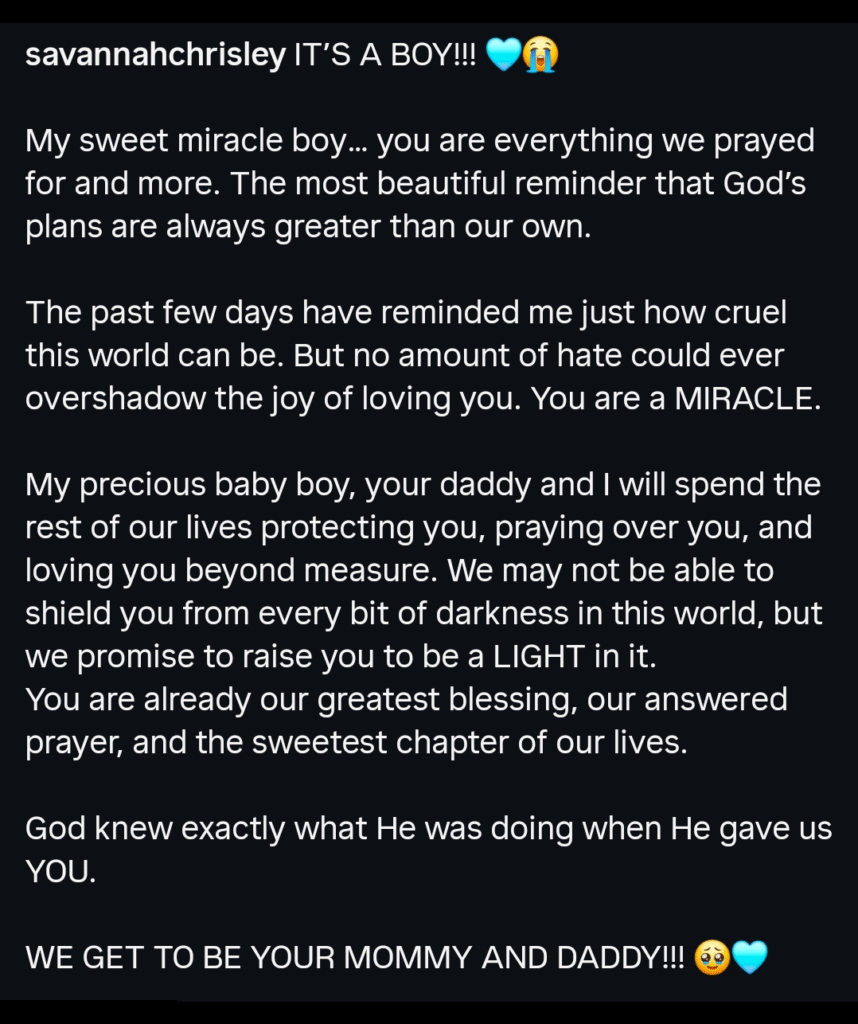
“We may not be able to shield you from every bit of darkness in this world,” Savannah acknowledged.
“But,” she continued, “we promise to raise you to be a LIGHT in it.”
Savannah cheered: “You are already our greatest blessing, our answered prayer, and the sweetest chapter of our lives.”
Again referring to her Christian beliefs, she expressed: “God knew exactly what He was doing when He gave us YOU.”
Enthusiastically, Savannah concluded: “WE GET TO BE YOUR MOMMY AND DADDY!!!”
Just days earlier, Savannah had lashed out at critics — from Mar-a-Lago, of all places — lamenting that “this world can be so incredibly cruel.”
In her now-deleted Story post, she wrote: “People can be quick to judge, quick to condemn, and slow to show grace.”
It seems very clear that Savannah is doubling down on framing personal criticism of her choices as almost spiritual warfare.
“I’ve learned that you don’t have to defend what God has already ordained,” she penned. “You don’t have to fight every battle, answer every accusation, or convince the world of what God already knows to be true.”
It appears that Savannah believes that her whirlwind romance, pregnancy, and secret marriage to a Trump-pardoned criminal nearly twice her age was divinely ordained. One could argue with that, but to what end?
Savannah Chrisley Reveals Baby’s Gender, Claps Back at Critics of Pregnancy & Secret Marriage was originally published on The Hollywood Gossip.
The Hollywood Gossip

Even though Arby’s loaded curly fries fell off of the fast food chain’s menu five years ago, these hacks can help add to your curly fries fun.

Mashed – Fast Food, Celebrity Chefs, Grocery, Reviews
[00:00:19] Nathan Wrigley: Welcome to the Jukebox podcast from WP Tavern. My name is Nathan Wrigley.
Jukebox is a podcast which is dedicated to all things WordPress. The people, the events, the plugins, the blocks, the themes, and in this case, building partnerships between WordPress product makers and hosting companies.
If you’d like to subscribe to the podcast, you can do that by searching for WP Tavern in your podcast player of choice, or by going to wptavern.com/feed/podcast, and you can copy that URL into most podcast players.
If you have a topic that you’d like us to feature on the podcast, I’m keen to hear from you and hopefully get you, or your idea, featured on the show. Head to wptavern.com/contact/jukebox, and use the form there.
So on the podcast today we have Martin Schmidt.
Martin has been deeply involved in the WordPress and hosting industries since 2005 when he created his first WordPress travel blog while living in New Zealand. Over the years, he’s developed websites for small businesses, spent 13 years with IONOS in various management and strategy roles, and built partnerships at Wix, and a German SaaS company.
Most recently, Martin has focused on connecting WordPress plugin companies with web hosts, helping both sides unlock growth through smarter partnerships.
Today, the conversation focused on the often overlooked world of partnerships between plugin developers and hosting companies. Martin shares insights from his two decades of experience on why hosting providers are the perfect allies for WordPress product makers looking to grow, given their established relationships and marketing channels to large customer bases.
We talk about the curious fact that many plugin builders put enormous effort into their products, but stumble when it comes to sales, marketing, and building the business relationships necessary for broader success.
Martin discusses what hosting companies are actually looking for in a partnership, the technical and marketing preparations plugin makers should have ready, and why empathy and preparation make all the difference when trying to connect with busy product managers.
If you’re a developer, freelancer, or agency owner interested in taking your WordPress product to the next level, or if you want a candid look at how partnerships really work in the open source ecosystem, this episode is for you.
If you’re interested in finding out more, you can find all of the links in the show notes by heading to wptavern.com/podcast, where you’ll find all the other episodes as well.
And so without further delay, I bring you Martin Schmidt.
I am joined on the podcast by Martin Schmidt. Hello Martin.
[00:03:14] Martin Schmidt: Hi, Nathan. Great to be here.
[00:03:16] Nathan Wrigley: Yeah, thank you. Martin and I do not know one another, so this is our first call, but we were joined together, on maybe LinkedIn. I’m not entirely sure.
[00:03:23] Martin Schmidt: I was LinkedIn. Yeah. Yeah.
[00:03:25] Nathan Wrigley: Probably LinkedIn, by Nicole, so thank you to Nicole for doing that, really appreciate the linking together there. And we’re going to have a conversation today about, I suppose the word to describe it would be partnerships. How to partner with various different entities, possibly hosting companies are going to come up and things like that, so.
Before we begin that conversation, Martin are you able to just give us your little bio? Tell us a little bit about who you are and what you’ve done in the hosting partnership WordPress space, whatever you think fits best.
[00:03:55] Martin Schmidt: Yes, absolutely. I’m from Germany. I lived down south in Karlsruhe. Originally from the Cologne area. Started working with WordPress actually in I think 2005, something like that. When I was moving to New Zealand and started studying in New Zealand. That’s when I spun up my first WordPress site as a travel blog. And this was my first contact with WordPress. So I think, yeah, one of the, not one of the first users, but one of the very early.
[00:04:20] Nathan Wrigley: Fairly early, yeah, pretty early.
[00:04:22] Martin Schmidt: Very early. So that’s when you still had to like download WordPress and upload it via FTP, and there was no like auto update in the WordPress admin, and stuff like that. So one of the very early users and.
Yeah, around that time, that’s also how I got in touch with like the whole hosting industry. I was a web developer myself, started in high school developing websites for small businesses. Built them for people here in Germany and then also in New Zealand while I was studying over there.
And when I got back from New Zealand, I started applying for jobs. And one was with Google, the other one was with Ionos. And Ionos answered I think within a week, and I’m still waiting for the answer from Google till today. So, they never really got back to me, but yeah, it’s somewhere in the mail, yeah.
But luckily the guys from Ionos got back to me and I think a week later I had a phone interview. Another four days later an interview in Karlsruhe. And then I started, I think two weeks later. Already started there like end of October with my first job as a product manager at Ionos.
And then spent 13 years at Ionos in various roles, in product management and the last five years in strategy. And from there I got the chance to move on to Wix. Worked for Wix.com in Germany. There was, during the COVID pandemic, I moved employers and started to work for Wix, and spent two years there building partnerships in, Europe.
Actually also put them in touch with a company called Sevdesk, which is a German accounting company, similar to Zero or QuickBooks Online. And couple of months later the CEO asked me if I was interested in joining their side, after they had raised some money and built partnerships from their side. I kept him waiting a little bit, but then after a while I decided, that’s interesting to join a German SaaS company. Something different than hosting, and online presence.
So yeah, I spent the next two years building the ecosystem around the SaaS software, like all the software that integrates with the accounting product basically.
Then end of 24, I got a call from my former boss from Ionos, who had just moved to hosting.com and became the CRO, and they also wanted to do partnerships. So, yeah, had a chat with him and with the CEO and started there in February 2025, and started building partnerships for hosting.com.
And, the main focus was really on building partnerships with WordPress companies. Just after Cloudfest, we launched the partnership with WP Rocket. Started to build quite a few more partnerships, or that were in the making. And by the end of the year, which was interesting to me, I had a lot of those WordPress plugin companies that I reached out to telling me, look, this is super interesting. We want to work with hosting companies.
We’re really glad to be working with you. We would also love to work with a lot of more hosting companies, but honestly we don’t really know where to start, and how to do this. And they really got me thinking. And then over New Years, and you know when you like, get some time to maybe reflect on the year and stuff that’s happening, this was like, it, really hit me. It’s like, well there’s so much interest of companies wanting to partner with web hosts.
And I’ve sat on the other side for some 20 years, like people pitching to me, like explaining me why their product is going to be the next big thing for me in the hosting company. And you start to see patterns of like things that people do good, and maybe things that people don’t do as well when like trying to pitch to you as a hosting company.
And I saw all this demand from these WordPress plugin companies and I was like, hey, maybe this is finally the idea of starting my own business. Like something I wanted to do for the last five years, but I never really had the idea of like what to do? Or not the idea that was convincing enough for myself to give up my corporate job.
And, once you got a house and family, I mean, it becomes a bit more difficult to just jump into the cold water, right? I guess a lot of people can relate to that. But this time it was different. I felt like this could really be something. So I started reaching out to more people in my network, and ask them, hey, I’m thinking about doing like this sort of consulting advisory thing. Do you think this is interesting? And I got a lot of positive feedback, way more than I had anticipated.
So I thought, okay, if I’m not doing this now, I will never do it. I will never try and do it. So yeah, I decided to go independent and officially started in May. And that’s what I’m doing now, like helping tech companies who want to partner with web hosts to find a way to do it.
And I always tell people that are interested in, you can do it by yourself, right? You can find it all out yourself. It’s probably going to take you like three to four years to figure out the right model, and make all the connections. Build the trust with the hosting companies. Find out the right business model. The right support model, like the co-marketing activities, all the things you need to do. Or if you don’t want to wait for four years, you can work with me and I help you take a shortcut.
And the goal is by month six that you have someone in your organisation who can take care of partnerships, and just run this by yourself. But you don’t make all of those mistakes, and all of those extra investments that don’t turn into anything.
My pitch to my customers is like, I’m helping you cut down the time to market. I’m telling you what works and what doesn’t work, and what makes a good pitch.
[00:09:49] Nathan Wrigley: Yeah, this is genuinely really interesting to me, and we’ll get into that a little bit later. But I have a different angle to you, but probably we’ll end up at exactly the same place.
I’ve been podcasting in the WordPress space for a decade. So 2016, something like that, I started. And, if you do podcasting often enough, your voice is heard, and people have this sort of expectation, if you send an email to me with a product that you’ve just launched, I will somehow have a silver bullet for making you successful.
And first thing to say is, I basically don’t. You know, I can put you on a podcast episode, but that really is the limits of what I can do.
But also what’s quite fascinating, and I honestly genuinely, I probably get about 30 or 40 of these emails a week. And the bit that stands out for me is how unprepared, let’s go for that word, how poorly prepared the email that I receive is.
So in many cases over the last couple of years, it’s clearly been written by an AI. There hasn’t been a lot of due diligence about who I am, so it kind of feels like this really, really cold call. I somehow got on an email list somehow. And it comes, you know, with all of the usual caveats. The first paragraph is telling me what I do, and I already know what I do. So like there was an AI in there somewhere.
But also it feels like they’ve got a product. Quite often I’ll go and look at the product and I think to myself, boy, that’s so good. Look at what they’ve done. Like they’ve built a plugin and it’s fulfilling a real need.
Unfortunately, I can’t really help them except put them on a podcast, but it occurs to me if only they could connect with all the right people, have the right language, know how to pitch themselves, know how their website should look so that it speaks to people that drop into it.
What I’m basically trying to build up a picture is of is that there’s loads of people out there who are building things, but clearly the building of it is the part that they’ve been interested in. And as soon as it’s built, they then have this moment of, oh, now what do I do with it? You know? And they don’t have that marketing expertise, and so they’re kind of looking around trying podcasters and what have you. And it feels like you are trying to step into that gap a little bit.
But instead of it being a podcast, you are trying to hook them up to what are the big players in the WordPress space? The people with deep pockets. The people who have reliable income month over month. And that’s the hosting companies. Have I summarised that correctly? Is that your experience as well? You get people that have got a thing, but don’t really know how to move on from the I’ve built the thing, to now I need to sell the thing.
[00:12:37] Martin Schmidt: Yes. So I think you’re spot on. And I would add there’s probably, I would say two groups. There’s the one which is maybe the builder who doesn’t know marketing, right? And we had these people before AI that were building fantastic products. But they just don’t know marketing because they’re fantastic builders. They’re tech people, but they’re missing that marketing piece.
And the one thing they don’t hire a marketing person who does it for them. I think that’s always a shame. You see this fantastic product, someone like driving a product with their passion. They’re really solving a pain point, but they just don’t understand how to sell it. Because to them it’s all clear, it’s all obvious, but you do need to translate it to people in your target audience.
So I think this is one group, and I see that also a lot with WordPress plugin companies. It feels like, coming from the hosting space, where all of the big companies are so good at marketing. Looking at WordPress companies, I feel like this is really something that they are somewhat missing.
I think the most successful WordPress plugin companies, I think that’s probably the ones that have understood that next to building fantastic product, and also needs fantastic marketing. But I think this is really the one group.
And the other one is, I would call them like lazy salespeople. They’re just sending out like sales messages. And we had them way before AI, just sending out without doing any research at all. You get messages and you look at them or you look at the product, it’s like, there’s no fit at all. I’m selling to small businesses, and you pitching me a product for enterprise customers. Like, why? You are just wasting time, right?
If your goal is to work with a company to potentially sell to hundred, thousands, or millions of customers, and that’s going to be a deal worth hundred thousands or millions of dollars, you should invest maybe an hour, half an hour, of research and just see if there’s any fit at all right. And then if you take the time to go in a meeting with me and pitch your product, do a little bit of research to just make it fit. Just this tiny bit of research will make you stand out amongst the crowd like completely.
[00:14:41] Nathan Wrigley: It feels to me in the first case as if, timing’s not really the right word, but there’s a component of timing in here. And what I’m meaning by that is, what I’m feeling is that a lot of people have spent all of their time building the thing. So that might be time, but it might be money, whatever the thing that you’ve got going on in your business.
But at no point during the time from conception, idea to completed product have they said to themselves, okay, at some point we’re going to have to market this. We’re going to have to think about it.
So maybe, and I don’t know if this is part of the sort of wisdom that you have, but it feels like maybe halfway through that process of build to complete build, you need to put the brakes on and say, okay, now we’re halfway through, let’s work in two channels now. Let’s do the, finish the build, but also at the same time, let’s do the marketing.
So I don’t know if there’s anything in there, like just put on the brakes before you finish, have some resources, have some ideas of contacts, have some marketing, have a website and all of that kind of stuff done. So that when you finish, it’s all ready to roll.
[00:15:43] Martin Schmidt: Yes. That’s definitely it. I don’t know if you have to put on the brakes, but I think it’s like, at least you as the CEO, you have to like work on two tracks. There’s the guys building the product, but then there’s also the marketing piece of it, right?
And you can have the most fantastic product if you’re not telling the story, if you’re not letting the world know. How are people going to find you, right? I think we see, I saw a stat on LinkedIn recently that there’s like a thousand plugins published on the repository every week. It’s going to be so crowded. You need to do something to stand out and to be found.
And I think that’s also with web hosts and every tech company, you can have the most amazing product, but if you’re not found, if the target audience doesn’t know about you, nobody will use your product. And you’re going to be the only user of your own product.
I think in the end, you need to master marketing to be successful with your business. And it’s not just about the best product. And, I think that’s the important message here. You don’t need to know marketing yourself. Just hire someone. There’s so many people specialise in marketing. Just get someone on board who knows marketing and who understands a little bit of tech to get why your product is so special, and who’s able to translate that into a customer pain point, and figure out how to sell it. that’s really it.
[00:16:58] Nathan Wrigley: So we’ve done podcast episodes on this podcast before where we’ve talked about partnerships in a different way. We’ve talked about partnerships in terms of plugin Company A joining with plugin Company B, because they’ve got similar enough products that they kind of overlap, and they can help each other out and mutually market and do marketing campaigns together and things like that.
But that’s not what we’re talking about here. We’re talking specifically about going to hosting companies. So I guess the first question is, why go to hosting companies? What is it that they bring? I suppose the obvious answer is they’ve got bajillions of customers. In many cases, you know, some of the big hosts, if you can forge some sort of relationship with them, goodness knows, you know, maybe they literally have millions of customers. But why have you made hosting companies the bit of the half of this jigsaw puzzle?
[00:17:45] Martin Schmidt: Yes. beside me coming from hosting and knowing hosting, which was kind of like, make it a bit easy to decide for hosters. But I think they also play an important role. In the end, if a small business wants to run a website, they need to host it somewhere. They decide for hosting company. They get their WordPress site spun up. And then, that’s where usually in the next step you would go with like certain plugins. Like for SEO, performance, backup, security, translations, whatever your use case is, right?
As you mentioned, the hosting company is the one that has all of the relationships with the customers. And unlike the WordPress companies, who are not allowed by the repository rules to directly market to their customers via email and things like that, they can only use popups inside the WordPress admin.
One thing that the host is free to do, they can call the customers, they can send text messages, they can send them emails. They can do all of the up and cross sell marketing to their customers. And I think that’s one advantage that the hoster has that they can bring to the table, beside all of these customer relationships, right? They can really do the full blown marketing to those free users, to push a premium version of the plugin.
[00:18:59] Nathan Wrigley: Okay. So it’s not just visibility within the platform of, I don’t know, you’re at the point of it installing a plugin because you’ve got a brand new WordPress website. And look, here’s a bunch of partners that we’ve got, you may be interested in those.
That’s one piece of it. But there’s also this sort of marketing side. Presumably just like every company on earth, web hosting companies are as keen to keep front of mind as any other company. So if they can come up with a good, and I’m doing air quotes, excuse to send out an email, they’ll do that. And why not send out an email because we’ve onboarded a new partner and, you know, have you thought about doing this with your website? It turns out we’ve got a partnership with this particular plugin company.
I’m guessing there that the ability to send out emails is something, you know, to keep front of mind is something that the web host would want to do. But what’s in it for the web host? Like if I was a plugin company coming to a web host, I would want to have in my mind, okay, these are the kind of things I know they’re looking for. What are they, what do the web hosts want in return?
[00:19:55] Martin Schmidt: Yeah. So a lot of web host will tell you, hey, I want new customers, and that’s what I usually tell the web hosts. This is something you can’t expect from the WordPress plugin company. Because they are like in the later stage of that decision process. So the customer decides for the plugin a lot later than they decide for the host. So it’s not fair to ask the plugin company to bring in new customers to the web host.
But what they can do and what the WordPress plugin company can help with is, A, make the product a lot more attractive. They’re web hosts that sell hosting bundled in with plugins like WP Rocket. So the product itself is more attractive from the get go.
And if you don’t bundle it in the start, you can also help solve certain customer pains that make the customer more happy, therefore more sticky, right? So you prevent churn. As a host, you reach like a hundred thousand, 200,000 customers. You really need to work hard that your new customer growth isn’t eaten up all by churn. Making your customers sticky and drive up the revenue per customer, that’s in the interest of the web host, right? And, with a certain size, increasing that revenue per customer also becomes very important and interesting for the web host.
So I think that’s where the plugin company can come in and help the web host. They won’t just partner with any plugin. The plugin needs to solve a certain pain point for the customer. So this could be performance, this could be SEO, this could be accessibility. So these are challenges that the customers of the web host are actually faced with. And the plugin is simply a solution to that pain point.
So the hoster has an answer to that question of their customer. They’re in the role of the trusted advisor to their customers. And if the customer says, look, I’m running a website on your servers. I need to now be in compliance with the accessibility requirements in my country, or I need to do certain things. Then there’s the answer. Let’s use WP Rocket for performance. Here’s a partnership that we have with them, right? And that’s where the plugin company can come in and help the host.
Beyond that, obviously joint co-marketing will also help the hoster. And obviously if you talk like Ionos, GoDaddy or Newfold, I mean they’re massive, like they have millions of customers. So probably what a plugin company can bring to help them in co-marketing is not going to make a huge impact. There’s hundreds of hosters with hundred thousands of customers. For them working with one of those plugin companies can still be very interesting in doing like joint co-marketing, and getting the word out.
[00:22:32] Nathan Wrigley: That’s interesting. In the back of my head, when we were talking until just now, for some reason I was thinking about all the big hosts. You know, the ones that you’ve all heard of with the millions of customers. But of course that’s not the case, is it? There are thousands of smaller hosts.
[00:22:47] Martin Schmidt: Yes.
[00:22:48] Nathan Wrigley: Who may be more amenable to this kind of thing because, well, Idon’t know, they just don’t have that sort of scale that they need to worry about. And, you know, they’re looking for opportunities because they themselves are looking to grow in different ways that perhaps the other big hosts don’t have to think about quite so much.
Okay. So that’s interesting. So, you know, if it doesn’t fit one hosting company and you get a silent wall from all the big ones, that doesn’t mean you’re out of the game. It may be that the smaller hosts with different staff, and a different approach, and different geography and things like that, they may be more amenable to that.
[00:23:21] Martin Schmidt: Yes, absolutely. And I will always tell my clients, I know that GoDaddy, Ionos and Newfold look very interesting because their publications, that they have millions of customers, but you don’t want to start with them. It’s going to take you three or four years to get a deal done if at all. If you start with them, I mean you’re going to give up frustrated halfway through probably.
So start with the smaller guys. They’re more approachable, right? They may be less busy. You mentioned that you get like 30 emails a week. That’s what the everyday of a product manager at an Ionos or GoDaddy looks like as well. They get pitches all the time. Getting some air time with them is nearly impossible.
Start with the smaller guys and they’re going to be a lot more open to discuss with you. And start some smaller partnerships. Work through the teething problems of partnerships with bigger companies, right? Build some track record. And once you’ve established a track record, you can work your way up, right? Every hoster has a competitor that’s bigger and one that’s smaller. Once the smaller competitor starts doing something, they will notice, and they will look like, why are these guys partnering with plugin company XYZ? Should we be doing the same? So you kind of like work your way up to the bigger guys and the bigger guys, right?
[00:24:34] Nathan Wrigley: Yeah.
[00:24:35] Martin Schmidt: Everyone is watching the other guys and watch what they do. So it’s, once you start working with some of them, the rest will start like, oh, this is interesting. If X, Y, Z worked with them, maybe we should too. That’s how you build the traction, but you need someone to start, right? And that’s probably not going to be the biggest guy.
[00:24:53] Nathan Wrigley: Yeah, and again, I hadn’t really thought about that, but yeah, the, sort of looking over your shoulder if you’re a hosting company, seeing with perhaps jealous eyes, oh look, they’re getting loads of attention out there on social media because they’ve formed this relationship. And their emails are going out, and people are making comments on their tweets and their blog posts and things like that. Oh, we should definitely get a bit of that. Okay. That’s, really interesting.
So if somebody approaches you, then let’s say they’ve got a plugin. Let’s just assume that it’s a plugin that is useful and that a hosting company would be interested in it, if they had everything wrapped up correctly. What would be some wisdom that you would drop in terms of how to wrap it up? Like, how prepared do you need to be? What are the kind of things that you expect plugin developers to have ready, so that on day one, when you do your first outreach to the first hosting company, you feel confident that, okay, I’ve got a good client here, we’ve got a good chance. What are the bits and pieces that you need to have them have done?
[00:25:50] Martin Schmidt: I think on the technical side, I mean they will need to have some sort of like provisioning enabled. The host would probably want to sell the plugin themselves within their billing engine, and their system. So they will need some sort of provisioning to your system to say look, someone bought a licence and this licence needs to be valid and stuff like that.
So, this integration and that usually, I mean, if you don’t have that, it probably takes you a few months to implement that. So that’s something like, I would really start first and built these kind of things.
The other stuff that I think the plugin company should have ready is, what’s your proposition to the web host? And what’s the proposition of your product to the web host customers? I always tell my clients like, don’t make the other guys think. Tell them. Show them that you thought about it. Coming back to our earlier point about people being unprepared, don’t be that unprepared person. Like once you get some air time with these guys, tell them what your product is. Tell them what your product, or your company can do for the web host. But also tell them how they should be using your product and marketed to their customers.
[00:26:56] Nathan Wrigley: Kind of spoonfeed them basically.
[00:26:58] Martin Schmidt: Yes.
[00:26:59] Nathan Wrigley: Have everything so that they can lift it and just walk off with it and, okay, we’ll do that then.
[00:27:03] Martin Schmidt: Yes. It might feel like spoonfeeding and like, why do I need to do your job? But I mean, in the end, put yourself in the shoes of that product manager, and tell them, look, if I was you, I would be selling my product this and this way.
Some of the worst product pitches I had. Companies came to me. Told me look, this is our product. You’re going to make millions with it. And then I was like, okay, that’s interesting. How do I sell it to my customer? And then the answer was like, I don’t know your customers. You need to know how to sell stuff to your customer. It’s like, that’s not how you land a deal, right?
And one thing I like to do when I was pitching products. I looked at the website of the company I was pitching to. I mocked up their website with my product, and I put that in my presentation, and I told them, look sorry guys, we already hacked your website. Our product is already on your website. This is what it’s going to looks like. This is what it’s sold for, right? It shows them that you put some thought into that. That’s going to make you stand out.
Understand the work life of that product manager. They get those 30 emails like you, do. They decide to go on that meeting with you. You spend 30 minute pitching your product, and then you leave them with this big question mark. Like okay, this sounds interesting, but how the heck do I sell this to my customers?
After your meeting then they have lunch, then there’s like an escalation, then there’s an all hands, then there’s the weekend. On the next Monday they will have almost forgotten about you. And if they think about you it’s, oh, I still have to figure out how to sell this. This is complicated. I don’t have time for this. I’m going to postpone it. And that’s not what you want to achieve.
You want them to go out of that meeting and thinking, well this is an amazing product, solves a problem for my customers. And these partners, they think about me. They think about how I should be selling it. And maybe it’s not a hundred percent right. It’s not about getting it a hundred percent right.
[00:28:51] Nathan Wrigley: Right. They can adapt.
[00:28:52] Martin Schmidt: Yes. But giving them something to adapt is like a lot more than just don’t give them anything, right. And adapting is always easier than coming up with it yourself.
[00:29:01] Nathan Wrigley: So, the email that I typically get is basically a description of a product. It tells me what it’s called and then what it does. And often it’s a fairly technical description of a product. And, I imagine that if you are a marketer, you’re four lines into that email and your eyes have glazed over, and it’s like, okay great.
But what you are describing is go the extra mile. Don’t just explain the product. Presumably, there’s a bit of that’s got to go on, but it’s also now explain to the person receiving that email how their company can use that. How they could market it. The way that could be marketed. The sort of mockup landing page that you described just there. Go the extra mile, sit in their seat for a minute. Try to imagine what their busy life is like, have a bit of empathy, and imagine that they’ve only got an attention span of a few moments. It’s more that, than the here’s a product description. Now that you know what it is, please come and contact us, because that’s just not going to happen.
[00:29:59] Martin Schmidt: No, it’s not. I think it’s the same for us in private life. If you get emails about products that. I mean you just know yourself. You’re busy with so many things in between. Your kids coming home from school, and someone calling, your parents calling and all of that. You, just look at the email and if it doesn’t click immediately, it goes to the trash bin.
And it’s the same with these guys as well. Convincing people just in email is probably going to be difficult. You need to at least get them into the meeting. And I think that’s the one step before that. But once you have them in a meeting, spend that time wisely. It’s difficult enough to get them into the meeting. But if you have them in a meeting, don’t waste it with generic presentations.
Invest this little bit of effort, and mocking up that websites or just taking a bit of a look at who they’re selling to and adapting your message to that. It doesn’t take a ton of work. And it didn’t take a tonne of work four or five years ago. And now with AI it’s even less, it’s even less work, right? But if you want me to trust you as my partner to go forward and sell to my customers, that’s going to blame me for everything. I want to see that you invest a little bit of effort too.
[00:31:04] Nathan Wrigley: I think that’s right. Yeah. I think that’s a very human characteristic, isn’t it? I would like to see that you made an effort, if I’m going to make an effort. That’s just how the game goes, right? That’s just how it is. You know, if I get the impression that you just want to rock up, make loads of money, and do nothing, that’s never going to work really.
[00:31:25] Martin Schmidt: No.
[00:31:26] Nathan Wrigley: I mean there’s the occasional person that manages to pull that off, but on the whole, that’s not how human relationships flourish and work.
[00:31:33] Martin Schmidt: In the end, it’s about you want to build a partnership, right? And that’s not, I come to you and you give me loads of money. I don’t have a lot of friends like that. And I don’t think anyone else has a lots of friends like that.
Usually it’s like you give and you receive, right? And sometimes one side invests a bit more, and the other side invests a bit more. But usually if only one side is giving and the other one is only taking, that’s a toxic relationship. And usually they tend to break. So why should business relationships work any differently?
But it’s a funny conception that a lot of companies have is oh, I want to do partnerships. I just go out there and then they’re going to sell my product and I’m going to make lots of money, and I don’t need to do anything. That’s honestly what a lot of companies think.
And that’s the difficulty that a lot of partner managers have, right? They’re being sent out to get those partners, and then they’re expected to bring in just all the revenue without any additional investment. And that’s just not happening. Honest truth, nobody is out there waiting for you and for your product.
[00:32:32] Nathan Wrigley: Yeah. That is the brutal truth isn’t it? Do you subscribe to doing things in person? You know, so WordPress has got a real panoply of events, Meetups and WordCamps and there’s obviously other things that you mentioned, you know, Cloudfest and things like that. Do you find that tends to short circuit things?
I guess there’s a bit of personality that comes into this as well. You know, some people are, seem to have all the characteristics for selling. They’re incredibly good at that kind of thing. Maybe they’re practised at it. Maybe they’re just, you know, born in that wonderful manner. Do you subscribe to that? Is that a part of this jigsaw puzzle as well? You know, show up, meet the people, shake the hands, go to the restaurants, do the schmoozing and all of that.
[00:33:12] Martin Schmidt: Absolutely. You could do all the Zoom calls that you want, but I’ve experienced it firsthand. Like during COVID, we were talking to people for six months via video conference. Like one in person meeting in Munich. It felt like this moved us further than just the six months of constant video calls.
You can meet people, and you can relate to them, and there can be some sympathy and stuff like that. And you might not have to meet ever, but it usually helps a lot to build that trust. To just meet the person face to face, shake a hand, maybe have a beer and have a laugh and stuff like that just helps a great deal.
And I’ve seen partnerships without any face-to-face meeting, but usually I would definitely advise to see people in person. And some people are just difficult to get hold of. And then catching them at the Colosseum Bar at Cloudfest 10 o’clock at night really helps to suddenly be in touch with that person.
[00:34:07] Nathan Wrigley: There is something ever so human about that isn’t there? And I think we all on some level enjoy that.
So you found yourself in this product market space. Like I said, I know that this is a thing. So I would imagine that given a fair wind, you’ll be doing this for years to come.
Where do you find yourself online? Do you have a website where you’ve packaged up these products and services, you know, these partnership liaison services that you do? Where can people find you? Where do they go online to discover more about you?
[00:34:37] Martin Schmidt: At the moment mostly active on LinkedIn. That’s where I meet a lot of the people. I also have a website, martinschmidt.co. And that’s where also people can reach out to me. The website has been a little bit neglected to be quite fair because I straight on, jumped into LinkedIn and started publishing on LinkedIn, because the audience is already there. And people are not searching for how do I build partnerships with web hosts? But they come to me via LinkedIn because they tend to read some of my posts, and that’s how I get to speak to people like yourself.
[00:35:07] Nathan Wrigley: Yeah. Well, that is exactly how it happened. It was LinkedIn and I think you’re right. I think having a website would be of great value, but at the same time, you know, given the proclivities of what you’re doing, LinkedIn seems to be very much the best place to do that.
What I’ll do is I will put your bits and pieces into the show notes. So if dear listener, you head to wptavern.com you search for the episode with Martin Schmidt, that’s S-C-H-M-I-D-T, you’ll be able to find the links there. So hopefully you’ll be able to contact Martin via LinkedIn and what have you.
Really interesting topic and Martin, thank you for chatting to me about it today.
[00:35:42] Martin Schmidt: Yes. Thanks for having me, Nathan. It was fantastic.
On the podcast today we have Martin Schmidt.
Martin has been deeply involved in the WordPress and hosting industries since 2005, when he created his first WordPress travel blog while living in New Zealand. Over the years, he’s developed websites for small businesses, spent 13 years with IONOS in various management and strategy roles, and built partnerships at Wix and a German SaaS company. Most recently, Martin has focused on connecting WordPress plugin companies with web hosts, helping both sides unlock growth through smarter partnerships.
Today the conversation focused on the often-overlooked world of partnerships between plugin developers and hosting companies. Martin shares insights from his two decades of experience on why hosting providers are the perfect allies for WordPress product makers looking to grow, given their established relationships and marketing channels to large customer bases.
We talk about the curious fact that many plugin builders put enormous effort into their products, but stumble when it comes to sales, marketing, and building the business relationships necessary for broader success.
Martin discusses what hosting companies are actually looking for in a partnership, the technical and marketing preparations plugin makers should have ready, and why empathy and preparation make all the difference when trying to connect with busy product managers.
If you’re a developer, freelancer, or agency owner interested in taking your WordPress product to the next level, or if you want a candid look at how partnerships really work in the open source ecosystem, this episode is for you.
WP Tavern

 Matthew McConaughey’s latest milestone took way more than 10 days.
The How to Lose a Guy in 10 Days star turns 57 years old Nov. 4. And unlike that love fern, he’s continuing to grow.
Though,…
E! Online (US) – Top Stories

 Tonight KATSEYE might need to take a break.
Fans of the girl group—consisting of members Daniela Avanzini, Yoonchae, Lara Raj and Megan Skiendiel, as well as Manon Bannerman and Sophia Laforteza,…
E! Online (US) – Top Stories

Genevieve Mina, D-Anchorage, waves a sign on Election Day, Tuesday, Nov. 3, 2026 in Midtown Anchorage. (Photo by Loren Holmes/Alaska Beacon)
The “blue wave” that marked national results during Election Day appears to have washed into the Alaska House of Representatives as well.
According to preliminary election results updated early Wednesday morning, independent and Democratic lawmakers are leading in 23 of the House’s 40 seats. Independents and Democrats won 19 seats in the 2024 elections.
Many votes remain uncounted, including thousands of early and absentee ballots that could change the results in districts where all precincts have reported Election Day results.
Since 2024, the House has been controlled by a 21-person coalition that includes 16 Democrats, 3 independents and 2 Republicans, and Election Day results indicate that coalition is likely to grow, even if no Republicans choose to join.
The 20-person state Senate has been controlled by a 14-member coalition for the past two years, and preliminary election results indicate that coalition is likely to continue as well, with coalition-minded senators either being elected or re-elected.

Former Democratic state Rep. Cliff Groh will return to the Alaska House after defeating Republican Dan Sager in the House district covering Anchorage’s Government Hill and Joint Base Elmendorf-Richardson.
Republican Rep. David Nelson did not seek re-election, leaving the seat open. Groh previously represented the district but was defeated by Nelson in 2024. The district’s large military population does not usually vote in midterm elections, which causes its state House representation to regularly flip between Republican and Democratic control.
Elsewhere in Anchorage, Democratic candidate Denny Wells has defeated Republican incumbent Rep. Mia Costello after unsuccessfully challenging her in 2022 and 2024. With all six precincts reporting results, Wells has 52.4% of the vote for House District 15, which covers the Campbell Lake and Jewel Lake area of Anchorage.
Democratic-backed independent candidate Joy Beth Cottle leads Republican candidate Harmony Tomaszewski by 43 votes out of 6,601 counted so far in House District 34, which covers northern Fairbanks.
Some absentee and early votes remain uncounted.
House District 34 voted strongly for Republican President Donald Trump in 2024 and re-elected state Republican Rep. Frank Tomaszewski by a wide margin over Cottle in that year, but Tomaszewski declined to run for re-election and instead ran for the state Senate seat being vacated by Sen. Robb Myers, R-North Pole.
Myers announced his retirement close to the election filing deadline, which deterred other candidates from running for the office. It also deterred candidates from running against his wife Harmony, who had inside knowledge of the upcoming state House vacancy and filed to replace her husband.

With Speaker of the House Bryce Edgmon, I-Dillingham, vacating his state House seat to run for Senate, House District 37 had four candidates vying to replace him.
As of Wednesday morning, that race remained unresolved. With 22 of 35 precincts reporting results, Democratic candidate Evelynn Trefon had 36.4% of the vote, followed by Republican Brenda Wilson with 33.7%, independent Mark Smith with 22.6% and independent Cade Woods with 6.8%.
The district went for Trump in 2024, and the winner of the state House race will be decided by a ranked-choice runoff.
If Wilson wins, it likely will be the only district to flip to Republican control in this election.
Both of Eagle River’s state House seats were undecided early Wednesday morning. In House District 24, where Republican Rep. Dan Saddler retired after a long tenure, Republican Ken McCarty leads fellow Republican Gina Wall by just 16 votes out of 6,729 cast. The margin could change as more absentee and early votes are counted.
The race for House District 23 is headed to a ranked choice runoff, as incumbent Republican Rep. Jamie Allard has 38.1% of the vote. Behind her are Democratic challenger Jim Arlington with 28.5%, Republican candidate Ruby Jones with 26.4%, and Democratic candidate Lee Hammermeister with 6.8%.

Sen. Cathy Tilton, R-Wasilla, was one of the longest-serving Republican members of the state House when Gov. Mike Dunleavy appointed her to fill a Senate vacancy last year.
But late in her first senatorial election campaign, several local residents accused her of having a predatory relationship with a teenager in the 1990s, and an anonymous website accused her of grooming the teenager for sex. After the Anchorage Daily News covered the allegations, Tilton denied any criminal conduct.
With all precincts in Senate District M reporting results Tuesday night, Tilton had 33.4% of the vote, followed by Republican challenger Ryan Berry with 32.5%. Democratic candidate Pat Chesbro was third with 28.3% and Republican Zane Vrvilo was fourth with 5.5%.
The race is almost certain to be decided by a ranked choice runoff.
The Matanuska-Susitna Borough had several legislative races stocked with candidates, and preliminary Election Day results showed most will be headed to ranked-choice runoffs.
In Senate District O, where Sen. George Rauscher, R-Sutton, is running for election after being appointed by Gov. Mike Dunleavy to fill a vacant seat, Rauscher has 43% of the vote compared to 30.7% for Republican challenger Ryan Sheldon and 26% for Democratic candidate Peter Bauer.
Longtime Republican Rep. DeLena Johnson, R-Palmer, is in a close three-way race. She has 36.7% of the vote, while independent challenger Steve Merritt has 32.6% and Republican Michael Bowles has 30.4%.
Incumbent House District 28 Rep. Elexie Moore, R-Wasilla, is trailing a more conservative Republican, Stephen Wright. Moore has 35.2% of the vote to Wright’s 37.4%. Democratic candidate Kit Kennedy has 26.9%, meaning Democratic votes will decide the district when the ranked choice runoff takes place.
Rep. Garret Nelson, R-Sutton, was appointed by Gov. Mike Dunleavy and is running in his first election campaign. He has 35.7% of the vote, ahead of fellow Republican Steve Menard with 33.7%, Democrat Kimberly Slone with 18.8% and independent Jessica Kusner-Kalarchik with 11.7%. The ranked choice runoff will decide the race.
And in House District 30, incumbent Rep. Kevin McCabe has 38.4% of the vote while Republican challenger Doug Massie has 35.8%. Democratic candidate Sandra Loomis has 25.4%, meaning that Democrats’ second-choice votes are likely to decide the ranked choice runoff.
The race to replace Sen. Lyman Hoffman, D-Bethel, the longest-serving member of the Alaska Legislature, remained uncertain early Wednesday morning, with only 37 of 57 precincts reporting results from Senate District S in southwest Alaska.
Speaker of the House Bryce Edgmon, I-Dillingham, led a four-candidate race with 30.4% of the vote, followed by Republican Darren Deacon with 28%. Democrat Wassilie Guy was fourth with 25.2% and independent Rick Robb of Bethel had 16.1%.
The race is almost certain to be decided by a ranked-choice runoff.
The race for House District 38, covering Bethel and parts of the Yukon delta region, remained undecided early Wednesday morning but likely to remain in Democratic control.
With 15 of 22 precincts reporting results, incumbent Democratic Rep. Nellie Unangiq Jimmie led former Democratic Rep. CJ McCormick, whom Jimmie defeated in 2024. Jimmie had 35.5% of the vote, and McCormick had 32.1%.
Republican candidate Willy Keppel was third with 22.5%, and independent Joseph Amik was fourth with 9.7%.
A ranked choice runoff likely will decide the result.
In Senate District C, which covers Kodiak, the southern Kenai Peninsula and Prince William Sound, incumbent Sen. Gary Stevens, R-Kodiak, retired after serving as Senate President.
With all precincts reporting results, Rep. Louise Stutes, R-Kodiak, leads the race to replace him. She has 48.1% of the vote, followed by Republican Heath Smith with 39.4% and Republican Carrie Harris with 11.6%.
Stutes has been a member of the House’s coalition majority for several years and is expected to join the Senate’s coalition if elected. Smith said he would not join the Senate coalition.
If no candidate has at least 50% of the first-choice votes, a winner will be chosen through the ranked choice runoff.
Stutes is vacating the House District 5 seat, where independent candidate Kathy Simpler is leading Republican Sheldon Prout. Simpler, who is expected to replace Stutes in the House coalition, has 55.9% of the vote, with 11 of 12 precincts reporting results.
Senate District C’s other half is House District 6, where Republican incumbent Rep. Sarah Vance has 51.3% of the vote against independent challenger Brent Johnson.
Johnson had more votes than Vance in the primary, but Vance reversed the result in the general election.
All four incumbent Anchorage senators on the ballot won re-election by healthy margins Tuesday night. Republican Sen. Cathy Giessel and Democrats Elvi Gray-Jackson, Löki Tobin and Bill Wielechowski will each return to the Capitol in January.
Tobin and Wielechowski ran unopposed.
Election Day wrought no changes in Southeast Alaska’s legislative contingent. Republican Sen. Bert Stedman, R-Sitka, was unopposed for re-election, as was Rep. Sara Hannan, D-Juneau. Sen. Jesse Kiehl, D-Juneau, was not up for election this year.
In Ketchikan, Republican Rep. Jeremy Bynum won re-election against independent challenger Grant EchoHawk, and in Sitka, independent Rep. Rebecca Himschoot defeated Republican Kenny Skaflestad and undeclared candidate Alston Evans.
In Juneau, Democratic Rep. Andi Story beat Republican challenger Annette Kreitzer of Haines.
Similarly, there were no changes on the Kenai Peninsula either. Republican Rep. Justin Ruffridge defeated Democrat Kate Veh in House District 7, and Republican Rep. Bill Elam earned 76% of the vote against two independent candidates in House District 9. Republican Sen. Jesse Bjorkman was not up for election this year.

American meals went through changes in the 1950s – including at breakfast, which featured more convenience foods like cold cereal, Spam, and frozen waffles.

Mashed – Fast Food, Celebrity Chefs, Grocery, Reviews