Ben Jones, the actor best known for playing beloved mechanic Cooter Davenport on The Dukes of Hazzard, has died.
He was 84 years old.
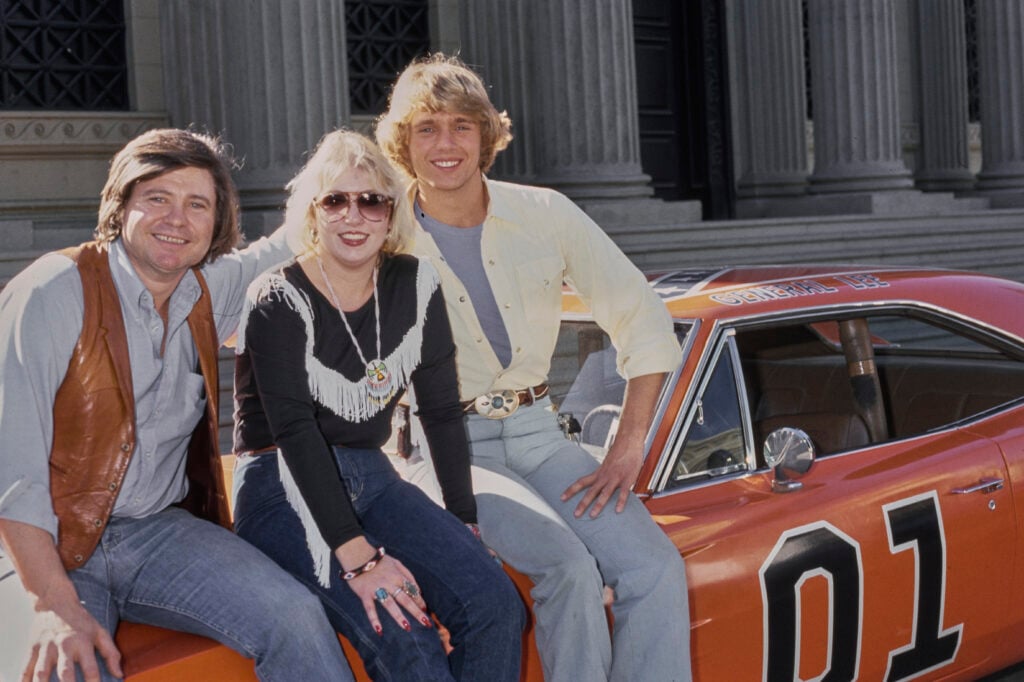
American actor and politician Ben Jones and American actor and singer John Schneider sitting on the General Lee, United States, January 1981. (Photo by Michael Ochs Archives/Getty Images)
Jones died Sunday, August 9, at his home in Washington, Virginia, following a massive heart attack, according to his wife, Alma Viator.
Viator shared the heartbreaking news on Facebook, remembering her husband as someone who lived a full and meaningful life.
“I lost the love of my life today. Ben passed from a massive heart attack,” she wrote.
Jones was at home in his favorite chair when he died, Viator revealed, waiting for the Atlanta Braves to take on the New York Yankees.
“Ben had the most amazing, rich, full life,” she added. “He loved and was loved by so many. He will be missed. I loved him so so much.”
For millions of television viewers, Jones will forever be associated with Cooter, the good-natured mechanic and friend of the Duke family.
The CBS series ran from 1979 through 1985, with Jones appearing throughout its original seven-season run. He also reprised the character in later Dukes of Hazzard reunion projects.
Cooter was the owner of the local garage and tow truck in Hazzard County, making him an important ally to Bo and Luke Duke whenever the cousins found themselves in trouble.
Jones once explained the character’s appeal by noting that Cooter was always working because he operated the only garage and tow truck in town.
“He had the only garage and the only tow truck in a place where all they did was wreck cars,” Jones said in a 2008 interview. “Every time you saw him, he was working, and people can relate to that.”
But Jones’ career extended far beyond Hollywood.
After The Dukes of Hazzard, he was elected to the U.S. House of Representatives from Georgia’s Fourth Congressional District in 1988. He was reelected in 1990 and served as a Democrat.
During his time in Congress, Jones served as Democratic whip and worked on the House Veterans’ Affairs and Public Works and Transportation committees. He later ran against Newt Gingrich in 1994 but lost.
Jones eventually returned to his Dukes of Hazzard roots.
He opened museums dedicated to the series in Virginia and helped launch DukesFest, an annual celebration that brought together fans of the classic show.
His death has prompted an outpouring of affection from fans, friends, and former castmates.
Tom Wopat, who played Luke Duke, paid tribute to Jones on social media.
“The Dukes of Hazzard lost another integral part of their cast today,” Wopat wrote, describing Jones as “a fine friend” and “a fierce advocate of all the best things we can offer in the entertainment business.”
“He will be sorely missed,” Wopat continued. “But I feel like we lost a Duke cousin today.”
Jones is survived by his wife, Alma, and his two children, Rachel and Walker. Our condolences go out to his loved ones during this enormously difficult time.
The Adams County Jail, just north of Denver, does not allow in-person visits. Over the course of their incarceration, people detained there will never share a visiting room with their families and children, or even sit across from them behind a plexiglass barrier.
In-person visits at Adams County Jail have not been permitted for nearly 20 years, as reported by 9News.
Video visitation can be a lifeline for family members when distance, work schedules or travel costs make in-person visits difficult. When video visitation is run well, visitors may appreciate avoiding security screenings, long waits and the harsh correctional environment. But many still miss physical touch with their loved one.
As researchers who studyvisitation in correctional settings, our role is not to say how the courts should rule. But the Adams County case raises an important question we’ve spent much of our careers examining: What impacts do in-person visits have on incarcerated people and their families?
The answer is not as straightforward as it might seem. Many incarcerated people receive no visits at all. For those who do, visits can be enormously beneficial for them and their loved ones. But the benefits are not the same for everyone — they depend on the environments in which visits occur, the preexisting relationships between incarcerated people and their visitors, and what happens during the visits themselves.
Temporary relief from the pain of separation
For many incarcerated people, separation from family and friends is one of the most painful aspects of life behind bars. Visits can offer temporary relief from that separation and provide a unique chance for families to connect face-to-face.
For a little while, incarcerated people can get a break from their identity as a prisoner and act as a parent, son, daughter, partner, sibling or friend again. Visits also break up the monotony of confinement and give incarcerated people something to look forward to – so much so that correctional facilities commonly use visitation as an incentive for good behavior.
Correctional settings are not designed for comfort – they are designed for security. Razor wire, steel doors, surveillance cameras and uniformed officers typically surround daily life inside, and firm rules govern nearly all aspects of in-person visitation.
What an in-person visit looks like varies widely from facility to facility. In some settings, families sit together in a room. In others, visits are “noncontact,” meaning families are separated by a physical barrier and must communicate through a phone or speaker. Incarcerated people and their visitors have more positive experiences when they can sit side by side, embrace and share food or games. They have more negative experiences when physical contact is not allowed.
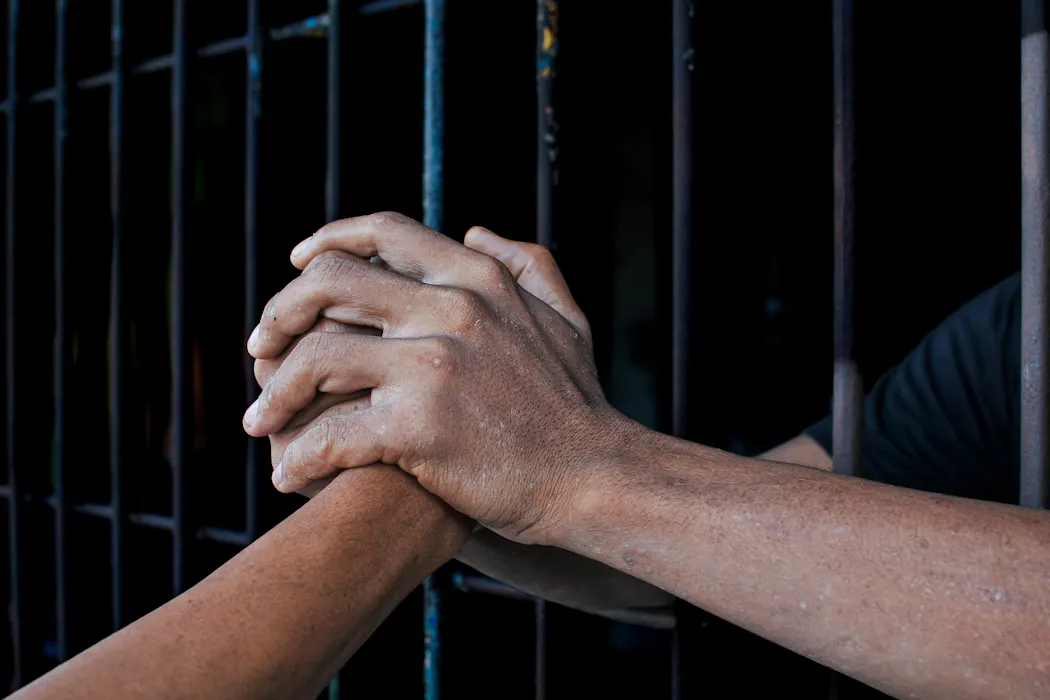
Prisoners greet visitors in different environments, sometimes separated from their loved ones by glass. South_agency/E+ via Getty Images
Family-friendly visiting rooms – spaces with comfortable seating, toys or activities for children and opportunities for families to interact more naturally – are rare in U.S. jails.
Visits are shaped by both the relationships families bring with them and what they do with their limited time together. In one of our studies, family members described highs and lows with their loved ones long before incarceration. In another, visitors described relationships ranging from “close” and “loving” to “strained” and “terrible,” with some carrying hurt, anger or mistrust into visits. Strong relationships may make it easier for visitors to offer reassurance, affection and practical support, whereas fraught relationships can make visits less comforting or reopen emotional wounds.
Jails in the U.S. have become a front-line response for people with unmet mental health and substance-use needs. Such needs often weigh on family relationships and shape what happens during visits. Some visits consist mainly of “family time,” catching up or sharing news, while others take on harder tasks. Families may voice long-held frustrations, challenge incarcerated people to “step up” to their responsibilities, talk about change and set expectations for the future. These harder visits may be more likely to cause distress for all those involved, but they can also help families address unresolved problems.
In this way, visits can serve as a makeshift form of family therapy, with families confronting problems of addiction, parenthood and mental health under conditions that are far from ideal. These conversations can be tense and emotional, but, ultimately, they can be how families repair bonds, settle the past and prepare for a loved one’s return.
Jillian Turanovic receives funding from the National Institute of Justice, the Bureau of Justice Assistance, and the National Collaborative on Gun Violence Research.
Melinda Tasca receives funding from the Bureau of Justice Assistance.
There’s no one right way to grieve (or to move on)
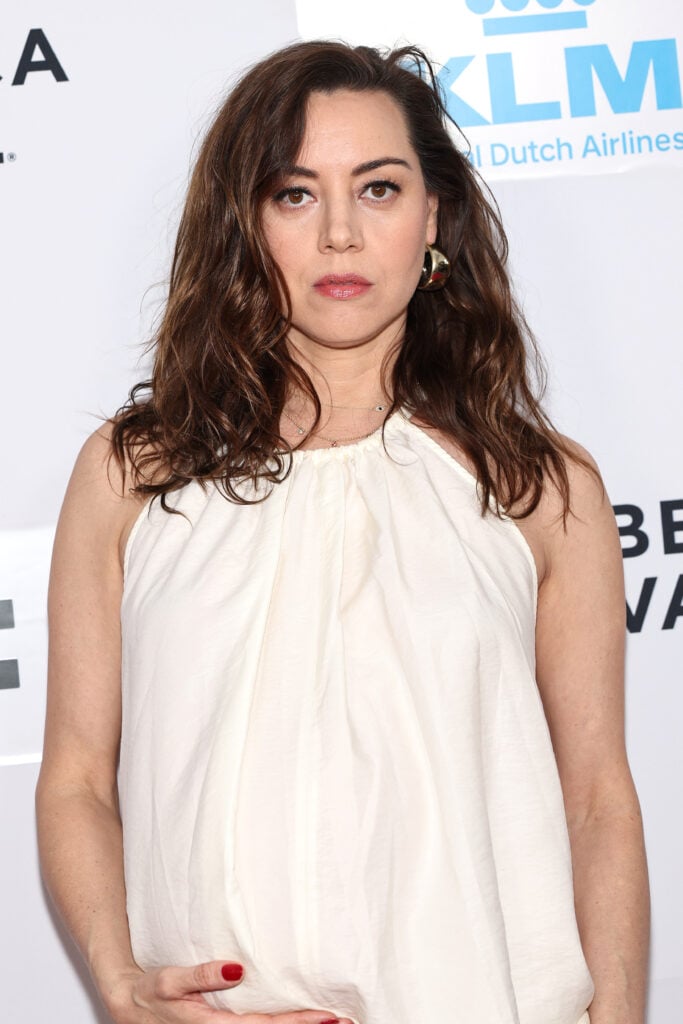
News of Plaza’s pregnancy was met with joy — but also a level of surprise.
Previously, she was married to screenwriter and director Jeff Baena.
The two met and began dating in 2011, and married in 2021. In late 2024, they separated amidst mental health concerns about Baena.
Though Plaza would continue to care about her ex, even at one point having a friend check on him and encouraging him to attend therapy, Baena ended up dying by suicide in January 2025.
It was a shock to everyone, including Plaza. And some fans were left feeling puzzled by pregnancy news just months later.
In reality, many of us know that different people grieve in different ways.
AI is becoming crucial for monitoring domain abuse, enabling automated analysis and real-time detection. However, careful oversight is essential to avoid errors, especially as domain registrations surge.
Part of Kelly Clarkson’s outfit tried to breakaway in the middle of her latest show.
The “Since U Been Gone” singer suffered a wardrobe mishap while performing at her Las Vegas residency, but… E! Online (US) – Top Stories
Trader Joe’s is known for its own-brand delights, with plenty of premade foods that make life just that much easier. Here are five that you just can’t miss.
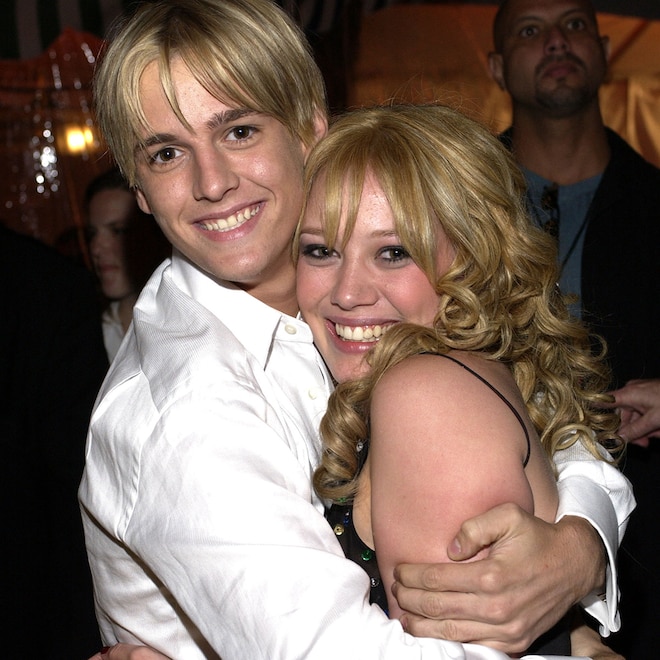
Hilary Duff is making sure people remember.
While performing in Philadelphia on Aug. 9, the Disney Channel alum paid tribute to the late Aaron Carter, whom she dated on and off for three years in… E! Online (US) – Top Stories
The next time you’re making a batch of muffins, consider the temperature of your ingredients. If it’s off by too many degrees, your muffins will suffer.
Mashed – Fast Food, Celebrity Chefs, Grocery, Reviews
Eight in ten American households have one parent who runs the household’s meal-planning operations. A new survey of 2,000 parents of school-aged children found that 82% of families have a default dining manager who handles meal planning, shopping and cooking.…












 Part of Kelly Clarkson’s outfit tried to breakaway in the middle of her latest show.


 Hilary Duff is making sure people remember.