Categories
Alaska News Featured Juneau News juneau Juneau Local Juneau Local Ketchikan Local News Feeds Sitka Local

Here’s when to expect results in Alaska’s 2026 statewide primary election

By: James Brooks, Alaska Beacon
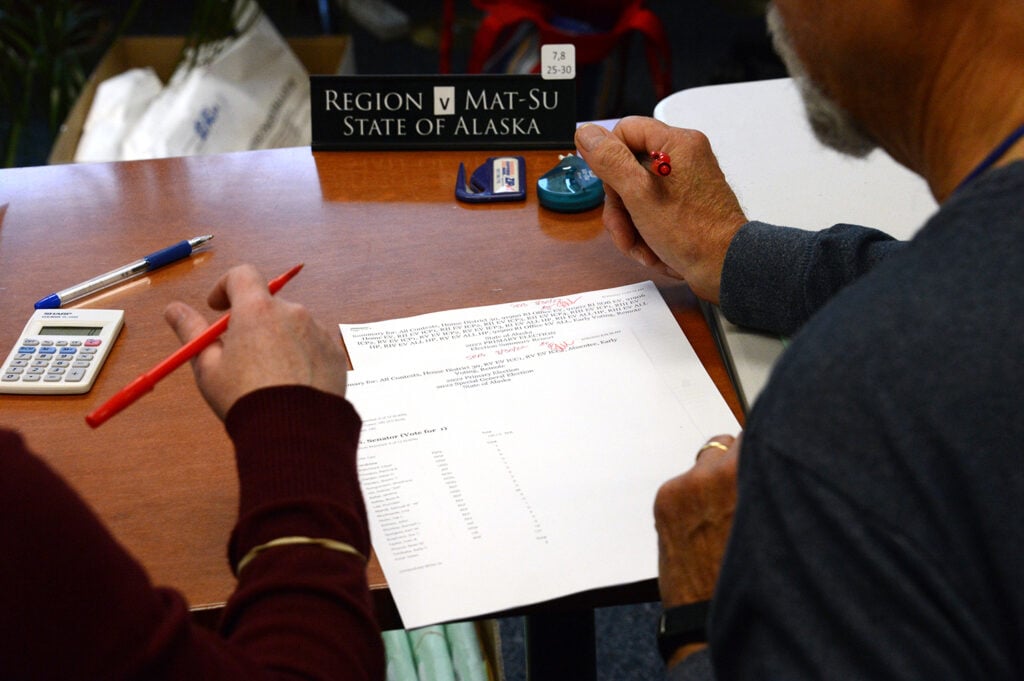
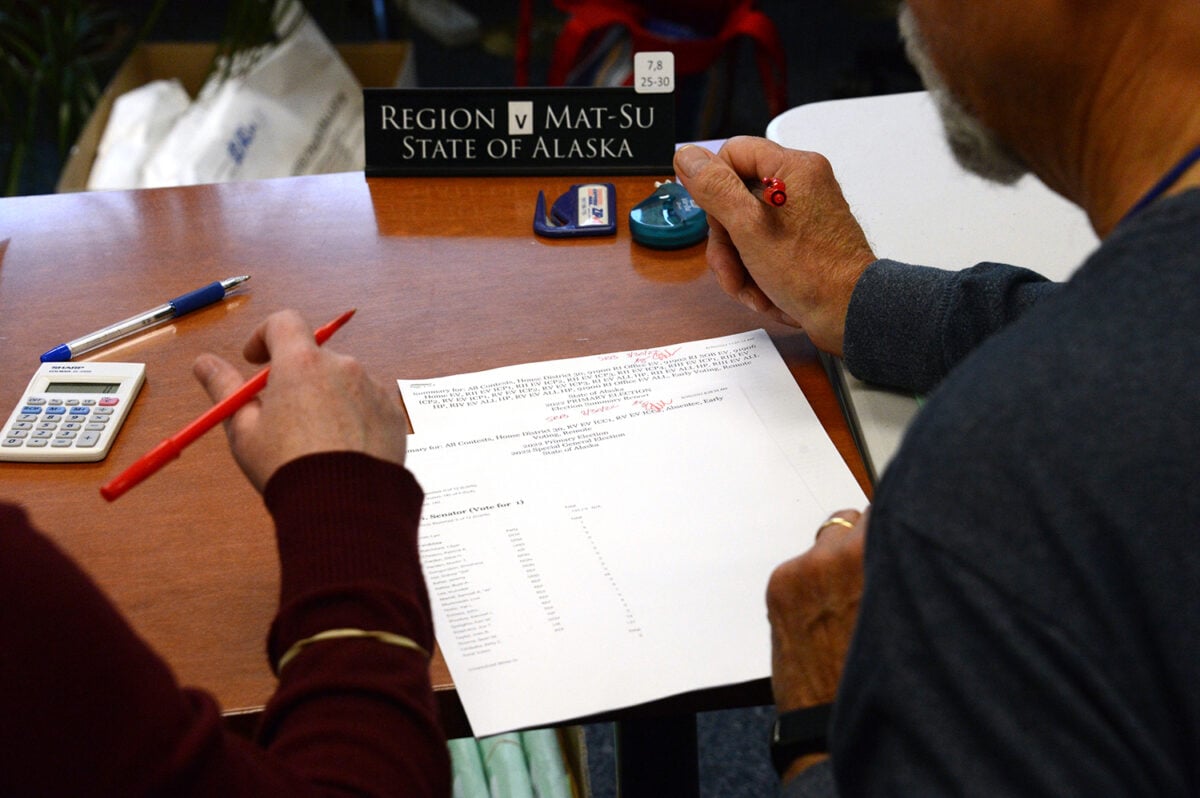
Elections workers double-check the results of Alaska’s Aug. 16, 2022 primary election during a meeting of the state review board on Tuesday, Aug. 30, 2022 at the Alaska Division of Elections in Juneau. (Photo by James Brooks/Alaska Beacon)

Early, in-person voting begins Monday for Alaska’s Aug. 18 state primary election, and thousands of voters have already cast absentee ballots by mail.

Regardless of when — or how — Alaskans vote, ballots will be counted starting on election day, according to a preliminary schedule provided by the Alaska Division of Elections. 

Polls close at 8 p.m. Alaska Daylight Time, and the division expects to have the first preliminary results “between 8:45 p.m. and 9 p.m.”

“There are additional results updates that follow but how many or at what time they will be published will vary,” the division said in an information packet given to reporters.

The final unofficial tally will take place Aug. 28, 10 days after election day, and the division expects to certify official results by Aug. 31.

Any recounts must be requested by Sept. 5, and any lawsuit challenging a result must be filed by Sept. 10.

Timeline of the 2026 primary election

  • Aug. 3 – Early voting begins in person.
  • Aug. 11 – Elections officials begin ID checks on absentee ballot envelopes. Absentee votes in those envelopes are not counted until at least Aug. 18.
  • Aug. 18 – Election day. Polls open across the state. 
  • Late Aug. 18 – Absentee ballots begin to be counted, in-person votes are counted.
  • 9 p.m. Aug. 18 – First results expected online.
  • Early morning Aug. 19 – final election day results expected online.
  • Aug. 25 – Absentee votes counted to this point are added to the unofficial tally.
  • Aug. 28 – Final unofficial results available online.
  • Aug. 31 – Official results certified. Deadline for final four candidates to withdraw from the November election. 
  • Sept. 5 – Deadline to request recounts.
  • Sept. 10 – Deadline to challenge election results in court.

Under Alaska’s election system, voters pick one candidate for each race in the primary election. The top four vote-getters, regardless of political party, advance to the general election in November. If there are four or fewer candidates in a race, all advance to the general election.

In practice since 2022, lower-finishing Republican candidates have preferred to withdraw after the primary rather than compete against another Republican.

The Valley Republican Women, a notable group from the Matanuska-Susitna Borough, are running ads this year to promote the strategy. Those ads urge Republicans to “consolidate the vote” and “don’t split the field.”

In races with many competitors, a withdrawn candidate will be replaced by another until there are four options on the ballot or no more replacements are available. Any replacements may themselves withdraw.

The deadline to withdraw after the primary is Aug. 31. 

Normally, ballots cast in person are counted on election day itself. Since 2020, votes cast in person have leaned Republican. 

It’s common for some rural Alaska precincts to not report results on election night itself.

Two years ago, for example, only 387 of 403 precincts had reported results by 1 a.m. Wednesday, the day after election day. Four years ago, four precincts needed more than four days to report results from election day.

Historically, some rural precincts have had staffing problems that prevented them from opening on election day. In 2024’s primary, two precincts failed to open, and one opened only in the afternoon. In 2022, two precincts failed to open. In both 2024 and 2022, voters in the affected places were able to cast absentee ballots instead.

Absentee ballots are counted starting on election day, but that counting process extends until Aug. 28. Under Alaska law, absentee ballots — if they are postmarked on or before Aug. 18 — can reach the Division of Elections up to 10 days after election day and still be counted.

Counting an absentee ballot requires the division to first verify the identity information on the outside of the ballot envelope. That verification process starts Aug. 11, the division said, though the ballot inside the envelope won’t be counted until at least election day.

The verification process continues after election day, with ballots added to the tally in batches. The division expects to update results on Aug. 25 and again on Aug. 28, with additional updates possible between those two dates.

Categories
Alaska News

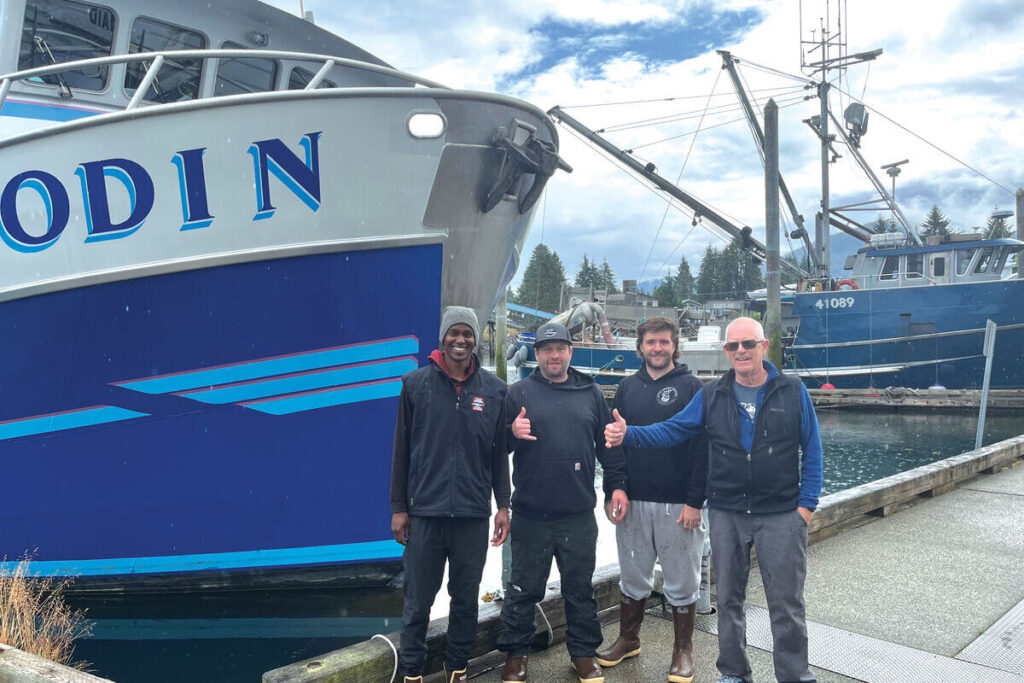
Petersburg crew revives Sitka deckhand with CPR after overboard near-drowning

On Wednesday, July 29, Trevor McKay, Mike Doyle, Brent Birchell and Mark Severson sent their encouragement to their fellow F/V Odin crewman Tausani Ieremia at home in Sitka, recovering from the accident. (Courtesy/Karen Severson)

Tausani Ieremia, of Sitka, was setting the net aboard the Petersburg seiner Odin on the morning of Sunday, July 26, when the boat’s own purse line snared his ankle and dragged him over the stern and into the water near Saint Joseph Island, west of Prince of Wales. In the minutes that followed, the 22-year-old fisherman was pulled under by the net, lost consciousness and stopped breathing. The Odin’s crew pulled him back, revived him with CPR. He was helicoptered by the Coast Guard to Sitka then life-flighted to Anchorage. He is now home recovering in Sitka.

The accident happened around 11:30 a.m., skiffman Trevor McKay said. Fishing has been slow so far this season, and it was slow again that morning as the Odin began its set. Ieremia had just fixed a lead line and walked to the stern to throw it clear when he stepped into a bight of the purse line. It caught him by the ankle and pulled him over the stern – a moment captured on the boat’s deck camera. Skipper Mark Severson was setting the net slowly, around two knots, and is glad he was, figuring that the low speed probably spared Ieremia much worse injury going over the stern.

McKay, running the power skiff, had been watching the net go out. “I usually look at the net go out for the first 10 to 15 fathoms before I give it any gas,” he said. The net was clear, so he turned and began to speed up toward the kelp line. “It wasn’t long before I felt a big jerk,” he said – usually the sign of a ring snarl. He looked back and saw “a body and a tangle of web flying over the rail.”

McKay released the pin as Severson immediately came over the radio – “Go get him!” – spun the skiff around and ran full throttle toward Ieremia. He watched him go down and surface once, then turned to ready his plunger pole. When he looked again, “all I could see was his hand, and it was sinking.” He reached the net, threw the skiff in reverse and landed just above a set of sunken corks. Ieremia was nowhere in sight, pulled into the dark water by the weight of the fishing gear. Corks sit low like that only when something is tangled in the purse line or rings, McKay said. He swirled his pole through the water, hoping Ieremia might grab it. Nothing. Minutes passed.

“I started to feel the reality that he isn’t going to come back up,” McKay said. Then there were bubbles, and a hand rose toward him through the sunlit water alongside the corks – “like an angel was guiding him up to me.”

Ieremia had managed to slip from his boots, freeing him from the net, said Severson.

McKay caught Ieremia’s hand and lifted him about halfway out of the water. “His eyes were as big as I’ve seen, lips blue and skin pale,” he said. Ieremia was too heavy to pull in, and everything on his raingear McKay grabbed with his free hand was tearing or breaking; he held tightly onto Ieremia’s hand. “I remember yelling, ‘Help! I need help,’” he said. He felt the grip in Ieremia’s hand fade to nothing; Ieremia’s head fell back as he lost consciousness. The Odin was right on top of them by then, McKay said, and the crew got Ieremia up onto the deck and immediately started CPR.

On the Odin’s deck, crew members Mike Doyle and Brent Birchell began chest compressions and rescue breaths – McKay soon joined them. Water came up from his lungs from the chest compressions, Severson said. After around ten minutes of continuous CPR, Ieremia began breathing on his own. He grew more responsive over the next 20 minutes and was on his feet roughly a half-hour after that.

“I was told to never stop CPR trying to save a life,” McKay said. “We weren’t going to stop.”

The F/V Reality, a nearby seiner with a crewmember trained as an EMT, reached the Odin soon after Ieremia had been revived and assisted with his care, the family told the Pilot.

A Coast Guard Jayhawk helicopter crew arrived and lowered a rescue swimmer to the deck, and Ieremia got into the rescue basket under his own power, Severson said. The Coast Guard flew him to Mt. Edgecumbe Medical Center in Sitka; a Coast Guard public affairs officer said he was in stable condition when he was delivered. Guardian Flight then flew Tausani and his father, Joe, to Providence hospital in Anchorage for ICU monitoring. He thankfully had no broken ribs and no brain damage, Severson said, but was very bruised from the chest compressions; the family said the water remaining in his lungs was cleared in Anchorage. He is now home.

Severson, who has fished for about 50 years, said he sets his net slowly by habit – so that if something goes wrong, the boat does less damage. In five decades, he said, he had never seen a crewman taken over the stern like that, “but always worried about it.” Just two days before the accident, he remembers warning the crew: “Don’t get close to the net and never turn your back on it.”

Severson said he hopes the near-miss pushes the whole seine fleet to tighten up around the net and to stay current on first aid. “Everybody needs to go do their CPR class every year,” he said. It had been years since his own last class, he acknowledged, and techniques change – but what his crew did worked. He shared the deck-camera footage which captured the entire incident with the Coast Guard and his insurer, who praised the Odin’s crew for their nonstop effort.

“It was the most horrifying, worst set of my life, and it turned out to be the best one,” Severson said. He knew Ieremia would be all right, he said, when the young fisherman got to his feet on deck. “He’s a great kid,” he said.

In their statement, the Ieremia family thanked McKay, Doyle, Birchell and Severson, the crew of the F/V Reality, the neighboring boats, the Coast Guard and the Guardian Flight crew that carried their son to Anchorage. They singled out “the incredible skill and herculean effort taken by Trevor to retrieve him and never let go,” Severson’s handling of the boat around the net “under intense pressure,” and Doyle and Birchell, “who performed CPR and didn’t stop.”

“Tausani is now home, surrounded by family and friends, as he recovers from the injuries and trauma of this near-tragic fishing accident,” the family wrote. “We all know how amazing it is that we have this incredible outcome of Tausani’s survival. It feels like a miracle.”

The post Petersburg crew revives Sitka deckhand with CPR after overboard near-drowning appeared first on Chilkat Valley News.

Categories
Alaska News Featured Juneau News juneau Juneau Local Juneau Local Ketchikan Local News Feeds Sitka Local

Ranked-choice voting? Hold on. Alaskans have another ballot measure to decide first.

By: James Brooks, Alaska Beacon

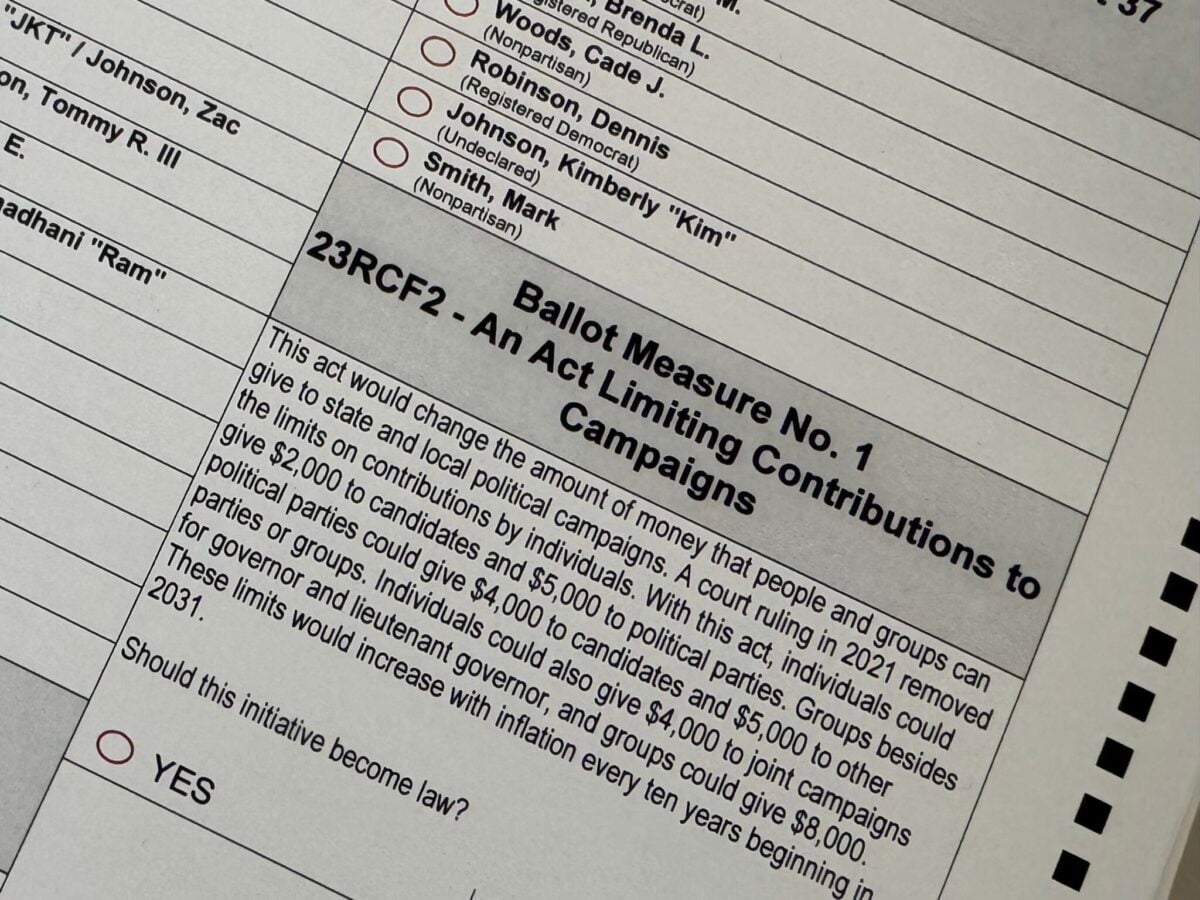
 A sample ballot seen at the headquarters of the Alaska Division of Elections on Thursday, July 9, 2026, shows the language for the campaign finance ballot measure. (James Brooks photo/Alaska Beacon)

On Aug. 18, Alaskans will be asked if they want to change the way the state’s elections operate, but not in the way that most voters are thinking.

The sole ballot measure before voters in the primary election would reimpose limits on the amount of money that individuals and groups can donate to political candidates in state elections.

A well-funded campaign to repeal the state’s system of open primaries and a ranked choice general election — known as Ballot Measure 2 — won’t be voted on until November.

The measure on the ballot in August would prohibit political donors from giving a candidate more than $2,000 per election. Groups would be allowed to give no more than $4,000 per candidate per election.

Both limits would be adjusted for inflation every 10 years, and they would only apply to state-level elections — for governor, state House and state Senate.

Federal elections, those for President, U.S. Senate and U.S. House, operate under different limits enshrined in federal law.

A low-budget group called Citizens Against Money in Politics gathered tens of thousands of signatures in 2024 to put the newly proposed state limits on the ballot. 

In the state’s official election pamphlet, the chairs of the group — former state attorney general Bruce Botelho; Rep. Calvin Schrage, I-Anchorage; dog musher David Monson — state their case, explaining that they view campaign donation limits as “guardrails” on democracy.

“​​Without these guardrails, wealthy individuals and special interests can have an oversized impact and shift a candidate’s focus away from the constituents they are supposed to serve,” they wrote.

Speaking in a public hearing on Monday, Schrage said, “When a single donor can spend hundreds of thousands or even millions of dollars on a single candidate, it creates a dangerous environment. It not only grants undue influence to the ultra-wealthy, but it also exposes our elected officials to the risk and perception of quid pro quo corruption.”

In the pamphlet, three Republicans, all former legislators, argue against the initiative.

“Campaign contributions are a form of political speech. To limit someone’s ability to support a candidate is to limit their voice in the democratic process,” said former Rep. Ben Carpenter, R-Nikiski; former Sen. David Wilson, R-Wasilla; and former Rep. Liz Vazquez, R-Anchorage.

In addition, imposing limits on outside donations gives an advantage to candidates who are wealthy enough to pay for their own campaigns, they said.

In Monday’s hearing, another Republican, Amy Demboski, spoke in support of their position.

“Reintroducing new caps creates a pay-to-play barrier where only those who already possess significant name recognition can thrive, effectively silencing the grassroots support necessary for insurgent or unconventional candidates,” she said.

The U.S. Supreme Court has previously ruled that it is unconstitutional to limit the amount of money that a candidate may spend on their own campaign. 

Ballot Measure 1 also does not limit the amount of money that a third-party group can independently spend to support or oppose a candidate. The U.S. Supreme Court’s 2010 decision, known as Citizens United, allows unlimited amounts of spending by groups that don’t coordinate directly with candidates.

Also this year, the Supreme Court ruled that political parties may spend unlimited amounts of money in coordination with federal candidates. That decision may affect state races in the future.

Ballot Measure 1 is the consequence of a lengthy and successful legal challenge by a group of Republicans inside and outside the state.

Until 2021, Alaska had some of America’s lowest limits on financial donations to candidates — $500 per candidate, per year. Those were installed by a 2006 ballot measure that passed with the support of 73% of participating voters. 

But a group of Republicans challenged the legality of those limits in 2015, arguing that they unduly restricted free speech. The case was appealed and remanded multiple times before a three-judge panel of the 9th U.S. Circuit Court of Appeals struck down the limits in July 2021.

Gov. Mike Dunleavy declined to appeal the issue further, and the limits were removed ahead of Dunleavy’s successful re-election campaign the following year.

In 2022 and 2024, state lawmakers attempted but failed to pass a bill reimposing limits. Legislators this year passed a bill identical to Ballot Measure 1, but Gov. Mike Dunleavy vetoed that bill.

In his veto statement, the governor said the new limits “would radically tilt in the favor of the wealthy when it comes to elected office.”

The lack of limits has had its biggest effect on Alaska’s races for governor. In 2022, all three leading candidates — Dunleavy, independent Bill Walker and Democratic candidate Les Gara — recorded large contributions from individual donors. 

In this year’s race, the two leading Democratic candidates — Jonathan Kreiss-Tomkins and Tom Begich — have received large donations from out-of-state contributors. Both Democrats say they support passage of Ballot Measure 1. 

Most of the other 15 candidates in the governor race, including most of the Republicans, have taken similarly large donations, but not to the extent that the leading Democrats have.

The Republican candidate who has raised the most money, podiatrist Matt Heilala, has spent more than $1.25 million on his own campaign. Click Bishop, a Republican who has raised a middling amount of money, is also being boosted by a large union-funded third-party group. Those latter types of spending would not be affected by Ballot Measure 1.

Categories
Alaska News

Sitka, cruise lines, negotiate taxes after Skagway’s lawsuit

Visitors sit at a picnic table near the Sitka Sound Science Center Wednesday June 8, 2022. (Photo by James Poulson/Sitka Sentinel)

The City and Borough of Sitka and the cruise line trade association have reached agreement on some questions of collecting sales tax on on-board sales of goods and services that occur in Sitka, including Sitka Sound.

But a number of questions remain unanswered, pending the conclusion of a lawsuit filed by the industry against the City of Skagway.

The suit questions whether Skagway has the right to collect taxes on sales that take place outside the city’s boundaries for services that occur within the city boundaries.

A two-page letter in the July 28 Assembly packet from Administrator John Leach summarized what Sitka and and the Cruise Lines International Association have agreed on.

Leach spoke to the Daily Sitka Sentinel last week and today about the negotiation process, and working with the cruise lines to clarify what sales tax must be remitted under city code.

“Throughout this we made it clear we didn’t pass any new laws or apply anything newly created; it’s just application of existing code,” he said.

Leach said the city has heard concerns from the public that the city is not receiving the full sales tax due from cruise lines for tours and excursions in Sitka.

“They’re sold to the ship wholesale,” he said. “The cruise ship puts a commission on that and we’re not getting that full value. We’re getting the value on the price it was sold to the cruise lines at. The reason we don’t get the full value is because of our code.”

The city does not tax commissions on sales.

Still up in the air is the question of collecting sales tax on services (including tours) that occur in Sitka, when the purchase is made elsewhere.

“Let’s say you’re a person sitting in Idaho, you buy a cruise to Sitka, and a shore excursion as part of the package; the nexus of that service takes place here,” Leach said. “Our argument is that you have to pay sales tax because the service is provided here. They’re pushing back on that, and they’re not wrong. That’s what the lawsuit is about in Skagway.”

Sitka is not part of the lawsuit, and Leach in his letter says that the city is waiting to hear what happens with CLIA v. Skagway. “We reserve our right to reopen the topic, pending the Skagway decision,” the administrator said.

Also in the letter, Leach confirmed with the cruise industry that cruise ships must collect sales tax for on- board sales that take place within Sitka. The two parties agreed that the boundary is Sitka Sound, as defined by the Department Fish and Game.

“I don’t understand how it was overlooked for so long,” Leach said.

Leach said he became aware that cruise ships were not collecting sales taxes for goods and services within the boundary when he was contacted by one of the cruise lines, asking for a sales tax account in order to collect and remit.

He also learned through his work on the Port Communities of Alaska association that other communities in Southeast are collecting sales taxes for onboard transactions in the ships’ food and gift shops. As Sitka starts collecting this tax it will mean additional revenue, though he doesn’t expect it to be a lot: some cruise lines close their stores while the ship is in port.

In the letter, Leach thanked Cruise Lines International Association Alaska for the group’s “cooperation and collaborative approach” on this issue.

The post Sitka, cruise lines, negotiate taxes after Skagway’s lawsuit appeared first on Chilkat Valley News.

Categories
Entertainment

Stassi Schroeder’s Marital Problems Shock Viewers of New Reality Show

Reading Time: 2 minutes

Stassi Schroeder is no stranger to showcasing a toxic relationship on reality TV.

The woman dated Jax Taylor, for Pete’s sake.

But these days, Stassi is older, wiser, and more mature — and her marriage to Beau Clark seems to be much healthier than her earlier romances.

Which is why fans are shocked to see the couple’s dark side showcased on House of Stassi.

Beau Clark and Stassi Schroeder Clark celebrate the release of her new book "YOU CAN'T HAVE IT ALL: The Basic B*tch Guide To Taking The Pressure Off" at Barnes & Noble The Grove on September 18, 2024 in Los Angeles, California.
Beau Clark and Stassi Schroeder Clark celebrate the release of her new book “YOU CAN’T HAVE IT ALL: The Basic B*tch Guide To Taking The Pressure Off” at Barnes & Noble The Grove on September 18, 2024 in Los Angeles, California. (Photo by Rodin Eckenroth/Getty Images)

The new Hulu show follows the former Vanderpump Rules star as she balances a booming career with raising two young children alongside Clark. But behind the polished social media posts, the couple reveals they’re facing some very real relationship struggles.

The entire eight-episode first season dropped on Thursday, and viewers expressed surprise at scenes in which Clark became emotional while discussing how much their relationship has changed since he stepped away from his career as a casting director to become the family’s primary caregiver.

“I’ve felt angry and resentful,” he admitted, explaining that he often feels more like a roommate than a husband.

Clark said he has struggled with losing his sense of identity after leaving the workforce, adding that staying home with the couple’s children has taken a toll on his mental health.

At one point, Beau even compared himself to “a 1950s housewife,” saying he feels unfulfilled despite loving his family.

The candid confession caught Stassi by surprise.

She acknowledged that she hadn’t realized just how unhappy her husband had become and admitted she wished he had shared his feelings sooner.

While Stassi said she’s grateful for everything Beau has done for their family, she also explained that her expanding career has created opportunities she doesn’t want to walk away from.

The former Bravo personality has been busier than ever with House of Stassi, her podcast, and other business ventures.

She told Clark that she has no desire to stop working, even suggesting she would financially support him if he wanted to stay home permanently.

But for Beau, the issue isn’t money.

Instead, he said he misses having a career of his own and wants to return to casting because it gives him a sense of purpose. He emphasized that his frustration stems from feeling disconnected from himself, not from resentment toward Schroeder’s success.

By the end of their emotional conversation, Schroeder promised to make more of an effort to reconnect with her husband and prioritize their relationship alongside their careers and parenting responsibilities.

The couple, who married in 2020 and share daughter Hartford and son Messer, appear committed to working through their challenges rather than hiding them from viewers.

If nothing else, House of Stassi is proving that even reality TV’s happiest-looking couples aren’t immune to the everyday pressures of marriage.

Stassi Schroeder’s Marital Problems Shock Viewers of New Reality Show was originally published on The Hollywood Gossip.

​The Hollywood Gossip

Categories
Music

Riley Green Reveals ‘That’s Just Me’ Track List, Drops New Song ‘Imagine That’

Riley Green is continuing to build anticipation for his upcoming studio album, That’s Just Me, arriving September 18.

This week, the country star gave fans a preview of all 19 tracks, sharing short snippets of each song on social media while offering even longer previews exclusively to members of his Back 40 fan club.

Along with the previews, Green also unveiled the album’s full track list, revealing several collaborations. The project will feature the recently released duet “Go Again” with Hannah McFarland, as well as “Well Well Whiskey” with Jake Worthington, “Pave All Them Red Dirt Roads” featuring Brooks & Dunn, and “Lookout Mountain” with Randy Owen of country supergroup Alabama.

Riley Green; That's Just Me
Riley Green; That’s Just Me

The album also showcases a number of co-writes from some of Green’s longtime collaborators, including Randy Montana, Erik Dylan, Jonathan Singleton, and others. Green also penned or co-penned several of the album’s tracks himself.

Riley Green That’s Just Me Track List: 

1.  My Way (Riley Green)

2.  That’s Just Me (Riley Green)

3.  Don’t Come Any Closer (Riley Green, Randy Montana, Erik Dylan)

4.  Go Again (featuring Hannah McFarland) (Riley Green)

5.  Imagine That (Riley Green, Jonathan Singleton, Ray Fulcher)

6.  Got That From You (Riley Green, Rhett Akins, Erik Dylan, Nick Walsh)

7.  Bartender In Destin (Sam Banks, Nick Walsh)

8.  Beach Happy (Randy Montana, Jeremy Stover, Corey Crowder)

9.  Think As You Drunk  (Riley Green, Jessi Alexander, Erik Dylan, Wyatt McCubbin, Scott Emerick, Toby Keith)

10. Well Well Whiskey (featuring Jake Worthington) (Riley Green)

11. P.O.S. (Riley Green, Randy Montana, Erik Dylan, Drake White)

12.Runs In The Family (Riley Green, Jessi Alexander, Jameson Rodgers)

13. Pave All Them Red Dirt Roads (featuring Brooks & Dunn) (Riley Green, Dallas Davidson)

14. Lookout Mountain (featuring Randy Owen of Alabama)  (Riley Green, Erik Dylan, Randy Montana, Drake White)

15. Seven Second Ride (Jimi Bell, Tucker Bethard, Jonathan Singleton)

16. Radio Road (Riley Green, Erik Dylan)

17.Ol’ Stray Dog (Erik Dylan, Jon Randall)

18.More Of A Man Than Me (Riley Green)

19.Ten Pairs of Boots (Joe Fox, Seth Ennis, Chase McGill, Josh Miller)

Riley Green - Imagine That
Riley Green – Imagine That

With the full track list now out and the album’s release just around the corner, Green also surprised fans by dropping a brand-new song, “Imagine That.” The track, which appears as No. 5 on That’s Just Me, was co-written by Green alongside Jonathan Singleton and Ray Fulcher.

The emotional song tells the story of two former lovers who never truly move on from each other. Blending heartfelt lyrics with vivid storytelling, “Imagine That” delivers the kind of stripped-back country sound Riley Green has become known for.

As fans count down to the release of That’s Just Me, they’ll also have plenty of chances to see Green perform the new music live. The country star recently added 10 more dates to his headlining Cowboy As It Gets Tour, and with a packed schedule of festival appearances and headlining fair shows still ahead, he has no plans of slowing down.

The post Riley Green Reveals ‘That’s Just Me’ Track List, Drops New Song ‘Imagine That’ appeared first on Country Now.

​Country Now

Categories
Alaska News

Flooding from glacial outburst damages Fish Creek site near Hyder

A popular bear and salmon observation site near Hyder remains closed after being damaged on July 16 by floodwaters stemming from a glacial outburst.

U.S. Forest Service staff plan to continue assessing the damage to the Fish Creek Wildlife Observation Site next week, according to USFS information. Meanwhile, the State of Alaska has issued an emergency authorization to state immediate repairs of a levee that was breached in the flooding.

“Work is expected to begin today (Friday) and will focus on filling the breached area with rock,” according to a Forest Service reply to a Daily News inquiry.

Located about three miles north of  the small Alaska community of Hyder, which itself is located on the mainland at the head of Portland Canal about 75 miles northeast of Ketchikan, the Fish Creek site draws visitors from around the world to watch from an approximately 600-foot-long elevated observation walkway as brown and black bears eat pink and chum salmon returning to Fish Creek to spawn.

The site is protected from the adjacent Salmon River primarily by the Fish Creek levee. The Salmon River flows from the large Salmon Glacier that sits at a higher elevation just across the U.S.-Canada border. A lake above the Salmon Glacier — Summit Lake — experiences a sudden “jökulhlaup” glacial outburst that sends lake water coursing below the Salmon Glacier and into the Salmon River.

It was this type of glacial outburst that resulted in the river cresting to a level that caused the Fish Creek levee along the river to fail, producing “damaging impacts to the Fish Creek Bear Viewing area,” according to a National Weather Service report.

The Forest Service quickly announced that the “rushing waters broke off at least 100 (feet) of the viewing platform,” and that the site was closed until further notice.

In an email response to the Daily News on Friday, Tongass National Forest Public Affairs and Partnerships Staff Officer Paul Robbins Jr. wrote that Ketchikan/MIsty Fjords District Ranger Cathy Tighe, “joined by engineers and fisheries staff, visited the site earlier this week to begin damage assessment.

“While water levels have returned to normal, the glacial silt added by the new waters made it difficult to fully assess areas downstream,” wrote Robbins. “Staff did note the remaining sections of the raised platform sustained significant damage to support footings. Another trip will be made by Forest Service staff next week to obtain additional information (including downstream drone footage) and continue assessment. The Forest Service plans to open a portion of the Fish Creek Wildlife Observation Site once the dike repair is complete and additional safety measures are in place.”

Alaska Department of Transportation public information staff did not return Daily News email and phone inquiries by presstime on Friday.

The National Weather Service report from July 16 noted that “another potential impact area for this event is the road from Hyder to Premier, Canada, at around mile point 9 along the Salmon River.”

The magnitude of the damage to the observation site, levees and roads was described by a July 20 letter from Hyder Board of Development Director Nick Korpela to the governor’s office, legislative offices, Forest Service and DOT.

“During the peak of the flood, a significant portion of the flow was redirected into the forest near the Fish Creek Bear Viewing Platform. With Marx Creek inundated and backed up, the only remaining outlets were over the roadway itself and over the Fish Creek levee beneath the Bear Viewing Platform,” states the letter. “This overtopping severely eroded the backside of the roadway in multiple locations near the Fish Creek observation platform parking area and completely unraveled the Fish Creek levee in the Blue Lagoon area. A new river channel has formed that is now carrying approximately 1/4 of the total Salmon River flow. The Salmon River Highway was never designed for this volume of water and sustained heavy erosion in one primary location along with lesser damage elsewhere. ”

Overall, the “resulting damage to the Fish Creek site, surrounding salmon habitat, and the Salmon River Highway is severe, ongoing, and will only worsen with every subsequent high-water event,” states the letter, which requests immediate action to rebuild the Fish Creek levee and and the longer-term extension of another levee in the area.

The letter states that the “State of Alaska owns the levees that protect an area under the stewardship of the U.S. Forest Service.”

The road itself extends across the U.S-Canada border into British Columbia and past the Salmon Glacier into a long-standing mining district. The area has Cambria Gold’s Premier Gold mining complex, the Scottie Resources Corp.’s Scottie Gold Mine Project area, Goldstorm Metals’ exploration property, and the Long Lake Hydro Project, all of which are accessible by road, only via the road from Hyder.

The post Flooding from glacial outburst damages Fish Creek site near Hyder appeared first on Chilkat Valley News.

Categories
Alaska News

No seine midweek opening due to low pink slamon numbers

For the second week in a row, the commercial purse seine fishing fleet will not have a mid-week harvest opening in the southern Southeast Alaska Districts 1-4 because of low numbers of pink salmon in the region.

“We’re just not seeing what we need to see for pink salmon abundance, in a nutshell,” Troy Thynes, the Alaska Department of Fish and Game’s Region 1 management coordinator, told the Ketchikan Daily News late Tuesday afternoon after the department released its midweek salmon purse seine fishery announcement.

As in the previous midweek announcement, the inside waters areas of Section 1-F and District 2, along with the outside waters Section 3-A, 3-B and District 4 off the southwest coast of Prince of Wales Island are closed.  Also as in the pervious week, there will be some limited mid-week harvest opportunities for the seine fleet farther north, according to Tuesday’s announcement.  A portion of the Amalga Harbor Terminal Harvest areas in Section 11-A will be open from 9 a.m. to 6 p.m. on Thursday, and portions of Section 13-B near Sitka will be open from 5 a.m. to 8 p.m. Thursday.

Pink salmon have long been a mainstay species for the seine fleet, which also focuses on chum salmon.

The department’s preseason forecast for the 2026 pink salmon harvest in Southeast Alaska was 19 million fish. That’s considered to be on the lower end of “average pink salmon harvest range” of 19 million to 33 million, according to Fish and Game.

Regular seine harvest opportunities began in late June, with the first openings in southern Southeast Alaska beginning with a July 2 midweek opening in portions of Section 1-F south of Ketchikan and District 2 off the southeast coast of Prince of Wales Island.

Portions of southern Southeast areas were opened along with some farther north sections for specific hours each Sunday and Thursday until Thursday, July 23, when only two areas farther north were opened.

Fish and Game included District 4 and portions of Section 1-F, District 2 and Sections 3-A and 3-B in this past Sunday’s seine openings, but noted on Friday that “pink salmon harvests to date have been very poor and well be below average for this time of year. Due to the low harvest and observations of low pink salmon abundance and escapement a midweek opening did not occur this week.”

According to the department’s “Blue Sheet” preliminary in-season catch estimates online as of Tuesday evening, commercial fishermen had landed an approximate total of only 269,000 pink salmon in Southeast Alaska.

Meanwhile, chum salmon catches in Southeast Alaska, which include the substantial seine, gillnet, troll and cost-recovery fisheries for hatchery produced chum salmon in terminal harvest areas, have been stronger, totaling about 2.9 million fish to date, according to the “Blue Sheet” preliminary numbers.

In addition to looking at harvest numbers, Fish and Game’s commercial fisheries managers spend a lot time doing aerial surveys of the region to see where fish are located along the shorelines and in spawning rivers and streams.

“We’ve seen a weak harvest (of pinks) so far this year,” Thynes said. “You know, our managers and (Ketchikan area commercial fisheries management biologist Bo Meredith) in particular, … he’s been out flying, looking at escapement, you know, looking for fish moving along the bays and systems, and he just hasn’t been seeing what he needs to see for pink salmon abundance and escapement.”

The survey work will continue ahead of the department’s next seine opening announcement, which is scheduled to be published on Friday ahead of potential seine openings on Sunday.

“Our managers around the region will continue to look for, look at pink salmon abundance, look at pink salmon escapement, and look for opportunities,” Thynes said. “… They’re working very hard, very diligently, trying to line things up for … future seine openings.”

Pink salmon runs usually peak in mid-August. One indicator of run timing is the ratio of male and female fish. Typically, the start of the run has more male fish, with the ratio shifting to a greater proportion of female fish as the run continues to its conclusion.

Thynes said that the current year’s run of pink salmon thus far is showing a higher-than-normal percentage of males, “which would indicate, you know, later run timing.

So, you know, we do have that going for it,” he said, “But, you know, time will tell.”

The post No seine midweek opening due to low pink slamon numbers appeared first on Chilkat Valley News.

Categories
Music

The Trailer for Season 2 of Leanne Morgan’s Show ‘Leanne’ is Here

Leanne is getting her groove back! Continue reading…​Country Music News – Taste of Country

Categories
Music

The Trailer for Season 2 of Leanne Morgan’s Show ‘Leanne’ is Here

Leanne is getting her groove back! Continue reading…​The Boot – Country Music News, Music Videos and Songs