
Categories
Alaska News

Takshanuk withdraws permit after Warren family opposition

(Lizzy Hahn/ Chilkat Valley News) The Takshanuk Watershed Council building on April 7, 2026 in Haines, Alaska.

Takshanuk Watershed Council has withdrawn a permit application due to concern about proximity to a neighboring Native allotment. 

The local nonprofit applied on June 2 to permit three tent platforms and an outhouse at its Jones Point property. The organization planned to use the site for an educational program it said would “consist primarily of environmental education, habitat restoration, watershed monitoring, volunteer projects, research activities, and related nonprofit mission activities.”

Deemed an “educational facility” by borough staff, the project was required to go through the borough’s more stringent conditional-use permitting process, including a public hearing in front of the planning commission. At that public hearing two weeks ago, the permit faced strong opposition from family members of the late Edward Warren, who died last year.

Warren owned a roughly 40-acre Native allotment, which is now in probate, and is in the process of being transferred to his children, family members say. 

The allotment and the Takshanuk property are adjacent parcels at Jones Point, where Warren was born. Takshanuk purchased its roughly 50-acre parcel from Klukwan Inc. in 2015, three years after the village corporation filed for bankruptcy.

During the recent public hearing, the two parties presented differing views on the impact of the proposed project.

In Takshanuk’s eyes, the 

proposal was for a limited amount of building near the center of their property, away from property lines. 

But members of the Warren family who spoke at the meeting viewed the permit application as part of a long history of fighting for jurisdiction over the allotment land. 

“This is more than just land to us,” said Amanda Warren, Ed Warren’s granddaughter. “This is a legacy that my grandfather and great-grandfather had to fight for… It’s been a fight that’s so emotional that my grandfather had a hard time even talking about it. I look at paperwork for decades, over two people’s lifetimes, of what they had to do to protect the integrity of the land they had secured. It’s heartwrenching.”

Warren, in a later interview, said her great-grandfather had originally applied for a 160-acre claim to the land he had lived on. Today, the allotment is roughly a quarter of that size.

She also outlined a number of recent events that have increased her distrust of the property neighbors’ intentions.

One of the biggest issues is a heavily-used trail between Jones Point and River Road that runs through the allotment. People have repeatedly trespassed on the family’s allotment while using that trail, Warren said. Now, signs put up by Takshanuk mark the trail as private property and state that people using the Jones Point trailhead must return to the Jones Point trailhead. 

Warren also has pushed back against Southeast Alaska Regional Health Consortium development on another neighboring parcel and a proposed cell tower nearby and worries that the development will lead to encroachment or will otherwise restrict the family’s use of the allotment land in the future. 

“They think the public, and specifically tourists, should have more right to that land than we do,” Warren said of proposed development in the general area — specifically of trail infrastructure. 

Warren added that she “didn’t trust” that Takshanuk was building the tent project “for just the purpose they’re saying. In our opinion there’s likely a bigger picture for what they’re doing here.”

The conflict, she also said, is deeply personal: “My great-grandfather and grandfather didn’t get to live to see all the effort they went through… What they went through, I won’t let it be in vain. Because there’s no excuse. If my grandpa could get on a boat around the age of 10 and catch a ride with a fisherman to Juneau to do the application then I can do this in my 40s.” 

Takshanuk staff and board members, on the other hand, said they were actively working to avoid encroaching on the Warren land, pointing to the fact that the tent-platform project was at the center of the organization’s parcel. 

“The location of this camp, three tents and an outhouse, is more than 600 feet from the allotment boundary on the parcel viewer,” Takshanuk executive director Derek Poinsette told planning commissioners at the hearing. “It’s kind of dead smack in the center of Takshanuk’s property. We couldn’t put it any farther away from any of our neighbors. It’s almost right in the middle.”

Poinsette is a planning commissioner and recused himself from deliberation and voting on the permit outside of his testimony.

Poinsette also said he had met with Warren family members last summer and had offered to block the River Road pass through, and had put up signage marking the trail through the allotment as private property.

“I’m willing to do more with signs,” Poinsette said. “Whatever is necessary. When the survey is done we’ll block the trail — we’ll block it on our side, we don’t need to do it right on the boundary.”

The survey Poinsette referenced is being conducted by the Warren family, and may offer a route toward less contentious land-use management in the area. 

At the moment, the boundaries of the allotment aren’t certain, with it last being surveyed in 1914. Borough lands department staff said on properties surveyed that long ago, survey markers were often lost or buried, or boundaries were determined by other less precise means than actual physical markers. 

The borough’s online parcel viewer does show property boundaries, including those of the Warren allotment, but planning commissioners say they aren’t legally enforceable. 

Commissioner Rachel Saitzyk said during the meeting that guidance from borough staff is that “the lines can be off on the parcel viewer by acres.”

“I want to say we can rely on them here but our [Geographic Information System] guy has told us not to rely on those,” Saitzyk said. 

Amanda Warren said Wednesday she would like neighboring land owners to hold off on any development until after the survey is completed, expected to be this fall. In her eyes, that would offer more legal protection against any possible encroachment. 

In a similar vein, at the public hearing, she asked the planning commission to hold any approval for Takshanuk’s project until after her family had time to consult with lawyers. 

At one point, commission chair Patty Brown asked Edward Warren’s daughter, Cora Lee Cooper, if there were special conditions the commission could place on the permit, besides holding it for a legal review, to make the family “feel more secure.” 

“I think that would be better suited for a lawyer to answer than myself,” Cooper responded.

That appeared to be a complicated procedural question for the commission: in borough code, the planning commission is required to weigh input from neighbors when hearing conditional use permits like Takshanuk’s, but is not required to give neighbors any other power over the process.

“The (conditional use permit) is a requirement from the borough,” Brown said to Cooper and Warren at one point in the hearing. “It’s really a relationship between Takshanuk and the borough… You’ve heard how supportive people are, but it feels a little circular that other people have to ask their lawyers what Takshanuk is allowed to do. Takshanuk is the proprietor of the property.”

Ultimately, the permit never came to a vote. Between the planning commission meetings on June 18 and 25, when the commission was set to decide on the permit, Takshanuk withdrew its permit application.

Poinsette this week did not respond to requests for comment, but borough lands staff said the organization would not be going forward with its plans for the educational program at the Jones Point property.

The post Takshanuk withdraws permit after Warren family opposition appeared first on Chilkat Valley News.
Categories
Alaska News

Gillnetters see plentiful fish and high prices

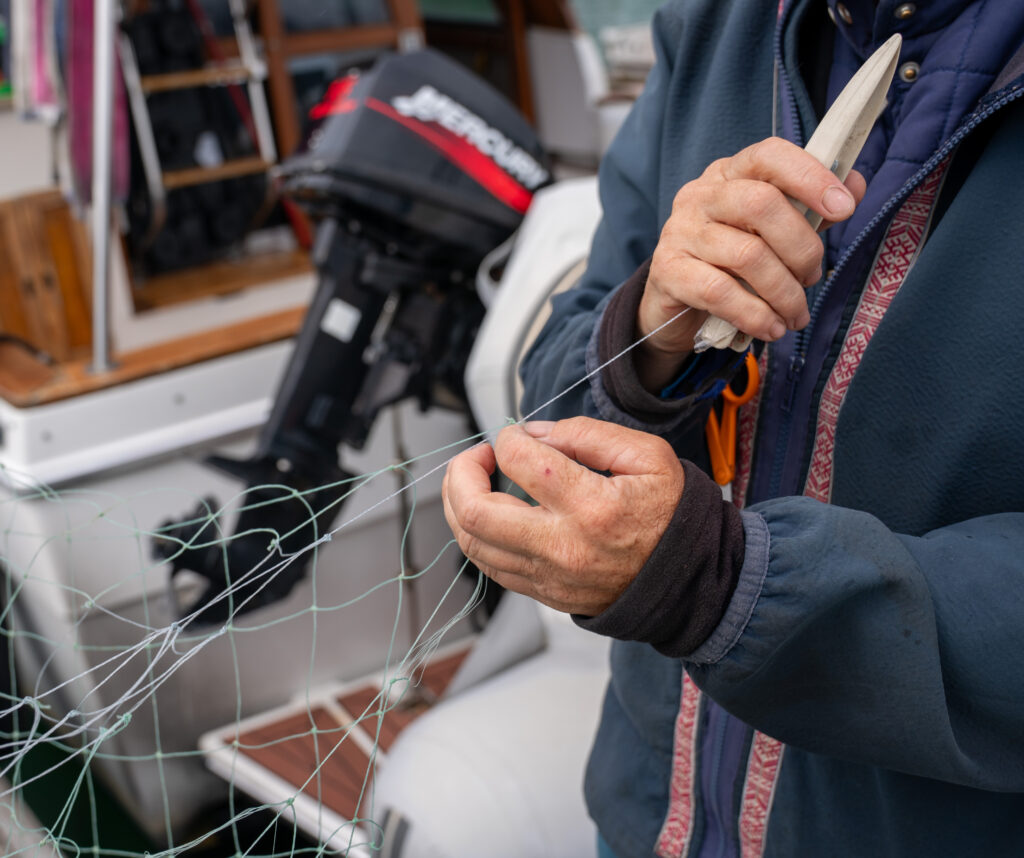
Rebecca Brewer fixes a fisherman’s net on the dock on June 26, 2026 in Haines, Alaska. (Lizzy Hahn/ Chilkat Valley News)

Commercial fishers from the Chilkat Valley are reporting success during their first two weeks. The fishery had its first opening on Father’s Day, with 90 boats fishing in District 15, or the Lynn Canal. The first opener lasted two days with an estimated total of 91,658 fish caught.  Just over 88,000 of them were chum salmon, according to the Alaska Department of Fish and Game.

Dawson Evenden, a gillnetter from Haines, said many were pleasantly surprised with the volume of fish. Evenden was fishing in Boat Harbor, located about 46 miles south of Haines. Evenden said he was mainly going after the chum salmon, which people were chasing in the southern end of the Lynn Canal, rather than the sockeyes in the northern end.

Greg Smith, communications director for Alaska Seafood Marketing Institute, said that there is a “strong demand for seafood in Alaska,” as well as across the U.S. and around the world. ASMI’s outlook report for the 2026 chum run reports that over the past three years, Japan’s chum run has collapsed.

The chum price per pound last year in Southeast last year was 66 cents. As of June 30, the price per pound for chums sits at $1.35 — a number that many said they have not seen in years. 

“It’s a good price for both (sockeyes and chum) but with a good price for chum, it doesn’t take very many to add up,” Evenden said. He is mainly going after chums because of their size and abundance in the canal.

Tenders from the Haines Packing Company and Silver Bay Seafoods in Sitka bought fish harvested during the first opener. Despite repeated phone calls and messages left with both processors, neither responded to questions about their plans for this year’s fishing season.

The Haines Harbor makes salt ice, using pool salt, for fishers to pick up before heading out. Harbormaster Henry Pollan said they typically make 16 to 26 tons of ice per opener, depending on the demand and how many boats are in the harbor before the opener starts.

Down on the dock on Friday afternoon, Rebecca Brewer was mending gillnets after various setbacks impacted fishers during the first opener. She named the highlights of the first opener as “big shreds,” including an Alaska Marine Lines tug and barge running through a net, a sport boat hitting another net, and someone else wrapping their net around an island.

“It’s been a heck of a week for repairs. We’ve been working nonstop all week,” Brewer said. She has been doing net repairs for 18 seasons. 

Gillnetter Cynthia Adams left last weekend planning to be out on the ocean for most of the summer. 

“We’re going to try and hit it hard,” Adams said, with Boat Harbor being a main anchorage location. She said this was at least her 27th year gillnetting and captaining. Adams and deckhand Lucia Chapell are likely the only all-woman crew in the local fleet. Adams said the highest price she has seen for chum was a dollar. Last year, the price was not very good, however there were a lot of fish, Adams said.

“It seems like if the price is good, there aren’t as many fish,” she said. “The price is bad, there’s a lot of fish.” This year however, the price is good and there are a lot of fish.

Adams brought flowers and a suitcase of food from Trader Joe’s to enjoy while out on the water. She said they will enjoy salads and roasted veggies, with the goal of nurturing “your physical being because it’s hard work out there.” Fishing is open from 4 a.m. to 10 p.m., due to a night closure enacted by the Alaska Department of Fish and Game.

“It’s just nice to be comfortable and have some fun things like flowers to cheer you up if it’s rainy, if you’re working hard,” Adams said.

The gillnet season lasts until late September or October, depending on weather conditions and fish abundance.

“July is our big month. We work really hard and the [Southeast State Fair] is kind of the light at the end of the tunnel,” Adams said. She is boycotting the fair this year because the date is a week early compared with previous years. “It’s right in the middle of some of the best fishing we have.” 

Kyle Clayton went out during the first opener with veteran fisher J.R. Churchill, who showed him what hazards to keep an eye out for in the canal and around Mab Island. Clayton was a deckhand in Bristol Bay for eight seasons. This year is both his first season fishing in the Lynn Canal and his first time running his own boat. He said the Bristol Bay fishery was a much faster pace and had a shorter amount of fishing time compared with the Lynn Canal fishery that is “a little more sustained throughout the weeks.” 

Editor’s note: Kyle Clayton is a former owner of the Chilkat Valley News. 

The post Gillnetters see plentiful fish and high prices appeared first on Chilkat Valley News.

Categories
Alaska News

State increases non-resident king salmon fishing

(File photo/Chilkat Valley News) A family fishes on the Chilkoot River un 2021.

The Alaska Department of Fish and Game last week  increased the king salmon take allowed for non-resident anglers this summer, in response, department officials say, to lower-than-expected harvest. 

Previously, non-residents across Southeast had been permitted to keep one king salmon from July 1 onward. With the new regulations, non-residents will be permitted two, with king salmon caught before July 1 counted toward that limit. The new regulations make no changes to other user groups; resident anglers may keep two king salmon per day with no annual limit. 

The change comes with king salmon harvest in the region well below expected levels. Prior to the season, Fish and Game was targeting a total Southeast king salmon sport fish harvest of 43,600 fish. That number is just below the harvest allowed by the Pacific Salmon Treaty, which allocates specific portions of the king salmon take to geographic areas, gear groups and user groups in the United States and Canada.

In-season management to meet that target is partially the product of a relatively new regulatory regime, passed in early 2025 by the state’s Board of Fisheries. 

In the past, the regional troll and sport fisheries had overlapping allocations — the number of king salmon that could be harvested by each group.  With the sport fishery generally targeting king salmon earlier in the season, if sport fishermen caught more than they were allotted,  there would be a corresponding decrease in the troll fishing harvest later in the season. When the sport fishery undershot its allotment, the troll fishery would be given extra opportunity. 

That changed when the Board of Fisheries last year voted to separate the allotments. Instead of allowing the sport fish harvest to fluctuate above and below targets, compensated for by the troll fishery, Fish and Game is now directed to continuously adjust regulations in-season to meet allocation targets exactly. 

The change had strong support from the troll fishery and was opposed by a large number of charter boat and lodge owners. Trollers cited the lack of a limited entry system for tourist-oriented sport fish operations and argued the industry had been taking an outsize share of the king salmon population at the expense of troll openings. 

“There should be clear direction to ADF&G to implement inseason management as necessary to preserve both resident sport fishing opportunity and maintain the troll allocation,” wrote the Alaska Longline Fishermen’s Association in public comment on the management change. “Inseason management requires inseason harvest projections and responsive adjustments.”

On the other hand, the Craig Fish and Game Advisory Council called the change a “kiss of death” for the charter fleet due to potentially reduced harvest for non-residents early in the season. 

“Our business is absolutely dependent on sufficient non-resident access to king salmon in the early season… there is not enough access to other species of fish during this time of year, and non-residents will simply not travel across the country and spend the incredible amount of money that they do in our communities if this limit is reduced in June and early July,” said one public comment from Thorne Bay lodge owner Luther Jenson. 

This year, sportfish harvest has came in well below expectations. Based on data from before the regulation change, the fishery was expected to undershoot its 43,600 fish target by roughly 15-20%, said Fish and Game Haines area sportfish biologist John Whitinger. Now, state managers hope the new regulations will bring harvest closer to that target. 

On a regionwide level, Fish and Game staff don’t have a clear explanation for why harvest has been down. 

The total amount of fishing being done — known as effort — is roughly in line with last year, Fish and Game regional manager Troy Tydinco said this week. But the catch per unit, essentially the productivity of those anglers, is lower than expected. 

That could be explained by at least two different factors, Tydinco said: one, that the fish aren’t where they usually are, so anglers are missing them. Or, there are fewer fish than expected. Likely, he said, it’s a combination of multiple factors. 

There’s special concern about the king salmon population in the Lynn Canal: the king salmon sport fishery this year opened for the first time in nearly a decade, following years of low population numbers in the 2010s. 

Fish and Game’s preseason projection was for a strong run of Chilkat River king salmon, but there’s limited data in-season to determine whether that forecast is coming to pass. 

There’s king salmon abundance data from Fish and Game area researcher Brian Elliott, who runs a king salmon tagging project on the Chilkat river. The project consists of a tagging event and a recapture event, and there should be some preliminary data from that first tagging event in the next two weeks. But the data is only enough for a “ballpark” guess at run strength — enough to place abundance in categories of “good, average, or bad,” Elliot said — and not enough for a real estimate. That more accurate population estimate is only expected to come in early September. 

Meanwhile, some say Fish and Game’s effort to increase harvest will threaten the recovery of the Chilkat run. One of those voicing that concern is Ken Gross, who operates one of Lynn Canal’s two charter boats targeting kings.

With bad fishing so far this season, Gross assumed new regulations would restrict harvest, and was surprised to find fisheries managers have done the opposite.

Theoretically, with his majority non-resident clientele, Gross is part of the group that stands to benefit from loosened regulations on non-resident anglersBut Gross says he’s more worried about the long-term health of the stock, especially given that he believes his business won’t even see a short-term boost. 

While the new regulations allow more retention for non-residents, his charter operation is primarily catch and release, he said, almost by necessity: “I can’t take care of meat on my boat. You can’t bleed them or gut them, and I don’t even have ice on my boat. (Clients) can’t take it to a processor, they can’t take it on a cruise ship, and the restaurants aren’t allowed to cook it.” 

One group that can benefit and take more meat home are Canadian anglers, he said. But he called that “absurd,” in light of the years of closures for locals. 

Fish and Game staff have a different perspective, noting the unlimited annual limit for locals. 

“It is in legislation that the fishery is managed so residents have priority, no matter what,” Whitinger said. “This measure does not impact that because residents have an unlimited annual limit. We’re providing opportunity for non-residents, but still not giving them more than residents.” 

That’s another effect of the new system voted into place by the Board of Fish, which aims to hold resident limits steady and instead use non-resident limits as a primary in-season management tool. 

Both Tydinco and Whitinger also pointed to restricted area on the Chilkat side this year as a special conservation measure meant to protect the local stock. The river is closed to anglers from around Kochu Island north — roughly even with the Chilkat State Park entrance — through July 15, at which point most of the run is expected to have migrated into the river, Whitinger said. 

Whitinger also pointed to area-specific factors that he said will decrease the impact of the new regulations on the Chilkat run. 

In Southeast broadly, non-residents represent about three-quarters of the king salmon sportfish harvest. The Lynn Canal, however, only has the two charter operations, which Whitinger believes will reduce the impact of the new non-resident regulations. 

As new harvest projections come in, the regulations may yet again change. 

“We project effort and harvest and inevitably, it’s not exactly what we anticipate,” Tydinco said. “As we go through the season we’ll have to keep fine tuning and making adjustments. Ideally we’d set the regulations perfectly and leave them in place. We’re trying to balance stability in the fishery and meeting the allocation; we may have to make adjustments again toward the end of the season, though it’s our hope we don’t have to.”

The post State increases non-resident king salmon fishing appeared first on Chilkat Valley News.

Categories
Music

Trisha Yearwood’s Debut Album Made Her a Star Overnight

She was a star straight out of the gate! Continue reading…​Country Music News – Taste of Country

Categories
Music

Top 10 Chris Stapleton Songs – Country’s Most Important Artists

Before he ever stepped into the spotlight, Chris Stapleton was already shaping country music — just from behind the scenes in Nashville. Continue reading…​Country Music News – Taste of Country

Categories
Music

Top 10 Chris Stapleton Songs – Country’s Most Important Artists

Before he ever stepped into the spotlight, Chris Stapleton was already shaping country music — just from behind the scenes in Nashville. Continue reading…​The Boot – Country Music News, Music Videos and Songs

Categories
Food

14 Aldi Sweet Treats That Will Shine All Summer

Aldi, known for its weekly Aldi Finds (aka “Specialbuys”), is also famous for its rotating list of seasonal treats. Here are the best for this summer.

​Food Republic – Restaurants, Reviews, Recipes, Cooking Tips

Categories
Politics

The World Cup has returned to a radically hotter America

Dangerously hot temperatures are blanketing the central and eastern United States as the soccer tournament enters its knockout rounds, putting tens of millions of people at risk.

Roughly a quarter of all matches since the start of the games are expected to be played in hazardous heat, according to an analysis by World Weather Attribution, which models how climate change influences extreme weather events. It also warns that the wet bulb global temperature — a measure of temperature, humidity and factors affecting heat stress in the human body — could rise high enough to justify postponing some games. Sticky, hot weather is not unusual in North America during summer. But extreme heat has intensified since the U.S. last hosted the World Cup in 1994.

“Around half of human-caused climate change has occurred since the World Cup was last hosted in North America in 1994. As a result, the climate that the tournament is being played in today has fundamentally shifted in just 32 years,” Joyce Kimutai, an extreme weather and climate change researcher at Imperial College London and lead author of the WWA study, said in an email.

Players aren’t the only ones that are affected. Fans often spend hours in stifling heat while attending outdoor celebrations or watch festivals. Stadium workers are also at risk. Organizers have attempted to reduce the threat by installing cooling stations and scheduling some games at off-peak heat hours. But the current heat wave could hit the games hard.

The National Weather Service estimates that more than 175 million people will endure temperatures this week that put them at major or extreme risk of heat-related health impacts. Some of the places facing the greatest dangers include World Cup host cities like Philadelphia, New York and Atlanta, where street parties filled with sweaty crowds and free-flowing alcohol put fans at greater risk of heat illness.

“A whole bunch of warm bodies standing close to each other does make it more difficult to cool down,” said Kristie Ebi, a scientist at the University of Washington who specializes in climate change and public health. “And alcohol of course is not a fluid one drinks for hydration. It tends to dehydrate people.”

Some host cities, like Kansas City, are bracing for this week’s heat after enjoying cooler-than-average temperatures during the tournament. Others, like Miami, have been sweltering since the games began.

“Pretty much every game in Miami has been played under oppressively hot and humid conditions,” said Tom DiLiberto, media director at Climate Central, which reports on the impacts of climate change and has been tracking its effects on the World Cup games.

Three games at Miami’s open-air stadium have been held at 6 p.m., when the sun is near its hottest point of the day. Climate Central estimates that there is a “high likelihood” that heat could impact player performance at all seven matches in Miami’s stadium and that climate change is increasing the odds of such heat by up to 20 percentage points.

Officials in Miami-Dade County say they’ve been tailoring their heat protocols since the World Cup began, adding new interventions as they experience the matches. The county’s emergency management department has added additional hydration stations near the stadium and elsewhere in the city, as well as cooling and misting stations, after observing a lot of people in need of relief. Officials have also tailored the languages on signs directing international visitors to cooling stations.

“We’ve learned from each of these matches,” said Jesse Spearo, assistant director of Miami-Dade’s department of emergency management. “Each one has changed a little bit.”

Other host cities have turned to Miami for advice. “Weather has always been kind of a big talking point with this group because Miami is always hot,” Spearo said. “We have been coordinating with them … saying this is what we’ve been doing for people, this is what we’ve learned, this is what you should be emphasizing to fans.”

Public health agencies that track heat-related hospitalizations in host cities say they haven’t seen statistical spikes directly linked to the World Cup. But fan celebrations have offered cautionary tales: 110 heat-related medical incidents were reported at a Houston fan festival on the World Cup’s opening day, FOX Weather reported. And Miami-Dade’s fire rescue teams have reported an uptick in heat-related illnesses among people requiring medical transport, Spearo said.

The extreme temperatures this week could put host cities under strain.

State and county emergency management agencies in most host cities affected by the heat wave did not respond to requests for comment on their heat action plans. A spokesperson for the Dallas emergency management office referred questions to the city’s FIFA organizing committee, which referred questions to FIFA.

A FIFA spokesperson said climate-related risks “are assessed as part of overall tournament planning and managed in close coordination with the host cities, stadium authorities and national agencies.” It’s working with medical experts and national meteorological and emergency management authorities on contingency plans, the spokesperson said.

Ebi, the public health expert, said the biggest challenges around the collision of extreme heat and international sporting events often revolve around communication strategies.

“The protections that need to be in place for periods of high temperatures are the same for all human beings,” she said. “What’s different is how do you reach people who may not be watching the news? How do you reach people who may not have English as a first language?

As public health experts worry about spectators in this week’s heat, some scientists also worry that FIFA isn’t doing enough to protect its players.

It’s “absolutely ridiculous” for FIFA to be hosting games at 5 p.m. and 6 p.m. in a place like Miami, said Douglas Casa, a kinesiology professor at the University of Connecticut and head of the Korey Stringer Institute, which researches ways to prevent athlete deaths from things like extreme heat.

“We can anticipate the risks, and there’s a lot of strategies you can have in place to absolutely minimize the risks,” he said, pointing to holding games later in the day, extending hydration breaks when temperatures are high and having aggressive cooling strategies during halftime.

Casa signed onto a May letter to FIFA with more than 20 climate and public health experts that called FIFA’s current guidelines on heat stress mitigation “inadequate” and “impossible to justify,” saying they could put players at risk of heat injury.

FIFA’s heat guidelines for players only mandate cooling breaks if the wet bulb global temperature, or WBGT, exceeds 32 degrees Celsius (89.6 degrees F). It leaves the decision to cancel or suspend a match to the organizers.

That doesn’t line up with guidance from the global players’ union known as FIFPRO, which recommends breaks once the WBGT exceeds 26 degrees and says matches should be delayed if the WBGT temperatures top 28 degrees.

“FIFPRO believes that FIFA’s guidelines do not do enough to protect the health and performance of players,” the organization says on its website.

“FIFA continues to monitor conditions in real time, integrating Wet Bulb Globe Temperature and Heat Index surveillance, and stands ready to apply established contingency protocols should extreme weather events occur,” the FIFA spokesperson said. “Outdoor matches during the hottest parts of the day have been strategically limited, kick-off times adjusted in certain markets, and matches expected in warmer windows prioritised for covered stadiums where possible.”

When Qatar hosted the last men’s World Cup in 2022, FIFA moved the matches to November to avoid the hottest time of year. But summers elsewhere are quickly becoming a concern as climate change accelerates.

Temperatures are forecast to be close to 100 degrees on Saturday when Paraguay takes on France in Philadelphia. Even Toronto, which isn’t used to such extreme heat, is expected to see temperatures in the 90s for its Thursday game.

It also doesn’t end with this year’s matches, said DiLiberto from Climate Central. The next men’s World Cup in 2030 will be in Morocco, Spain and Portugal — areas that saw a major heatwave this month and have much less access to air conditioning.

“If you take these sorts of huge events and put them in incredibly hot conditions in places without air conditioning, you can expect to see a whole host of other health issues,” DiLiberto said.

​Politics

Categories
Politics

Why this year’s World Cup is so pricey

Americans are breaking the bank to attend the FIFA World Cup.

This year’s tournament is historically expensive for fans looking to support their favorite teams in person. Tickets for group stage matches routinely cost more than $1,000 in the months before tournament kickoff, reportedly even drawing the ire of President Donald Trump.

Ticket problems don’t end there. A number of states have launched investigations into whether FIFA misled fans over the location and quality of seats they bought to attend matches. Many fans who bought tickets on resale sites have fallen victim to ghost ticketing, in which resellers flog tickets they don’t actually have.

To get a better sense of it all, POLITICO talked to Florian Ederer, a professor of markets, public policy and law at Boston University’s Questrom School of Business — and a soccer super fan. He’s written extensively about World Cup ticket pricing and access during the tournament, and hopped on the phone the day before his beloved Austria takes on Spain in a knockout match Thursday.

This interview has been edited for clarity. 

Why are World Cup tickets so expensive this year?

Well, there are several factors in this. Number one is that this is the biggest sports event in the world. There’s tremendous demand for it. It only happens every four years. FIFA basically has a monopoly on this biggest sports event, there’s nothing that sort of can supplant it. You can’t start a rival league or anything of that sort. Secondly, the event is being held in the United States and in Canada and in Mexico, in particular the U.S. and Canada. These are some of the richest countries in the world, they have also very, very, very large populations, and Mexico does too.

You also talk about another phenomenon, that FIFA has realized this is an opportunity to maximize profits. 

It has also adopted two additional things. One is price discrimination, which is that all the group stage matches of previous World Cups were all priced exactly the same. And here, FIFA has taken the approach, well, England vs. Croatia is a more interesting match than Algeria vs. Jordan, and so we’re going to set prices higher for England Croatia than for Algeria Jordan.

They’ve also introduced dynamic pricing, so the price that I get charged for buying a ticket, even if it’s the same ticket for the same game, is going to be different depending on when I buy. Basically like buying a ticket for an airline.

The third tactic that FIFA has engaged in — in addition to price discrimination, dynamic pricing — is that they’ve also done some very opaque supply management, where they’ve not made it clear at all as to how many tickets are actually available at any given time, and they’ve created a little bit this artificial scarcity where they want to keep fans in the dark as to whether they should buy now at higher prices, or just wait until the very end, and maybe get a good deal close to the start of a game.

Then there’s ghost ticketing and other practices out on the secondary market that sometimes leave fans outside a World Cup stadium arena with no tickets, even though they spent the money on a resale platform.

This is something that I think is separate from FIFA. I think the problem there is that the platforms have not used sufficient fines and punishment for resellers that are not fulfilling these promised transactions. The reason they are not fulfilling those transactions is because they resold those tickets for a potentially very interesting match already three months before, and then the prices increase even further, and then the temptation is, of course, to not deliver on that transaction, and instead resell it on another platform for even higher markups. And this is, of course, when these platforms should step in and say, look, you know, somebody was deceived here. We need to institute fines to keep those non-reputable sellers off our platforms.

Are there any steps the federal government could take to make things easier for consumers next time around?

I think there should be much clearer guidance that gives consumers information about how many seats are actually available and what are the prices, and then I think that’s an issue of just consumer transparency and lack of deception that can absolutely pass with legislation. Similarly, with those ghost tickets, I think you should be able to hold the platform liable for these issues, rather than just any particular seller, and the platforms should have to compensate these buyers for other charges that they incurred. If I’m buying a vacation to Dallas to see Austria vs. Argentina, then I’m not just buying the ticket on a platform, but I’m making everything else reliant on that ticket.

FIFA President Gianni Infantino has defended the high cost of attendance in recent months, telling an audience at the Milken Institute Global Conference in California in May that the organization was applying “market rates” to its tickets.

“We have to look at the market — we are in the market in which entertainment is the most developed in the world. So we have to apply market rates,” Infantino said. “In the U.S. it is permitted to resell tickets as well. So if you were to sell tickets at the price which is too low, these tickets will be resold at a much higher price.” 

​Politics

Categories
Alaska News

Free legal aid services in Alaska get a boost from state and foundation funding

The state courthouse in Nome is seen on April 8, 2026. (Photo by Yereth Rosen/Alaska Beacon)

More Alaskans are set to have access to free legal aid as Alaska’s largest provider of legal assistance for civil cases gets a boost in short and longer term funding from the state and the Rasmuson Foundation. 

The Alaska Legal Services Corporation is a nonprofit that helps Alaskans with civil legal issues such as housing, public assistance, family law like custody disputes and protective orders, wills and probate issues, Alaska Native law and other areas specific to veterans, seniors, and people with disabilities. It is also the largest provider of free legal services for survivors of domestic violence and sexual assault. 

State funding for the agency comes from legal civil punitive damages and filing fees in the Alaska Court system. This year, the Alaska Legislature approved an increase from 10% to 25% of fees, estimated at roughly $460,000 per year. Gov. Mike Dunleavy allowed the legislation, House Bill 48, to go into law without his signature on June 4. The bill is set to go into effect next July, in 2027. 

Maggie Humm, executive director of the corporation, told lawmakers she estimates the organization turns away one person for every person they help due to limited resources. She said they provided legal assistance in over 5,400 cases, impacting nearly 15,000 Alaskans last year. 

On Wednesday, Humm said in an interview that she and her colleagues are grateful for the state’s support and expect that sustained funding will help the agency assist an estimated 800 more households each year. 

“So that’s very encouraging for us, particularly because when folks, if they do get turned away from our services, they often have nowhere else to go,” Humm said.

While every criminal defendant has the constitutional right to a lawyer, that’s not the case for civil cases. Nationally, only about 8% of legal problems are adequately addressed in low-income households, Humm said. “It can result in just a cascade of consequences for them, particularly low-income Alaskans, because their legal problems often impact their livelihood, their housing, their ability to put food on their table, the safety of themselves or their children,” she said.

Also on Wednesday, the Rasmuson Foundation, an Alaska-focused family foundation, announced an award to Alaska Legal Services Corp. of $1 million to go toward the agency’s Community Justice Worker program.

The program trains community members who are not lawyers to provide legal assistance on specific issues, under a rule approved by the Alaska Bar Association in 2022, Humm said. It’s a significant boost for the agency whose budget is roughly $9.5 million. 

“We are creating an additional level of legal helpers for our communities, and with the hope that we will be able to help more people,” she said. 

Humm said the model is inspired by the tribal Community Health Aide Program model, aimed at training local residents to serve as healthcare providers, particularly in rural and remote Alaska communities. The community justice workers are trained in providing legal assistance for debt collection defense, the enforcement of the Indian Child Welfare Act, Supplemental Nutrition Assistance Program advocacy, domestic violence protective orders and probate and wills, Humm said. 

“We have trained our first class of CJWs to represent folks in court in domestic violence protective order hearings, so we have staff CJWs who are already practicing in court, which is very exciting,” she said.

Gretchen Guess, President and CEO of the Rasmuson Foundation, said in an emailed statement Wednesday that the organization supports ALSC’s work to expand access to legal assistance. 

Its Community Justice Worker Program is a proven, innovative approach to ensuring Alaskans can receive appropriate legal services, regardless of where they live. Rasmuson Foundation’s mission is to empower Alaskans to help each other, and we believe Alaska Legal Services is doing just that with this growing network of community justice workers,” she wrote.

Humm said the agency currently provides services in roughly 200 communities across Alaska, with the ultimate goal to expand to all communities.

“Our dream is to have a community justice worker, a legal helper in every community in Alaska, so that would be really wonderful,” she said. “But we’re going to set our sights high, and get as many community justice workers as we can across the state.”

SUPPORT: YOU MAKE OUR WORK POSSIBLE