SEATTLE — In late May, Greg Moriarty formally presented his credentials to President Donald Trump as Australia’s man in Washington. But it wasn’t until mid-June that Moriarty encountered one of the U.S. officials he most needed to meet: Energy Secretary Chris Wright, whose department plays a key role in critical-minerals deals between the two countries.
Moriarty’s encounter with Wright did not take place at the Energy Department’s headquarters just off the National Mall in Washington, or at any of its many facilities around the country. Rather the men met at Lumen Field in Seattle, at last Friday’s crucial World Cup match between their countries, where Wright led the U.S. delegation — an auspicious occasion for an envoy to make connections in a new post.
“The United States is a very sports-mad country, so is Australia, so [it’s] a great opportunity to get to know them on a different level, because you might touch on one or two items of business,” Moriarty said in an interview. “But it’s generally just so that you can both enjoy the spectacle and the connection that we both have through sports.”
Moriarty also introduced himself to Health and Human Services Secretary Robert F. Kennedy Jr., a figure of particular fascination in Australia given that country’s embrace of harsh Covid-era lockdowns, as well as members of Congress in attendance. Moriarty, a former defense secretary and national security adviser, will work to keep Washington’s foreign-policy establishment focused on the Indo-Pacific in a year when its attention has drifted alternately to the Arctic, Caribbean and Persian Gulf.
“The United States is a superpower. It clearly has global commitments and global responsibilities,” said Moriarty. “But Australia, we think that the United States’s commitment to the Indo-Pacific is very solid.”
In Seattle, however, business was front of mind for Moriarty, who finds himself fighting a new 12.5 percent tariff that the Trump administration has imposed on countries accused of not doing enough to prevent slave labor in their supply chains. At the waterfront Edgewater Hotel, Moriarty joined corporate leaders — including Microsoft’s Australian-raised Deputy General Counsel Antony Cook, who has taken a leading role in the company’s approach to AI regulation, and Mikaël Limapalaër of heavyweight pension fund Australian Super — to discuss the future of the bilateral trade relationship.
Moriarty is unusual among Australia’s ambassadors to Washington for not having been a politician — his immediate predecessor, Kevin Rudd, previously served as the country’s prime minister — but he already shows a deft instinct for intertwining economic ties, military alliances and cultural affinity. At one point, he linked a coming National Football League game in Melbourne to the arrival of nuclear submarines as part of the AUKUS security partnership.
“We’re really keen to sort of see how we can use American football to grow an audience in Australia, that will again be really good for the business connections and the people-to-people connections,” said Moriarty.
“Australia will be ready to host the first rotation of U.S. submarines by the end of next year, and we’re hoping that all the Americans who come down to and live down in Western Australia bring their own love of football.”
Dan Sullivan of Petersburg (left) filed to run against Republican incumbent U.S. Sen. Dan Sullivan. (Campaign photo by Dan Sullivan and photo of the senator by Corinne Smith/Alaska Beacon)
An Anchorage judge heard oral arguments on Thursday in a case poised to decide whether the Alaska Division of Elections has the authority to remove a candidate with the same name as the incumbent from the race for U.S. Senate.
The court is expediting the case and a decision is expected Friday. Any appeals are expected to be before the Alaska Supreme Court on Monday, ahead of a looming deadline for the division to print primary ballots no later than noon on Tuesday, June 30.
The division made the unprecedented decision to remove Dan J. Sullivan, a retired teacher from Petersburg, from the ballot on June 15, citing a “preponderance of evidence” the candidate had not filed a “good faith candidacy” and filed with the purpose to “confuse or mislead” voters.
Sullivan appealed that decision, saying he meets all eligibility requirements to run for office. He challenged the state’s decision as unlawful, and requested the court overturn the decision and restore his candidacy on the Alaska ballot for U.S. Senate.
In opening arguments, attorneys for the Division of Elections defended the decision to disqualify Sullivan from the ballot. They said the state has a duty to protect voters from confusion, and that the state is not obligated to place a candidate on the ballot where evidence shows the candidate is seeking to “compromise the fairness of the ballot.”
Sullivan was one of sixteen candidates to file to run for one of Alaska’s U.S. Senate seats, challenging Republican incumbent U.S. Sen. Dan Sullivan in the high-stakes election that could determine the control of the U.S. Senate after the November elections. One candidate has withdrawn since then, leaving 14 challengers, including former Democratic U.S. Rep. Mary Peltola. The November election results will determine a candidate for a six-year term.
Critics of Sullivan said he was trying to confuse voters to the benefit of Peltola, the Democratic front-runner. Officials with the Peltola campaign and the Alaska Democratic Party have said they have no affiliation with either Sullivan.
Attorneys representing the Petersburg Sullivan and the Alaska Division of Elections went head to head in livestreamed Superior Court hearing, where over 300 viewers tuned in but others were not able to watch the stream. Officials with the court later apologized calling it a “record-breaking” livestream and posted a recording on their website.
Jeffrey Robinson, representing Sullivan, opened his argument reiterating that Sullivan met all the constitutional requirements to run for office: at least 30 years old, a U.S. citizen, and an inhabitant of Alaska if and when elected.
Jeffrey Robinson, an attorney for Dan J. Sullivan, argues his appeal case in Anchorage Superior Court on June 25, 2026. (Screenshot of court livestream)
“Mr. Sullivan unambiguously meets each of these criteria,” Robinson said. “As seen in previous cases, states are not allowed to add to those qualifications.”
He cited the case where the Alaska Democratic Party sought to remove Eric Hafner, a U.S. House candidate imprisoned out of state, and the division did not investigate his motives but found he met the qualifications to run for office. Robinson argued the state has subjectively and unlawfully added additional criteria for Sullivan, including restrictions on his perceived political goals, how he presents his name, campaign and his party affiliation.
“Here the division imposed a substantive mental state-based qualification for U.S. Senate candidates in Alaska, and then it cynically and arbitrarily determined that Mr. Sullivan did not meet that qualification,” he said.
Robinson said it’s up to political campaigns to distinguish candidates and educate voters. He agreed the division has the authority to make sure candidates appearing on the ballot do not confuse voters, and noted that there are state regulations that offer solutions, like adding middle initials. But he said there are no “good faith” requirements, nor any other regulations that would give the division such broad authority to look at a candidate’s motives for office.
“They have no explicit authority in situations like this to even look into a candidate’s motives. Any subjective standard for candidates imposed by the division necessarily erodes the trust of voters,” he said. “If this standard were to apply, the director could challenge any or disqualify any potential reasons of personal dislike, or that the candidate may lose to their preferred candidate.”
Arguing for the Division of Elections, attorney Chris Murray said the division has the authority to review candidates and make sure the ballot is not presented in a way that would be confusing to voters.
Chris Murray, an attorney for the Alaska Division of Elections, argues against the appeal of Dan J. Sullivan in Anchorage Superior Court on June 25, 2026. (Screenshot of court livestream)
In this case, he said the division director, Carol Beecher, reviewed complaints against the candidate filed by the Alaska Republican Party and the National Republican Senatorial Committee, which works to elect Republicans, that say his name, party affiliation and campaign materials mimic the incumbent’s. Murray said Beecher found that Sullivan “accentuated the similarity” between himself and Sen. Sullivan.
“She was stuck with the preponderance of the evidence pointing to this being a declaration of candidacy filed for the purpose of seeking office, but a declaration of candidacy filed for an ulterior purpose to cause voter confusion,” he said. “The director does not have the ability to permit that.”
Murray said in the Hafner case, there was no complaint filed prior to the primary on Hafner’s candidacy. He said the division has authority to review complaints and determine whether candidates made a “proper filing” before the primary, which they did for Sullivan.
“So where’s the line? The line is: the decision on qualification has to be made before somebody is placed onto the primary ballot, that is where Alaska law, that’s where the ‘properly filed’ comes in, that’s when there’s discretion in the Division of Elections — but that’s when the Division of Election decides who goes on the ballot, it’s before the primary election, that case was after the primary election,” he said.
Judge Thomas Matthews asked Murray how the division would handle the situation of three Dan Sullivans, in a hypothetical situation where a former Anchorage mayor, Dan A. Sullivan decided to enter the U.S. Senate race.
Superior Court Judge Thomas Matthews presides over the appeal case brought by Dan J. Sullivan challenging the Division of Elections decision to disqualify him for running for U.S. Senate on June 25, 2026. (Screenshot of court livestream)
Murray said a “genuine candidate” would seek to distinguish himself from other candidates, and the division could use a middle initial or notation like “challenger” or “nonincumbent” on the ballot.
“I would say that if you were dealing with all of them, and all of them were trying to get on the ballot in order to win, I think they would all be cooperatively participating in a process where they could be effectively distinguished from each other, so as to avoid voter confusion. That’s not what we have here,” he said.
Judge Matthews asked if there was a way to effectively distinguish the two Dan Sullivans.
Murray said he did not believe that is the division’s responsibility if the candidate’s goal is to confuse voters. “Where the confusion is the goal, Your Honor, we don’t believe the division is under an obligation to try and mitigate it or accommodate it,” he said. “The court could order that the division implement some method to distinguish him, and I’ll say right now, we don’t think a middle initial is sufficient.”
Murray also argued the court ruling would be an important precedent for the division to administer elections.
“If this decision is not affirmed, and it turns out that the court holds that Alaska is just simply powerless, and the division is powerless to stop this sort of behavior, we’re going to be inviting more of this,” he said.
Judge Matthews said he will announce a ruling by Friday, and it could be after business hours.
Attorneys for Sullivan also filed a stay with the court to delay the division printing primary ballots until a final decision is ruled on by the courts. Matthews said he would consider the petition.
After the ruling, both parties are expected to appeal before the Alaska Supreme Court on Monday.
Many Costco shoppers are aware of the hidden gems that pop up in the liquor section. One of these limited-edition finds is this prized bourbon variety.
Mashed – Fast Food, Celebrity Chefs, Grocery, Reviews
Hyperpigmentation can be a frustrating, complicated skincare issue to treat. To answer all of our questions about how to treat it, we spoke to Dr. Muneeb Shah, the board-certified dermatologist,… E! Online (US) – Top Stories
The Anchorage Assembly will vote on new management contracts for Sullivan Arena, Ben Boeke and Dempsey-Anderson. City leaders say the change would improve operations, increase oversight and lower costs for the Municipality. The proposal has received mixed reactions from members…
OTTAWA — Mark Carney may be Canada’s loudest booster at the World Cup, but some of his countrymen fear he may be hurting more than helping — because he always does when it comes to sports.
In March 2025, the new prime minister joined the Edmonton Oilers for a pre-game skate. That night the Oilers fell to the Winnipeg Jets, followed by a wave of injuries on the team. Former Oiler and “Spittin’ Chiclets” podcast host Ryan Whitney took to X: “The Carney Curse is real for Edmonton. What the hell just happened. Guy is on the ice with the Oil this morning and now everyone is injured.”
Now some Canadians are worried that their prime minister has brought the “Carney Curse” to the World Cup, blaming him for Canada’s defeat against Switzerland on Wednesday. His country’s only only goal coincided with a moment that Carney left his box seat at Vancouver’s BC Place.
For a brief, glorious moment last week, the Ottawa fishbowl wondered if the curse had been broken. Carney skipped Canada’s World Cup opener against Bosnia-Herzegovina. But then, after days of anxious whispers over whether he’d jinx the squad, the prime minister witnessed Canada thrash Qatar. If Canada had beaten or tied the Swiss, the team could’ve played as many as two elimination games in Vancouver. With the loss, they fell to runner-up — and a knockout-round game in Los Angeles against South Africa on Sunday.
Canada’s men’s soccer team joins an ever-growing list of inadvertent “victims” of prime-ministerial fanhood, including: the Toronto Blue Jays, who lost the World Series after Carney visited the team; the Canadian women’s rugby team, for whom he traveled to the United Kingdom to cheer on at the World Cup last summer; and the Montreal Canadiens, whom he dubbed “Canada’s team” during the Stanley Cup playoffs.
Nina Dobrev and Paul Wesley are bringing their onscreen chemistry back from the dead.
The former Vampire Diaries costars confirmed they are set to team back up for an upcoming TV series based on… E! Online (US) – Top Stories
(The Center Square) – Justice Colleen Melody says voters should consider her appellate experience as they weigh their options for the Washington Supreme Court this August after she joined the bench last January following her appointment by Gov. Bob Ferguson.
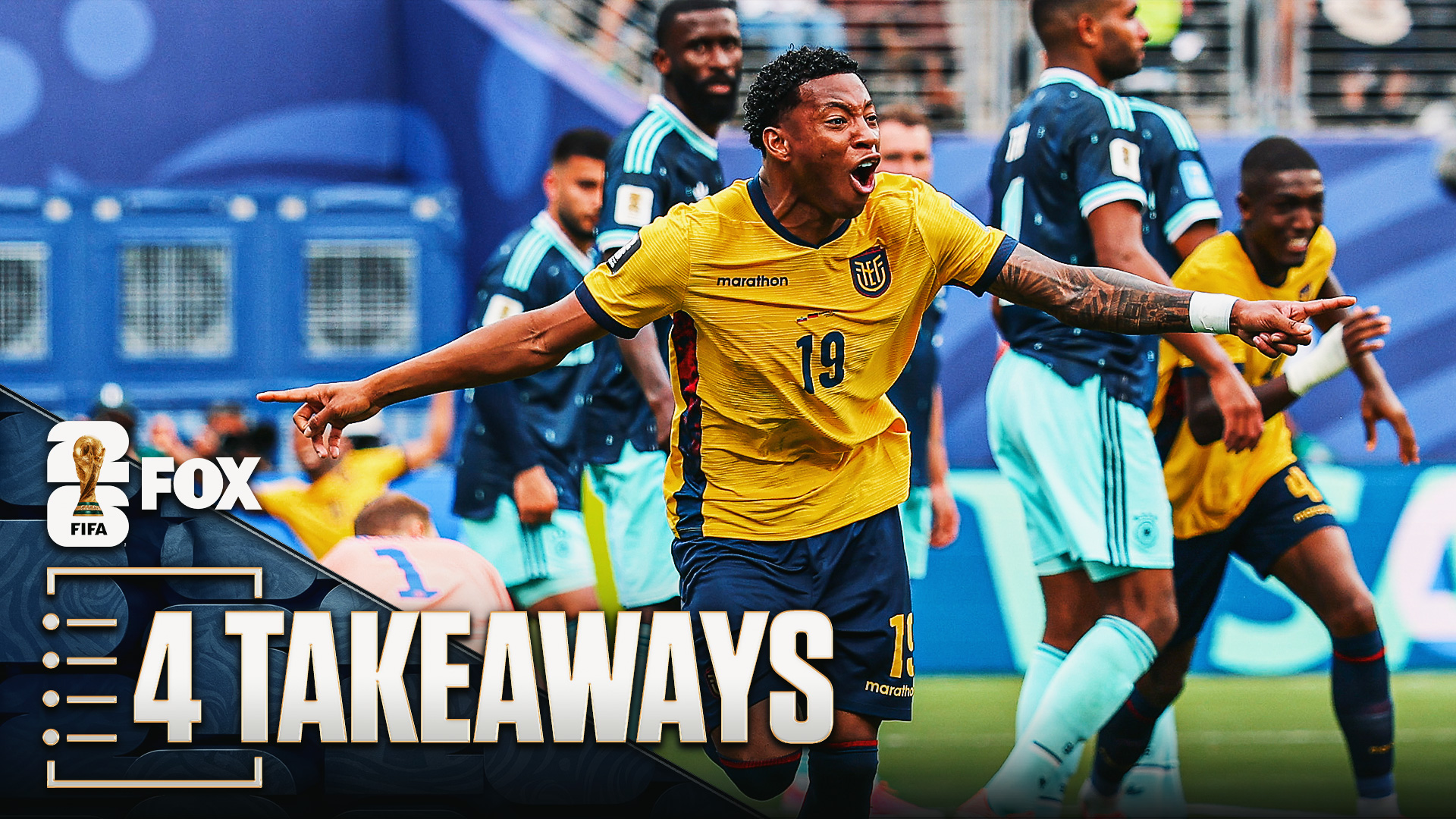
Germany still tops the group. Ecuador finally found its finishing touch. Germany lost, and it cost the team nothing. Ecuador won, rescuing its World Cup dreams. On a hot Thursday afternoon at the New York New Jersey Stadium, Ecuador came from behind to stun a strong Germany side, 2-1 — a result that means wildly different things to the two teams trudging off the same field. Julian Nagelsmann’s side top Group E regardless. Sebastián Beccacece’s side leaves with its first goals of the tournament and is currently the best third-place team. Here are my takeaways: 1. Germany Top The Group — And Can Afford A Night Like This Here’s the perk of sealing your group early: you can lose like this and barely feel it. Top spot was secure before kickoff, so Thursday was a free hit, and Julian Nagelsmann’s side played like a team that knew it. It struck inside two minutes, then eased off. The press loosened. Ecuador pounced. The positives remain real, though. Seven goals past Curaçao. A grown-up win over Ivory Coast. Tons of attacking midfield talent. The back line wobbled, the finishing vanished and the complacency will gnaw at Nagelsmann all the way to the round of 32. But nobody lifts the trophy in June. You qualify, you learn, you move on. Germany has the first part down. 2. ¡Sí Se Puede! Ecuador Found Its Goals At The Perfect Time Two games, zero goals. Then the group winners rolled into town, and Ecuador remembered where the net was. That’s its whole tournament. A 1-0 loss to Ivory Coast, which it was incredibly wasteful against. A toothless 0-0 draw with Curaçao. An attack allergic to the final third. And then, against Germany of all teams, Nilson Angulo leveled inside 10 minutes, and Gonzalo Plata smashed in the winner with 13 to play, nodded down by substitute Kevin Rodríguez. Sebastián Beccacece always had the spine. Moisés Caicedo and Pedro Vite ran the middle. Vite set an Ecuadorian record for tackles in a World Cup match. The missing piece was a punch up top, as the living fossil Enner Valencia feels like a relic from the past. But in the most important game of the group, the squad collectively stepped up. Third place, four points, and — pending the other groups — a ticket to the knockouts. Sí se puede, indeed. 3. Florian Wirtz, Jamal Musiala, And A Reunion Worth Watching Remember when Florian Wirtz picked Liverpool over Bayern Munich partly to avoid sharing the No. 10 role with Jamal Musiala? Now they share it with Germany — the most tantalizing thing Nagelsmann owns. Thursday was a tease. Wirtz slid one gorgeous ball through to Musiala that Joel Ordóñez blocked superbly, then coughed up possession in the exact spots that made his Liverpool autumn such a slog. That’s the subplot. His £116 million move began miserably — no goal until after Christmas, mockery over the fee, the lot — before he roared back in the spring to look like himself again. The World Cup is the stage to finish that comeback. Pair a rediscovered Wirtz with a fearless Musiala between the lines, and Germany has a duo nobody wants to defend. A glimpse today. Imagine the team at its best for a full 90 in a game that actually matters in the knockouts. 4. Ecuador Didn’t Just Win — It Defended Like It Meant Everything Beating the group winner takes more than two good finishes. It takes a back line willing to throw itself in front of everything — and Ecuador had exactly that. Once Gonzalo Plata’s winner landed, the final stretch turned into a siege. Germany piled forward in waves; Ecuador refused to break. Willian Pacho, Joel Ordóñez and Piero Hincapié — three of the most composed young defenders at this tournament — blocked, headed and cleared everything coming their way. In front of them, Pedro Vite ran himself into the ground for nine tackles, the most by an Ecuadorian in a World Cup match on record and the joint-most by anyone at this one. Sebastián Beccacece spent two games hunting a goal. On Thursday, his side showed the other half of a knockout team: the intestinal fortitude to defend such an important lead against one of the best teams in the world.Latest Sports News from FOX Sports













 Hyperpigmentation can be a frustrating, complicated skincare issue to treat. To answer all of our questions about how to treat it, we spoke to Dr. Muneeb Shah, the board-certified dermatologist,…



 Nina Dobrev and Paul Wesley are bringing their onscreen chemistry back from the dead.