Singer Tyler Farr is opening up about the “freak deal” that led to him suffering a severe concussion. Continue reading…The Boot – Country Music News, Music Videos and Songs








Singer Tyler Farr is opening up about the “freak deal” that led to him suffering a severe concussion. Continue reading…The Boot – Country Music News, Music Videos and Songs
Singer Tyler Farr is opening up about the “freak deal” that led to him suffering a severe concussion. Continue reading…Country Music News – Taste of Country

Bering Sea snow crab, with two specimens seen in this undated photo, support an iconic Alaska seafood harvest. A crash in population triggered two consecutive years of closures, starting in late 2022. Federal officials are now providing $75.2 million in aid for the lost Bering Sea snow crab harvest in the winter of 2023-24, part of an aid package for recent fishery disasters in Alaska, Washington state, Oregon and California. (Photo provided by National Oceanic and Atmospheric Administration)
Alaska has been allocated about $99 million in new fishery disaster assistance, making up the majority of the $123.6 million in aid that federal officials on Wednesday said is headed to Alaska, Washington, Oregon and California.
In Alaska, the money is to address previously declared fishery disasters for Bering Sea snow crab and Chignik and Cook Inlet salmon harvests, the National Oceanic and Atmospheric Administration’s Fishery service said.
For the lost snow crab harvest of the 2023-24 winter, the second year that the usually lucrative fishery was canceled because of low stocks, NOAA Fisheries is allocating $75.2 million in aid. That follows a 2024 allocation of $39.5 million in aid for the lost harvest in the winter of 2022-23.
Snow crab harvests have now resumed, though at much lower levels than in past years.
For the Chignik salmon disaster that occurred in 2022, the agency is allocating $18.5 million in aid. For the declared disaster for the 2023 Upper Cook Inlet east side setnet salmon harvest, the agency said it is allocating $5.8 million in aid.
Other aid announced on Wednesday was for salmon disasters in 2023 and 2024 in California, Oregon and Washington state.
“Fishery resource disasters have devastating effects on local communities and our economy,” NOAA Administrator Neil Jacobs said in a statement. “This disaster funding provides much needed assistance to our fishing industry, and we will work with the affected communities to help them recover. This action demonstrates our continued commitment to hardworking American fishermen and to the president’s vision to uphold the United States as the world’s dominant seafood leader.”
Under federal law, NOAA Fisheries may provide aid to address disasters affecting commercial seafood harvests and losses to subsistence harvests. However, aid distribution depends on appropriations from Congress; there is no standing fund for NOAA to use for its disaster assistance program.
While aid amounts are now on their way for the three named 2022 and 2023 harvests, there are 13 pending disaster-assistance requests for various Alaska harvests that were plagued by problems in 2024 and 2025. Those fisheries are in multiple locations around the state, from Kotzebue in the northwest to the Yukon River in Interior Alaska to Prince William Sound in the eastern part of Southcentral Alaska.
In a joint statement, Alaska’s two U.S. senators said they were grateful for the assistance to harvesters and communities coping with multiple fishery disasters.
“Our fishing industry is part of the beating heart of coastal Alaska, but seemingly every fishery over the last decade has been hit hard by disasters beyond their control,” Sen. Lisa Murkowski, R-Alaska, said in the statement.
Sen. Dan Sullivan, R-Alaska, used similar wording: “Alaska’s subsistence harvesters, commercial fishermen, and fishing communities have endured a series of fishery disasters and stock collapses beyond their control, threatening livelihoods and entire coastal economies.”

Journalist Priska Neely from Birmingham, Alabama visited friends in Haines recently. This was Neely’s first visit to Alaska. She said the highlights of the trip were kayaking on Chilkoot Lake, operating a stick-shift vehicle for the first time in five years, whale-spotting, picnicking on Battery Point Trail, and having the best nap of her life. Neely took her legendary snooze on the fluffy grass in Fort Seward at the very same time Mayor Tom Morphet was also spotted enjoying a midday nap. Neely found herself volunteering at the Victory Garden later in the week. She learned an important lesson about personal growth and garlic with garden coordinator, Sarah Ammons, and shared it with followers on her social media where she posts regular “Life Lessons from Plants.”
Audrey Smith said the Alaska Arts Confluence recently installed two new artists’ work in the IGA windows for all to enjoy. Nancy Drake applies her love of portraiture to bears through the use of pastel, photography and woodburning. Justin Mitman’s ceramic rocks precariously balancing with a tiny gold nugget might suggest a balance that we try to achieve in our lives. These artists join Rhonda Degtoff, Helen Alten, Donna Catotti, Tom Ganner, Tresham Gregg and Denise Sherman-Stickler in the rotating window display.
Amelia Nash celebrated her birthday with much fanfare this weekend. Dave Thomas and Mollie Dwyer hosted a surprise petit parade of mini art floats, musical instruments, ribbon dancers, bubble blowers, kazoos and even a dinosaur, which burst in on Nash while she was enjoying a cocktail at the Port Chilkoot Distillery. From there, Nash was transported via wheelbarrow to the Big Gay Croquet bash underway at Fort Seward with help from Mike Swasey, Kelsey Lovig, Dirk Foss, Nick Schlosstein, Leah Wagner, Dustin Craney, and Rachel Saitzyk. The birthday parade joined roughly 40 croquet enthusiasts for a few rounds of tackle croquet, traditional croquet and killer ball croquet as well as hula-hooping and juggling. Prizes for Big Gay Croquet included hand-made rainbow wall hangings with devil’s club stalk, donated by Sue Clayton Folletti. Michelle Strohecker won Best Sportsmanship at the event. Nash’s half-century birthday bash went on to Dylan Morgan’s hostel in Officers Row for a taco bar, karaoke and a giant three-tiered lemon cake. The lemon cake was made by Andrea Nelson. It was nicely complimented by the bathtub full of prosecco, gifted by Nash’s sister Lenore Nash, who could not attend in person.
The Kluane Mountain Bluegrass Festival in Haines Junction, Yukon took place June 12-14 and was attended by a handful of faithful Haines bluegrass fans including Mardell Gunn, Nene Wolfe, Greg Podsiki, Judy Hall Jacobson, Terry Jacobson, Alison Adams, Tom Heywood, Marian and John Carlson, Chad Soiseth, Gina St. Clair, Dan Humphrey, Bill Finlay, Nancy McGrew, and Anna and Jim Jurgeleit. The festival has been drawing in Haines music fans since 2003 and includes bluegrass concerts, workshops, dancing, roving bands and plenty of camping options. This year four locals cycled to the festival, two cycled back. They reported strong headwinds and great music.
Ed Schmid, master glass blower and jack of all trades from Bellingham, Wa. was in Haines again recently. Schmid returned to visit his friend Bill Chetney and conduct some glass blowing lessons with locals and visitors at Viking Cove. Some of the highlights of this trip were flying over the glaciers and mountains with Drake Air, close encounters with migrating cetaceans, spout humps and flukes. One of Schmid’s pieces of art can be seen at the Hammer Museum, The Glass Claw Hammer with Handy Handle. Schmid made it in 2021 while teaching a local glass working class.
Lyndsey Marie DeFazio-Hura and her five year old son Jaxson Hura-Grant were both entered in the Haines sportsman’s associations Dolly Derby and on the prowl for Dolly Varden when they got a big surprise: a humpback whale, not two feet from them. Hura accidentally hit record and caught the short video of the whale bubble feeding right off the dock at Letnikof Cove about two feet from herself and Jaxson. He was standing at the side of the boat launch dock about to cast his line and she was about to get video of it. Right after the incident, she said that Jaxson marched up the dock and informed her that he was “done fishing for now, Mom!” She says that after a few minutes of negotiations he came back down and they watched the whale for a few more hours. Also noteworthy, Team Lyndsey Marie DeFazio-Hura and son won the final week of the Dolly Derby.
The Haines Animal Rescue Kennel board member Michelle Strohecker said a new “Tiny Library for dogs” came to fruition after the staff brought the creative idea to the board. The box, which looks like the Little Free Libraries seen around the world, is stocked with dog must-have’s for a good day in Haines. This includes, but is not limited to, balls, bandanas, squeaky toys, and a curated selection of the best fetching sticks in town. The library features pet waste bags for daily use, on the side. HARK staff say that dog lovers can replace items as needed, but ask that people not contribute food or treats, and clean toys only.
Local Haines artist Matilda Rogers has released her first album with the band Petty Thieves. The EP is five tracks called The Things We Stole, released June 4th. The album includes Maddox Rogers as producer, Aaron Davis, recording engineer and song writer Addison Myers. Myers and Matilda Rogers have been making music since they met while rafting in Wyoming.
The post Duly Noted: Birthday, gay croquet, a bluegrass festival and more appeared first on Chilkat Valley News.

From ageless wonders to breakout stars, the first week of the 2026 World Cup provided some outstanding performances. We’re here to highlight, position by position, players who deserve some recognition after each of the 48 teams in the tournament have played their first Group Stage game. Matteo’s Top Performers Going with a 4-4-2 formation, there are plenty of recognizable names alongside players who will be worth watching closely the rest of the tournament. The 40-year-old kept the world’s second-ranked side scoreless, making seven saves in a 0-0 draw with Spain on Cape Verde’s first-ever World Cup appearance. No one older has played in a nation’s debut World Cup match, and no keeper at this tournament has had a better afternoon. Morocco’s captain spent the night strolling through Brazil’s midfield and tearing up the left flank in a 1-1 draw that flattered the five-time champions. He’s now Morocco’s most-capped World Cup player, and still the most dangerous right back on the planet. When Curaçao stunned Germany with an early equalizer, the Borussia Dortmund center back restored order, heading home his first international goal in a 7-1 rout. Left-footed and calm on the ball, Schlotterbeck’s an important building block for Germany coach Julian Nagelsmann at the back. The most underrated defender at the tournament held Bosnia’s line together against a relentless Canada — never rushed, never beaten in a duel that mattered. Then, with the game on the line late, he threw his body in front of a goal-bound Larin shot to rescue the point. “Jedi” was the engine down the USA’s left in a 4-1 demolition of Paraguay, driving the ball forward for the move that teed up Balogun’s opener. Fulham’s asking price just went up on this evidence. He’s among the best left backs in the field. The teenage right midfielder dribbled and ran at Ecuador relentlessly. He created five chances — more than any player at the tournament — in the Ivory Coast’s 1-0 win over Ecuador. No goal, no assist, didn’t matter; you don’t forget a debut like that. The Brighton midfielder starred in a 5-1 thrashing of Tunisia with two long-range thunderbolts and ran the game in between. One of those strikes is already on the goal-of-the-tournament shortlist. At 18, he sat in the middle of the park against Brazil and dictated, making Casemiro and Bruno Guimarães look a step slow in that 1-1 draw. Alongside Diomande, he’s the breakout teenager of the opening round — and he plays like he’s been doing it for a decade. On a night Brazil looked ordinary, Vini cut inside and smashed an unstoppable strike into Bounou’s top corner to salvage a 1-1 draw with Morocco. He was the one Brazilian who actually looked like he belonged on the favorites’ list. Two first-half goals — the second a left-footed beauty into the upper corner. He bullied Paraguay’s backline all night and finally looked like the No. 9 this nation has been searching for years. He walked off with the official Player of the Match award against Tunisia, scoring once and setting up another goal. His partnership with striker Viktor Gyökeres looked like it could become one of the tournament’s best strike tandems. Luis Miguel’s Top Performers Let me just say that it was not an easy decision as many players deserved a nod. But in the end, these stood out to me as the best XI independent of of position not just for how they played, but for their approach and resilience. Is there any need to think about anyone else? Having to deal with 27 shots and seven saves (six of them inside the box), the 40-year-old goalkeeper produced one of the best performances in recent modern World Cup history, helping Cabo Verde earn a historic point against mighty Spain. His Instagram following count is not too shabby either these days. In front of the aforementioned Vozinha stood Diney Borges, who alongside Roberto “Pico” Lopes, created a formidable center-back pairing in denying any attempt from Spain. Lopes was great but Borges? It was a steel-driven display from the defender, who plays for Al Bataeh in UAE’s Pro League. Freeman was undoubtedly the unsung, underrated gem in the USA’s imposing win over Paraguay. The 21-year-old defender (and son of Super Bowl champion Antonio Freeman) practically won every battle, and it was thanks to his pass to Weston McKennie that started the sequence that led to the first goal. Freeman was very, very impressive. The Colombian full back is quite simply Sonic the Hedgehog. When he gets forward and out of nowhere, he can create magic out of nothing. Especially when he has distribution from Luis Díaz, who found the Crystal Palace man for a beautiful goal, which opened the scoring against Uzbekistan. Portugal just could not handle how to break through this man. After Pedro Neto failed, Rafael Leão entered – but again, Wan Bissaka stood firm. The tackle against the aforementioned Leão was a remarkable block. It was so good that the camera turned to Portugal manager Roberto Martínez, showing his frustrated reaction, knowing that Wan Bissaka and his Congolese teammates were simply not going to lose. I was at the game between Brazil and Morocco and let me tell you something, Bouaddi was exceptional. He created opportunities and driving runs, leaving the Brazilian midfield lost in disbelief. At 18 years old, Bouaddi, who was born in the north of Paris to Moroccan parents, was only allowed to play for the Atlas Lions last March when he was cleared by FIFA after France coach Didier Deschamps never called him up. Well, France’s loss is Morocco’s gain. What a talent. I wanted to give this spot to Australia’s Nestory Irankunda, but apologies, because Bellingham truly stood out against a tough opponent such as Croatia. And there has been so much talk about his role for England, from his positioning to his attitude. It’s all ridiculous, and I am glad he had the performance we witnessed on Wednesday, which included a goal with a statement. It was a wonderfully aggressive, determined solo effort that was there to prove a point. Balogun gave one of the best performances by an American male striker I have seen at the World Cup. It’s as simple as that. He became the first USA men’s player to score a brace in a World Cup match since 1930, but more than that, it was movement and creativity that opened the doors for other teammates to penetrate Paraguay’s box. Fantastic stuff from the Monaco forward. It was a match for the ages where Mbappé became France’s all-time top scorer after his remarkable brace in a 3-1 victory against Senegal. I was there to witness it and my goodness, the electrifying power of the Real Madrid star stood out in the second half and when he turns it on, it’s really quite a sight. Did you ever doubt I was going to include this man? I mean, what else is there to say? What other superlative could possibly exist that hasn’t been mentioned? Lionel Messi’s hat trick against broke multiple records (and Algerian hearts) but most importantly, it was a reminder that days before his 39th birthday, he’s a genius – and the greatest ever. Full stop. Norway fans will be upset at me right now for not including Erling Haaland but I had to include Kane over the Manchester City striker due to two factors. One, the difficulty of the opponent. And two, their overall contributions. Kane was unbelievable against Croatia, proving why he is the greatest English male striker. Gary Lineker agrees after Kane’s brace leveled England’s record in World Cup goals. He also became the second England player to score in three different World Cups (after David Beckham.) But it was more than his goals. His overall game is so important for Thomas Tuchel’s game plan, opening the pitch and becoming a provider and protector.Latest Sports News from FOX Sports
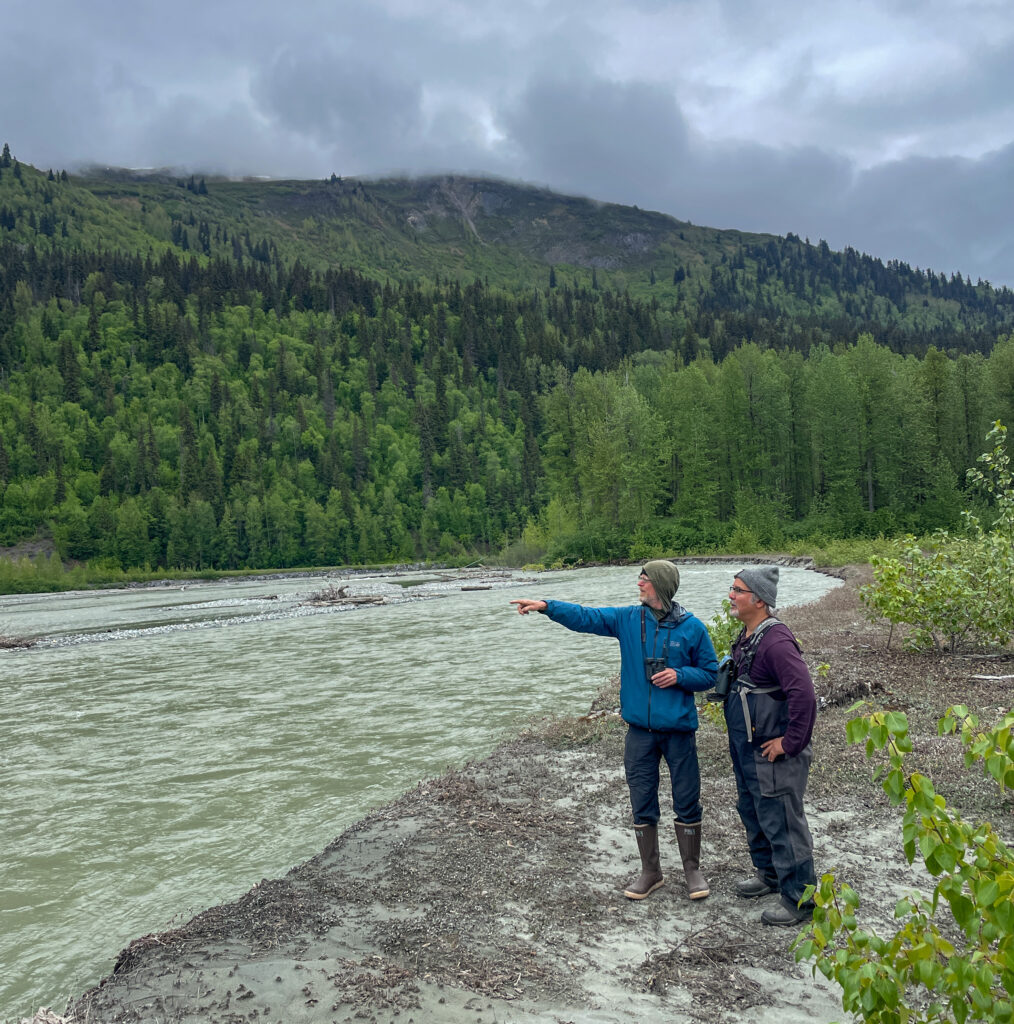
A lunch break on a gravel bar on the Klehini River wound to a close as Russ Lyman and Joe Ordóñez studied a massive log jam. The duo have guided raft trips in the Chilkat Valley for nearly 40 years.
The tangled pile of trees blocked one channel of the river and had the potential to flip one or both of the 16-foot rafts being used on this expedition.
The two stood on the riverbank, binoculars in hand, considering the group’s options.
In front of them, the logs were being squished together by the loud, strong current, with branches shaking. The white water below the logs pointed out just how much force was in front of this jam.
They devised a plan to avoid the jam entirely by crossing over two channels.
Ordóñez and Lyman took over the oars from guides in training and brought the boats across the first channel, where passengers hopped out to scoot the boat over a gravel bar. They then crossed the second channel, sticking to one side and watching the log jam’s immense force as the boat drifted by, unscathed. Lyman approached the situation with calm expertise, as the new guides looked on, learning from each paddle stroke. Passengers gripped the rope on the perimeter of the boat, keeping a steady eye on the jam they had just passed.
Once past the obstacle, Rainbow Glacier Adventures’ newest guides, Lydia Andriesen and Jack Kendall, took over the oars again. This is the duo’s first season as raft guides in the Chilkat Valley.
While looking out for obstacles downstream, Lyman began counting up roughly how many trips he had done on the Klehini and Chilkat rivers. He estimated that he would do roughly 200 rafting trips a year, which adds up to “a thousand” trips on the river. Lyman started guiding on daytrips but switched over to 10-12 day trips on the Alsek and Tatshenshini rivers. Ordóñez also guided these longer trips.
“We spent all summer on those rivers and that’s how you really get good,” Ordóñez told the new guides during their lunch break on a bank of the river around 30 mile of the Haines Highway.
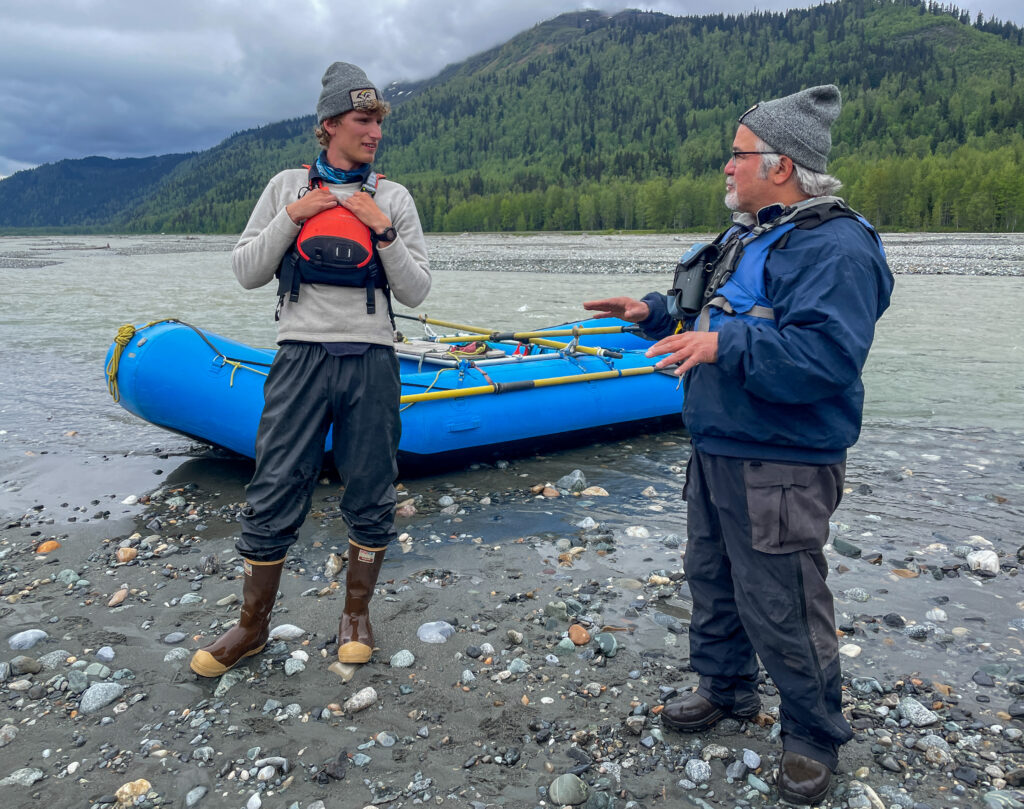
This June 5 training run for the river guides is something of an annual tradition for raft companies in Haines, helping prepare new guides to manage hundreds of passengers who want to float down the river and see wildlife.
The upper Klehini River serves as a level-up for new guides, providing challenges that are not as common on the Chilkat River where they most often escort passengers.
The Klehini has a steeper gradient, more debris and a swifter current than the Chilkat River.
“I always believe that the guides need to be competent above their level,” said Rainbow Glacier Adventures owner Ordóñez . “They have to be able to perform in a situation beyond what the river is showing them right now.”
Ordóñez has been rafting in Haines since 1987. He and raft guide instructor Lyman took the company’s newest river guides down the Klehini as part of their preparation for the summer season.
As guides are giving their spiel, pointing out eagles, bears or other natural sights during rafting trips, they also have to navigate down the river and look ahead to avoid upcoming obstacles.
Guides also learn how to move with the river, not against it, while paddling.
“You are not stronger than this river,” Ordóñez said.
Rafting requires knowledge not only of the river but also of its surroundings. Lyman said one of the biggest challenges for guides is learning how to read the river’s ripples, which indicate where the deep water is to avoid unwantedly beaching the raft.
“With the fast pace of the Klehini, you really got to be making those quick choices and committing to a good line,” said Kendall.
The river changes day to day, week to week.
When Lyman started guiding in 1989, the Tsirku River was running in a completely different area through the forest. Lyman estimated that over the course of 15, maybe 20 years, “it worked its way… across the delta clear to the lower end.” Both the Klehini and Tsirku rivers join the Chilkat River.
“It shifts around like that real dramatically,” he said.
The Klehini is also changing, cutting further west toward the forest. Lyman said there is one section where this change is especially visible, in a bank cutting into the forest just after the Porcupine Bridge.
He estimates that “eventually that’s probably where most of the river will go.”
The river, according to Lyman, is eroding everywhere.
“Eventually, that little tiny flood channel we were seeing, years from now that could be the main channel cutting back through here,” he said.
Guides have to learn how to read the river and manage changes that happen daily.
At one point, passengers on one of the rafts got stuck on a gravel bar. They bounce on the inflated tubes to help push the boat off the bank and back into the current.
Gravel bars, submerged trees, constantly shifting channels and swift-moving water are some of the obstacles guides face.
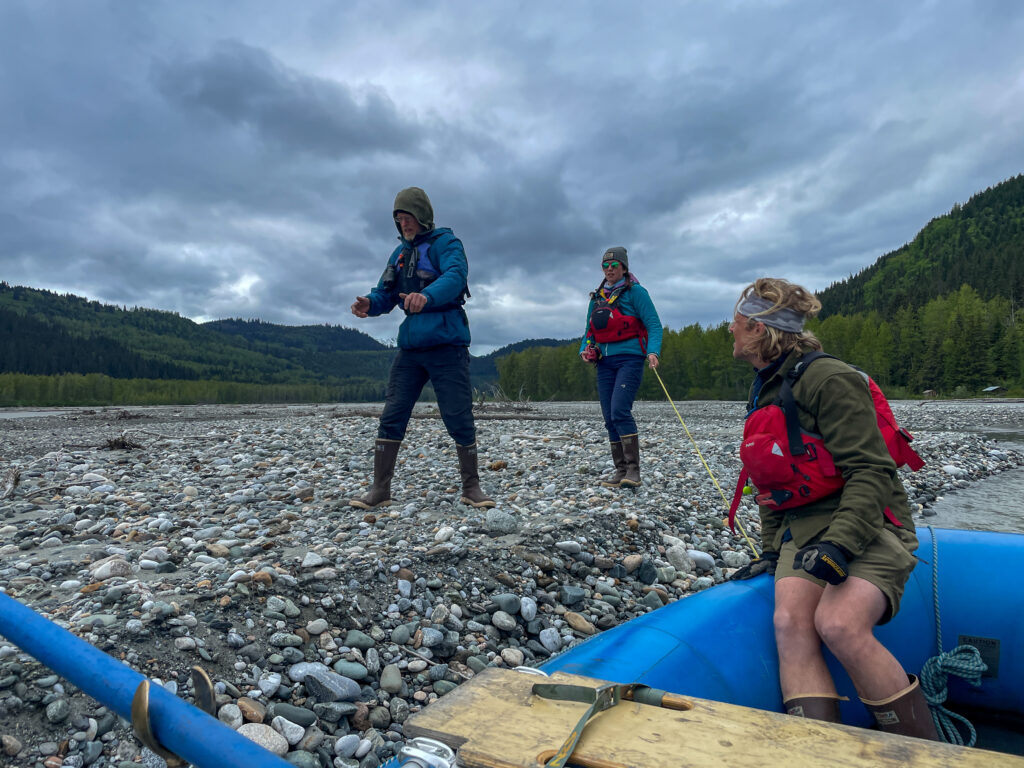
“One of the biggest things is that the people who are training me have been doing it for 40 years, you don’t often get the experience,” Andriesen said while paddling the raft.
The Klehini is classified as Class II and sometimes Class III river when water levels are high. Rivers are classified from Class I to Class V, with V being the most difficult or technically challenging whitewater. Class II rivers are defined as straightforward rapids with Class III having more intense rapids.
Andriesen and Kendall were practicing their swiftwater stop with lines. To conduct this stop, guides line up the boat to be at a 45-degree angle from the river bank, and get a bag with rope attached to the boat. Holding this rope, the guides jump onto the dry banks, stopping the raft from continuing down the river. Lyman said that this is a technique that is unique to the rivers in the Chilkat Valley.
“We have to be able to stop where there’s not an eddy or anything, on our own.” Lyman has been rafting in Haines on and off for 37 years and has been instructing new guides on and off for the past 10 years.
All guides are required to have their wilderness first responder certificate and swiftwater rescue training. Swiftwater training teaches guides to be able to get a boat unstuck, utilize rope work and learn the current.
Every spring, Lyman helps instruct the new round of Chilkat Guides’ guides. This training lasts for nine days. For most of these guides, it’s their first time in Alaska and often their first time rowing.
Before guides get out on the river, they practice in an on-land raft and then head to Chilkoot Lake or the harbor to learn the basics of rowing. Lyman estimates that usually two-thirds have never rowed before. During training, guides learn how to row a raft, read the river, navigate the channels and perform a swiftwater stop with eight passengers.
This year, Chilkat Guides trained 27 new guides over the course of nine days and Rainbow Glacier Adventures trained two new guides, all of whom Lyman helped instruct.
The post Raft guides learn the sticks on an ever changing river appeared first on Chilkat Valley News.
The indefinite closure of Haines’ popular Chilkoot campground may be coming to an end.
The Alaska Division of State Parks, which administers the Chilkoot Lake campground, has kept the facility and its 32 camp sites closed this season due to what they say is understaffing.
Now, state parks has advertised a new park technician position, which, when filled, will allow the campground to reopen, regional superintendent Brad Garasky said this week. The position closes on June 30.
Even advertising the vacant position had been a major hurdle due to a state government hiring freeze put in place by Gov. Mike Dunleavy last spring. To bypass the hiring freeze, state agencies must get a waiver from the Governor’s office specific to each position they hope to hire for.
During an assembly meeting last month, mayor Tom Morphet said the community and borough officials would “have to raise our voices a little bit, stomp our feet,” to push the state for a new hire and campground reopening.
The foot stomping has come from multiple sources:
This winter, the regional State Parks Citizen Advisory Board sent a letter to Dunleavy and Department of Natural Resources commissioner John Crowther advocating for new hiring and campground reopening.
“Restoring these roles, especially the Parks Technician and associated seasonal support positions, would directly improve day-to-day operations, protect public safety, and strengthen the tourism infrastructure that so many Southeast communities rely on,” wrote board chair and Haines resident Nate Arrants.
State Parks officially submitted its request to hire for the park technician position on Feb. 27, but for months it went unapproved.
Earlier this month, borough manager Alekka Fullerton, along with the borough’s state government lobbyist met with Crowther and sent him an official letter earlier advocating the governor approve hiring for the vacant position.
Yet a third letter came from former Haines Borough manager Annette Kreitzer, who recently announced her candidacy for the state representative seat for the Chilkat Valley.
In her letter, Kreitzer referred to “a drastic need for a waiver for a park technician to re-open the Chilkoot State Park Campground.”
Kreitzer, a longtime legislative staffer and former commissioner of the Alaska Department of Administration, has pitched her experience and state government relationships as pluses of her candidacy.
“That’s not the way you engage with the state,” she said of Morphet’s feet-stomping analogy. “I don’t doubt others have attempted to call, but connections are important. I have lots of relationships (in state government) that I don’t try to pull on more than I need to or want to, but to me there was no movement on the issue.”
Meanwhile, her opponent, incumbent Andi Story, said she has been advocating to fill the vacant Chilkoot position for months.
“I have elevated this request to the last two Commissioners’ attention multiple times,” Story wrote in an email this week.
Story also said requests for hiring freeze waivers “have been a group effort for quite some time,” citing the advisory board’s letter and advocacy from Haines residents.
Department of Natural Resources spokesperson Lorraine Henry said this week the waiver had been approved by the governor as a “public safety exemption” to the hiring freeze.
Reopening the campground should increase both access to the popular state recreation site, as well as discussions of how to best manage the area.
Chilkoot Lake is particularly popular due to the proximity of bears to the campground and road. Bear viewing, however, has presented challenges, with reports last year of tourists dangerously close to bears, and citations for tour operators stopping in the road for bear viewing.
Diane Moore, who has worked seasonally in Haines out of her RV for the last four summers, said she’d ordinarily spend some time at the Chilkoot campground. Instead, she’s currently at the Haines Hitch-Up RV Park, which she also works for.
“It’s a special place. It’s just beautiful,” Moore said of the Chilkoot area. But, she added, she makes a habit of checking the cruise ship schedule anytime she goes out to the lake in the hopes of avoiding the crowds.
It was a similar message from Sue Rakes, who has worked as State Parks’ campground host for the last two summers. Rakes spoke to the value of bringing people to the Chilkoot area, but also the importance of safe interactions with bears.
“I think it’s natural that people want to be tied into nature, they just need the tools to do it,” she added. “When people have that knowledge they want to take on the responsibility of looking out for the welfare of the bears, and they can just be in wonder and enjoy nature.”
The post Chilkoot campground may reopen this summer appeared first on Chilkat Valley News.
The borough is headed to Superior Court over a decision by its own Board of Equalization to exempt a local Episcopal church property from borough tax.
The dispute surrounds a parcel at 1 Mile Haines Highway purchased in 2000 by St. Michael & All Angels’ Episcopal Church. After the purchase, the church converted a small existing structure on the property into a chapel, and maintains the land, church representatives have said, as a place for members to walk, pray, and meditate.
According to state statute, municipalities may exempt from property tax land “used exclusively for nonprofit religious, charitable, cemetery, hospital or educational purposes.” The borough has granted that exemption to the 1-Mile parcel since it was purchased. But this year, the borough’s contracted assessor, Martins Onskulis, reversed course and removed the exemption. Onskulis has valued the property and building at $241,700.
At issue is what exactly constitutes the “exclusive use” required by statute for the exemption.
Both sides agree that there are hypothetically clear violations of this exclusive use clause: for instance, if the church had some kind of for-profit, non-religious activity on the grounds. But that’s not what’s happening, and Onskulis doesn’t dispute congregation members’ assertion that the only official activities on the grounds have been religious services.
Instead, Onskulis has said the religious activities have not been recent, or regular enough to qualify the property for an exemption. If regular services begin again, he said last month, the tax exemption would return.
In an email to attorney and congregation member Linn Asper in April, Onskulis wrote that “while the statute does not explicitly define (exclusive use), the concept implies an element of temporality and frequency, meaning the property should be used consistently and regularly over time for religious purposes.”
Onskulis, at an equalization hearing this spring, cited a Fairbanks tax case decided in Superior Court earlier this year as the basis for that reading of statute. But in some ways, it seems to be uncharted waters: Onskulis said he brought the case to a meeting of all the state’s assessors, and his fellow assessors said they had not dealt with a comparable case.
The church is currently being represented by retired Haines District Court judge Linn Asper. Asper told Onskulis this spring the church had held 72 services at the property since 2000, but none in the last six years. The church holds its regular services at the Chilkat Center.
Asper disagrees with how Onskulis is interpreting the law. In Asper’s view, the frequency of the services shouldn’t be relevant.
In an April email, he wrote to Onskulis that “the church concedes there has not been a religious service on the property for some time… however, the term ‘current’ is not in the controlling statute.”
“If the borough can dictate what type of service, how often, where it happens, they’re seeking to control the church,” Asper said this week. “I think that’s a really bad precedent.”
There are a couple of layers of appeals in the case. The first was the Board of Equalization hearing, in which the church appealed Onskulis’ original decision to remove the exemption. In that hearing, the board — an assembly-appointed body that hears property tax appeals — unanimously sided with the church, voting to exempt the property from tax.
“It’s not our place to say what someone’s religious experience is,” said board member Brenda Josephson.
“We’ve seen a lot of flim-flam outfits come into Haines and someone lives in a house out the road and calls themselves a church and says their property isn’t taxable — I’ve seen that several times,” said board member Jim Stanford. “That isn’t the case here. This is an established Episcopalian church that bought this property to use for religious purposes and I don’t want to be the one to say they aren’t using it.”
Now, the borough’s appeal to Superior Court seeks to overturn it’s own board’s decision, removing the tax exemption once more.
The borough filed the appeal on June 10.
In a court document filed Wednesday, Asper asked the court to dismiss the appeal, including on the grounds that the borough “has not alleged abuse of discretion or other actions of the Board that violate the requirements of the Alaska Administrative Procedure Act.”
The court has not yet scheduled a first hearing in the case.
As church members await a final decision, they’re putting work into the property to prepare for more regular use, including a newly-built bridge over a stream and a remodeling of the chapel. The work follows what Asper describes as a difficult stretch for the church since the start of the COVID-19 pandemic, Asper said.
“It gives us hope for the future,” said member Joan Degen of the recent work. Degen was at the property Wednesday mowing the grass.
“We’re a smaller congregation, lots of older members, many on limited incomes. I hope (the appeal) goes our way so we don’t have to downsize.”
The post Religious use tax exemption headed to court appeared first on Chilkat Valley News.
I was schooled to tip the dealer if dealt a win at the table. I’ve benefitted, and the dealer is acknowledged as contributing to my good fortune.
The Skagway Borough recently won a court decision that saved AP&T customers in Skagway and Haines potential charges of over $4 million, the estimated cost of replacing the broken section of an undersea cable. The decision also denied in part AP&T’s request for a 70% rate increase. Skagway footed the cost of the argument: $767,000.
In 2023 the Haines Borough resolved to participate in the initial phase of the lawsuit (then $144,000) with $10,000. The check was never written.
Mayor Morphet brought to the Assembly on May 9, news of our failure to write the check, and suggested that the Haines Borough acknowledge our good fortune today by participating in the cost of the lawsuit at the original proportion, or 7%: $54,000. The Assembly said “No!”
What sort of people are we that won’t recognize an action taken by another to benefit us? It doesn’t matter what money we think we don’t have…we would have much less without the willingness of the Skagway Borough to take a risk and step up to the table. Let’s applaud them and say “Thank You.”
Please call your favorite Assembly member and ask for a reconsideration of the decision to acknowledge more fairly the work of our neighbors for saving Haines’ AP&T ratepayers substantially into our future.
Debra Schnabel
The post We should be pitching in for the cost of the AP&T rate lawsuit appeared first on Chilkat Valley News.

Neymar has been ruled out of Brazil’s second World Cup match because of a lingering calf injury. The Brazilian soccer confederation said Thursday that Neymar wasn’t going to travel with the rest of the squad for Friday’s match against Haiti in Philadelphia. “He will remain in New Jersey to optimize the final phase of his recovery process,” the confederation said in a statement. The Brazilian confederation said the 34-year-old Santos player will continue his recovery at the facilities of the team’s hotel. Neymar was back on the training field for the first time on Tuesday, doing physical conditioning exercises. He rejoined his teammates for parts of the session on Wednesday, being applauded by them after getting on the field. Neymar has yet to practice in fuller sessions with the rest of the team since reporting to Brazil’s squad while nursing an injured right leg. Looking to play in his fourth World Cup, Neymar underwent tests on his right calf on Monday to determine the progress of the injury that he sustained while playing with Santos on May 17. The five-time World Cup champions began their tournament with a 1-1 draw against Morocco on Saturday in Group C. There was widespread debate in Brazil over whether Neymar, whose first World Cup was on home soil in 2014, should have been called up for the tournament by coach Carlo Ancelotti. Reporting by the Associated Press.Latest Sports News from FOX Sports