A few social media posts from Bunnie Xo are getting a closer look after surprising news about her marriage to Jelly Roll. Continue reading…The Boot – Country Music News, Music Videos and Songs









A few social media posts from Bunnie Xo are getting a closer look after surprising news about her marriage to Jelly Roll. Continue reading…The Boot – Country Music News, Music Videos and Songs

A new report is making a surprising claim about one of country music’s most visible and beloved couples. Continue reading…The Boot – Country Music News, Music Videos and Songs

 Jelly Roll and Bunnie Xo’s relationship isn’t as sweet anymore.
The “Amen” singer and the Dumb Blonde podcast host have broken up after nearly 10 years of marriage, according to court records…
E! Online (US) – Top Stories

Jelly Roll has filed for divorce from his wife, Bunnie XO, according to a report from TMZ.
The outlet reports that the country star filed for divorce in Tennessee in May, citing court records obtained by the publication.
According to sources who spoke with TMZ, the decision to end the marriage was mutual and remains a private family matter.
The news comes after Bunnie XO revealed that the couple planned to expand their family with the addition of twins in her book, Stripped Down: Unfiltered and Unapologetic. She shared that they had found a surrogate and that she was in the process of starting IVF.
“Now that we’re finally stable financially and somewhat emotionally after all the healing we’ve done over this decade together, we’re talking about the future—including growing our family,” she wrote in the brand new book. “J and I have a surrogate, the sweetest woman ever, and soon I’ll be starting my IVF stims.”
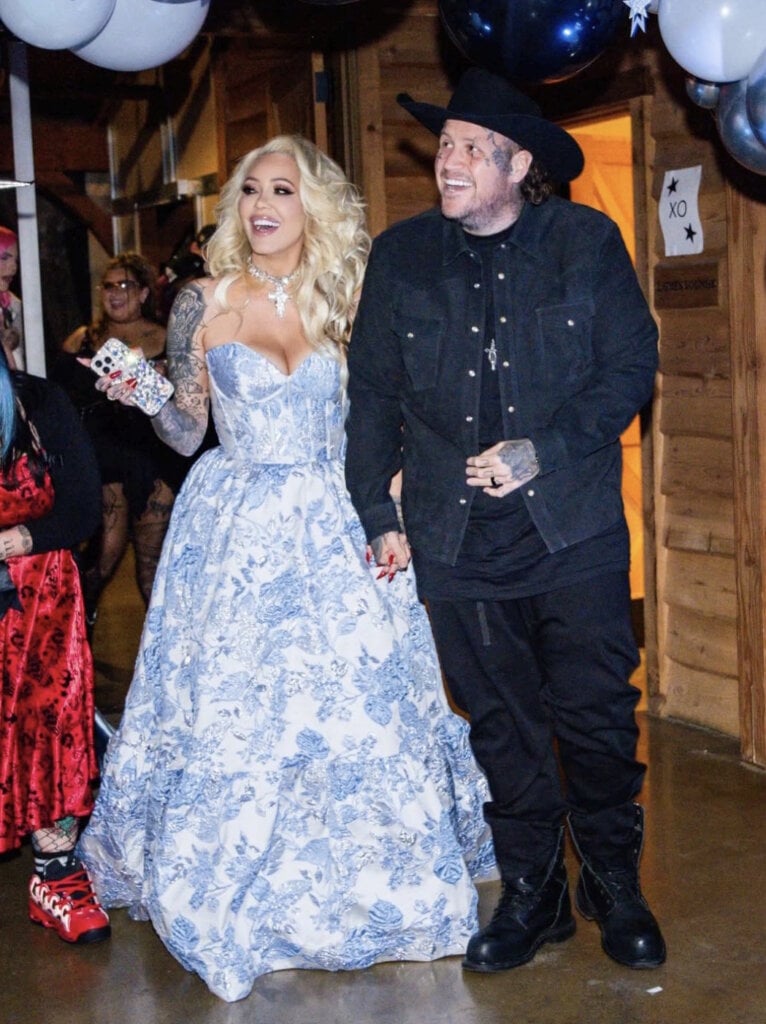
Jelly Roll is a father to Bailee Ann and Noah both from separate previous relationships.
The couple first met in 2015 at one of his concerts on Fremont Street in Las Vegas and quickly formed a connection. The couple went on to marry on August 31, 2016.
In 2023, they revisited A Stained Glass Wedding Chapel in Las Vegas, where they originally said “I do,” for an intimate vow renewal ceremony that marked another chapter in their love story.

According to Bunnie XO, the couple broke up in 2018. She says that split helped them grow as a couple.
“Who knew us breaking up in 2018, me moving back to Vegas & you coming to get me back – would have put us on this wild journey called life,” Bunnie wrote.
“We finally committed to each other & did everything we promised each other the first night in 2016,” she continued. “Our castle in the sand had to crumble so we could rebuild on solid ground. I yuh you so muchhh.”
Their relationship certainly had its ups and downs.

During an October 2025 appearance on the “Human School” podcast, the GRAMMY-winning singer opened up about a difficult chapter in his marriage, revealing that he was unfaithful to his wife and later had to put in significant effort to rebuild their relationship.
“I don’t talk about this publicly at all but one of the worst moments of my adulthood was when I had an affair on my wife,” he said.
They worked on their marriage and at the time, Jelly Roll admitted they were “stronger than we could have ever been.”
Neither Jelly Roll nor Bunnie XO has publicly commented on the reported filing at this time.
The post BREAKING: Jelly Roll Files for Divorce From Wife Bunnie XO appeared first on Country Now.
Country Now

 Teddi Mellencamp is starting a new chapter.
The former Real Housewife of Beverly Hills—who was diagnosed in 2025 with stage four cancer following an initial stage two melanoma discovery in…
E! Online (US) – Top Stories

 Andrew Rannells has the scoop on Anderson Cooper.
The Broadway star shared he was in a “very brief relationship” with the journalist during his 20s, confirming long-running speculation that a…
E! Online (US) – Top Stories

 Pat Sajak is living the ranch life—sort of.
The former Wheel of Fortune host gave an update on his post-retirement life, saying he’d recently moved to Montana. However, fans were quick to note…
E! Online (US) – Top Stories

Dan Sullivan of Petersburg (left) filed to run against Republican incumbent U.S. Sen. Dan Sullivan. (Campaign photo by Dan Sullivan and photo of the senator by Corinne Smith/Alaska Beacon)
The Alaska Division of Elections announced Dan Sullivan of Petersburg is ineligible as a candidate for U.S. Senate and will be removed from the ballot. Officials said his filing was “for the purpose of confusing or misleading voters,” in a final decision issued on Monday.
Dan Sullivan, a retired teacher from Petersburg, filed to run as a Republican for the U.S. Senate in May, which drew immediate criticism and complaints from the Republican incumbent with the same name, U.S. Sen. Dan Sullivan, and Republican groups. The Petersburg Sullivan has defended his campaign as genuine.
The division’s ruling follows an investigation announced by Lt. Gov. Nancy Dahlstrom and a preliminary decision last week, citing two complaints by Republican groups, including the Alaska Republican Party, claiming Sullivan was ineligible. The complaints accused the Petersburg Sullivan of misrepresenting himself and intending to mislead voters to the benefit of the Democratic candidate, Mary Peltola.
In a letter on Monday, Carol Beecher, the elections division director, agreed with the complaints.
“On review of the complaints and other information in the Division’s possession, I conclude that your declaration of candidacy was not properly filed with the Division,” she wrote. “Because it was not filed in order to declare an actual good-faith candidacy for the office of United States Senator, but was instead filed with a purpose to confuse or mislead and to thereby compromise the ballot’s fairness or neutrality.”

A spokesperson for the Division of Elections declined to comment on the ruling, explain the other information cited in the letter, or say if similar scrutiny would be applied to the other 14 candidates running for U.S. Senate. “Consistent with our standard practice, we do not discuss ongoing reviews, investigations, or related proceedings,” said Stephen Kirch, public relations manager with the division, by email on Monday.
In the letter, Beecher cited the candidate’s filing under the name “Dan Sullivan” while his voter registration was under the name “Dan J. Sullivan, Jr.” as evidence of an attempt to mislead voters, calling it a “new nickname.”
She said Sullivan had mistakenly requested his name appear on the ballot as “Dan S. Sullivan,” the same name as the incumbent. “Indeed, you yourself appeared to be confused when you initially emailed the Division asking to be listed on the ballot as “Dan S. Sullivan.” “S” is Senator Sullivan’s middle initial, not yours,” she said.
She suggested he was seeking to confuse voters. Beecher raised the same issue with Sullivan registering as a Republican.
In an interview with the Alaska Beacon last week, Sullivan from Petersburg said he was previously affiliated with the Alaska Independence Party. After it disbanded last year, he decided to register and file his candidacy as a Republican, saying he identified as an “old school” centrist Republican like his father and grandfather.
Beecher acknowledged Sullivan had the right to change party affiliation under Alaska law, but rejected the filing as suspicious.
“Of course, under Alaska law, you are free to change your party affiliation. This said, that you chose to change your affiliation to the same political party — one you’d never affiliated with before — as the incumbent Senator immediately before filing a declaration of candidacy in which you asked to access the ballot under the same name – in a shortened form you’d never used before — as the incumbent Senator strongly suggests an intent to confuse yourself with the incumbent Senator rather than to distinguish yourself from him,” she wrote.
Beecher also said the Petersburg Sullivan’s campaign website and logo are similar to the incumbent’s, and said that appears to be “deliberate.” She cited a complaint by the National Republican Senatorial Committee, which works to elect Republicans, who accused the Petersburg Sullivan of working with a political consultant, Amber Lee, to misrepresent his campaign. Beecher did not name the consultant but said she was a “known longtime supporter of Democratic candidates.”
“This consultant’s work on your behalf is, in isolation, innocuous,” Beecher wrote. “Alongside the other facts I have catalogued in this letter, however, it suggests a determined effort and a deliberate attempt to use the similarity of your name to confuse Alaska voters in the upcoming primary election.”
Beecher said she had concluded that Sullivan had not filed in good faith and would be decertified from the election.
“I conclude that the preponderance of the evidence is that you chose this new nickname and party affiliation because that name and party affiliation happen to be the name and party affiliation of another candidate in the race,” she wrote.
The Petersburg Sullivan can appeal within 30 days or challenge the decision in Alaska Superior Court, according to the letter.
He did not respond to calls on Monday about whether he plans to appeal and challenge the ruling.
In a social media post on Sunday that celebrated his 70th birthday ahead of the ruling, the Petersburg Sullivan questioned the premise of the state’s investigation and threats to disqualify him from the ballot.
“Should every American be allowed to run for any political office if they are qualified? Should a candidate’s chances of winning an election disqualify them from trying? Should a person’s given name be a qualifier to be on a ballot? To me it’s not complicated,” he wrote. “I met the qualification and I entered this race because I am unhappy with the 12 year record of the current Senator and I feel we need a change. It’s that simple.”
Members with the re-election campaign for Republican incumbent Sen. Sullivan praised the decision on Monday, thanking Dahlstrom, who oversees Alaska’s elections.
“We thank Lieutenant Governor Dahlstrom for upholding that right and for ensuring Alaskans can choose their next senator without a sham candidate whose primary purpose was to confuse Alaskan voters, treat Alaskans with contempt, and rig the election for Peltola” said Billy Mackey, Senator Sullivan’s campaign manager, in an emailed statement.
Alaska Sen. Forrest Dunbar, D-Anchorage, said in a social media post Monday he had requested a legal review of the division’s decision, saying the reasoning “appears extremely weak.” In another post, Dunbar pointed to U.S. House Rep. Nick Begich III filing for office in 2024 under the same name as his grandfather who also served in the U.S. House, “Nick Begich.”
“I urge folks to set aside their partisan biases and think about the precedent this sets if it is allowed to stand, the authoritarian power we would be handing incumbent administrations to decide who is or is not permitted to run against them or their allies,” Dunbar wrote.
“This started out as sort of a funny curiosity (no offense to Dan J. Sullivan, whom I have never met or spoken to, and probably has good ideas for federal policy). But now the Department of Elections and Lieutenant Governor have made it much more serious — a question about whether or not fully qualified American citizens can appear on a ballot and exercise their First Amendment rights.”

 Summer plans have a way of multiplying, and somehow, so does the stuff we need to bring with us. Whether you’re headed to the beach, navigating airport security, packing up for a road trip, or…
E! Online (US) – Top Stories

 Welcome to New York, Taylor Swift and Travis Kelce’s wedding has been waitin’ for you.
And though details of the Grammy winner and NFL star’s upcoming nuptials are being kept strictly under wraps,…
E! Online (US) – Top Stories