New England Patriots quarterback Drake Maye called Mike Vrabel “a great human being,” and said he doesn’t think the head coach’s off-field issues will be a distraction for the defending AFC champions this upcoming season. “No, I don’t,” Maye said. “I mean, he’s our head coach. I think he’s done a great job of talking to us and talking us through it. I’m just looking forward to getting back to work and getting ready.” Maye spoke to The Associated Press on Wednesday following the Truist Championship Pro-Am in Charlotte in which he was paired with PGA Tour pro Gary Woodland on the back nine at Quail Hollow. Vrabel has found himself entangled in controversy after the New York Post posted pictures of him with longtime NFL reporter Dianna Russini at an Arizona resort. Vrabel said on April 24 that he was taking accountability for his actions without addressing specifics about the published photos. Vrabel missed the third day of the draft to attend counseling. Vrabel said he had to have hard conversations with the people that he cared about the most, including his family, his team and members of the Patriots organization. He added that, “My previous actions don’t meet the standard that I hold myself to. They don’t.” When asked if the issues are something the Patriots will need to put behind them before the season, Maye said, “I think that’ll take care of itself.” “I know he’s got the right mindset and I know he’s a great human being,” Maye added. “I think he’s … like I said, I love playing for him.” [More Patriots: Ranking the 10 Best NFL Offenses Entering Offseason Workouts] Maye, the third overall pick in 2024 who grew up in nearby Huntersville, North Carolina, led the Patriots to an appearance in Super Bowl 60 in just his second season. He was runner-up to Los Angeles Rams QB Matthew Stafford for the AP NFL MVP award in 2025. Maye also addressed former Patriots teammate Stefon Diggs’ acquittal on charges that he assaulted his live-in personal chef. The charges stemmed from a Dec. 2 incident at his Massachusetts home where Jamila Adams testified that Diggs slapped and choked her during an argument. Diggs had pled not guilty to a felony strangulation charge and a misdemeanor assault and battery charge. The jury deliberated for less than two hours before clearing Diggs of all charges. The acquittal in court clears a path for the four-time Pro Bowl wide receiver to return to the field, although he could still face discipline from the NFL. “Well, you know, he’s always been a great teammate to me and I know he’ll do great things,” Maye said. “I was fortunate enough to have a year with him, and I’m looking forward to seeing what happens to him. He’s a great player.” And as for the shoulder injury that hampered him down the stretch last season, Maye said he’s doing “great.” “Nothing, nothing, no problems at all,” said Maye, adding that he did not need surgery. The Patriots will host a three-day rookie minicamp beginning Friday in Foxborough, Massachusetts. Reporting by The Associated Press.Latest Sports News from FOX Sports
After the success of their debut album Access All Areas, Flo is gearing up for their sophomore album. The British pop/R&B trio have officially announced the new album Therapy at the Club will debut on July 24, 2026, and have shared the title track from the album as its second single. “Therapy At The Club” is available to purchase and stream now, while the album is officially available for preorder.
Click to load video
“We’re incredibly proud to finally share Therapy at the Club, our sophomore album with the world. It’s a body of work that feels super personal to us, it’s been a labour of love. For us, the club is more than just a night out, it’s like therapy. I mean, where else do you feel more understood than in a girls bathroom on a night out…that’s the vibe!” say Flo about their new album. “We’ve been very hands on with the writing and creation of this project alongside our very special collaborators, and that’s made it even more meaningful to us. This album represents where we are right now – honest, evolving, and unafraid to feel everything. We really hope you love it!”
Flo first shared a taste of Therapy at the Club with the lead single “Leak It,” which debuted in March. That track takes the best elements of a Y2K-era club banger and gives it a pulsing update brimming with Flo’s tight harmonies. “Leak It” and “Therapy in the Club,” which shows the group in a more soulful balladic mode, introduce what promises to be a processing of difficult emotions on the dance floor. The group has also enlisted an all-star group of collaborators for the project, including Amy Allen, Steph Jones (both of whom have recently worked with Sabrina Carpenter), Julian Bunetta, and Boy Matthews.
Access All Areas earned a Grammy nomination for Best Progressive R&B Album, making Flo the first British girl group nominated for a Grammy in 20 years. That album features hits like “Walk Like This,” “In My Bag” with Glorilla, and “Check.”
As it turns out, the generational divide between baby boomers and millennials extends even to fitness practices, including how to lose fat and gain muscle.
Health Digest – Health News, Wellness, Expert Insights
Studying the types of messages hate groups spew online helps researchers understand the groups’ persistence. Westend61/Westend61 via Getty Images
Hate communities often flourish online for years, raising the question of how they persist. My research team has found that powerful stories keep members of a hate group galvanized, either by repeating the story over and over or by constantly adding fresh accusations and interpretations to it.
First, we measured who was posting and how that related to engagement on a site. Groups in which a small number of people produced most of the content tended to attract more reactions and responses. Then we looked at subjects the group members discussed – religion, immigration, geopolitics – and the kinds of stories members told about those topics, such as describing an entire group of people as criminals or warning that certain types of people are secretly taking over a country’s way of life.
When we put these pieces together, we discovered some clear patterns. Messages posted by a few very active people were strongly associated with higher site engagement in the form of likes and shares in the near term. And repetition – espousing the same ideas again and again – was an effective tactic. We also found that when many users kept adding fresh accusations, conspiracy theories and explanations, a group tended to persist. Very uniform content that used the same framing led to less engagement over time.
Different communities seemed to be drawn to different messaging patterns. In Islamophobic groups, the most prolific posters tended to repeat a narrow, consistent set of messages. Often these were religiously framed posts that portrayed Muslims as morally condemned. In antisemitic groups, the most engaged members were more likely to impart a mix of narratives, from tales of victimization to conspiracy theories about public figures.
A woman protests after a Kashmiri shawl seller was assaulted in India on Jan. 31, 2026. NurPhoto via Getty Images
Why it matters
Our findings suggest that hate communities can sustain themselves in various ways, so efforts to moderate them should consider these variations. If a few voices drive the conversation, removing them could quiet the noise. If new stories constantly appear from many contributors, harmful ideas may survive even if a few key online accounts are taken down. Hate networks can persist even after social media platforms ban specific groups or accounts.
It is also important to understand how stories can make prejudice feel justified and emotionally compelling. Extremist stories may claim that a group is under attack, that outsiders are dangerous or subhuman, or that violence is the only way to stay safe. Groups seen as outsiders – such as immigrants – are common targets, and they may be described as an “invasion” that threatens the nation.
What other research is being done
Researchers are finding that extremist ideas are now spreading through looser networks where many voices contribute and messaging can vary widely. That could affect whether engagement in the future still depends on consistent repetition or novelty. Some investigators are also scrutinizing how harmful language, conspiracy theories and propaganda evolve over time.
What’s next
Another important direction is tracking how hate narratives are spread by public figures and influencers, how the narratives move between online platforms, and how they surface in offline groups and efforts to organize supporters, all of which can normalize harmful ideas. My group is starting to study how this amplification works: who shares which narratives and why, which kinds of people become bridges across different online platforms, and how those roles shape which messages spread.
The Research Brief is a short take on interesting academic work.
Yu-Ru Lin’s research has received federal funding, including National Science Foundation and the Department of Defense (DARPA, AFOSR, Minerva, and ONR). Any opinions, findings, and conclusions or recommendations expressed in this material do not necessarily reflect the views of the funding sources.
If you follow the Trump administration’s social media posts, you might spot its new mascot: a cartoon lump of coal with big eyes and babylike features. “Coalie” sparked a backlash almost as soon as Interior Secretary Doug Burgum debuted it for the Office of Surface Mining and Reclamation Enforcement in early 2026.
As a scholar of American literature and culture, I write about media portrayals of coal, beginning in the 19th century with its rise to become the leading fuel in the United States. Coal use grew until the early 2000s, when other sources became cheaper and its health and environmental damage became unacceptable to more of the public.
While “Coalie” might be new, the logic behind it is not. For centuries, coal’s promoters have worked hard to show coal as harmless – as well as “clean” and “beautiful,” to use President Donald Trump’s words.
‘An agreeable heat’
Humans living with the effects of burning coal have disliked it for as long as they have burned it.
In 1578, Queen Elizabeth complained that she was “greatly grieved and annoyed with [its] taste and smoke” in the air. In 1661, John Evelyne’s treatise Fumifugium outlined negative health effects of breathing coal smoke.
English settlers were drawn to North America in part because of the continent’s abundant supply of timber, a substitute for coal that deforestation had made prohibitively expensive in England.
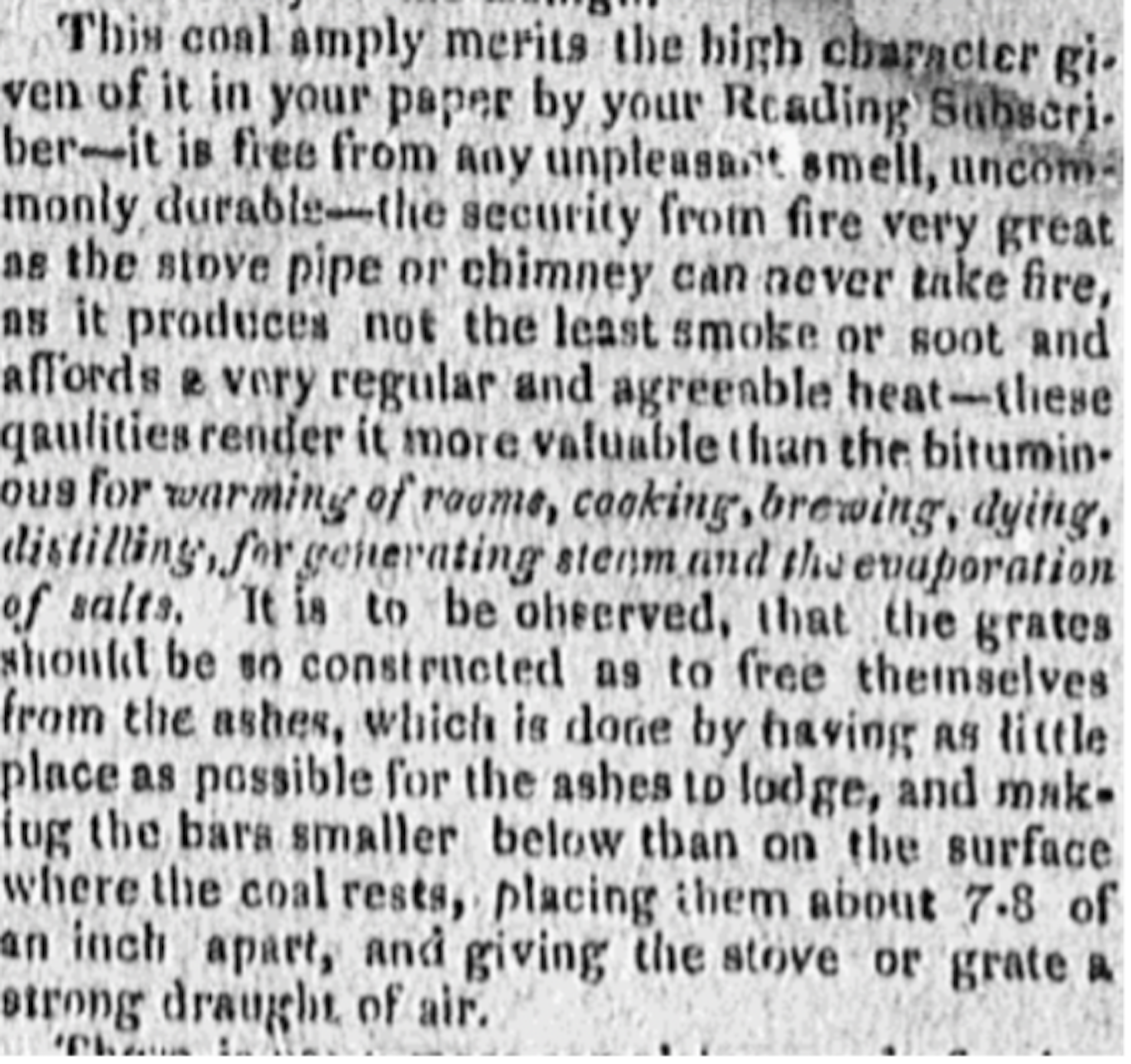
In addition to its lower price, anthracite coal grew desirable because of its high carbon, low-sulfur content, which produced less visible smoke when it was burned. An enthusiastic 1815 letter to the editor of the American Daily Advertiser captured increasingly common attitudes toward anthracite as “affor[ding] a very regular and agreeable heat.”
‘A healthful home’
The spread of anthracite also shored up tolerance for smokier but cheaper bituminous coal.
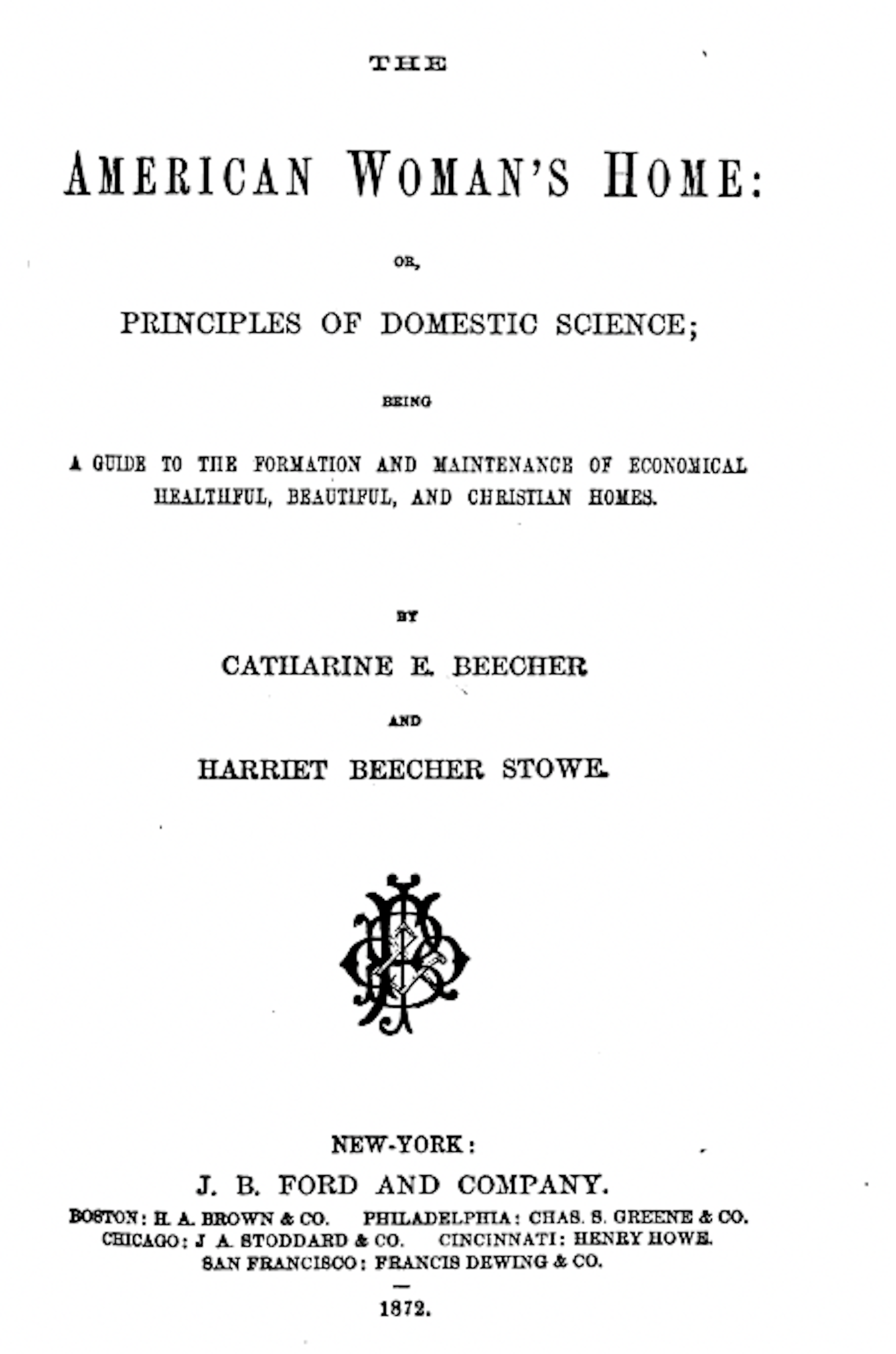
To help people, housekeeping manuals aimed at the fossil fuel’s mostly female users tried to invent workarounds for its smoke. In 1869, Harriet Beecher Stowe, best known as the author of “Uncle Tom’s Cabin,” and her sister Catharine Beecher wrote one of many 19th-century articles to acknowledge the “evils” of coal smoke, while outlining “modes of making a healthful home,” in the housekeeping manual American Woman’s Home.
Consumers provided temporary solutions for maintaining indoor air quality while burning coal by sending in suggestions that were published in housekeeping manuals, magazines and newspapers.
An 1892 advertisement in the Rocky Mountain News promoted a brand of coal stoves as ‘the best, handsomest and most economical.’ Nineteenth Century Newspapers
At the same time, as the century progressed, coal and coal-stove companies began to suggest that burning coal was healthy, that it could improve indoor air as well as domestic aesthetics. One 1892 newspaper advertisement claimed that stoves were “necessary to heat, cheer, and beautify the home and preserve its health.”
To keep the children clean and bright …
In the 20th century, marketers churned out more colorful claims about the benefits of coal: One magazine advertisement showed a mother and child pointing at the crackling stove aflame with the company’s coal, saying it “cannot be excelled in purity, cleanliness, and free-burning qualities.”
Similarly, the Lackawanna Railroad Company came up with the classy, often rhyming, character of Phoebe Snow. In one ad, she points to the importance of comfort, suggesting that not only could anthracite fuel faster travel, but it could also make your travel – and your life – more comfortable.
Coal marketing often used children to suggest safety and reach parents. Another iteration of the Phoebe Snow series promised that anthracite-powered railway travel could keep children “clean and bright.”
A 1930s advertisement went so far as to position a piece of anthracite coal next to a child in a bathtub, a visual proximity implying that coal was as good as soap.
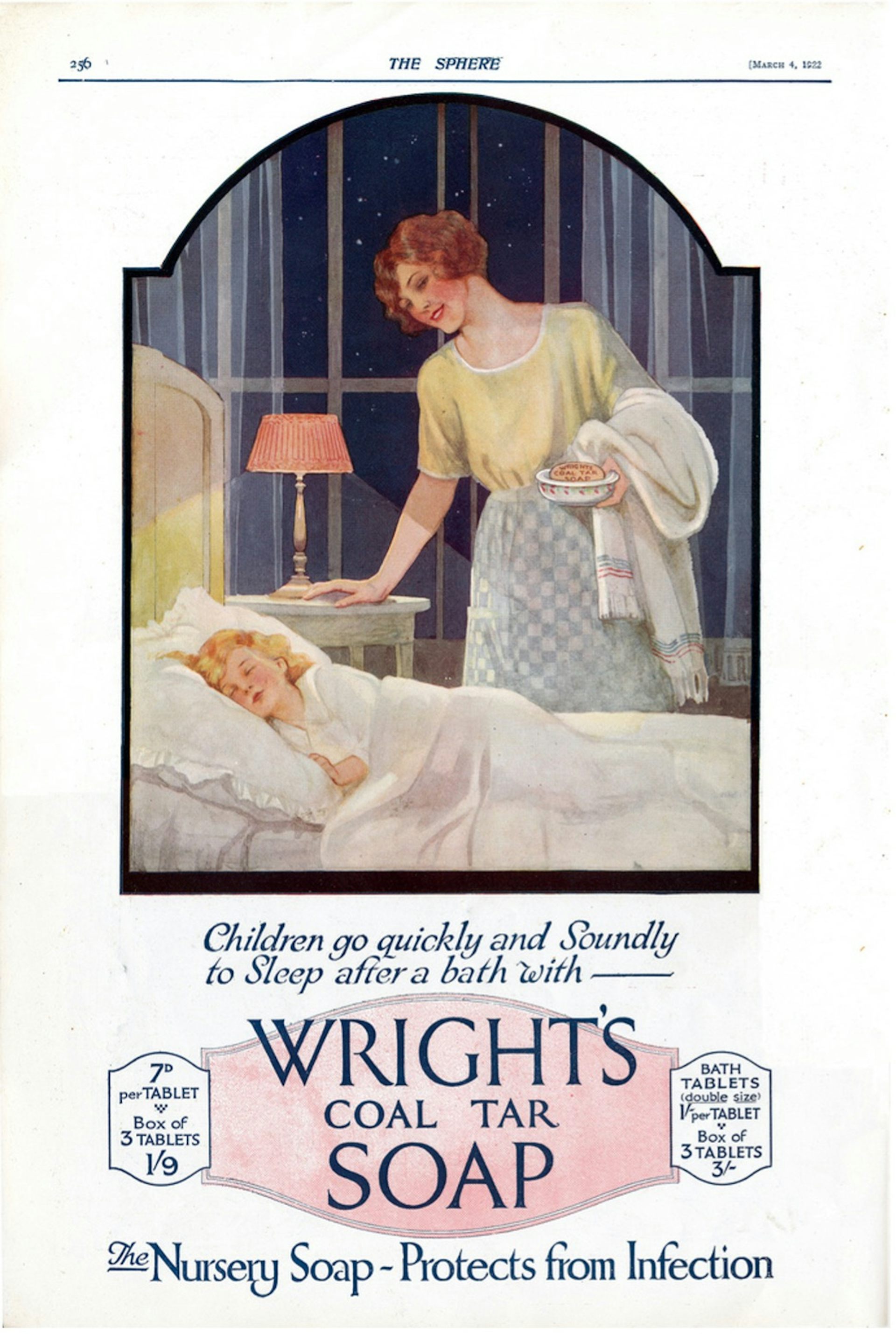
In fact, soap made of “coal tar” – a liquid byproduct of producing coke, a fuel made from bituminous coal used in industrial blast furnaces – did (and does) exist. The British company Wright’s, also popular in the U.S., generated a slew of advertisements praising its soap as having antiseptic properties for children.
Wright’s Coal Tar Soap used a sleeping child dressed in white and sleeping on white sheets to advertise its ‘nursery soap,’ which it claimed protected children from infection, in 1922. Wikimedia Commons
Each of these advertisements tried to capitalize on a mother’s desire for healthy children. And they pushed back against the image of the tyrannical “King Coal” that had come about amid strikes by miners protesting dangerous, degraded working and living conditions as well as the rise of black lung disease.
In response, coal companies doubled down on the fantasy of “clean” coal.
An American Electric Power ad in The Wall Street Journal in 1976 talked about cleaning coal. Wall Street Journal archive
A 1979 advertisement for American Electric Power, for example, flew in the face of Clean Air Act mandates that coal corporations employ “scrubbing” technology to remove sulfur dioxide from smoke – the ad depicted someone cleaning coal by hand.
In addition to ordering some coal plants to continue operating, the Trump administration has pulled out old coal promotion tactics from the past, including repeatedly referring to coal as “clean and beautiful.” One image inserts Coalie next to a coal-mining family that otherwise looks like an ad that could have appeared a century ago.
A 2026 promotion for the Office of Surface Mining Reclamation and Enforcement includes a cartoon family with ‘Coalie’ added to the picture, looking like a child’s toy. OSMRE
The myth of coal as healthy and family friendly has been around for centuries – but coal has never been clean, or cute.
Annie Persons does not work for, consult, own shares in or receive funding from any company or organization that would benefit from this article, and has disclosed no relevant affiliations beyond their academic appointment.
On the eve of the American Revolution, Matthias Aspden made a decision that would change the trajectory of his life. A wealthy merchant from Philadelphia, Aspden carefully prepared to leave his home in March 1776 as rumors of revolution circulated. He drafted a will and appointed trusted friends to manage his property while he traveled to England.
As a loyalist, someone who wanted to remain loyal to the crown and the British empire, Aspden believed the war would be brief. Historians estimate that at the beginning of the war as many as one-third of all American colonists identified as loyalists. Aspden believed his departure would be temporary. Order, he assumed, would soon be restored, and he would permanently return within a few years.
But that wasn’t the case.
The American Revolution is often told as a triumphant story of democracy and freedom. But this narrative leaves out a significant group: the loyalist men and women who remained faithful to Britain and, as a result, lost their homes, property and sometimes their sense of belonging.
As a historian of the American Revolution who studies Philadelphia loyalists, I believe Aspden’s story offers a glimpse into an overlooked experience of the war.
A wealthy Philly merchant exiled in England
Born and raised in Philadelphia, Aspden was not a marginal figure. He was a Quaker merchant with extensive property holdings, including a home on Water Street, in what is now the Old City neighborhood, and land in Chester County outside Philadelphia.
When he left in 1776, he abandoned nearly everything he owned, believing he would return. As others celebrated independence that summer, Aspden quietly slipped away to London.
A letter written by Matthias Aspden from London in 1779. Yale University
In England, reality set in. Exile was not just physical; it was deeply social and emotional. In Philadelphia, Aspden had been established. In London, he was one of tens of thousands of displaced loyalists trying to rebuild a life. He gravitated toward communities of fellow exiles. These networks offered some stability, but they could not replace what he had left behind.
Aspden’s letters to friends and family from this period reveal a man caught between hope and anxiety. He followed news from Philadelphia obsessively, requesting newspapers and updates from friends and business contacts. At one point, he described himself as “an idle man until I can return to America.” His words suggest both longing and uncertainty, as if his life were on pause.
By 1780, that uncertainty turned into fear.
A ‘traitor’ trying to come back home
Aspden began hearing about laws in Pennsylvania aimed at confiscating loyalist property. These laws required individuals accused of treason to appear in court and defend themselves. Aspden, still in England, could not do so. As a result, he was tried in absentia, declared a traitor and subjected to the state’s harshest penalties.
The consequences were devastating. In 1782, Aspden learned that all of his property had been confiscated and would be sold to aid the patriots in the American Revolution. An official commissioner of confiscation seized his Philadelphia home and wharf, which were worth thousands of pounds, along with his land in Chester County. Aspden, facing financial ruin, decided to return to Philadelphia to defend his name and his property.
In 1785, after nearly a decade abroad and with the war over, he crossed the Atlantic, hoping the new United States would restore his property under the terms of the peace treaty with Britain. Instead, he was met with rejection.
Pennsylvania officials informed him that individuals in his position were not protected. He had no legal claim to his property and, more shockingly, no rights as a citizen. While the peace treaty prevented further confiscation of loyalist property, his property was not restored.
The message was clear: Philadelphia was no longer his home.
Aspden left again, traveling through New Jersey and New York before securing passage back to England. Reflecting on his departure, he wrote of the pain of being forced from his “native country.” His brief return confirmed what he had feared. He had no home.
In the years that followed, Aspden sought compensation wherever he could. The American government offered nothing, so he turned to Britain. The Loyalist Claims Commission, established to reimburse those who had lost property during the war, eventually awarded him just over 1,100 pounds, a fraction of his estimated losses.
Aspden made one final visit to America in the early 1790s. By then, he had received a legal pardon and could travel without fear of arrest. But he still could not recover his property or successfully pursue compensation in American courts. Once again, he left – this time for good.
Aspden died in England in 1824, having spent nearly 50 years in exile from the city he always considered home.
Decades after his death, his heirs pursued a legal claim in the United States against Pennsylvania, arguing that his estate had been unjustly seized. After years of litigation, the court ruled in their favor in 1848, awarding them over a half-million dollars – approximately US$20 million today. It was a remarkable reversal, but Aspden never saw justice.
His life raises difficult questions about loyalty, identity and belonging. Aspden did not see himself as disloyal to Philadelphia. To him, loyalty to the British Crown and loyalty to home were not opposites.
His story reminds us that the Revolution was not just a fight for independence. It was also a civil conflict that divided communities and reshaped lives. For every celebrated patriot, there were loyalists like Aspden and others who lost so much during the American Revolution.
Kimberly Nath does not work for, consult, own shares in or receive funding from any company or organization that would benefit from this article, and has disclosed no relevant affiliations beyond their academic appointment.