Categories
Alaska News

Alaska Legislature considers bills to ban bottom trawling in state waters

Trawlers are seen in Unalaska on Sept. 24, 2013. Trawlers use nets to harvest pollock and other groundfish species in the Bering Sea; the ships' incidental bycatch of river-bound salmon puts the pollock industry in conflict with commercial and subsistence fishermen in Western Alaska. (Photo by James Brooks/Alaska Beacon)

Trawlers are seen in Unalaska on Sept. 24, 2013. Trawlers use nets to harvest pollock and other groundfish species in the Bering Sea; the ships’ incidental catch of river-bound salmon puts the pollock industry in conflict with commercial and subsistence fishermen in Western Alaska. (Photo by James Brooks)

The Alaska Legislature is considering proposals to ban bottom trawling in state waters as a way to protect salmon and the seafloor.

In recent years, popular social media campaigns have opposed trawling and its links to bycatch, the taking of salmon and halibut as fishers target other species. Meanwhile, trawlers have come out vocally in support of the industry, focusing on its economic benefits for Alaska while seafood processors and other stakeholders struggle. 

Access to salmon is a highly charged and emotional issue in Alaska. It is tied to jobs, food security and Alaska Native culture. 

A persistent salmon crash in the Yukon River has been linked to climate change, overfishing and salmon from hatcheries competing with wild salmon for food, among other causes. However, anti-trawl campaigners have focused their ire on trawling and bycatch, arguing that is the main culprit for the salmon crisis.  

Now, conservative politicians, tribal leaders and conservation groups have formed unlikely alliances that seek to limit bottom trawling, a form of fishing where open nets are dragged along the seafloor to harvest fish like pollock. 

Tok Republican Sen. Mike Cronk and Big Lake Republican Rep. Kevin McCabe introduced bills last year to end bottom trawling and dredging in state waters, starting in 2028. The Alaska Department of Fish and Game would also be tasked with filing a report in 2027 that details the impacts of trawling in Alaska. 

State officials estimate it would cost roughly $3.9 million to construct surveying equipment and conduct the trawling study. 

Cronk told fellow lawmakers last week that the goals of his legislation are twofold: protect the ocean floor habitat and access to salmon for Alaskans. 

‘Salmon is our identity’

Federal regulators have responded to a salmon crash in the Yukon River by banning Chinook salmon fishing for seven years. Chum salmon bycatch has also been limited in the Bering Sea. 

Brian Ridley, chief/chairman of the Tanana Chiefs Conference, represents 18,000 people in Interior Alaska. Since 2020, he said TCC has purchased more than 120,000 pounds of salmon to replace lost food for tribal members. Ridley said it had cost the tribal consortium up to $2 million per year.

Beyond a critical source of subsistence, Ridley told legislators about the essential cultural nature of salmon for Alaska Native communities on the Yukon River.

“Salmon is our identity,” he said.

Bottom trawling largely takes place off the coast of Alaska for pollock in the Bering Sea. Large trawling ships, often based out of Seattle, can harvest around 3 billion pounds of pollock per year. 

State officials estimate that more than 90% of bottom trawling for pollock in the Bering Sea occurs in federal waters, which suggests a state ban on the practice may have a limited effect. 

At a recent Senate Resources Committee hearing, Cronk wore a bolo tie with a sockeye salmon clasp. He acknowledged trawling is not widespread in state waters. But he said banning bottom trawling would send a message to federal fisheries managers about the importance of salmon in Alaska.

“We’re putting Alaskans first and the resource first,” he said.

Trawl industry boosters point to billions of dollars in economic activity and thousands of jobs created by the fishery. They have also highlighted research that suggests only a small portion of salmon bycatch caught by the Bering Sea fleet are headed to the Yukon River. 

Still, the issue of bycatch remains divisive. 

The Senate Resources Committee received over 1,000 pages of public testimony for Cronk’s bill — much of it opposed to trawling from people who forwarded an online letter drafted by Alaska Community Action on Toxins

Former Democratic U.S. Rep. Mary Peltola of Alaska won a U.S. House seat in 2022, campaigning to limit bycatch among other issues. She continues to support protecting fish as a central part of her platform as she campaigns for the U.S. Senate this year. 

At her annual address to the Legislature in March, Republican U.S. Sen. Lisa Murkowski spoke about the “crisis” impacting Alaska fisheries and the need to reduce bycatch. She said salmon run collapses could not be attributed to one factor, citing the impacts of climate change. 

Murkowski urged lawmakers to be cautious about “demonizing one sector of Alaska’s fisheries” in trawling.

“And while it is easy and often appropriate to point fingers at Seattle, we have to remember that many Alaska towns and villages are suffering after losing their fleets and processing plants,” she said. “Life isn’t necessarily better without them.”

No canneries

In general, bottom trawling is not widely practiced in Alaska state waters — areas of the ocean that are 3 nautical miles from the shoreline. But there are some state fisheries where it does occur, including scallop and shrimp fishing across Alaska, state officials said. 

Patrick O’Donnell, president of the board Alaska Whitefish Trawlers Association, told legislators that trawling is a key aspect of seafood processing year-round in Kodiak. He said that around 280 Kodiak families would be impacted by the ending of scallop and shrimp trawling.

In recent years, major seafood processors have closed plants in rural Alaska. O’Donnell said that when he started fishing in Kodiak in 1990 there were 13 canneries. Now, there are three, he said. 

“I see a future where we might not have any canneries,” O’Donnell said. 

Cronk, who represents Interior Alaska communities, told lawmakers that it wasn’t his intention to end shrimp or scallop fisheries and that he could support amendments to the bill. 

However, Cronk and McCabe’s bills could go further than prohibiting bottom trawling. Their legislation states fishing gear that makes “substantial” contact with the seafloor would be included in the new ban. 

Commissioner Douglas Vincent-Lang of the Department of Fish and Game told legislators last week that could impact “pelagic” trawl fishing, where nets are used to target fish higher in the water column. 

Findings in 2022 suggest pelagic trawl fishing routinely sees nets make contact with the seafloor. 

Vinent-Lang said the bill could end trawling for pollock in Prince William Sound. Last year, that fishery became a flashpoint between supporters and opponents of trawling when the Alaska Board of Fisheries heard proposals to limit the practice. 

After heated testimony, state regulators allowed pollock trawling to continue in Prince William Sound. Conservation groups, tribal leaders and industry boosters have continued to lock horns since then. 

At last week’s Senate Resources Committee hearing, industry supporters testified against Cronk’s bill. They said Alaska’s state regulator for fish allotments — the Alaska Board of Fisheries — was the proper venue to debate methods of fishing.

In response, Cronk said he would prefer that the Alaska Department of Fish and Game and the Board of Fisheries manage the state’s fisheries for the benefit of Alaskans. But he said “the fact is, they’re not doing that.”

The Senate Resources Committee has heard Cronk’s bill twice since it was introduced in April last year. The House Fisheries Committee has not heard McCabe’s bill. 

The 2026 legislative session must end by midnight of May 20. 
SUPPORT: YOU MAKE OUR WORK POSSIBLE

Categories
Music

‘The Road’ Winner Adam Sanders Reveals How He Spent Prize Money

Adam Sanders spent part of the money he got for winning ‘The Road’ on the right person. Continue reading…​The Boot – Country Music News, Music Videos and Songs

Categories
Music

‘The Road’ Winner Adam Sanders Reveals How He Spent Prize Money

Adam Sanders spent part of the money he got for winning ‘The Road’ on the right person. Continue reading…​Country Music News – Taste of Country

Categories
Music

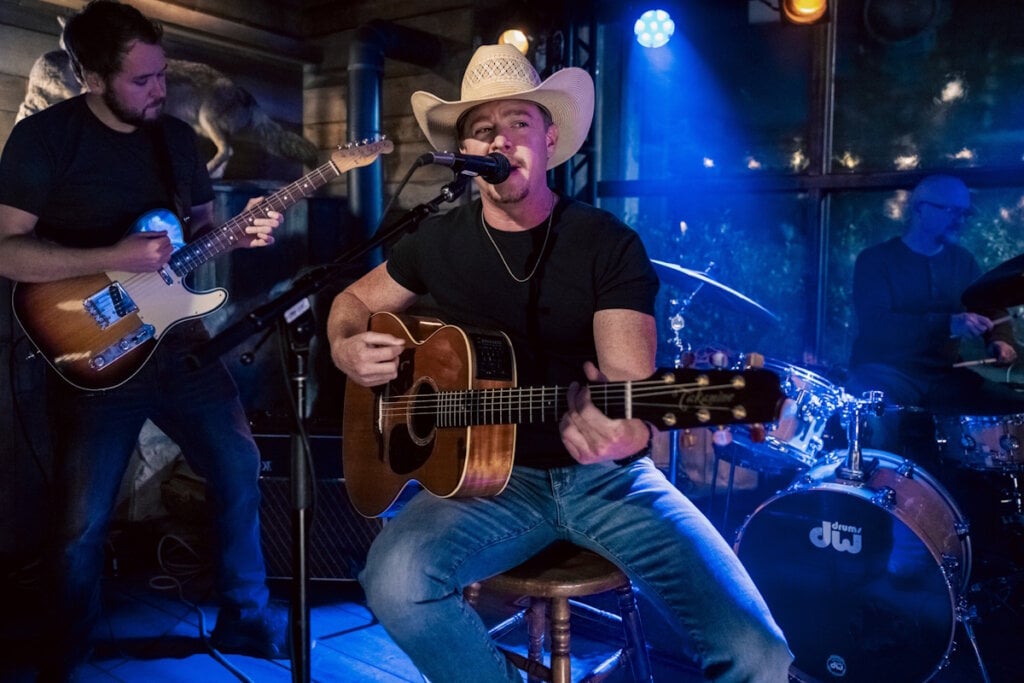
Country Singer Adam Sanders Heads to CBS’ ‘Yellowstone’ Spinoff ‘Marshals’ After ‘The Road’ Win

Another country artist is heading to CBS’ new Yellowstone spinoff, Marshals. Fresh off his big win on The Road, Adam Sanders is set to appear on the TV series this Sunday, April 12.

Fans first got to know Sanders throughout his time on the show’s inaugural season, which followed twelve aspiring artists as they experienced the realities of life of a touring musician. Blake Shelton and Keith Urban teamed up with Taylor Sheridan to search for the next country star in the docu-series-style competition.

After 10 weeks on the road, the competition finally came to a close at the historic Ryman Auditorium, where live audience votes determined Sanders the winner. As his country music career continues to gain momentum, viewers will see his talent emerge in a whole new way.

Adam Sanders; Photo: Fred Hayes/CBS

During an interview with Taste of Country Nights host Evan Paul, the Lake City, FL native discussed the brand-new song that he’s set to perform on the show. The tune, penned by Sanders with Jordan Walker, Adam Craig and Zach Crowell, is one that the singer has been keeping in his pocket for years, waiting for the perfect time to share it with the world.

Tapping into his love for “late ’90s, early 2000s country music,” the track channels that beloved era of the genre while still feeling uniquely his. He offers a mid-tempo sound with carries an authentic country twang that comes through in full force, pairing perfectly with a story rooted in the kind of reckless, all-in love that you know probably won’t end well, but you dive into anyway.

“That is my bread and butter,” he tells the outlet of that era of country. “I’ve always had ’90s country as sort of the roots of my music, but I wanted to find a way — how do I make this branches of my music? So this song is a product of that.”

He adds, “It reminds me of an old Brooks & Dunn song. Like a ‘She Used To Be Mine’ or ‘She Ain’t the Cheatin’ Kind.’”

Sanders goes on to say that during his time on set of Marshals, he had the chance to get to know with the show’s star, Luke Grimes, who portrays the role of Kayce Dutton in the series. Through their conversation, they found common ground in the style of music they are drawn to.

“It was really cool to … find out what makes his ticker tick,” Sanders explained. “His type of music is a little different than mine. He likes that old-school stuff that’s kind of like ’80s and ’70s, and I’m kind of right in the middle of ’90s country.”

The Road contestant isn’t the only country act making an appearance throughout the season. Ashley Cooke performed in a previous episode and Riley Green is set to make his long-awaited acting debut as Garrett, a former Navy SEAL, on Sunday, April 19.

Green’s character shows up at the ranch unexpectedly, looking to reconnect with Kayce Dutton and Cal (Logan Marshall-Green) in an attempt to move forward from his past. He won’t just make a quick cameo, he is expected to be a part of several episodes.

Following his performance on Marshals, Adam Sanders will head to Indio, CA on Sunday, April 26 to make his debut at Stagecoach. In addition to the $250,000 cash prize and recording contract from winning The Road, taking the Mane Stage at Stagecoach is also included in the winner’s prize package.

The post Country Singer Adam Sanders Heads to CBS’ ‘Yellowstone’ Spinoff ‘Marshals’ After ‘The Road’ Win appeared first on Country Now.

​Country Now

Categories
Entertainment

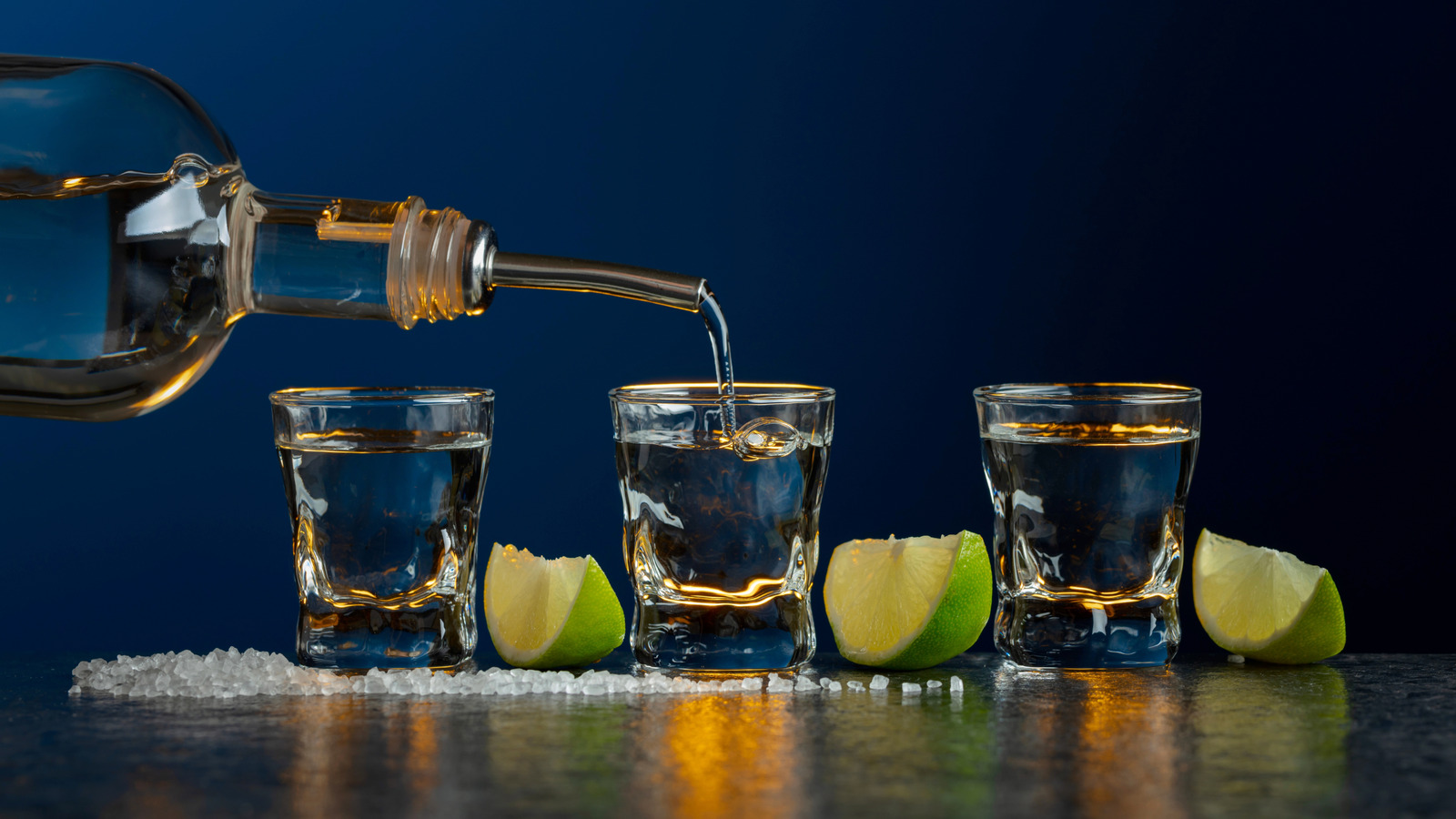
How Many Bottles Of Tequila Come From One Agave Plant?

Tequila production is a time-honored process that involves growing and harvesting agave, but how much liquor can one plant provide? We’ve got answers.

​Mashed – Fast Food, Celebrity Chefs, Grocery, Reviews

Categories
Politics

Inside the DNC’s Middle East (not) working group

After the Democratic National Committee punted on two resolutions in August that highlighted the party’s deep divide on Israel, DNC Chair Ken Martin convened a task force “to have the conversation” and “bring solutions back to our party.”

Seven months later, the Middle East working group — meeting today in-person for the second time — still has work to do.

The group, composed of eight DNC members with backgrounds in Jewish and Palestinian advocacy, has struggled to meet consistently or coalesce around shared objectives. Part of that is due to the difficulties of coordinating across schedules and time zones, with at least one member actively running for office. But atop those hurdles come the challenges of productive discourse about one of the party’s most contentious debates among a cohort with sharp ideological divides.

“People aren’t comfortable with being uncomfortable,” Steph Newton, a DNC member from Oregon who’s part of the working group, told POLITICO. “These uncomfortable discussions are how we’re going to be able to move the party forward and find a solution.”

The working group met for the first time in December at the DNC’s winter meeting in Los Angeles, and convened virtually two more times, on March 1 and March 18. Those meetings mostly centered on figuring out what the group should be working on in the first place. “Most of the time, what we’ve talked about is, ‘What are we supposed to be doing?’” said James Zogby, another member from D.C.

The working group comes as divides over support for Israel remain a persistent liability for Democrats, and as AIPAC’s involvement in midterm primaries presents a new purity test for candidates. “No one gets anywhere by trying to shout the other side of the room — as a matter of fact, I think that would be harmful politics,” Andrew Lachman, another working group member from California, said.

A DNC spokesperson emphasized the group’s goal is to figure out how to talk to voters about the Middle East in a way that ultimately helps the party build coalitions and win elections.

The group’s inaction so far came into sharper focus yesterday at the DNC’s spring meeting in New Orleans, when the party’s resolutions committee considered one brought by Joe Salas, another member of the working group from California, to recognize Palestinian statehood.

“It is necessary for the Democratic National Committee to address the ongoing heinous and illegal acts against the Palestinian people. Some here may say that there is a working group. To that, I say that we are in a midterm year and they are yet to produce any results in a moment where anger has only grown amongst the American people,” said Cameron Landon, VP of the College Democrats of America, who spoke on behalf of Salas.

Salas, who wasn’t at the meeting, submitted the resolution without discussing it with the other members of the Middle East working group, according to Zogby and Newton, who said she was “surprised” to see it in the resolutions packet.

“I would assume that if we’re on a work group together discussing these issues, you say, ‘Hey, work group members, teammates, I want to submit a resolution on X, Y and Z. I know we’re working toward something like this together. Is this something that we can discuss?’” Newton said.

Deborah Cunningham-Skurnik, another member of the group from California, told the resolutions panel yesterday that there were “some parts of it I would like to go bit by bit over with” Salas.

Salas said in an interview ahead of the vote he wouldn’t attend the New Orleans meeting because “I’m just gonna let them have those words and reject them, accept them, modify them, whatever they want to do.” He didn’t respond to further requests for comment about why he didn’t tell the working group he submitted the resolution.

The panel ultimately referred those resolutions back to the working group — with a warning. “As a body, we recommend this going back to the task force,” said Ron Harris, the resolutions committee co-chair. “But then we can put some — I don’t want to say ‘constraints,’ but expectations that we hear back.”

John Verdejo, a DNC member from North Carolina, was more direct. “It can’t just be we have a task force and then the next time we have a DNC meeting, it just comes up again. No, we want to see your progress. You want to have a task force? You want to make the hard changes, have the hard discussions? Then do it,” he said.

Allison Minnerly, another working group member from Florida, said after the snafu that “so long as the party does not prioritize this conversation, you will see what happened today, which is that DNC resolutions committee members have many questions on the inaction and the results of the working group. It’s really clear that this issue will keep coming up at every subsequent DNC meeting until there’s a clear direction, solution, talking points.”

Now that the party has referred the resolutions to the working group, it finally has a clear, near-term objective for its meeting today.

“I actually am pleased that we will now have a very specific charge that we must accomplish in a defined period of time,” Zogby said. “We have not had a defined agenda, and it’s been difficult to get people together. Now we have to get this done, and there’s just no way we can duck it at this point.”

Like this content? Consider signing up for POLITICO’s Playbook PM newsletter.

​Politics

Categories
Politics

Pope Leo XIV condemns war, rejects claims of divine backing

Pope Leo XIV on Friday issued a sweeping condemnation of war, continuing to reject the idea that military action can bring about peace or freedom as the Trump administration and other leaders use religion to justify the U.S.-Israel war in Iran.

“God does not bless any conflict,” Leo wrote on X. “Anyone who is a disciple of Christ, the Prince of Peace, is never on the side of those who once wielded the sword and today drop bombs.”

Military force, he added, will not result in peace or freedom — that “comes only from the patient promotion of coexistence and dialogue among peoples.” He did not mention President Donald Trump or other leaders by name in the post on X.

Trump, who describes himself as a Christian, but not Catholic, has invoked faith several times throughout his term as a means to justify his actions.

Trump on Monday told reporters at a White House press briefing that he believes God supports the Iran war “because God is good” and wants to “see people taken care of.”

Leo had previously condemned Trump’s threat from earlier this week to destroy Iranian civilization.

He called the threat “truly unacceptable” and urged that the conflict in the Middle East “is only provoking more hatred.”

At a Palm Sunday mass, Leo insisted that no one could use God to justify war, telling the tens of thousands of people gathered before him that God “does not listen to the prayers of those who wage war, but rejects them.”

Defense Secretary Pete Hegseth has framed the Iran war, which reached a temporary ceasefire Tuesday after six weeks of fighting, as divinely sanctioned — often turning to prayer and belief that God is on the side of the U.S. military.

At a Pentagon church service held weeks after the Iran war began, Hegseth, who is also a Christian, but not Catholic, read a prayer that called for violence against military enemies.

“Let every round find its mark against the enemies of righteousness and our great nation,” he prayed during the livestreamed service. “Give them wisdom in every decision, endurance for the trial ahead, unbreakable unity, and overwhelming violence of action against those who deserve no mercy.”

​Politics

Categories
Food

9 Costco Kitchen Finds That Customers Love

Costco has more than just food and drinks in its aisles. From whole refrigerators to charcuterie boards, these kitchen finds from Costco are customer approved.

​Food Republic – Restaurants, Reviews, Recipes, Cooking Tips

Categories
Entertainment

Donald Trump Shares Graphic Murder Video on Social Media, Continues to Concern Supporters …

Reading Time: 2 minutes

Earlier today, we reported that Hunter Biden had challenged Donald Trump Jr. and Eric Trump to a cage fight.

And if you thought that would be the wildest political story of the day, then you’re clearly a newcomer to life in 2026.

Donald Trump’s Truth Social has been a hotbed of insanity this week, and his latest post contains uncensored video of a brutal murder.

U.S. President Donald Trump responds to a reporters question as he leaves after signing a series of bills related to California’s vehicle emissions standards during an event in the East Room of the White House on June 12, 2025 in Washington, DC.
U.S. President Donald Trump responds to a reporters question as he leaves after signing a series of bills related to California’s vehicle emissions standards during an event in the East Room of the White House on June 12, 2025 in Washington, DC. (Photo by Chip Somodevilla/Getty Images)

“An Illegal Alien Criminal from Haiti, who was released into our Country by the WORST President in History, Crooked Joe Biden, and the Radical Democrats in Congress, just beat an innocent woman to death with a hammer at a gas station in Florida,” Trump wrote in his post, adding:

“The video of her brutal slaying is one of the most vicious things you will ever see.

“The Biden Administration granted him, and all Haitians, ‘Temporary Protective Status,’ a massively abused and fraudulent program which my Administration is working to terminate.”

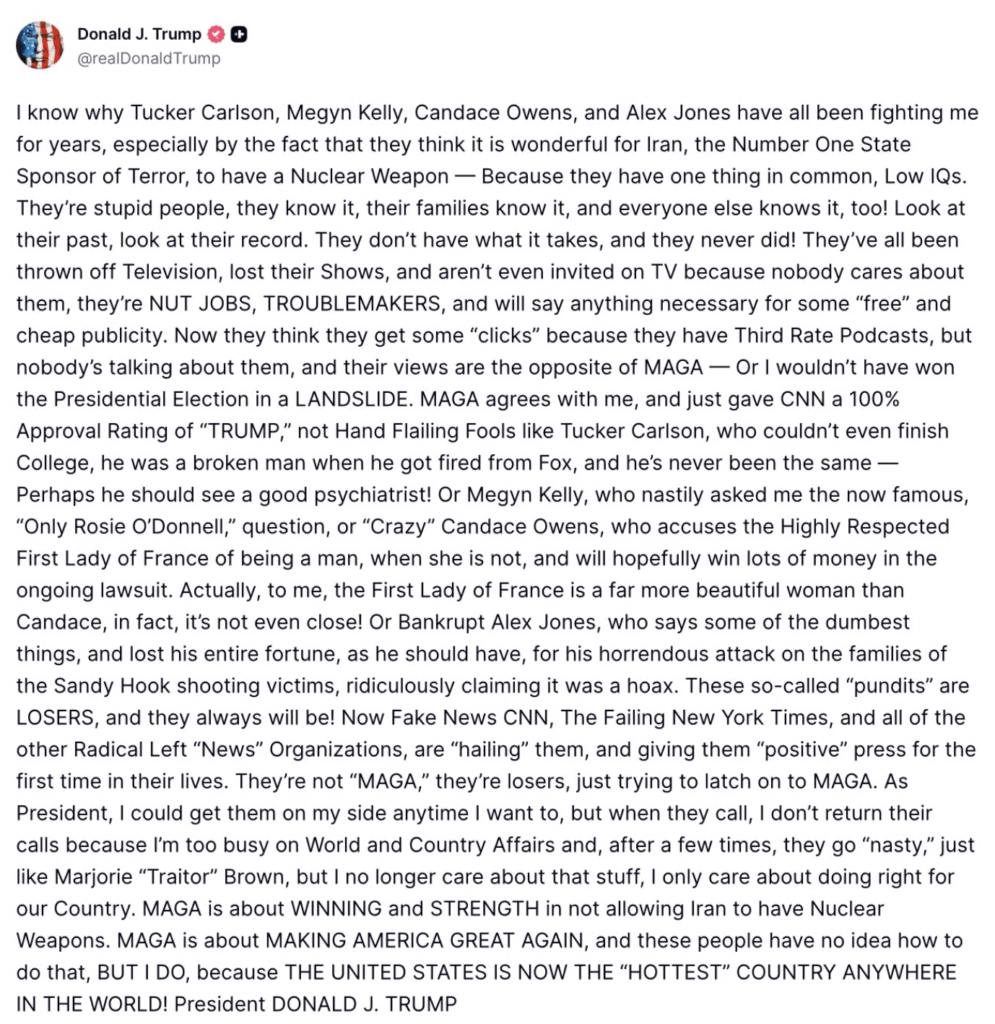
The post comes just one day after Trump blasted Tucker Carlson, Megyn Kelly, and other conservative pundits in a lengthy tirade.

Donald Trump unleashed on his former conservative media allies in a recent rant.
Donald Trump unleashed on his former conservative media allies in a recent rant. (Truth Social)

Many believe that Trump is attempting to distract from recent policy failures like the war in Iran and his administration’s handling of the Epstein files by reminding his base about his hardline stance on immigration.

“This one killing should be enough for these Radical Judges to STOP impeding my Administration’s Immigration Policies, and allow us to END THIS SCAM ONCE AND FOR ALL,” Trump continued, adding:

“Please say a prayer for this innocent woman’s family. We will ensure quick and severe JUSTICE is served in this case!”

Ironically, Trump concluded by warning his followers not to watch the footage:

President Donald Trump tours the assembly line at the Ford River Rouge Complex on January 13, 2026 in Dearborn, Michigan.
President Donald Trump tours the assembly line at the Ford River Rouge Complex on January 13, 2026 in Dearborn, Michigan. (Photo by Anna Moneymaker/Getty Images)

“I don’t recommend you watch this tape, because it is so terrible, but felt I had an obligation to put it up so that people can see what Democrats are protecting, and wanting to come into our Country, even now, after all we’ve been through,” he wrote, adding:

“Again, viewer discretion advised — Not for children!”

Very little is known about the case, aside from what Trump said in his post.

We will have further updates on this developing story as new information becomes available.

Donald Trump Shares Graphic Murder Video on Social Media, Continues to Concern Supporters … was originally published on The Hollywood Gossip.

​The Hollywood Gossip

Categories
Music

Kenny Chesney Cancels Two Shows at the Sphere, But Why?

There are now just nine chances to see Kenny Chesney at the Sphere in Las Vegas in 2026. Continue reading…​The Boot – Country Music News, Music Videos and Songs