It’s important to note that we know very little about these incidents, and there are many reasons why Lyonne may have been a little unsteady on her feet.
But the actress has struggled with addiction issues in the past, and the internet is taking this as a sign that Natasha has relapsed. More on that later.
First, we’ll address the plane situation, which sounds like the sort of thing Natasha will be offering up amusing anecdotes about in her next interview.
According to Page Six, Natasha boarded a Delta flight a few hours after the premiere, still sporting the same outfit she had worn on the red carpet.
Natasha Lyonne attends the Gothams 34th Annual Film Awards at Cipriani Wall Street on December 02, 2024 in New York City. (Photo by Mike Coppola/Getty Images for The Gotham Film & Media Institute)
When flight attendants asked her to put away her laptop and store her tray table she didn’t respond. They eventually surmised that she was asleep.
“Ah! You scared me!” Lyonne reportedly shouted when they finally woke her up
“Ma’am, do you need medical attention?” one attendant asked.
“Ma’am, I need you to come off the plane. Do you need help with your belongings?” another remarked
“Where are we?” Lyonne was overheard asking, before being told, “We’re still in LA. The plane hasn’t gone anywhere … The plane is not going anywhere until you come off it.”
Witnesses say Lyonne shushed the gate agent who had come on board, then headed to the bathroom and emerged eating a bag of pretzels.
She then exited the plane after being informed that her luggage had already been removed.
Natasha Lyonne attends the Los Angeles Premiere of HBO’s “Euphoria” Season 3 at TCL Chinese Theatre on April 07, 2026 in Hollywood, California. (Photo by Monica Schipper/Getty Images)
“We have a passenger, who for whatever reason, wouldn’t follow some basic commands,” the captain reportedly told the other passengers once Lyonne had been removed.
“We had a passenger who didn’t seem up to the task tonight so that’s why they were asked to be booked on another flight — I do apologize for the inconvenience, but we will get you to New York as quickly and as safely as possible.”
As for the Euphoria incident, Lyonne will be appearing on the show’s third season, and — maybe the pressure of a red carper event just got the best of her?
The 45-year-old announced back in January that she had relapsed after several years of sobriety.
“Proud to report this kid is doing a whole lot better & back on her feet,” she wrote on X (formerly Twitter) at the time.
“Want to thank our recovery communities and the fans who stood by and were so supportive. Aiming to keep the journey somehow private, but look forward to sharing my experience, strength and hope as makes sense.”
The comments on the TikTok video were full of judgment, but thankfully there were some supportive fans.
“Sobriety isn’t linear. I hope Natasha can get back on track for herself,” one commenter wrote.
Democrats are, once again, punting on what to do about Israel.
DNC members rejected a symbolic resolution to limit the influence of the American Israel Public Affairs Committee and dark-money corporate groups in Democratic primaries — an unsurprising result that is nevertheless a blow to those within the party that have been infuriated by the pro-Israel group’s recent interventions.
They also punted on a pair of sweeping resolutions concerning conflicts in the Middle East that pushed the party to support conditioning military aid to Israel. The measures were referred to the party’s nascent Middle East Working Group, which is meeting for the fourth time this week and has been slow to coalesce around an agenda.
While the resolutions were not expected to pass, the outcomes reflect a party establishment still grappling with how to respond to the increasingly thorny politics around Israel and AIPAC — and their base’s sharp turn away from the longtime U.S. ally.
The AIPAC resolution called for the DNC to condemn “the growing influence of dark money” in Democratic elections, including from the pro-Israel group that has pumped tens of millions of dollars into recent primaries in Illinois and New Jersey.
Several members of the DNC’s resolutions committee said they voted it down because they had passed a resolution earlier in their meeting broadly condemning the influence of dark money in the midterms without calling out individual groups. Committee members similarly struck language from the catchall dark-money resolution that had singled out the glut of spending from AI- and cryptocurrency-aligned PACs.
DNC Chair Ken Martin amplified that messageon X: “We had various resolutions that focused on different industries and groups, and instead of going one-by-one, we passed a blanket repudiation,” he said. “I have made my position on this clear from day one: We must end the influence of dark money in our politics and restore power back to the people.”
Pro-Israel groups applauded the DNC for quashing the nonbinding resolution.
“The DNC made clear today that all Democrats, including millions who are AIPAC members, have the right to participate fully in the democratic process. And we plan to do just that,” AIPAC spokesperson Deryn Sousa said in a statement.
Halie Soifer, a former Kamala Harris adviser and CEO of the Jewish Democratic Council of America, suggested that the votes show the party hasn’t shifted on Israel as much as it seems.
“There are misconceptions because there is a vocal, far-left faction of our party, but they are in no way leading here,” Soifer said. “The DNC as a whole has not shifted from where it has been … which is an organization that is inclusive of Jewish Americans and is supportive of the U.S.-Israel security relationship, as well as Israel’s future as a Jewish and Democratic state.”
But Florida Democrat Allison Minnerly, who introduced the AIPAC resolution, argued there’s “merit to calling out different PACs with intention” given their individual efforts to influence the party’s elections. She said in an interview after the vote that she was unsurprised but disappointed by the result.
DNC leadership “really does not want to continue having this conversation … but our voters, our base, does,” she said. “These are hard questions on a local and national level, but the DNC ultimately has to not just kick things down the road but address things head on because people are tired of waiting.”
A Pew Research survey released this week showed 80 percent of Democrats and Democratic-leaning independents hold unfavorable views of Israel, up from 69 percent last year and 53 percent in 2022. A NBC News poll conducted in late February and early March, meanwhile, found that 57 percent of Democrats view Israel negatively, a dramatic change from when just 35 percent held a negative view of the country after Hamas attacked it on Oct. 7, 2023.
The DNC has struggled for years with how to address the shift within its base — a challenge that has returned to the fore with Israel’s involvement in the unpopular U.S. operation in Iran. That’s being compounded by tensions over AIPAC after the historically bipartisan group intervened in a series of hotly contested primaries.
In a sign of how sensitive — and politically treacherous — both issues are for the party, one DNC member told POLITICO they had received calls about the resolutions from two potential 2028 presidential contenders.
Martin established a working group last summer to guide the party’s Middle East policy. It has yet to begin its work in earnest and has been plagued with internal dysfunction, with some members lamenting that the panel lacks heft within the broader party machine.
Some on the eight-member working group hoped by bringing the resolutions to a larger committee they could force discussion on issues around Israel. But the resolutions committee members sent the measures back to the working group — even as they raised concerns about its pace and progress.
Progressive activists and pro-Palestinian groups bristled at the DNC refusing to directly call out AIPAC and deferring action on measures that included recognizing the “State of Palestine” and pausing or conditioning military aid to Israel.
“Today’s vote once again showed that Democratic leadership is asleep at the wheel when it comes to one of the biggest existential threats to the party,” said Margaret DeReus, the head of the IMEU Policy Project, a pro-Palestinian group that had lobbied members to approve the resolutions. “Party leadership needs to wake up.”
(Lizzy Hahn/ Chilkat Valley News) Students rush to grab eggs during the Easter egg hunt in the Haines High School on April 5, 2026.
With baskets in hand, Haines youth filled the high school Sunday afternoon on the hunt for Easter eggs.
More than 160 children spread out throughout the school, filling their baskets and bags.
Organizer Krystal Lloyd said 14,000 eggs were in the building, a large number compared with the previous year’s 11,000 eggs and the 2024 count of 8,000 eggs. Most eggs had candy; however, 153 had prize slips within. The Salvation Army donated additional prizes “to make sure that we didn’t run out,” Lloyd said.
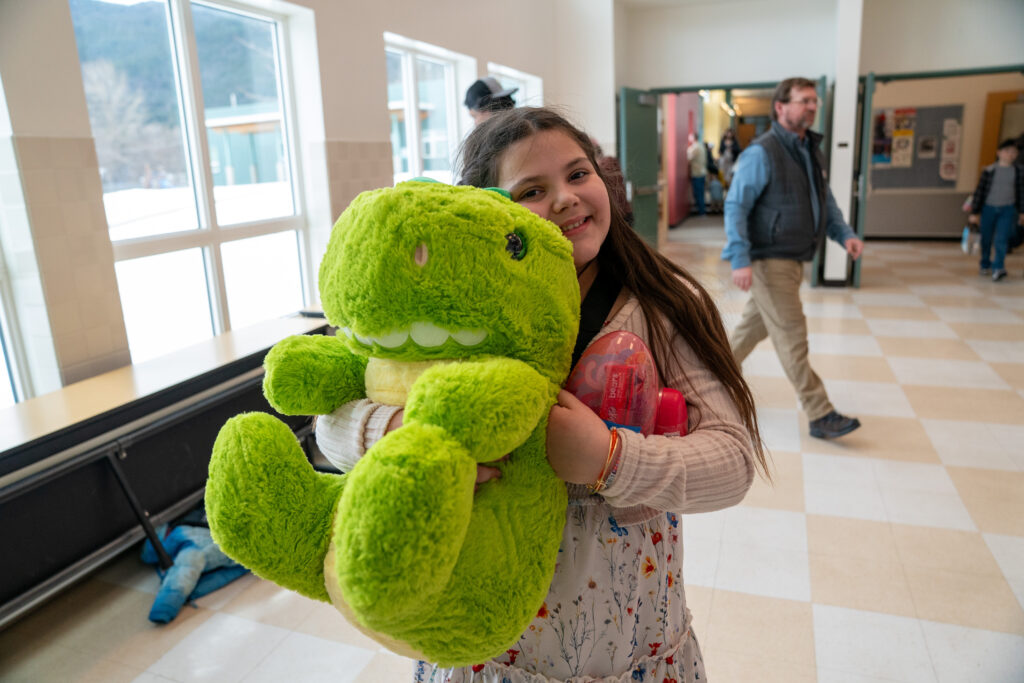
(Lizzy Hahn/ Chilkat Valley News) Lillee Grant hugs the dinosaur stuffy she got after finding a prize slip within an Easter egg in the Haines High School on April 5, 2026.
Lillee Grant, 9, collected more than 50 eggs and found a coveted prize slip. She used it to pick out a large, green Tyrannosaurus Rex.
“I’m getting this (dinosaur stuffy) ’cause it’s giant,” Grant said.
To keep from getting trampled in all of the excitement, the younger kids, like 2-year-old Olen Leazier and 21-month-old Stella Swinton, had a dedicated section in a different part of the school, where children could leisurely pick up eggs and fill bags their size.
(Lizzy Hahn/ Chilkat Valley News) Stella Swinton, 21 months old, holds an Easter egg during the egg hunt in the Haines High School on April 5, 2026.
Lloyd said 19 adults and two children helped her fill the plastic eggs with candy. In order to fill 14,000 eggs, Lloyd estimated about 60 people made donations. It took about 10 hours to fill 14,000 eggs with “a lot of donated stuffers.”
The eggs are reused each year with 100 to 200 broken ones. Lloyd has been organizing the local Easter egg hunt for the past five years. The first hunt had about 30 kids and has since grown exponentially.
“Unless we get a nice donation, like we did this year, for next year, it’ll be really hard to meet the 14,000,” Lloyd said.
This year, she said Jody Miller purchased the entire Amazon cart of goods for the event, becoming one of the biggest donors along with Howsers IGA, Oleruds and the Salvation Army.
Krystal Lloyd helped to organize the Haines community Easter egg hunt and hot dog social this year. She gathered volunteers to fill the plastic eggs for the 14,00-egg event at the school on Easter. On Friday and Saturday Ron Weibel, Sue Waterhouse, Joshua Lloyd, Serena Woods, Judy Weibel, Neil Einsbruch, Joan Degen, Megan Highfield-Stewart, Savannah Tinnes, Phyllis Sage, Gary “Bubba” Hinkle, Sophia Armstrong, Chloe Lloyd, Allie Lloyd, Christina Lloyd, Lynndsey Stearns, Kristy Hinkle, Lucille Lloyd and Gloria Kosinski all helped fill the eggs. According to Einsbruch and Waterhouse, the best items stuffed into plastic eggs included the rubber-band punching balloon and slapper wrist bands. The Twix candy bars and stickers were also noteworthy.
Three members of Haines Drama, Debate and Forensics team served salmon and halibut at the Mosquito Lake School on Wednesday. Chisel Triezenberg,Walther Jim, and Zorza Szatkowski helped with the meal and clean-up after an Interface for Change meetup. The fish were donated by Erika Merklin who helped coordinate locally for a 5-year Alaska EPSCoR project partnering with coastal communities on research. Alaska EPSCoR representatives held a community participation workshop where they shared research information about lake sediment using field data, analyses of red seaweed in the Lynn Canal, complete with an interactive memory game, and made VR equipment available for a closer look at what underwater farming looks like. And it came with a delicious dinner. Community members contributed side dishes including local foragers Mike Ogborn and Ron Maudlin who shared pickled fiddlehead salad with herring eggs, onion and garlic. The potato casserole, contributed by Tammy Hauser, was a popular side item also, reminiscent of the Cracker Barrel version of the dish. The lucky winners of swag bags that included an Olerud’s gift card were Mardell Gunn and Charles Peep. The Interface of Change team went on to host the same presentation in Haines at the Alaska Native Brotherhood and Sisterhood Hall on Thursday where CVN editor Rashah McChesney won a beanie for building the tallest tower out of tinker toys. She may, or may not, have been the only participant. At both locations, a photography project about wild foods, climate and community done by local middle and high school students was also on display.
Amy Kane is moving to Wrangell. Kane has lived in Haines for six years and is relocating for her job with the Alaska Marine Highway System. She is going to get health insurance! Some people know her as the face of The Book Store, before the new owners took over last year. Others know her as a quality source of focaccia bread at pop-ups and potlucks all over the Chilkat Valley. Kane relocated to Haines from Sitka, where she owned and ran the Larkspur Cafe. Kane’s focaccia bread was an important part of the restaurant even though she said she is not a bread maker. She turned out large trays of the bread for paninis and settled on the recipe after some trial and error. Kane calls it a forgiving bread and highlights the importance of a working class bread that can be whipped up quickly, while still allowing the baker to add and take away ingredients based on what is available. Before she moves on to a new chapter in Wrangell, Kane passed along her focaccia bread recipe to Brynn Murphy, who agreed to learn the recipe in a one-on-one baking afternoon. They started with separating the fresh rosemary and thyme, and spent a Friday afternoon practicing the technique for making a really great focaccia. Murphy took detailed notes while they went through the process. She left with her practice bread and a whole new skill set. Murphy intends to share the bread with Haines for years to come
Paul Swift moved to Haines in 1970 and has been thinking about snow and weather ever since. From 2012 to 2018 he was a local volunteer observer for the National Weather Service. In 2018 retired meteorologist Jim Green took over this responsibility. Some of those tasks include logging stats, recording minimum and maximum daily temperatures, snowfall and converting snowfall into liquid measurements. Swift’s wife Anne Boyce shared a picture of him on a porch from the winter of 2011-2012, showing the stark reality of springtime melt in the Chilkat Valley. That year, she said, nearly 360 inches of snow was recorded in Haines. Current NOAA observer Green said Haines has been a very reliable source of weather data for 100 years because of the volunteers in the Chilkat Valley. Both Swift and Green have found it challenging to take vacations, as not many house sitters are willing and able to measure the weather while they are gone. Fun fact, if the observer misses three days of data in a month the information can not be used historically.
Ketch Jacobson took some Haines locals out to test the new engine in the Fjordland Express and look for some wildlife along the way. What they found in Skagway was a pirate named Trevor Clark and a bundle of red rope. Clark needed some help moving his 750-pound engine across the boat yard. Trygve Bakke, Charlotte Martin, Lizzy Hahn, Baylee Pearson, Justin Letson, and Brooke Robinson were up to the task. The group made a plan to move the engine with the rope slung under it and over their shoulders while they shuffle stepped across the boat yard in their XtraTuffs. In the end, Clark got his engine moved and Jacobson tested his new engine. They spotted a few ducks, and everyone enjoyed Easter dinner in Skagway.
The team visiting Haines from Alaska EPSCoR, led by Davin Holen, hosted a mini Alaska science Olympiad at Klukwan School. Shk’oohaaleeJustina Hotch kept the children on schedule as they handed out medals to the winners for STEM-based team activities and practiced tower building with tinker toys. First-place tallest tinker-toy tower builders were Kyle Willard Wilson and Sampson Duffy-Webb. Their tower came in at 57.5 inches. Duffy-Webb has previous building experience, with a pirate fort at home. This might have contributed to the team’s win.
If you happened to be sitting in Rusty Compass on Tuesday morning, you might have noticed a group of 10 people quickly file in from the entrance at the rear of the building. They corralled chairs, ordered coffee and snacks and seemed to be having a grand old time when Kristy Hinkle walked in the front door and gasped. Shouts of “Happy Birthday” filled the space, and then someone started to sing the song – which most in the packed cafe joined in to sing. At some point, someone handed Hinkle a helium balloon which she held as she took turns hugging her well-wishers. She turned 41 on Tuesday, and was tricked into heading to the coffee shop by her sister Krystal Lloyd, who also corralled everyone into the surprise greeting. Recently, Derek Poinsette was snowmachining on Chilkat Lake when he encountered a moose who was maybe curious, maybe mad, maybe feeling territorial – it’s unclear. Regardless, as he passed it, the moose began following him and continued to do so for about a half mile or so, he estimated. Poinsette stopped to get video of it as it followed him across the lake. He kept having to take off to put distance between the two of them, and eventually it lost interest and moved along. Fish and Game wildlife biologist Hannah Manninen and wildlife education and outreach coordinator Abby McAllister viewed the video with some interest outside of the Haines library after a presentation they gave on Tuesday evening. The three speculated about why the moose followed Poinsette for so long. Manninen also noted that it appeared to be a female, and both McAllister and Manninen said she looked pregnant.
The window for team sign-ups for the Kluane-Chilkat bike race is now a matter of days.
Race coordinator Mike Kramer said the June 18 relay race between Haines Junction, Yukon, Haines reached its cap of 1,200 team riders within eight days of opening March 15, with some teams signing up before 5 a.m.
“It’s great that the event has become so popular, but it’s heartbreaking to get an email from somebody who’s done the race for years and find they missed the deadline,” Kramer said.
In previous years, registration filled up in three weeks.
Kramer attributed the accelerated registration to the number of riders in previous years who missed the deadline. “This year, they had their alarms and phones set.”
Solo riders can continue to register until May 13. “In theory, there are as many solos as people want to ride,” Kramer said.
24 years ago – April 11, 2002
Local effort to reprint classic text pays off
Citing a Haines woman’s efforts to encourage interest in Tlingit culture, the University of Washington Press will reprint its popular 1991 reference book, “The Tlingit Indians.”
The book, by historians George Thornton Emmons and Frederica deLaguna, is widely considered the definitive history of traditional Tlingit culture at its peak in the late 19th century.
The first edition of 5,000 sold out shortly after its release and remained highly sought after, bringing as much as $200 through online booksellers.
The book’s scarcity prompted local resident Susan Brouillette to mount a telephone and letter-writing campaign among Alaska Northwest retailers, museums, and individuals to persuade the publishers to reprint the book.
It didn’t take long to prove that a market exists for a second printing, she said. “Most of the people I talked to knew that there weren’t any more out there. I wanted to show the press that they could sell 400 or 500. After word got out about what I was doing, I had people coming up to me on the street saying ‘Include me, I’ll buy four copies,’… stuff like that.”
Bookstores provided most of the numbers needed, Brouillette said
Sitka’s Old Harbor Books owner Don Muller said the classic reference would sell at least 100 copies a year at his store. “It’s not a best seller, but as long as there are Tlingit Indians or interest in Tlingits, it’ll sell. At least here.”
Muller said the book is too good to keep out of circulation. “It’s an amazing book and it’s amazing that they let it go out of print. If we had to buy 100 to get it reprinted, we’d do it.”
The Sheldon Museum bookstore will order 20 to 30, curator Cindy Jones said.
University of Washington Press assistant marketing director Mary Anderson said high costs and perceived low demand for the 500-page book, which retails for $75, made the press reluctant to launch a second edition.
But Anderson said Brouillette convinced the company to move. “We learned that there’s a greater demand than we thought at first. I commend her. It was a wonderful effort. Sometimes publishers are like that. They need the feedback.”
Anderson said the second edition, like the first, will be printed in hardcover instead of less expensive, glossy paperback, reflecting the book’s high value.
“We will be reprinting in hardcover, mainly because the people who buy this book want to buy it forever. It’s the kind of book that’s handed down. It’s not like a paperback that’s thumbed-through and read. It’ll be passed down through generations,” Anderson said.
Anderson wouldn’t say how large the press run will be. “It’s fetching a high price. I’m hoping we can produce sufficient numbers to meet the demand.”
She said the edition is on schedule for production this summer, with release set for this fall. It will be featured in the University Press’ fall catalog, and be featured at the upcoming National Book Exposition in New York City.
Brouillette said she’s telling everyone who’s interested to buy a copy of the book at the local museum this winter. “I am so elated. I’m thrilled as can be. Now I see how you can make things happen if you want to. That’s pretty cool.”
50 years ago – April 3, 1975
Drama festivals will take place next week
From Kodiak and Fairbanks, Petersburg and Skagway, Juneau and Sitka – even from Portland and Seattle – actors will gather next week at the Chilkat Center for the Arts for the biennial Alaska State and Northwest Regional Community Theatre Festivals.
The participants will each present a maximum of 60 minutes of drama, and will be judged by an outstanding group of theatre arts leaders, chosen specially for the Alaskan and regional festivals.
The Alaska State Festival will have one matinee (Thursday), and three evening performances of two plays each Wednesday, Thursday and Friday. Saturday, Oregon will perform in the afternoon, and Washington and the Alaskan winner will appear in the evening.
Tickets are available for individual performances, for the whole state festival, and for the regional one, too.
This will be the second state festival held in Haines, which has been named the permanent festival city. It will be the first time that the Northwest Regional Festival will have been held in Alaska.
Sunday, March 29 A caller in the 2000 block of Lutak Road requested a citizen assist. An officer provided an escort into town. A caller at 100 Main Street reported a burglary alarm going off. An officer responded.
Monday, March 30 A caller reported an incident of stalking behavior. An officer responded.
A caller in Haines reported receiving a call from someone claiming there was a warrant out for his arrest. The caller was advised this was a scam phone call.
Tuesday, March 31 Officers assisted a citizen on the 200 block of Main Street. An officer assisted another agency at Kelsall Road. A caller reported they were testing fire alarms on the 50 block of Haines Highway. A caller reported a driver speeding and recklessly driving on the Haines Highway. An officer was advised.
Wednesday, April 1 A caller in Haines reported a protective order violation. An officer responded. A service call was performed in the 800 block of Oslund Drive. A caller on Main Street reported stolen property from their vehicle. An officer was advised. Multiple callers reported receiving a text message stating they had an unpaid traffic ticket and needed to pay immediately. Callers were advised this was a scam and a nixle alert was sent out. A caller in the 100 block of Chestnut Drive reported a damaged stop sign and a vehicle impeding traffic. An officer and public works were advised. An officer conducted a vehicle stop at 2 Mile Mud Bay Road and issued a verbal warning for trailer-light requirements.
Thursday, April 2 A caller on Lutak Road reported multiple vehicles speeding throughout the day. An officer was advised. An officer conducted a vehicle stop and issued a verbal warning for tail-light requirements. An officer conducted a vehicle stop on Allen Road and issued a verbal warning for taillight requirements and a citation for no proof of insurance. Officers observed an unlocked business after hours on Main Street. The business owner was contacted.
Friday, April 3
A caller on Mud Bay road reported a person who came into their apartment without permission. Officers responded.
A caller reported a fire on the 100 block pf Second Avenue. Officers and the fire department responded.
A driver received a verbal warning for trailer-light requirements at 3 Mile the Haines Highway.
A driver received a verbal warning for failure to stop at a stop sign and speeding on Young Road.
Saturday, April 4
A caller reported finding a bag of medication on the 1000 block of Small Tracts Road. An officer responded.
A driver received a verbal warning for turn-signal requirements on Union Street.
A driver received a verbal warning for headlight requirements on the 300 block of Haines Highway.
There were two 911 hang-up calls, four EMS calls and eight burn permits issued.
(Rashah McChesney/Chilkat Valley News) Staff from Brice Construction sink monitoring wells into the beach at Tanani Point on July 14, 2024, in Haines, Alaska. The site, which is owned by the U.S. Army used to be a tank farm which has been in various stages of testing and remediation for contamination for decades.
As the Trump administration moves to rescind regulations on so-called forever chemicals, Alaska lawmakers hope to create a separate, stricter set of state standards.
PFAS chemicals are durable, water-soluble compounds that have long been used in both consumer and industrial products for their non-stick and water-resistant properties.
Usage in firefighting foams in particular has led to widespread soil contamination around the state, including at Haines’ Tanani Point Tank Farm and fuel terminal, formerly the southern end of the Haines-Fairbanks Pipeline. Research in recent decades has linked PFAS exposure to cancer and a range of chronic illnesses.
Bills in each chamber of the state Legislature, HB 235 and SB 219, would mandate state testing of all public water systems and require those systems to show near-zero concentrations of PFAS. Those concentration limits would replicate the Biden-era federal limits that the Trump administration has since moved to rescind.
The legislative effort is a new regulatory tack, following years of fluctuating guidance from executive-branch agencies at the state and federal level. If the state-specific standards are put into place, it would force a change to current Dunleavy administration policy of fixing PFAS policy to federal guidelines.
The state’s Department of Environmental Conservation (DEC), through spokesperson Sam Dapcevich, said last week it does not take official positions on pending legislation.
But in recent years, Dunleavy’s administration has been accused by some of resisting a shift to safer standards.
In testimony on the bill last month, Alaska Community Action on Toxics director Pamela Miller referred to a “failure to act” by the state regarding PFAS drinking-water regulation.
“It’s just not acceptable to allow for these delays, because people are continuing to be exposed to dangerous levels,” Miller said in an interview last week.
State PFAS regulations were set to tighten in 2018 under Dunleavy’s predecessor, Gov. Bill Walker. Walker’s policy proposed setting a limit for the total concentrations of five different PFAS compounds in public drinking water.
The following year, when Dunleavy came into office, DEC cut the policy down to only consider total concentrations of two of those compounds toward the limit. One DEC contaminated sites program manager wrote at the time that the change went “against our responsibility as environmental and health professionals to ensure the drinking water of Alaskans is safe,” according to an internal memo.
That policy stood through 2023, when then-DEC commissioner Jason Brune pledged to implement new, stronger state standards, indicating the change would happen that year.
But new standards never came, and DEC staff now says their official policy is to follow the limits set by the federal government.
There’s disagreement on what that means.
Previous federal guidelines set a limit of 70 parts per trillion for the sum of two compounds. Two years ago, the Biden administration dropped allowable concentrations for a wider range of PFAS compounds to levels near zero.
Sen. Jesse Kiehl, who represents Haines, is a cosponsor of the Senate’s version of the PFAS bill. He said this week he believes the state is currently regulating at the looser, 70 parts per trillion level. Multiple people testifying during committee discussion on the bill reiterated that idea, that the state is currently using the looser regulations.
But in an email this week, Dapcevich said DEC is following the stricter, Biden-era standards. Those standards are also listed on DEC’s website.
The near-zero Biden-era levels are aligned with what scientists and advocates have told legislators in recent months, citing research showing no safe level of PFAS exposure. Even trace amounts, they say, can have major health consequences.
If the state continues to stick with federal guidelines, however, the stricter regulatory regime will be short-lived. Last year, the Trump administration announced an intent to rescind federal limits on four of six major PFAS compounds. It also announced an intent to extend the compliance deadline for limits on the two remaining compounds from 2029 to 2031.
Last year, it said those changes would be finalized this spring.
DEC staff have been reticent to speak about PFAS regulation. Dapcevich said last week the department would not make any staff available for interviews on the topic of PFAS and said it would only provide written answers to written questions. The head of the department’s drinking water program, Cindy Christian, did not respond to multiple messages requesting information about testing in Haines.
The agency, along with the Department of Transportation, has answered questions from legislators on the senate version of the bill, including providing cost estimates. According to those estimates, the bill would add $19 million to the state budget for next year, and around $10.5 million long term.
Some of those costs would come from increased testing. There are also provisions in the bill that would make the state liable for contamination from public facilities. That would require the state to provide clean drinking water and testing to individuals affected by state contamination, even if they had private wells.
“When you know it’s toxic and you know it’s in Alaska’s water, it’s irresponsible not to do something about it,” Kiehl said in an interview this week.
Even so, for Haines, it doesn’t appear the bill would have much of an immediate local impact.
According to state testing in 2024 of the Lilly Lake and Piedad water treatment plants, the borough’s public water system is currently clear of PFAS. The testing included all six compounds covered under the strictest version of the federal standards, borough records show. Borough water and sewer director Dennis Durr said last week that the borough’s water system is set to undergo another round of voluntary state PFAS testing this month.
The public water main, however, only stretches out Lutak Road as far as the Haven Court neighborhood. At least some lots in the area next to the tank farm draw from groundwater. In at least one location outside the tank farm fence — the public beach below the site — testing has found groundwater runoff to have PFAS levels above the allowed drinking water limits.
The state, however, is not planning to test private wells in the area regardless of whether either of the bills pass.
For one, the site cleanup project is under the jurisdiction of the U.S. Army and has not included testing toward homes south of the property, said Greg Rutkowski, of Brice Engineering, the federal contractor testing the site.
Dapcevich said the state “may become involved” with testing private wells if they’re believed to be exposed to contamination. However, “based on current data,” he wrote in an email, the state does not believe the nearby Tanani Point homes are at risk.
Miller said last week Alaska Community Action on Toxics would provide free testing kits to interested residents.
Eliminating the source of the contamination at Tanani Point also looks to be far off. Brice Engineering is currently mapping PFAS levels around the site, and Rutkowski said last week the mapping is expected to be finished and made public in July.
Once that evaluation is complete, Brice would have to conduct yet another study, this time on the viability of different cleanup methods, before actually conducting any soil remediation. Both that study and the cleanup itself remain unfunded.
The property has been slated by the Department of Defense to be transferred to the Chilkoot Indian Association, but only once cleanup is fully complete. In 2010, the Department of Defense estimated cleanup would be complete and the land would be transferred by 2013. Currently, there is no estimated date for full cleanup. The state legislative bills also face uncertain prospects. Both have only been heard by one committee, and even if passed would still have to make it across the Governor’s desk. Dunleavy in 2023 vetoed a bill to ban the use of PFAS-containing firefighting foams. The following year, Dunleavy allowed an altered version to pass his desk into law without a veto, but also without his signature.
It’s the time of year to think about growing food. You can get a lot of food out of a small amount of space once you get the hang of it. But this is a learned skill. The worse our economy gets, the more you are going to wish you knew how to grow your own, and the best way to find out how is to get started now if you haven’t already.
Those with no backyard to dig up have options. Haines community garden has plots, or go help at Mosquito Lake, which is bigger and is communal, so you aren’t trying to do it all yourself. You’ll learn a lot and have fun. Both have a playground for children.
Another option is container growing. Old 5-gallon buckets are ideal, but almost anything will do, including cardboard boxes lined with plastic — just make sure your container has holes in the bottom for drainage.
Fill your container with a mixture of whatever you can find: rotted wood from dead trees, maybe some soil mix from the hardware store, seaweed, rotted sawdust, compost. You can use dirt as part of the mix, but not all; by itself in a container, it will pack down hard.
Add a couple handfuls of lime or ashes and maybe some dry fertilizer. I fill the bottoms of mine with composted chicken manure.
One of the most reliable crops is potatoes. Get seed potatoes (the hardware store should have them) rather than those from the grocery store, which are often treated with chemicals to prevent sprouting. Set them out for several days or weeks until they begin sprouting, and then set them in their buckets. Be gentle and don’t break off the sprouts. Cover with a couple inches of the dirt mixture, water them and keep them in a reasonably warm place until you see leaves. Then set them out in the sun, keep watering, and add more soil mix as the summer progresses. The bucket should be pretty well filled by the end.
To harvest, dump the bucket into a wheelbarrow. Save the dirt, you’ll want it next year.
Green beans and carrots also grow very well in containers.
Carrots need to be thinned carefully. They simply won’t grow if overcrowded. Many other crops do beautifully in containers too. For instance, lettuce and other salad greens and herbs can be particularly successful in pots. And it’s very nice to have them handy. Locally grown tomatoes are hard to find; you just about have to grow your own.
Personally, I seem to have lost my green thumb with tomatoes, but that shouldn’t stop you. Cherry tomatoes seem to be the most reliable.
I always add seeds for nasturtiums, sweet peas or other flowers. You can eat nasturtiums (not sweet peas), but I mostly grow them because I like them.
I’ve never grown zucchinis or other summer squash in containers. They’re quite rampageous, but they do very well in the ground. A summer without them would be sad, even unthinkable.
My favorites are the beautiful little yellow crooknecks with green ends, but they’re all delicious. Go with vegetable infanticide here, 6 or 8 inches long or even smaller.
Like potatoes, you can make a full meal with just zucchinis, a bit of tomato and some cheese, maybe an egg. Unless you are a teenager, in which case it would be just an appetizer before the hamburger and whatnot.
Plant sales should be coming up, which are always worth going to. You can save yourself a lot of time and trouble buying things like tomato seedlings, and the sales are a lot of fun.
A great place to buy flower seedlings too, and what’s summer without lots of pansies?
Sally McGuire is a 40-year resident of the Chilkat Valley who raised four healthy children in Fairbanks and Haines on a budget, but always with an eye to real food and producing as much as possible of what the family ate. The column Eating Well in the Chilkat Valley is focused on making affordable meals with what’s local, seasonal and available at the grocery store.
Alaska Department of Fish and Game staff tagged 13 moose in the Chilkat Valley last week. But those tags are different from the ones they’ve been putting on moose for the last seven years.
During a meeting at the Haines library, area management biologist Hannah Manninen said Fish and Game staff are making the switch from VHF to GPS collars.
This isn’t the first year that staff have used GPS collars, but Manninen said this year has been the “biggest push” to get the collars deployed.
VHF, or very high frequency, collars give off limited data. Generally, researchers on the ground or in the air get a series of “pings” from a transmitter attached to a moose that changes in tone depending on how close the animal is and the direction the signal is coming from.
GPS, a more recent technology, uses satellites to provide positioning and can allow almost real-time tracking.
Manninen said that means they can also track mortality much faster and – if they can get to the site fast enough – determine how a moose died.
The state has surveyed moose in the Chilkat Valley for more than 60 years, but didn’t start collaring moose to help with population estimates until 2019.
Manninen said next week, weather permitting, they’ll fly a few flights to try to get more data on calf survival, and estimate how many yearlings made it through the winter.
One reason for the switch, Manninen said, is to gather more concrete data about local moose.
Manninen said Fish and Game staff will not share real time movement data and location specific information for the moose.
But, she said her office will use the data to help establish the animals’ home ranges and “figure out where they spend their time.”
That, in turn, could inform future land-use decisions in the Chilkat Valley.