(Lizzy Hahn/ Chilkat Valley News) Stella Swinton, 21 months old, holds an Easter egg during the egg hunt in the Haines High School on April 5, 2026.
(Lizzy Hahn/ Chilkat Valley News) Students rush to grab eggs during the Easter egg hunt in the Haines High School on April 5, 2026.
(Lizzy Hahn/ Chilkat Valley News) Lillee Grant hugs the dinosaur stuffy she got after finding a prize slip within an Easter egg in the Haines High School on April 5, 2026.
(Lizzy Hahn/ Chilkat Valley News) Students rush to grab eggs during the Easter egg hunt in the Haines High School on April 5, 2026.
(Lizzy Hahn/ Chilkat Valley News) Two-year-old Olen Leazier figures out how to get a lollipop out of an Easter egg during the egg hunt in the Haines High School on April 5, 2026.
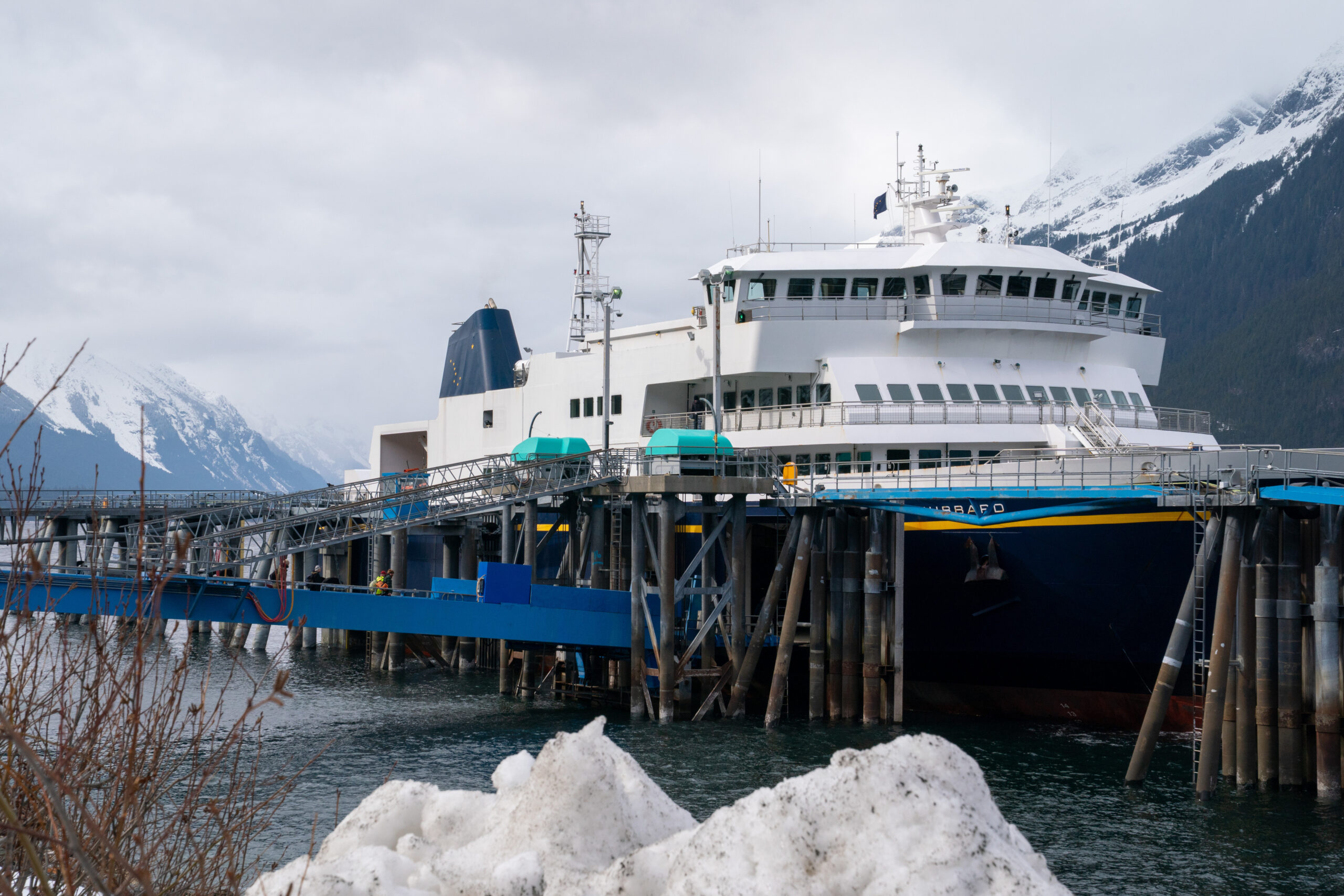
(Lizzy Hahn/ Chilkat Valley News) People walk down the causeway to board the MV Hubbard at the Haines Ferry Terminal on April 7, 2026 in Haines, Alaska.
(Lizzy Hahn/ Chilkat Valley News) Police officer Max Marty on April 2, 2026 in Haines, Alaska.
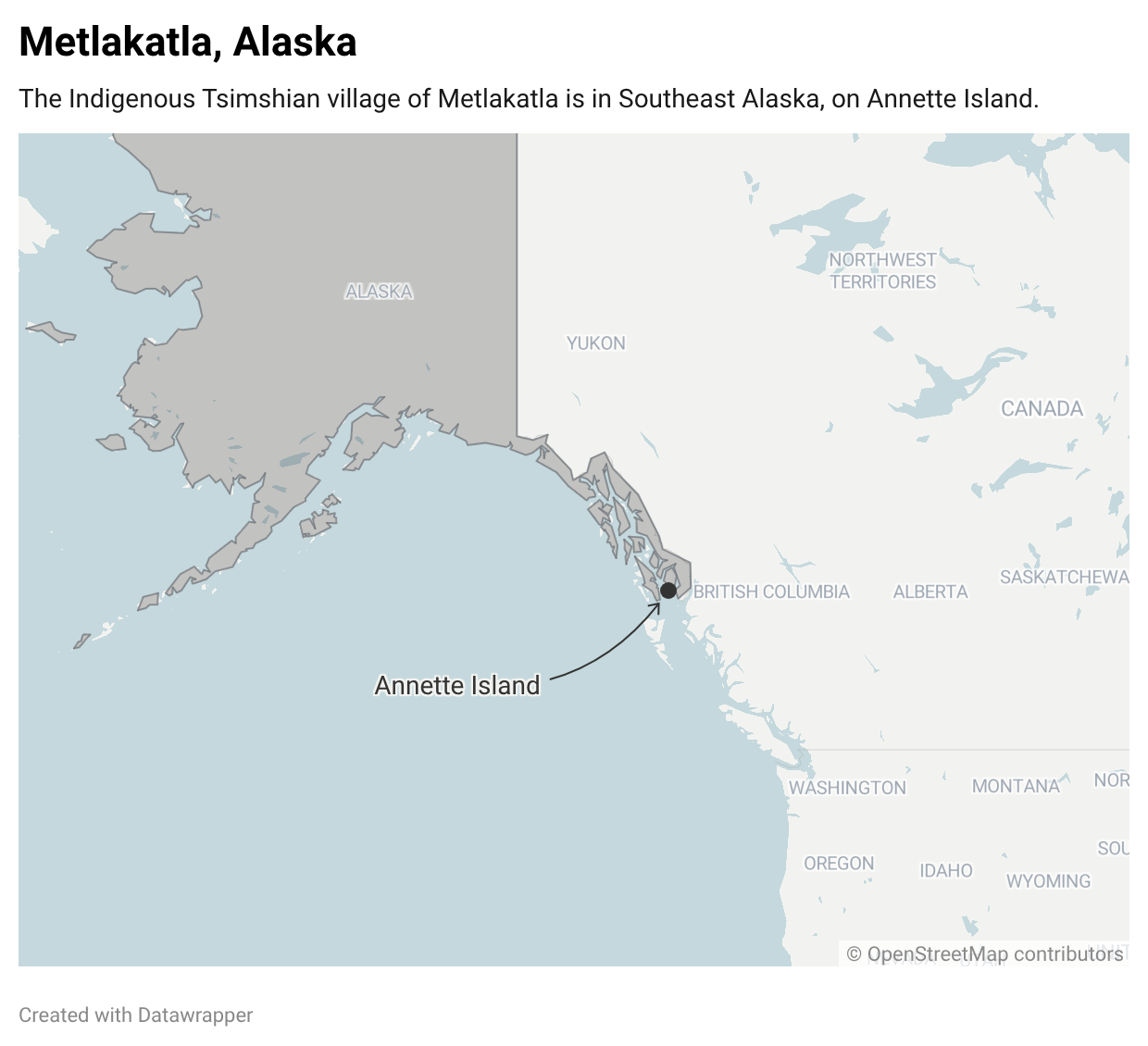
METLAKATLA, ALASKA — Across Alaska’s coastline, from the Indigenous communities of Bristol Bay to the Tlingit and Haida villages of the panhandle, rural harbors that once bustled with commercial fishing boats now sit unused and empty.
Abandoned boats covered with mold and algae line the shores of one Southeast town; others have seen their fleets sold off and relocated.
In the Indigenous village of Metlakatla, though, it’s a different story.
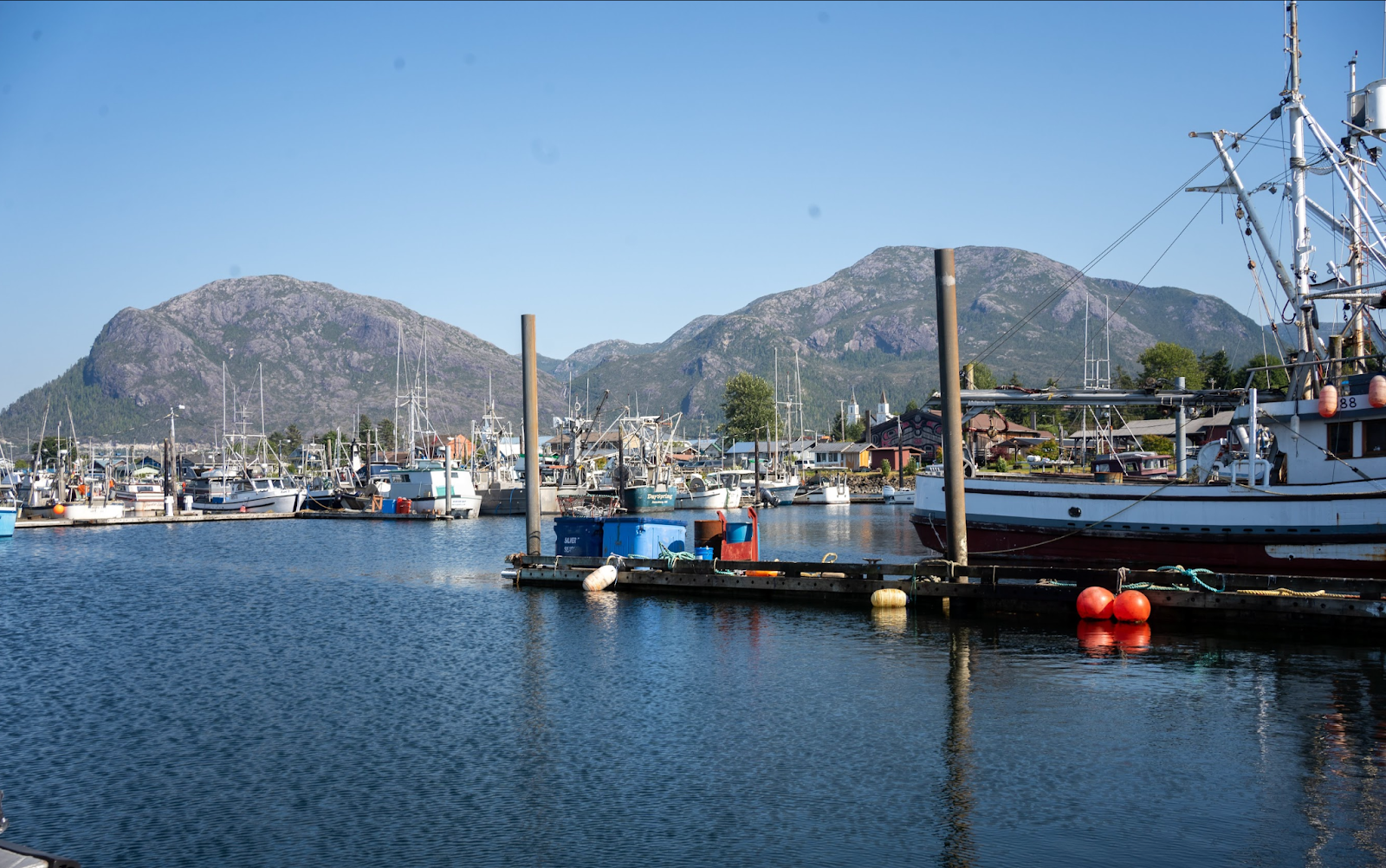
Fishing vessels pack the downtown harbor on Annette Island, which sits just off the coast at Alaska’s southernmost tip. Huge seiners, with onboard cranes to reel in fish-laden nets, loom over the docks, with many more slips filled in by smaller gillnetters. Fathers and grandfathers still fish with sons and grandsons.
Experts and industry players disagree about the exact reasons for the decline of commercial fishing in the rest of rural, coastal Alaska — with some blaming state policies and others pointing to global market trends.
In Metlakatla, local leaders say their success in sustaining their fishing culture stems from the community’s unusual history.
In the 1970s, the village stayed out of a land claims settlement between Alaska Natives and the federal government — a deal that could have brought cash in exchange for ceding Metlakatla’s reservation and residents’ collective right to pull fish from the waters off their shores. All the other Native reservations in the state were terminated.
Seine boats such as these in Metlakatla’s harbor use an onboard crane to help pull fish-laden nets on board. (Nathaniel Herz/Northern Journal)
As a result, Metlakatla is the only Native community in Alaska that manages its own commercial fishing harvest. The right to earn a living from the ocean waters surrounding the island is tied to tribal membership and can’t be sold off to outsiders — as happened in other rural and Native communities across the state.
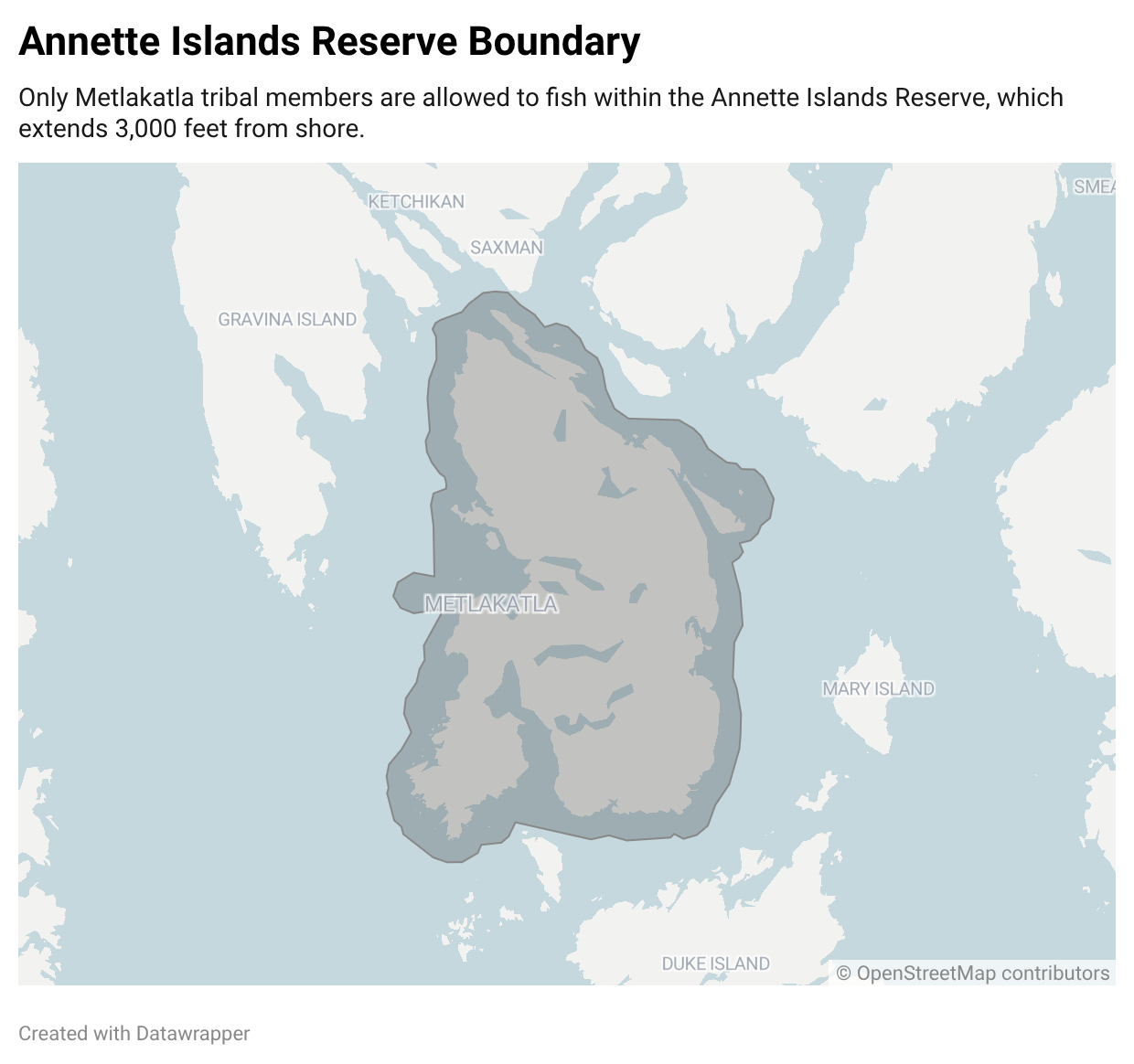
Elsewhere, Native residents of coastal villages and cities might have to pony up $100,000 or more for a permit to access state-managed commercial fisheries just offshore. Meanwhile, any Metlakatla tribal member with a boat and $25 can buy a permit and cast their net in the Indigenous-managed fishery that extends 3,000 feet around Annette Island.
“It’s 100% of the reason why we’re not down to one boat,” said Albert Smith, Metlakatla’s mayor.
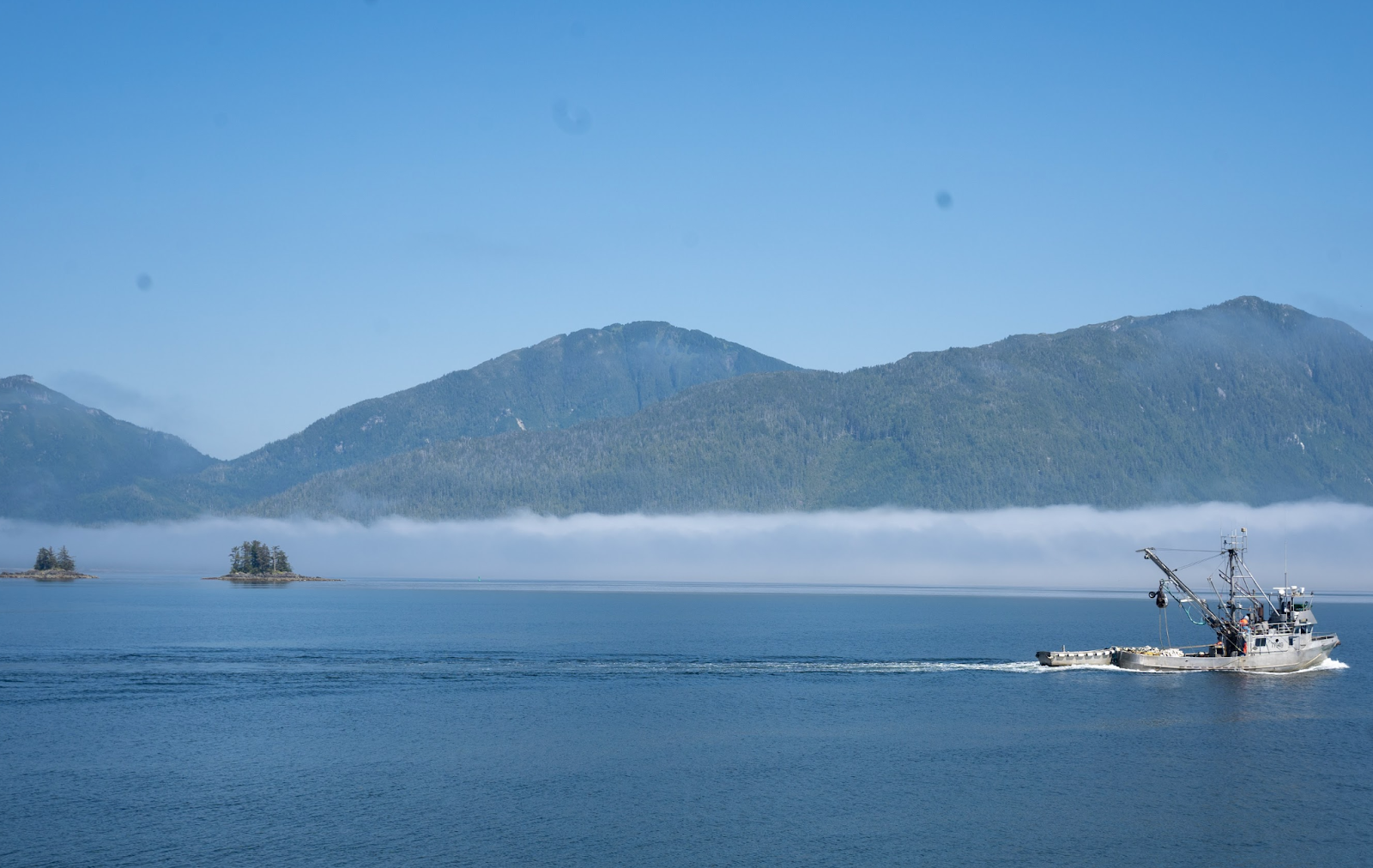
A seiner tows a small skiff along the ocean just outside Metlakatla in 2024. (Jack Darrell/KRBD)
The island fishery sustains the largest tribally managed salmon harvest in the United States. The 1,600-person community has dozens of active commercial fishing vessels, which harvested more than 1.3 million salmon in 2024, according to the most recent tribal data available.
The community stands today as a kind of experiment. Its fishery represents an alternate reality that could have unfolded in rural Alaska if more communities had the same opportunities to access nearby waters — or had state policymakers not chosen to privatize commercial harvest rights in the rest of Alaska’s big salmon fisheries, as they did in the 1970s.
Metlakatla’s narrative is a “direct refutation” of the argument that coastal Alaska Native villages are to blame for the loss of their fishing industries, said Jonathan Kreiss-Tomkins, who once represented Metlakatla in the state House and several years ago pushed an unsuccessful bill to boost access to rural commercial fishing careers.
In Metlakatla, “every slip in the harbor is full — high schoolers are deckhanding for their uncle, their dad, their best friend’s dad,” Kreiss-Tomkins said. “I think it’s a fascinating case study.”
Local leaders say they’ve still had to fight to sustain Metlakatla’s fleet and its tribal fishery.
The community is now in the midst of a six-year legal effort to expand the waters available to tribal members, which leaders say could help solidify the future of Metlakatla’s fishing industry. But its federal lawsuit faces opposition from Alaska Gov. Mike Dunleavy’s administration, competing fishermen and even neighboring Indigenous people.
Metlakatla’s main harbor is near the center of the village, next to a small casino and an artist workshop. (Jack Darrell/KRBD)
‘We’re the salmon people’
The Metlakatlans left northern British Columbia in the late-19th century amid conflicts over land ownership.
Residents secured an invitation to America from President Grover Cleveland and members of Congress at the behest of William Duncan, a charismatic Anglican minister. Duncan had worked with the region’s Indigenous Tsimshian people to establish the original Metlakatla in British Columbia, which he envisioned as a model Christian community.
After a mass migration in canoes and other vessels, the new Metlakatla was built 70 miles away on Annette Island, just across the international border in Alaska, where residents eventually built an enormous church.
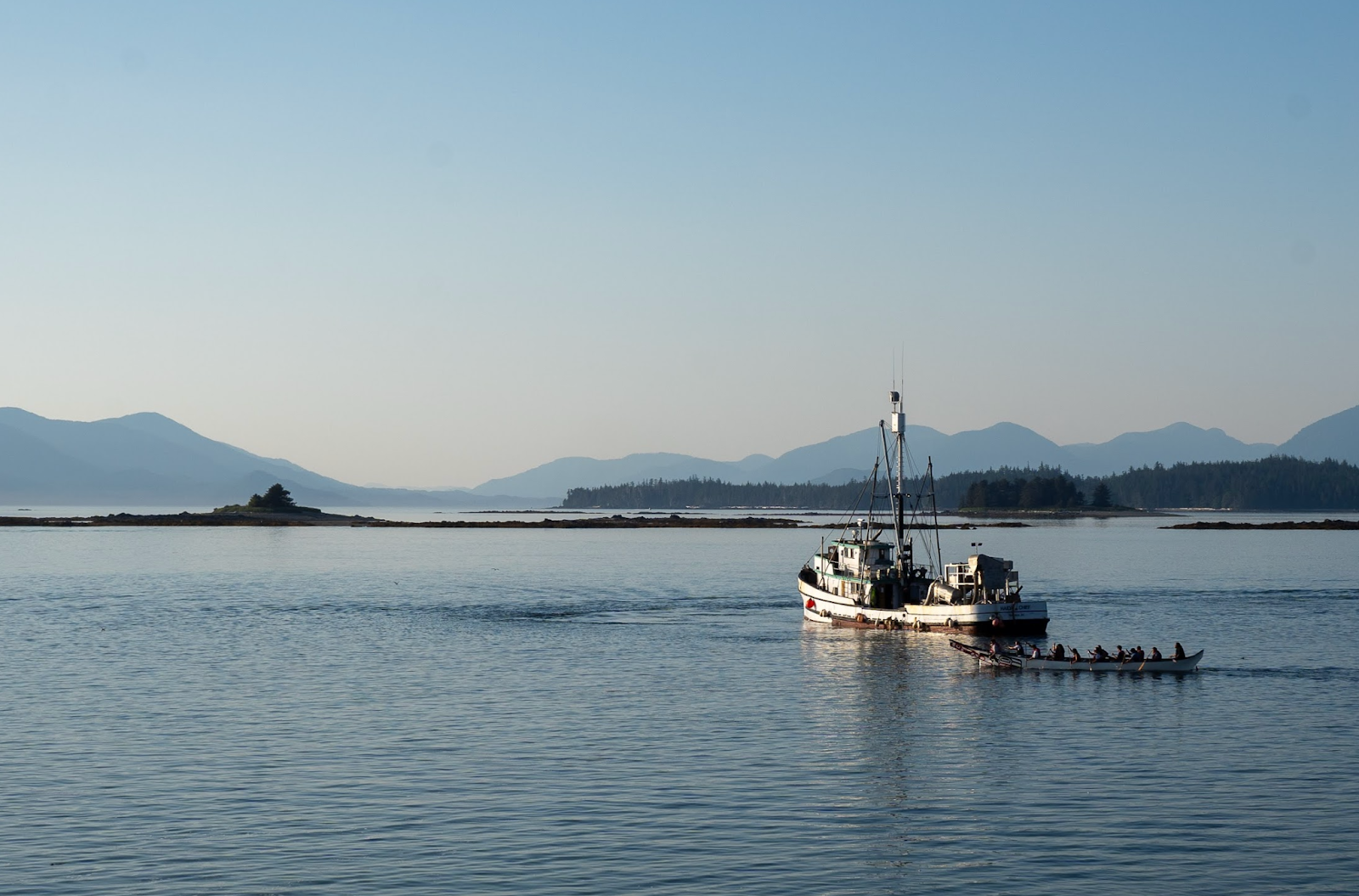
A canoe passes by a fishing industry vessel just offshore of Metlakatla in 2024. (Jack Darrell/KRBD)
A cannery served as a market for residents’ ancestral fishing tradition, which the tribe has described as a “bedrock of the Coast Tsimshian culture and way of life.” A presidential proclamation from Woodrow Wilson in 1916 subsequently set aside the 3,000-foot strip around the island exclusively for use by the village’s fishermen.
For decades afterward, Metlakatla’s commercial fleet harvested both inside and outside the exclusive zone.
Skippers of today, who are mostly men, learned to fish from their fathers, who learned from their fathers and grandfathers before them.
Fishing is “one of the few things that remain unbroken from our forever history,” said David R. Boxley, a Metlakatla artist who served on the village’s tribal council until recently.
Artist and former tribal council member David R. Boxley details a traditional bentwood box in his workshop in Metlakatla. (Nathaniel Herz/Northern Journal)
“That’s our culture, even though it’s changed in how we do it,” he said. “It’s as old as our people. We’re the salmon people.”
Tribal fishery ‘saved our butts’
In 1971, Congress passed the Alaska Native Claims Settlement Act, which came with a painful tradeoff.
Newly formed, Indigenous-owned corporations would receive a total of $1 billion and some 45 million acres — roughly 10% of the state. In exchange for that money and property, Alaska’s Indigenous people would give up claims to larger swaths of traditional lands, and those that had reservations would surrender them.
Metlakatla had one of only 23 reservations in Alaska and exclusive fishing rights to boot, so it had more to lose. It may have also had less to gain, because the community’s emigration from Canada made its Alaska land claims less certain.
Some in Metlakatla wanted to pursue the payout anyway, according to Boxley.
But elders whose parents and grandparents had been through the exodus from the original village site in British Columbia saw their sovereignty as priceless, he explained.
“We’d already lost a Metlakatla,” Boxley said. “We had to build two communities — one was basically taken from us. Why would we do that again?”
The other 22 reservations in Alaska were dissolved as a result of the settlement. Today, only Metlakatla’s remains.
A few years after the other tribes settled, in an effort to prevent overfishing and make the industry more profitable, the state of Alaska established its “limited entry” program. The system capped the number of skippers in each commercial fishery and transformed fishing from a public right to a private privilege, one available only to those who could afford or inherit a permit. And since the supply of permits was limited, they became valuable commodities.
Commercial fishing permits can now be bought and sold on the open market, in some cases fetching six-figure prices. And over the years, residents of many rural and Indigenous communities have sold their permits to people from Alaska’s larger cities and towns, and from other states.
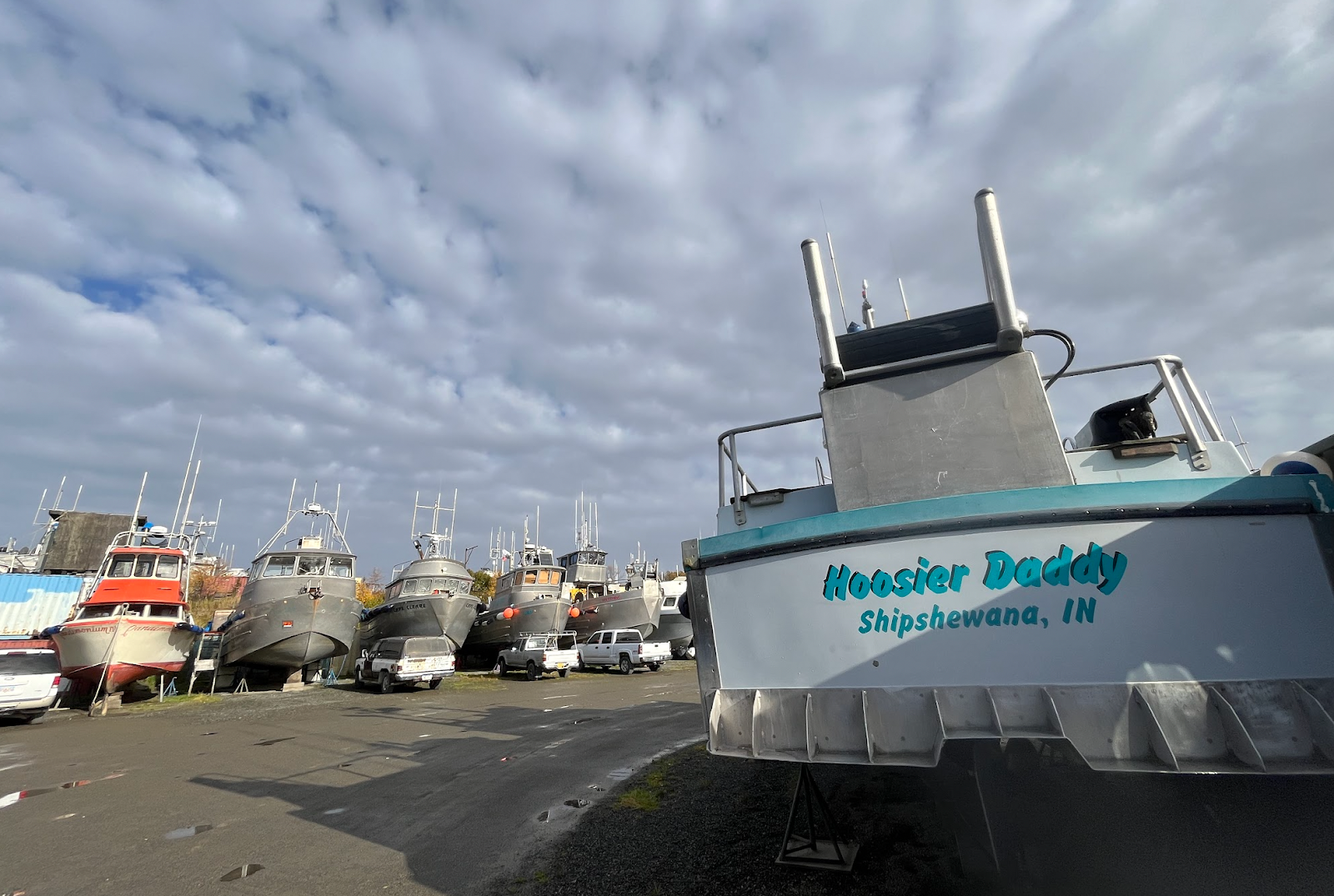
Fishing boats sit in winter storage in the Bristol Bay region, Alaska’s salmon fishing capital, where many skippers are out-of-state residents. (Nathaniel Herz/Northern Journal)
Rural fishermen also moved out of villages and took their permits with them. And those forces conspired to hollow out rural, coastal communities economically — even as Alaska lawmakers have done little to stem the tide.
In Metlakatla, though, tribal members don’t need those expensive permits to pursue a commercial fishing career. While many fishermen in the village have purchased them anyway — allowing harvests both inside and outside the 3,000-foot zone — other Metlakatlans fish only inside that exclusive strip.
Even top fishermen who roam well beyond Annette Island say that the tribal fishery has helped sustain them in lean years — particularly by providing lucrative catches of sea cucumbers and clams, which are harvested in underwater diving gear and fetch high prices in Asia.
“We’ve had terrible seasons seining,” said longtime Metlakatla fisherman Daniel Marsden, 48, referring to the technique of catching salmon with a huge, circular net. “And we go diving, and that saved our butts.”
A lawsuit to expand fishing rights
While commercial fishing remains vibrant in Metlakatla, the community’s fish processing plant is another story.
The business was long an economic mainstay for the village, providing local jobs and revenue for the tribal government.
But beginning in the 1990s, falling seafood prices challenged its profitability, and since 2018, it’s processed only small amounts of fish.
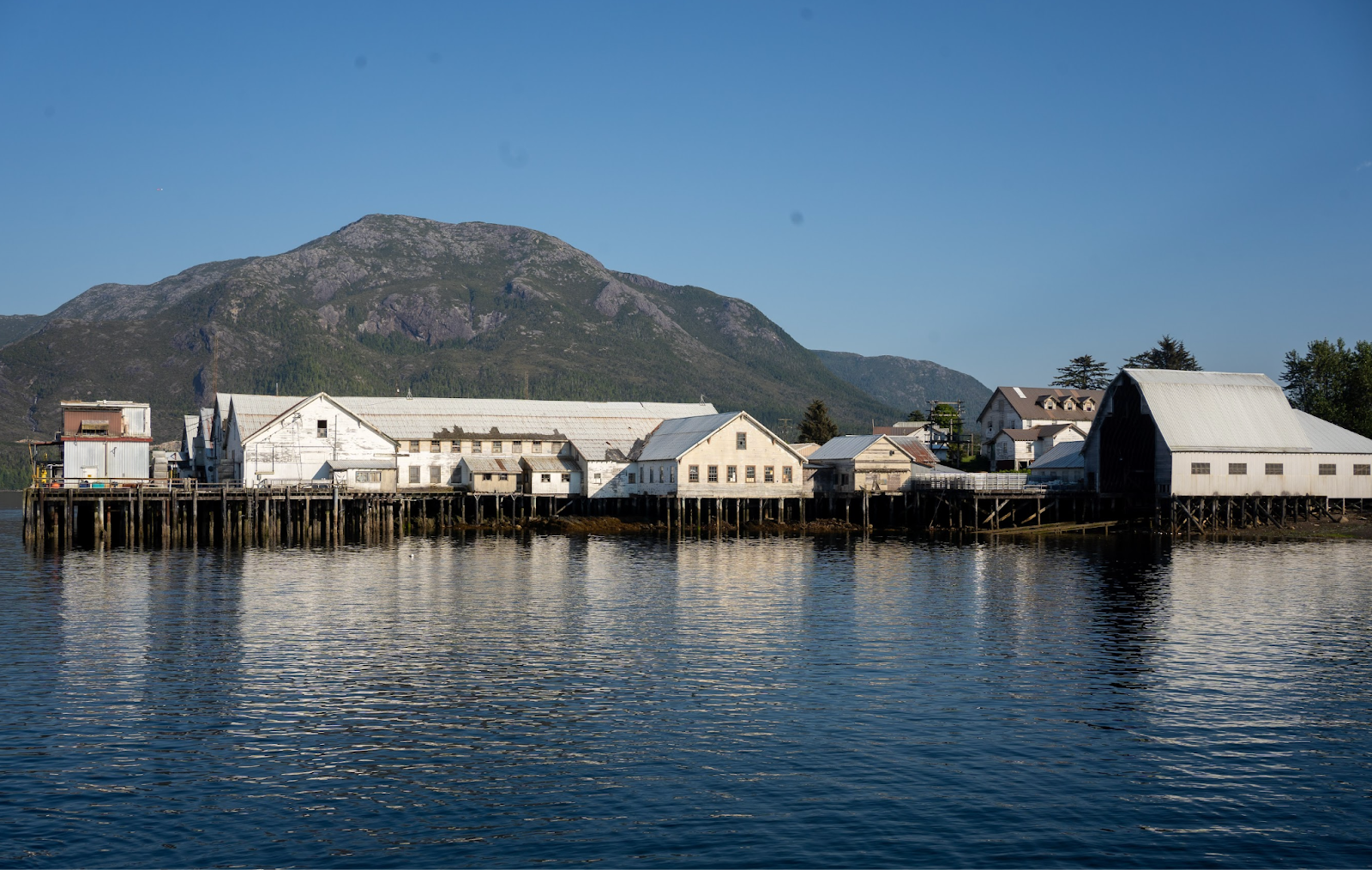
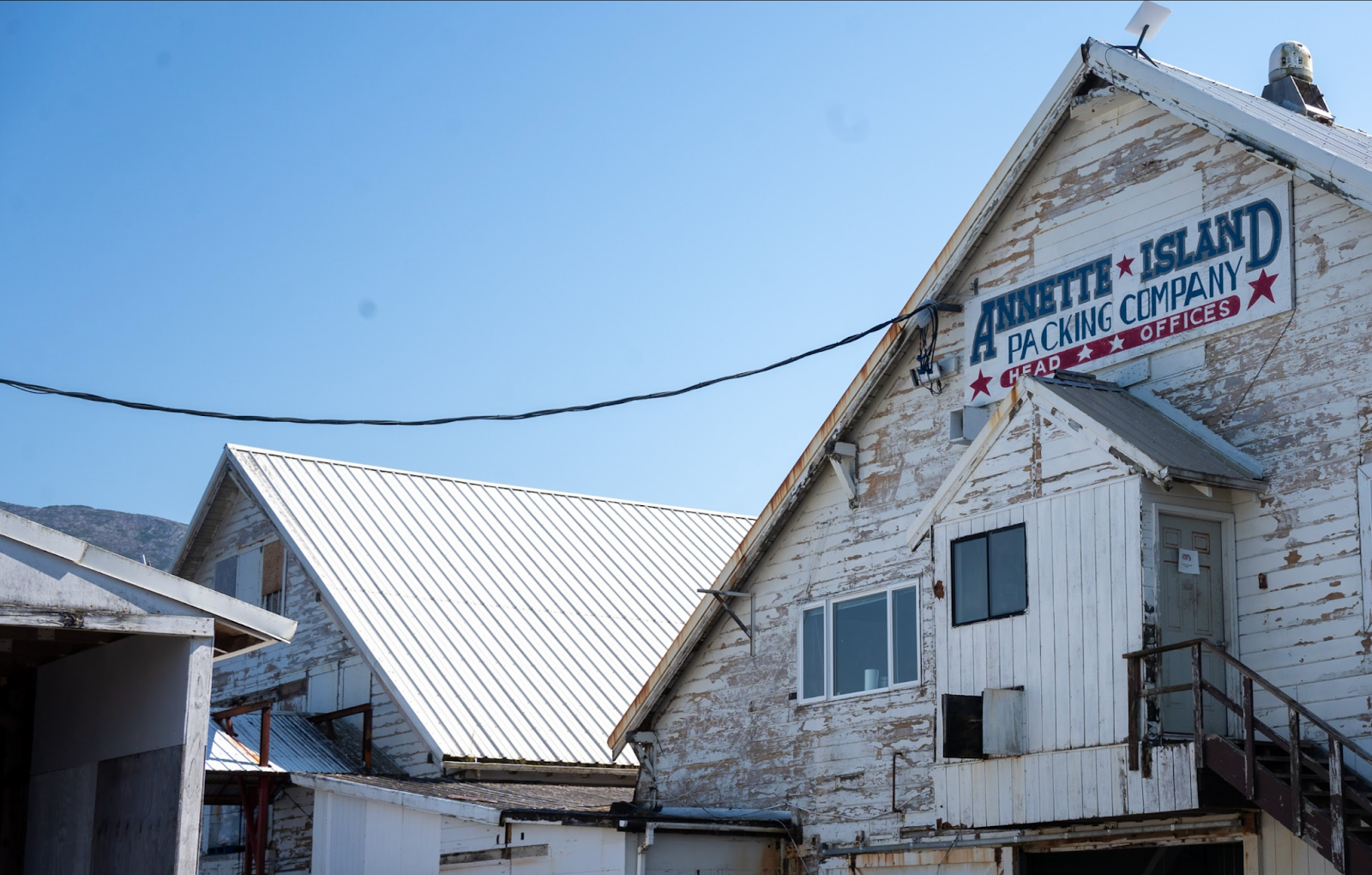
Metlakatla’s fish processing plant sits on the water near the village’s downtown. (Jack Darrell/KRBD)
Today, the cavernous waterfront processing buildings, with peeling white paint, operate at a fraction of their capacity.
Most fishermen who live in Metlakatla and dock their boats in the village harbor sell the salmon they harvest not to the tribally owned plant, but to processing businesses in Ketchikan, 15 miles north. The tribal plant currently lacks the equipment it needs to handle the large volumes of salmon netted by Metlakatla’s fleet, Smith explained.
If more of Metlakatla’s up-and-coming fishermen could harvest farther from the island without having to buy expensive state permits, he added, their catch could be large enough to justify reinvesting in the tribally owned plant.
The 3,000-foot strip around Annette Island, local leaders argue, is no longer the community’s breadbasket. It’s become a “cage” holding back the village’s fleet, according to one longtime fisherman, Edward Gunyah.
To break out of that cage, Metlakatla filed a lawsuit.
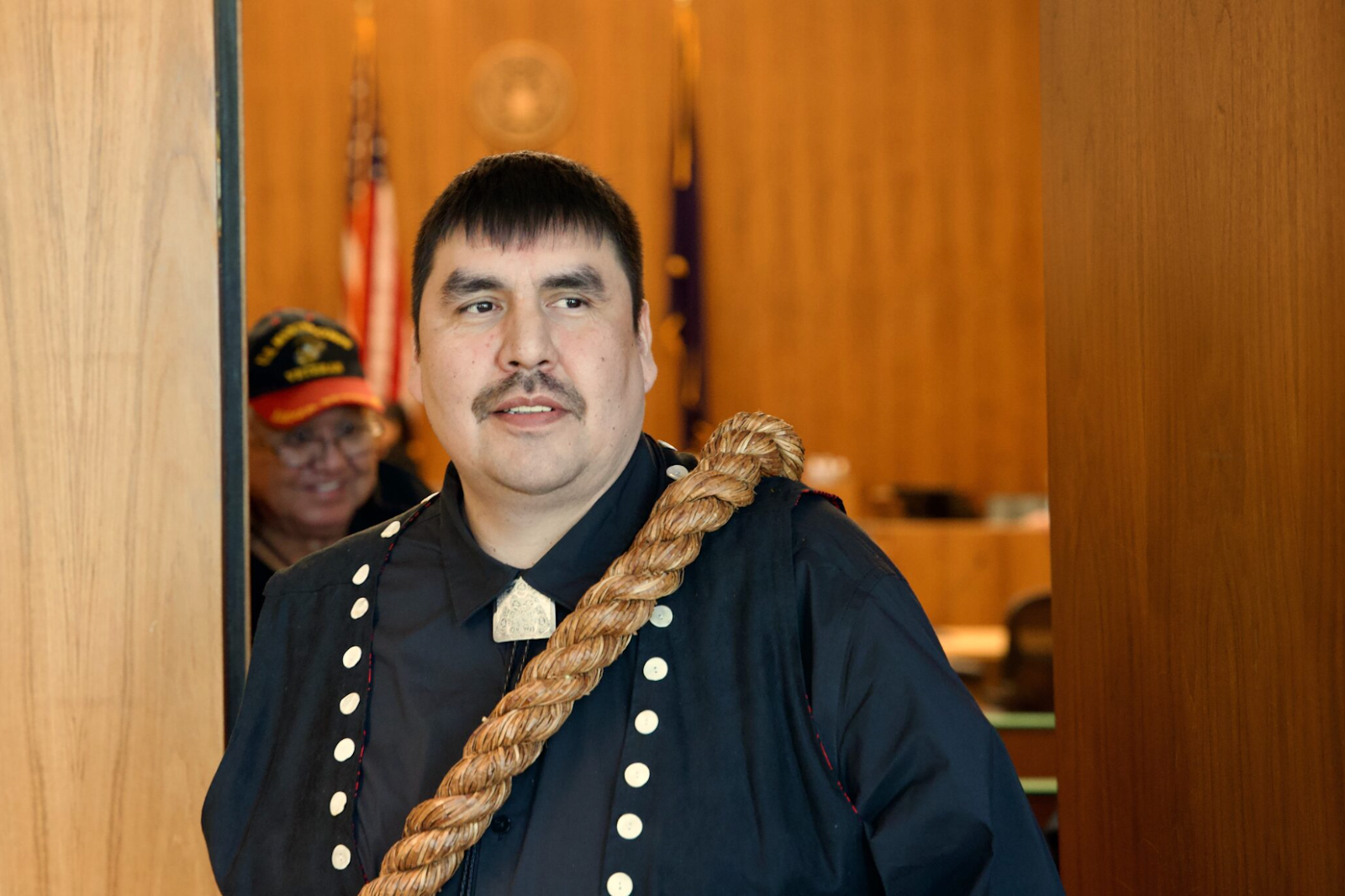
Albert Smith, Metlakatla’s mayor, leaves a courtroom in Juneau. (Eric Stone/Alaska Public Media)
Nearly six years ago, the tribe entered a complaint in federal court, asserting that the state of Alaska’s limited entry permit program was illegally barring Metlakatlans from harvesting in areas they were entitled to fish.
The tribe argues that an 1891 federal law granted it the right to enough fish to make the village self-sustaining — which should allow members to harvest anywhere within roughly a day’s travel from the reservation. The suit doesn’t seek to expel other skippers from the disputed waters, only to allow Metlakatla residents to fish there without buying pricey state permits.
“Congress intended to give the community an opportunity to prosper by accessing the fisheries in the waters surrounding the Annette Islands,” the tribe said in its amended complaint.
State and tribal opposition
Metlakatla’s attorneys filed the 2020 lawsuit in federal court on Aug. 7 — a yearly community holiday commemorating the 1887 arrival of the village’s advance party at Annette Island.
Since then, Metlakatla has won preliminary victories as the case has wound through rounds of lower court decisions and appeals.
But it has also faced strong opposition — from the state government, the fishing industry and other tribes.
“We’re going to see this through to the end,” Doug Vincent-Lang, Alaska’s fish and game commissioner, told a group of Ketchikan fishermen in 2024, according to a recording obtained by Northern Journal and APM Reports.
A win by Metlakatla, he said, would invite efforts from other tribes “that don’t have a treaty, or want to expand what they consider their rights to fish outside the state regulatory environment.”
Doug Vincent-Lang is Alaska’s fish and game commissioner. (Alaska Department of Fish and Game)
“We’re not against Metlakatla,” Vincent-Lang said in an interview. “We support their right to fish in their tribal waters. It’s just when you start fishing outside of those waters, there’s treaty implications and everything else that comes into play. How do you account for that? It’s just all kinds of questions that come up.”
Some of the group’s members are concerned about the potential for the lawsuit to expand Metlakatlans’ fishing rights in a way that increases competition, said Tom Meiners, who leads the group’s board.
“We don’t see the need for the island fishery to be expanded,” Meiners said, noting how numerous Metlakatla fishermen already have state permits and wouldn’t directly benefit if the tribe wins.
Salmon seiners operate outside the Southeast Alaska town of Sitka. (Nathaniel Herz/Northern Journal)
Meanwhile, nearly five years into the litigation, a group of other Southeast Alaska tribal governments, the Central Council of the Tlingit and Haida, filed their own motion to dismiss Metlakatla’s case.
The request, ultimately rejected by the judge, said Metlakatla’s Tsimshian residents were descended from Canadians and were infringing on traditional Tlingit and Haida harvest rights and tribal property.
The fight against the lawsuit, particularly by the state and the other tribes, has deeply frustrated Metlakatla’s leaders and allies, who say the village has long contended with hostility to its unique fishing rights. They also say that both written and oral tradition reflect the longtime presence of Tsimshian people on both sides of the U.S.-Canadian border before it was established, with traditional names for Southeast Alaska sites derived from Tsimshian names.
“We should be working together” against factory fishing boats that accidentally harvest salmon, and against out-of-state commercial permit holders, said Boxley, the former Metlakatla tribal council member. He added: “That’s who’s devastating the fishery. Not us.”
‘Control our own future’
After five years of the lawsuit ping-ponging between lower and appeals courts, a decision on the expansion of Metlakatla’s tribal fishing rights could come as soon as this year.
Smith, the mayor, said a victory could help rev the village’s processing plant back to life.
“The vision is to see it going full-fledged again,” he said.
While awaiting a decision, the tribe leased a corner of the plant to a start-up, Circle Seafoods, that is testing a new concept for fish processing. Rather than trying to fillet and pack the whole summer salmon harvest in a single frenetic push of a few weeks, Circle freezes fish whole, then thaws and cuts them in batches throughout the rest of the year.
Metlakatla’s plant currently processes only small quantities of fish. (Jack Darrell/KRBD)
The tribe is interested in replicating the idea because it could sustain a year-round workforce in the village, Smith said. Meanwhile, Annette Island Packing Co., which is owned by the tribe, recently launched a line of freeze-dried salmon pet treats. They’re branded as Ksa Hoon — “just fish” in Sm’algyax, the Tsimshian language.
Operating at full capacity, the plant could churn out profits that the tribe could use to diversify — investing and expanding into other businesses such as ecotourism, Boxley said. He described the lawsuit as aligning with Metlakatlans’ decision a century ago to move from Canada to Alaska, where tribal members would have more autonomy.
“We did all this to be in control of our own future,” Boxley said. “That’s why we came here.”
This story was produced as part of the Pulitzer Center’s StoryReach U.S. Fellowship. It was reported and edited by Northern Journal and APM Reports.
Nathaniel Herz welcomes tips at natherz@gmail.com or (907) 793-0312. This article was originally published in Northern Journal, a newsletter from Herz. Subscribe at this link.
When looking at Rihanna’s career trajectory, most people point to her 2005 debut single, “Pon De Replay,” or her 2007 international smash hit “Umbrella,” as her starting point. But it was her second album, A Girl Like Me, that set Robyn Rihanna Fenty’s future in motion.
The dancehall “chune” “Pon De Replay” displayed the Bajan icon’s ability to combine her native musical roots with commercial appeal; but at the start of her career it often left her unjustly pigeonholed by critics. Yet while “Umbrella” found her reaching new heights as a superstar-gone-bad-gal, her previous two albums often went overlooked.
A Girl Like Me started with a radio hit that sampled Soft Cell’s 1981 synth-pop cover of Gloria Jones’ Northern soul hit “Tainted Love.” “SOS” – and its respective “la la la” hook – reached No.1 on the Billboard Hot 100 and Dance Songs chart. This nicely followed the unexpected success of “Pon De Replay,” continuing Rihanna’s genre experimentation.
More than your average 18-year-old
Released on April 10, 2006, A Girl Like Me proved that the Def Jam star and Jay-Zprotégé was more than your average 18-year-old. By the time of its release, she’d already adopted the one-name moniker (a true sign of divadom), and she would notch two more Top 10 singles on the back of “SOS.”
Click to load video
The first of these was the Evanescence-inspired “Unfaithful,” a dark piano ballad that starts out with a “story of my life” opener that manifests into a tale of unrequited love penned by Ne-Yo and produced by Stargate. The second, “Break It Off,” was a dancehall hit that recalled the riddims of her debut album, Music Of The Sun, and featured Sean Paul. A Girl Like Me’s third single, “We Ride,” brings the spirit of 90s-centric hip-hop soul into the mid-00s. While the song didn’t garner the same commercial success as its immediate predecessors, her diehard fanbase still regard it as an underappreciated cult favorite.
Outside of these singles, listeners get to experience the truest indications of Rihanna’s emerging music persona. Though her follow-up album would initiate the Good Girl Gone Badphase, songs like “Selfish Girl” would lay out her “by any means necessary” nature. Hidden beneath a bubbly reggae-pop arrangement, “Selfish Girl” implies that Rihanna’s willing to venture to the dark side if that means pleasing her crush. It’s the underlying premise of A Girl Like Me. If the album doesn’t quite go so far as the whips and chains of “S&M,” it’s certainly an indicator of what was to come.
Click to load video
Laying the template for cultural dominance
While her next album, Good Girl Gone Bad, was straightforward in its titling, A Girl Like Me walks the fine line between overt sexuality and radio-friendly pop, as evidenced on the rocksteady jaunt “Kisses Don’t Lie.” The album strikes a perfect balance between the star-making hits that would propel Rihanna to superstardom and her own musical identity as inspired by her native roots and personal artistry. For every pop and R&B ballad on the record, there’s an equal amount of dancehall and soca tracks.
Rihanna wasn’t the first artist to incorporate patois slang into pop music. Everyone from Bob Marley to Shabba Ranks and Sean Paul had been doing it for years. But Rihanna was certainly one of the first solo female artists to do it on a massive scale, speaking to an entire generation in the process. From “Dem Haters” (featuring fellow Barbados native Dwayne Husbands) to “Crazy Little Thing Called Love” (which takes its cues from Marley, Barrington Levy, and Dawn Penn), Rihanna proudly wears her influences on her sleeve and puts the spotlight on Caribbean music.
A Girl Like Me not only introduced the world to an emerging pop force to be reckoned with, but an artist serious about her craft, laying the template for her complete cultural dominance in the near future.
The year 1989 was a momentous one for London’s Soul II Soul, who took the world by storm with their unique and distinctive mash-up of Caribbean-tinged soul, funk, reggae, hip-hop, house, and jazz flavors. A collective of singers, instrumentalists, rappers, and DJs led by the MC and producer Jazzie B (AKA “The Funki Dredd”), the group were hugely successful in their home country and even made a huge impact in America, where they topped Billboard’s R&B singles charts twice within the space of three months: first with the infectious “Keep On Movin’” and then with its equally appealing follow-up, the UK No. 1 “Back To Life (However Do You Want Me),” both showcasing the exquisitely soulful vocals of Caron Wheeler.
Click to load video
Those two chart-topping singles were plucked from the group’s debut album, Club Classics Vol. 1, a landmark release that altered the landscape of R&B at a time when the brash, hip-hop-influenced swingbeat sound had been America’s dominant sound. After Soul II Soul’s arrival, many R&B records aped the distinctive drum loop and string arrangements that had defined the group’s two biggest singles; and Jazzie B and his partner in crime, the band’s keyboardist Simon Law, were also in demand as producers and remixers, working on tracks for a variety of artists, ranging from US house music queen Kym Mazelle to R&B star Jody Watley, and even the reggae group Ziggy Marley & The Melody Makers.
Offering an assortment of different musical styles, Club Classics Vol. 1 reflected the musical eclecticism of British club culture and stayed true to the band’s motto: “A happy face, a thumpin’ bass, for a lovin’ race!” Its tracks ranged from minimalist electro-funk (“Fairplay,” featuring vocalist Rose Windross) to bubbling house music (“Holdin’ On”), sampladelic hip-hop (“Feelin’ Free”), and jazz-infused dance cuts (“African Dance”). Though it covered a lot of different musical bases – and sometimes sounded like it featured several different bands – the LP was given a sense of cohesion by Jazzie B’s groove-conscious production that gave each track an addictive dance pulse.
Click to load video
On its release in April 1989, Club Classics Vol. 1 (which was retitled Keep On Movin’ for the US market) rocketed to the summit of the UK albums chart during an incredible 60-week stay in the hit parade. It also topped the US R&B charts and rose to No. 14 in the Billboard 200. In 1990, two tracks from the album brought the group a couple of Grammy awards: “Back To Life” won Best R&B Performance By A Duo Or Group With Vocal, while “African Dance” grabbed the Best R&B Instrumental Performance. Quite an achievement for a debut album that more than lived up to its title.
From classic poacher’s finishes to rainbow flicks. At iconic venues like the Santiago Bernabéu and Old Trafford. And certainly under the bright lights of the World Cup. He could score on the turn, with his head, his heel, or even with his face. Javier Hernández scored in many ways – but always when his team needed him most. Hernández had an amazing club career that spanned Chivas de Guadalajara, Manchester United, Real Madrid, Bayer Leverkusen, West Ham United, Sevilla, and the LA Galaxy. Now that Hernández joins FOX Sports as analyst ahead of the 2026 World Cup, let’s revisit 10 goals (and a couple of honorable mentions) that tell the full story of Mexico’s all-time leading goalscorer: Honorable Mention: Chivas vs. Tecos (Liga MX Clausura 2010) One of the earliest glimpses at the talent Hernández possessed. In Week 3 of the Torneo Bicentenario, Chivas trailed Estudiantes Tecos 2-1 at halftime. The home crowd was restless, then Hernández took over. He scored twice in the second half to complete the comeback, which displayed he was ready to move on to a more competitive league. Honorable Mention: LA Galaxy vs. Colorado Rapids (2022 MLS Regular Season) The Galaxy were already leading Colorado by two goals before Hernández added an absurd third. A low cross from Julian Araujo fizzed across the six-yard box. Most strikers would have tried to turn and shoot. Not Hernández. He stuck out his back leg like a matador and back-heeled the ball past the stunned keeper. Even in the twilight stage of his career, Hernández still found new ways to score. Honorable Mention: Mexico vs. Spain (2010 Friendly) Only months after his 2010 World Cup breakout summer in France (we’ll get to that shortly), he did the unthinkable in Mexico City by scoring against the reigning world champions. Gerardo Torrado sent a long pass forward. Hernández used his speed to outrun the Spanish defense and slotted the ball past goalkeeper Iker Casillas to give Mexico a 1-0 lead. It was him announcing he wasn’t a one-tournament wonder. Rather, he was only getting started. 10. Mexico vs. USA (2015 CONCACAF Cup) Mexico met their biggest rivals, the United States, at the Rose Bowl with a spot in the 2017 Confederations Cup on the line. A fast-paced attack developed when Raul Jimenez played the ball to Oribe Peralta on the right side of the box. Peralta would provide the assist, as Hernández tapped in the first of five goals that night in a 3-2 Mexico victory. It marked his first of two career goals he had vs. the USA. 9. Real Madrid vs. Atlético Madrid (2015-16 Champions League) “Never fall in love with a loan player,” is a phrase used a lot amongst club soccer fans, but Madristas had every reason to love Hernández after this goal in a Champions League quarterfinal match. In the 88th minute at the Bernabéu against their crosstown rivals, Cristiano Ronaldo’s cross from the left found Hernández’s perfectly timed run at the near post. One touch. One explosion of white shirts. Hernández collapsed to his knees and exhaled as Madridistas celebrated. That goal alone earned him cult hero status in the Spanish capital. 8. Bayer Leverkusen vs. Borussia Mönchengladbach (2015-16 Bundesliga) The first hat trick of Hernandez’s club career came in Germany. His third of the night is the pick of the bunch. Hernandez drifted off the shoulder of the last defender, took one touch to kill a diagonal ball dead, and smashed a rising shot into the roof of the net. A stellar hat trick announced that marked his arrival to Germany with authority. 7. Mexico vs. Argentina (2010 World Cup Round of 16) A lost cause? Not for Hernández. Down 2-0 and reeling, Mexico needed a spark. Pablo Barrera’s pass found Hernández ghosting between two Argentine giants as he turned to get around defender Martín Demichelis before sending his left-footed shot beyond reach of goalkeeper Sergio Romero. Mexico ultimately lost 3-1, but that goal said something louder than the scoreline: I belong here, on this stage, against these names. 6. Mexico vs. South Korea (2018 World Cup Group Stage) A vintage Hernández was on display in Russia during his third and final World Cup appearance. He collected the ball near the top of the box, shifted it past a sliding defender with a touch that felt slower than it actually was, and curled a low, skipping shot into the near corner. The keeper never had a chance. He also became the third Mexican player to score in three different World Cups, after Cuauhtémoc Blanco and Rafael Márquez. That goal sent an entire nation dreaming of playing a fifth game—even if the dream would end a week later. 5. Mexico vs. USA (2019 Friendly) It was a friendly, but anytime these two rivals play, there is always going to be plenty of pride on the line. It was a fitting moment for Hernández as he made his final appearance for the Mexican national team. He helped open the scoring with this acrobatic diving header from Jesus “Tecatito” Corona’s looping pass after sneaking into the six-yard box. A signature header for his 52nd goal for Mexico, a record that still stands. 4. Mexico vs. Croatia (2014 World Cup Group Stage) The knockout round clincher in Recife, Brazil. A corner kick found Rafael Marquez’s head and went into the box as Hernández sprinted toward goal and headed the ball into the back of the net to ice what would be a 3-1 win over Croatia. He pointed to the sky and fell to his knees as Mexico earned a spot in the Round of 16. 3. Manchester United vs. Chelsea (2010 Community Shield) His debut in a Manchester United shirt came during the 2010 FA Community Shield Final at the historic Wembley Stadium. Minutes after coming on as a substitute, he received a cross from Antonio Valencia, kicked the ball into his own face before it bounced over the Chelsea goal line. It didn’t matter what part of Hernandez’s body was used to score, as long as he scored. 2. Manchester United vs. Stoke City (2010-11 Premier League) Physics forgot to apply at the Britannia Stadium. Facing away from goal, with a defender climbing his back like a jungle gym, Hernández arched his neck and flicked a backward header that went past Thomas Sorensen and into the far corner. Unorthodox but absolutely brilliant. 1. Mexico vs. France (2010 World Cup Group Stage) The world was introduced to Hernández in South Africa in the summer of 2010, already set for the anticipated move from Chivas to Manchester United. In this group stage game against France, Hernández broke the offside trap to latch onto a Rafael Márquez pass, got past goalkeeper Hugo Lloris, and scored. Mexico would go on to win over the reigning World Cup runner-up. Hernandez’s first World Cup goal had some extra sentimental value, as his grandfather, Tomas Balcazar, also scored for Mexico in a loss to France in the 1954 tournament. However, in this instance, Hernandez’s side won against Les Bleus. 2026 FIFA World Cup: How To Watch The World Cup will run from June 11–July 19, 2026. Spread across three countries, the tournament will culminate with the final on July 19 at New York New Jersey Stadium in East Rutherford, New Jersey. All 104 tournament matches will air live across FOX (70) and FS1 (34) with every match streaming live and on-demand within both the FOX One and the FOX Sports apps. A record 40 matches, more than one-third of the tournament, will air in primetime across FOX (21) and FS1 (19).Latest Sports News from FOX Sports
David Isaacman is no longer the lion to Abbey Romeo’s lioness.
The Love on the Spectrum stars have broken up after five years of dating, according to multiple reports.
The pair—who met on season… E! Online (US) – Top Stories
NEW YORK – The Mets’ best hitter isn’t at his locker at Citi Field. He’s not in the batting cages. He’s not on the field, in his usual blue sweatshirt with his hoodie pulled up, in the still-freezing April temperatures in Queens. Juan Soto is nowhere to be found because his directive is, simply, to rest. Soto strained his right calf while running the bases during the Mets’ series against the Giants at Oracle Park last weekend. He went on the injured list on April 4. The team expects the outfielder to miss anywhere from 2–3 weeks, at best. No one around the Mets is happy about this, but they also understand that life, the schedule, and the games must go on. New York has to find a way to win without their superstar slugger, who was off to a terrific .355/.412/.516 start at the plate before he hit the shelf. “He’s irreplaceable,” Mets shortstop Francisco Lindor told me at his locker on Wednesday. “He’s a top-three player in the league. He’s that good. As a team, we’ve always said that it’s about sticking together at a time like this. Gather around him and be all together in this, and support him and play for each other. I hope this is a very short, very short IL for him.” So far, at least, the Mets have managed to stay afloat without Soto. Entering Thursday, they’re 4-1 since he landed on the IL. The schedule has been kind to them in this stretch, with the Mets winning the series against the Giants while going for another series win against the Diamondbacks on Thursday. They host a three-game set against the Athletics on Friday to wrap up the soft part of their April itinerary. But things will get challenging on Monday, when the Dodgers welcome the Mets in Los Angeles for their first matchup since June 2025, when they split the series at Chavez Ravine. The Mets will continue asking for their younger stars to step in Soto’s absence. “As a group we know we have a lot of depth in here,” Mets second baseman Marcus Semien told me in the Citi Field clubhouse on Wednesday. “It’s an opportunity for guys to play a little bit more. The main thing is we all have his back. And we’ll just let him know, we’ll all hold it down until he comes back. It’s a little hiccup for him. But at the end of the day, we’ve been playing some good baseball.” It’s been uncanny to see part-time players and bench bats take charge without Soto. On Tuesday, infielder Ronny Mauricio was promoted from the minor leagues to the majors to replace Soto on the 26-man roster. Hours later, his first big-league hit of the year was a three-run walk-off home run in extra innings against Arizona. Earlier in that same game, outfielder Jared Young delivered a key sacrifice fly to tie the game in the eighth inning. Infielder Mark Vientos was a huge factor in the series finale against the Giants on Sunday, which was Soto’s first missed game, going 3-for-5 with an RBI two runs scored. It’s unclear if those role players performing has helped Soto ease any pressure of wanting to return to the lineup as fast as possible. As previously mentioned, the outfielder has vanished from the usual pregame preparation and day-to-day activities. But the Mets broadcasting the weeks-long timeline for Soto’s return on the very same day he went on the IL is an indication that the team is not messing around with his recovery. As much as Soto may be itching to hit again, the silver lining is the timing of his injury on the baseball calendar. Right now, the Mets can afford to play it safe. “You definitely want to be patient with injuries like that,” Semien said. “You’ve seen guys have nagging things and they try to come back too quick, and it ends up being a bigger deal. That’s going to be hard, because he’s a guy who’s played in 160-plus games in most seasons.” J.D. Martinez Gets Comfortable Upstairs J.D. Martinez received a text when news dropped last week that the retired slugger joined the Mets as a special assistant to baseball operations. The message was from his former 2024 Mets teammate, Jose Iglesias, with a screenshot of the news and three letters: “OMG.” Those three letters are the name of a popular song by Iglesias, who moonlights as a singer-songwriter named Candelita. The 2024 Mets rallied behind the song and went all the way to the National League Championship Series that season, with Martinez and Iglesias revered at the time as the team’s two vital clubhouse leaders. After his lone season with the Mets, Martinez sat out the 2025 season before rejoining the organization as a member of the front office this month. On Wednesday, Martinez started settling into his new role upstairs. “It’s interesting,” Martinez said of the front-office side of baseball, speaking in the Mets dugout on Wednesday. “Yesterday, they took me up there and it’s like an army up there. It’s kind of wild. I was like, ‘Wait. These are all the people that give us information and help us out?!’ And they were like, ‘Yeah. This is behind-the-scenes.’ I’ve never seen anything like this. “I was a little intimidated by it, because they’re a lot smarter than us. But then I come down here and everything feels normal again. So it’s something that I definitely want to continue to learn from. I think it would be good for me to be in those meetings.” Martinez has stayed in contact with the Mets, including president of baseball operations David Stearns, since that 2024 season. He envisions his role to involve mainly mentorship and strategy, while relaying to the front office what the players’ perspective can be throughout the season, acting as a liaison between the two sides. Martinez in ‘24 was known to go out of his way to help players out. Now, he’ll have the time in the world to do just that. “This could be fun,” Martinez said of his thought process when deciding to join the organization. “I like what they’re doing here. I like the team they built here. I had a great experience here with the front office, with ownership, with the clubhouse, everything. It was just a really fun place to come. So I said, why not? Let’s do it.” Deesha Thosar covers Major League Baseball as a reporter and columnist for FOX Sports. She previously covered the Mets as a beat reporter for the New York Daily News. The daughter of Indian immigrants, Deesha grew up on Long Island and now lives in Queens. Follow her on Twitter at @DeeshaThosar.Latest Sports News from FOX Sports
UPDATE: Joey Lawrence and his wife Samantha Cope welcomed their second baby together—a son named Ford Joseph Lawrence—on April 6.
“What an absolute blessing you are baby boy!” the couple shared on… E! Online (US) – Top Stories
The devil is in the details, which is why Anna Wintour doesn’t have time to wonder about people’s perception of her based on The Devil Wears Prada.
“What I’m really interested in is the creative… E! Online (US) – Top Stories





























 David Isaacman is no longer the lion to Abbey Romeo’s lioness.

 UPDATE: Joey Lawrence and his wife Samantha Cope welcomed their second baby together—a son named Ford Joseph Lawrence—on April 6.
 The devil is in the details, which is why Anna Wintour doesn’t have time to wonder about people’s perception of her based on The Devil Wears Prada.