We have distressing news out of Jupiter, Florida, where Tiger Woods has been involved in a rollover car accident.
Details are scarce, but initial reports indicate that Woods was “seriously injured” in a single-vehicle rollover crash on Monday morning.
The incident reportedly prompted a major emergency response, and there’s widespread concern across the sports world.
Tiger Woods of the United States looks on from the 18th green during the final round of The Genesis Invitational 2026 at Riviera Country Club on February 22, 2026 in Pacific Palisades, California. (Photo by Mike Mulholland/Getty Images)
According to police records obtained by NBC News, Woods was driving north on a rural stretch of road when his GMC Yukon left the roadway, struck a tree and rolled.
The force of the impact was significant enough that the vehicle was heavily damaged and required specialized rescue crews to extract him.
Woods was arrested at the scene for DUI, but it’s unclear if he will remain in police custody once he’s released from medical care.
Florida Highway Patrol officials told NBC that Woods was wearing his seatbelt and there’s no indication that speeding played a role
Emergency responders arrived quickly and found Woods conscious. He was taken to St. Mary’s Medical Center in West Palm Beach, where he was listed in stable condition.
Interestingly, news of the crash comes just hours after Donald Trump revealed on Fox News that Woods would not be competing in the Masters tournament next month.
It does not appear that the president was aware of Woods’ accident at the time of his announcement.
As for the crash investigators are still working to reconstruct the sequence of events that led to the rollover.
News of Woods’ crash spread rapidly across social media and the sports world, with fellow athletes and organizations expressing relief that he survived and urging support for his recovery:
“Praying for Tiger,” one PGA Tour pro wrote online.
“Stay strong, brother,” posted another.
Fans and fellow athletes offered messages of support, with many reflecting on Woods’ resilience and long history of overcoming injury and adversity throughout his career.
Over the past decade, he has returned from multiple major surgeries and serious injuries — including a brutal leg injury in a 2021 car crash in California.
That history makes today’s accident especially concerning, but also underscores why many in the golf community remain hopeful.
Officials have stressed that the investigation is ongoing, and no additional details about the cause or circumstances of the crash have been released.
As of now, Woods remains under medical care, and the focus for fans and fellow athletes alike is on his recovery and well-being.
We will have further updates on this developing story as new information becomes available.
Lauren Conrad’s husband William Tell doesn’t need to go back to the beginning.
In fact, the musician-turned-lawyer has no interest in watching his wife’s breakout reality series Laguna Beach,… E! Online (US) – Top Stories
A South African comedian is being sued for millions by the singer of ‘The Lion King’s iconic ‘Circle of Life’ opening chant for a deeply unexpected reason. Continue reading…The Boot – Country Music News, Music Videos and Songs
Photo Courtesy of UAS, from their Alaska Native Arts, Language and Studies program.
NOTN- The Central Council of the Tlingit & Haida Indian Tribes of Alaska and the University of Alaska Southeast are launching a collaborative effort to develop a School of Indigenous Studies in Southeast Alaska.
Leaders from both organizations signed a memorandum of understanding at the Andrew Hope Building in downtown Juneau this morning, marking what officials describe as an initial step toward building a new academic program grounded in Indigenous knowledge.
This is only the biggening of the collaboration.
The agreement signed, outlines a shared vision between Tlingit and Haida and UAS, of an education model that reflects Indigenous languages, traditions and values, that supports workforce development, research and economic opportunities.
“We are really excited to have a formal relationship with the tribe to create a school of Indigenous Studies at UAS.” Said UAS Chancellor Aparna Palmer, “This is one of the few times where a university has worked with a tribe to co-create a vision for this school, and the school is so important and transformative and amazing because it will honor the values of the tribe, while at the same time giving us a chance to bring together all of the disciplines that we already offer.”
As part of the effort, a working group, with representatives from both Tlingit & Haida and the university will be formed to develop a roadmap for the School of Indigenous Studies.
“We already offer classes on the language and the culture and the history of the indigenous peoples of Southeast Alaska, and now they will be housed at a school that is specific and integrated within UAS.”
While the Duggars have mostly kept quiet about Kendra’s child endangerment charges, they’ve been much more outspoken about Joseph’s situation.
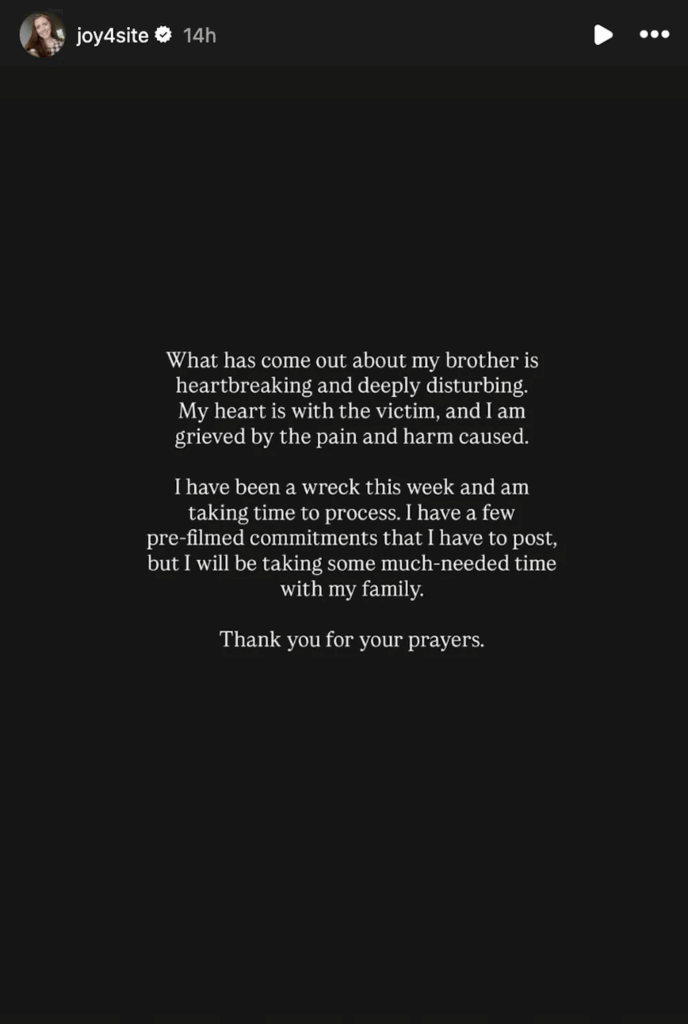
The latest to speak out is Joseph’s sister Joy-Anna Duggar.
“What has come out about my brother is heartbreaking and deeply disturbing,” she wrote in her Instagram Stories.
(Instagram)
“My heart is with the victim, and I am grieved by the pain and harm caused. I have been a wreck this week and am taking time to process,” she said.
“I have a few pre-filmed commitments that I have to post, but I will be taking some much-needed time with my family. Thank you for your prayers.”
Joy-Anna is just the latest of several Duggars to speak publicly on the Joseph situation in the wake of his arrest.
“I did not think my heart could break like it has this week,” Jinger Duggar said on the latest episode of her podcast.
“The pain and heartbreak that we’ve had over this and just thinking of how it’s affected so many — yeah, it’s just unthinkable. It’s so hard and painful on many levels.”
Jinger and Joy’s cousin Amy Duggar also spoke out about Joseph, stating that the well-being of the victim is her first concern.
Joy-Anna Duggar shares a story here on YouTube. (Image Credit: YouTube)
“My first thoughts are with the victim, a child who deserved to be safe, protected and surrounded by people she could trust,” she said, adding:
“The courage it took for her to come forward, especially after years of carrying something so heavy, cannot be overstated. That bravery deserves to be honored above all else.”
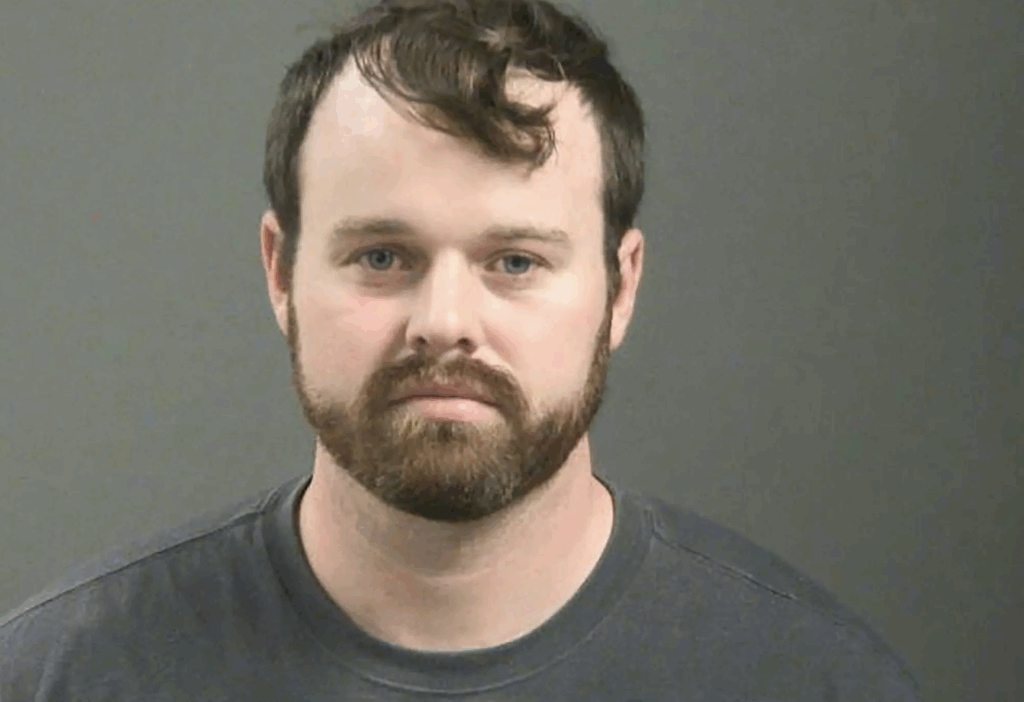
Joseph was arrested after police conducted a “forensic interview” with a 14-year-old girl who alleges that Joseph molested her during a Florida vacation in 2019.
As for Kendra, she was arrested when police searched the house and found that the doors to her children’s bedrooms had locks on the outside, indicating that she and Joseph were in the habit of locking their kids inside.
“She’s not suspected or accused of participating in his alleged crime,” a source close to the situation tells People.
We will have further updates on this developing story as new information becomes available.
Celebration comes in many forms, and for Dasha, it’s a trip to Louis Vuitton and a new Bronco with quilted seats. What a ride! Continue reading…The Boot – Country Music News, Music Videos and Songs
Celebration comes in many forms, and for Dasha, it’s a trip to Louis Vuitton and a new Bronco with quilted seats. What a ride! Continue reading…Country Music News – Taste of Country
If you want to make the quickest but gosh darn tastiest lemon frosting imaginable, you only need three simple ingredients (and you probably have them).
The United States, alongside other countries, has a growing pro-democracy and nonviolent civil movement.Oliver Helbig/Getty Images
On Feb. 24, The Conversation hosted a webinar titled, “What Americans can learn from other nonviolent civil activism movements.”
Executive editor and general manager Beth Daley interviewed John Shattuck, professor of practice at The Fletcher School of Law and Diplomacy at Tufts University, and Oliver Kaplan, associate professor at Josef Korbel School of Global and Public Affairs at the University of Denver and a visiting scholar at Stanford University.
Shattuck is the former president of Central European University in Hungary, where he defended academic freedom against a rising authoritarian government. Kaplan is the author of “Resisting War: How Communities Protect Themselves.” This interview has been condensed and edited for print.
Beth Daley: What is an authoritarian regime, and what are their characteristics?
John Shattuck: The authoritarian, often referred to as a “king,” is the ideal role from the point of view of the king, but certainly not from the point of view of the people. Authoritarian characteristics include centralized unlimited power, the opposite of democracy; no accountability and no rule of law; no independent courts; no checks and balances on how the king operates; rule by fear and coercion, and when necessary, in order to carry out the king’s orders, rule by by force. There are no individual rights or civil liberties except those the king decides to allow those who are loyal to him to have, at least until he decides to take them away.
John Shattuck defines authoritarian regimes in a sound bite from The Conversation’s webinar on nonviolent civil movements.
That’s a nutshell informal description of an authoritarian regime. A special threat today is that an authoritarian can emerge from a democratic election, and, indeed, a democratic election can be used to turn a weak democracy into an authoritarian regime. But when this happens, it opens the door to challenge the authoritarian in a subsequent election if civic activism can defend the electoral process by which the authoritarian was elected.
BD: What are we seeing and not seeing in the U.S. that other countries have gone through in terms of authoritarian government?
Oliver Kaplan: I think we are heading toward an autocracy, if not there already. In their 2026 report, the Varieties of Democracy Project writes that the U.S. is no longer a liberal democracy and is moving into “competitive authoritarianism,” marked by executive overreach and erosion of judicial and legislative checks. The report notes that U.S. democracy is being dismantled at a speed that is “unprecedented in modern history.”
One of the things we’re not seeing at full force yet is a complete shutdown of civic space. We’re able to hold this kind of conversation, and people are still able to dialogue and go out on the street. There are some efforts at curtailing free speech, and I think there’s some self-censorship possibly happening. But there’s still this open space and a powerful mass movement growing in this country.
BD: John, you were on the front lines, particularly in Hungary as the head of Central European University. What did you see there that has parallels today to the U.S.?
JS: There’s certainly a parallel between Hungary and the U.S., even though the countries are very different in size, history and background. What I saw in Hungary when I became president of Central European University in 2009 was a weak, new democracy that was only established in 1990 after 70 years of fascism and communism.
I was in Hungary from 2009 to 2016 and, despite the differences, I could begin to see some parallels. Many people had grievances in Hungary about how their economy was operating, particularly after the global financial crisis that affected Hungary more than any other Eastern European country. Then there was an urban-rural divide, the urban elite versus the rural majority in the country.
Along came a cynical populist-nationalist politician, Viktor Orbán. Orban started manipulating these grievances, and did so to significantly divide Hungarian society. He attacked many of the institutions of democracy, which were increasingly unpopular because of people’s grievances. He went after elites, and foreigners, and migrants, and the media. And he blamed all of them for the country’s problems. He then was able to ride these grievances into office.
Once in office, Orban amended the constitution and laws relating to the parliament. He undermined the independence of the media and the judiciary so as to centralize power. All of this happened while I was running an international university in Budapest, which remained independent because it received no funding from the Hungarian government. We were able to resist the increasingly authoritarian regime over issues of academic freedom. The government tried to shut down our programs of migration studies and gender studies, and tried to censor aspects of our history department.
BD: How do communities respond in different ways to authoritarian regimes?
OK: Pro-democracy movements and protection types of movements at the local level often co-occur. For example, in Colombia there have been various leftist movements and political parties that have pushed for greater democratic opening while communities mobilize to keep people safe and help them cope with repressive conditions. In places like Chile, El Salvador and Guatemala, communities built trust and support networks to provide aid, such as for people who needed food assistance. This provides space to independently operate and preserve the community.
Fact-finding and countering stigma are important, and in the U.S. we’re seeing that in the form of the video recording and publicizing of harmful actions. This has played out similarly in Syria with fact-finding to protect nongovernment organizations.
There’s also accompaniment where outside actors come in to provide support to communities. Around the world, church organizations play important accompaniment roles. We’re seeing clergy in the U.S. step up and visit places that are at risk.
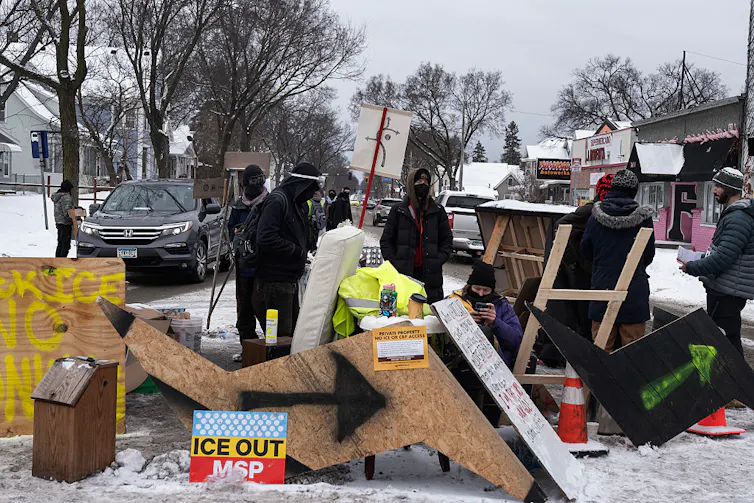
Anti-ICE protestors in Minneapolis built a barricade to monitor federal law enforcement vehicles traveling through the neighborhood. Star Tribune via Getty Images
And then, there are protests, the most visible kind of action. In Minnesota, we’ve seen communities actually setting up community barricades, which has also happened in Mexico, Colombia and Northern Ireland. Communicating the nonviolent nature of these movements is important to avoid any pretext for additional crackdowns.
I think Americans have been taking similar actions to places around the world in part because there are some similar background conditions: repression and strong social capital networks. Those two things come together to produce these strategies.
BD: Could you speak more about the need to build a clear narrative and a positive one?
JS: There are two basic rules for how to resist authoritarianism that I’ve learned from experience: Build a diverse coalition and develop a unifying theme. You need a diverse coalition in order to appeal to a broad range of the public, and in order to do that, you need agreement on the goal and values of what you’re trying to accomplish. You need a clear and unifying narrative. The narrative often involves economic issues and issues of corruption, since there’s often a great deal of corruption in authoritarian regimes.
Hungary will have its next parliamentary election in April in which Orban will seek his fifth term as prime minister. The opposition has developed a broad coalition and a unifying theme, while Orban is using the centralized instruments of government and media that he controls to try to manipulate public opinion. The opposition coalition is headed by Peter Magyar, who was once a major supporter of Orban’s government. Magyar’s name can be magical in Hungary – sort of like a “Joe America” in the U.S.
With Magyar as its head, the opposition is aiming to peel off supporters of the regime. It’s campaigning on economic grounds, with a positive message and on moderate terms. And most importantly, it includes parties from the left, right and center.
Feb. 26, 2026, webinar led by The Conversation U.S. executive editor Beth Daley, examining what we can learn from other nonviolent civil resistance movements.
Poland has succeeded in doing what the Hungarian opposition is attempting. It managed to vote out an authoritarian government by putting together a broad coalition to defend the independence of the Polish judiciary. That became a coalition to elect parliamentarians in 2023, and that succeeded in changing the government.
BD: How important is the preexisting social fabric of a community to the success of a protest movement?
JS: It’s important, but complicated. Hungary had a very weak civil society after 70 years of totalitarian fascism and communism. When I was there, the very word to “volunteer,” which we think of as the essence of community action and service, was seen to be a bad word in Hungarian because it was closely associated with collaborating with the regime.
In the U.S., we’re the opposite in a sense, although the U.S. is now slipping on this. We have a long history of volunteerism, we have all these civil society organizations, we have a tradition of barn raising, people getting together with their neighbors and doing things in their communities. This is very much a part of the American spirit and a core value.
But today, I would say a combination of consumerism and economic individualism coming out of decades of economic deregulation has caused our civil society to fray. But the authoritarian challenge that we face now, and the way in which we are beginning to respond to it, is in fact bringing communities back together again. I think what happened in Minneapolis is an example of that. And this may reflect a growing capacity to resist an authoritarian regime.
Former President, Central European University (2009-2016)
Oliver Kaplan does not work for, consult, own shares in or receive funding from any company or organization that would benefit from this article, and has disclosed no relevant affiliations beyond their academic appointment.
Barber Motorsports Park (Leeds, Ala.) — They say a picture is worth a thousand words. At Barber Motorsports Park, a picture is worth a thousand double-takes. From a big spider statue in one turn to a huge figurine of a lady’s head in a lake to a mannequin hanging from one of the bridges, this 2.3-mile, 17-turn road course is picturesque and eclectic like no other. Drivers will try not to pay attention to the artwork around the track. Well, that’s unless the mannequin Georgina falls and gets clipped by one of the cars like it did two years ago. They will likely pay most attention to Alex Palou, who led 81 of the 90 laps last year. The Children’s of Alabama Indy Grand Prix is part of a FOX-FS1 doubleheader of racing with coverage of Barber beginning at 1 p.m. ET on FOX and then the NASCAR race at Martinsville set for 3:30 p.m. ET on FS1. Here’s what to know about this race weekend at Barber: Is Alex Palou the points leader? No. No he is not for the second race in a row. Kyle Kirkwood, for the first time in his five seasons in the series, leads the standings. Yes, it is only after three races of an 18-race schedule, but he is the leader. “Hopefully it’s not just for one weekend,” Kirkwood told me and other reporters Friday morning. “It’s a good feeling to be the points leader for the first time ever in an INDYCAR championship. I haven’t led a points championship since Indy Lights in 2021 so it’s a pretty big deal. “It’s a fun time to be alive in INDYCAR racing. Given that, we’re three races in. It’s not really a big focus right now, but it is a nice feather in my cap to say I had led an INDYCAR championship. And hopefully that trend does continue.” Prior to coming over to the media, Palou talked to Kirkwood. He said they weren’t talking about points. They were talking about the IMSA race at Sebring last weekend. “It’s rough,” the three-time defending series champion Palou sarcastically told me and other reporters Friday morning about not being the points leader. “It’s tough.” [INDYCAR INSIGHTS: Rotating Points Leaders Means More INDYCAR Parity] Can Palou lead 81 laps again? He can. But much like the way he views his overall dominance from last year, he views a repeat performance as tough. “Last year was great for the 10 car [of me],” Palou said. “Who knows [if it will be the same]. We will try. I think it changes every year. Two years ago, we’re not like that. Then last year we were. So hopefully [we are]. “It’s a place I love. I’m excited to be back on a road course. Finally, first one of 2026.” Can Andretti Have Clean Pit Stops? Andretti Global teams had a rough day on pit road at Arlington. The organization did not make changes for Barber. “Pit stops are not my job, so I just drive the car, hit the marks, and that’s it,” Kirkwood said. “On our car, we were having an issue with the right rear, and we know exactly what was happening. “We’ve been really good at pit stops at the beginning of the year. Across the board, we’re all faster than we have been. But we just need the consistency now and to tie it all together.” Kirkwood doesn’t get into suggesting what they can do better. He just tries to keep his crew motivated. “When I saw our rear right guy, Adam [Martin] after the race, I just was like: Listen, dude, you’ve been great all season, yes, there’s a couple of hiccups this weekend, but we know how good you are. Don’t be too hard on yourself. We know we’re going to rebound here at Barber, and everything’s going to be fine,” Kirkwood said. Who Might Surprise Fans? Nolan Siegel started sixth and finished ninth at Barber last year. The Arrow McLaren driver could really use that type of day as he has had finishes of 20th, 20th and 24th this year. “It’s interesting and almost more frustrating in a way because I actually feel like this year has felt much better than the majority of the races last year,” Siegel told me and other reporters Friday morning. “I feel like the team has worked well together. I feel like the execution has actually been quite good, and the results have been just really poor. We have not matched kind of the way that I felt. It’s exciting to come here where we know we’ll be strong and just try to kind of get the results going and get some momentum building.” [INSIDE THE GARAGE: How Bad do Drivers Want to Beat Former Teammates?] How Is Mick Schumacher Doing? Former F1 driver Mick Schumacher sits last in the standings but he’s optimistic. He never got a chance to race at St. Pete after getting taken out on a first-lap crash. Phoenix was his first oval. And then he had a drive-through penalty for avoidable contact at Arlington. “Overall, I think that the results don’t really speak for the performance that we’ve shown,” Schumacher told me and other reporters Friday morning. Was There A Penalty From Arlington? Yes, INDYCAR explained on Wednesday afternoon that Kyffin Simpson would be penalized to the tail end of the lead lap for unavoidable contact on the restart before the one-lap dash to the finish March 15 at Arlington. Simpson finished 19th, as he was able to continue after the wreck, finishing ahead of Felix Rosenqvist. They ended up switching positions with Rosenqvist 19th and Simpson 20th. “I get it,” Simpson told me and other reporters on Friday morning. “The incident was my fault. I take responsibility for it, so I understand the penalty.” Will The Same Format As Arlington Be Used For Qualifying? No. The final round of the six fastest drivers will be a group session. INDYCAR experimented at Arlington by sending them out one at a time for one lap. The sanctioning body is still evaluating whether to use that format again. The issue at Arlington was because they went from slowest to fastest in the final round. The sixth-fastest driver from the previous round got to go out first and had more heat in his tires. Do they give an extra set of tires for use in the final round if they go single-car? Is it that big a benefit? The biggest benefit is that those drivers and teams get the attention for a couple of minutes with no other cars on the track. “[Those cars] should get exposure for that. … People talking about them, it creates this excitement, Team Penske driver Scott McLaughlin told me and other reporters Friday morning. Are The Tire Rules The Same As Arlington? No. There are different tire-use rules on permanent road courses than on street courses. The rule for street courses is that teams must use at least two sets of soft tires (used or new) and at least one set of primary tires (used or new) during the race. The rule for road courses is that teams must use at least one set of new soft tires and at least one set of primary tires (used or new) during the race. What Else Should Fans Watch For? There will be tributes throughout the weekend to track founder George Barber, who died in February. He was 85. His passionate advocacy for INDYCAR and motorsports is seen throughout the course, which in some ways is one big tribute to him and his vision.Latest Sports News from FOX Sports









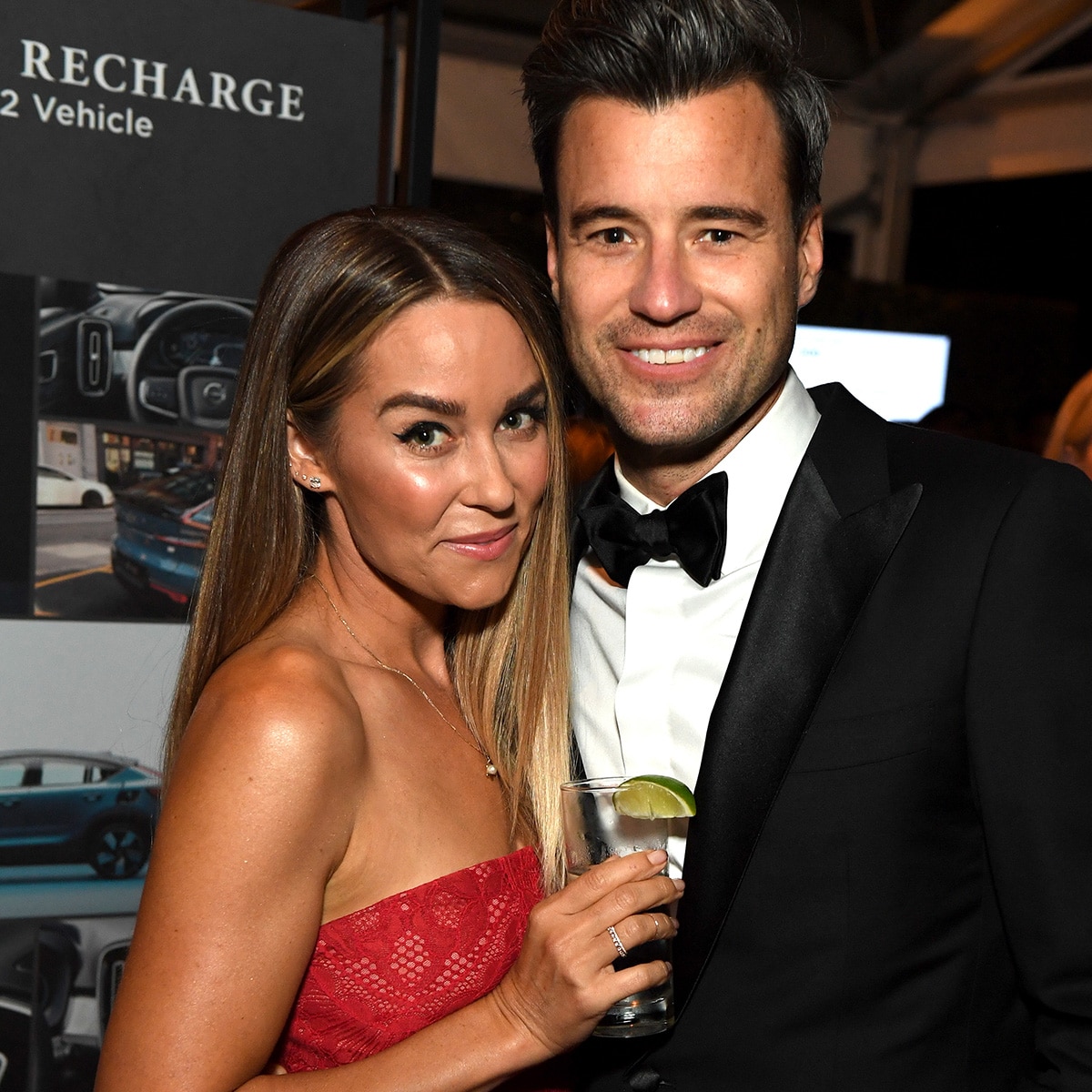
 Lauren Conrad’s husband William Tell doesn’t need to go back to the beginning.


![<a href="https://theboot.com/ixp/204/p/dasha-splurge-purchases-bronco-designer-bags/" target="_blank">[EXCLUSIVE] We Want to Take a Ride in Dasha’s Splurge Purchase</a>](https://townsquare.media/site/204/files/2026/03/hqdefault1.jpg?format=natural)