Dwight Yoakam was 90 minutes late to a show last week, but things could have been much, much worse. Continue reading…Country Music News – Taste of Country









Dwight Yoakam was 90 minutes late to a show last week, but things could have been much, much worse. Continue reading…Country Music News – Taste of Country
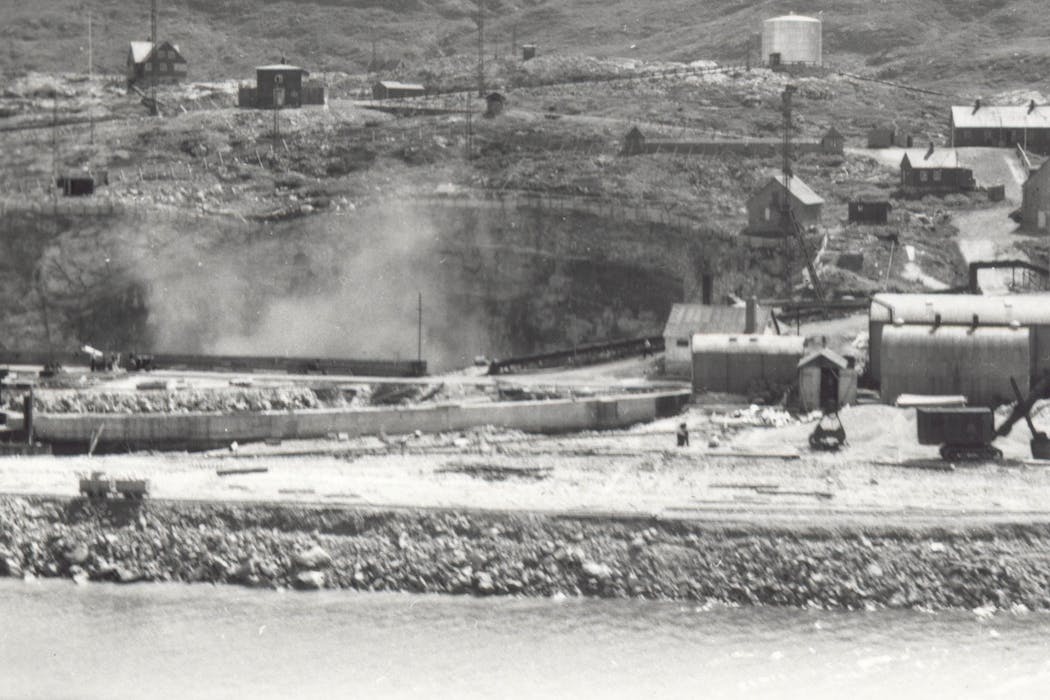
On April 9, 1940, Nazi tanks stormed into Denmark. A month later, they blitzed into Belgium, Holland and France. As Americans grew increasingly rattled by the spreading threat, a surprising place became crucial to U.S. national security: the vast, ice-capped island of Greenland.
The island, a colony of Denmark’s at the time, was rich in mineral resources. The Nazi invasions left it and several other European colonies as international orphans.
Greenland was essential for air bases as U.S. planes flew to Europe, and also for strategic minerals. Greenland’s Ivittuut (formerly Ivigtut) mine contained the world’s only reliable supply of the most important material you’ve probably never heard of: cryolite, a frosty white mineral that the U.S. and Canadian industries relied upon to refine bauxite into aluminum, and thus essential to assembling a modern air force.
A month after the Nazis seized Denmark, five American Coast Guard cutters set sail for Greenland, in part to protect the Ivittuut mine from the Nazis.
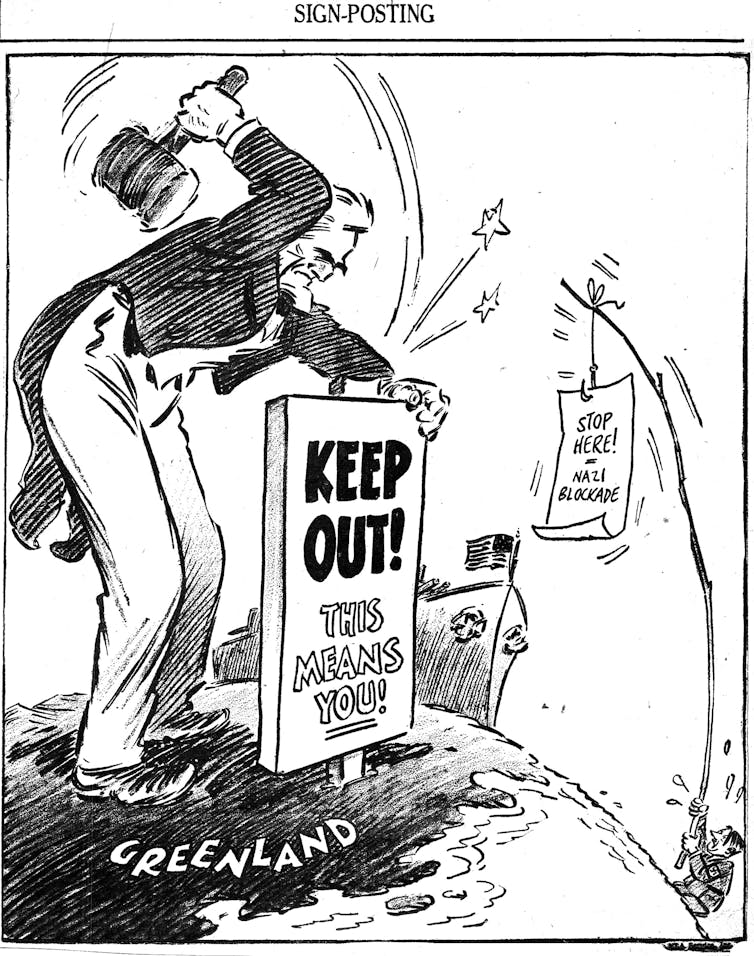
People sometimes forget that World War II was a dog-eat-dog struggle for resources – oil and uranium but also dozens of other materials, everything from rubber to copper. Without these strategic materials, no modern military could produce crucial new weapons such as tanks and airplanes. The resource struggle often started before actual fighting.
Foreign materials fueled American global power, but also raised tricky questions about access to resources and about sovereignty, just as the old European imperial order was being rethought. As in 2026, U.S. presidents had to skillfully balance force and diplomacy.

As a historian at Macalester College, I research how Americans shape environments around the world through their purchasing and national security needs, and how foreign landscapes enable and constrain American actions. Today, control of Greenland’s natural resources is again on an American president’s radar as demand for critical minerals rises and supply tightens.
During the spring of 1940, America and its European allies mapped out patterns of resource use and ideas of global interconnection that would shape the international order for decades. Greenland helped give birth to this new order.
On May 16, 1940, President Franklin Roosevelt addressed a joint session of Congress, including many “American first” isolationists wary of European entanglements. Roosevelt implored Americans to wake up to new threats in the world – to, in his words, “recast their thinking about national protection.”
New weapons, he warned, had shrunk the world, and oceans could no longer shield the United States. The nation’s fate was inextricably tied to Europe’s. Nothing showed this better than Greenland: “From the fiords of Greenland,” FDR warned, “it is four hours by air to Newfoundland; five hours to Nova Scotia, New Brunswick and to the province of Quebec; and only six hours to New England.”

But Greenland set off alarm bells for another reason. To protect itself in a dangerous world, Roosevelt famously called for the U.S. to hammer out 50,000 planes a year. But in 1938, America had produced only 1,800 planes.
To meet this ambitious goal, Roosevelt and his advisers knew that little could be done without Greenland. No Greenland, no cryolite. No cryolite, no massive American air force. Without cryolite, making 50,000 planes would be infinitely more difficult.
Americans, National Geographic explained in 1942, lived in an “age of alloys.” Without aluminum alloys and other metallic mixtures, assembly lines churning out modern tanks, trucks and airplanes would grind to a halt. “More than any other struggle in history, this is a war of many metals, and the lack of a single one may be a blow far worse than the loss of a battle.”

Few materials mattered more than aluminum. Light yet strong, aluminum formed 60% of a heavy bomber’s engines, 90% of its wings and fuselage, and all of its propellers.
But there was a problem: Refining aluminum from bauxite ore required working with dangerously hot metallic mixtures, over 2,000 degrees Fahrenheit (1,100 degrees Celsius). Cryolite solved the problem by reducing the temperature to a more manageable 900 F (480 C).
The Nazis’ chemical industry had found a substitute for cryolite using fluorspar, but the U.S. preferred the more resource-efficient cryolite and wanted to prevent the Germans from having it.
Just days after German tanks rolled into Denmark in April 1940, Allied officials huddled to devise ways to protect Ivittuut’s magical mineral. On May 3, Danish Ambassador to the U.S. Henrik de Kauffmann, risking trial for treason, requested American assistance. On May 10, the U.S. Coast Guard Cutter Comanche departed New England for Ivittuut. Four others soon followed, one with guns for the mine’s defenders.

That very week in Washington, at a meeting of the Pan American Union, Roosevelt and his advisers spoke with hundreds of geologists and other representatives from Latin America — a resource-rich region that the U.S. saw as an answer to its strategic materials shortages.
Nervous about the history of U.S. imperial high-handedness in the region, some Latin Americans thought that their countries should seal off their resources to outside control, as Mexico had in nationalizing U.S. and European oil holdings in 1938.

With European empires crumbling, Roosevelt faced a delicate diplomatic dance with Greenland. He wanted to maintain the appearance of neutrality, keep skeptical isolationists in Congress from revolting and give no provocations to Latin American anti-imperialists to cut off resources. Crucially, he also needed to avoid giving the resource-starved Japanese a legal justification to seize the oil-rich Dutch East Indies, now Indonesia – another European colony orphaned by the Nazi invasion.
Roosevelt’s solution: enlist Coast Guard “volunteers” to guard Ivittuut. By the end of the summer, long before the U.S. officially entered the war, 15 sailors resigned from their ships and took up residence near the mine.
Roosevelt also got creative with geography.
In an April 12, 1940, press conference, just days after the Nazi invasion, he began to emphasize Greenland as part of the Western Hemisphere, more American than European, and thus falling under Monroe Doctrine protections. To calm fears in Latin America, U.S. officials recast the doctrine as development-oriented hemispheric solidarity.
Maj. William S. Culbertson, a former U.S. trade official speaking before the Army Industrial College in fall 1940, noted how the scramble for resources pulled the U.S. into a form of nonmilitary warfare: “We are engaged at the present time in economic warfare with the totalitarian powers. Publicly, our politicians don’t state it quite as bluntly as that, but it is a fact.” For the rest of the century, the front line was just as likely a far-off mine as an actual battlefield.
On April 9, 1941, exactly a year after the Nazis seized Denmark, Kauffmann met with U.S. Secretary of State Cordell Hull to sign an agreement “on behalf of the King of Denmark” placing Greenland and its mines under the U.S. security blanket. At Narsarsuaq, on the island’s southern tip, the U.S. began constructing an airbase named “Bluie West One.”

During the rest of World War II and throughout the Cold War, Greenland would house several important U.S. military installations, including some that forced Inuit families to relocate.
What transpired in Greenland in the 18 months before Pearl Harbor fit into a larger emerging pattern.
As the U.S. ascended to global leadership and realized that it couldn’t maintain military dominance without wide access to foreign materials, it began to redesign the global system of resource flows and the rules for this new international order.

It rejected the Axis’ “might makes right” territorial conquest for resources, but found other ways to guarantee American access to critical resources, including loosening trade restrictions in European colonies.
The U.S. provided a lifeline to the British with the destroyers-for-bases deal in September 1940 and the Lend-Lease Act in March 1941, but it also gained strategic military bases around the world. It used aid as leverage to also pry open the British Empire’s markets.
The result was a postwar world interconnected by trade and low tariffs, but also a global network of U.S. bases and alliances of sometimes questionable legitimacy designed in part to protect U.S. access to strategic resources.

During the Cold War, these global resources helped defeat the Soviet Union. However, these security imperatives also gave the U.S. license for support of authoritarian regimes in places like Iran, Congo and Indonesia.
America’s voracious appetite for resources also often displaced local populations and Indigenous communities, justified by the old claim that they misused the resources around them. It left environmental damage from the Arctic to the Amazon.

Strategic resources have been at the center of the American-led global system for decades. But U.S. actions today are different. The cryolite mine was a working mine, rarer than today’s proposed critical mineral mines in Greenland, and the Nazi threat was imminent. Most important, Roosevelt knew how to gain what the U.S. needed without a “damn-what-the world-thinks” military takeover.

Thomas Robertson does not work for, consult, own shares in or receive funding from any company or organization that would benefit from this article, and has disclosed no relevant affiliations beyond their academic appointment.
Politics + Society – The Conversation

The country legend reflects on the early days of his fame and credits his wife with helping him slow down before success cost him everything. Continue reading…The Boot – Country Music News, Music Videos and Songs
The country legend reflects on the early days of his fame and credits his wife with helping him slow down before success cost him everything. Continue reading…Country Music News – Taste of Country

Ice cream is a delicious treat all on its own, but once you hear this tip for adding dates, you’ll never go back to eating it plain again. Here’s what to do.

Food Republic – Restaurants, Reviews, Recipes, Cooking Tips

Bunnie Xo is getting candid about her marriage to the country superstar, reflecting on how their relationship began and why it looks different today. Continue reading…The Boot – Country Music News, Music Videos and Songs

From the hills of Hazard, Kentucky, 19-year-old Landon Hughes is bringing his love for bluegrass and his pride for his Appalachian upbringing to American Idol. During his audition, which aired on Monday night, the aspiring singer held nothing back as he performed his rendition of “Little Maggie” by The Stanley Brothers, leaving the judges wanting more.
Hughes explained that he is currently a soccer player at Lake Erie College in Painesville, Ohio. When Idol judge Luke Bryan asked if he enjoys playing the sport, he said “yes,” but explained that his real passion has evolved into connecting with the kind of music that reminds him of home.
“I’ll be God’s honest… I love it. I didn’t think going up there would be as much of a life changing experience as it is, but it kind of made me re-fall in love with music,” Hughes shared. “As Appalachians, we had a very unique experience in life, but I used to hate home while I was growing up. After coal crashed, a lot of stuff was taken away, and I was the first generation to really experience the Hazard with not a lot.”
That longing for his roots started the minute he moved out of Kentucky. Looking for a way to honor his roots, he started to dive into classic bluegrass albums and found that he was instantly transported back to the mountains all the way from Ohio.
“Whether I’m in Cleveland or Nashville, it really transports me back home,” he stated proudly. “Listening to bluegrass really made me realize I took Appalachia for advantage for many years and I live there and now I’ve changed. I’m here 100% to represent Appalachia. When I play the music, that’s the sound of home. When they see me, that’s the look of home. And I walk with it every day. I carry dirt from home on my boots. I carry home with me, and I carried it here to American Idol because I’m proud of it.”
After noting how much this audition means to him, he did exactly what he set out to do: “I’m going out here to pick it, pick it fast, sing it loud. Hopefully it has an impact on ‘em.”
Hughes plucked his guitar strings with precision, letting his free-spirited, mountainous energy fill the room. His rich bluegrass tones were drawn out in every note, showcasing his unmistakable Appalachian flair and making the performance feel both authentic and joyful.
Among the panel of judges, Carrie Underwood was first to share her thoughts. She started by saying how “happy” the performance made her feel, but then expressed some hesitation about his ability to perform in other genres.

“I have one for real question. So in this competition we do Rock Hall of Fame, we do Disney Night, we throw things at you. We want you to be you. Can you be you in other genres?” she asked.
With confidence, he responded, “I think I can do about every genre I love music all across the board. Not just bluegrass because of where I’m from, but I love every bit of music.”
Lionel Richie told him, “I like your vibe” and commended him on the unique “character” quality of his vocals.
“You’re going to have to take us on that journey where we don’t get too comfortable knowing what you’re going to do. You’re going to have to kind of guide us through it,” he added.

Luke Bryan wasn’t completely on board at first, admitting he was “a little skeptical.”
“There was some stuff you did at the end where you had a little vibrato in there and it was really nice, so I think you’re still exploring a lot with your voice.”
In the end, the judges felt that he deserved the chance to prove himself in the competition, and awarded him a unanimous “yes,” putting him through to Hollywood Week.
Hughes was incredibly grateful for the opportunity. Although he knows his audition wasn’t “perfect,” he stated the audition gave him the confidence he needed to find himself.
“Thank you. This means the world to me. For so long I was afraid of kind of exploring who I was and where I was from. I can finally be who I am and be proud of it…This has my heart. It’s everything and I’m very proud to take this ticket back home.”
Landon Hughes got to showcase his talent during the final round of auditions tonight. Next Monday, February 23, Hollywood Week officially begins in Nashville, TN and the judges will be forced to make the “biggest cut in Idol history.” By the end of the night, the top 30 will be unveiled.
New episodes of American Idol Season 24 air Monday nights at 8/7c on ABC and streams the next day on Hulu.
The post Luke Bryan Admits Skepticism, Then 19-Year-Old Landon Hughes Wins Over ‘Idol’ Judges With Bluegrass-Fueled Audition appeared first on Country Now.
Country Now

Walmart relies on many third-party manufacturers to produce the goods it sells. Some very well-known companies are involved in the store’s bakery.

Mashed – Fast Food, Celebrity Chefs, Grocery, Reviews

 Ray J still has his sight set on performing.
Three weeks after the “Sexy Can I” singer shared that he believed he only had months to live after being hospitalized for pneumonia, he performed on…
E! Online (US) – Top Stories
By: Corinne Smith, Alaska Beacon
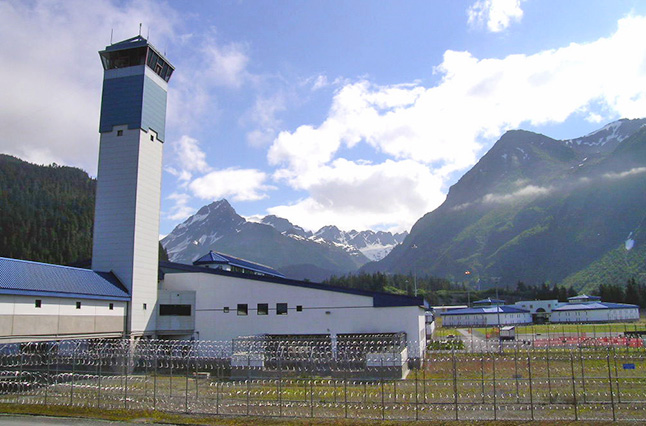
Officials with the Alaska Department of Corrections told lawmakers a “large fight” with a hefty price tag broke out at the state’s maximum security prison in January, amid downsizing and cost-cutting efforts.
The fight at Spring Creek Correctional Center involved 50 inmates, some of whom sustained minor injuries, officials said.
“Quick napkin math, we believe it to be just under $200,000 that that cost us,” Jen Winkelman, the commissioner for the corrections department, told lawmakers. “Anecdotally, the pressures of moving the individuals around and being at capacity in our max unit — I believe that, (and) we all believe that that plays a part in it,” she said.
She said the altercation increased agency spending on medical and transportation costs to transfer those involved.
The disclosure came in a budget update to members of the House Finance subcommittee for DOC on Feb 10, as lawmakers are reviewing the department’s additional $24 million spent last year, and request for just over a $500 million budget for next year.

Spring Creek is the state’s only maximum-security prison for men, located just outside Seward on the Kenai Peninsula, and housed approximately 375 inmates last year.
Last year, the legislature directed DOC to close one of three housing units at the prison, which contained 247 beds, as a cost-cutting measure. It was intended “to direct personnel to other areas of the facility, reduce overtime and find efficiencies,” according to a presentation by DOC officials.
The housing unit was closed July 14, and the inmates relocated to other housing in Spring Creek and to other prisons across the state, April Wilkerson, deputy commissioner told lawmakers. She said Spring Creek is now over capacity, with a waitlist of inmates to transfer into the maximum-security prison.
“Ultimately we are not achieving the savings that was identified in the department’s budget,” Wilkerson said.
According to the department, a fight broke out between two groups of inmates on Jan. 24. It involved 50 people, according to department spokesperson Betsy Holley. “Staff responded quickly. 5 inmates had non-threatening injuries and were treated. No staff were injured,” she said in an email after the hearing.
Holley said the fight lasted approximately 10 minutes, and staff responded effectively. “Those inmates involved are currently undergoing the discipline process,” she said, according to DOC policies, which may include suspension from activities or solitary confinement.
Holley said there were no further details on the cost estimate.
On Thursday, Winkelman said in a short interview between hearings at the Capitol that DOC officials reported the incident to lawmakers to illustrate how incidents can occur beyond the department’s control.
“These things happen, and they have a cost incurred, and we can’t plan for it,” Winkelman said. “It happened at eight o’clock in the morning. But they happen often — little things happen often, that have big price tags. So that’s the point that we’re trying to make.”
