Members of a self-styled African tribe have been evicted from a Scottish forest.The Latest News from the UK and Around the World | Sky News









Members of a self-styled African tribe have been evicted from a Scottish forest.The Latest News from the UK and Around the World | Sky News

The screams from the women and children pierce the air as the battering ram smashes through the front door of their home.The Latest News from the UK and Around the World | Sky News

A man has been shot by police after reports of a stabbing at a synagogue in Manchester on the Jewish holy day of Yom Kippur.The Latest News from the UK and Around the World | Sky News
By: James Brooks, Alaska Beacon

The cruise line Holland America will have a large Alaska-themed float in the annual Macy’s Thanksgiving Day Parade, the company announced Monday during a ceremony in Juneau.

Alaskans have occasionally participated in the parade in New York City, which is celebrating its 99th anniversary this year, but the company believes this will be the first time that the state will be represented by a float in the event.
The announcement came on one of the last days of Holland America’s summer cruise ship operations in Alaska’s capital city. Juneau will continue receiving occasional large cruise ships through October.
“The float will be named simply ‘The Land of Glaciers, Wildlife and Wonder,’” said Leanne Jones with Holland America official during a ceremony announcing the float and a $5,000 donation to Trail Mix, a local trail-building nonprofit in Juneau.
“This marks the first time Alaska will be featured in the iconic holiday event, and the first time Holland America Line has ever participated in this parade,” Jones said. The parade is scheduled to start at 4:30 a.m. Alaska time on Thursday, Nov. 27.
A rendering displayed Monday shows a howling wolf, black bear and a moose at the back of the float. The main platform is a glacier and river with leaping salmon.
“Well, that’s a pretty exciting announcement,” said Juneau Mayor Beth Weldon. “And you know, after Macy’s parade, we do have a Fourth of July parade in Juneau.”


NOTN- Juneau’s city leaders heard directly from Goldbelt Inc. on Monday night about the corporation’s plan for the Douglas Island port project, which includes two proposed cruise ship docks.
Deputy Mayor Greg Smith said it was the first time the full Assembly had received a detailed briefing from Goldbelt, calling it “a good start to the conversation.” The project, nicknamed “Goldbelt Aaní” is still in its early stages with no announced opening date.
“They give a good overview of the project, of the vision, the intent, you know, ,there’s still a fair bit to be determined and plan.” Said Smith. “There wasn’t an expected date. I did ask what kind of minimum infrastructure they would need out there to be open, they’re still evaluating that.”
According to Goldbelt, Goldbelt Aaní will highlight Lingít culture and boost the city’s economy.
Plans include docks, a welcome center, employee housing, child care facilities, and even a replica Lingít village.
Smith said Assembly members raised questions about transportation impacts, including whether North Douglas Highway could handle added traffic.
“My sense from the response was that they’re not planning to be bussing in tons and tons and tons of people. It’s people staying on the site, or going places via water again, we still need to learn more how that would work, what that looks like.” Said Smith, “How does the five ship limit play into it? That’s definitely been a big concern.”
Smith noted the project remains under evaluation, but Monday’s discussion helped open communication between the city and the Native corporation.
By: James Brooks, Alaska Beacon

Reporters and editors at the Homer News and Peninsula Clarion announced their resignations on Monday, citing a decision by the papers’ corporate owners to bow to political pressure to amend an article about a vigil for the slain far-right activist Charlie Kirk.
The resignations, which include two editors and two reporters based in Homer and Kenai, were scheduled to take effect in two weeks, but managers at Carpenter Media Group fired all four immediately.
Carpenter Media Group, an international chain, owns the News, Clarion and the Juneau Empire, as well as the Yukon News and hundreds of other newspapers in the Lower 48 and Canada.
The resignations follow a similar mass resignation at the Juneau Empire earlier this summer.
When combined, both actions leave Carpenter Media Group with a single in-state Alaska reporter among its three newspapers.
Mary Kemmis, senior vice president of Carpenter’s publications in Alaska and Canada, did not return phone calls seeking comment on Tuesday, nor did Chloe Pleznac, the reporter who authored the original article.
Jake Dye, a former reporter for the Peninsula Clarion and one of the people who resigned this week, said by phone that Carpenter’s handling of the story was “problematic in a lot of ways.”
Charlie Kirk, a far-right commentator, free speech activist and Christian nationalist who was an ally of President Donald Trump, was shot and killed on Sept. 10 at an appearance in Utah. One person has been arrested and charged with his killing and is awaiting trial.
Since his killing, conservatives, including many Republicans, have held rallies to memorialize Kirk.
After a vigil in Homer, Pleznac published an article describing Kirk as a “far-right political activist and Christian-Nationalist icon,” and went on to describe his “often racist and controversial views” before going on to detail the vigil.
Soon after the article was published, Rep. Sarah Vance, R-Homer, published a letter on official state legislative letterhead that criticized the characterization of Kirk and the Homer News coverage and said in part, “If the paper continues to treat community events as opportunities for partisan spin, the consequence will be financial as well as reputational.”
After the letter, which was reprinted on her legislative Facebook page, Carpenter officials rewrote the article without consulting editors or reporters at the Homer News, according to the staff who resigned.
Afterward, Vance thanked the newspaper’s owners for the change.
Vance did not answer a phone call and text message Tuesday asking about the incident.
In their resignation letter, Carpenter’s Alaska reporters and editors said they don’t have an issue with Vance’s perspective but “what we do have a problem with is Carpenter Media management changing a story at the behest of an elected official. We believe this destroys the credibility the public has placed in us as reporters and editors.”
The worry, the resigning staff said, is that having once caved to political pressure, Carpenter Media will invite further attempts to steer news coverage by political officials and people who are part of the story.
“We cannot do our jobs knowing that pressure from an elected official can mean our stories are edited without prior consultation with us,” the resignation letter says.
Vance’s letter to Carpenter Media comes amid nationwide pressure by Republican and conservative officials to clamp down on language deemed critical of Kirk. Some states have launched investigations of university officials and other public employees for comments made on social media.
The three publications were owned by Georgia-based Morris Communications until 2017, when they were purchased by New Jersey-based GateHouse Media. Later that year, they were sold again to Washington-based Sound Publishing, a division of Canada-based Black Press.
Carpenter Media Group bought Black Press in 2024.
In Juneau, the entire reporting staff of the Juneau Empire — including seasonal interns — resigned simultaneously amid complaints about low pay, benefits and a lack of institutional support.
The former editor of that newspaper has since gone on to help start an independent, nonprofit newsroom for capital-city news.
Dye, by phone on Tuesday, said he’s not sure what’s next for either himself or the Peninsula Clarion. Journalism in Alaska as a whole is in a dim spot amid budget cuts to public media, he said, but he’s trying to stay optimistic.
“There’s not a lot of light at the end of the tunnel, but I guess I truly believe that somehow, things are going to work out for the state and for us,” he said.
By: Jennifer Shutt and Ariana Figueroa, States Newsroom

This report has been updated.
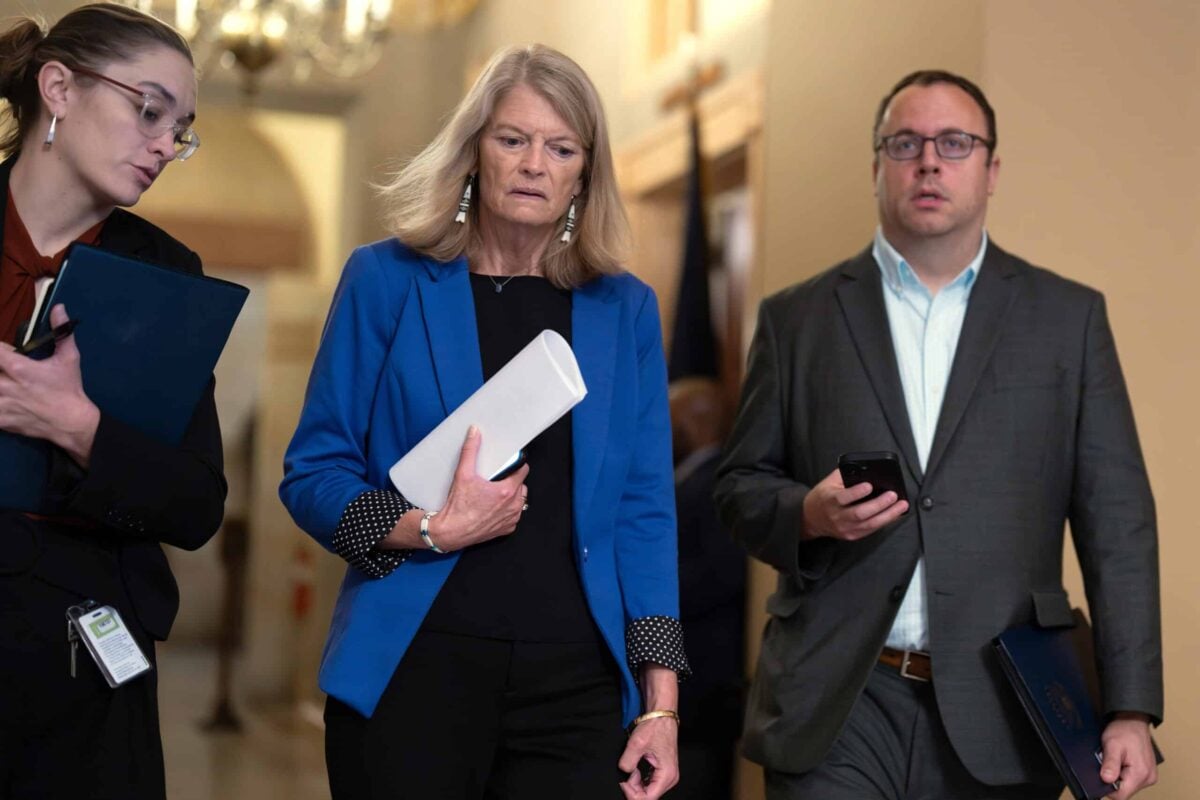
WASHINGTON — The federal government started shutting down early Wednesday after Congress failed to approve a funding bill before the beginning of the new fiscal year — resulting in widespread ramifications for hundreds of programs and giving the Trump administration an avenue to fire federal workers en masse.
The U.S. Senate was unable to advance two short-term government funding bills Tuesday when Democrats and Republicans deadlocked for the second time this month, with just hours to go before the midnight Tuesday shutdown deadline.
Senators voted 55-45 on Republicans’ bill that would fund the government for seven weeks and 47-53 on a Democratic stopgap proposal that would keep the lights on for a month and included several health care provisions that they said were needed for their support. Neither had the 60 votes needed to advance.
Nevada Democratic Sen. Catherine Cortez Masto, Pennsylvania Democratic Sen. John Fetterman and Maine independent Sen. Angus King voted with GOP senators on their stopgap bill. Kentucky GOP Sen. Rand Paul voted against it.
White House Office of Management and Budget Director Russ Vought said in a memo to departments and agencies Tuesday night after the Senate vote that “affected agencies should now execute their plans for an orderly shutdown.” Vought said federal employees should report for their next regularly scheduled tour of duty to undertake shutdown activities.
The consequences of a shutdown will be sweeping in the nation’s capital and across the country, where states are bracing for the impact. About 750,000 federal workers could be furloughed, leading to a $400 million impact a day, the nonpartisan Congressional Budget Office reported. All federal employees would go unpaid until the shutdown is over.
Additionally, the Trump administration plans to lay off thousands of federal employees, which would reshape the federal workforce. President Donald Trump again vowed Tuesday to undertake layoffs and a major government employee union filed suit in federal court in advance of such a move.
Senate Majority Leader John Thune, R-S.D., said hours before the votes there wouldn’t be any talks with Democrats during a shutdown.
“The negotiation happens when the government is open. So let’s keep the government open and then we will have the negotiations,” Thune said.
“We’re happy to sit down and talk about these issues that they’re interested in,” he said. “But it should not have anything to do with whether or not for a seven-week period we keep the government open, so that this government can continue to do its work and that we can do our work through the regular appropriations process to fund the government.”
After the votes failed, Thune expressed his frustration with Democrats during a press conference.
“This is so unnecessary and uncalled for,” he said.
Thune said he plans to bring up a vote on the continuing resolution again. He said as soon as Wednesday the federal government can be funded if five Democrats voted with Republicans.
“Democrats may have chosen to shut down the government, but we can reopen it tomorrow,” Thune said.
Republican Whip John Barrasso of Wyoming said the “cracks in the Democrats are already showing,” noting that three Democrats voted with Republicans Tuesday night.
“There is bipartisan support for keeping the government open,” Barrasso said. “We’re happy to see that the Democrats are already starting to break from (Senate Democratic Leader Chuck Schumer) and we’re going to continue to offer a clean (continuing resolution) on the floor of the Senate to open the government for the next seven weeks.”
The disagreement isn’t entirely about GOP lawmakers writing their short-term funding bill behind closed doors and then expecting Democrats to help advance it in the Senate, where bipartisanship is required for major legislation.
Democratic leaders have raised concerns for weeks about the end-of-year sunset of enhanced tax credits for people who buy their health insurance on the Affordable Care Act Marketplace, arguing a solution is needed now ahead of the open enrollment period starting on Nov. 1.

Democrats have also grown increasingly frustrated with the White House budget office’s unilateral actions on spending, arguing Vought is significantly eroding Congress’ constitutional power of the purse. Sen. Susan Collins of Maine, the Republican chairwoman of the U.S. Senate Appropriations Committee, said Tuesday the Government Accountability Office should sue the Trump administration over its efforts to freeze or unilaterally cancel spending approved by Congress.
Senate Minority Leader Chuck Schumer said Democrats need an agreement with Republicans to extend the enhanced tax credits.
Schumer said people will begin getting notices in October telling them how much the cost of their ACA plans will increase during the next year, which he expects will ratchet up pressure on Republican leaders to broker a bipartisan agreement.
“We’re going to be right there explaining to them it’s because the Republicans wouldn’t negotiate with us,” Schumer said, referring to consumers. “We’re ready to do it anytime. And there will be huge heat on (Republicans) on this issue.”
People who buy health insurance on the ACA marketplace and receive subsidies through enhanced ACA tax credits could expect to pay on average more than double for annual premiums in 2026 if the credits expire as scheduled at the end of this year, according to an analysis released Tuesday by the nonprofit health policy research organization KFF.
The analysis found premiums could increase from an average of $888 this year to $1,904 in 2026.
Schumer also rebuffed GOP leaders saying that Democrats want to include people without legal immigration status in federal health care programs.
“They say that undocumented people are going to get these credits. That is absolutely false. That is one of the big lies they tell, so they don’t have to discuss the issues,” Schumer said. “The federal government by law that we passed does not fund health insurance for undocumented immigrants in Medicaid, nor the ACA nor Medicare. Undocumented immigrants do not get federal health insurance premiums.”
Immigrants in the country without legal authorization are not eligible for Medicaid, and neither are most immigrants with legal status, such as those with student visas or enrollment in the Deferred Action for Childhood Arrivals program, known as DACA.
Only immigrants with a “qualified status,” such as legal permanent residents, asylees and refugees, are able to get Medicaid benefits, and they usually have to wait five years before their coverage can even begin.
Cortez Masto of Nevada wrote in a statement explaining her vote to advance the GOP stopgap bill that she could not support “a costly shutdown that would hurt Nevada families and hand even more power to this reckless administration.”
“We need a bipartisan solution to address this impending health care crisis, but we should not be swapping the pain of one group of Americans for another,” she added. “I remain focused on protecting health care for working families, and I call on my colleagues on both sides of the aisle to work together to tackle this problem.”
Pennsylvania’s Fetterman wrote in a statement of his own that his vote on the Republican bill “was for our country over my party.
“Together, we must find a better way forward.”
Collins said during a brief interview before the vote she is worried about the broad authority the White House holds during a shutdown and how the Office of Management and Budget has indicated it will use that power.
“I’m much more concerned about OMB sending signals that there should be mass firings of federal employees who have the misfortune to be designated as non-essential, when in fact they’re performing very essential work, they’re just not being paid,” Collins said.
North Dakota Republican Sen. John Hoeven, chairman of the Agriculture spending subcommittee, said lawmakers will have to sort through how various departments implement their contingency plans as well as the possibility of mass layoffs during a shutdown.
“We’ll have to work through those things and figure out how we do keep things going as best we can during this Democrat shutdown,” Hoeven said.
West Virginia Sen. Shelley Moore Capito said Republicans are “unified in the belief that this is an easy choice” to fund the government with a stopgap bill that doesn’t include any contentious or political provisions.
Capito — who chairs the Appropriations subcommittee that funds the departments of Education, Health and Human Services, and Labor — said there are several programs that will be “missed” during a shutdown.
“And that’s concerning. So I think the option is to keep the government open so we can avoid this pain,” Capito said.
Missouri Republican Sen. Josh Hawley said he is worried about the possible impacts of a shutdown on his home state and that keeping the government open is the only way to avoid that.
“I’m sure the administration will do everything they can,” Hawley said. “But the solution is to not shut the government down. I mean, why would you punish working people because you’re not getting what you want on any issue, whatever it is.”
South Dakota Republican Sen. Mike Rounds said he doesn’t expect a shutdown will end until after Democrats have sent a message to their voters.
“I’m not optimistic that we’re going to get a path forward until they’ve had a shutdown,” he said.
Rounds, who negotiated a handshake agreement with the White House budget director this summer to preserve some funding for rural tribal radio stations after Congress eliminated funding for the Corporation for Public Broadcasting, said that deal could be affected by a shutdown.
“They’re putting the administration in a position where they can pick and choose what they’re going to do, and a shutdown is not going to be beneficial to these Native American radio stations,” Rounds said.
Democratic Sen. Elissa Slotkin of Michigan said she wants Democrats and Republicans to negotiate on health care provisions.
“I’ve been making the case constantly, that (it) is literally my obligation to try and fight for health care, and I’m willing to talk to anyone,” she said. “I’m willing to accept that I certainly will not get everything I want.”
Senate Minority Whip Dick Durbin of Illinois said that while Democrats agreed to help advance what’s known as a continuing resolution in March, they can’t now because of “what President Trump is doing to this country, particularly when it comes to health care costs for families.”
The shutdown will significantly affect the operations of the federal government as lawmakers have not passed any of the dozen full-year appropriations bills that finance agency operations. Oct. 1 is the beginning of the new fiscal year for the federal government.
Departments began releasing updated contingency plans this weekend, detailing how many of their employees would work during a government shutdown and how many would be furloughed.
The Interior Department, which includes the Bureau of Land Management, U.S. Fish and Wildlife Service and National Park Service, posted its updated plans late Tuesday.
The National Park Service plans to furlough 9,300 of its 14,500 workers.
The Trump administration will allow several activities necessary for the protection of life or property to continue, including fire suppression for active fires, permitting and monitoring First Amendment activities, border and coastal protection and surveillance, and law enforcement and emergency response.
The contingency plan says that roads, lookouts, trails, and open-air memorials will generally remain accessible to visitors,” but it adds that if “access becomes a safety, health or resource protection issue … the area must be closed.”
In anticipation of layoffs by the Trump administration, labor unions representing more than 1 million federal workers filed a lawsuit in the Northern District of California on Tuesday to block the Trump administration from carrying out mass firings. The suit argues that there is no statutory authority to fire federal employees during a government shutdown.
“These actions are contrary to law and arbitrary and capricious, and the cynical use of federal employees as a pawn in Congressional deliberations should be declared unlawful and enjoined by this Court,” according to the suit filed by the American Federation of Government Employees and the American Federation of State, County and Municipal Employees.
Ashley Murray and Shauneen Miranda contributed to this report.

Hundreds of generals and admirals converged on Quantico, Virginia, on Sept. 30, 2025, after being summoned from across the globe by their boss, Pentagon chief Pete Hegseth, for a session that, as expected, covered what Hegseth often describes as the “warrior ethos.”
Listening quietly, they heard Hegseth promise to make the military “stronger, tougher, faster, fiercer and more powerful than it has ever been before,” and declare that he would fix “decades of decay” in the military.
President Donald Trump spoke for more than an hour in a political speech that derided presidents who came before him. He asserted that “political correctness” would be banished from the military.
The meeting came soon after Trump’s Sept. 5 executive order renaming the Department of Defense the “Department of War.” With that change, Trump reverted the department to a name not used since the 1940s.
The change represents far more than rebranding – it signals an escalation in the administration’s embrace of a militaristic mindset that, as long ago as 1961, President Dwight D. Eisenhower warned against in his farewell address, and that the nation’s founders deliberately aimed to constrain.
The timing of this name change feels particularly notable when considered alongside recent reporting revealing secret U.S. military operations. In 2019, a detachment of U.S. Navy SEALs crept ashore in North Korea on a mission to plant a listening device during high-stakes nuclear talks. The risks were enormous: Discovery could have sparked a hostage crisis or even war with a nuclear-armed foe.
That such an operation was approved by Trump in his first term at all exemplifies an increasingly reckless militarism that has defined American foreign policy for decades. That militarism is the very subject of my book, “Dying by the Sword.”
Further, the name change was announced just days after Trump authorized a U.S. military strike on a Venezuelan boat that the administration claimed was carrying drug-laden cargo and linked to the Tren de Aragua cartel. The strike killed 11 people. The administration justified the killings by labeling them “narcoterrorists.”

The Department of War existed from 1789 until 1947, when Congress passed the National Security Act reorganizing the armed services into the National Military Establishment. Just two years later, lawmakers amended the act, renaming the institution the Department of Defense.
Officials disliked the “NME” acronym – which sounded uncomfortably like “enemy” – but the change was not only about appearances.
In the aftermath of World War II, U.S. leaders wanted to emphasize a defensive rather than aggressive military posture as they entered the Cold War, a decades-long standoff between the United States and Soviet Union defined by a nuclear arms race, ideological rivalry and proxy wars short of direct great-power conflict.
The new emphasis also dovetailed with the new U.S. grand strategy in foreign affairs – diplomat George F. Kennan’s containment strategy, which aimed to prevent the expansion of Soviet power and communist ideology around the world.
Kennan’s approach narrowly survived a push to a more aggressive “rollback” strategy of the Soviet Union from its occupation and oppression of central and eastern Europe. It evolved instead into a long game: a team effort to keep the adversary from expanding to enslave other peoples, leading to the adversary’s collapse and disintegration without risking World War III.
On the ground, this meant fewer preparations for war and more emphasis on allies and intelligence, and foreign aid and trade, along with the projection of defensive strength. The hope was that shaping the environment rather than launching attacks would cause Moscow’s influence to wither. To make this strategy viable, the U.S. military itself had to be reorganized.
In a 1949 address before Congress, President Harry S. Truman described the reorganization sparked by the 1947 legislation as a “unification” of the armed forces that would bring efficiency and coordination.
But a deeper purpose was philosophical: to project America’s military power as defensive and protective, and for Truman, strengthening civilian oversight.
The wisdom of this restraint is clearest in Eisenhower’s farewell address of January 1961.
In less than 10 minutes, the former five-star general who had commanded Allied forces to victory in World War II cautioned Americans against the rise of a “military-industrial complex.” He acknowledged that the nation’s “arms must be mighty, ready for instant action,” but warned that “the potential for the disastrous rise of misplaced power exists and will persist.”
The risky North Korean team mission by the Navy SEALs illustrates how America’s militaristic approach often produces the very dangers it aspires to deter.
Rather than enhancing diplomacy, the operation risked derailing talks and escalating conflict. This is the central argument of my book: America’s now-reflexive reliance on armed force doesn’t make America great again or more secure. It makes the country less secure, by creating new enemies, destabilizing regions and diverting resources from the true foundations of security.
It also makes the U.S less admired and respected. The State Department budget continues to be dwarfed by the Department of War’s budget, with the former never reaching more than 5.5% of the latter. And the U.S. Agency for International Development, or USAID, once the leading arm of U.S. soft power as quiet purveyor development aid around the world, is now shuttered.
Today’s Pentagon budget exceeds anything Eisenhower could have imagined.
Trump’s rebranding of the Department of Defense into the Department of War signals a shift toward framing U.S. power primarily in terms of military force. Such a framing emphasizes the use of violence as the principal means of solving problems and equates hostility and aggression with leadership.
Yet historical experience shows that military dominance alone has not translated into strategic success. That’s the mindset that lost the U.S. endless wars in Afghanistan and Iraq, and failed in interventions in Libya and Syria – conflicts that altogether cost trillions of dollars and hundreds of thousands of lives while leaving the country less secure and eroding its international legitimacy.
“Only an alert and knowledgeable citizenry,” Eisenhower said, can compel the proper balance between military power and peaceful goals.
The very title of my and my co-author’s book comes from the Gospel of Matthew – Chapter 26, verse 52 – that “to live by the sword is to die by the sword.” Throughout modern history, true security has come from diplomacy, international law, economic development and investments in health care and education. Not from an imaginary “warrior ethos.”
America, I would argue, doesn’t need a Department of War. It needs leaders who understand, as Eisenhower did, that living by the sword will doom us all in the end. Real security comes from the quiet power that builds legitimacy and lasting peace. The U.S. can choose again to embody those strengths, to lead not by fear but by example.
This story has been updated to reflect the Pentagon meeting in Quantico, Virginia.

Monica Duffy Toft does not work for, consult, own shares in or receive funding from any company or organization that would benefit from this article, and has disclosed no relevant affiliations beyond their academic appointment.
Politics + Society – The Conversation

Texas A&M University announced the resignation of its president, Mark A. Welsh III, on Sept. 18, 2025, following a controversial decision earlier in the month to fire a professor over a classroom exchange with a student about gender identity.
The university – a public school in College Station, Texas – fired Melissa McCoul, a children’s literature professor, on Sept. 9. McCoul’s dismissal happened after a student secretly filmed video as the professor taught a class and discussed a children’s book that includes the image of a purple “gender unicorn,” a cartoon image that is sometimes used to teach about gender identity.
The student questioned whether it was “legal” to be teaching about gender identity, given President Donald Trump’s January 2025 executive order – which is not legally binding – that said there are only two genders, male and female.
The video went viral, triggering backlash from Republican lawmakers who called for McCoul to be fired and praised the fact that the school also demoted the College of Arts and Science’s dean and revoked administrative duties from a department head.
Texas A&M officials have said that McCoul was fired because her course content was not consistent with the published course description. McCoul is appealing her firing and is considering legal action against the school.
Academic freedom advocates have condemned McCoul’s firing and say it raises questions about whether professors should be fired for addressing politically charged topics.
As a history educator researching curriculum design, civics education and generational dynamics, I study how classroom discussions often mirror larger cultural and political conflicts.
The Texas A&M case is far from unprecedented. The Cold War offers an example of another politically contentious time in American history when people questioned if and how politics should influence what gets taught in the classroom – and tried to restrict what teachers say.

During the Cold War – a period of geopolitical tension between the U.S. and the Soviet Union that came after World War II and lasted until 1991 – fears of communist infiltration spread widely across American society, including the country’s schools.
One particularly contentious period was in the late 1940s and 1950s, during what is often referred to as the McCarthy era. The era is named after Wisconsin Sen. Joseph McCarthy, a Republican who led the charge on accusing government employees and others – often without evidence – of being communists.
Beginning in the late 1940s, local school boards, state legislatures and Congress launched investigations into teachers and professors across the country accused of harboring communist sympathies. This often led to the teachers being blacklisted and fired.
More than 20 states passed loyalty oath laws requiring public employees, including educators, to swear that they were not members of the Communist Party or affiliated groups.
In California, for example, the 1950 Levering Act mandated a loyalty oath for all state employees, including professors at public universities. Some employees refused to sign the oath, and 31 University of California professors were fired.
And in New York, the Feinberg Law, approved in 1949, authorized school districts to fire teachers who were members of “subversive organizations.” More than 250 educators were fired or forced to resign under the Feinberg Law and related anti-subversion policies between 1948 and 1953.
These laws had a chilling impact on academic life and learning.
Faculty, including those who were not under investigation, and students alike avoided discussing controversial topics, such as labor organizing and civil rights, in the classroom.
This pervasive climate of censorship also made it challenging for educators to fully engage students in critical, meaningful learning.
By the mid-1950s, questions about the constitutionality of these laws – and the extent of professors’ academic freedom and First Amendment right to freedom of speech – reached the Supreme Court.
In one such case, 1957’s Sweezy v. New Hampshire, Louis C. Weyman, the New Hampshire attorney general, questioned Paul Sweezy, a Marxist economist, about the content of a university lecture he delivered at the University of New Hampshire.
Weyman wanted to determine whether Sweezy had advocated for Marxism or said that socialism was inevitable in the country. Sweezy refused to answer Weyman’s questions, citing his constitutional rights. The Supreme Court ruled in Sweezy’s favor, emphasizing the importance of academic freedom and the constitutional limits on state interference in university teaching.
The Supreme Court also considered another case, Keyishian v. Board of Regents, in 1967. With the Cold War still ongoing, this case challenged New York’s Feinberg Law, which required educators to disavow membership in communist organizations.
In striking down the law, the court declared that academic freedom is “a special concern of the First Amendment.” The ruling emphasized that vague or broad restrictions on what teachers can say or believe create an unconstitutional, “chilling effect” on the classroom.
While these cases did not remove all political pressures on what teachers could discuss in class, they set significant constitutional limits on state efforts to regulate classroom speech, particularly at public institutions.

There are several important differences between the McCarthy era and current times.
For starters, conservative concern centered primarily on the spread of communism during the McCarthy era. Today, debates often involve conservative critiques of how topics such as gender identity, race and other cultural issues — sometimes grouped under the term “woke” — are addressed in schools and society.
Second, in the 1950s and ‘60s, external pressures on academic freedom often came in the form of legal mandates.
Today, the political landscape in academia is more complex and fast-paced, with pressures emanating from both the public and federal government.
Viral outrage, administrative investigations and threats to cut state or federal funding to schools can all contribute to an intensifying climate of fear of retribution that constrains educators’ ability to teach freely.
Despite these differences, the underlying dynamic between the two time periods is similar – in both cases, political polarization intensifies public scrutiny of educators.
Like loyalty oaths in the 1950s, today’s political controversies create a climate in which many teachers feel pressure to avoid contentious topics altogether. Even when no laws are passed, the possibility of complaints, investigations or firings can shape classroom choices.
Just as Sweezy and Keyishian defined the boundaries of state power in the 1950s and ‘60s, potential legal challenges like the appeal from the fired Texas A&M professor may eventually lead to court rulings that clarify how people’s First Amendment protections apply in today’s disputes over curriculum and teaching.
Whether these foundational protections will endure under the Supreme Court’s current and future makeup remains an open question.

Laura Gail Miller does not work for, consult, own shares in or receive funding from any company or organization that would benefit from this article, and has disclosed no relevant affiliations beyond their academic appointment.
Politics + Society – The Conversation

Reading Time: 2 minutes
Keith Urban has allegedly moved on from Nicole Kidman.
Yes, already.
Just hours after we first learned that Kidman and Urban were splitting up after 19 years of marriage (the actress officially filed for divorce on September 30), TMZ is reporting that the singer has found a girlfriend.
The website would like to make one thing clear, however…
It’s unclear whether Urban was involved with this individual while actively working on his marriage to Kidman; they could very well have hooked after the pair separated.
This is possible because E! News previously quoted an insider who said Urban and Kidman had been living apart “since the beginning of summer.”
In the case of this mysterious new girlfriend, TMZ simply writes that “sources connected to Kidman say “all the signs point to the fact Keith is with another woman. Let’s just say, Nicole doesn’t dispute that, but she’s still shocked over it.”
Well, sure.
The celebrities had been married since 2006 and share two kids.

Based on what we’ve been able to gather thus far, Kidman fought hard to try and save her relationship.
However, TMZ reports that Urban has rented his own home in Nashville and has shown no signs of wanting a reconciliation.
“Nicole’s sister [Antonia] has been a rock and the entire Kidman family has come together to support one another,” a source told People Magazine on Tuesday.
Kidman and Urban didn’t talk too often about their romance with the press, but the former said just last year that she was “so lucky that I have Keith who’s just my love, my deep, deep love” when sitting down with People.

News of their split came months after Kidman attended the Met Gala by herself in May.
She and Urban were last spotted out in public at the FIFA Club World Cup 2025 game in Nashville on June 20, an outing that came just five days before their 19th wedding anniversary.
“Happy Anniversary Baby ❤️ @KeithUrban,” the veteran star captioned a photo of her snuggling up with Urban as he held a guitar.
We wish both halves of this now-former couple nothing but the best moving forward.
Keith Urban Girlfriend? Singer Already Dating in Wake of Nicole Kidman Divorce was originally published on The Hollywood Gossip.
The Hollywood Gossip