Categories
Uncategorized

ICE and Border Patrol in Minnesota − accused of violating 1st, 2nd, 4th and 10th amendment rights − are testing whether the Constitution can survive

ICE officers and federal agents clash with protesters in south Minneapolis after Alex Pretti was fatally shot by federal agents on Jan. 24, 2026. Richard Tsong-Taatarii/The Minnesota Star Tribune

Forcibly entering homes without a judicial warrant. Arresting journalists who reported on protests. Defying dozens of federal orders. Killing U.S. citizens for noncompliance. Asking constitutionally protected observers this chilling question: “Have you not learned?”

This is daily life in Minnesota. Operation Metro Surge, ostensibly an immigration enforcement initiative, has become something more consequential: a constitutional stress test. Can constitutional protections withstand the actions of a federal government seemingly intent on aggressively violating the rule of law?

In Minneapolis, a city still reckoning with its own grim history of policing, the federal operation raises fundamental questions about law enforcement and the limits of executive power.

Legal scholars and civil rights advocates are especially worried about ongoing violations of the First, Second, Fourth and 10th amendments, as are other observers, including historians like us.

Catalog of violations

First Amendment concerns stem from reports that agents from ICE – described by some scholars as a paramilitary force – and the Border Patrol have deployed excessive force as well as advanced surveillance methods on suspects, observers and journalists. When enforcement activity impedes the rights to assemble, document and criticize government action, that chills those rights, and the consequences extend beyond any single demonstration. These rights are not peripheral to democracy. They are central to it.

Second Amendment issues erupted following the fatal shooting of a legally armed Alex Pretti in Minneapolis. Highly placed administration officials claimed Americans could not bring firearms to protests, despite a long-standing interpretation that in most states, including Minnesota, a person who was legally permitted to carry a firearm could bring it to such events. The assertion was in fact contrary to the Trump administration’s support for gun rights.

Thanks to the videos flooding social media, Fourth Amendment concerns are the most familiar. Allegations include entering homes without warrants, stopping, intimidating and seizing legal observers, and detaining suspects by virtue of their appearance or accent. Those are clear violations of the Fourth Amendment’s safeguards against unreasonable searches and seizures, which were adopted to prevent the exercise of arbitrary government power.

Finally, the 10th Amendment lies at the heart of Minnesota’s legal cases against the federal government.

One lawsuit contests the federal government’s refusal to allow the Minnesota Bureau of Criminal Apprehension to investigate the killings of Renee Good and Alex Pretti. Another challenges efforts to pressure local governments into assisting federal immigration enforcement. These disputes implicate federalism itself – the constitutional division of authority between states and the federal government that is the foundation of the American system.

The massive and rapid accumulation of these alleged constitutional violations – now working their way through the courts – in a single geographic locale is striking. So are the mass resignations from the state’s U.S. attorney’s office, which is responsible for representing the federal government in these cases.

And so is the deeper historical context.

A retreat from federal constitutional oversight

Starting in 1994, federal intervention became a powerful corrective whenever local police violated constitutional rights.

From Newark to New Orleans, federal oversight was not always welcomed, but it was frequently necessary to enforce equal protection and due process.

Federal oversight has been essential in enforcing civil rights when municipalities would not. Active monitoring of policing in those cities kept officers and administrators accountable and encouraged officers to follow constitutional standards. At its core, what experts call “constitutional policing” requires that government’s use of authority to ensure order be justified, limited and subject to oversight.

In that vein, after the 2020 murder of George Floyd by a Minneapolis policeman, the 2023 U.S. Department of Justice report on policing in Minneapolis identified questionable patterns and practices. Those problems included the “unreasonable” use of deadly force, racial profiling and retaliation against journalists. The Department of Justice’s proposed consent decree – grounded in constitutional policing – offered a way forward.

But in May 2025, the Department of Justice, under the leadership of President Donald Trump’s appointee Pam Bondi, withdrew the recommended agreement.

Seven months later, Operation Metro Surge deployed thousands of federal agents to Minnesota with a markedly different enforcement philosophy.

Indeed, the recent expansion of federal enforcement authority in Minnesota followed a retreat from federal constitutional oversight.

An excerpt from a court opinion asserting that ICE had violated more judicial orders in January 2026 than 'some federal agencies have violated in their entire existence.'
An excerpt from an opinion by Chief U.S. District Judge Patrick J. Schiltz asserts that ICE had violated more judicial orders in January 2026 than ‘some federal agencies have violated in their entire existence.’
courtlistener.com

Taking the handcuffs off

A presidential executive order, signed by Trump in late April 2025 and titled “Strengthening and Unleashing America’s Law Enforcement to Pursue Criminals and Protect Innocent Citizens,” pledged to remove what were described as “handcuffs” on police.

Soon thereafter, the administration deployed the National Guard to Los Angeles amid immigration protests.

Though a federal judge later rejected the legal rationale for that deployment, in August 2025, the president sent National Guard forces to Washington, D.C., purportedly to reduce crime. In September 2025, Trump described American cities as potential “training grounds” for the military to confront what he called the “enemy from within.”

Each episode reflects an increasingly expansive view of executive branch authority.

Whether Operation Metro Surge ultimately withstands judicial scrutiny remains to be seen. Numerous lawsuits continue to wind their way through the courts.

But the broader question is already clear: When, in the name of security, the executive branch directly challenges so many Bill of Rights protections at once, how much strain can the American legal system absorb? Will basic constitutional rights survive this moment?

What is unfolding in Minnesota is not simply a local enforcement story. It is a test of whether the Constitution as we know it will survive.

The Conversation

The authors do not work for, consult, own shares in or receive funding from any company or organization that would benefit from this article, and have disclosed no relevant affiliations beyond their academic appointment.

​Politics + Society – The Conversation

Categories
Uncategorized

Congress has exercised minimal oversight over ICE, but that might change

President Donald Trump and Congress agreed to separate funding for the Department of Homeland Security from a larger spending bill that enables the federal government to continue operations. They now face a self-imposed deadline of Feb. 13, 2026, to negotiate potential changes to immigration enforcement.

The fact that funding for the department – and in particular Immigration and Customs Enforcement, or ICE – has become politically contentious represents a new turn on Capitol Hill.

Funding for ICE has increased substantially over the past year, with the number of its agents more than doubling.

On July 4, 2025, Trump signed a massive tax-and-spending package that increased annual funding for ICE from US$8 billion in 2024 to $28 billion in 2025.

During the first year of Trump’s second term, Republican majorities in the House and Senate have taken a hands-off approach to oversight of what is now the nation’s most highly funded law enforcement agency.

I am a professor of government who studies Congress and its oversight role. Since ICE’s funding increase, the Senate has held just one public hearing on ICE, according to my own unpublished data. Although the House has held a few routine oversight hearings of DHS, none have focused on ICE or Customs and Border Protection.

Traditional role for Congress

Congress holds longtime, well-established constitutional authority to oversee and investigate the executive branch and other political institutions. Having authorized funding for federal programs, it typically – if inconsistently – conducts substantial oversight to ensure its policies are being carried out successfully and as lawmakers originally intended.

Following the January 2026 killings of Renee Good and Alex Pretti in Minneapolis, Minnesota, members of Congress from both parties have called for investigations.

However, “investigations” is a broad term that encompasses several options. The Justice Department announced on Jan. 30, 2026, that it is pursuing a civil rights investigation into Pretti’s death. That same day, DHS announced that the FBI is leading the federal probe into his death, with assistance from ICE.

But Congress could also establish an independent, bipartisan commission to examine the killings and make recommendations for laws and regulations to prevent future deaths and ensure quick accountability. Some notable examples of congressional commissions include one that investigated the terrorist attacks of Sept. 11, 2001, and a 2010 commission that recommended $4 trillion worth of budget changes to address the national debt.

Or Congress could take the lead itself.

Rand Paul, the Republican chair of the primary oversight panel in the Senate, and New York Republican Rep. Andrew Garbarino, the chair of the House Homeland Security Committee, have asked top immigration officials to testify this month. But other congressional Republicans have remained vague about what shape the investigations should take and which branch of government should lead them.

Who’s in charge of oversight?

The debate over which branch of government should investigate government failures is a long-standing one.

Early in the republic’s history, under President George Washington, a federal militia suffered a massive defeat at the hands of Native American tribes at the Battle of Wabash in 1791. Congress was unsure of its constitutional authority to investigate the disastrous encounter: Did the separation-of-powers system prevent Congress from investigating another, independent branch of government? Or did the Constitution’s system of checks and balances imply that the Washington administration could not credibly investigate itself?

Ultimately, the House opted to establish its own investigative committee, and Washington, setting an important precedent, agreed to turn over requested information.

Sen. Rand Paul touches two fingers to his lips as he listens to someone testifying.
Republican members of Congress, including Kentucky Sen. Rand Paul, are calling for hearings about ICE.
AP Photo/J. Scott Applewhite

There are several benefits to Congress leading its own inquiries, whether in lieu of, or in addition to, federal agency investigations. For one, even highly combative committee hearings are valuable arenas for information gathering and processing, helping members of Congress thoroughly understand an issue and thus make informed and effective policy changes.

An in-depth committee investigation of the Minneapolis killings could make it more likely that new restrictions and oversight mechanisms are written into law.

Investigations can be bipartisan

Additionally, Congress’ subpoena power is a legally binding tool that enables committees to draw necessary information from the agencies they are investigating. This information, presented at hearings and in committee reports, becomes part of the historical record and serves as an important resource for future investigations both within and outside Congress, including scholarship.

For instance, the final reports of the House Select Committee to Investigate the January 6th Attack in 2022 and the House Committee on Benghazi in 2016 provide exhaustively detailed timelines of the respective attacks that do not exist anywhere else.

Republican-led investigations into the Minneapolis killings, and continued oversight of ICE and CBP, would also lend credibility to both the party and the independence of the legislative branch.

Liz Cheney, a former House Republican, speaks at a microphone alongside other Jan. 6 investigators.
High-profile hearings in the past, including the House investigation into the Jan. 6, 2021, assault on the Capitol, have shed light on events but not always resulted in consensus.
AP Photo/Jacquelyn Martin

Political scientists have found that committees are less likely to investigate the executive branch when the president is from their own party. However, significant bipartisan probes do occur even in a highly polarized era. In 2005, for instance, Virginia Republican Rep. Tom Davis launched an inquiry into the George W. Bush administration’s response to Hurricane Katrina, despite facing pushback from the White House.

More recently, in 2018, the Republican-controlled House Committee on Oversight and Government Reform investigated Republican Gov. Rick Snyder’s handling of the Flint water crisis in Michigan, earning praise from Democrats on the panel.

Risks of grandstanding

However, while Congress has investigative powers, it does not have any enforcement authority. Congress can recommend criminal charges after an investigation, but only the Justice Department can bring indictments.

There are also significant political risks to committee-led inquiries, particularly public hearings. Political scientists have found that investigations of the executive branch diminish the president’s approval rating.

Additionally, members of Congress often engage in performative outrage and grandstanding during public hearings, which tends to help individual members’ electoral prospects but does little to enhance collective public faith in Congress’ legitimacy or its ability to conduct independent and fact-based inquiries.

Given the continuing partisan divide over ICE and the agency’s increased presence in Minneapolis and other cities, it’s possible that congressional hearings could devolve into rancor and name-calling. However, public opinion polling has found that ICE has become a liability for Trump and the Republican Party.

With the 2026 midterm elections coming up, Republicans in Congress may not be able to afford to stay silent.

The Conversation

Claire Leavitt has received funding from the Project on Government Oversight (POGO) and the Levin Center for Oversight and Democracy.

​Politics + Society – The Conversation

Categories
Uncategorized

‘Inoculation’ helps people spot political deepfakes, study finds

Can figurative inoculations ward off the scourge of political deepfakes? Canonmark/iStock via Getty Images

Informing people about political deepfakes through text-based information and interactive games both improve people’s ability to spot AI-generated video and audio that falsely depict politicians, according to a study my colleagues and I conducted.

Although researchers have focused primarily on advancing technologies for detecting deepfakes, there is also a need for approaches that address the potential audiences for political deepfakes. Deepfakes are becoming increasingly difficult to identify, verify and combat as artificial intelligence technology improves.

Is it possible to inoculate the public to detect deepfakes, thereby increasing their awareness before exposure? My recent research with fellow media studies researchers Sang Jung Kim and Alex Scott at the Visual Media Lab at the University of Iowa has found that inoculation messages can help people recognize deepfakes and even make people more willing to debunk them.

Inoculation theory proposes that psychological inoculation – analogous to getting a medical vaccination – can immunize people against persuasive attacks. The idea is that by explaining to people how deepfakes work, they become primed to recognize them when they encounter them.

In our experiment, we exposed one-third of participants to passive inoculation: traditional text-based warning messages about the threat and the characteristics of deepfakes. We exposed another third to active inoculation: an interactive game that challenged participants to identify deepfakes. The remaining third were given no inoculation.

Participants were then randomly shown either a deepfake video featuring Joe Biden making pro-abortion rights statements or a deepfake video featuring Donald Trump making anti-abortion rights statements. We found that both types of inoculation were effective in reducing the credibility participants gave to the deepfakes, while also increasing people’s awareness and intention to learn more about them.

Why it matters

Deepfakes are a serious threat to democracy because they use AI to create very realistic fake audio and video. These deepfakes can make politicians appear to say things they never actually said, which can damage public trust and cause people to believe false information. For example, some voters in New Hampshire received a phone call that sounded like Joe Biden, telling them not to vote in the state’s primary election.

This deepfake video of President Donald Trump, from a dataset of deepfake videos collected by the MIT Media Lab, was used in this study about helping people spot such AI-generated fakes.

Because AI technology is becoming more common, it is especially important to find ways to reduce the harmful effects of deepfakes. Recent research shows that labeling deepfakes with fact-checking statements is often not very effective, especially in political contexts. People tend to accept or reject fact-checks based on their existing political beliefs. In addition, false information often spreads faster than accurate information, making fact-checking too slow to fully stop the impact of false information.

As a result, researchers are increasingly calling for new ways to prepare people to resist misinformation in advance. Our research contributes to developing more effective strategies to help people resist AI-generated misinformation.

What other research is being done

Most research on inoculation against misinformation relies on passive media literacy approaches that mainly provide text-based messages. However, more recent studies show that active inoculation can be more effective. For example, online games that involve active participation have been shown to help people resist violent extremist messages.

In addition, most previous research has focused on protecting people from text-based misinformation. Our study instead examines inoculation against multimodal misinformation, such as deepfakes that combine video, audio and images. Although we expected active inoculation to work better for this type of misinformation, our findings show that both passive and active inoculation can help people cope with the threat of deepfakes.

What’s next

Our research shows that inoculation messages can help people recognize and resist deepfakes, but it is still unclear whether these effects last over time. In future studies, we plan to examine the long-term effect of inoculation messages.

We also aim to explore whether inoculation works in other areas beyond politics, including health. For example, how would people respond if a deepfake showed a fake doctor spreading health misinformation? Would earlier inoculation messages help people question and resist such content?

The Research Brief is a short take on interesting academic work.

The Conversation

Bingbing Zhang receives funding from the School of Journalism and Mass Communication at the University of Iowa.

​Politics + Society – The Conversation

Categories
Uncategorized

The Supreme Court may soon diminish Black political power, undoing generations of gains

U.S. Rep. Cleo Fields, a Democrat who represents portions of central Louisiana in the House, could lose his seat if the Supreme Court invalidates Louisiana’s congressional map. AP Photo/Gerald Herbert

Back in 2013, the Supreme Court tossed out a key provision of the Voting Rights Act regarding federal oversight of elections. It appears poised to abolish another pillar of the law.

In a case known as Louisiana v. Callais, the court appears ready to rule against Louisiana and its Black voters. In doing so, the court may well abolish Section 2 of the Voting Rights Act, a provision that prohibits any discriminatory voting practice or election rule that results in less opportunity for political clout for minority groups.

The dismantling of Section 2 would open the floodgates for widespread vote dilution by allowing primarily Southern state legislatures to redraw political districts, weakening the voting power of racial minorities.

The case was brought by a group of Louisiana citizens who declared that the federal mandate under Section 2 to draw a second majority-Black district violated the equal protection clause of the 14th Amendment and thus served as an unconstitutional act of racial gerrymandering.

There would be considerable historical irony if the court decides to use the 14th Amendment to provide the legal cover for reversing a generation of Black political progress in the South. Initially designed to enshrine federal civil rights protections for freed people facing a battery of discriminatory “Black Codes” in the postbellum South, the 14th Amendment’s equal protection clause has been the foundation of the nation’s modern rights-based legal order, ensuring that all U.S. citizens are treated fairly and preventing the government from engaging in explicit discrimination.

The cornerstone of the nation’s “second founding,” the Reconstruction-era amendments to the Constitution, including the 14th Amendment, created the first cohort of Black elected officials.

I am a historian who studies race and memory during the Civil War era. As I highlight in my new book “Requiem for Reconstruction,” the struggle over the nation’s second founding not only highlights how generational political progress can be reversed but also provides a lens into the specific historical origins of racial gerrymandering in the United States.

Without understanding this history – and the forces that unraveled Reconstruction’s initial promise of greater racial justice – we cannot fully comprehend the roots of those forces that are reshaping our contemporary political landscape in a way that I believe subverts the true intentions of the Constitution.

The long history of gerrymandering

Political gerrymandering, or shaping political boundaries to benefit a particular party, has been considered constitutional since the nation’s 18th-century founding, but racial gerrymandering is a practice with roots in the post-Civil War era.

Expanding beyond the practice of redrawing district lines after each decennial census, late 19th-century Democratic state legislatures built on the earlier cartographic practice to create a litany of so-called Black districts across the postbellum South.

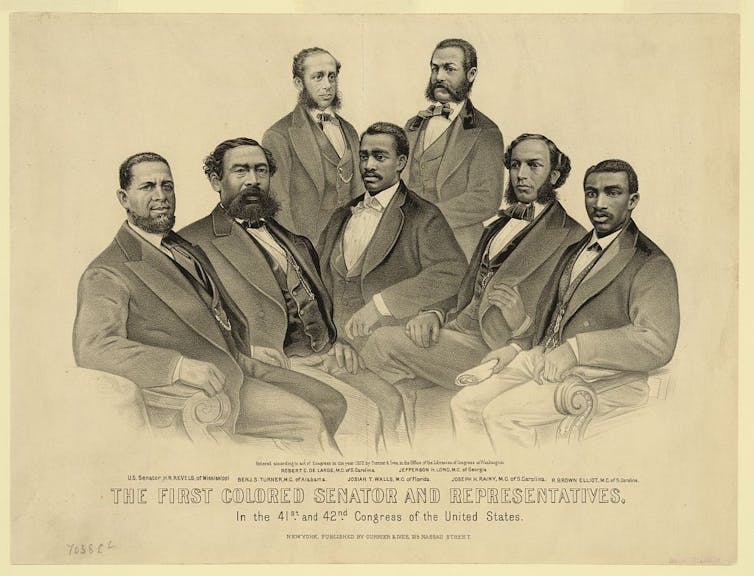
The nation’s first wave of racial gerrymandering emerged as a response to the political gains Southern Black voters made during the administration of President Ulysses S. Grant in the 1870s. Georgia, Alabama, Florida, Mississippi, North Carolina and Louisiana all elected Black congressmen during that decade. During the 42nd Congress, which met from 1871 to 1873, South Carolina sent Black men to the House from three of its four districts.

A group portrait depicts the first Black senator and a half-dozen Black representatives.
The first Black senator and representatives were elected in the 1870s, as shown in this historic print.
Library of Congress

Initially, the white Democrats who ruled the South responded to the rise of Black political power by crafting racist narratives that insinuated that the emergence of Black voters and Black officeholders was a corruption of the proper political order. These attacks often provided a larger cultural pretext for the campaigns of extralegal political violence that terrorized Black voters in the South, assassinated political leaders, and marred the integrity of several of the region’s major elections.

Election changes

Following these pogroms during the 1870s, southern legislatures began seeking legal remedies to make permanent the counterrevolution of “Redemption,” which sought to undo Reconstruction’s advancement of political equality. A generation before the Jim Crow legal order of segregation and discrimination was established, southern political leaders began to disfranchise Black voters through racial gerrymandering.

These newly created Black districts gained notoriety for their cartographic absurdity. In Mississippi, a shoestring-shaped district was created to snake and swerve alongside the state’s famous river. North Carolina created the “Black Second” to concentrate its African American voters to a single district. Alabama’s “Black Fourth” did similar work, leaving African American voters only one possible district in which they could affect the outcome in the state’s central Black Belt.

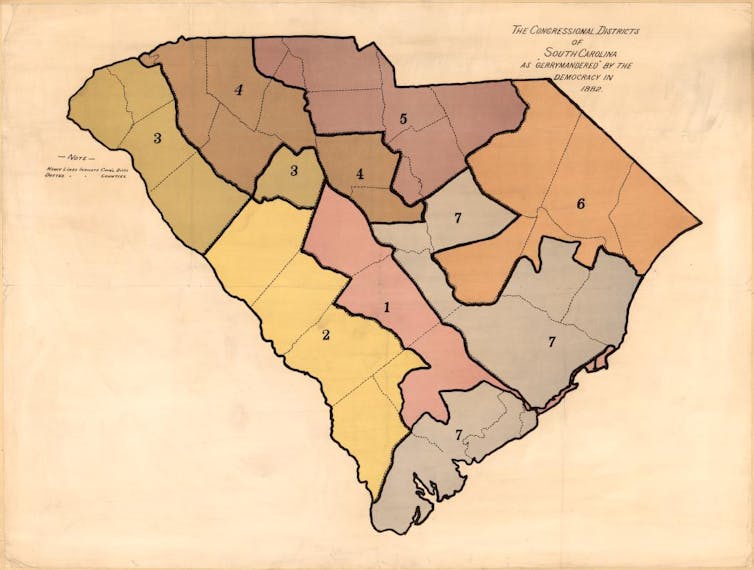
South Carolina’s “Black Seventh” was perhaps the most notorious of these acts of Reconstruction-era gerrymandering. The district “sliced through county lines and ducked around Charleston back alleys” – anticipating the current trend of sophisticated, computer-targeted political redistricting.

Possessing 30,000 more voters than the next largest congressional district in the state, South Carolina’s Seventh District radically transformed the state’s political landscape by making it impossible for its Black-majority to exercise any influence on national politics, except for the single racially gerrymandered district.

A map showing South Carolina's congressional districts in the 1880s.
South Carolina’s House map was gerrymandered in 1882 to minimize Black representation, heavily concentrating Black voters in the 7th District.
Library of Congress, Geography and Map Division

Although federal courts during the late 19th century remained painfully silent on the constitutionality of these antidemocratic measures, contemporary observers saw these redistricting efforts as more than a simple act of seeking partisan advantage.

“It was the high-water mark of political ingenuity coupled with rascality, and the merits of its appellation,” observed one Black congressman who represented South Carolina’s 7th District.

Racial gerrymandering in recent times

The political gains of the Civil Rights Movement of the 1950s and 1960s, sometimes called the “Second Reconstruction,” were made tangible by the 1965 Voting Rights Act. The law revived the postbellum 15th Amendment, which prevented states from creating voting restrictions based on race. That amendment had been made a dead letter by Jim Crow state legislatures and an acquiescent Supreme Court.

In contrast to the post-Civil War struggle, the Second Reconstruction had the firm support of the federal courts. The Supreme Court affirmed the principal of “one person, one vote” in its 1962 Baker v. Carr and 1964 Reynolds v. Sims decisions – upending the Solid South’s landscape of political districts that had long been marked by sparsely populated Democratic districts controlled by rural elites.

The Voting Rights Act gave the federal government oversight over any changes in voting policy that might affect historically marginalized groups. Since passage of the 1965 law and its subsequent revisions, racial gerrymandering has largely served the purpose of creating districts that preserve and amplify the political representation of historically marginalized groups.

This generational work may soon be undone by the current Supreme Court. The court, which heard oral arguments in the Louisiana case in October 2025, will release its decision by the end of June 2026.

The Conversation

Robert D. Bland does not work for, consult, own shares in or receive funding from any company or organization that would benefit from this article, and has disclosed no relevant affiliations beyond their academic appointment.

​Politics + Society – The Conversation

Categories
Uncategorized

Federal power meets local resistance in Minneapolis – a case study in how federalism staves off authoritarianism

Protesters against Immigration and Customs Enforcement march through Minneapolis, Minn., on Jan. 25, 2026. Roberto Schmidt/AFP via Getty Images

An unusually large majority of Americans agree that the recent scenes of Immigration and Customs Enforcement operations in Minneapolis are disturbing.

Federal immigration agents have deployed with weapons and tactics more commonly associated with military operations than with civilian law enforcement. The federal government has sidelined state and local officials, and it has cut them out of investigations into whether state and local law has been violated.

It’s understandable to look at what’s happening and reach a familiar conclusion: This looks like a slide into authoritarianism.

There is no question that the threat of democratic backsliding is real. President Donald Trump has long treated federal authority not as a shared constitutional set of rules and obligations but as a personal instrument of control.

In my research on the presidency and state power, including my latest book with Sidney Milkis, “Subverting the Republic,” I have argued that the Trump administration has systematically weakened the norms and practices that once constrained executive power – often by turning federalism itself into a weapon of national administrative power.

But there is another possibility worth taking seriously, one that cuts against Americans’ instincts at moments like this. What if what America is seeing is not institutional collapse but institutional friction: the system doing what it was designed to do, even if it looks ugly when it does it?

For many Americans, federalism is little more than a civics term – something about states’ rights or decentralization.

In practice, however, federalism functions less as a clean division of authority and more as a system for managing conflict among multiple governments with overlapping jurisdiction. Federalism does not block national authority. It ensures that national decisions are subject to challenge, delay and revision by other levels of government.

Dividing up authority

At its core, federalism works through a small number of institutional mechanics – concrete ways of keeping authority divided, exposed and contestable. Minneapolis shows each of them in action.

First, there’s what’s called “jurisdictional overlap.”

State, local and federal authorities all claim the right to govern the same people and places. In Minneapolis, that overlap is unavoidable: Federal immigration agents, state law enforcement, city officials and county prosecutors all assert authority over the same streets, residents and incidents. And they disagree sharply about how that authority should be exercised.

Second, there’s institutional rivalry.

Because authority is divided, no single level of government can fully monopolize legitimacy. And that creates tension. That rivalry is visible in the refusal of state and local officials across the country to simply defer to federal enforcement.

Instead, governors, mayors and attorneys general have turned to courts, demanded access to evidence and challenged efforts to exclude them from investigations. That’s evident in Minneapolis and also in states that have witnessed the administration’s deployment of National Guard troops against the will of their Democratic governors.

It’s easy to imagine a world where state and local prosecutors would not have to jump through so many procedural hoops to get access to evidence for the death of citizens within their jurisdiction. But consider the alternative.

If state and local officials were barred without consent from seeking evidence – the absence of federalism – or if local institutions had no standing to contest how national power is exercised there, federal authority would operate not just forcefully but without meaningful political constraint.

Protesters fight with law enforcement as tear gas fills the air.
Protesters clash with law enforcement after a federal agent shot and killed a man on Jan. 24, 2026, in Minneapolis, Minn.
Arthur Maiorella/Anadolu via Getty Images

Third, confrontation is local and place-specific.

Federalism pushes conflict into the open. Power struggles become visible, noisy and politically costly. What is easy to miss is why this matters.

Federalism was necessary at the time of the Constitution’s creation because Americans did not share a single political identity. They could not decide whether they were members of one big community or many small communities.

In maintaining their state governments and creating a new federal government, they chose to be both at the same time. And although American politics nationalized to a remarkable degree over the 20th century, federal authority is still exercised in concrete places. Federal authority still must contend with communities that have civic identities and whose moral expectations may differ sharply from those assumed by national actors.

In Minneapolis it has collided with a political community that does not experience federal immigration enforcement as ordinary law enforcement.

The chaos of federalism

Federalism is not designed to keep things calm. It is designed to keep power unsettled – so that authority cannot move smoothly, silently or all at once.

By dividing responsibility and encouraging overlap, federalism ensures that power has to push, explain and defend itself at every step.

“A little chaos,” the scholar Daniel Elazar has said, “is a good thing!”

As chaos goes, though, federalism is more often credited for Trump’s ascent. He won the presidency through the Electoral College – a federalist institution that allocates power by state rather than by national popular vote, rewarding geographically concentrated support even without a national majority.

Partisan redistricting, which takes place in the states, further amplifies that advantage by insulating Republicans in Congress from electoral backlash. And decentralized election administration – in which local officials control voter registration, ballot access and certification – can produce vulnerabilities that Trump has exploited in contesting state certification processes and pressuring local election officials after close losses.

Forceful but accountable

It’s helpful to also understand how Minneapolis is different from the most well-known instances of aggressive federal power imposed on unwilling states: the civil rights era.

Hundreds of students protest the arrival of a Black student to their school.
Hundreds of Ole Miss students call for continued segregation on Sept. 20, 1962, as James Meredith prepares to become the first Black man to attend the university.
AP Photo

Then, too, national authority was asserted forcefully. Federal marshals escorted the Black student James Meredith into the University of Mississippi in 1962 over the objections of state officials and local crowds. In Little Rock in 1957, President Dwight D. Eisenhower federalized the Arkansas National Guard and sent in U.S. Army troops after Gov. Orval Faubus attempted to block the racial integration of Central High School.

Violence accompanied these interventions. Riots broke out in Oxford, Mississippi. Protesters and bystanders were killed in clashes with police and federal authorities in Birmingham and Selma, Alabama.

What mattered during the civil rights era was not widespread agreement at the outset – nationwide resistance to integration was fierce and sustained. Rather, it was the way federal authority was exercised through existing constitutional channels.

Presidents acted through courts, statutes and recognizable chains of command. State resistance triggered formal responses. Federal power was forceful, but it remained legible, bounded and institutionally accountable.

Those interventions eventually gained public acceptance. But in that process, federalism was tarnished by its association with Southern racism and recast as an obstacle to progress rather than the institutional framework through which progress was contested and enforced.

After the civil rights era, many Americans came to assume that national power would normally be aligned with progressive moral aims – and that when it was, federalism was a problem to be overcome.

Minneapolis exposes the fragility of that assumption. Federalism does not distinguish between good and bad causes. It does not certify power because history is “on the right side.” It simply keeps power contestable.

When national authority is exercised without broad moral agreement, federalism does not stop it. It only prevents it from settling quietly.

Why talk about federalism now, at a time of widespread public indignation?

Because in the long arc of federalism’s development, it has routinely proven to be the last point in our constitutional system where power runs into opposition. And when authority no longer encounters rival institutions and politically independent officials, authoritarianism stops being an abstraction.

The Conversation

Nicholas Jacobs does not work for, consult, own shares in or receive funding from any company or organization that would benefit from this article, and has disclosed no relevant affiliations beyond their academic appointment.

​Politics + Society – The Conversation

Categories
Featured Juneau News Juneau Local Juneau Local Ketchikan Local News Feeds Sitka Local Uncategorized

Lawmakers consider changes to public school funding

Representative Andi Story presenting to the House Education Committee, Screengrab courtesy of Gavel Alaska and KTOO

NOTN- A bill heard at 8 A.M this morning would overhaul how public schools are funded by changing how students are counted for state aid.

House Bill 261, rewrites large portions of the state’s public school funding statutes.

“We force school districts to budget in such an irrational way.” Said Representative Andi Story, “This backwards budgeting consumes a great deal of valuable time to reshuffle numbers, from personal experience this causes great pain in the community.”

In the full text of House Bill 261, available on The Alaska State Legislature Website, the measure is intended to stabilize school funding particularly through enrollment declines.

The biggest change in the bill is how Alaska calculates average daily membership, or ADM, which is the student count used to determine state education funding.

According to the Alaska Department of Education and Early Development, the ADM is a count of enrolled K-12 students taken for 20 days ending the last Friday in October of each year, the ADM is adjusted due to a few factors including school size, district cost, and special needs.

Under the bill, districts would generally receive funding based on the higher of their most recent student count or a three-year average.

“Alaska should create a 3 year averaging approach statewide to replace the current Hold Harmless Provision.” Story said during her presentation.

The Hold Harmless Provision currently protects school funding if their ADM drops by 5% or more each year, which allows the previous year’s student count to be used as a base to mitigate a drop in funding.

“It could also provide districts with greater stability and planning.” Story said, “As districts would not be so concerned about unexpected changes in enrollments at the October count period. About 19 states use an approach that either averages, combines or provides the better of multiple years of student counts.”

The bill also alters how districts are funded following school consolidations or closures, it would allow temporary offsets to soften funding losses over a period of several years.

The bill would also restrict districts from reopening schools too quickly after consolidation.

HB 261 also changes or revises how special education funding is calculated, particularly for students who require intensive services.

Using the above 3 year count, districts that identify additional students requiring intensive services midyear would be eligible for retroactive funding.

The bill applies to school districts statewide and does not directly increase the base student allocation, which is the per-student dollar amount set separately by the Legislature.

Categories
Uncategorized

Trump’s climate policy rollback plan relies on EPA rescinding its 2009 endangerment finding – but will courts allow it?

Trucks leave a smoggy Port of Long Beach in 2008, the year before the endangerment finding was released. Luis Sinco/Los Angeles Times via Getty Images

In 2009, the U.S. Environmental Protection Agency formally declared that greenhouse gas emissions, including from vehicles and fossil fuel power plants, endanger public health and welfare. The decision, known as the endangerment finding, was based on years of evidence, and it has underpinned EPA actions on climate change ever since.

The Trump administration now wants to tear up that finding as it tries to roll back climate regulations on everything from vehicles to industries.

But the move might not be as simple as the administration hopes.

An airplane flying over a packed highway with San Diego in the background.
Transportation is the nation’s leading source of emissions, yet the federal government aims to roll back vehicle standards and other regulations written to help slow climate change.
Kevin Carter/Getty Images

EPA Administrator Lee Zeldin sent a proposed rule to the White House Office of Management and Budget in early January 2026 to rescind the endangerment finding. Now, a Washington Post report suggests, action on it may be delayed over concerns that the move wouldn’t withstand legal challenges.

Cracks in the administration’s plan are already evident. On Jan. 30, a federal judge ruled that the Department of Energy violated the law when it handpicked five researchers to write the climate science review that the EPA is using to defend its plan. The ruling doesn’t necessarily stop the EPA, but it raises questions.

There’s no question that if the EPA does rescind the endangerment finding that the move would be challenged in court. The world just lived through the three hottest years on record, evidence of worsening climate change is stronger now than ever before, and people across the U.S. are increasingly experiencing the harm firsthand.

Several legal issues have the potential to stop the EPA’s effort. They include emails submitted in a court case that suggest political appointees sought to direct the scientific review.

To understand how we got here, it helps to look at history for some context.

The Supreme Court started it

The endangerment finding stemmed from a 2007 U.S. Supreme Court ruling in Massachusetts v. EPA.

The court found that various greenhouse gases, including carbon dioxide, were “pollutants covered by the Clean Air Act,” and it gave the EPA an explicit set of instructions.

The court wrote that the “EPA must determine whether or not emissions from new motor vehicles cause or contribute to air pollution which may reasonably be anticipated to endanger public health or welfare.”

But the Supreme Court did not order the EPA to regulate greenhouse gas emissions. Only if the EPA found that emissions were harmful would the agency be required, by law, “to establish national ambient air quality standards for certain common and widespread pollutants based on the latest science” – meaning greenhouse gases.

The Supreme Court justices seated for a formal portrait.
The Supreme Court under Chief Justice John Roberts in 2007 included seven justices appointed by Republican presidents. Front row, left to right: Anthony M. Kennedy (appointed by Ronald Reagan), John Paul Stevens (Gerald Ford), John Roberts (George W. Bush), Antonin Scalia (Reagan) and David Souter (George H.W. Bush). Standing, from left: Stephen Breyer (Bill Clinton), Clarence Thomas (George H.W. Bush), Ruth Bader Ginsburg (Clinton) and Samuel Alito Jr. (George W. Bush).
AP Photo/J. Scott Applewhite

The EPA was required to follow formal procedures – including reviewing the scientific research, assessing the risks and taking public comment – and then determine whether the observed and projected harms were sufficient to justify publishing an “endangerment finding.”

That process took two years. EPA Administrator Lisa Jackson announced on Dec. 7, 2009, that the then-current and projected concentrations of six key greenhouse gases in the atmosphere – carbon dioxide, methane, nitrous oxide, hydrofluorocarbons, perfluorocarbons and sulfur hexafluoride – threatened the public health and welfare of current and future generations.

Challenges to the finding erupted immediately.

Jackson denied 10 petitions received in 2009-2010 that called on the administration to reconsider the finding.

On June 26, 2012, the U.S. Court of Appeals for the D.C. Circuit upheld the endangerment finding and regulations that the EPA had issued under the Clean Air Act for passenger vehicles and permitting procedures for stationary sources, such as power plants.

This latest challenge is different.

It came directly from the Trump administration without going through normal channels. It was, though, entirely consistent with both the conservative Heritage Foundation’s Project 2025 plan for the Trump administration and President Donald Trump’s dismissive perspective on climate risk.

Trump’s burden of proof

To legally reverse the 2009 finding, the agency must go through the same evaluation process as before. According to conditions outlined in the Clean Air Act, the reversal of the 2009 finding must be justified by a thorough and complete review of the current science and not just be political posturing.

That’s a tough task.

Energy Secretary Chris Wright has talked publicly about how he handpicked the five researchers who wrote the scientific research review. A judge has now found that the effort violated the 1972 Federal Advisory Committee Act, which requires that agency-chosen panels providing policy advice to the government conduct their work in public.

All five members of the committee had been outspoken critics of mainstream climate science. Their report, released in summer 2025, was widely criticized for inaccuracies in what they referenced and its failure to represent the current science.

Scientific research available today clearly shows that greenhouse gas emissions harm public health and welfare. Importantly, evidence collected since 2009 is even stronger now than it was when the first endangerment finding was written, approved and implemented.

Map shows many ares with record or near record warm years.
Many locations around the world had record or near-record warm years in 2025. Places with local record warmth in 2025 are home to approximately 770 million people, according to data from Berkeley Earth.
Berkeley Earth, CC BY-NC

For example, a 2025 review by the National Academies of Sciences, Engineering and Medicine determined that the evidence supporting the endangerment finding is even stronger today than it was in 2009. A 2019 peer-reviewed assessment of the evidence related to greenhouse gas emissions’ role in climate change came to the same conclusion.

The Sixth Assessment of the Intergovernmental Panel on Climate Change, a report produced by hundreds of scientists from around the world, found in 2023 that “adverse impacts of human-caused climate change will continue to intensify.”

Maps show most of the US, especially the West, getting hotter, and the West getting drier.
Summer temperatures have climbed in much of the U.S. and the world as greenhouse gas emissions have risen.
Fifth National Climate Assessment

In other words, greenhouse gas emissions were causing harm in 2009, and the harm is worse now and will be even worse in the future without steps to reduce emissions.

In public comments on the Department of Energy’s problematic 2025 review, a group of climate experts from around the world reached the same conclusion, adding that the Department of Energy’s Climate Working Group review “fails to adequately represent this reality.”

What happens if EPA does drop the endangerment finding

As an economist who has studied the effects of climate change for over 40 years, I am concerned that the EPA rescinding the endangerment finding on the basis of faulty scientific assessment would lead to faster efforts to roll back U.S. climate regulations meant to slow climate change.

It would also give the administration cover for further actions that would defund more science programs, stop the collection of valuable data, freeze hiring and discourage a generation of emerging science talent.

Cases typically take years to wind through the courts. Unless a judge issued an injunction, I would expect to see a continuing retreat from efforts to reduce climate change while the court process plays out.

I see no scenario in which a legal challenge doesn’t end up before the Supreme Court. I would hope that both the enormous amount of scientific evidence and the words in the preamble of the U.S. Constitution would have some significant sway in the court’s considerations. It starts, “We the People of the United States, in Order to form a more perfect Union,” and includes in its list of principles, “promote the general Welfare.”

The Conversation

Gary W. Yohe does not work for, consult, own shares in or receive funding from any company or organization that would benefit from this article, and has disclosed no relevant affiliations beyond their academic appointment.

​Politics + Society – The Conversation

Categories
Uncategorized

Suspending family-based immigrant visas weakens US families and the economy

The United States has paused immigrant visa processing for 75 countries. Photo by Ufuk Celal Guzel/Anadolu via Getty Images

The U.S. Department of State has announced that starting on Jan. 21, 2026, it has indefinitely stopped issuing immigrant visas for people from 75 countries, claiming concerns that some immigrants may rely on public benefits once they get to the United States.

While applications may still be processed, no immigrant visas will be issued during the pause, including family-based visas for U.S. citizens to sponsor their parents.

This focus leaves little room for recognizing the unpaid caregiving and everyday family support provided by immigrant parents already living in the U.S., support that allows others, including their U.S. citizen children, to remain employed and households to stay stable.

Family-based immigration, particularly visas that allow U.S. citizens to sponsor their parents, strengthens social capital: the networks of care and shared responsibility that allow people to work, stay healthy and raise children who become productive members of society. Weakening these networks risks undermining the social foundations of long-term economic growth.

As a scholar who studies family relationship dynamics and social capital, I have observed how these family ties are not simply private family matters but a public good that sustains community well-being. When parents are present, families are better able to share child care, navigate illness and remain economically active.

Family reunification as social infrastructure

The United States offers no national paid family leave, unlike countries such as Finland and Hungary, which guarantee paid time off to care for children, aging parents or ill family members. Instead, the U.S. provides only unpaid leave under federal law.

Consequently, many families rely on informal caregiving to balance work and care. Research shows that when adequate support is unavailable, workers, especially parents, are more likely to reduce hours or leave the labor force altogether.

This strain is widespread across the U.S.: Roughly 63 million Americans, nearly 1 in 4 adults, provide unpaid care for a family member with a serious health condition or disability, in addition to unpaid child care.

A man's hands rest on top of a podium.
The State Department has raised concerns that some immigrants may rely on public benefits once they get to the U.S.
Photo by Mandel NGAN / AFP via Getty Images

Sponsored immigrant parents often become part of this informal care system. They provide child care, prepare meals and supervise children.

In many U.S. states, the cost of child care now exceeds in-state college tuition, pushing families to reduce formal care or rely on relatives.

Family reunification, therefore, functions as social infrastructure, filling gaps that markets and public systems do not, a role family scholars have emphasized.

Decades of research illustrates this dynamic. In their book “Immigrant America,” sociologists Alejandro Portes and Rubén G. Rumbaut show that immigrant families often rely on close family ties when government support is limited.

Families also pool resources by living together and combining time, skills and income to cover basic needs. These arrangements help households cope with job instability, illness and long work hours. They also reduce reliance on formal child care and paid domestic labor.

Economic development does not happen in isolation from family life. The Organization for Economic Co-operation and Development’s framework on measuring well-being emphasizes that economic performance, health, social connections and family support are interconnected rather than separate policy domains. When people are supported and less stressed, they are healthier and more productive.

Sociologist James Coleman similarly has noted that children raised in stable, supportive households are more likely to succeed in school and contribute meaningfully as adults. Family reunification, therefore, is an investment in the social relationships that underpin economic prosperity.

Social capital and child development

Immigrant grandparents and extended kin often play an active role in children’s lives. They help with learning, language development and daily routines.

This kind of family involvement also helps explain what scholars call the “immigrant paradox,” in which many immigrant children achieve better-than-expected academic and emotional results despite socioeconomic challenges.

As of 2023, about 19 million U.S. children, roughly 1 in 4, have at least one parent who is an immigrant. Therefore, policies that restrict family reunification shape the everyday environments in which millions of children grow up. This influences the support they receive at home and the workforce they will help build as adults.

Social capital is not public dependency

Concerns raised by federal policymakers that immigrants will become a “burden on taxpayers” shape restrictions on family-based immigration. These concerns are reflected in federal policy through the Department of Homeland Security’s public charge rule, which allows immigration officials to assess whether applicants are likely to rely primarily on government assistance such as cash welfare or long-term public support for basic needs.

However, analyses of 2022 U.S. Census data show that immigrants overall use public assistance at lower rates than native-born Americans.

In practice, family reunification is less about public dependency and more about sustaining the relationships that allow families and the economy to function.

The question for policymakers is not whether the U.S. can afford to support family reunification, but whether it can afford not to. In a country facing caregiver shortages, rising parental stress and limited public care infrastructure, investing in social capital through family reunification may be one of the most effective and overlooked ways to support long-term economic growth.

The Conversation

Sothy Eng does not work for, consult, own shares in or receive funding from any company or organization that would benefit from this article, and has disclosed no relevant affiliations beyond their academic appointment.

​Politics + Society – The Conversation

Categories
Uncategorized

I’m a former FBI agent who studies policing, and here’s how federal agents in Minneapolis are undermining basic law enforcement principles

U.S. Border Patrol agents stand guard at the Bishop Henry Whipple Federal Building in Minneapolis, Minn., on Jan. 8, 2026. Charly Triballeau/AFP via Getty Images

The Trump administration says federal agents have “absolute immunity” from prosecution in Minneapolis. Department of Justice and Homeland Security officials have indicated that criminal investigations into the killings by immigration agents of Minneapolis protesters Renee Good and Alex Pretti are inappropriate, declaring that both were domestic terrorists.

The killing of Good and Pretti raises legal, tactical and policy questions regarding law enforcement practices by federal agents.

In December 2025, the Department of Homeland Security launched “Operation Metro Surge” to enforce immigration laws in Minneapolis. The operation is being conducted by federal agents with the U.S. Immigration and Customs Enforcement and the U.S. Customs and Border Protection. One of the stated goals of Metro Surge is to arrest the “worst of the worst criminal illegal aliens.”

Metro Surge has also affected the lives of U.S. citizens, including citizens protesting immigration enforcement efforts. On Jan. 7, 2026, Good – a 37-year-old U.S. citizen and mother of three – was shot and killed in her vehicle by an ICE agent on a residential street in Minneapolis. On Jan. 24, 2026, CBP agents shot and killed 37-year-old Pretti, a U.S. citizen, on a public street in Minneapolis.

As a policing scholar and former FBI special agent, I believe these cases illustrate how some federal agents are engaging with the public in a way that undermines established principles of policing and constitutional law.

Law of deadly force

The Fourth Amendment to the U.S. Constitution protects the “right of the people to be secure in their persons … against unreasonable … seizures.” A law enforcement officer’s use of force – including deadly force – is considered in law to be a seizure and must be reasonable.

In the 1989 decision Graham v. Connor, the U.S. Supreme Court construed the objective “reasonableness” of force based upon “the perspective of a reasonable officer on the scene, rather than with the 20/20 vision of hindsight.” The court explained “reasonableness” in light of the idea that police officers must sometimes make “split-second” judgments.

In Tennessee v. Garner, the Supreme Court in 1985 established that the use of deadly force to prevent the escape of a fleeing suspect is unreasonable unless the suspect poses a significant threat of death or serious physical injury to the officer or others.

These legal principles form the basis of DHS deadly force policy, which is similar to the policy I followed as an FBI agent: Law enforcement officers, or LEOs, “may use deadly force only when the LEO has a reasonable belief that the subject of such force poses an imminent threat of death or serious bodily injury to the LEO or to another person.”

The legal question raised by the Good and Pretti killings is whether the officers had a reasonable belief that Good and Pretti posed an imminent threat of death or serious bodily injury to the officers.

Moments before the ICE agent killed Good, the agent walked around Good’s parked vehicle filming Good with his phone in one hand. Good, sitting behind the wheel in her car, says “That’s fine dude, I’m not mad at you.”

As the shooting agent positions himself in front of Good’s vehicle, a second agent walks quickly toward Good’s vehicle and tries to open the door and reach inside. Good turns her steering wheel and tries to drive away – what a law enforcement agent could interpret as potentially an act of fleeing. The agent in front of Good’s vehicle shoots Good three times as she drives by him. He then mutters, “f-cking b-tch,” and walks away from Good’s crashed vehicle. There is dispute about whether Good’s vehicle grazed the agent.

Moments before Pretti was killed by federal agents, he was standing in a public street when agents approached him and sprayed him with a chemical agent. Pretti’s hands are visible and show that he is holding a cellphone.

The agents wrestle Pretti to the ground and repeatedly beat him with an object. Pretti is not seen brandishing a firearm. However, an agent approaches Pretti during the scuffle and appears to remove a firearm from Pretti’s waistband. Shortly thereafter, agents shoot Pretti 10 times. Pretti had kicked the taillight of a law enforcement vehicle – and was then tackled and tear-gassed by agents – 11 days before he was killed.

Some former federal prosecutors argue that these facts in the Good and Pretti cases warrant a thorough criminal investigation regarding whether federal agents illegally used lethal force in the killings. The central legal question is whether the evidence shows that the agents reasonably feared for their lives, or whether they acted unlawfully out of anger, frustration, retaliation or some other unjustified mental state.

Tactics, policy and split-second decisions

Beyond legal questions, Operation Metro Surge raises tactical and policy questions about DHS law enforcement practices.

State, local and federal law enforcement officers are required to follow firearms safety rules. While training at the FBI Academy at Quantico, I was required to learn and follow the cardinal safety rules, which include (1) treating all firearms as loaded, (2) keeping firearms pointed in a safe direction and (3) keeping one’s finger off the trigger until one is ready to press it.

These rules help keep officers and the public safe, including by preventing unintentional discharges of firearms.

There were multiple bystanders and officers in the immediate vicinity of both the Good and the Pretti shootings. That raised risks associated with unintentional discharges and jeopardizing officers’ ability to meet the requirement to respect human life.

DHS officers specifically are also required to “employ tactics and techniques that effectively bring an incident under control while promoting the safety of LEOs and the public,” which includes avoiding “intentionally and unreasonably placing themselves in positions in which they have no alternative to using deadly force.”

In both the Good and the Pretti cases, federal agents placed themselves in poor tactical positions that increased the likelihood of using deadly force.

When feasible, DHS agents are required to issue a verbal warning to comply with the agent’s instructions. Agents rushed to physically remove Good from her vehicle and similarly rushed to push Pretti off the street and then spray him with a chemical agent. There is reason to think the agents could have taken a more measured, composed and communicative approach to de-escalate the situation.

These tactical and policy principles reveal that the legal analysis of an agent’s “split-second” decision to use deadly force is not the only issue raised by these cases. Analysis of the seconds and minutes leading to the use of force is also crucial.

Many people in the nighttime standing next to a memorial of candles and signs about the killing of Alex Pretti.
Mourners placed candles at a memorial to Alex Pretti on Nicollet Ave. in Minneapolis, Jan. 24, 2026.
Jeff Wheeler/The Minnesota Star Tribune

Warriors in the community

ICE and CBP federal agents are not police officers. However, they are law enforcement officers engaged in policing. Operation Metro Surge has made these agents highly visible.

Instead of the more traditional, methodical and long-term investigations they normally conduct, federal agents are now routinely taking on more of a traditional police role in the public eye. This role ranges from managing traffic violations to maintaining order during chaotic public protests.

Although the surge has brought these agents closer to a traditional police role, they are pursuing a militarized warrior model of policing.

Masked federal agents in tactical gear roaming the streets of Minneapolis blur the line between civilian and military policing. Coupled with events such as the killings of Good and Pretti, it is unsurprising that public trust is eroding not only in federal law enforcement agencies such as ICE but also in police departments generally.

Policing is difficult work under any circumstance. If federal agents continue to increase their interactions with the public, I believe they will need to embrace tactics from community policing and what is called procedurally just models of policing. These models emphasize building popular legitimacy by reinforcing relationships – through honest cooperation and partnership between law enforcement officers and the public.

The rule of law

Publicly available facts and evidence raise significant questions about whether federal agents acted contrary to established principles of policing and constitutional law in the deaths of Good and Pretti.

The rule of law is a cornerstone of liberal democracies that limits the exercise of discretionary or arbitrary power by government officials. This idea includes holding officials accountable when there is evidence of unauthorized uses of power. A thorough investigation into DHS tactics, I believe, is necessary to preserve the rule of law.

The Conversation

Luke William Hunt does not work for, consult, own shares in or receive funding from any company or organization that would benefit from this article, and has disclosed no relevant affiliations beyond their academic appointment.

​Politics + Society – The Conversation

Categories
Uncategorized

From Colonial rebels to Minneapolis protesters, technology has long powered American social movements

Technology doesn’t create social movements, but it can supercharge them. Arthur Maiorella/Anadolu via Getty Images

Tens of millions of Americans have now seen video of the killings of Renee Good and Alex Pretti at the hands of federal agents in Minneapolis. The activities organized in response have not been initiated by outside agitators or left-wing zealots, but, rather, by everyday Americans protesting the tactics of federal agents in that city.

These community members are communicating over encrypted messaging apps such as Signal and using their cellphones to record Immigration and Customs Enforcement and Border Patrol officers. Some have been using apps such as ICEBlock to help monitor ICE activities. They are using 3D printers to mass-produce whistles for community members to blow to alert each other when federal agents are in the area.

While the technology in some of these instances is new, this pattern – grassroots activists using the latest technology literally at their fingertips – is older than the republic itself. As a legal scholar who has studied American social movements and their relationship to technology, I see that what regular Americans in Minneapolis are doing is part of a very American tradition: building on trusted interpersonal relationships by harnessing the most recent technology to supercharge their organizing.

a smartphone displaying a map
The app ICEBlock helps communities share information about the presence of federal officers in their areas. The Apple and Google app stores removed the app in October 2025 at the Trump administration’s request.
Justin Sullivan/Getty Images

From Colonial era to the Civil Rights Movement

As the first stirrings of the American revolutionary spirit emerged in the 1770s, leaders formed the committees of correspondence to coordinate among the Colonies and in 1774 formed the Continental Congress. They harnessed the power of the printing press to promote tracts such as Thomas Paine’s Common Sense. One of the first acts of the new Congress was to create what it called the Constitutional Post, a mail system from the Maine territories to Georgia that enabled the colonists to communicate safely, out of reach of loyalist postmasters.

And the date Americans will be celebrating in 2026 as the 250th anniversary of the United States, July 4, commemorates when the drafters of the Declaration of Independence sent the final document to John Dunlap, rebel printer. In other words, what we celebrate as the birth of our nation is when the founders pressed “send.”

In the 1830s, as the battle over slavery in the new nation began to emerge, a new type of printing press, one powered by steam, helped supercharge the abolitionist movement. It could print antislavery broadsides much more rapidly and cheaply than manual presses.

The introduction of the telegraph in 1848 helped launch the women’s rights movement, spreading word of its convention in Seneca Falls, New York, while similar meetings had not quite caught the public’s imagination.

Fast-forward over 100 years in U.S. history to the Civil Rights Movement. Leaders of that movement embraced and harnessed the power of a new technology – television – and worked to create opportunities for broadcast media to beam images of authorities attacking young people in Birmingham, Alabama, and marchers on the Edmund Pettus Bridge outside Selma, Alabama, into living rooms across the United States. The images galvanized support for legislation such as the Civil Rights Act and the Voting Rights Act.

Social movements today

Today, new technologies and capabilities such as the smartphone and social media are making it easier for activists – and even those who have never seen themselves as activists – to get involved and help their neighbors. But it’s important not to mistake the method of communication for a movement. Indeed, without people behind the smartphones or as members of a group chat, there is no movement.

And what is happening in Minneapolis and in places across the country is still people organizing. Mutual aid networks are sprouting up nearly everywhere that immigration enforcement agents are amassed to carry out the Trump administration’s deportation policies, helped but not supplanted by technology. These technologies are important tools to support and catalyze the on-the-ground work.

Minnesotans have been using 3D printers to mass-produce whistles for alerting each other to the presence of federal agents.

It’s also important for advocates and would-be advocates to know the limits of such technologies and the risks that they can pose. These tools can sap a movement of energy, such as when someone posts a meme or “likes” a message on a social media platform and thinks they have done their part to support a grassroots effort.

There are also risks with any of these digital technologies, something the founders realized when they created their independent postal system. That is, use of these tools can also facilitate surveillance, expose networks to disruption and make people vulnerable to doxing or worse: charges that they are aiding and abetting criminal behavior.

Technology and trust

Most importantly, while technological tools might facilitate communication, they are no substitute for trust, the type of trust that can be forged only in face-to-face encounters. And that’s another thing that activists across American history have known since before the nation’s founding.

Until the late 1960s, groups participating in the work of democracy have often formed themselves into what political scientist Theda Skocpol calls “translocal networks”: collectives organized into local chapters connected to state, regional and even national networks.

It was in those local chapters where Americans practiced what French aristocrat Alexis de Tocqueville described in his visit to the United States in the 1830s as uniquely American: the “infinite art” of association and organizing. Americans used this practice to solve all manner of local problems. The local manifestations of those groups would often then engage in larger campaigns, whether to promote women’s rights in the 19th century or civil rights in the 20th.

Today’s technologies are reigniting the kind of grassroots activism that is deeply rooted in trust and solidarity, one block, one text message, one video at a time. It is also a profoundly American method of protest, infused with and catalyzed – but not replaced – by the technology such movements embrace.

The Conversation

Ray Brescia does not work for, consult, own shares in or receive funding from any company or organization that would benefit from this article, and has disclosed no relevant affiliations beyond their academic appointment.

​Politics + Society – The Conversation