NOTN- The City and Borough of Juneau survey seeking public input on how to address a projected $10 million budget gap has officially closed, but now the Assembly is preparing for a series of community workshops to further guide its decisions this tense budget season.
The survey, asked residents to weigh in on municipal services and identify what they value most as the Assembly begins work on the fiscal year 2027 budget.
Assembly Member Neil Steininger said the city faces a significant revenue shortfall following voter-approved ballot measures that eliminated sales tax on food and capped the local mill rate. The changes reduced revenue and left the Assembly with the task of determining how to maintain services with less funding.
“We got that message from the voters that, they wanted lower taxes. We need to figure out how to make that work and how to deliver city services, and we’re really looking for information from the voters to understand what their priorities are for what they see from government here in Juneau.” He said. “It is very difficult to make these decisions, which is something that we want to impress to people.”
Detailed reports from the survey are expected in the coming weeks.
“I think that’s just a really important thing for everyone to do, especially in a community like Juneau that’s so small and so closed, I think it’s important that people actively voice what they want prioritized in our city, so that the assembly can use that information to better inform their decision making.” Steininger said.
In addition to the survey, the city is hosting three in-person Community Compass workshops This month and early March. During the 60- to 90-minute sessions, participants will work through mock budgeting scenarios and discuss how to respond to unexpected financial changes.
“now it’s your turn to put yourself in an assembly member’s shoes and actively decide the city budget and then react to unforeseen circumstances that will ask you to reallocate certain pieces of the budget accordingly.” Steininger said.
Input gathered at the workshops will be shared with the Assembly as it moves deeper into the budgeting process this spring.
The workshops are scheduled for Feb. 18 at the Filipino Community Hall, Feb. 24 at Mendenhall Valley Public Library and March 3 at Douglas Public Library.
“Are you a white male who has experienced discrimination at work based on your race or sex? You may have a claim to recover money under federal civil rights laws. Contact the @USEEOC as soon as possible,” she wrote in a post on X.
In February 2026, the EEOC began to investigate Nike on what the agency said was suspicion of discrimination against white workers.
Both initiatives followed the EEOC’s March 2025 characterization of diversity, equity and inclusion efforts, or DEI, as potentially discriminatory against white men. The EEOC characterization falls within the Trump administration’s larger pattern of calling DEI “illegal discrimination.”
Given the EEOC’s December 2025 solicitation for white men to file discrimination complaints, we revisited our prior research to see what is known about discrimination against white people and, in particular, what is known about white and white male discrimination charges registered with the EEOC.
As part of our research, the EEOC gave us access to discrimination charges submitted to the agency and state Fair Employment Practices Agencies from 2012 to 2016. By law, all U.S. employment discrimination claims must be submitted to the EEOC, or state agencies with equivalent roles, prior to any legal actions.
While the EEOC has a history of sharing its data with researchers stretching back to the 1970s, the EEOC stopped sharing current and historical data with researchers in 2016. As a result, we do not have any data on discrimination complaints after 2016. Judging by the EEOC’s yearly reports, the basic patterns have not changed much in the interim.
White men already file complaints
When we looked at all sex- and race-based discrimination charges received by the EEOC, unsurprisingly we found that men are much less likely than women to file sex-based discrimination charges. But white men do file about 10% of sex discrimination complaints. While Black, Hispanic and Asian male employees are more likely to file racial discrimination complaints, white men file about 9% of such complaints.
In the same study, when we compared legal charges filed with the EEOC to national survey data, we found that percentages submitting a legal complaint to the EEOC roughly correspond to the percentages of survey-reported experiences of discrimination at work. Together, these two findings suggest that white people generally, and white men in particular, were already filing employment discrimination charges.
EEOC chair Andrea Lucas in December 2025 encouraged white men to file more discrimination complaints against their employers. AP Photo/Mariam Zuhaib, File
Second, we did a deeper dive on sexual harassment charges. We found that while white men were 46% of the labor force, they filed 11% of sexual harassment charges and 11% of all other charges, most commonly tied to disability and age.
The general pattern is that, while white men already file discrimination charges, they are less likely to experience employment discrimination than other groups.
The risk of filing complaints
Charges filed with the EEOC can result in two types of benefits to the charging party: monetary settlements and mandated changes in workplace practices.
White men who filed sexual harassment charges received some benefit 21% of the time, lower than white women, at 29%. That’s also lower than Black women, 23%, and higher than Black men, 19%. The EEOC already receives discrimination charges from white men and, at least for sexual harassment, treats them similarly to other groups.
Most people who submit a discrimination charge do so to improve their employment experience and those of their co-workers. But submitting these claims to the EEOC or a state Fair Employment Practices Agency is a high-risk, low-reward act.
We found that, at least for sexual harassment, employers responded to white men’s complaints in much the same way as to other groups. White men who filed sexual harassment discrimination charges lost their job 68% of the time and experienced employer retaliation at about the same rate. Retaliation can include firing but also other forms of harassment at work, such as abusive supervision and close monitoring by human resource departments.
The Nike logo is shown on a store in Miami Beach, Fla., on Aug. 8, 2017. AP Photo/Alan Diaz, File
We found this pattern of employer retaliation and worker firings for all demographic groups that file any type of discrimination complaint. White men who file discrimination charges receive the same harsh treatment from their employers as any other group.
Urging more white men to submit discrimination complaints based on the perceived unfairness of DEI practices, as the EEOC has done, is likely to lead to job loss and retaliation from employers.
What will happen?
It’s possible that EEOC chair Lucas’ call for more discrimination charges from white men will increase the number of filings.
This is exactly what happened after 2012 when the EEOC ruled that the 1964 Civil Rights Act’s prohibition of sex discrimination also protected LGBTQ workers from sexual-orientation and gender-identity discrimination.
More concerning is the EEOC defining employer efforts to prevent discrimination and create inclusive workplaces as discrimination against white men.
In the end, all workers want to be treated fairly and with respect. Employer efforts to create such workplaces should be supported. It would be a better use of EEOC resources to support companies’ efforts to create such workplaces.
When this research was completed the authors received funding from the W.K.Kellogg Foundation, the U.S. National Science Foundation, and the U.S. Department of Labor.
When this research was completed the author received funding from the U.S. National Science Foundation, and the U.S. Department of Labor.
Georgia General Election 2020 ballots are loaded by the FBI onto trucks at the Fulton County Election hub on Jan. 28, 2026, in Union City, Ga.AP Photo/Mike Stewart
What if a determined executive branch used federal law enforcement to seize election materials to sow distrust in the results of the 2026 midterm congressional elections?
Courts and states should be wary when an investigation risks commandeering the evidence needed to ascertain election results. That is where a largely forgotten Supreme Court case from the 1970s matters, a case about an Indiana recount that sets important guardrails to prevent post-election chaos in federal elections.
The day after Election Day in 1970, votes were very close in the Indiana election for U.S. Senate. A challenge to the outcome would lead to an important U.S. Supreme Court case. The Purdue Exponent, Nov. 4, 1970
Congress’s constitutionally-delegated role
The case known as Roudebush v. Hartke arose from a razor-thin U.S. Senate race in Indiana in 1970. The ballots were cast on Election Day, and the state counted and verified the results, a process known as the “canvass.” The state certified R. Vance Hartke as the winner. Typically, the certified winner presents himself to Congress, which accepts his certificate of election and seats the member to Congress.
The losing candidate, Richard L. Roudebush, invoked Indiana’s recount procedures. Hartke then sued to stop the recount. He argued that a state recount would intrude on the power of each chamber, the Senate or the House of Representatives, to judge its own elections under Article I, Section 5 of the U.S. Constitution. That clause gives each chamber the sole right to judge elections. No one else can interfere with that power.
Hartke worried that a recount might result in ballots that could be altered or destroyed, which would diminish the ability of the Senate to engage in a meaningful examination of the ballots if an election contest arose.
But the Supreme Court rejected that argument.
It held that a state recount does not “usurp” the Senate’s authority because the Senate remains free to make the ultimate judgment of who won the election. The recount can be understood as producing new information – in this case, an additional set of tabulated results – without stripping the Senate of its final say.
Furthermore, there was no evidence that a recount board would be “less honest or conscientious in the performance of its duties” than the original precinct boards that tabulated the election results the first time around, the court said.
A state recount, then, is perfectly acceptable, as long as it does not impair the power of Congress.
At the same time, each chamber of Congress judges its own elections, and courts and states should not casually interfere with that core constitutional function. They cannot engage in behaviors that usurp Congress’s constitutionally-delegated role in elections.
Each chamber of Congress judges its own elections, with no interference by courts and states with that core constitutional function. David Shvartsman, Moment/Getty Images
Those items are not just evidence. They are also the raw materials for the canvassing of votes and certification of winners. They provide the foundation for audits and recounts. And, importantly, they are necessary for any later inquiry by Congress if a House or Senate race becomes contested.
That overlap creates a structural problem: If a federal investigation seizes, damages, or destroys election materials, it can affect who has the power to assess the election. It can also inject uncertainty into the chain of custody: Because ballots are removed from absentee envelopes or transferred from Election Day precincts to county election storage facilities, states ensure the ballots cast on Election Day are the only ones tabulated, and that ballots are not lost or destroyed in the process.
Disrupting this chain of custody by seizing ballots, however, can increase, rather than decrease, doubts about the reliability of election results.
That is the modern version of “usurpation.”
From my perspective as an election law scholar, Roudebush is a reminder that courts should be skeptical of executive actions that shift decisive control over election proof away from the institutions the Constitution expects to do the judging.
Congress doesn’t just adjudicate contests
Congressional election observers were sent to Iowa in 2024 to monitor a recount. Fox News
There is another institutional reason courts should be cautious about federal actions that seize or compromise election materials: The House already has a long-running capacity to observe state election administration in close congressional races.
The program exists for a straightforward reason: If the House may be called upon to judge a contested election under Article I, Section 5, it has an institutional interest in understanding how the election was administered and how records were handled.
That observation function is not hypothetical. The committee has publicly announced deployments of congressional observers to watch recount processes in tight House races throughout the country.
I saw it take place first-hand in 2020. The House deployed election observers in Iowa’s 2nd Congressional District to oversee a recount of a congressional election that was ultimately certified by a margin of just six votes.
Democratic and Republican observers from the House politely observed, asked questions, and kept records – but never interfered with the state election apparatus or attempted to lay hands on election equipment or ballots.
Congress has not rejected a state’s election results since 1984, and for good reason. States now have meticulous recordkeeping, robust chain-of-custody procedures for ballots, and multiple avenues of verifying the accuracy of results. And with Congress watching, state results are even more trustworthy.
When federal investigations collide with election materials
Evidence seizures can adversely affect election administration. So courts and states ought to be vigilant, enforcing guardrails that help respect institutional boundaries.
To start, any executive branch effort to unilaterally inject itself into a state election apparatus should face meaningful scrutiny. Unlike the Fulton County warrant, which targeted an election nearly six years old, warrants that interrupt ongoing state processes in an election threaten to usurp the constitutional role of Congress. And executive action cannot proceed if it impinges upon the ultimate ability of Congress to judge the election of its members.
In the exceedingly unlikely event that a court issues a warrant, a court should not permit seizure of election equipment and ballots during a state’s ordinary post-election canvass. Instead, inspection of items, provision of copies of election materials, or orders to preserve evidence are more tailored means to accomplish the same objectives. And courts should establish clear chain-of-custody procedures in the event that evidence must be preserved for a future seizure in a federal investigation.
The fear driving much public commentary about the danger to midterm elections is not merely that election officials will be investigated or that evidence would be seized. It is that investigations could be used as a pretense to manage or, worse, disrupt elections – chilling administrators, disorganizing record keeping or manufacturing doubt by disrupting custody of ballots and systems.
Roudebush provides a constitutional posture that courts should adopt, a recognition that some acts can usurp the power of Congress to judge elections. That will provide a meaningful constraint on the executive ahead of the 2026 election and reduce the risk of intervention in an ongoing election.
Derek T. Muller does not work for, consult, own shares in or receive funding from any company or organization that would benefit from this article, and has disclosed no relevant affiliations beyond their academic appointment.
Hoping to preserve his narrow majority, U.S. House Speaker Mike Johnson campaigned alongside Matt Van Epps, who narrowly won a December 2025 special election in a strongly Republican district in Tennessee.AP Photo/John Amis
On Feb. 7, 2026, Chasity Verret Martinez won a special election to fill a vacant seat in the Louisiana House. That’s an outcome that might not mean very much to people outside of the state or even outside her Baton Rouge-area district.
Because fewer people turn out for special elections, they’re considered an early predictor of partisan enthusiasm heading into regularly scheduled elections. And with the 2026 midterm elections less than nine months away, analysts are already scrambling for indications of the likely outcome.
As a political scientist who studies congressional elections, I’m interested in the question of whether special elections can really tell us which way the political winds are currently blowing.
In the 2026 election cycle, as in previous ones, prognosticators and political professionals are looking to the outcomes of these intermittent races at various levels of government as a gauge of how voters are feeling about the two parties. And the results from the first 15 months of the second Trump administration appear to spell very bad news for the Republicans.
Setting a baseline
Since Election Day 2024, 88 special elections featuring candidates from both major parties have taken place for institutions including state legislatures and the U.S. House.
When analyzing the results of these races, it’s important to have figures to compare them to. After all, a Democrat just barely squeaking by in a state legislative race may not look very impressive on its face – but if that race took place in the rural heart of a red state, it could raise hackles among Republicans.
New York Democrat Hakeem Jeffries would likely become the first Black U.S. speaker of the House if Democrats win a majority in 2026. AP Photo/Rod Lamkey
Most political analysts agree that the best available comparison point for special elections are the results for the most recent presidential election in that same district. There are a few reasons for this.
Second, using presidential results creates the same baseline for all races. By comparing special election results to the prior election environment, all the special election results get compared to the same standard.
Finally, and perhaps most importantly, recent midterm elections have typically served as a referendum on the party in power, particularly the president. In trying to measure how voters are reacting to Trump’s second term, it makes sense to measure their behavior against the last time Trump was on the ballot.
Conversely, in 2018 – like this year, a midterm following a Trump election – Democrats bested Republicans by 8 percentage points in November, after overperforming Hillary Clinton’s 2016 margins in special elections throughout the previous two years by 9 percentage points on average.
The 2024 cycle is a clear exception to this pattern of regular elections closely following special election results: Prior to the presidential election, Democrats outperformed in special elections by an average of 4 percentage points but ended up losing nationally by 3 percentage points in November.
Like special elections, midterm contests tend to turn out fewer but more engaged voters than presidential years. Therefore, it may be that special elections are more predictive of midterm results than presidential cycles. At any rate, if previous midterm outcomes are any guide, the numbers being posted by Democrats in special elections so far in the 2026 cycle are impossible to ignore.
On average, they’re running ahead of Harris’s 2024 margins by a whopping 13 percentage points. That’s better than they did in 2018, when they ultimately picked up 40 seats in the House and seven governorships across the country.
What’s different about specials?
Democrats, however, may not want to pop the champagne corks just yet. Many roadblocks remain in their quest to take back control of Congress. For one thing, the U.S. Senate map remains a difficult one for Democrats. Even if they end up creating a 2018-like election environment with an unpopular president, many Senate contests are taking place in solidly red states.
It’s also always worth bearing in mind that there’s no telling how the events of the next nine months might reshape public opinion.
U.S. Sen. Susan Collins of Maine has proved an elusive target for Democrats in a state they carry at the presidential level. AP Photo/J. Scott Applewhite
And special elections, while useful metrics, are far from perfect barometers of public opinion. They take place at different times, and could be just as reflective of hyperlocal factors, such as flawed candidates, as they are of nationalized partisan conditions.
Special elections tend to have far lower turnout than regular midterm or presidential contests. It’s also difficult to tell whether overperformance is due to highly motivated partisans or persuasion of independents and voters from the other party.
Using all the tools available
Still, special elections do have key advantages over traditional polling. Although polls do their best to approximate voters’ political attitudes, elections reveal these attitudes through voters’ actual, observed behavior – exactly the type of behavior that analysts are trying to predict in November.
In the end, special elections are just one piece of the prediction puzzle. But the other puzzle pieces are also spelling out potential bad news for the GOP.
The generic ballot, a standard polling question that asks voters’ intent to vote for one party or the other in November without naming specific candidates, has the GOP about 6 percentage points behind the Democrats. Trump’s approval rating, meanwhile, continues to hover below 40%.
There’s no telling for sure whether these indicators will turn out to be truly predictive until November. But all of them should be sounding alarm bells for Republicans.
Charlie Hunt does not work for, consult, own shares in or receive funding from any company or organization that would benefit from this article, and has disclosed no relevant affiliations beyond their academic appointment.
The House has passed a new version of an election security bill, but it faces an uphill climb in the Senate.Getty Images/Apu Gomes
The Republican-led House of Representatives voted Feb. 11, 2026 to approve the Safeguard American Voter Eligibility Act – or SAVE America Act. The bill would require individuals to provide proof of citizenship when they register to vote and present photo identification when they do vote in federal elections.
This marks the third year in a row that the House has passed similar legislation. Passage in the Senate, which would require Democratic votes, continues to appear unlikely. But Republicans from President Donald Trump on down are clearly interested in finding ways to enhance election security – although critics contend the SAVE America Act would unfairly disenfranchise millions of citizens.
The SAVE America Act would require anyone registering to vote in federal elections to first “provide documentary proof of U.S. citizenship” in person, such as a passport or birth certificate. The new version goes further than its predecessor by requiring many individuals voting in federal elections to present photo identification at the polls indicating proof of U.S. citizenship.
Voting rights experts and advocacy organizations have detailed how the legislationcould suppress voting. In part, they say it would particularly create barriers in low-income and minority communities. People in such communities often lack the forms of ID acceptable under the SAVE America Act for a variety of reasons, including socioeconomic factors.
As of now, at least 9% of voting-age American citizens – approximately 21 million people – do not even have driver’s licenses, let alone proof of citizenship. In spite of this, many legislators support the bill as a means of eliminating noncitizen voting in elections.
As a legal scholar who studies, among other things, foreign interferencein elections, I find considerations about the potential effects of the SAVE America Act important, especially given how rare it is that a noncitizen actually votes in federal elections.
Yet, it is equally crucial to consider a more fundamental question: Is the SAVE America Act even constitutional?
How the SAVE America Act could change voting requirements
The SAVE America Act would forbid state election officials from registering an individual to vote in federal elections unless this person “provides documentary proof of United States citizenship.” Furthermore, it would forbid individuals from voting unless they bring such proof to the polls each time they vote, unless their state agrees to submit voter registration lists to the U.S. Department of Homeland Security on a quarterly basis.
So – should the SAVE America Act become law – if a person turns 18 or moves between states and wishes to register to vote in federal elections in their new home, they would likely be turned away if they do not have any such documents readily available. At best, they could still fill out a registration form, but they would need to mail in acceptable proof of citizenship.
For married people with changed last names, among others, questions remain about whether birth certificates could even count as acceptable proof of citizenship for them.
The Constitution says little about voting rights
Despite the national conversation the SAVE America Act has sparked, it is unclear whether Congress even has the power to enact it. This is the key constitutional question.
The U.S. Constitution imposes no citizenship requirement when it comes to voting. The original text of the Constitution, in fact, said very little about the right to vote. It was not until legislators passed subsequent amendments, starting after the Civil War up through the 1970s, that the Constitution even explicitly prohibited voting laws that discriminate on account of race, sex or age.
Who, then, gets to decide whether someone is qualified to vote? No matter the election, the answer is always the same – the states.
Indeed, by constitutional design, the states are tasked with setting voter-eligibility requirements – a product of our federalist system. For state and local elections, the 10th Amendment grants states the power to regulate their internal elections as they see fit.
States also get to decide who may vote in federal elections, which include presidential and congressional elections.
When it comes to presidential elections, for instance, states have – as I have previously written – exclusive power under the Constitution’s electors clause to decide how to conduct presidential elections within their borders, including who gets to vote in them.
The states wield similar authority for congressional elections. Namely, according to Article 1 of the Constitution and the Constitution’s 17th Amendment, if someone can vote in their state’s legislative elections, they are entitled to vote in its congressional elections, too.
Conversely, the Constitution provides Congress zero authority to govern voter-eligibility requirements in federal elections. Indeed, in the U.S. Supreme Court’s 2013 ruling on the Arizona v. Inter Tribal Council case, the court asserted that nothing in the Constitution “lends itself to the view that voting qualifications in federal elections are to be set by Congress.”
Is the SAVE America Act constitutional?
The SAVE America Act presents a constitutional dilemma. By requiring individuals to show documentary proof of U.S. citizenship to vote, the SAVE America Act is implicitly saying that someone must be a U.S. citizen to vote in federal elections.
In other words, Congress would be instituting a qualification to vote, a power that the Constitution leaves exclusively to the states.
Indeed, while all states currently limit voting rights to citizens, legal noncitizen voting is not without precedent. As multiplescholarshave noted, at least 19 states extended voting rights to free male “inhabitants,” including noncitizens, starting from our country’s founding up to and throughout the 19th century.
Today, over 20 municipalities across the country, as well as the District of Columbia, allow permanent noncitizen residents to vote in local elections.
Any state these days could similarly extend the right to vote in state and federal elections to permanent noncitizen residents. This is within their constitutional prerogative. And if this were to happen, there could be a conflict between that state’s voter-eligibility laws and the SAVE America Act.
Yet, in this instance, where Congress has no actual authority to implement voter qualifications, the SAVE America Act would seem to have no constitutional leg on which to stand.
Reconciling the SAVE America Act with the Constitution
Politics, of course, plays some role here. Namely, noncitizen voting is a major concern among Republican politicians and voters. Every SAVE America Act co-sponsor is Republican, as were all but four of the 220 U.S. representatives who voted to pass the SAVE Act in April 2025.
When it comes to the constitutionality of the SAVE America Act, though, proponents simply assert that Congress is acting within its purview.
Specifically, many proponents have cited the Constitution’s elections clause, which gives Congress the power to regulate the “Times, Places and Manner” of congressional elections, as support for that assertion. Utah Sen. Mike Lee, for example, explicitly referenced the elections clause when defending the SAVE Act earlier in 2025.
But the elections clause only grants Congress authority to regulate election procedures, not voter qualifications. The Supreme Court explicitly stated this in the Inter Tribal Council ruling.
Congress can, for instance, require states to adopt a uniform federal voter registration form and even include a citizenship question on said form. What it cannot do, however, is implement a nonnegotiable mandate that effectively tells the states they can never allow any noncitizen to vote in a federal election.
For now, the SAVE America Act is simply legislation. Should the Senate pass it, Trump will almost assuredly sign it into law, given, among other factors, his recent call for Republicans to nationalize elections. If and when that happens, the courts would have to reckon with the SAVE America Act’s legitimacy within the country’s constitutional design.
John J. Martin does not work for, consult, own shares in or receive funding from any company or organization that would benefit from this article, and has disclosed no relevant affiliations beyond their academic appointment.
While extreme, these cases are not too unexpected. Both Miller’s statements and ICE’s monitoring extend from the framework of immigration enforcement that grew from the Sept. 11, 2001, terrorist attacks.
As a scholar of immigration in the U.S., I find that the growth of extreme immigration enforcement, both at the border and across the country, results from this change 25 years ago.
From criminality to terrorism
In November 2002, the Homeland Security Act created DHS. The founding of ICE followed a few months later. As the agency notes, it was part of “the single-largest government reorganization since the creation of the Department of Defense.” Immigration enforcement was folded into a national security priority whose primary purpose was to defend “homeland security.”
The notion of immigrants as potential criminals was widespread well before the creation DHS.
But after 9/11, the connection between immigration and law enforcement intensified and took on a new dimension: counterterrorism. Immigration was no longer treated as a civil issue in which immigrants were deported if found through a civil court to have violated the law.
Instead, immigrants were evaluated as possible threats to the country.
Immigration trials, such as for overstaying visas, increasingly took place in closed hearings, with the government’s secret evidence not shared with the accused. Those arrested for crossing the border illegally were imprisoned and faced [criminal prosecutions]. Expedited deportations took place at the border and across the country, even for immigrants who had been in the U.S. for years.
Further federal government practices connected immigrants to terrorism. The National Security Entry-Exit Registration System or NSEERS, introduced in 2002, required immigrant men from 25 countries – almost entirely in the Middle East, South Asia and North Africa – to register with the federal government after already residing in the country. It was framed as an effort to defend homeland security, and hundreds of people who had overstayed their visas for less than a month were detained.
United Nations human rights experts later criticized NSEERS for racial and religious profiling. Of the approximately 80,000 people registered, not a single terrorism prosecution resulted. About 14,000 were placed in deportation proceedings for visa irregularities, none for terrorism-related activity.
If the purpose of NSEERS was to identify terrorists, it failed.
But it succeeded in treating immigrants as potential terrorists. That connection has intensified since.
Federal government investment in facial recognition technology grew substantially after 9/11 with bipartisan support. The goal was to identify possible terrorists in American airports and cities.
Additionally, privately owned detention centers grew in response to the mass arrests of immigrants. Treatment of immigrants at these centers, according to human rights advocates, has included “abuse, solitary confinement, and medical neglect.” For years, ICE detention centers have been criticized for similar conditions.
Programs like NSEERS produced fear and led to what policymakers have called self-deportation, where immigrants voluntarily leave the U.S. Today, self-deportation has become a government-endorsed program.
Research also shows that heightened immigration enforcement after 9/11 led many immigrants, even those with legal status, to withdraw from public life, avoiding schools, hospitals and work. ICE today produces the same kinds of fear.
Going beyond technical reforms
The immigration enforcement response to 9/11 set the stage on which Miller’s language and the collection of everyday Americans’ data become viable.
Under this way of thinking, if the homeland is under threat, then those who challenge immigration enforcement are “domestic terrorists.” Investigations into ICE officers are muted, for the officers are protecting the homeland against existential danger. Severe tactics to detain immigrants and condemn protesters become not only permissible but also advisable, according to advocates.
But these measures do not address the underlying premise since 9/11 that immigration has become primarily viewed as a national security threat.
Pawan Dhingra does not work for, consult, own shares in or receive funding from any company or organization that would benefit from this article, and has disclosed no relevant affiliations beyond their academic appointment.
In mid-2023, around the time Elon Musk rebranded Twitter as X but before he discontinued free academic access to the platform’s data, my colleagues and I looked for signs of social bot accounts posting content generated by artificial intelligence. Social bots are AI software that produce content and interact with people on social media. We uncovered a network of over a thousand bots involved in crypto scams. We dubbed this the “fox8” botnet after one of the fake news websites it was designed to amplify.
We were able to identify these accounts because the coders were a bit sloppy: They did not catch occasional posts with self-revealing text generated by ChatGPT, such as when the AI model refused to comply with prompts that violated its terms. The most common self-revealing response was “I’m sorry, but I cannot comply with this request as it violates OpenAI’s Content Policy on generating harmful or inappropriate content. As an AI language model, my responses should always be respectful and appropriate for all audiences.”
We believe fox8 was only the tip of the iceberg because better coders can filter out self-revealing posts or use open-source AI models fine-tuned to remove ethical guardrails.
The fox8 bots created fake engagement with each other and with human accounts through realistic back-and-forth discussions and retweets. In this way, they tricked X’s recommendation algorithm into amplifying exposure to their posts and accumulated significant numbers of followers and influence.
Such a level of coordination among inauthentic online agents was unprecedented – AI models had been weaponized to give rise to a new generation of social agents, much more sophisticated than earlier social bots. Machine-learning tools to detect social bots, like our own Botometer, were unable to discriminate between these AI agents and human accounts in the wild. Even AI models trained to detect AI-generated content failed.
Bots in the era of generative AI
Fast-forward a few years: Today, people and organizations with malicious intent have access to more powerful AI language models – including open-source ones – while social media platforms have relaxed or eliminated moderation efforts. They even provide financial incentives for engaging content, irrespective of whether it’s real or AI-generated. This is a perfect storm for foreign and domestic influence operations targeting democratic elections. For example, an AI-controlled bot swarm could create the false impression of widespread, bipartisan opposition to a political candidate.
The current U.S. administration has dismantled federal programs that combat such hostile campaigns and defundedresearch efforts to study them. Researchers no longer have access to the platform data that would make it possible to detect and monitor these kinds of online manipulation.
I am part of an interdisciplinary team of computer science, AI, cybersecurity, psychology, social science, journalism and policy researchers who have sounded the alarm about the threat of malicious AI swarms. We believe that current AI technology allows organizations with malicious intent to deploy large numbers of autonomous, adaptive, coordinated agents to multiple social media platforms. These agents enable influence operations that are far more scalable, sophisticated and adaptive than simple scripted misinformation campaigns.
Rather than generating identical posts or obvious spam, AI agents can generate varied, credible content at a large scale. The swarms can send people messages tailored to their individual preferences and to the context of their online conversations. The swarms can tailor tone, style and content to respond dynamically to human interaction and platform signals such as numbers of likes or views.
Synthetic consensus
In a study my colleagues and I conducted last year, we used a social media model to simulate swarms of inauthentic social media accounts using different tactics to influence a target online community. One tactic was by far the most effective: infiltration. Once an online group is infiltrated, malicious AI swarms can create the illusion of broad public agreement around the narratives they are programmed to promote. This exploits a psychological phenomenon known as social proof: Humans are naturally inclined to believe something if they perceive that “everyone is saying it.”
This diagram shows the influence network of an AI swarm on Twitter (now X) in 2023. The yellow dots represent a swarm of social bots controlled by an AI model. Gray dots represent legitimate accounts who follow the AI agents. Filippo Menczer and Kai-Cheng Yang, CC BY-NC-ND
Such social media astroturf tactics have been around for many years, but malicious AI swarms can effectively create believable interactions with targeted human users at a large scale, and get those users to follow the inauthentic accounts. For example, agents can talk about the latest game to a sports fan and about current events to a news junkie. They can generate language that resonates with the interests and opinions of their targets.
Even if individual claims are debunked, the persistent chorus of independent-sounding voices can make radical ideas seem mainstream and amplify negative feelings toward “others.” Manufactured synthetic consensus is a very real threat to the public sphere, the mechanisms democratic societies use to form shared beliefs, make decisions and trust public discourse. If citizens cannot reliably distinguish between genuine public opinion and algorithmically generated simulation of unanimity, democratic decision-making could be severely compromised.
Mitigating the risks
Unfortunately, there is not a single fix. Regulation granting researchers access to platform data would be a first step. Understanding how swarms behave collectively would be essential to anticipate risks. Detecting coordinated behavior is a key challenge. Unlike simple copy-and-paste bots, malicious swarms produce varied output that resembles normal human interaction, making detection much more difficult.
In our lab, we design methods to detect patterns of coordinated behavior that deviate from normal human interaction. Even if agents look different from each other, their underlying objectives often reveal patterns in timing, network movement and narrative trajectory that are unlikely to occur naturally.
Social media platforms could use such methods. I believe that AI and social media platforms should also more aggressively adopt standards to apply watermarks to AI-generated content and recognize and label such content. Finally, restricting the monetization of inauthentic engagement would reduce the financial incentives for influence operations and other malicious groups to use synthetic consensus.
The threat is real
While these measures might mitigate the systemic risks of malicious AI swarms before they become entrenched in political and social systems worldwide, the current political landscape in the U.S. seems to be moving in the opposite direction. The Trump administration has aimed to reduce AI and social media regulation and is instead favoring rapid deployment of AI models over safety.
The threat of malicious AI swarms is no longer theoretical: Our evidence suggests these tactics are already being deployed. I believe that policymakers and technologists should increase the cost, risk and visibility of such manipulation.
Filippo Menczer receives funding from Knight Foundation, National Science Foundation, Swiss National Science Foundation, and Air Force Office of Scientific Research.
Turns out, grand juries − usually rubber stamps for prosecutors − might not indict a ham sandwich. ilbusca/iStock Getty Images Plus
The word “unprecedented” is getting a workout after a grand jury in Washington on Feb. 10, 2026, rebuffed an attempt by federal prosecutors to get an indictment against perceived enemies of President Donald Trump.
It began with an unprecedented video in November 2025 featuring six Democratic lawmakers alerting military and intelligence community members that they had the duty to disobey illegal orders. That enraged Trump, who in an unprecedented move said the lawmakers were guilty of sedition, which is punishable by death. The U.S. attorney for the District of Columbia, Jeanine Pirro, made the unprecedented attempt to indict the lawmakers. The final element in this drama – the federal grand jury’s rejection of Pirro’s request – wasn’t itself unprecedented. That’s because it’s only the latest in an unprecedented string of losses for the Trump administration before grand juries.
Dickinson College President John E. Jones III, a former federal judge, spoke with The Conversation politics editor Naomi Schalit about the role of grand juries, why a grand jury would not indict someone – and how all of this is a reflection of the administration’s remarkable loss of credibility with judges and the citizens who make up grand juries.
Six Democratic lawmakers advising the military and intelligence community that they do not need to obey illegal orders.
Ordinary citizens, not fewer than 16 or more than 23, have the facts presented to them by a United States attorney or assistant United States attorney. They must make a determination as to whether or not there is probable cause to believe that a crime has been committed. It is not the purview of grand jurors to determine guilt or innocence, but merely to determine whether there is probable cause sufficient to indict.
So that means that a prosecutor will come to a grand jury and present them with the facts that they have chosen to present them with. There’s no defense at that point, and the grand jury then, relatively routinely, says OK, “Indict that person,” or “Indict those people”?
That’s correct. It’s a very one-sided process. There are no defense attorneys present. There’s a court reporter, the grand jury, the United States attorney, and such witnesses as the United States attorney decides to call. While the target of a grand jury can endeavor to present witnesses, including themselves, that generally never happens because of the danger of self-incrimination. The grand jurors can ask questions of the witnesses, but the United States attorney can choose the evidence that it wants to present to the grand jury, and typically they present only such evidence as is necessary in order to establish probable cause that a crime has been committed.
Does the public know what is presented in a grand jury room by the prosecutor?
The grand jury proceedings are absolutely secret and they remain that way, unless a federal judge authorizes that they be unsealed. So in the case involving the six lawmakers, we don’t know what the prosecutor presented to the grand jury. We just know that the grand jury refused to return an indictment. As far as I know, we don’t even know what crimes were put before the grand jury, let alone what testimony was presented. What we do know is that in all six cases, the grand jury refused to vote in favor of the indictment that was requested by the United States attorney.
Why would a grand jury refuse to give the prosecutor what they want?
It’s unprecedented, although we now see a wave of grand juries pushing back against the government. I don’t recall a single instance, during the almost 20 years I served as a U.S. District judge, when a grand jury refused to return a true bill, an indictment. It just is completely aberrational. The grand jury would have to totally reject the whole premise of the case that’s being presented to them by the United States attorney because, remember, there are typically no witnesses appearing before the grand jury to dispute the facts. The grand jury is clearly saying, “Even accepting the facts you’re putting before us as true, we don’t think under these circumstances this case is worthy of a federal indictment.”
Can a prosecutor just try again?
They can return to the well, so to speak, and they did that in Virginia in the case of Letitia James. But it’s pretty perilous because, bluntly, it’s a way that a prosecutor can get their head handed to them twice.
Originally, as set out in the Fifth Amendment to the Constitution, the grand jury was supposed to be a vigorous and robust check against prosecutors simply charging people with crimes. But over time, it’s become far less than that. And there is the famous quote by Judge Sol Wachtler in New York that a grand jury can be made to “indict a ham sandwich.”
So to see a grand jury fail to return true bills multiple times over the past couple of months is remarkable and unprecedented. It occurs to me that what is happening here is kind of parallel to what’s taking place with the administration and federal judges. I think we now have entered a world where the Department of Justice has lost its credibility with the judiciary.
We’re seeing that time and again in appearances in court where judges simply don’t believe what U.S. attorneys are telling them, based on past demonstrable falsehoods that have been stated in open court. And now we see grand juries that are also doubting the credibility of federal prosecutors. And these grand jurors are not blind to what is taking place in the world around them.
I think that this is further polluted by the fact that the president of the United States, for example, in the case of the six defendants from Congress and the Senate, said that they had committed seditious acts – which is punishable by death.
Obviously, this tilts the scales and is fundamentally unfair because it is destroying the concept of due process of law. People notice what the president says, and I am happy to see that the average citizen serving on a grand jury has retained what I think is a fundamental sense of fairness, even in the face of a pretty stacked deck.
President Donald Trump’s social media post of Nov. 20, 2025, responding to the lawmakers’ video. Truth Social
What does it mean if you have a court system, judges and the grand juries who do not have faith in the administration and its legal claims?
It’s a complete drag on our system of justice. For all of the time that I sat on the federal bench, I had great respect for the Department of Justice, and the department had tremendous credibility. They were straight shooters. The prosecutors who appeared in front of me were professionals. I didn’t always agree with their arguments, of course, nor did I agree with a few of their charging decisions, but I can tell you that not once did I see a federal prosecution in front of me that I felt strongly should never have been brought at its inception.

But we now have a system where, because of the whims of the president, the Department of Justice has become utterly weaponized against his perceived enemies, and that’s a gross misuse of our prosecutorial power at the federal level.
Also, if, for example, these members of Congress had been indicted, they’d have to lawyer up, they’d have to fight their way out. That would take a lot of resources.
So, yes, the judiciary can be a bulwark against improvident prosecutions. But that comes at a cost to the defendant, and it’s been said that the process itself is the punishment. I suspect that’s what the president wants; it’s the trauma that you put somebody through that can be almost as bad as being convicted. And, of course, there’s the reputational harm as well.
John E. Jones III is affiliated with Keep Our Republic’s Article Three Coalition.
The National Park Service removed an exhibit on slavery at the President’s House site in Philadelphia on Jan. 22, 2026. The city of Philadelphia has sued the Trump administration in response. AP Photo/Matt Rourke
On the evening of May 21, 1796, Ona Judge made the daring decision to free herself.
Considering the prominence of her owner, the laws of the time and the dangerous trek to New Hampshire, a place where she could discreetly live freely, the act carried remarkable risk. Nevertheless, she slipped out of the President’s House undetected while the first family dined.
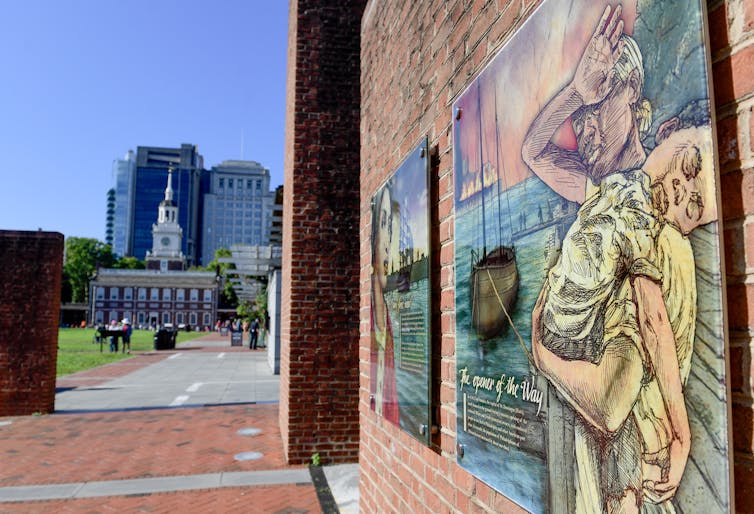
The house, then located at the intersection of 6th and Market streets in Philadelphia, served as the first executive mansion. It stood mere feet from Independence Hall, where the nation adopted its lofty language regarding freedom.
The slavery exhibition at Independence Hall opened in December 2010. It was the first slavery memorial on federal land in U.S. history. Michael Yanow/NurPhoto via Getty Images
Years later, Judge described her narrow escape to Rev. Benjamin Chase in an interview for the abolitionist newspaper The Liberator. Judge told Chase, “I had friends among the colored people of Philadelphia, had my things carried there beforehand, and left Washington’s house while they were eating dinner.”
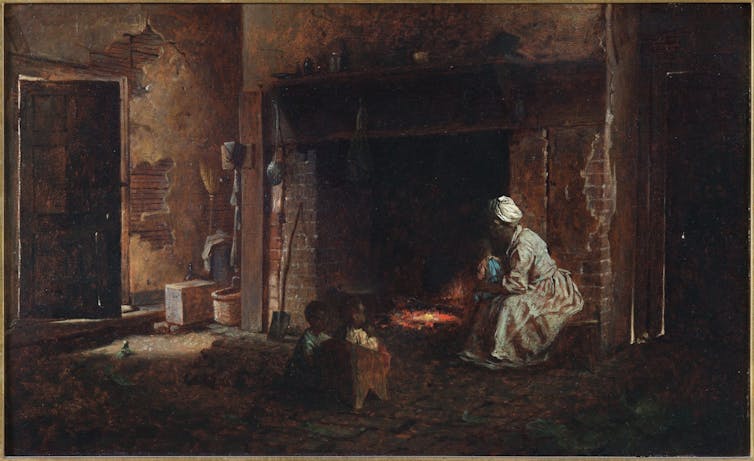
Prior to her escape, Judge served as a chambermaid in the President’s House. She spent years tending to Martha Washington’s every need: bathing and dressing her, grooming her hair, laundering her clothes, organizing her personal belongings, and even periodically caring for her children and grandchildren.
Being a chambermaid also included grueling daily tasks such as maintaining fires, emptying chamber pots and scrubbing floors.
Even though she engaged in this arduous labor as property of the Washingtons, living in Philadelphia provided Judge a glimpse of what freedom could eventually look like for her. Historians estimate that 5% to 9% of the city’s population at the time were free Black people. Prior to her escape, Judge befriended several of them.
In the spring of 1796, the Washingtons prepared to return to Virginia to resume private life. President Washington issued his farewell address in the fall of 1796, but he told family and close confidants of his plans earlier in the year.
During that time, Martha Washington made arrangements for their pending return to Mount Vernon. Her plans included bequeathing Ona Judge to her granddaughter, Elizabeth Parke Custis, as a wedding gift. Upon learning this, Judge made plans of her own.
In her interview with Chase she explained, “Whilst they were packing up to go to Virginia, I was packing to go, I didn’t know where; for I knew that if I went back to Virginia, I should never get my liberty.”
As a civil rights lawyer and professor in the Africology and African American Studies department at Temple University in Philadelphia, I study the intersection of race, racism and the law in the United States. I believe Judge’s story is vital to the telling of America’s history.
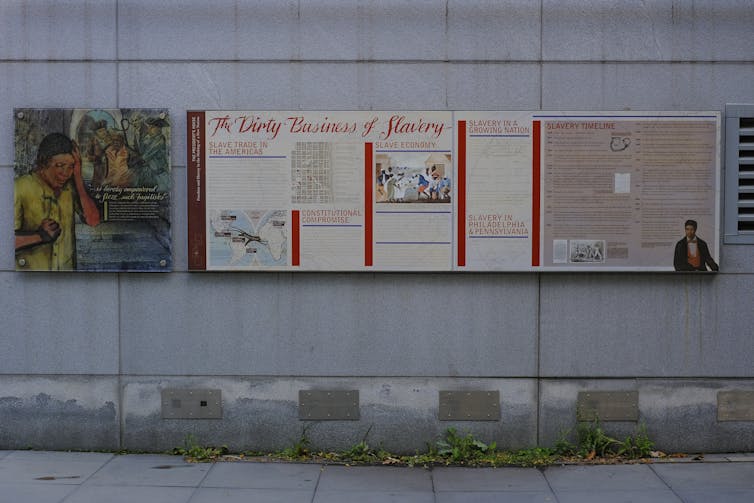
Before January 2026, those who wished to learn about Judge could literally stand on the same walkway in Philadelphia where Judge once stood when she chose to flee. Several footprints, shaped like a woman’s shoes and embedded into the pathway outside of where the President’s House once stood, memorialize the beginning of Judge’s journey. These footprints composed part of an exhibit examining the paradox between slavery, freedom and the nation’s founding.
The exhibit, “Freedom and Slavery in the Making of a New Nation,” also included 34 explanatory panels bolted onto brick walls along that sidewalk. They provided biographical details about the nine people the Washingtons owned while living in the presidential mansion. The exhibit presented the sobering reality that our nation’s first president enslaved people while he held the nation’s highest office.
These and other panels discussing the founders’ owning of slaves were removed in late January 2026, after an executive order issued by President Donald Trump in March 2025 called to eliminate materials deemed disparaging to the Founding Fathers or the legacy of the United States. Matthew Hatcher/Getty Images
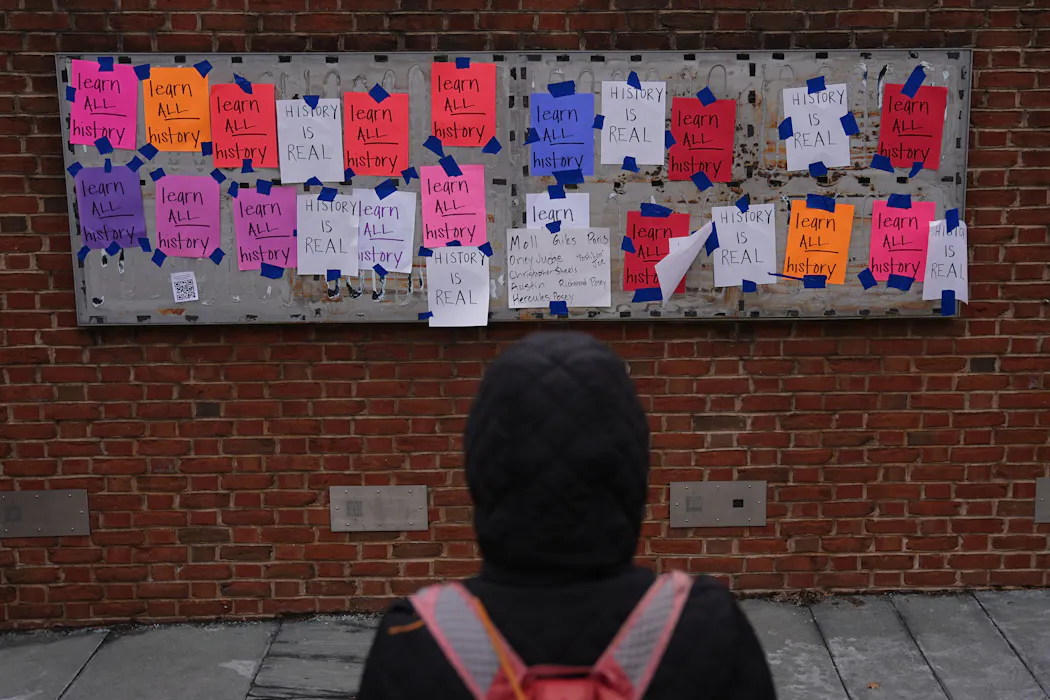
This changed in late January when the National Park Service dismantled the slavery exhibit at Philadelphia Independence National Historic Park. The removal sparked intense, immediate outrage from people across the country dismayed by the attempt to suppress unfavorable aspects of American history.
Philadelphia Mayor Cherelle Parker responded swiftly. “Let me affirm, for the residents of the city of Philadelphia, that there is a cooperative agreement between the city and the federal government that dates back to 2006,” she said in a public statement. “That agreement requires parties to meet and confer if there are to be any changes made to an exhibit.”
The city of Philadelphia later sued Interior Secretary Doug Burgum and National Park Service acting Director Jessica Bowron. Pennsylvania subsequently filed an amicus brief in support of the city’s lawsuit.
Civil rights activist and Philadelphia-based attorney Michael Coard recently had an opportunity to visit and examine the exhibits in storage. Coard has led the fight to create and preserve the exhibit and now is at the center of the fight to restore it.
Philadelphia-based attorney Michael Coard, who helped lead the effort to create the exhibition, visited the site after its removal. AP Photo/Matt Rourke
Limiting discussion of race
While the court deliberates the future of the exhibits, critics continue to raise key concerns regarding the exhibit’s removal. Many argue the National Park Service’s dismantling of the exhibit is an attempt to “whitewash history” and erase stories like Ona Judge’s.
This is particularly the case considering the Trump administration has restored and reinstalled two Confederate monuments of Albert Pike in Washington, D.C., and Arlington National Cemetery, while removing the slavery exhibit in Philadelphia.
Similarly, during the first Trump administration, the federal government engaged in various efforts to counterbalance the 1619 Project, a project spearheaded by Pulitzer-winning journalist Nikole Hannah-Jones that discussed the 400th anniversary of slavery’s beginnings in America. The 1619 Project spawned yearslong backlash. This included the 1776 Commission, created during the first Trump administration, which tried to discredit the conclusions of the 1619 project.
This pattern has intensified as the United States prepares to celebrate the 250th anniversary of the framers signing the Declaration of Independence. As the nation celebrates its history, it must decide how much of it to explore.
In the face of widespread pessimism about the political fate of the United States and growing political polarization, scholars and citizens across the country are reimagining how American democracy could better serve the needs of the whole population.
In an October 2025 poll, a slight majority said that radical change is needed to make life better in America, compared to 32% who answered only small change is needed.
Reimagining a political system’s future effectively begins with the system’s foundation: how the populace chooses the people who will represent them and make collective decisions.
The U.S. Constitution mandates elected representatives in Congress to decide important questions, such as how to tax the population and spend that collective revenue. And they determine whether to go to war or to defend allies if they are invaded.
What would it take to make that electoral system become more responsive to citizens’ needs? How could it be fairer and more accurate in representing the entire electorate?
One answer is found in proportional representation, an electoral system used in most of the rest of the world’s established democracies. These systems elect multiple representatives in a district in proportion to the number of people who vote for them.
It examined evidence from other countries and concluded that proportional representation could provide more fair and accurate representation and more choice. Proportional representation could also help with the deep political polarization engulfing the United States.
How proportional representation works
This proposal would change the way Americans elect representatives to the U.S. House of Representatives and potentially to state legislatures.
Currently, the winner-take-all system in the U.S. works like this: States are divided into districts based on population and elect one representative to the House of Representatives per district. The winner is the person who gets the most votes. Most states also use this single-member district system to elect members of their state legislatures.
A proportional representation system has larger, multimember districts. Candidates are elected according to the share of votes they or their parties receive.
Different versions of proportional list systems exist. In one version called open list proportional representation, voters choose a candidate from party lists of nominated candidates or from lists of independent candidates.
So if the Good People Party, for example, wins 40% of the vote in a district with 10 members, it will get four seats. And the top four vote-winners on their list will be elected. If the Serious People Party wins 20% of the vote, it will get two seats, with the top two vote-getters on their list elected.
This method simultaneously serves the purpose of a primary election, allowing voters to choose among nominees from a party.
Another version of proportional representation also has multimember districts but uses ranked-choice voting to select the members, where voters rank candidates in order of preference. New Zealand and Australia changed to this system for some of their representative bodies in 1993 and 1948, respectively.
A September 2024 poll found that over half of Americans think the U.S. should change the way representatives are elected to the House of Representatives. SDI Productions
The advantages of proportional representation include outcomes where many more voters would live in a district with at least one of the elected officials representing their choice. That differs from the winner-take-all system where those on the losing side feel unrepresented, especially when the district is split 51% to 49%, for example.
Proportional representation opens the door to more choice because it becomes possible for a smaller party to win one seat out of five, for example. It would begin to break up the two-party system that currently forces some voters to choose the “lesser of two evils,” or to vote strategically against their most disliked party rather than for someone they want.
To be sure, proportional representation can lead to difficulty in forming a majority coalition. This happened in Belgium in 2010. It can also lead to situations where small, extremist parties can demand major concessions to join a larger party in forming a majority coalition, which Israel recently experienced.
Israel is often cited as a negative example of proportional representation. But the country remains unusual in that its extreme electoral system includes the entire country as one large district with 120 seats, so that many small parties can be elected.
Research indicates that districts with three to eight members are ideal to provide more accurate representation without overly fragmenting the party system.
In the U.S. it’s more likely that proportional representation would allow for different factions of the existing parties to be represented. Imagine a five-seat district that elects one MAGA Republican, one traditional Republican, one progressive Democrat, one centrist Democrat and one third-party or independent candidate. This would begin to break down the polarization and allow for different coalitions to form across different issues.
Changing the system to elect House members does not require a constitutional amendment. The Constitution allows states to determine the manner of elections.
In a bloc system, voters get as many votes as there are seats in that district. So in a five-seat district, each voter gets five votes instead of only one vote in a proportional system. A majority group, say whites, could thus choose to vote for only white candidates and win across the board, locking out any minority candidate from winning. The repeal could include a prohibition on returning to that bloc system.
Proportional representation would require that lawmakers who hold their seats under the current system agree to change the 1967 law. And they may be reluctant to change to a system that would give voters more choice.
But interviews with retiring lawmakers show their frustration with the dysfunction and toxicity of the current Congress. And some lawmakers are pushing for a committee to study how changes to the electoral system could create a better-functioning Congress.
Additionally, there is growing support for electoral reform in the U.S. A September 2024 poll found that over half of Americans think the U.S. should change the way we elect representatives to Congress. And 63% believe the country would be better off with more than two competitive parties.
One U.S. city – Portland, Oregon – recently moved to proportional representation. The Portland City Council that took office in 2025 has greater gender, minority and neighborhood representation than in the past, even if it experienced some initial difficulty in forming a majority coalition. And Cambridge, Massachusetts, has used proportional representation since 1941, where 95% of voters see one of their top three choices elected.
States and municipalities could thus become laboratories of innovation, experimenting with different versions of proportional representation and providing models and momentum for a national-level change. And the country could begin not only to reimagine but to experience a different democracy that serves all.
Jennifer Lynn McCoy receives funding from the Carnegie Corporation for an Andrew Carnegie fellowship on depolarization as well as the Institute for Humane Studies.. She is Regent’s Professor of Political Science at Georgia State University and a nonresident scholar at the Carnegie Endowment for International Peace.