Categories
Politics

Shutdown polls show Democrats’ economic messaging still falling flat

Democrats’ hardline opposition to rising health care costs isn’t earning them voters’ trust on economic issues — a disconnect that lays bare the party’s challenge heading into next year’s midterms.

Voters blame Republicans more than Democrats for the federal government shutdown, according to a review of polling conducted after services shuttered. An Economist/YouGov survey of 1,648 Americans showed 41 percent hold the GOP accountable for the lapse in federal funding, compared to 30 percent who point a finger at Democrats and 23 percent who hold the parties equally responsible. A 2,441-person CBS News/YouGov survey also found Americans blame Republicans more than Democrats — 39 percent to 30 percent — with 31 percent faulting both. And a Harvard/Harris poll demonstrated 2,413 voters impugned Republicans more than Democrats by 6 points.

Those same voters, however, delivered the GOP a 4-point advantage when asked which party they trust more on economic issues. And a survey from Democratic-aligned firm Navigator Research showed 1,000 registered voters faulting Republicans for the shutdown by 11 points, but giving them a 2-point advantage on inflation and cost of living.

That dichotomy underscores an electoral hurdle for the party locked out of power: Even as Democrats hold the line over expiring health care subsidies that could send millions of Americans’ insurance prices soaring, voters still favor Republicans on the economy and cost of living.

“Are we going to get all the working class back? Probably not,” said Rep. Henry Cuellar (D-Texas), who is seeking reelection in a redrawn Texas district while facing federal bribery charges. “[But] I see an opening here. … And we need to jump on that and just really focus and repeat over and over and over that we Democrats are interested in bringing costs down.”

The next challenge for his party, he added: “Make sure people understand we are a viable alternative.”

The shutdown-polling paradox has shown up in surveys for months, as Democrats struggle to move voters who are souring on President Donald Trump and his party’s handling of the economy and inflation into their corner. And it underscores the uphill battle Democrats face in wresting power from Republicans, even as they narrow their scattered messaging to affordability.

Frontliner Rep. Laura Gillen (D-N.Y.) called her party’s shutdown stance “an important step” toward convincing voters Democrats can tackle rising costs.

“And it’s a crucial step to take right now … to make sure that people don’t see their premiums go up exponentially,” said Gillen, who is defending the Long Island swing seat she flipped last year. “But then it needs to be part of a broader discussion to show that we are on the side of the American people and we care about the economic pain they’re feeling and we have a concrete plan.”

The party is still hashing out the particulars of that plan, which depending on the candidate ranges from pitching a hardscrabble background to railing against a rigged economy and vilifying the billionaires that benefit from it.

Right now, Democrats are trying to leverage their minimal power to force Republicans to stop Affordable Care Act subsidies from expiring at the end of the year, attempting to squeeze out a policy win on a top cost-of-living issue as they scramble to regain working-class voters.

The political winds have been shifting in Democrats’ favor on the economy. Trump’s net approval rating on the subject has nosedived since the start of his second term, polling averages show. Voters routinely rank inflation as one of their top issues, but disapprove of his handling of it. The latest CBS/YouGov poll showed three-quarters of adults don’t think Trump is doing enough to lower prices — one of his 2024 campaign trail pledges. Labor Department statistics show the job market is slowing.

Despite signs of economic distress, Republicans consistently enjoy a polling advantage on the economy. And Liam Kerr, who co-founded the centrist WelcomePAC, warned that Democrats won’t be able to erase it through a single stand on health care costs.

“You can’t just do it one time and all is forgotten,” Kerr said. “Playing against type requires even more effort.”

Nevertheless, Democrats remain confident they can reverse their heavy losses in 2024 by drilling down on voters’ cost-of-living concerns, according to interviews with half a dozen congressional candidates.

They cast their party’s shutdown play as part of a broader strategy that ranges from hammering Republicans over tariffs that could drive up prices for consumers and for businesses, to battling utility companies over rising bills. And they believe the slate of working-class candidates the party is putting up for House and Senate seats, from a firefighter in Pennsylvania’s Lehigh Valley to a waitress in western Wisconsin, can convince voters that Democrats care about blue-collar Americans who have turned toward Trump in recent years.

They’re getting backup from Democrats’ national campaign arm, which on Friday launched a five-figure digital-and-billboard ad campaign and organizing effort to alert voters to the pending increase in their premiums.

Still, shutdowns carry risks for both parties, especially the longer they drag on. The Trump administration on Friday began firing federal workers, which could increase pressure on both sides to bring their standoff to an end. And some polls already show voters think Democrats should cave and reopen the government; a sentiment expressed by nearly two-thirds of voters in the Harvard/Harris survey and just over half of respondents to the Navigator poll.

But Democrats are dug in.

“We have to give people a reason to fight, and we have to get back to catering to the many over the few,” Cherlynn Stevenson, a state representative running for the Democratic nomination in Kentucky’s open 6th District, said. “This can be a big turning point for our party.”

Alec Hernández contributed to this report.

​Politics

Categories
Politics

Chuck Schumer gets his preferred candidate, Janet Mills, in crowded Maine Senate race

Maine Gov. Janet Mills joined her state’s crowded Democratic Senate primary as the establishment favorite on Tuesday, aiming to flip Republican Sen. Susan Collins’ seat in a pivotal midterm year.

Democrats view the seat as one of their top pickup opportunities — the only in a state Kamala Harris won in 2024 — and Mills is among a few top-tier candidates Senate Minority Leader Chuck Schumer aggressively recruited to run this cycle. But first the term-limited governor must contend with a competitive primary against breakout candidate Graham Platner, an oyster farmer who announced he has more than $3 million in the bank and already received the endorsement of Sen. Bernie Sanders (I-Vt.).

Maine Beer Company owner Dan Kleban is also running for the nomination and his fundraising figures will be made public Wednesday, when federal filings are released.

In her launch video, Mills highlighted her recent fight with President Donald Trump over transgender sports and accused Collins of enabling him. “I won’t sit idly by while Maine people suffer and politicians like Susan Collins bend the knee as if this were normal,” Mills said.

Despite initial hesitation, the governor started interviewing staff and telling local reporters she was seriously considering a bid last month.

She addressed that long contemplation in her announcement, saying in the video, “Honestly, if this president and this Congress were doing things that were even remotely acceptable, I wouldn’t be running for the U.S. Senate.”

The race sets up the latest generational clash for a party struggling to find its footing after losing the White House and both branches of Congress last year.

Mills, who won her seat by wide margins in her last two races, is 77 years old, making her five years Collins’ senior at a time when Americans are grappling with debates about the age of their politicians. If elected, she would be the oldest first-year senator ever. Platner is 41 and unlikely to leave the race for Mills; Kleban, who is 48, has so far dodged questions about what he would do if Mills jumped in.

Democrats need to pick up four seats in order to win back control of the Senate, a difficult task that all but has to include a pickup in Maine, where Harris won by 7 points.

Democrats poured millions of dollars into an ultimately-unsuccessful effort to unseat Collins in 2020 — but her declining popularity in the bluing state is giving Democrats hope that next year’s race could be their best chance yet.

Republicans are eager to expose Mills’ weaknesses, and have already targeted her public fight Trump, as well as her age.

​Politics

Categories
Politics

Political violence: What can happen when First Amendment free speech meets Second Amendment gun rights

The proliferation of guns in the U.S. can elevate political rhetoric to political violence. Douglas Sacha, Moment/Getty Images

The assassination in September 2025 of conservative activist Charlie Kirk has heightened attention on the relationship between political rhetoric and political violence.

Even before police had identified a suspect, President Donald Trump blamed the shooting on the “rhetoric” of the “radical left.” The Trump administration has since acted to silence left-leaning speakers and is threatening to intensify its attacks on left-wing political speech.

But my decades of studying free speech law have convinced me that suppressing political rhetoric, even through social norms rather than law, undermines the discussion, debate and constructive disagreement essential for a healthy democracy.

Gun proliferation complicates the problem by making political violence much easier to carry out.

Rise of political violence

Political violence – by which I mean any physical attack on people that aims to achieve a political goal – harms democracy by shifting the field of political disagreement from debate to aggression.

Under the U.S. constitutional system of limited government and individual rights, political violence by the government – for example, government assaults on anti-government protesters – is among the gravest threats to liberty.

But political violence committed by private individuals or groups also corrodes constitutional democracy. In the United States, acts of private political violence against members of government and against ordinary people have both increased dramatically in recent years.

Political assassinations are the most vivid form of political violence. The Kirk assassination is only the latest example.

An attendee wears a gun on their hip during a candlelight vigil and prayer event at which an American flag is displayed.
An attendee at a candlelight vigil and prayer event for assassinated Turning Point USA Founder Charlie Kirk on Sept. 10, 2025, in Seattle.
David Ryder/Getty Images

In June 2025, a shooter with a “hit list” of left-liberal targets assassinated Minnesota Democratic Rep. Melissa Hortman and her husband. In December 2024, a shooter angry about health insurance costs killed United Healthcare CEO Brian Thompson. In July 2024, a shooter wounded Trump at a campaign rally in a failed assassination attempt.

Political violence also includes bias-motivated murders. In 2022, a white supremacist murdered 10 Black patrons at a grocery store in Buffalo, N.Y. In 2019, an anti-immigrant racist murdered 23 mostly Latino shoppers at a Wal-Mart in El Paso, Texas. In 2018, an antisemite murdered 11 congregants at a Pittsburgh synagogue.

In those incidents and numerous others, extreme political ideas appear to have motivated the attackers. The linkage of extremist speech to lethal violence has prompted calls to legally restrict or punish extremist speech.

Political violence, free speech and cultural editing

The First Amendment, however, protects extremist speech, including advocacy of violence. Violent rhetoric must actually incite or threaten violence to lose the First Amendment’s shelter.

If law cannot curb the sorts of speech that may inspire political violence, what about social norms – widely shared beliefs about what speech is socially acceptable or appropriate?

Much speech that the First Amendment protects from government regulation eventually disappears from public discourse. That happens through a process I call “cultural editing”: popular and institutional rejection of outmoded or repellent ideas. For example, no serious medical conference discusses treating hay fever with cocaine, and no respectable political science panel includes Nazis.

In a social media post after Charlie Kirk’s killing, President Donald Trump blamed ‘radical left’ rhetoric for political violence.

The Trump administration’s blaming of the Kirk assassination on “radical left” rhetoric points toward a deeper level of cultural editing.

Trump and other conservatives have not cited speech that advocated violence against Kirk. Instead, some conservative activists, spurred on by Trump administration officials, called for harassing and punishing critics of Kirk’s statements and actions.

But such criticisms of Kirk, whatever their merits or lack thereof, fall within the scope of ordinary political debate.

Kirk was not a government official, but he had strong influence in the Trump administration. Robust democratic discourse requires space for people to criticize such powerful figures. Large-scale cultural editing of those criticisms, amounting to suppression of left-leaning views, would hurt the public’s ability to discuss and resolve political disagreements.

However, Trump and others who push for suppressing harsh political rhetoric might argue that the stakes of verbal attacks have increased. They might say that U.S. political culture can no longer indulge political invective because political violence has become more common.

Political violence and guns

That argument for suppressing harsh political speech ignores an independent cause of political violence: gun proliferation.

Most political violence in the U.S. involves guns. Guns make political violence easier by erasing the distance between extremist ideas and lethal action. Hate or fanaticism can end a life in an instant, hundreds of yards from the victim.

The U.S. has by far the highest number of civilian guns and rate of civilian gun ownership in the world. Since 2008, when the Supreme Court declared an individual Second Amendment right to keep and bear arms, annual U.S. gun purchases have increased from about 9 million to about 16 million.

Governments often find regulating speech easier, even though less effective, than tackling underlying problems. At times, federal and state governments have addressed political violence by regulating guns. The 1994 federal assault weapons ban exemplifies regulatory efforts to curb overall gun violence.

But the Supreme Court’s Second Amendment cases now appear to bar strong gun regulations.

People in a democratic society need freedom to make harsh, even extreme political statements with a minimum of cultural editing. The Second Amendment protects access to lethal weapons. This combination of free speech and gun rights makes the growing problem of political violence much harder to solve.

The Conversation

Gregory P. Magarian does not work for, consult, own shares in or receive funding from any company or organization that would benefit from this article, and has disclosed no relevant affiliations beyond their academic appointment.

​Politics + Society – The Conversation

Categories
Politics

How the government shutdown is making the air traffic controller shortage worse and leading to flight delays

The government shutdown has exacerbated the air traffic controller shortage, leading to delays at airports across the country, including in Burbank, Calif. Mario Tama/Getty Images

Airports across the United States have been experiencing significant flight delays recently because of a shortage of air traffic controllers, who have been required to work without pay since a government shutdown began on Oct. 1, 2025. Reports suggest employees have been calling in sick in increased numbers. And since there was already a shortage of controllers before the shutdown, the impact has been severe, with over 52,000 flights canceled ahead of the Columbus Day weekend.

The Conversation U.S. asked Brian Strzempkowski and Melanie Dickman, aviation experts at The Ohio State University, to explain how the shutdown is affecting air travel, what that means for passengers and air safety, as well as the air traffic controller shortage that has been plaguing U.S. airports for years.

How is the shutdown affecting air traffic controllers?

Air traffic controllers are deemed essential workers, meaning they are still required to work while not receiving compensation – which they would typically then receive in a lump sum after the shutdown ends. President Donald Trump created some uncertainty around this by suggesting workers may not get their back pay without explicit authorization from Congress, despite having signed a law in his first term that makes it a legal requirement.

Working without regular pay, combined with the possibility that they won’t get paid at all, is resulting in real financial stress for air traffic controllers, who perform one of the most stressful jobs there is.

As a result, there have been reports of air traffic controllers calling in sick in large numbers. This happened in previous shutdowns as well. During the 2018-2019 shutdown, for example, sickouts started to happen around the two-week mark, roughly when the first paycheck was missed. Controllers, airport security employees, and other essential workers were calling in sick often so they could work another part-time job to pay their bills.

In the current shutdown, this appears to be happening sooner, less than a week after it began. Transportation Secretary Sean Duffy said around 10% of the controller workforce is engaging in this practice and threatened to fire these “problem children.”

What does this mean for people about to take a flight?

Before the shutdown, there was already a critical shortage of air traffic controllers. Coupled with workers calling in sick in recent days, this has led to severe travel delays at many major airports, such as those in Atlanta and Denver, and regional ones, like those serving Burbank, California, and Daytona Beach, Florida.

A big question on travelers’ minds is whether this will affect air safety.

The air traffic control system is multi-layered and has redundancies built into it to ensure an incredibly safe environment. While controller shortages do begin to erode some of those redundancies, contingency plans are in place to help protect the system. For example, air traffic can be diverted away from affected locations or delayed, or the flight may even be be canceled before the plane leaves the gate.

As an example, Newark Liberty International Airport can accommodate approximately 80 aircraft departing or arriving per hour when the airport and airspace is fully operational. However, due to technical failures, staffing shortages and construction at the airport, capacity was limited to between 28 and 34 aircraft per hour in June 2025. Due to technology upgrades and procedural changes, that number was recently increased to between 68 and 72 aircraft per hour. By regulating the amount of traffic, the system can be protected to ensure the safety of every aircraft.

This was an example of high-level oversight in which the secretary of transportation was personally involved in seeking a solution to ensure air travel remained safe while trying to increase capacity.

a colorful plane flies near the top of an air traffic control tower
Air traffic controllers have one of the most stressful jobs.
AP Photo/Charles Rex Arbogast

How does the US keep air travel safe?

On a more day-to-day level, the Federal Aviation Administration relies on the Air Traffic Control System Command Center, located about 40 miles away from Washington, D.C. This facility oversees the entire national airspace system and essentially “controls” the controllers. Air traffic professionals monitor staffing at air traffic facilities, weather conditions, equipment failures and unexpected disruptions to the system.

When an incident arises, such as Burbank Airport recently reporting that no controllers were available, the command center issues an alert stating that any aircraft inbound to Burbank must divert to an alternate airport, and any aircraft that has not yet taken off will be held on the ground.

Staffing shortages at other air traffic control facilities may require alternate plans, such as transitioning workloads from one facility with fewer controllers, to another that is appropriately staffed. There is a wide range of tools that the Air Traffic Control System Command Center can utilize to protect the system, but it all stems from the idea of managing the capacity. Flight delays and cancellations, while disruptive to individual travelers, are actually good from a system perspective, because they prevent congestion in the airspace.

Why was there an air traffic controller shortage in the first place?

There has been a systemic problem with hiring of air traffic controllers for more than a decade.

Over the years, the FAA has fallen behind on training enough controllers to replace those who retire each year. In May 2025, we wrote about the FAA’s plan to utilize colleges across the country to provide the professional training for this career field. While it will take a little time for the students to matriculate through college and into the workforce, this plan will be a significant contributor to solving the controller shortage problem.

Meanwhile, the FAA Academy, which trains U.S. air traffic controllers, only has limited funding from the previous federal budget for current students. The shutdown means no new students can begin training. Depending on the length of the shutdown, the funding may run out as additional employees are furloughed. The ripple effects of a shutdown can remain for many months after the government reopens.

What’s the government doing to end the shortage?

In July, Congress authorized over US$12 billion in funding to help modernize the air traffic control system.

Secretary Duffy is currently leading an effort to identify a contractor to implement the technology upgrades needed to modernize the system and make it more robust. Duffy has said an additional $19 billion investment will be needed to complete the task.

The Conversation

Melanie Dickman is a member-at-large of Air Traffic Controllers Association (ATCA)

Brian Strzempkowski does not work for, consult, own shares in or receive funding from any company or organization that would benefit from this article, and has disclosed no relevant affiliations beyond their academic appointment.

​Politics + Society – The Conversation

Categories
Politics

In 1776, Thomas Paine made the best case for fighting kings − and for being skeptical

Were these protesters in Washington, D.C., on Aug. 16, 2025, inspired by Thomas Paine? Alex Brandon/AP

In one of his stand-up sets, comedian David Cross rejects all political commentary that tries to answer the question, “What would America’s Founding Fathers think if they were alive today?”

For Cross, it is pointless to speculate about the present-day views of men who could not have imagined cotton candy, let alone the machine that makes it.

“What’s a machine? What’s a machine???” he screams in their collective voice, recoiling from the sorcery of the state fair.

The first time I saw this bit, something odd happened. Having just read the 1776 political pamphlet “Common Sense,” I could hear its author, one of America’s founders, laughing louder than anybody.

That would be Thomas Paine, the man credited with turning the American Revolution from a complicated Colonial fracas into a titanic struggle for the soul of liberty itself.

If Cross is skeptical that anything 250 years old still holds up, Paine, were he alive today, could probably name one thing: skepticism. Ways of thinking and being do not grow out of the ground; we make them ourselves, then hand them down as best we can. Paine would smile to see his favorite heirloom, the skeptical worldview, still intact.

Saying “no” – especially to those in power – is an underrated American pastime, and Paine was its Babe Ruth. If you plan on joining No Kings rallies and have yet to find a slogan for your sign, Paine’s got you covered: “In America, the law is king!” “No King! No Tyranny!” “Monarchy hath poisoned the republic.”

I could go on. Because he did.

A yellowed copy of a short publication with the title 'Common Sense.'
Published in 1776, Thomas Paine’s pamphlet ‘Common Sense’ inveighed against monarchy and hereditary privilege and in favor of independence for the Colonies.
Smithsonian National Museum of American History

Birth of a revolutionary

Where did all this anti-monarchical fire come from? Originally, from a small town in Norfolk, England, in 1737. Turning from his father’s trade of corset-making, Paine tried his hand at business, met and impressed Benjamin Franklin in London, sailed to America, and there found his true metier as a pamphleteer and radical.

Using simple yet incandescent prose, Paine renounced, repudiated and ridiculed at a clip seldom witnessed in print before or since. Hereditary privilege, colonialism, the supernatural: no, no, no.

But what Paine made his name lambasting – what he knocked out of the park with almost steroidal force – were kings. All of them, from the figures of ancient legend and Scripture to those who warmed England’s throne during his lifetime.

Common Sense,” his first major work, was an urgent wake-up call to every light-sleeping lover of liberty within earshot. In that pamphlet, Paine labels kingship “the most prosperous invention the Devil ever set on foot for the promotion of idolatry.” He never minced words; he wanted the right people to choke on them.

Lawn signs that quote 'No King! No Tyranny!' and 'In America, the Law is King!'
Thomas Paine quotes in Lexington, Mass., not far from where the American Revolution began.
Photo: Joel Abrams, CC BY

‘Simple facts, plain arguments’

Exactly what was Paine’s problem with kings?

The same problem you’ll have, “Common Sense” promises, when you examine the evidence.

This is partly the secret of Paine’s rhetorical power: It’s hard to imagine any wordsmith demanding more vigorously that you not take his word for it.

Paine was a student of history, and history is chock-full of receipts. It shows that abuses of kingly power extend back to the “early ages of monarchy,” when some “principal ruffian” first took power, and “it was very easy, after the lapse of a few generations, to trump up some superstitious tale, conveniently timed … to cram hereditary right down the throats of the vulgar.”

Since that time, says Paine, even those fortunate enough to live under benevolent rule have seldom been more than one generation away from yet another dreadful monarch.

“One of the strongest NATURAL proofs of the folly of hereditary right in kings, is, that nature disapproves it, otherwise she would not so frequently turn it into ridicule by giving mankind an ASS FOR A LION.” What a tweet this would have made, caps and all.

Bring the Paine

The only thing Paine liked less than monarchical rule was its enablers, anyone who relinquished their freedom willingly to an aspiring tyrant.

This is not only wrong, Paine insists, but against nature, since all of us are created equal.

A somewhat puckish-looking middle-aged man from the 18th century, holding a
A somewhat puckish-looking Thomas Paine – with the wrong first name and a different spelling of his last one.
National Portrait Gallery, Smithsonian Institution

But even that’s not the worst part. Those who sacrifice their own freedom on the altar of monarchy also sacrifice that of future generations. Their “unwise, unjust, unnatural compact might (perhaps) in the next succession put them under the government of a rogue or a fool.” Ouch.

“Most wise men,” Paine adds, “in their private sentiments, have ever treated hereditary right with contempt; yet it is one of those evils, which when once established is not easily removed; many submit from fear, others from superstition, and the more powerful part shares with the king the plunder of the rest.”

Federal worker firings, court settlements, a government shutdown. Paine would loathe how right the U.S. is proving him.

Besides criticizing both tradition and manipulative elites for their role in abetting monarchs, Paine’s writing gestures toward a more widely accessible sense of false freedom that comes with getting what you want from whoever happens to wear the crown.

This kind of pleasure obscures a painful reality: that the tyrant can strike as well as stroke.

The problem of unchecked power is not nearly counterbalanced by any number of indulgences the wielder of that power deigns to bestow. Freedom, Paine insists, is not transactional; whatever price you name, you’re getting fleeced.

Or, to put it his way: “O ye that love mankind! Ye that dare oppose, not only the tyranny, but the tyrant, stand forth!”

The Conversation

Matthew Redmond does not work for, consult, own shares in or receive funding from any company or organization that would benefit from this article, and has disclosed no relevant affiliations beyond their academic appointment.

​Politics + Society – The Conversation

Categories
Politics

Refinery fires, other chemical disasters may no longer get safety investigations

A Chevron refinery in El Segundo, Calif., burns on Oct. 3, 2025. Allen J. Schaben/Los Angeles Times via Getty Images

When fire erupted at the Intercontinental Terminals Co. bulk liquid petroleum storage terminal, large plumes of dark smoke billowed into the clear skies over Deer Park, Texas. Despite the efforts of site staff and local firefighters, more than 70 million gallons of petroleum products burned or were otherwise released into the environment over the following three days in March 2019.

Even while the fire was still burning, investigations began looking into what had happened and what was still happening. The Environmental Protection Agency tested air and water samples to determine how much pollution was being released – both to determine cleanup efforts and to assess fines. The Occupational Safety and Health Administration reviewed what had happened, but found that with no workers injured, there was no reason to investigate further or impose fines or other penalties on the company.

A third federal agency, the Chemical Safety and Hazard Investigation Board, often known as the CSB, got to work figuring out what had gone wrong, without assigning legal or financial responsibility, but rather seeking to learn from this disaster how to prevent future accidents. It’s an approach much like the National Transportation Safety Board takes toward airplane crashes, train derailments and other transportation-related tragedies: document what happened and identify every opportunity to prevent or reduce the chances of it happening again.

That deep investigative process reportedly will not happen in the wake of the October 2025 explosion and fire at a Chevron refinery in El Segundo, California, because of the federal government shutdown and lack of funding for the organization.

As scholars of chemical disasters, we believe this absence – and the potential for the board to be eliminated entirely under the proposed 2026 federal budget – raises the risk of more, and more serious, chemical disasters, not just in the U.S. but around the world.

A fire at several large round buildings sends dark black smoke into the sky.
A fire burns at Intercontinental Terminals Co. in Deer Park, Texas, in March 2019.
AP Photo/David J. Phillip

Many serious incidents

The CSB investigation of that 2019 fire that burned 15 petroleum tanks at the Intercontinental Terminals Co., near the Port of Houston, yielded key recommendations to the company, OSHA and the EPA. They included necessary updates to safety management systems, the need for flammable-gas detectors to identify leaks, and remotely operated emergency shutoff valves so workers could close tanks containing hazardous material without exposing themselves to danger. The company has addressed the first recommendation and is reportedly working on the next two.

The board also recommended to the petroleum industry that storage tanks be spaced farther apart so they would be less likely to catch each other on fire – a recommendation that is still under review.

And the Texas fire was just one of several disasters the Chemical Safety and Hazard Investigation Board investigated that year. Since its activation in 1998, the board has conducted in-depth investigations of 102 chemical disasters in the chemical and industrial sectors – an average of about four per year. And its reports are regularly used worldwide, including in France, South Korea and China.

A U.S. Chemical Safety and Hazard Investigation Board video summarizes the agency’s findings about a March 2019 petrochemical terminal fire in Texas.

Creation and goals of the CSB

The U.S. Chemical Safety and Hazard Investigation Board was created by Congress in a 1990 amendment to the Clean Air Act, in the wake of several high-profile chemical disasters around the world.

Those included the 1976 dioxin release in Seveso, Italy, which caused skin lesions on over 600 people and contaminated nearly 7 square miles of land; the deaths of thousands in Bhopal, India, from the 1984 release of methyl isocyanate from a Union Carbide pesticide plant; and the Chernobyl nuclear plant disaster in 1986 in what was then the Soviet Union. The goal was to prevent similar accidents from occurring on U.S. soil by investigating the causes of incidents and providing recommendations for improvement.

Specifically designed to be independent of other organizations and political influence, the CSB cannot be forced to modify its findings by other agencies, branches or political parties, ensuring its impartiality.

It has no power to issue regulations, nor any authority to impose fines or other punishments for wrongdoing. Rather, it is a fact-finding, investigative body designed to learn from past disasters and issue voluntary recommendations so chemical companies can improve their equipment and processes to prevent future tragedies. The vast majority of its recommendations are adopted by the industries affected, usually by the investigated company, though sometimes recommendations become industry standards. These recommendations can range from changes in procedure, the addition of safety devices or even overall facility design recommendations.

What does the board do?

There are several kinds of events companies must report to the federal government, including deaths and releases of particular chemicals, such as chlorine, naphthalene and vinyl chloride.

The board reviews those reports and decides on its own which to investigate. When an inquiry is opened, a group of experts who work for the board travel to the incident site to gather evidence to understand not only what happened in the big picture but a detailed view of how events unfolded.

After the investigation, the board issues a report detailing what it found and recommending specific changes to the company to reduce the risk of that sequence of events happening again. The board also delivers its information to other federal agencies, such as the EPA and OSHA, which can determine whether changes would be appropriate to federal regulations that apply to all companies in an industry.

The board’s value

The board had a US$14 million annual budget for 2025, which is a tiny part of the more than $6 trillion the U.S. government spends each year.

The current administration’s justification for eliminating the CSB is that its capabilities are duplicated by agencies such as the EPA and OSHA. But the EPA focuses specifically on environmental violations and potential threats to human life. OSHA investigates regulatory violations leading to personal injury.

In fact, the CSB has helped the EPA and OSHA evaluate and improve regulations, such as for the open burning of waste explosives, and improved methods of investigating accidental chemical releases and implementing new emergency response rules.

The CSB is the only organization that looks into improving processes to prevent future accidents instead of punishing past acts. It’s the difference between investigating who robbed a bank to hold the robbers accountable and improving bank security so another robbery can’t occur.

The Conversation

The authors do not work for, consult, own shares in or receive funding from any company or organization that would benefit from this article, and have disclosed no relevant affiliations beyond their academic appointment.

​Politics + Society – The Conversation

Categories
Politics

Spanberger and Earle-Sears tussle over violent political rhetoric in only debate

Democrat Abigail Spanberger passed on a chance to use one of the most high-profile moments of her run for Virginia governor to withdraw her endorsement for her party’s attorney general nominee for his use of violent rhetoric in a text message.

The subject of Jay Jones’ violent message from three years ago emerged immediately as the Democrat faced Republican Winsome Earle-Sears on Thursday in the only planned debate of the closely watched race.

Spanberger condemned the text as “abhorrent” but repeatedly declined to say whether she would withdraw her support for Jones, saying it should be left to the voters in the Nov. 4 election.

“The voters now have the information, and it is up to voters to make an individual choice based on this information,” she said.

Jones suggested the former Republican House speaker should get “two bullets to the head.” He has apologized for the text, which became public last week amid rising fears of political violence following a string of incidents, including the killing of Charlie Kirk on Sept. 10 and the attack on Minnesota lawmakers in June.

Jones’ text dominated the early portion of the debate at Norfolk State University that otherwise include feisty exchanges on public policy and culture war issues.

Earle-Sears pivoted from the first question, about Virginia’s car tax, to insist that Spanberger address the issue. “My opponent needs to answer about Jay Jones.”

The lieutenant governor then repeatedly turned to ask Spanberger what it would take for her to call for Jones to leave the race. “You have little girls,” she said, looking directly at her opponent and ignoring moderators’ attempts to allow the Democratic nominee to answer. “What would it take? Him pulling the trigger? Is that what would do it and then you would say he needs to get out of the race, Abigail?”

While Spanberger declined to say whether she would continue to support Jones, she made it clear she disagreed with his text. “I denounced them when I learned of them and I will denounce them at every opportunity,” she said.

The debate frequently bogged down with cross-talk and by Earle-Sears’ interruptions of her opponent. Their differences centered around whose party deserves blame for the government shutdown, immigration enforcement, abortion rights and gay marriage — which the lieutenant governor opposes.

Virginia is one of two states electing governors in November and is often viewed as a bellwether election for the party occupying the White House. Democrats were hoping for decisive wins in Virginia to use as a springboard into next year’s midterms, but have encountered some turbulence as Republicans have announced a combined $3 million ad push in recent days to keep the text messaging saga top of mind for voters in the campaign’s final stretch.

President Donald Trump looms large in the Virginia gubernatorial contest. He’s not only unpopular with Democrats and Independents, his administration’s gutting of the federal government through DOGE cuts and his push to deny backpay to federal workers still on the payroll but forced off the job during the partial federal government shutdown disproportionately impact Virginia voters.

There was little talk about the history at stake during the hour-long debate. Either would be the first female governor of Virginia and Earle-Sears would be the first Black woman to lead the state.

​Politics

Categories
Politics

Oregon AG Dan Rayfield and Vani ‘Food Babe’ Hari | The Conversation

Oregon AG Dan Rayfield and Vani ‘Food Babe’ Hari | The Conversation

lead image

​Politics

Categories
Politics

Oregon AG to Trump: There’s no rebellion here

Dan Rayfield is Oregon’s attorney general — and the latest state-level politician to be thrust into the national spotlight by a legal clash with the Trump administration. In this instance, it’s over the federal government ordering troops into Portland, where protests against Immigration and Customs Enforcement have been deemed rebellion by the president.

I would invite anybody to come to Oregon and I think it’s pretty clear that there isn’t an invasion going on in Oregon,” Rayfield says. “Sometimes I’ll joke the only rebellion going on right now is when I tried to feed my son a vegetable.”

The AG explained that his opposition to Trump’s proposed deployment is because, in his view, the president’s stated reasons for doing so aren’t based on the facts — or in the best interest of the people of Oregon.“If you want to deploy the military, if you want to federalize the National Guard, I’m okay with that if you have the right facts for it.,” Rayfield says. “We should give any president some deference, but when you have zero facts to base it on, that’s when you’ve got to draw the line.”

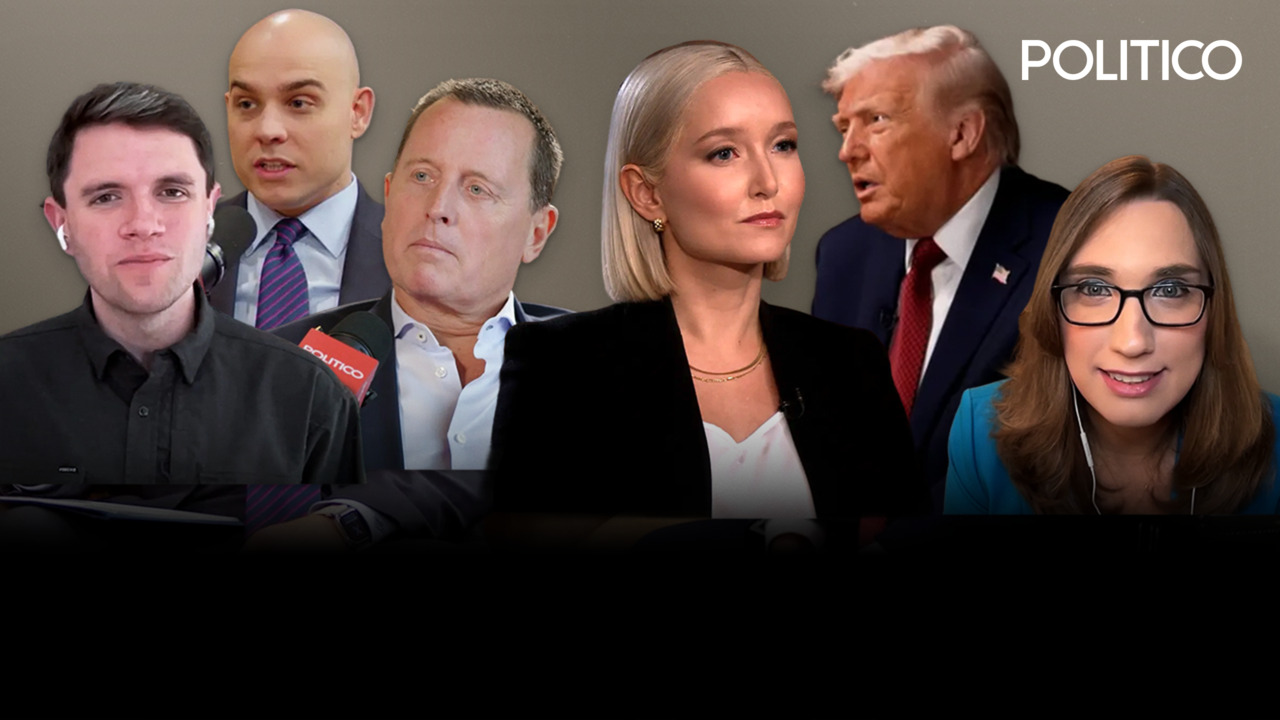
In this week’s episode of The Conversation, Rayfield talks with POLITICO’s Dasha Burns about how he’s trying to defend states rights by fending off the Trump administration’s attempted National Guard incursion in Portland, the reality of what’s happening in the city, freedom of speech and how progressive policies have drawn outside attention to the state in recent years.

Plus, blogger and activist Vani Hari — better known as “The Food Babe” — joins the show to talk about her influence on HHS Secretary Robert F. Kennedy Jr. and how she hopes to help the MAHA agenda become reality.

Check out the interview with Dan Rayfield on YouTube and the full episode wherever you get your podcasts.

​Politics

Categories
Politics

The nation’s cartoonists on the week in politics

Every week political cartoonists throughout the country and across the political spectrum apply their ink-stained skills to capture the foibles, memes, hypocrisies and other head-slapping events in the world of politics. The fruits of these labors are hundreds of cartoons that entertain and enrage readers of all political stripes. Here’s an offering of the best of this week’s crop, picked fresh off the Toonosphere. Edited by Matt Wuerker.

​Politics