Categories
Politics

The nation’s cartoonists on the week in politics

Every week political cartoonists throughout the country and across the political spectrum apply their ink-stained skills to capture the foibles, memes, hypocrisies and other head-slapping events in the world of politics. The fruits of these labors are hundreds of cartoons that entertain and enrage readers of all political stripes. Here’s an offering of the best of this week’s crop, picked fresh off the Toonosphere. Edited by Matt Wuerker.

​Politics

Categories
Politics

Winning with misinformation: New research identifies link between endorsing easily disproven claims and prioritizing symbolic strength

For some symbolic thinkers, an independent mind is paramount. Axel Bueckert/iStock via Getty Images Plus

Why do some people endorse claims that can easily be disproved? It’s one thing to believe false information, but another to actively stick with something that’s obviously wrong.

Our new research, published in the Journal of Social Psychology, suggests that some people consider it a “win” to lean in to known falsehoods.

We are social psychologists who study political psychology and how people reason about reality. During the pandemic, we surveyed 5,535 people across eight countries to investigate why people believed COVID-19 misinformation, like false claims that 5G networks cause the virus.

The strongest predictor of whether someone believed in COVID-19-related misinformation and risks related to the vaccine was whether they viewed COVID-19 prevention efforts in terms of symbolic strength and weakness. In other words, this group focused on whether an action would make them appear to fend off or “give in” to untoward influence.

This factor outweighed how people felt about COVID-19 in general, their thinking style and even their political beliefs.

Our survey measured it on a scale of how much people agreed with sentences including “Following coronavirus prevention guidelines means you have backed down” and “Continuous coronavirus coverage in the media is a sign we are losing.” Our interpretation is that people who responded positively to these statements would feel they “win” by endorsing misinformation – doing so can show “the enemy” that it will not gain any ground over people’s views.

When meaning is symbolic, not factual

Rather than consider issues in light of actual facts, we suggest people with this mindset prioritize being independent from outside influence. It means you can justify espousing pretty much anything – the easier a statement is to disprove, the more of a power move it is to say it, as it symbolizes how far you’re willing to go.

When people think symbolically this way, the literal issue – here, fighting COVID-19 – is secondary to a psychological war over people’s minds. In the minds of those who think they’re engaged in them, psychological wars are waged over opinions and attitudes, and are won via control of belief and messaging. The U.S. government at various times has used the concept of psychological war to try to limit the influence of foreign powers, pushing people to think that literal battles are less important than psychological independence.

By that same token, vaccination, masking or other COVID-19 prevention efforts could be seen as a symbolic risk that could “weaken” one psychologically even if they provide literal physical benefits. If this seems like an extreme stance, it is – the majority of participants in our studies did not hold this mindset. But those who did were especially likely to also believe in misinformation.

In an additional study we ran that focused on attitudes around cryptocurrency, we measured whether people saw crypto investment in terms of signaling independence from traditional finance. These participants, who, like those in our COVID-19 study, prioritized a symbolic show of strength, were more likely to believe in other kinds of misinformation and conspiracies, too, such as that the government is concealing evidence of alien contact.

In all of our studies, this mindset was also strongly associated with authoritarian attitudes, including beliefs that some groups should dominate others and support for autocratic government. These links help explain why strongman leaders often use misinformation symbolically to impress and control a population.

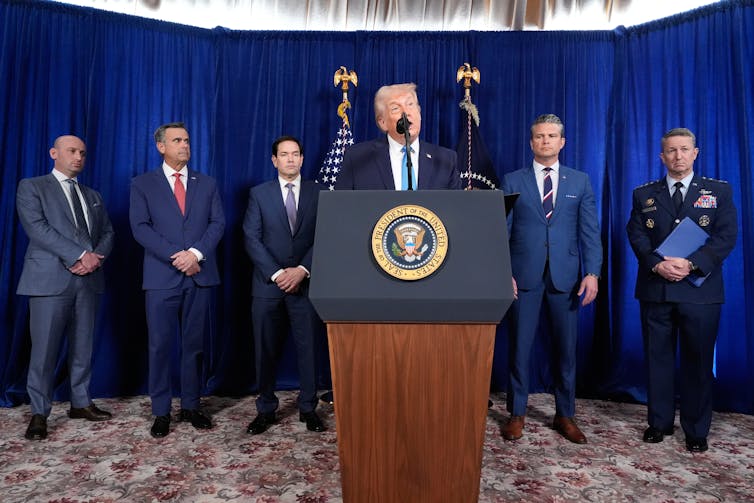
President Trump speaks into a microphone with various uniformed people behind him
Attempts to debunk misinformation look weak to someone who values a symbolic show of strength, while standing by a disprovable statement seems powerful.
Anna Moneymaker/Getty Images

Why people endorse misinformation

Our findings highlight the limits of countering misinformation directly, because for some people, literal truth is not the point.

For example, President Donald Trump incorrectly claimed in August 2025 that crime in Washington D.C. was at an all-time high, generating countless fact-checks of his premise and think pieces about his dissociation from reality.

But we believe that to someone with a symbolic mindset, debunkers merely demonstrate that they’re the ones reacting, and are therefore weak. The correct information is easily available, but is irrelevant to someone who prioritizes a symbolic show of strength. What matters is signaling one isn’t listening and won’t be swayed.

In fact, for symbolic thinkers, nearly any statement should be justifiable. The more outlandish or easily disproved something is, the more powerful one might seem when standing by it. Being an edgelord – a contrarian online provocateur – or outright lying can, in their own odd way, appear “authentic.”

Some people may also view their favorite dissembler’s claims as provocative trolling, but, given the link between this mindset and authoritarianism, they want those far-fetched claims acted on anyway. The deployment of National Guard troops to Washington, for example, can be the desired end goal, even if the offered justification is a transparent farce.

Is this really 5-D chess?

It is possible that symbolic, but not exactly true, beliefs have some downstream benefit, such as serving as negotiation tactics, loyalty tests, or a fake-it-till-you-make-it long game that somehow, eventually, becomes a reality. Political theorist Murray Edelman, known for his work on political symbolism, noted that politicians often prefer scoring symbolic points over delivering results – it’s easier. Leaders can offer symbolism when they have little tangible to provide.

The Conversation

The authors do not work for, consult, own shares in or receive funding from any company or organization that would benefit from this article, and have disclosed no relevant affiliations beyond their academic appointment.

​Politics + Society – The Conversation

Categories
Politics

When government websites become campaign tools: Blaming the shutdown on Democrats has legal and political risks

Screenshot of the Department of Health and Human Services homepage on Oct. 14, 2025. HHS website

For decades, federal shutdowns have mostly been budget fights. The 2025 one has become bigger than that: It’s turned into a messaging war.

Official government communications, including website banners, out-of-office email replies and autogenerated responses that denounce “Senate Democrats,” “the Radical Left” or “Democrats’ $1.5 trillion wishlist” for closing the government, mark a sharp break from past practice.

These messages are more than rhetorical escalation. Many may violate the Hatch Act, the 1939 statute that limits partisan political activity by federal employees and agencies. They also represent new tests for how far a White House can push the bounds of campaign-style messaging while also claiming to govern.

In any democracy, power lies not only in who writes the laws or signs the budgets but in who shapes the story. Communication is not an afterthought or byproduct of governance. It is one of its essential instruments. Political narrative helps citizens understand who’s responsible, who’s acting in good faith and who’s to blame.

The 2025 shutdown has turned that truth into strategy. Federal communication systems – agency websites, automated emails and public information portals – are being used to persuade rather than inform. It’s a move that is both politically risky and legally perilous.

Serve the public, not a party

The Hatch Act was passed during the Great Depression, after years of concern that federal agencies were being used improperly as political machines. Its goal was simple: to ensure that public servants worked for the American people, not for the party in power.

At its core, the Hatch Act prohibits executive branch federal employees – except for the president and vice president – from engaging in partisan political activity as part of their official duties or under their official authority. Government workers may not use their positions or public resources to influence elections, coerce individual behavior or engage in political advocacy.

The law requires federal agencies to avoid the partisan fray and focus on serving the public rather than political agendas.

The Office of Special Counsel, which enforces the law, has been clear on this point. “The purpose of the Act,” says an Office of Special Counsel guide written for federal employees, “is to maintain a federal workforce that is free from partisan political influence or coersion.” Government communication can inform, but it cannot campaign.

An email auto-reply from the Department of Education blaming the shutdown on Democrats.
An auto-reply to an email sent to the press staff at the U.S. Department of Education on Oct. 14, 2025.
CC BY

Yet the shutdown has already produced multiple potential violations:

• The Department of Education, according to a lawsuit, altered employees’ email auto-responses – without consent – to say things like “the Democrats have shut the government down.” Such changes do more than convey impartial information. They compel employees to align themselves with institutionally imposed scripts.

• Likewise, agencies including Health and Human Services and the Small Business Administration reportedly distributed or directed staff to adopt partisan out-of-office auto-replies assigning blame to Democrats.

• The Department of Housing and Urban Development posted a banner on its official website stating that the “Radical Left are going to shut down the government.”

Taken individually, each incident might provoke a Hatch Act complaint. Collectively, they amount to a systematic campaign to transform nonpartisan federal agencies into partisan political messengers.

'The radical left in Congress shut down the government' reads a banner across the US Department of Housing and Urban Development homepage, Oct. 14, 2025.
The message on the U.S. Department of Housing and Urban Development homepage, Oct. 14, 2025.
U.S. Department of Housing and Urban Development

Why this is unprecedented

What sets the 2025 messaging apart isn’t just its volume – it’s the scale, the coordination and the brazenness of its political targeting.

In past shutdowns, partisan spin lived mostly in press conferences and campaign talking points. Agencies themselves, even under pressure, stayed neutral.

This time, the administration is using the machinery of government to deliver partisan blame.

The timing and similarity of messages across departments seems coordinated. Housing and Urban Development posted a banner blaming Democrats the day before the shutdown began. Within hours, other agencies followed using nearly identical language.

More troubling are the reported changes to federal employees’ auto-replies without their consent.

These missives forced career civil servants, many of them furloughed, to become unwilling messengers for partisan ends. Federal agencies and their workers are supposed to serve everyone, not only those who support the party in power.

And because the watchdogs who could enforce the legal boundary are also sidelined – the Office of Special Counsel is furloughed – complaints have nowhere to go, at least for now. They simply land in unattended email inboxes.

Legal challenges and limits

Whether shutdown communications truly violate the Hatch Act – or related laws – is not yet clear. The administration could argue that it’s not campaigning but merely explaining why services are suspended. As a scholar of political communication and American democracy, I believe that defense weakens when official messages explicitly assign partisan blame or name a political party.

And not every political statement is a Hatch Act violation. The law allows employees to express views off duty or in private contexts, so long as they use their own phones and computers.

Even if the Office of Special Counsel later finds violations, harm will likely persist. Once messages are posted or auto-replies sent, their effects can’t always be undone. And because ethics officials are furloughed, too, accountability will be delayed, if it comes at all.

Some employees are likely to claim their speech rights were violated by being forced to send partisan messages. This is an argument already at the heart of the lawsuit filed by the American Federation of Government Employees against the Education Department.

A sign on a door warns people that during a partial government shutdown, the IRS office will be closed.
Doors at the Internal Revenue Service in a Seattle federal building are locked and a sign advises that the office will be closed during the 2018-2019 partial government shutdown.
AP Photo/Elaine Thompson

Why this matters

Federal agencies exist to administer laws impartially and to do so on behalf of the people.

When the government uses its own infrastructure for partisan messaging, the very neutrality on which democratic governance depends erodes. It dilutes public trust in the idea of a neutral state.

The damage also extends into the future. If the current administration succeeds in turning its administrative machinery into a political weapon, without consequence, a precedent will be created. Future presidents may be tempted to follow suit, making acceptable the use of taxpayer-funded systems as campaign tools.

And because enforcement bodies such as the Office of Special Counsel also are sidelined during a shutdown, accountability has to wait. That creates an asymmetry of power: One side gets to amplify its message through government channels in real time, while its opponents must wait for the system to restart just to file a complaint. By the time they can, the moment will have passed and the political narrative is likely to have already hardened.

Crises demand explanation, even blame. Citizens expect their leaders to tell them what went wrong. But they also expect honesty and fairness in how that story is told. The administration’s messaging strategy during this shutdown tests whether government communication remains a public service or becomes another instrument of political power.

The Conversation

Stephanie A. (Sam) Martin does not work for, consult, own shares in or receive funding from any company or organization that would benefit from this article, and has disclosed no relevant affiliations beyond their academic appointment.

​Politics + Society – The Conversation

Categories
Politics

The limits of free speech protections in American broadcasting

FCC Chairman Brendan Carr testifies in Washington on May 21, 2025. Brendan Smialowski/AFP via Getty Image

The chairman of the Federal Communications Commission is displeased with a broadcast network. He makes his displeasure clear in public speeches, interviews and congressional testimony.

The network, afraid of the regulatory agency’s power to license their owned-and-operated stations, responds quickly. They change the content of their broadcasts. Network executives understand the FCC’s criticism is supported by the White House, and the chairman implicitly represents the president.

I’m not just referring to the recent controversy between FCC Chairman Brendan Carr, ABC and Jimmy Kimmel. The same chain of events has happened repeatedly in U.S. history.

President Franklin Delano Roosevelt’s FCC chairman, James Lawrence Fly, warned the networks about censoring news commentators.

Then there was John F. Kennedy’s FCC chairman, Newton Minow, who criticized the networks for not airing more news and public affairs programming to support American democracy during the Cold War.

And there was George W. Bush’s FCC chairman, Michael Powell. He decided that a fleeting “wardrobe malfunction” during the 2004 Super Bowl halftime show – when Janet Jackson’s breast was exposed – was sufficient to punish CBS with a fine.

In each of those cases, the FCC represented the views of the White House. And in each case, the regulatory agency was employed to pressure the networks into airing content more aligned with the administration’s ideology.

But what’s interesting in those four examples is that two of the FCC chairmen were Democrats – Fly and Minow – and two were Republicans – Powell and Carr.

As a media historian, I’m aware of the long-existing bipartisan enthusiasm for exploiting the fact that no First Amendment exists in American broadcasting. Pressuring broadcasters by leveraging FCC power occurs regardless of which party controls the White House. And when the agency is used in partisan fashion, the rival party will criticize such politicization of regulation as a threat to free speech.

This recurring cycle is made possible by the fact that broadcasting is licensed by the government. Since a Supreme Court decision in 1943, the supremacy of the FCC in broadcast regulation has been unquestioned.

Such strong governmental oversight separates broadcasting from any other medium of mass communication in the United States. And it’s the reason why there’s no “free speech” when it comes to Kimmel, or any other performer, on U.S. airwaves.

The FCC’s empowerment

Since its establishment in 1934, the FCC’s primary role in broadcasting has been to authorize local station licenses “in the public interest, convenience, or necessity.”

In 1938, the FCC began its first investigation into network practices and policies, which resulted in new regulations. One of the new rules stated that no network could own and operate more than one licensed station in any single market. This forced NBC, which owned two networks that operated stations in several markets, to divest itself of one of its networks. NBC sued.

In the first serious constitutional test of the FCC’s full authority, in 1943, the Supreme Court vindicated the FCC’s expansive power over all U.S. broadcasting in its 5–4 verdict in National Broadcasting Co. v. United States. The ruling has stood since.

That’s why there’s no First Amendment in broadcasting. The Supreme Court ruled that, due to spectrum scarcity – the idea that the airwaves are a limited public resource and therefore not every American can operate a broadcast station – the FCC’s power over broadcasting must be expansive.

The 1934 act, the 1943 Supreme Court decision read, “gave the Commission … expansive powers … and a comprehensive mandate to ‘encourage the larger and more effective use of radio in the public interest,’ if need be, by making ‘special regulations applicable to radio stations engaged in chain (network) broadcasting.’”

The ruling also explains why the FCC can be credited with having created the American Broadcasting Company. Yes, the same ABC that suspended Kimmel in the face of FCC threats was the network that emerged from NBC’s forced divestiture of its Blue Network as a result of the 1943 Supreme Court decision.

The empowerment of the FCC by NBC v. U.S. led to such content restrictions as the Fairness Doctrine, which intended to ensure balanced political broadcasting, instituted in 1949, and later, additional FCC rules against obscenity and indecency on the airwaves. The Supreme Court decision also encouraged FCC chairmen to flex their regulatory muscles in public more often.

A Black woman and white man sing onstage.
A federal appeals court ruled on Nov. 2, 2011, that CBS should not be fined US$550,000 for Janet Jackson’s infamous ‘wardrobe malfunction.’
AP Photo/David Phillip

For example, when CBS suspended news commentator Cecil Brown in 1943 for truthful but critical news commentary about the U.S. World War II effort, FCC Chairman Fly expressed his displeasure with the network’s decision.

“It is a little strange,” Fly told the press, “that all Americans are to enjoy free speech except radio commentators.”

When FCC Chairman Minow complained about television in the U.S. devolving into a “vast wasteland” in 1961, the networks responded both defensively and productively. They invested far more money into news and public affairs programming. That led to significantly more news reporting and documentary production throughout the 1960s and 1970s.

A ‘hands-off’ FCC

In the early 2000s, FCC Chairman Powell promised to “refashion the FCC into an outfit that is fast, decisive and, above all, hands-off.”

Yet his promise to be “hands-off” did not apply to content regulation. In 2004, his FCC concluded a contentious legal battle with Clear Channel Communications over comments ruled “indecent” by shock jock Howard Stern. The settlement resulted in a US$1.75 million payment by Clear Channel Communications – the largest fine ever collected by the FCC for speech on the airwaves.

Powell apparently enjoyed policing content, as evidenced by the $550,000 fine his FCC levied against CBS for the fleeting exposure of singer Janet Jackson’s breast during the Super Bowl. The fine was eventually overturned. But Powell did successfully lobby Congress to significantly hike the amount of money the FCC could fine broadcasters for indecency. The fine for a single incident increased from $32,000 to $325,000, and up to $3 million if a network broadcasts it on multiple stations.

Powell’s regulatory activism, done mostly to curb the outrageous antics of radio shock jocks, resulted in some of the most significant and long-lasting restrictions on broadcast freedom in U.S. history. Thus, Carr’s 2025 threats toward ABC can be viewed in a historical context as an extension of established FCC activism.

Demonstrators holds signs in front of a building with columns.
Demonstrators hold signs on Sept. 18, 2025, outside Los Angeles’ El Capitan Entertainment Centre, where the late-night show ‘Jimmy Kimmel Live!’ is staged.
AP Photo/Damian Dovarganes

But Carr’s threat also appeared to contradict his previously espoused values.

As the author of the FCC section in Project 2025, a conservative blueprint for federal government policies, Carr wrote: “The FCC should promote freedom of speech … and pro-growth reforms that support a diversity of viewpoints.” In exploiting the FCC’s licensing power to threaten to penalize speech he found offensive, Carr failed to promote either freedom of speech or diversity of viewpoints.

If there’s one thing the Carr-Kimmel episode teaches us, it’s that more Americans should know the structural constraints in the U.S. system of broadcasting. Media literacy has proved essential as curbs to free expression – both official and unofficial – have become more popular.

When the FCC threatens a broadcaster, it does so in Americans’ name.

If Americans applaud regulatory activism when it supports their partisan beliefs, consistency demands they accept the same regulatory activism in the hands of their political opponents. If Americans prefer their political opposition show restraint in the regulation of broadcasting, then they need to promote restraint when their preferred administration is in power.

The Conversation

Michael J. Socolow does not work for, consult, own shares in or receive funding from any company or organization that would benefit from this article, and has disclosed no relevant affiliations beyond their academic appointment.

​Politics + Society – The Conversation

Categories
Politics

Jeffries talked redistricting with Illinois delegation

House Minority Leader Hakeem Jeffries met in a Zoom meeting with members of the Illinois congressional delegation Monday to talk about redistricting in the state — an effort that is already triggering concern among lawmakers who fear the changes could dilute Black political power.

No maps were shown to the group but some versions of boundaries have been shared during individual conversations, according to one person in the meeting who was granted anonymity to speak freely.

“It’s what you’d expect. They’re trying to get another district,” the person said, adding that Republican Rep. Mary Miller’s downstate district appears to be the target. Miller is one of three Republicans in the 17-member delegation.

Redistricting talk is raising concern that adjusting congressional boundaries could dilute Black communities in districts, thereby undermining Black political influence.

“At what cost do you try to get one more seat? How many more do you put in jeopardy?” said another person on the call who was also granted anonymity to speak about a private meeting.

The implications go beyond Illinois. As national Democrats look ahead to the 2026 and 2028 election cycles, there’s pressure to find winnable seats in Republican-dominated districts. Any redistricting effort in Illinois would come before the midterms in an effort to counter Republicans’ push for more favorable maps to keep the House.

Jeffries sees Illinois and Maryland as states that could pick up Democrats, according to one of the people in Monday’s meeting.

A few weeks ago during a visit to Springfield, Jeffries acknowledged the push to get more seats in some states, including Illinois. President Donald Trump wants to “rig the midterms,” he told POLITICO. “Democrats will respond in self-defense of the American people.”

Illinois Gov. JB Pritzker didn’t immediately return a request for comment, but he previously has not ruled out congressional redistricting. “None of us want to do it. None of us want to go through a redistricting process. But if we’re forced to, it’s something we’ll consider doing,” he said in a recent interview.

The Illinois General Assembly, which is controlled by Democrats in both chambers, would have to vote on any new maps.

After the 2020 census, Democrats redrew district maps to adjust for losing a seat because of population decline. They cut out two Republican incumbents and created a new district favoring their party. The state’s congressional delegation now includes 14 Democrats and three Republicans from deeply conservative areas of the state.

Regardless of the political dynamics, candidates have until Nov. 3 to file for congressional races, meaning any revised map would need to be finalized before that deadline.

Election attorneys in Illinois say the Legislature can make adjustments to accommodate new boundaries.

“The main complication is that currently, each district has a different signature requirement, based on the number of votes cast in that district in the last primary,” said election lawyer Michael Dorf, whose past clients include the Democratic Party of Illinois and several statewide officials. “But the Legislature could revert to the standard used in the first election following a redistricting, where every congressional candidate just needs 600 signatures.”

So far, leaders in the Illinois House and Senate say there are no ongoing talks about altering the current map. But it could come up in caucus meetings today when lawmakers return for a legislative session to take up new bills and address potential vetoes.

“We haven’t seen any maps. We haven’t had any conversations with our members about maps,” House Speaker Emanuel “Chris” Welch said in a statement when asked Monday whether his caucus would be addressing the issue.

Illinois House Republican Leader Tony McCombie said “it would be obscene” for Illinois Democrats “to erase” any Republican-held seats given Trump won 44 percent of the statewide vote.

​Politics

Categories
Politics

Pennsylvania man pleads guilty in arson attack at governor’s mansion while Shapiro’s family slept

A man who scaled an iron security fence in the middle of the night, eluded police and used beer bottles filled with gasoline to ignite the occupied Pennsylvania governor’s mansion pleaded guilty Tuesday to attempted murder and other charges.

Cody Balmer, 38, also entered pleas to terrorism, 22 counts of arson, aggravated arson, burglary, aggravated assault of Gov. Josh Shapiro, 21 counts of reckless endangerment and loitering in the April 13 attack that did millions of dollars in damage to the state-owned brick building.

Under a plea deal, Balmer was sentenced to 25 to 50 years in prison.

Shapiro and members of his family had to be awakened and evacuated, but no one was injured. The multiple endangerment charges reflected the number of people in the residence at the time, including the governor’s family, guests and state troopers.

The fire was set hours after they celebrated the Jewish holiday of Passover with a Seder in the residence. Prosecutors played video clips that showed Molotov cocktails going off and a figure inside and outside the residence. Judge Deborah Curcillo called the video “horrific” and “very frightening.”

Balmer told police he planned to beat Shapiro with a small sledgehammer if he had encountered him after breaking into the building, according to court documents. Balmer turned himself in the next afternoon to face charges of attempted homicide, terrorism, aggravated arson and aggravated assault.

Police say Balmer broke in through the southern wing of the residence, into a room often used to entertain crowds and display art. Investigators recovered two broken glass beer bottles containing gasoline. The fire charred walls, tables, buffet serving dishes, plates and a piano. Window panes and brick around doors and windows were also damaged.

Shapiro’s Jewish faith and the attack during the Passover weekend raised questions about Balmer’s motivation, but Balmer told The Associated Press in a May letter from jail that had not been a factor in his decision.

“He can be Jewish, Muslim, or a purple people eater for all I care and as long as he leaves me and mine alone,” Balmer wrote.

He said in a brief June 9 video interview from Camp Hill State Prison that he did think beforehand about whether children might be injured.

“Does anyone ever consider children?” Balmer said in June. “It doesn’t seem that way. I sure as hell did. I’m glad no one got hurt.” Asked why he felt Shapiro had somehow done him wrong, Balmer replied: “I’m not going to answer that.”

Balmer’s mother said days after his arrest that she had tried to get him assistance for mental health issues, but “nobody would help.” Court proceedings had been delayed while he received mental health treatment, his lawyer has said.

At a court hearing a few days after the fire, Balmer told a judge he was an unemployed welder with no income or savings and “a lot of children.”

The residence, built in 1968, did not have sprinklers. Work to fix the damage and to bolster its security features continues.

​Politics

Categories
Politics

‘It’s revolting’: More Young Republican chat members out of jobs as condemnation intensifies

NEW YORK — Two more members of a Young Republican group chat strewn with racist epithets and hateful jokes stepped down from their jobs Tuesday after POLITICO published an exclusive report on the Telegram exchanges.

Peter Giunta’s time working with New York Assemblymember Mike Reilly “has ended,” the Republican lawmaker said. Giunta served as chair of the New York State Young Republicans when the chat took place. Joseph Maligno, who previously identified himself as the general counsel for that group, is no longer an employee of the New York State Unified Court System, a courts spokesperson confirmed.

Another chat member, Vermont state Senator Sam Douglass, faced mounting calls for his resignation as well, including from the state’s Gov. Phil Scott, a Republican, and Douglass’ fellow Republican lawmakers, who called his statements “deeply disturbing.”

POLITICO’s in-depth look into how one group of Young Republicans spoke privately was met Tuesday with widespread condemnation in New York, Washington and beyond. The members of the chat — 2,900 pages of which were leaked and reviewed by POLITICO — called Black people monkeys, repeatedly used slurs for gay, Black, Latino and Asian people, and jokingly celebrated Adolf Hitler.

In a bipartisan outcry, members of Congress and other political leaders from around the country said they were appalled by the contents of the group chat. The board of directors of the National Young Republicans said every member of the chat “must immediately resign” their state organization.

Senate Minority Leader Chuck Schumer, speaking on the Senate floor, described the chat as “revolting” and “disgusting.”

“If this report is accurate, every single Republican leader from President Trump on down … ought to condemn these comments swiftly and unequivocally,” Schumer said.

Vice President JD Vance had a different view and broke with Republicans who broadly condemned the comments within the chat.

On X Tuesday night, Vance drew attention to Democratic candidate for Virginia attorney general Jay Jones, who texted a colleague about shooting the then-Republican House speaker and wishing harm on his children.

“This is far worse than anything said in a college group chat, and the guy who said it could become the AG of Virginia,” Vance wrote with a screenshot of the text exchange. “I refuse to join the pearl clutching when powerful people call for political violence.”

The fallout over the Telegram group chat comes after two others in the slur-laced private exchanges saw their job statuses change before the article even published. William Hendrix, the Kansas Young Republicans’ vice chair at the time of the chat, is “no longer employed” at Kansas Attorney General Kris Kobach’s office. Bobby Walker, who was chair of the New York State Young Republicans as of Tuesday, will not be brought onto New York congressional candidate Peter Oberacker’s campaign as originally planned.

Maligno and Douglass did not respond to repeated requests for comment. In separate statements, both Giunta and Walker apologized for the messages they wrote in the chat but questioned whether they had been altered or taken out of context. They also attempted to blame the release of their chat on the New York Young Republican Club, a political group that operates at the city level and which is often at odds with the state group.

“I am so sorry to those offended by the insensitive and inexcusable language found within the more than 28,000 messages of a private group chat that I created during my campaign to lead the Young Republicans,” Giunta said. “These logs were sourced by way of extortion and provided to POLITICO by the very same people conspiring against me in what appears to be a highly-coordinated year-long character assassination led by Gavin Wax and the New York City Young Republican Club.”

Walker struck a similar tone.

“There is no excuse for the language and tone in messages attributed to me. The language is wrong and hurtful, and I sincerely apologize,” he said. “It’s troubling that private exchanges were obtained and released in a way clearly intended to inflict harm, and the circumstances raise real questions about accuracy and motive but none of that excuses the language. This has been a painful lesson about judgment and trust.”

Wax declined POLITICO’s request for comment.

New York Republican leaders, including Rep. Elise Stefanik, state Senate Minority Leader Rob Ortt and state party chair Ed Cox, had preemptively denounced the chat as POLITICO reported out the story.

“We are appalled by the vile and inexcusable language revealed in the Politico article published today. Such behavior is disgraceful, unbecoming of any Republican, and stands in direct opposition to the values our movement represents,” the National Young Republicans group said Tuesday in a statement posted on X.

New York Democrats piled on after the conversations became public.

“Take them out of the party, take away their official roles, stop using them as campaign advisers. There needs to be consequences. This bullshit has to stop,” Gov. Kathy Hochul told reporters.

House Minority Leader Hakeem Jeffries posted an image of POLITICO’s article on Instagram and wrote: “These are sick people. Every single one of these racists and antisemites must be publicly exposed and held accountable.”

Rep. Yvette Clarke, chair of the Congressional Black Caucus, quoted from the article — “Monkeys” “Watermelon people” “1488” — and added on X, “But when we say white supremacy is thriving on the right, they call us reactionary… Give me a break. The future of the Republican Party proudly embraces bigotry that belongs in the past, and every American needs to recognize how dangerous that is.”

Rep. Grace Meng, chair of the Congressional Asian Pacific American Caucus, said in a statement that “their willingness to engage in such vile rhetoric behind closed doors speaks volumes to their character and the tone set by our nation’s leaders.”

POLITICO’s reporting on the thousands of messages shared among a dozen Young Republican club members between January and August also reverberated Tuesday in one of the country’s most contentious congressional battlegrounds.

The Democrat-aligned House Majority PAC shared photos of Giunta and Walker with vulnerable New York GOP Rep. Mike Lawler at local GOP events. And some of Lawler’s Democratic challengers, including Beth Davidson, Cait Conley and Mike Sacks, amplified the connection between the New York Republicans.

“You are the company you keep,” Conley wrote on X.

Lawler, who represents the suburbs north of New York City, disavowed the chat members and called for their resignations.

“The deeply offensive and hateful comments reportedly made in a private chat among members of the New York State Young Republicans are disgusting,” his spokesperson Ciro Riccardi said in a statement. “They should resign from any leadership position immediately and reflect on how far they have strayed from basic human respect and decency.”

Ahead of next year’s midterms, the union- and Democrat-backed Battleground New York PAC ramped up the pressure on the state’s GOP representatives.

“These racist, anti-Semitic, and disgusting texts need to be disavowed, full stop, by New York Republicans,” the group’s spokesperson Andrew Grossman said. “Then, New York Republicans need to come clean about the rot within their party that even led to this moment.”

​Politics

Categories
Politics

‘I love Hitler’: Leaked messages expose Young Republicans’ racist chat

NEW YORK — Leaders of Young Republican groups throughout the country worried what would happen if their Telegram chat ever got leaked, but they kept typing anyway.

They referred to Black people as monkeys and “the watermelon people” and mused about putting their political opponents in gas chambers. They talked about raping their enemies and driving them to suicide and lauded Republicans who they believed support slavery.

William Hendrix, the Kansas Young Republicans’ vice chair, used the words “n–ga” and “n–guh,” variations of a racial slur, more than a dozen times in the chat. Bobby Walker, the vice chair of the New York State Young Republicans at the time, referred to rape as “epic.” Peter Giunta, who at the time was chair of the same organization, wrote in a message sent in June that “everyone that votes no is going to the gas chamber.”

Giunta was referring to an upcoming vote on whether he should become chair of the Young Republican National Federation, the GOP’s 15,000-member political organization for Republicans between 18 and 40 years old.

“Im going to create some of the greatest physiological torture methods known to man. We only want true believers,” he continued.

Two members of the chat responded.

“Can we fix the showers? Gas chambers don’t fit the Hitler aesthetic,” Joe Maligno, who previously identified himself as the general counsel for the New York State Young Republicans, wrote back.

“I’m ready to watch people burn now,” Annie Kaykaty, New York’s national committee member, said.

The exchange is part of a trove of Telegram chats — obtained by POLITICO and spanning more than seven months of messages among Young Republican leaders in New York, Kansas, Arizona and Vermont. The chat offers an unfiltered look at how a new generation of GOP activists talk when they think no one is listening. 

Since POLITICO began making inquiries, one member of the group chat is no longer employed at their job and another’s job offer was rescinded. Prominent New York Republicans, including Rep. Elise Stefanik and state Senate Minority Leader Rob Ortt, have denounced the chat. And festering resentments among Young Republicans have now turned into public recriminations, including allegations of character assassination and extortion.

A liberating atmosphere

The 2,900 pages of chats, shared among a dozen millennial and Gen Z Republicans between early January and mid-August, chronicle their campaign to seize control of the national Young Republican organization on a hardline pro-Donald Trump platform. Many of the chat members already work inside government or party politics, and one serves as a state senator.

Together, the messages reveal a culture where racist, antisemitic and violent rhetoric circulate freely — and where the Trump-era loosening of political norms has made such talk feel less taboo among those positioning themselves as the party’s next leaders.

“The more the political atmosphere is open and liberating — like it has been with the emergence of Trump and a more right wing GOP even before him — it opens up young people and older people to telling racist jokes, making racist commentaries in private and public,” said Joe Feagin, a Texas A&M sociology professor who has studied racism for the last 60 years. He’s also concerned the words would be applied to public policy. “It’s chilling, of course, because they will act on these views.”

The dynamic of easy racism and casual cruelty played out in often dark, vivid fashion inside the chats, where campaign talk and party gossip blurred into streams of slurs and violent fantasies.

Peter Giunta participates in a CNN-POLITICO Grill discussion at the Republican National Convention in Milwaukee, July 16, 2024.

The group chat members spoke freely about the pressure to cow to Trump to avoid being called a RINO, the love of Nazis within their party’s right wing and the president’s alleged work to suppress documents related to wealthy financier Jeffrey Epstein’s child sex crimes.

“Trumps too busy burning the Epstein files,” Alex Dwyer, the chair of the Kansas Young Republicans, wrote in one instance.

Dwyer and Kaykaty declined to comment. Maligno and Hendrix did not return requests for comment.

But some involved in the chat did respond publicly.

Giunta claimed the release of the chat is part of “a highly-coordinated year-long character assassination led by Gavin Wax and the New York City Young Republican Club” — an allusion to a once obscured internecine war that has now spilled into the open.

“These logs were sourced by way of extortion and provided to POLITICO by the very same people conspiring against me,” he said. “What’s most disheartening is that, despite my unwavering support of President Trump since 2016, rouge [sic] members of his administration — including Gavin Wax — have participated in this conspiracy to ruin me publicly simply because I challenged them privately.”

Wax, a staffer in Trump’s State Department, formerly led the New York Young Republican Club — a separate, city-based group that is at odds with the state organization, the New York State Young Republicans. He declined to comment.

Despite his allusions to infighting, Giunta still apologized.

“I am so sorry to those offended by the insensitive and inexcusable language found within the more than 28,000 messages of a private group chat that I created during my campaign to lead the Young Republicans,” he said. “While I take complete responsibility, I have had no way of verifying their accuracy and am deeply concerned that the message logs in question may have been deceptively doctored.”

At least one person in the Telegram chat works in the Trump administration: Michael Bartels, who, according to his LinkedIn account, serves as a senior adviser in the office of general counsel within the U.S. Small Business Administration. Bartels did not have much to say in the chat, but he didn’t offer any pushback against the offensive rhetoric in it either. He declined to comment.

A notarized affidavit signed by Bartels and obtained by POLITICO also sheds light on the intraparty rivalry that led the “RESTOREYR WAR ROOM” Telegram chat to be made public. Bartels references Wax as well. He wrote that he did not give POLITICO the chat and that Wax “demanded” in a phone call that he provide the full chat log.

“When I attempted to resist that demand, after providing some of the requested information, Wax threatened my professional standing, and raised the possibility of potential legal action related to an alleged breach of a non-disclosure agreement,” Bartels claimed in the affidavit. “My position within the New York Young Republican Club was directly threatened.”

Walker, who now leads the New York State Young Republicans, touched on a similar theme, saying that he believes portions of the chat “may have been altered, taken out of context, or otherwise manipulated” and that the “private exchanges were obtained and released in a way clearly intended to inflict harm.”

He also apologized.

“There is no excuse for the language and tone in messages attributed to me. The language is wrong and hurtful, and I sincerely apologize,” Walker said. “This has been a painful lesson about judgment and trust, and I am committed to moving forward with greater care, respect, and accountability in everything I say and do.”

251 times

Mixed into formal conversations about whipping votes, social media strategy and logistics, the members of the chat slung around an array of slurs — which POLITICO is republishing to show how they spoke. Epithets like “f—-t,” “retarded” and “n–ga” appeared more than 251 times combined.

In one instance, Walker — who at the time was a staffer for Ortt — talked about how a mutual friend of some in the chat “dated this very obese Indian woman for a period of time.”

Giunta responded that the woman “was not Indian.”

“She just didn’t bathe often,” Samuel Douglass, a state senator from northern Vermont and the head of the state’s Young Republicans, replied to Giunta.

In a separate conversation, Giunta shared that his flight to Charleston, South Carolina, landed safely. Then, he offered some advice for his fellow Young Republicans.

“If your pilot is a she and she looks ten shades darker than someone from Sicily, just end it there. Scream the no no word,” Giunta wrote.

Douglass did not respond to requests for comment.

In a statement, Ortt called for members of the chat to resign.

“I was shocked and disgusted to learn about the racist, anti-Semitic, and misogynistic comments attributed to members of the New York State Young Republicans,” Ortt said. “This behavior is indefensible and has no place in our party or anywhere in public life.”

Bobby Walker speaks at the NYSYR 2023 Winter Conference and 6th Annual Rising Stars Reception.

Walker had been in line to manage Republican Peter Oberacker’s campaign for Congress in upstate New York, but a spokesperson for the campaign said Walker won’t be brought on in light of the comments in the chat.

Seeking Trump’s endorsement

The private rhetoric isn’t happening in a vacuum. It comes amid a widespread coarsening of the broader political discourse and as incendiary and racially offensive tropes from the right become increasingly common in public debate. Last month, Trump posted an artificial intelligence-generated video that showed House Minority Leader Hakeem Jeffries in a sombrero beside Senate Minority Leader Chuck Schumer, whose fabricated remarks were about trading free health care for immigrant votes — a false, long-running GOP trope. The sombrero meme has been widely used to mock Democrats as the government shutdown wears on.

In his 2024 campaign, Trump spread false reports of Haitian migrants eating pets and, at one of his rallies, welcomed comedian Tony Hinchcliffe, who called Puerto Rico a “floating island of garbage” and joked about Black people “carving watermelons” on Halloween.

Liz Huston, a White House spokesperson, rejected the idea that Trump’s rhetoric had anything to do with the chat members’ language.

“Only an activist, left-wing reporter would desperately try to tie President Trump into a story about a random groupchat he has no affiliation with, while failing to mention the dangerous smears coming from Democrat politicians who have fantasized about murdering their opponent and called Republicans Nazis and Fascists,” she said. “No one has been subjected to more vicious rhetoric and violence than President Trump and his supporters.”

In the “RESTOREYR WAR ROOM” chat, Giunta tells his fellow Republicans that he spoke with the White House about an endorsement from Trump for his bid to become chairman of the national federation. Trump and the Republican National Committee ultimately decided to stay neutral in the race.

A White House official said that it has no affiliation with Restore YR and that hundreds of groups ask the White House for its endorsement.

Giunta was the most prominent voice in the chat spreading racist messages — often encouraged or “liked” by other members.

When Luke Mosiman, the chair of the Arizona Young Republicans, asked if the New Yorkers in the chat were watching an NBA playoff game, Giunta responded, “I’d go to the zoo if I wanted to watch monkey play ball.” Giunta elsewhere refers to Black people as “the watermelon people.”

Hendrix made a similar remark in July: “Bro is at a chicken restaurant ordering his food. Would he like some watermelon and kool aid with that?”

Hendrix was a communications assistant for Kansas’ Republican Attorney General Kris Kobach until Thursday. He also said in the chat that, despite political differences, he’s drawn to Missouri’s Young Republican organization because “Missouri doesn’t like f–s.”

William Hendrix during a portrait shoot in Topeka, Kansas,  July 16, 2021.

POLITICO reached out to Danedri Herbert, a spokesperson for the attorney general who also serves as the Kansas GOP chair, and shared with her excerpts of the chat involving Hendrix. In response, Herbert said that “we are aware of the issues raised in your article” and that Hendrix is “no longer employed” in Kobach’s office.

In another exchange, Dwyer, the Kansas’ chair, informs Giunta that one of Michigan’s Young Republicans promised him the group “will vote for the most right wing person” to lead the national organization.

“Great. I love Hitler,” Giunta responded.

Dwyer reacted with a smiley face.

Few minority groups spared

Giunta, who serves as chief of staff to New York state Assemblymember Mike Reilly, ultimately fell six points short of winning the chairship to lead the Young Republican National Federation earlier this year — despite earning endorsements from Stefanik and longtime Trump adviser Roger Stone.

Reilly did not respond to requests for comment.

Earlier this year, Stefanik accepted an award from the New York State Young Republicans. She lauded Giunta for his “tremendous leadership” in August and had her campaign and the political PAC she leads donate to that state organization. Alex deGrasse, a senior adviser for Stefanik, said the congresswoman “was absolutely appalled to learn about the alleged comments made by leaders of the New York State Young Republicans and other state YRs in a large national group chat.”

“According to the description provided by Politico, the comments were heinous, antisemitic, racist and unacceptable,” he continued, noting Stefanik has never employed anyone in the chat. “If the description by Politico is accurate, Congresswoman Stefanik calls for any NY Young Republicans responsible for these horrific comments in this chat to step down immediately.”

Stone also condemned the comments in a statement.

“I of course, have never seen this alleged chat room thread,” he said. “If it is authentic, I would, of course, denounce any such comments in the strongest possible terms, This would surprise me as it is inconsistent with Peter that I know, although I only know him in his capacity as the head of the New York Young Republicans, where I thought he did a good job.”

Few minority groups are spared from the Young Republican group’s chat. Their rhetoric — normalized at most points as dark humor — mirrors some popular conservative political commentators, podcasters and comedians amid a national erosion of what’s considered acceptable discourse.

Giunta’s line on a darker-skinned pilot, for example, echoes one used by slain conservative activist Charlie Kirk last year when he said, “If I see a Black pilot, I’m going to be like, boy, I hope he’s qualified.” Kirk was discussing how diversity hiring “invites unwholesome thinking.”

Walker also uses the moniker “eyepatch McCain” (originally coined by conservative commentator Tucker Carlson) in an apparent reference to GOP Rep. Dan Crenshaw. Crenshaw lost his eye while serving as a Navy SEAL in Afghanistan. Walker also makes the remark, “I prefer my war heroes not captured,” a repeat of a similar 2015 line from Trump.

Art Jipson, a professor at the University of Dayton who specializes in white racial extremism, surmised the Young Republicans in the chat were influenced by Trump’s language, which he said is often hyperbolic and emotionally charged.

“Trump’s persistent use of hostile, often inflammatory language that normalizes aggressive discourse in conservative circles can be incredibly influential on young operatives who are still trying to figure out, ‘What is that political discourse?’” Jipson said.

White supremacist symbols

Jipson reviewed multiple excerpts of the Young Republicans’ chat provided by POLITICO. One was a late July message where Mosiman, the chair of the Arizona Young Republicans, mused about how the group could win support for their preferred candidate by linking an opponent to white supremacist groups. But Mosiman then realized the plan could backfire — Kansas’ Young Republicans could end up becoming attracted to that opponent.

“Can we get them to start releasing Nazi edits with her… Like pro Nazi and faciam [sic] propaganda,” he asked the group.

“Omg I love this plan,” Rachel Hope, the Arizona Young Republicans events chair, responded.

“The only problem is we will lose the Kansas delegation,” Mosiman said. Hope and the two Kansas Young Republicans in the chat reacted with a laughing face to the message. Hope did not respond to requests for comment. Mosiman declined to comment.

Jipson said the Young Republicans’ conversations reminded him of online discussions between members of neo-Nazi and white supremacist groups.

“You say it once or twice, it’s a joke, but you say it 251 times, it’s no longer a joke,” Jipson said. “The more we repeat certain ideas, the more real they become to us.”

Weeks later, someone in the chat staying in a hotel asks its members to “GUESS WHAT ROOM WE’RE IN.”

“1488,” Dwyer responds. White supremacists use the number 1488 because 14 is the number of words in the white supremacist slogan “We must secure the existence of our people and a future for white children.” H is the eighth letter in the alphabet, and 88 is often used as a shorthand for “Heil Hitler.”

In another conversation in February, Giunta talks approvingly about the Orange County Teenage Republican organization in New York — which appears to be part of the network of national Teen Age Republicans — and how he was pleased with its young members’ ideological bent.

“They support slavery and all that shit. Mega based,” he said. The term “based” in internet culture is used to express approval with an idea, often one that’s bold or controversial.

In a statement, Orange County GOP Chair Courtney Canfield Greene said the party was disappointed to learn its teen group was mentioned in the chat.

“Our teen volunteers have no affiliation with the NYSYR’s or the YRNF,” she said. “This behavior has no home within the Republican Party in Orange County.”

Ed Cox, the chair of the New York State GOP, also condemned the remarks made in the chat.

“I was shocked and disgusted to learn about the reports of comments made by a small group of Young Republicans,” he said. “Just as we call out vile racist and anti-Semetic rhetoric on the far left, we must not tolerate it within our ranks.”

Vicious words for enemies

Members of the Telegram chat speak about their personal lives, too. Extensive discussions about their everyday lives include one exchange about how devoutly Catholic some chat members are and how often they attend church.

Many of the slurs, epithets and violent language used in the chat often appear to be intended as jokes.

Mosiman was derided by members of the chat as “beaner” and “sp-c.”

“Stay in the closet f—-t,” Walker of New York also jested in July, though he is the group’s main target for the same epithet.

The group used slurs against Asians, too.

“My people built the train tracks with the Chinese,” Walker says at one point, referring to his Italian ancestors.

“Let his people go!” Maligno responds. “Keep the ch–ks, though.”

In another instance, Mosiman tells the group that, “The Spanish came to America and had sex with every single woman.”

“Sex is gay,” Dwyer writes.

“Sex? It was rape,” Mosiman replies.

“Epic,” Walker says.

There’s more explicit malice in some phrases, too, especially when they turn their ire on opponents outside the chat, such as the leader of the rival Grow YR slate, Hayden Padgett, who defeated Giunta and was reelected chairman of the Young Republican National Federation this summer.

“So you mean Hayden F—-t wrote the resolution himself?” Giunta asked the group about the National Young Republicans chair in late May.

“RAPE HAYDEN,” Mosiman declared the following month.

“Adolf Padgette is in the F—-tbunker as we speak,” Walker said in July.

Padgett responded to the chat’s language in a statement.

“The Young Republican National Federation condemns all forms of racism, antisemitism, and hate,” Padgett said. “I want to be clear that such behavior is entirely inconsistent with our values and has no place within our organization or the broader conservative movement.”

Samuel Douglass.

Giunta also had expletive-laden criticism for the Young Republicans in states that were supporting or leaning toward Padgett’s faction.

“Minnesota – f—-ts,” he messaged, continuing: “Arkansas – inbred cow fuckers Nebraska – revolt in our favor; blocked their bind and have a majority of their delegates Maryland – fat stinky Jew … Rhode Island – traitorous c—s who I will eradicate from the face of this planet.”

Giunta also said he planned to make one of the competing Young Republicans “unalive himself on the convention floor.”

In another instance, Douglass, the Vermont state senator, describes to the group members how one of Padgett’s Jewish colleagues may have made a procedural error related to the number of Maryland delegates permitted at the national convention.

“I was about to say you’re giving nationals to [sic] much credit and expecting the Jew to be honest,” Brianna Douglass, Sam’s wife and Vermont Young Republican’s national committee member, replied to her husband’s message. Brianna Douglass did not respond to repeated requests for comment.

‘If we ever had a leak of this chat…’

While reporting this article, POLITICO was examining a separate allegation: that Giunta and the Young Republicans mismanaged the New York organization’s finances and hadn’t paid at least one venue for a swanky holiday party it hosted last year. POLITICO’s report detailed how the organization was missing required financial disclosure forms and how their subsequent efforts to file the forms revealed the organization was in more than $28,000 of debt. As of Tuesday, updated records show the organization is in more than $38,000 of debt.

Donations to New York State Young Republicans’ political account must be reported to the state Board of Elections. Expenditures must be reported too.

At the time, Giunta told POLITICO the allegations were “nothing more than a sad and pathetic attempt at a political hit job.” But in their “RESTOREYR WAR ROOM” chat, he and Walker speak flippantly about mishandling the club’s finances.

“NYSYR Account be like: $500 – Balding cream $1,000 – Ozempik,” Walker said in one message. “NYSYR will be declaring bankruptcy after this I just know it,” he said in another.

“I drained $10k tonight to pay for my next vacation to Italy,” Giunta appeared to joke about the organization’s bank account.

“I spent it on massage,” he says of another check that was deposited in the account.

“Great. Can’t wait to get sued by our venue,” Walker replies.

Members of the chat occasionally appeared to be aware of its toxicity and even made remarks that considered the possibility someone outside their tight-knit group could view it.

Walker seemed to consider that possibility the most.

In one instance, he joked about bombing the Young Republican National Federation’s convention in Nashville and then remarked, “Just kidding for our assigned FBI tracker.”

In another, he considered the totality of the thousands of messages he and his peers had written, and what would happen if the public saw them come to light.

“If we ever had a leak of this chat we would be cooked fr fr,” he wrote.

​Politics

Categories
Politics

Supreme Court redistricting ruling could upend decades of voting rights law – and tilt the balance of power in Washington

Black Louisiana voters and civil rights advocates ask U.S. Supreme Court justices to uphold a fair and representative congressional map in Louisiana v. Callais on March 24, 2025. Jemal Countess/Getty Images

On Oct. 15, 2025, the Supreme Court will hear oral arguments in one of the most anticipated cases of the 2025-2026 term, Louisiana v. Callais, with major implications for the Voting Rights Act, racial representation and Democratic Party power in congress.

The central question in the case is to what extent race can, or must, be used when congressional districts are redrawn. Plaintiffs are challenging whether the longstanding interpretation of Section 2 of the Voting Rights Act, which requires protection of minority voting power in redistricting, violates the Equal Protection Clause of the U.S. Constitution, which guarantees that individuals should be treated the same by the law.

In short, the plaintiffs argue that the state of Louisiana’s use of race to make a second Black-majority district is forbidden by the U.S. Constitution.

This is the second time that the court will hear oral arguments in Louisiana v. Callais after no decision was reached last term. From my perspective as a scholar of U.S. federal courts and electoral systems, this case represents the collision of decades of Supreme Court decisions on race, redistricting and the Voting Rights Act.

Long legal battle

To understand the stakes of the current case, it’s important to know what the Voting Rights Act does. Initially passed in 1965, the act helped end decades of racially discriminatory voting laws by providing federal enforcement of voting rights.

Section 2 of the Voting Rights Act forbids discrimination by states in relation to voting rights and has been used for decades to challenge redistricting plans.

The current case has its roots in the redistricting of Louisiana’s congressional districts following the 2020 Census. States are required to redraw districts each decade based on new population data. Louisiana lawmakers redrew the state’s six congressional districts without major changes in 2022.

Police smashing marchers on a street with billy clubs.
State troopers in Selma, Ala., swing billy clubs on March 7, 1965, to break up a march by advocates for Black Americans’ voting rights.
AP Photo, File

Soon after the state redistricted, a group of Black voters challenged the map in federal court as a violation of the Voting Rights Act. The plaintiffs argued that the new map was discriminatory because the voting power of Black citizens in the state was being illegally diluted. The state’s population was 31% Black, but only one of the six districts featured a majority-Black population.

The federal courts in 2022 sided with the plaintiffs’ claim that the plan did violate the Voting Rights Act and ordered the state legislature to redraw the congressional plan with a second Black-majority district.

The judges relied on an interpretation of Section 2 of the Voting Rights Act from a 1986 Supreme Court decision in the case known as Thornburg v. Gingles. Under this interpretation, Section 2’s nondiscrimination requirement means that congressional districts must be drawn in a way that allows large, politically cohesive and compact racial minorities to be able to elect representatives of their choice.

In 2023, the Supreme Court upheld a lower court’s interpretation of Section 2 of the Voting Rights Act in a similar racial gerrymandering case in Alabama.

Louisiana lawmakers redraw districts

Following the court order, the Louisiana state legislature passed Senate Bill 8 in January 2024, redrawing the congressional map and creating two districts where Black voters composed a substantial portion of the electorate in compliance with the Gingles ruling. This map was used in the 2024 congressional election and both Black-majority districts elected Democrats, while the other four districts elected Republicans.

These new congressional districts from Senate Bill 8 were challenged by a group of white voters in 2024 in a set of cases that became Louisiana v. Callais.

The plaintiffs argued that the Louisiana legislature’s drawing of districts based on race in Senate Bill 8 was in violation of the 14th Amendment’s Equal Protection Clause, which requires equal treatment of individuals by the government, and the 15th Amendment, which forbids denying the right to vote based on race.

Essentially, the plaintiffs claimed that the courts’ interpretation of Section 2 of the Voting Rights Act was unconstitutional and that the use of race to create a majority-minority district is itself discriminatory. Similar arguments about the 14th Amendment’s Equal Protection Clause were also the basis of the Supreme Court’s recent decisions striking down race-based affirmative action in college admissions.

In 2024, a three-judge district court sided with the white plaintiffs in Louisiana v. Callais, with a 2-1 decision. The Black plaintiffs from the original case, and the state of Louisiana, appealed the case to the Supreme Court. The court originally heard the case at the end of the 2024-2025 term before ordering the case re-argued for 2025-2026.

A large, white building with a tall tower in the middle.
The Louisiana state Capitol in Baton Rouge.
AP Photo/Stephen Smith, File

High stakes and significant precedent

If the Supreme Court ultimately upholds the lower court decision in Louisiana v. Callais, deciding that Louisiana’s congressional districts are unconstitutional racial gerrymanders, it will have substantial impacts on minority representation. The decision would upend decades of precedent for Section 2 of the Voting Rights Act.

For 39 years, Section 2 of the Voting Rights Act has required redistricting institutions to consider racial and ethnic minority representation when devising congressional districts. Majority-minority districting is required when a state has large, compact and cohesive minority communities. Historically, some states have redistricted minority communities in ways that dilute their voting power, such as “cracking” a community into multiple districts where they compose a small percentage of the electorate.

Section 2 also provides voters and residents with a legal tool that has been used to challenge districts as discriminatory. Many voters and groups have used Section 2 successfully to challenge redistricting plans.

Section 2 has been the main legal tool for challenging racial discrimination in redistricting for the past decade. In 2013, the Supreme Court effectively ended the other major component of the Voting Rights Act, the preclearance provision, which required certain states to have changes to their elections laws approved by the federal government, including redistricting.

If the court overrules the current interpretation of Section 2, it would limit the legality of using race in redistricting, end requirements for majority-minority districts and eliminate the most common way to challenge discriminatory districting.

Additionally, because of the strong relationship between many minority communities and the Democratic party, the court’s decision has major implications for partisan control of the House of Representatives.

If Section 2 no longer required majority-minority districts, then Republicans could use the ruling to redraw congressional districts across the country to benefit their party. Politico reported that Democrats could lose as many as 19 House seats if the Supreme Court sides with the lower court.

Recent Supreme Court precedent gives conflicting signals as to how it will decide this case.

In 2023, the court rejected a challenge to Section 2 of the Voting Rights Act related to Alabama’s congressional districts. In 2024, the court overruled a lower court’s finding of racial vote dilution in South Carolina.

The Conversation

Sam D. Hayes does not work for, consult, own shares in or receive funding from any company or organization that would benefit from this article, and has disclosed no relevant affiliations beyond their academic appointment.

​Politics + Society – The Conversation

Categories
Politics

Far fewer Americans support political violence than recent polls suggest

Some surveys have reported that a large number of Americans are willing to support the use of force for political ends. stellalevi, DigitalVision Vectors/Getty Images

A series of recent events has sparked alarm about rising levels of political violence in the U.S. These episodes include the assassination of political activist Charlie Kirk on Sept. 10, 2025; the murder of a Democratic Minnesota state legislator and her husband in June 2025; and two attempts to kill Donald Trump during the 2024 presidential campaign.

Some surveys have reported that a large number of Americans are willing to support the use of force for political ends, or they believe that political violence may sometimes be justified.

My research is in political science and data analytics. I have conducted surveys for almost 25 years. For the past three years, I have studied new techniques that leverage artificial intelligence to conduct and analyze interviews.

My own recent surveys, which use AI to ask people about why they give their answers, show that the surprisingly high level of support in response to these questions is likely the result of confusion about what these questions are asking, not actual support for political violence.

People in uniforms and others carry a casket out of a church.
Law enforcement officials lead a procession as pallbearers carry caskets after a funeral ceremony for Minnesota state Rep. Melissa Hortman and her husband, Mark Hortman, on June 28, 2025, in Minneapolis.
Stephen Maturen/Getty Images

A failure to communicate

Why would multiple surveys get the answers to this important question wrong? I believe the cause is an issue called response error. It means that respondents don’t interpret a question in the way the researcher thinks they will.

As a result, the answers people provide don’t really reflect what the researcher thinks the answers show.

For example, asking whether someone would support the use of force to achieve a political goal raises the question of what the respondent thinks “use of force” means in this context. It could be interpreted as violence, but it could also be interpreted as using legal means to “force” someone to do something.

Such response errors have been a concern for pollsters ever since survey research began. They can affect even seemingly straightforward questions.

What did you mean by that?

To avoid this problem, I used an AI interviewing system developed by CloudResearch, a well-known survey research company, to ask respondents some of the same questions about political violence from previous surveys. Then I used it to ask what they were thinking when they answered those questions. This process is called cognitive interviewing.

I then used AI to go through these interviews and categorize them. Two short reports that summarize this process as applied to both polls are available online. These analyses have not been peer-reviewed, and the results should be considered very preliminary.

Nonetheless, the results clearly demonstrate that respondents interpret these questions in very different ways.

Nuance matters

For example, in my survey, about 33% of Democrats agreed with the statement that “use of force is justified to remove President Trump from office.” However, when asked why they agreed, more than 57% gave responses like this: “I was not thinking physically but more in the sense that he – the president – might need to be ‘fired’ or forced out of office due to rules or laws.” Still others were envisioning future scenarios where a president illegally seizes power in a coup.

Once you account for these different interpretations of the question, the AI only coded about 8% of Democrats as supporting use of force in violent terms under current conditions.

Even here, there was substantial ambiguity – for example, this type of response was not unusual: “The language ‘use of force’ was a bit too broad for me. I could not justify killing Trump, for example, but less extreme uses of force were valid in my eyes.”

Similarly, 29% of Republicans agreed that “use of the military is justified to stop protests against President Trump’s agenda.” However, almost all of the respondents who agreed with this statement envisioned the National Guard interceding nonviolently to stop violent protests and riots. Only about 2.6% of Republicans gave comments supporting use of the military against nonviolent protests.

Almost all those who agreed that use of the military was justified expressed thoughts like this: “I see the military coming and acting as a police force to stop or prevent the demonstrations that become violent. Peaceful protesters must be allowed to exercise their right to free speech.”

When is political violence justified?

Even questions that explicitly ask about political violence are open to wide interpretation. Take, for example, this question: “Do you think it is ever justified for citizens to resort to violence in order to achieve political goals?”

The lack of a specific scenario or location in this question invites respondents to engage in all kinds of philosophical and historical speculation.

In my survey, almost 15% of respondents said violence could sometimes be justified. When asked about the examples they were thinking of, respondents cited the American Revolution, the anti-Nazi French Resistance and many other incidents as a reason for their responses. Only about 3% of respondents said they were thinking about actions in the U.S. at the current time.

Moreover, almost all respondents stated that violence should be a last resort when all other peaceful and legal methods fail.

One respondent illustrated both problems with one sentence: “The (American) colonists tried petitions and negotiations first, but, when those efforts failed, they resorted to armed conflict to gain independence.”

A call for understanding

Even these numbers likely overestimate Americans’ support for political violence. I read the interviews, checking the AI system’s labeling, and concluded that, if anything, it was overestimating support for violence.

Other factors may also be distorting reports of public support for political violence. Many surveys are conducted primarily online. One study estimated that anywhere from 4% to 7% of respondents in online surveys are “bogus respondents” who are selecting arbitrary responses. Another study reported that such respondents dramatically increase positive responses on questions about political violence.

Respondents may also be willing to espouse attitudes anonymously online that they would never say or do in real life. Studies have suggested that “online disinhibition effects” or “survey trolling” can impact survey results.

In sum, my preliminary research suggests that response error is a substantial problem in surveys about political violence.

Americans almost universally condemn the recent political violence they have witnessed. The recent poll results showing otherwise more likely stem from confusion about what the questions are asking than actual support for political violence.

The Conversation

Ryan Kennedy does not work for, consult, own shares in or receive funding from any company or organization that would benefit from this article, and has disclosed no relevant affiliations beyond their academic appointment.

​Politics + Society – The Conversation