Categories
Politics

How citizenship chaos was averted, for now, by a class action injunction against Trump’s birthright citizenship order

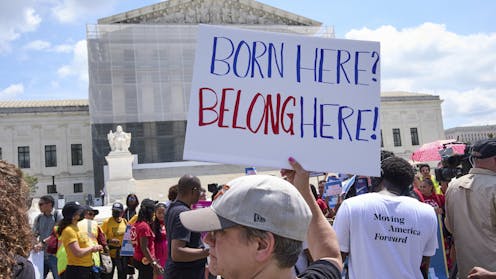
Protesters support birthright citizenship on May 15, 2025, outside of the Supreme Court in Washington. AP Photo/Jacquelyn Martin

Legal battles over President Donald Trump’s executive order to end birthright citizenship continued on July 10, 2025, after a New Hampshire federal district judge issued a preliminary injunction that will, if it’s not reversed, prevent federal officials from enforcing the order nationally.

The ruling by U.S. District Judge Joseph Laplante, a George W. Bush appointee, asserts that this policy of “highly questionable constitutionality … constitutes irreparable harm.”

In its ruling in late June, the Supreme Court allowed the Trump administration to deny citizenship to infants born to undocumented parents in many parts of the nation where individuals or states had not successfully sued to prevent implementation – including a number of mid-Atlantic, Midwest and Southern states.

Trump’s executive order limits U.S. citizenship by birth to those who have at least one parent who is a U.S. citizen or legal permanent resident. It denies citizenship to those born to undocumented people within the U.S. and to the children of those on student, work, tourist and certain other types of visas.

The preliminary injunction is on hold for seven days to allow the Trump administration to appeal.

The June 27 Supreme Court decision on birthright citizenship limited the ability of lower-court judges to issue universal injunctions to block such executive orders nationwide.

Laplante was able to avoid that limit on issuing a nationwide injunction by certifying the case as a class action lawsuit encompassing all children affected by the birthright order, following a pathway suggested by the Supreme Court’s ruling.

Pathways beyond universal injunctions

In its recent birthright citizenship ruling, Trump v. CASA, the Supreme Court noted that plaintiffs could still seek broad relief by filing such class action lawsuits that would join together large groups of individuals facing the same injury from the law they were challenging.

And that’s what happened.

Litigants filed suit in New Hampshire’s district court the same day that the Supreme Court decided CASA. They asked the court to certify a class consisting of infants born on or after Feb. 20, 2025, who would be covered by the order and their parents or prospective parents. The court allowed the suit to proceed as a class action for these infants.

Several people raise their hands as a man at a podium answers questions.
President Donald Trump takes questions on June 27, 2025, in Washington, D.C., after the Supreme Court ruled on the birthright citizenship case.
Joe Raedle/Getty Images

What if this injunction doesn’t stick?

If the U.S. Court of Appeals for the 1st Circuit or the Supreme Court invalidates the New Hampshire court’s newest national injunction and another injunction is not issued in a different venue, the order will then go into effect anywhere it is not currently barred from doing so. Implementation could begin in as many as 28 states where state attorneys general have not challenged the Trump birthright citizenship policy if no other individuals or groups secure relief.

As political science scholars who study race and immigration policy, we believe that, if implemented piecemeal, Trump’s birthright citizenship order would create administrative chaos for states determining the citizenship status of infants born in the United States. And it could lead to the first instances since the 1860s of infants being born in the U.S. being denied citizenship categorically.

States’ role in establishing citizenship

Almost all U.S.-born children are issued birth certificates by the state in which they are born.

The federal government’s standardized form, the U.S. standard certificate of live birth, collects data on parents’ birthplaces and their Social Security numbers, if available, and provides the information states need to issue birth certificates.

But it does not ask questions about their citizenship or immigration status. And no national standard exists for the format for state birth certificates, which traditionally have been the simplest way for people born in the U.S. to establish citizenship.

If Trump’s executive order goes into effect, birth certificates issued by local hospitals would be insufficient evidence of eligibility for federal government documents acknowledging citizenship. The order would require new efforts, including identification of parents’ citizenship status, before authorizing the issuance of any federal document acknowledging citizenship.

Since states control the process of issuing birth certificates, they will respond differently to implementation efforts. Several states filed a lawsuit on Jan. 21 to block the birthright citizenship order. And they will likely pursue an arsenal of strategies to resist, delay and complicate implementation.

While the Supreme Court has not yet confirmed that these states have standing to challenge the order, successful litigation could bar implementation in up to 18 states and the District of Columbia if injunctions are narrowly framed, or nationally if lawyers can persuade judges that disentangling the effects on a state-by-state basis will be too difficult.

Other states will likely collaborate with the administration to deny citizenship to some infants. Some, like Texas, had earlier attempted to make it particularly hard for undocumented parents to obtain birth certificates for their children.

Protesters hold signs in front of a federal building.
People demonstrate outside the Supreme Court of the United States on May 15, 2025, in Washington, D.C.
Matt McClain/The Washington Post via Getty Images

Potential for chaos

If the Supreme Court rejects attempts to block the executive order nationally again, implementation will be complicated.

That’s because it would operate in some places and toward some individuals while being legally blocked in other places and toward others, as Justice Sonia Sotomayor warned in her Trump v. CASA dissent.

Children born to plaintiffs anywhere in the nation who have successfully sued would have access to citizenship, while other children possibly born in the same hospitals – but not among the groups named in the suits – would not.

Babies born in the days before implementation would have substantially different rights than those born the day after. Parents’ ethnicity and countries of origin would likely influence which infants are ultimately granted or denied citizenship.

That’s because some infants and parents would be more likely to generate scrutiny from hospital employees and officials than others, including Hispanics, women giving birth near the border, and women giving birth in states such as Florida where officials are likely to collaborate enthusiastically with enforcement.

The consequences could be profound.

Some infants would become stateless, having no right to citizenship in another nation. Many people born in the U.S. would be denied government benefits, Social Security numbers and the ability to work legally in the U.S.

With the constitutionality of the executive order still unresolved, it’s unclear when, if ever, some infants born in the U.S. will be the first in the modern era to be denied citizenship.

The Conversation

The authors do not work for, consult, own shares in or receive funding from any company or organization that would benefit from this article, and have disclosed no relevant affiliations beyond their academic appointment.

​Politics + Society – The Conversation
Categories
Politics

Border czar Tom Homan says ‘no amnesty’ for undocumented farmworkers | The Conversation

Border czar Tom Homan says ‘no amnesty’ for undocumented farmworkers | The Conversation

lead image

​Politics

Categories
Politics

Homan unsure of status of the eight men deported to South Sudan | The Conversation

Homan unsure of status of the eight men deported to South Sudan | The Conversation

lead image

​Politics

Categories
Politics

Justice Department efforts to strip citizenship from naturalized Americans likely violate constitutional rights

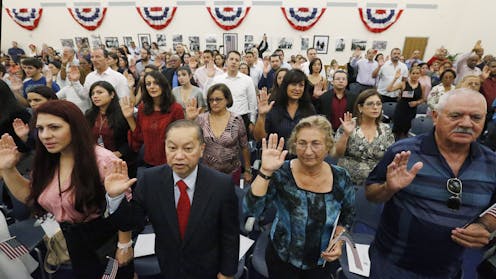
New American citizens recite the Oath of Allegiance during a naturalization ceremony in Miami on Aug. 17, 2018. AP Photo/Wilfredo Lee

The Trump administration wants to take away citizenship from naturalized Americans on a massive scale.

While a recent Justice Department memo prioritizes national security cases, it directs the department to “maximally pursue denaturalization proceedings in all cases permitted by law and supported by the evidence” across 10 broad priority categories.

Denaturalization is different from deportation, which removes noncitizens from the country. With civil denaturalization, the government files a lawsuit to strip people’s U.S. citizenship after they have become citizens, turning them back into noncitizens who can then be deported.

The government can only do this in specific situations. It must prove someone “illegally procured” citizenship by not meeting the requirements, or that they lied or hid important facts during the citizenship process.

The Trump administration’s “maximal enforcement” approach means pursuing any case where evidence might support taking away citizenship, regardless of priority level or strength of evidence. As our earlier research documented, this has already led to cases like that of Baljinder Singh, whose citizenship was revoked based on a name discrepancy that could easily have resulted from a translator’s error rather than intentional fraud.

A brief history

For most of American history, taking away citizenship has been rare. But it increased dramatically during the 1940s and 1950s during the Red Scare period characterized by intense suspicion of communism. The United States government targeted people it thought were communists or Nazi supporters. Between 1907 and 1967, over 22,000 Americans lost their citizenship this way.

Everything changed in 1967 when the Supreme Court decided Afroyim v. Rusk. The court said the government usually cannot take away citizenship without the person’s consent. It left open only cases involving fraud during the citizenship process.

After this decision, denaturalization became extremely rare. From 1968 to 2013, fewer than 150 people lost their citizenship, mostly war criminals who had hidden their past.

A man dressed in a suit and tie speaks and points his right index finger.
Sen. Joseph McCarthy appears at a March 1950 hearing on his charges of communist infiltration at the State Department.
AP Photo/Herbert K. White

How the process works

In criminal lawsuits, defendants get free lawyers if they can’t afford one. They get jury trials. The government must prove guilt “beyond a reasonable doubt” – the highest standard of proof.

But in most denaturalization cases, the government files a civil suit, where none of these protections exist.

People facing denaturalization get no free lawyer, meaning poor defendants often face the government alone. There’s no jury trial – just a judge deciding whether someone deserves to remain American. The burden of proof is lower – “clear and convincing evidence” instead of “beyond a reasonable doubt.” Most important, there’s no time limit, so the government can go back decades to build cases.

As law professors who study citizenship, we believe this system violates basic constitutional rights.

The Supreme Court has called citizenship a fundamental right. Chief Justice Earl Warren in 1958 described it as the “right to have rights.”

In our reading of the law, taking away such a fundamental right through civil procedures that lack basic constitutional protection – no right to counsel for those who can’t afford it, no jury trial, and a lower burden of proof – seems to violate the due process of law required by the Constitution when the government seeks to deprive someone of their rights.

The bigger problem is what citizenship-stripping policy does to democracy.

When the government can strip citizenship from naturalized Americans for decades-old conduct through civil procedures with minimal due process protection – pursuing cases based on evidence that might not meet criminal standards – it undermines the security and permanence that citizenship is supposed to provide. This creates a system where naturalized citizens face ongoing vulnerability that can last their entire lives, potentially chilling their full participation in American democracy.

The Justice Department memo establishes 10 priority categories for denaturalization cases. They range from national security threats and war crimes to various forms of fraud, financial crimes and, most importantly, any other cases it deems “sufficiently important to pursue.” This “maximal enforcement” approach means pursuing not just clear cases of fraud, but also any case where evidence might support taking away citizenship, no matter how weak or old the evidence is.

This creates fear throughout immigrant communities.

About 20 million naturalized Americans now must worry that any mistake in their decades-old immigration paperwork could cost them their citizenship.

A two-tier system

This policy effectively creates two different types of American citizens. Native-born Americans never have to worry about losing their citizenship, no matter what they do. But naturalized Americans face ongoing vulnerability that can last their entire lives.

This has already happened. A woman who became a naturalized citizen in 2007 helped her boss with paperwork that was later used in fraud. She cooperated with the FBI investigation, was characterized by prosecutors as only a “minimal participant,” completed her sentence, and still faced losing her citizenship decades later because she didn’t report the crime on her citizenship application – even though she hadn’t been charged at the time.

A woman accepts a small American flag handed to her from a man across a counter.
A woman receives a U.S. flag after passing her citizenship interview in Newark, N.J., on May 25, 2016.
AP Photo/Julio Cortez

The Justice Department’s directive to “maximally pursue” cases across 10 broad categories – combined with the first Trump administration’s efforts to review over 700,000 naturalization files – represents an unprecedented expansion of denaturalization efforts.

The policy will almost certainly face legal challenges on constitutional grounds, but the damage may already be done. When naturalized citizens fear their status could be revoked, it undermines the security and permanence that citizenship is supposed to provide.

The Supreme Court, in Afroyim v. Rusk, was focused on protecting existing citizens from losing their citizenship. The constitutional principle behind that decision – that citizenship is a fundamental right which can’t be arbitrarily taken away by whoever happens to be in power – applies equally to how the government handles denaturalization cases today.

The Trump administration’s directive, combined with court procedures that lack basic constitutional protections, risks creating a system that the Afroyim v. Rusk decision sought to prevent – one where, as the Supreme Court said, “A group of citizens temporarily in office can deprive another group of citizens of their citizenship.”

The Conversation

The authors do not work for, consult, own shares in or receive funding from any company or organization that would benefit from this article, and have disclosed no relevant affiliations beyond their academic appointment.

​Politics + Society – The Conversation

Categories
Politics

The nation’s cartoonists on the week in politics

Every week political cartoonists throughout the country and across the political spectrum apply their ink-stained skills to capture the foibles, memes, hypocrisies and other head-slapping events in the world of politics. The fruits of these labors are hundreds of cartoons that entertain and enrage readers of all political stripes. Here’s an offering of the best of this week’s crop, picked fresh off the Toonosphere. Edited by Matt Wuerker.

​Politics

Categories
Politics

Trump administration’s lie detector campaign against leakers is unlikely to succeed and could divert energy from national security priorities

The Department of Homeland Security and FBI are reportedly using polygraphs aggressively to identify dissenters. standret/Getty Images

The Trump administration has recently directed that a new wave of polygraphs be administered across the executive branch, aimed at uncovering leaks to the press.

As someone who has taken roughly a dozen polygraphs during my 27-year career with the CIA, I read this development with some skepticism.

Polygraphs carry an ominous, almost mythological reputation among Americans. The more familiar and unofficial term – lie detector tests – likely fuels that perception. Television crime dramas have done their part, too, often portraying the device as an oracle for uncovering the truth when conventional methods fail.

In those portrayals, the polygraph is not merely a tool – it’s a window into the soul.

Among those entering government service, especially in national security, the greater anxiety is not the background check but passing the polygraph. My advice is always the same: Don’t lie.

It’s the best – and perhaps only – guidance for a process that most assessments have concluded is a more subjective interpretation than empirical science.

Why the polygraph persists

Polygraphs are “pseudo-scientific” in that they measure physiological responses such as heart rate, blood pressure and perspiration. The assumption is that liars betray themselves through spikes in those signals. But this presumes a kind of psychological transparency that simply doesn’t hold up. A person might sweat and tremble simply from fear, anger or frustration – not deceit.

There also are no specific physiological reactions associated with lying. The National Academy of Sciences in 2003, and the American Psychological Association in a 2004 review, concluded that the polygraph rests more on theater than fact. Recent assessments, published in 2019, have reached the same conclusion.

Accordingly, polygraph results are not generally admissible in U.S. courts. Only a handful of states – such as Georgia, Arizona and California – permit their use even under limited conditions. And they typically require that both parties agree to admission and a judge to approve it. Unconditional admissibility remains the exception, not the rule.

And yet, inside many national security agencies, polygraphs remain central to the clearance process – a fact I observed firsthand during my time overseeing personnel vetting and analytic hiring within the intelligence community.

While not treated as conclusive, polygraph results often serve as a filter. A candidate’s visible discomfort – or the examiner’s subjective judgment that a response seems evasive – can stall or end the hiring process. For instance, I know that government agencies have halted clearances after an examiner flagged elevated reactions to questions about past drug use or foreign contacts, even when no disqualifying behavior was ultimately documented.

Exterior view of a federal building with an American flag flying on a mast.
The FBI’s J. Edgar Hoover headquarters building in Washington in 2016.
AP Photo/Cliff Owen

In some cases, an examiner’s suggestion that a chart shows an anomaly has led otherwise strong applicants to volunteer details they hadn’t planned to share – such as minor security infractions, undeclared relationships, or casual drug use from decades earlier – that, while not disqualifying on their own, reshape how their trustworthiness is perceived.

The polygraph’s power lies in creating the conditions under which deception is confessed.

A predictable pattern

No administration has been immune to the impulse to investigate leaks. The reflex is bipartisan and familiar: An embarrassing disclosure appears in the press – contradicting official statements or exposing internal dissent – and the White House vows to identify and punish the source. Polygraphs are often part of this ritual.

During his first term, Trump intensified efforts to expose internal dissent and media leaks. Department guidelines were revised to make it easier for agencies to obtain journalists’ phone and email records, and polygraphs were reportedly used to pressure officials suspected of talking to the press. That trend has continued – and, in some areas, escalated.

Recent policies at the Pentagon now restrict unescorted press access, revoke office space for major outlets and favor ideologically aligned networks. The line between legitimate leak prevention and the surveillance or sidelining of critical press coverage has grown increasingly blurred.

At agencies such as the Department of Homeland Security and the FBI, polygraphs are reportedly being used more frequently – and more punitively – to identify internal dissenters. Even “cold cases,” such as the leak of the Supreme Court’s Dobbs opinion ahead of its overturning of Roe v. Wade, have been reopened, despite prior investigations yielding no definitive source.

Government reaction varies

Not all leaks are treated the same. Disclosures that align with official narratives or offer strategic advantage may be quietly tolerated, even if unauthorized. Others, especially those that embarrass senior officials or reveal dysfunction, are more likely to prompt formal investigation.

In 2003, for example, the leak of CIA officer Valerie Plame’s identity – widely seen as retaliation for her husband’s criticism of the Iraq War – triggered a federal investigation. The disclosure embarrassed senior officials, led to White House aide Scooter Libby’s conviction for perjury, later commuted, and drew intense political scrutiny.

A man dressed in a suit and tie rides in the back seat of a car.
Lewis Libby, Vice President Dick Cheney’s chief of staff, rides in the backseat of a limousine on Oct. 27, 2005, in McLean, Va.
Win McNamee/Getty Images

Leaks involving classified material draw the sharpest response when they challenge presidential authority or expose internal disputes. That was the case in 2010 with Chelsea Manning, whose disclosure of diplomatic cables and battlefield reports embarrassed senior officials and sparked global backlash. Government reaction often depends less on what was disclosed than on who disclosed it – and to what effect.

A narrow set of disclosures, such as those involving espionage or operational compromise, elicit broad consensus as grounds for prosecution. But most leaks fall outside that category. Most investigations fade quietly. The public rarely learns what became of them. Occasionally, there is a vague resignation, but direct accountability is rare.

What the future holds

Trump’s polygraph campaign is not likely to eliminate leaks to the press. But they may have a chilling effect that discourages internal candor while diverting investigative energy away from core security priorities.

Even if such campaigns succeed in reducing unauthorized disclosures, they may come at the cost of institutional resilience. Historically, aggressive internal enforcement has been associated with declining morale and reduced information flow – factors that can hinder adaptation to complex threats.

Some researchers have suggested that artificial intelligence may eventually offer reliable tools for detecting deception. One recent assessment raised the possibility, while cautioning that the technology is nowhere near operational readiness.

For now, institutions will have to contend with the tools they have – imperfect, imprecise and more performative than predictive.

The Conversation

As a former US intelligence officer, I am required to submit any written draft, before sharing it with other persons, for prepublication review. I submitted this draft to CIA’s Prepublication Review Board, which responded on 11 June: “No classified information was identified. Therefore, no changes are required for publication or sharing with others.”

​Politics + Society – The Conversation

Categories
Politics

My city was one of hundreds expecting federal funds to help manage rising heat wave risk – then EPA terminated the grants

The Pacific Northwest heat wave of 2021 left cities across Washington state sweltering in dangerous temperatures. AP Photo/Ted S. Warren

In June 2021, a deadly heat wave pushed temperatures to 109 degrees Fahrenheit (43 Celsius) in Spokane, Washington, a northern city near the Idaho border where many homes weren’t built with central air conditioning.

As the heat lingered for over a week, 19 people died in Spokane County and about 300 visited hospitals with signs of heat-related illnesses.

Scientists say it’s not a matter of if, but when, another deadly heat wave descends on the region. To help save lives, the city teamed up with my university, Gonzaga, to start preparing for a hotter future.

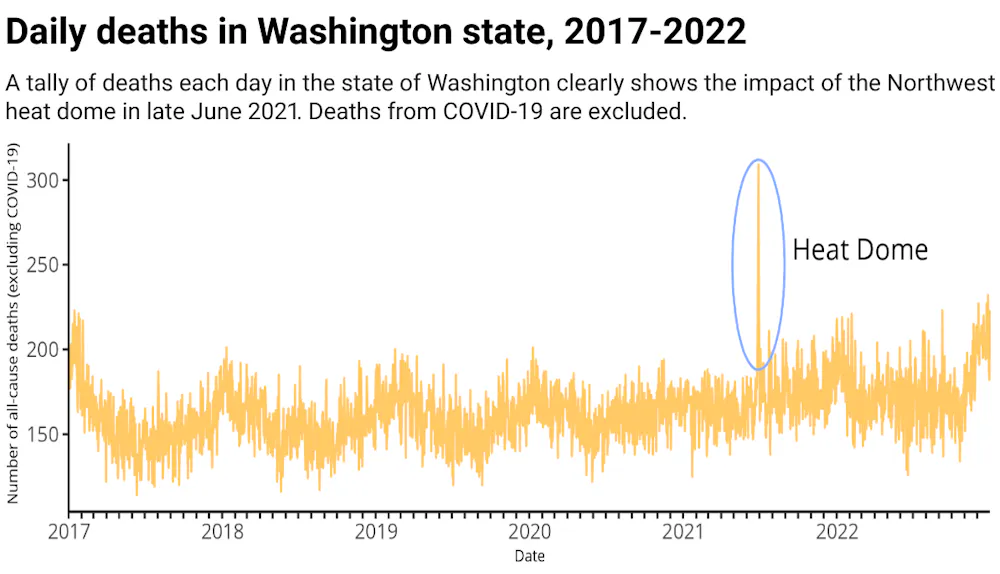
A line chart shows a big spike in deaths the week of the heat dome.
A chart of all deaths, excluding COVID-19, shows the extraordinary impact the 2021 heat dome had in Washington.
‘In the Hot Seat’ report, 2022

We were excited and relieved when the community was awarded a US$19.9 million grant from the Environmental Protection Agency to help it take concrete steps to adapt to climate change and boost the local economy in the process. The grant would help establish resilience hubs with microgrids and help residents without air conditioning install energy-efficient cooling systems. The city doesn’t have the means to make these improvements on its own, even if they would save lives and money in the long run.

Less than a year later, the Trump administration abruptly terminated the funding.

Spokane’s grant wasn’t the only one eliminated – about 350 similar grants that had been awarded to help communities across the country manage climate changes, from extreme heat and wildfire smoke to rising seas and flooding, were also terminated on the grounds that they don’t meet the White House’s priorities. Many other grants to help communities have also been terminated.

Many of the communities that lost funding are like Spokane: They can’t afford to do this kind of work on their own.

Why cities like Spokane need the help

Like many communities in the American West, Spokane was founded in the late 19th century on wealth from railroads and resource extraction, especially gold, silver and timber.

Today, it is a city of 230,000 in a metro area of a half-million people, the largest on the I-90 corridor between Minneapolis and Seattle. In many ways, Spokane could be on the cusp of a renaissance.

In January 2025, the U.S. Department of Commerce announced a $48 million grant to develop a tech hub that could put the Inland Northwest on a path to become a global leader in advanced aerospace materials. But then, in May, the Trump administration rescinded that grant as well.

The lost grants left the economy – and Spokane’s ability to adapt fast enough to keep up with climate changes – uncertain.

Spokane Falls includes a 25-foot dam and falls that tumble below it
Heat waves are becoming a growing risk in Spokane, known for its river and falls that tumble near downtown.
Roman Eugeniusz/Wikimedia Commons, CC BY-SA

This is not a wealthy area. The median household income is nearly $30,000 less than the state average. More than 13 out of every 100 people in Spokane live in poverty, above the national average, and over 67% of the children are eligible for free or reduced lunch.

The city is a light blue island in a dark red sea, politically speaking, with a moderate mayor. Its congressional district has voted Republican by wide margins since 1995, the year that then-House Speaker Tom Foley lost his reelection bid.

Lessons from the 2021 heat dome

The 2021 heat wave was a catalyzing event for the community. The newly formed Gonzaga Institute for Climate, Water and the Environment brought together a coalition of government and community partners to apply for the EPA’s Environmental and Climate Justice Community Change Grant Program. The grants, funded by Congress under the Inflation Reduction Act of 2022, were intended to help communities most affected by pollution and climate change build adaptive capacity and boost the safety of their residents.

A key lesson from the 2021 heat dome was that temporary, or pop-up, cooling centers don’t work well. People just weren’t showing up. Our research found that the best approach is to strengthen existing community facilities that people already turn to in moments of difficulty.

Half the $19.9 million award was for outfitting five resilience hubs in existing libraries and community centers with solar arrays and battery backup microgrids, allowing them to continue providing a safe, cool space during a heat wave if the power shuts down.

The locations and plans for five resilience hubs to serve Spokane, and the infrastructure they would receive.
Gonzaga Institute for Climate, Water and the Environment

Another $8 million in grant funding was meant to provide 300 low- to moderate-income homeowners with new high-efficiency electric heat pump heating, ventilation and air conditioning systems, providing more affordable utility bills while improving their ability to cool their homes and reducing fossil fuel emissions.

Communities are left with few options

Now, this and other work is at risk in Spokane and cities and towns like it around the country that also lost funding.

According to the Trump administration, the program – designed to help hundreds of communities around the country become safer – was “no longer consistent with EPA funding priorities.”

A class action lawsuit was recently filed over the termination of the grants by a coalition that includes Earth Justice and the Southern Environmental Law Center. If the case is successful, Spokane could see its funding restored.

Meanwhile, the city and my team know we have to move fast, with whatever money and other resources we can find, to help Spokane prepare for worsening heat. We formed the Spokane Community Resilience Collaborative – a partnership between community organizations, health officials and the city – as one way to advance planning for and responding to climate hazards such as extreme heat and wildfire smoke.

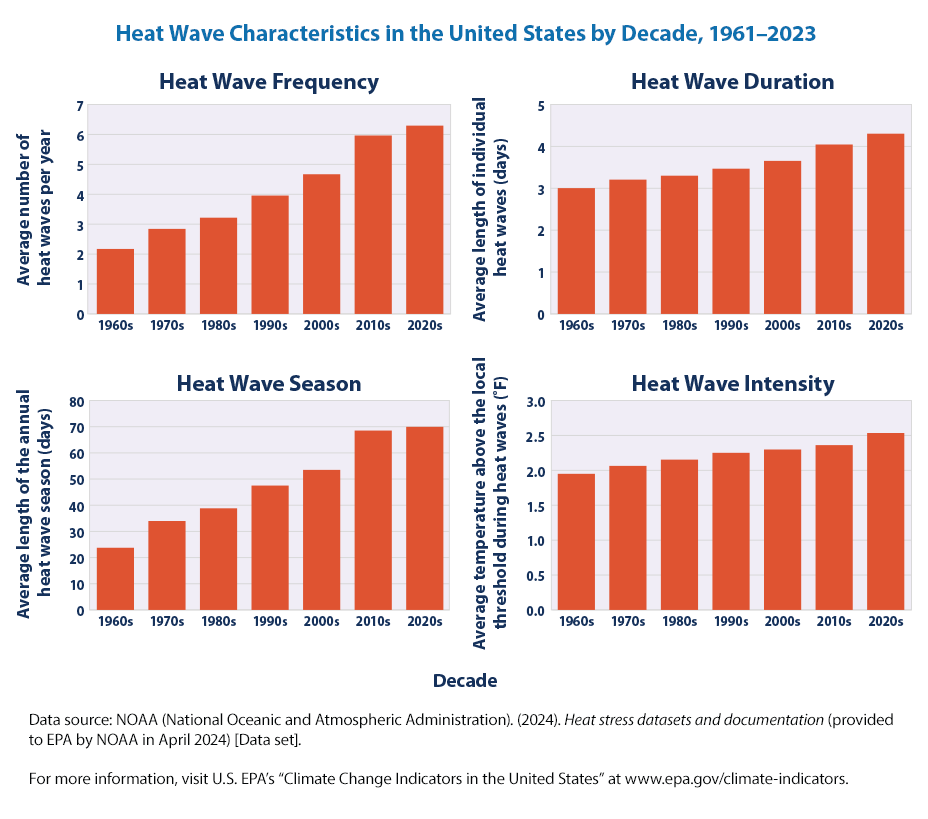
As concentrations of heat-trapping gasses accumulate in the atmosphere, both the frequency and severity of heat waves increase. It is only a matter of time before another deadly heat dome arrives.

The Conversation

Brian G. Henning receives funding from the Environmental Protection Agency.

​Politics + Society – The Conversation

Categories
Politics

Josh Cowen is launching a congressional bid in a swing Michigan district

Democrat Josh Cowen is launching a bid by highlighting education and affordability issues in what is already becoming a crowded primary in a tossup Michigan district.

Cowen, an education policy professor at Michigan State University, singled out the school choice and voucher programs pushed by Michigan Republicans like former Education Secretary Betsy DeVos as part of what inspired him to run for Michigan’s 7th Congressional District in the central part of the state.

“I’m a teacher, and I have been fighting Betsy DeVos across the country on a specific issue, and that’s privatizing public schools,” Cowen said in an interview. “She’s been trying to disinvest, defund commitments to kids and families all over the place, and that’s actually the same fight as everything that’s going on right now — trying to protect investing in health care through Medicaid and other systems — protect jobs.”

 Josh Cowen is running for Michigan's 7th Congressional District.

Several Democrats have already announced bids against Rep. Tom Barrett (R-Mich.), who flipped the seat last cycle after Rep. Elissa Slotkin (D-Mich.) vacated it to run for Senate. He could be a tough incumbent for Democrats to dislodge and reported raising over $1 million last quarter.

Still, Democrats see the narrowly divided seat as a top pickup opportunity next year, with former Ukraine Ambassador Bridget Brink and retired Navy SEAL Matt Maasdam among the field of candidates running. Cowen brushed off concerns about a contested primary, saying, “They’re going to run their campaigns. I’m going to run mine.”

“I am going to be running really hard on the fact that I am in this community. I’ve been here for 12 years. My kids went to public schools here. My youngest is still there,” he added.

​Politics

Categories
Politics

President Trump’s tug-of-war with the courts, explained

The U.S. Supreme Court in Washington, D.C. Stefani Reynolds/Bloomberg

The Supreme Court handed President Donald Trump a big win on June 27, 2025, by limiting the ability of judges to block Trump administration policies across the nation.

But Trump has not fared nearly as well in the lower courts, where he has lost a series of cases through different levels of the federal court system. On June 5, a single judge temporarily stopped the administration from preventing Harvard University from enrolling international students.

And a three-judge panel of the U.S. Court of International Trade blocked Trump on May 28 from imposing tariffs on China and other nations. The Trump administration has appealed this decision. It will be taken up in July by all 11 judges on the United States Court of Appeals for the Federal Circuit.

After that, the case can be appealed to the Supreme Court.

I’m a scholar of the federal courts. The reasons why some courts have multiple judges and others have a single judge can be confusing. Here’s a guide to help understand what’s going on in the federal courts.

Federal District Courts

The U.S. District Courts are the trial courts in the federal system and hear about 400,000 cases per year. A single judge almost always presides over cases.

This makes sense for a jury trial, since a judge might make dozens of spur-of-the-moment decisions during the course of a trial, such as ruling on a lawyer’s objection to a question asked of a witness. If a panel of, say, three judges performed this task, it would prolong proceedings because the three judges would have to deliberate over every ruling.

A more controversial role of District Courts involves setting nationwide injunctions. This happens when a single judge temporarily stops the government from enforcing a policy throughout the nation.

There have been more than two dozen nationwide injunctions during Trump’s second term. These involve policy areas as diverse as ending birthright citizenship, firing federal employees and banning transgender people from serving in the military.

A man at a podium speaks to dozens of reporters.
President Donald Trump speaks at the White House on June 27, 2025, after the Supreme Court curbed the power of lone federal judges to block executive actions.
Andrew Caballero-Reynolds/AFP via Getty Images

Trump and Republicans in Congress argue that the ability to issue nationwide injunctions gives too much power to a single judge. Instead, they believe injunctions should apply only to the parties involved in the case.

On June 27, the Supreme Court agreed with the Trump administration and severely limited the ability of District Court judges to issue nationwide injunctions. This means that judges can generally stop policies from being enforced only against the parties to a lawsuit, instead of everyone in the nation.

In rare instances, a panel of three District Court judges hears a case. Congress decides what cases these special three-judge panels hear, reserving them for especially important issues. For example, these panels have heard cases involving reapportionment, which is how votes are translated into legislative seats in Congress and state legislatures, and allegations that a voter’s rights have been violated.

The logic behind having three judges hear such important cases is that they will give more careful consideration to the dispute. This may lend legitimacy to a controversial decision and prevents a single judge from exercising too much power.

There are also specialized courts that hear cases involving particular policies, sometimes in panels of three judges. For instance, three-judge panels on the U.S. Court of International Trade decide cases involving executive orders related to international trade.

The federal Court of Appeals

The U.S. Court of Appeals hears appeals from the District Courts and specialized courts.

The 13 federal circuit courts that make up the U.S. Court of Appeals are arranged throughout the country and handle about 40,000 cases per year. Each circuit court has six to 29 judges. Cases are decided primarily by three-judge panels.

Having multiple judges decide cases on the Court of Appeals is seen as worthwhile, since these courts are policymaking institutions. This means they set precedents for the judicial circuit in which they operate, which covers three to nine states.

Supporters of this system argue that by having multiple judges on appellate courts, the panel will consider a variety of perspectives on the case and collaborate with one another. This can lead to better decision-making. Additionally, having multiple judges check one another can boost public confidence in the judiciary.

The party that loses a case before a three-judge panel can request that the entire circuit rehear the case. This is known as sitting en banc.

Because judges on a circuit can decline to hear cases en banc, this procedure is usually reserved for especially significant cases. For instance, the U.S. Court of Appeals for the Federal Circuit has agreed to an en banc hearing to review the Court of International Trade’s decision to temporarily halt Trump’s sweeping tariff program. It also allowed the tariffs to remain in effect until the appeal plays out, likely in August.

The exception to having the entire circuit sit together en banc is the 9th Circuit, based in San Francisco, which has 29 judges, far more than other circuit courts. It uses an 11-judge en banc process, since having 29 judges hear cases together would be logistically challenging.

Cargo ships are seen at a container terminal.
Cargo ships are seen at a container terminal in the Port of Shanghai, China, in May 2025. A three-judge panel of the U.S. Court of International Trade blocked Trump from imposing tariffs on China and other nations.
CFOTO/Future Publishing via Getty Images

The US Supreme Court

The U.S. Supreme Court sits atop the American legal system and decides about 60 cases per year.

Cases are decided by all nine justices, unless a justice declines to participate because of a conflict of interest. As with other multimember courts, advocates of the nine-member makeup argue that the quality of decision-making is improved by having many justices participate in a case’s deliberation.

Each Supreme Court justice is charged with overseeing one or more of the 13 federal circuits. In this role, a single justice reviews emergency appeals from the District Courts and an appellate court within a circuit. This authorizes them to put a temporary hold on the implementation of policies within that circuit or refer the matter to the entire Supreme Court.

In February, for example, Chief Justice John Roberts blocked a Court of Appeals order that would have compelled the Trump administration to pay nearly US$2 billion in reimbursements for already completed foreign aid work.

In March, a 5-4 majority of the high court sent the case back to U.S. District Judge Amir Ali, who subsequently ordered the Trump administration to release some of the funds.

The federal judicial system is complex. The flurry of executive orders from the Trump administration means that cases are being decided on a nearly daily basis by a variety of courts.

A single judge will decide some of these cases, and others are considered by full courts. Though the nine justices of the Supreme Court technically have the final say, the sheer volume of legal challenges means that America’s District Courts and Court of Appeals will resolve many of the disputes.

The Conversation

Paul M. Collins Jr. does not work for, consult, own shares in or receive funding from any company or organization that would benefit from this article, and has disclosed no relevant affiliations beyond their academic appointment.

​Politics + Society – The Conversation

Categories
Politics

How Philadelphia’s current sanitation strike differs from past labor disputes in the city

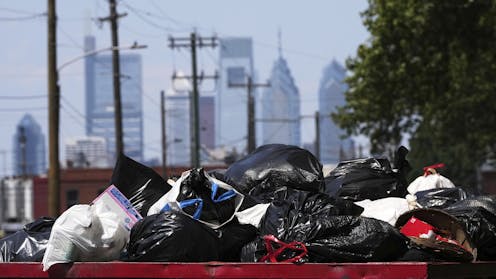
Curbside trash collection has been on pause in Philadelphia since July 1, 2025. AP Photo/Matt Slocum

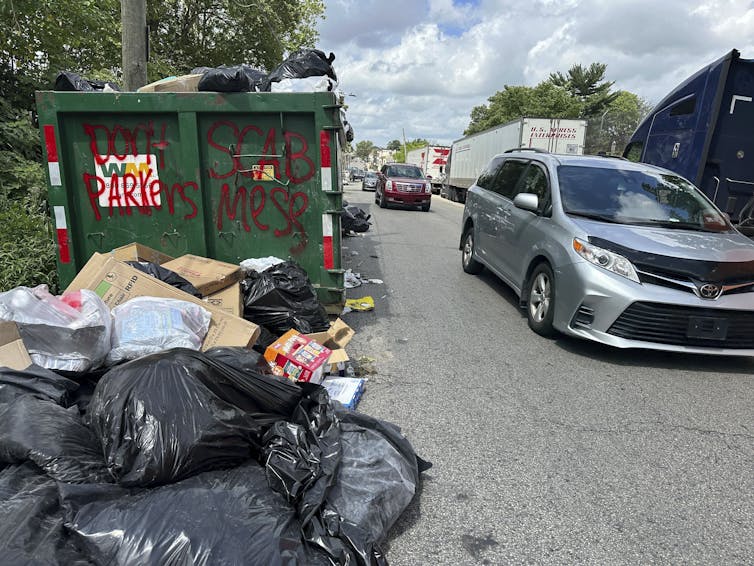
As the Philadelphia municipal workers strike enters its second week, so-called “Parker piles” – large collections of garbage that some residents blame on Mayor Cherelle Parker – continue to build up in neighborhoods across the city.

The American Federation of State, County and Municipal Employees District Council 33 union on strike represents about 9,000 blue-collar workers in the city, including sanitation workers, 911 dispatchers, city mechanics and water department staff.

The Conversation U.S. asked Francis Ryan, a professor of labor studies at Rutgers University and author of “AFSCME’s Philadelphia Story: Municipal Workers and Urban Power in Philadelphia in the Twentieth Century,” about the history of sanitation strikes in Philly and what makes this one unique.
Has anything surprised you about this strike?

This strike marks the first time in the history of labor relations between the city of Philadelphia and AFSCME District Council 33 union where social media is playing a significant role in how the struggle is unfolding.

The union is getting their side of the story out on Instagram and other social media platforms, and citizens are taking up or expressing sympathy with their cause.

Piles of garbage on the street beside a green dumpster spray-painted with 'Don't Scab Parker's Mess'
Some city residents are referring to the garbage buildup sites as ‘Parker piles.’
AP Photo/Tassanee Vejpongsa

How successful are trash strikes in Philly or other US cities?

As I describe in my book, Philadelphia has a long history of sanitation strikes that goes back to March 1937. At that time, a brief work stoppage brought about discussions between the city administration and an early version of the current union.

When over 200 city workers were laid off in September 1938, city workers called a weeklong sanitation strike. Street battles raged in West Philadelphia when strikers blocked police-escorted trash wagons that were aiming to collect trash with workers hired to replace the strikers.

Philadelphia residents, many of whom were union members who worked in textile, steel, food and other industries, rallied behind the strikers. The strikers’ demands were met, and a new union, AFSCME, was formally recognized by the city.

This strike was a major event because it showed how damaging a garbage strike could be. The fact that strikers were willing to fight in the streets to stop trash services showed that such events had the potential for violence, not to mention the health concerns from having tons of trash on the streets.

There was another two-week trash strike in Philadelphia in 1944, but there wouldn’t be another for more than 20 years.

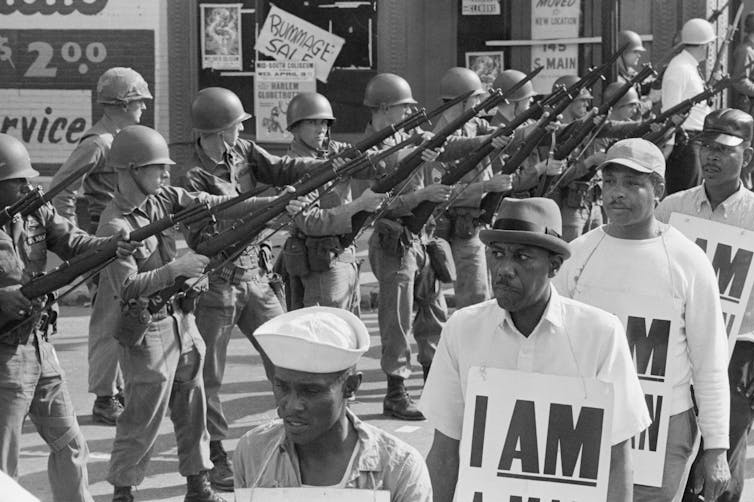
However, a growing number of sanitation strikes popped up around the country in the 1960s, the most infamous being the 1968 Memphis sanitation strike.

Black-and-white photo of a line of Black men walking past a row of white soldiers in uniform with bayonets fixed
Black sanitation workers peacefully march wearing placards reading ‘I Am A Man’ during the 1968 sanitation strike in Memphis, Tenn.
Bettmann via Getty Images

In Memphis, Tennessee, a majority African American sanitation workforce demanded higher wages, basic safety procedures and recognition of their union. The Rev. Martin Luther King Jr. rallied to support the Memphis workers and their families as part of his Poor Peoples’ Campaign, which sought to organize working people from across the nation into a new coalition to demand full economic and political rights.

On April 4, 1968, King was assassinated. His death put pressure on Memphis officials to settle the strike, and on April 16 the the strikers secured their demands.

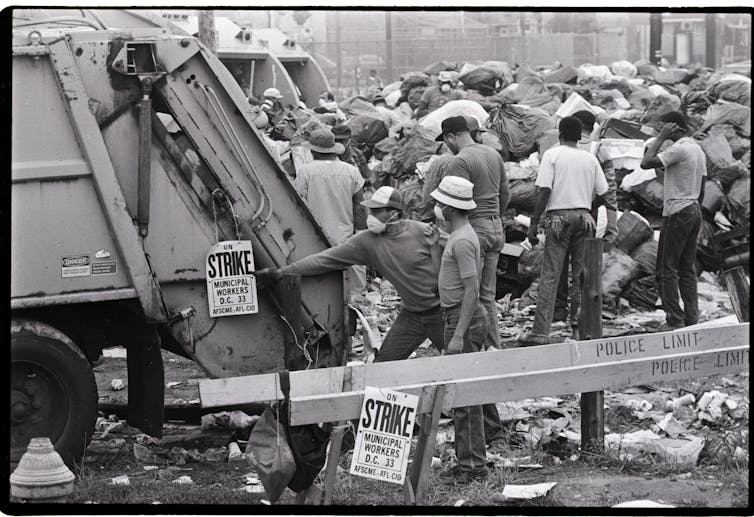
Following the Memphis strike, AFSCME began organizing public workers around the country, and through the coming years into the 1970s, there were sanitation strikes and slowdowns across the nation including in New York, Atlanta, Cleveland and Washington. Often, these workers, who were predominantly African American, gained the support of significant sections of the communities they served and secured modest wage boosts.

By the 1980s, such labor actions were becoming fewer. In 1986, Philadelphia witnessed a three-week sanitation strike that ended with the union gaining some of its wage demands, but losing on key areas related to health care benefits.

Black-and-white photo of men standing alongside a huge pile of trash and two trash trucks
Workers begin removing mounds of trash after returning to work after an 18-day strike in Philadelphia in July 1986.
Bettmann via Getty Images

How do wages and benefits for DC33 workers compare to other US cities?

District Council 33 President Greg Boulware has said that the union’s members make an average salary of US$46,000 per year. According to MIT’s Living Wage Calculator, that is $2,000 less than what a single adult with no kids needs to reasonably support themselves living in Philadelphia.

Sanitation workers who collect curbside trash earn a salary of $42,500 to $46,200, or $18-$20 an hour. NBC Philadelphia reported that those wages are the lowest of any of the major cities they looked at. Hourly wages in the other cities they looked at ranged from $21 an hour in Dallas to $25-$30 an hour in Chicago.

Unlike other eras, the fact that social media makes public these personal narratives and perspectives – like from former sanitation worker Terrill Haigler, aka “Ya Fav Trashman” – is shaping the way many citizens respond to these disruptions. I see a level of support for the strikers that I believe is unprecedented going back as far as 1938.

What do you think is behind this support?

The pandemic made people more aware of the role of essential workers in society. If the men and women who do these jobs can’t afford their basic needs, something isn’t right. This may explain why so many people are seeing things from the perspective of striking workers.

At the same time, money is being cut from important services at the federal, state and local levels. The proposed gutting of the city’s mass transit system by state lawmakers is a case in point. Social media allows people to make these broader connections and start conversations.

If the strike continues much longer, I think it will gain more national and international attention, and bring discussions about how workers should be treated to the forefront.

The Conversation
Francis Ryan does not work for, consult, own shares in or receive funding from any company or organization that would benefit from this article, and has disclosed no relevant affiliations beyond their academic appointment.

​Politics + Society – The Conversation