







Categories
Politics

Today Venezuela, tomorrow Iran: can the Islamic Republic survive a second Trump presidency?

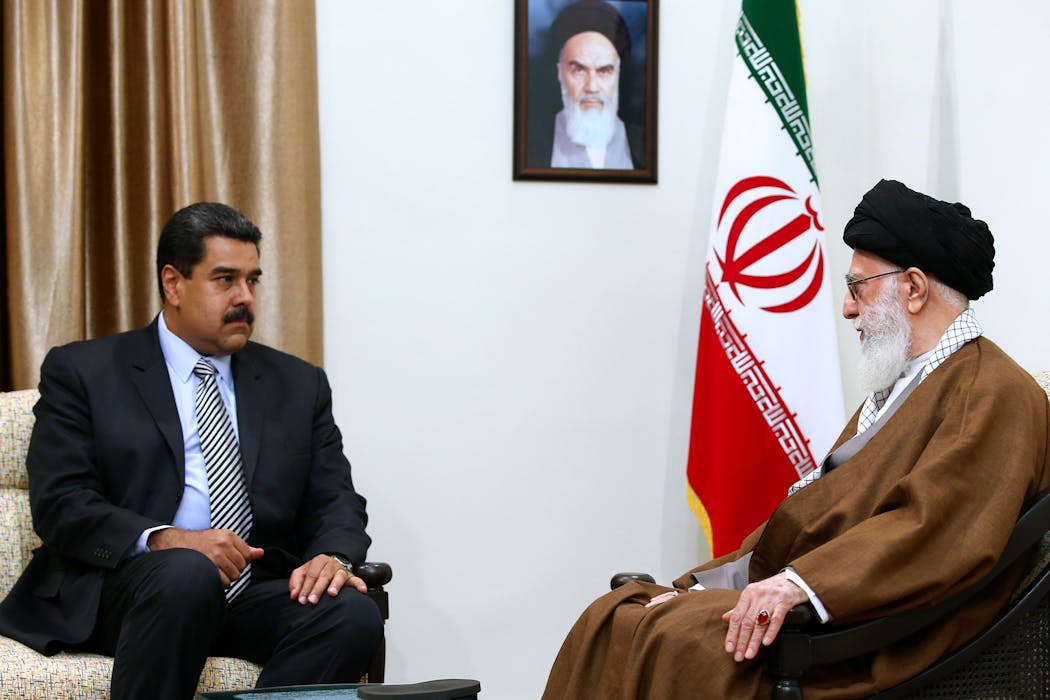
Better days: Venezuelan President Nicolas Maduro, left, met the supreme leader of Iran, Ali Khamenei, in Tehran on Oct. 22, 2016. Pool/Supreme Leader Press Office/Anadolu Agency/Getty Images

Perhaps no one outside of Venezuela or Cuba should care more about the U.S. capture of nominal President Nicolás Maduro than the Islamic Republic of Iran’s supreme leader, Ali Khamenei.

Khamenei and his regime are in trouble, and it’s not clear how they would survive should the Trump administration decide to support the millions who want a new government system without Khamenei and his ilk.

Iran has no state allies that would be willing to intervene militarily on its behalf. Further, its once-powerful network of partner and proxy militias – Lebanese Hezbollah, the Houthi rebels in Yemen, and other members of the Axis of Resistance – has been rendered incapable or reluctant to get involved. And Iran’s economy is in shambles in the midst of an ongoing water crisis with no relief in sight.

Further, the Iranian people have again taken to the streets to air their grievances against harsh economic conditions as well as government corruption, mismanagement and hypocrisy, echoing similar conditions to Venezuela in recent years.

Lastly, President Donald Trump has returned his attention to Iran. On Jan. 2, Trump warned Khamenei that if his forces violently suppress protesters, Iran would be “hit very hard” by the U.S.

Trump’s warning and show of solidarity will likely embolden protesters, which will almost certainly cause Iran’s internal security to crack down harder, as has happened in the past. Such U.S. intervention could lead to the overthrowing of the ayatollah, intended or not. Furthermore, Maduro’s fate demonstrates that the Trump administration is willing to use military force for that purpose if deemed necessary.

As an analyst of Middle East affairs focusing on Iran, I believe that these conditions place Khamenei’s regime under greater threat today than perhaps any other time in its 46-year history.

Protesters and security forces clash in Tehran’s Grand Bazaar in a video released on Jan. 6, 2026.

Growing threats, internal and external

If Khamenei hopes to survive politically or mortally, I believe he has three options.

First, he could capitulate to U.S. demands to halt Iran’s nuclear enrichment program. Second, Iran could sprint toward a nuclear bomb. Lastly, he could flee.

In hopes of restoring deterrence, Khamenei could also continue rebuilding his country’s military capabilities, which were significantly degraded during the June 2025 12-day war in which Israel and the U.S. aimed to destroy Iran’s nuclear capability.

Israel is eager to stifle Iran’s reconstitution plans, protests are spreading and growing more intense, and Trump – through hostile rhetoric and offensive military action – has put Khamenei on notice.

Khameini’s problems aren’t his alone. The revolutionary theocratic system of government that he leads is in danger of falling. And his military and internal security apparatus may not have the time or ability to address its growing and interrelated internal and external threats simultaneously.

There are two fundamental factors analysts like me consider when assessing enemy threats: offensive capability to inflict damage and hostile intentions to use these capabilities to harm enemies.

Determining offensive capability involves evaluating the quality of a country or organization’s complete arsenal – air, ground, maritime, cyber and space capabilities – and how trained, disciplined, integrated and lethal their forces might be. Determining intentions involves evaluating if, when and under what conditions offensive capabilities will be used to achieve their goals.

If states hope to survive when they come under such pressure, their defense strategy should account for differences between their own military capability and the enemy’s, especially if enemies intend to attack. Or states need to convince enemies to be less hostile, if possible.

Maduro’s mistake was his inability to defend against a far superior U.S. military capability while believing that U.S. leaders would not remove him from office. Maduro gambled and lost.

Bad choices

Iran’s supreme leader faces a similar conundrum: First, there is no foreseeable path that allows Tehran to produce or acquire the military capabilities necessary to deter Israel or defeat the United States, unless Iran develops a nuclear weapon.

And decades of mutual hostility, the memory of Iran’s once-clandestine nuclear weaponization program and recent Iranian lawmaker calls to develop nuclear bombs minimizes the prospect that U.S. leaders view Khamenei’s intentions as anything but hostile.

But as the clear weaker party, it is in Tehran’s interest to change Trump’s mind about Tehran’s hostile intent. The way to do that would be by abandoning nuclear enrichment.

In terms of threat analysis, the regime’s oft-repeated chants of “Death to America” and “Death to Israel” perhaps have sent an easily misinterpreted message: that Iran’s hostile leaders intend to destroy the U.S. and Israel. But they simply lack the capability, for now.

President Theodore Roosevelt famously said “speak softly and carry a big stick; you will go far.” Today, he might say that Khamenei is unwise for speaking with such vitriol considering the size of Iran’s stick. The United States and Israel possess military capabilities far superior to Iran’s – as demonstrated by the 12-day war – but they did not then share the same intent. Though both Israel and the U.S. operations shared the objective of neutralizing Iran’s nuclear capability, Israel’s objectives were more broad and included targeting senior Iranian leaders and destabilizing the regime.

To Khamenei’s momentary personal and institutional fortune, Trump immediately called for a ceasefire following U.S. B-2 strikes on Iranian nuclear facilities, delineating the United States’ narrower objectives that at the time did not include regime change in Iran.

But that was before U.S. forces removed Maduro from Caracas and before the outbreak of protests in Iran, both of which coincide with Israel’s signaling preparations for Round 2 against Iran.

A fighter jet taxiing behind a person holding lights.
Israel is telegraphing its ambitions for another attack on Iran; fighter jets like this taxiing F-16I would likely be part of Israel’s next campaign.
Israel Defense Forces (IDF) / Handout/Anadolu via Getty Images)

Iran without Khamenei?

During Trump’s Dec. 29 press conference at Mar-a-Lago with Israeli Prime Minister Benjamin Netanyahu, he warned that the U.S. could “knock the hell” out of Iran if the country reconstitutes its nuclear facilities.

This is separate from the ominuous warning that the U.S. could intervene on behalf of Iranian protesters; it would almost certainly differ in scale.

Nevertheless, a potential U.S. intervention could embolden protesters and further undermine and destabilize the Islamic Republic regime. Khamenei has predictably scoffed at and dismissed Trump’s warning.

I believe this is a serious mistake.

Secretary of State Marco Rubio warned on Jan. 3, 2025, that Khameini should not “play games” as Maduro did. Khamenei, Rubio said, should take Trump’s warnings seriously. I agree.

If Iran refrains from violent crackdowns on protesters, there is a chance that anti-government protestors overthrow the government. But the supreme leader’s chances of surviving a popular uprising are probably greater than surviving an unbridled U.S. or Israeli military intent on ushering in a new – post-Islamic Republic – Iran.

Otherwise, Khamenei has to address superior U.S. and Israeli military capability, quickly. But Iran is broke, and even if sanctions were not continuously strangling Iran economically, the country could probably never purchase its way to military parity with the U.S. or Israel.

Alternatively, Iran could determine that it must move quickly to develop a nuclear weapon to mitigate U.S. and Israeli military capabilities and deter future aggression. However, it is extremely unlikely Iran could do this without U.S. and Israeli intelligence discovering the project, which would immediately trigger an overwhelming military campaign that would likely expedite regime change in Iran.

And like Maduro, the supreme leader is utterly alone. None of Maduro’s closest partners – China, Russia, Cuba and even Iran – were willing to fight in his defense, despite weeks of forewarning and U.S. military buildup near Venezuela.

Under these circumstances, it may be impossible for Khamenei to address overwhelming U.S. and Israeli military capabilities. He could, however, reduce the threat by doing what is necessary to ensure the United States’ objectives for Iran remain narrow and focused on the nuclear program, which may also keep Israel at bay.

However, Khamenei would have to demonstrate unprecedented restraint from cracking down violently on protesters and a willingness to give up nuclear enrichment. Due to historical animosity and distrust toward the U.S., both are unlikely, increasing, I believe, the probability of a forthcoming Iran without Khamenei.

The Conversation

Dr. Aaron Pilkington is a U.S. Air Force Senior Analyst of Middle East affairs and a Fellow at the University of Denver’s Center for Middle East Studies. The views expressed are those of the author and do not reflect the official position of the Department of War, the Department of the Air Force, or any other organizational affiliation.

​Politics + Society – The Conversation

Categories
Entertainment

16 Toppings That Make Any Chicken Sandwich Better

From crunchy to creamy, sweet to spicy, these are the tasty toppings sure to take your next chicken sandwich to the next level. Thank us later.

​Mashed – Fast Food, Celebrity Chefs, Grocery, Reviews

Categories
Entertainment

6 Changes Coming To Grocery Stores In 2026

Several major grocery chains have big plans for 2026, so you’re likely to notice some differences, but not all of these advancements will benefit customers.

​Mashed – Fast Food, Celebrity Chefs, Grocery, Reviews

Categories
Entertainment

Bruce Springsteen’s Go-To New Jersey Diner Is Less Than A Mile Away From His Childhood Home

Both musically and biographically, Bruce Springsteen is inextricably linked to New Jersey. He even visits a Freehold eatery near one of his former homes.

​Mashed – Fast Food, Celebrity Chefs, Grocery, Reviews

Categories
Entertainment

The Reliable Street Food Rick Steves Orders No Matter Where He Travels

When it comes to travel advice, PBS host Rick Steves is a wealth of knowledge. To avoid overpriced eats or tourist trap meals, he recommends this street food.

​Mashed – Fast Food, Celebrity Chefs, Grocery, Reviews

Categories
Entertainment

The 16 Best Restaurants In Chicago Featured On Diners, Drive-Ins And Dives

If you’re an unwavering believer in Guy Fieri and find yourself in the Windy City, check out these spots that serve everything from pizza to Caribbean cuisine.

​Mashed – Fast Food, Celebrity Chefs, Grocery, Reviews

Categories
Health

Jimmy Kimmel Takes The Cognitive Test Donald Trump ‘Aced’ And The Results Spur More Health Questions

After the U.S. president shared the results of his third cognitive exam, Kimmel took the same test and aced it easily. What does this say about Trump’s health?

​Health Digest – Health News, Wellness, Expert Insights

Categories
Politics

The Supreme Court may leave alone the Voting Rights Act just long enough to keep the GOP from House control in 2026

Republicans want a big Supreme Court redistricting win. They’re losing hope it will help them in the 2026 midterms.

The Supreme Court’s decision in Louisiana v. Callais could weaken the Voting Rights Act and open the door to redrawing congressional maps, particularly across the South. Court watchers expect at least a partial win for conservatives that could let the GOP draw more seats for themselves by erasing Black- and Hispanic-majority districts.

But while that decision could theoretically come as soon as when the court returns on Friday, many experts think the case is more likely to be resolved with the flurry of decisions the court typically releases in late June.

The window of opportunity for new maps going into place before this November’s elections is rapidly closing, as states would need ample time to change deadlines, shift election calendars, vet signatures and print and distribute ballots. And the longer it takes for the Supreme Court to issue a ruling, the harder it will be for state-level Republicans to throw their maps out and draw new ones before this fall’s elections.

“It can get very complicated and very sticky, and that is not fast work,” said Tammy Patrick, the chief programs officer for The Election Center, a nonpartisan consulting firm that works with state and local election officials. “That is time-consuming, very methodical and detail-oriented work that needs to have sufficient time.”

Some state-level Republicans have already given up hope. Louisiana, the plaintiff in the Supreme Court case, will use its current map in its 2026 elections regardless of the Court’s decision, as the candidate qualifying period opens next month. Louisiana Republicans pushed back its 2026 primary election dates from April to May during a special session late last year, in hopes the Court would rule by the end of 2025 and give them time to install a new map. But the shift still wouldn’t be late enough for a late-term SCOTUS ruling.

At the center of the Supreme Court case is Section 2 of the VRA, a provision that broadly outlaws discrimination in elections on the basis of race and has led to the creation of majority-minority districts, where Black, Latino or Asian voters make up a majority of the population.

Republicans have long argued such districts violate the Constitution and benefit Democrats. Democrats warn that the elimination of seats drawn to satisfy Section 2 could decimate minority representation in Congress and allow lawmakers to redraw lines in such a way to eliminate as many as 19 Democrat-held, majority-minority districts, many in the South.

Democrats in Blue states could also take advantage of a Section 2 change and redraw, but the party’s options are more limited, both because of geographic limitations and pressure from civil rights and minority groups.

But even as many legal experts expect the court to rule in a way that weakens the VRA, the case’s prominence has led many watchers to predict an end of term ruling in June. At that point, many states across the country will have already held primary contests and there will be no room to undertake redistricting.

“If it’s in any way a big deal, we’re not going to get that decision before June,” said Justin Levitt, a professor of law at Loyola Law School who worked in the Biden White House as an adviser on democracy and voting rights. “It’s really hard for me to see a decision that does anything significant that wouldn’t occasion a major dissent, and it’s really hard for me to see that dissent not taking a fairly long time in the back-and-forth.”

Many southern states where Republicans stand the most to gain have early primaries — seven of the 11 states that belonged to the Confederacy have primaries scheduled before or on May 19 — making the timing even tougher for the GOP.

That doesn’t mean that lawmakers are done gerrymandering before the 2026 election.

At least three southern states — Florida, Kentucky and Virginia — are eyeing redistricting ahead of the 2026 midterms, and lawmakers seem emboldened to attempt it with or without a Supreme Court ruling. In Florida, state House Republicans hope to tackle the issue during the legislative session that started this month, while Gov. Ron DeSantis called a special session in late April, in an effort to wait as “long as feasible” for a Supreme Court decision. And in Kentucky, some Republican lawmakers are weighing a redraw, even though the map would likely be vetoed by Democratic Gov. Andy Beshear.

In Virginia, the Democratic-controlled legislature is considering a move independent of a Supreme Court decision that will put redistricting before voters akin to the move in California last year.

But other southern states reliant on a weakened VRA to redraw, like South Carolina and Alabama, may be out of luck. Republicans in the Palmetto State — including Rep. Ralph Norman, who is running for governor — are pushing the legislature to draw out the state’s lone Democrat, Rep. Jim Clyburn. But the state’s candidate filing deadline looms in late March.

Pushing back the filing deadline further in hopes for a Supreme Court decision would scramble the primary calendar and put elections officials in a bind.

“Anytime a state decides to redistrict, it creates a domino effect of administrative issues that need to be addressed,” said David Becker, the executive director and founder of the nonpartisan Center for Election Innovation & Research. “Election officials and voters are able to manage that when it’s once every 10 years. When it becomes once every two years, it might get very, very difficult for that to be managed.”

Utah got a taste of the challenge of shuffling deadlines late last year after a district judge installed a new congressional map in November. The state’s top election official, Republican Lt. Gov. Deidre Henderson, immediately announced her office would move forward with the new map, even as Republican lawmakers fumed and vowed to fight it. “There will likely be an emergency appeal,” she noted on X, “but the process of finalizing new boundary details will take weeks of meticulous work on the part of state and county officials.”

The state’s Republican-controlled legislature went forward with an appeal — which is unrelated to the VRA — after it pushed back the candidate filing deadline by two months for congressional hopefuls during a special session last month, offering itself a window for potential judicial action. Should the legislature — which meets for its scheduled session this month — again adjust the electoral calendar, it would send elections officials statewide into a scramble.

“The questions we would be asking are, you know, how much time do we have to program our ballot? What are the new dates? What would we communicate with voters?” said Nikila Venugopal, the Salt Lake County chief deputy clerk. “We haven’t heard any plans to do so at this point, and we’re moving forward with the assumption that the elections will be held as planned.”

​Politics

Categories
Food

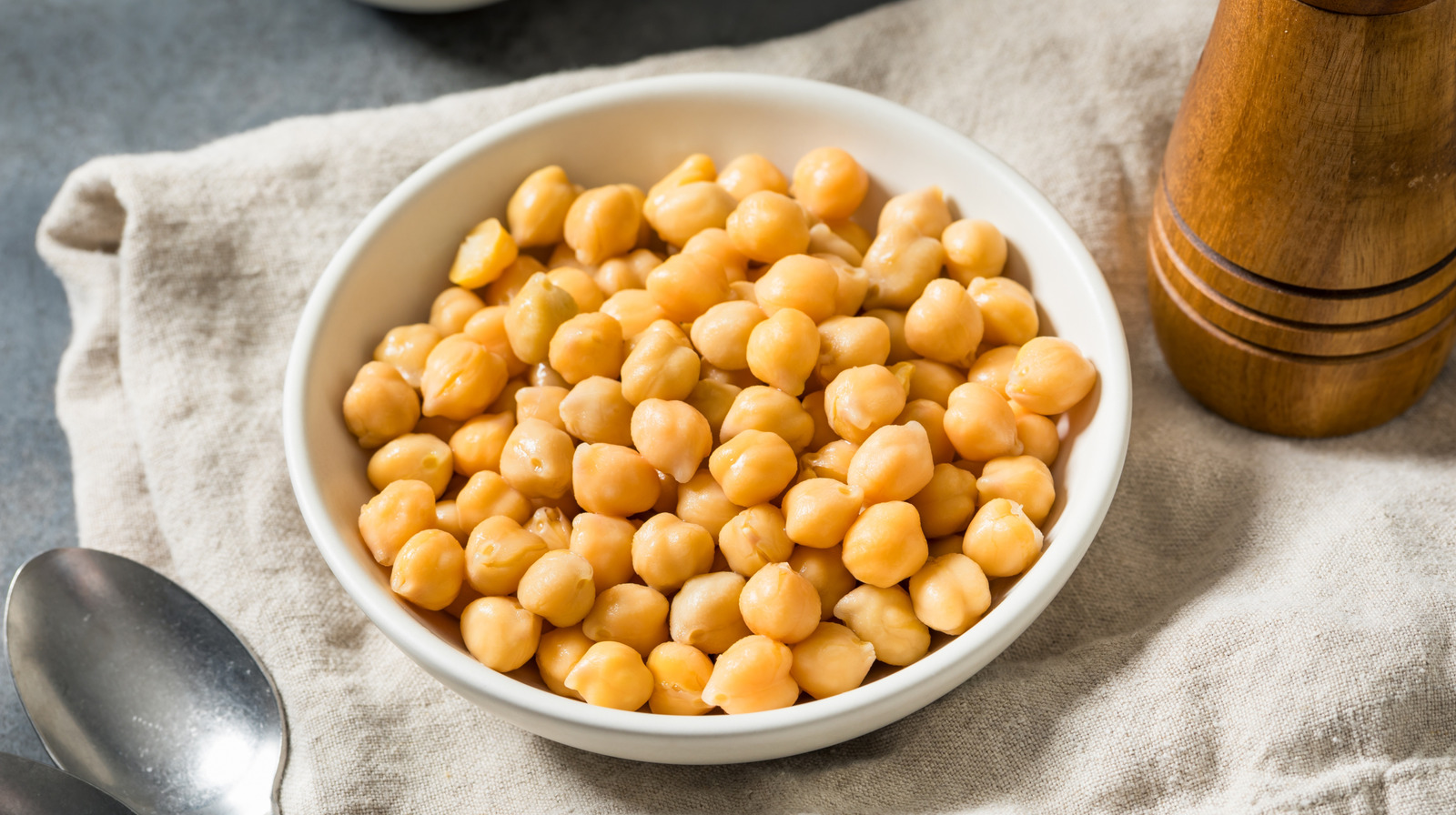
8 Clever Ways To Cook With Canned Chickpeas

Canned chickpeas are one of the most versatile ingredients in your pantry, begging to be used to their full potential. These are clever ways to cook with them.

​Food Republic – Restaurants, Reviews, Recipes, Cooking Tips

Categories
Food

The Foolproof Tool One Pizza Expert Recommends For Crispy Crust (It’s Not A Pizza Stone)

If you don’t have a pizza stone, one common kitchen staple can help you achieve the perfectly golden, crispy crust usually reserved for professional pizzerias.

​Food Republic – Restaurants, Reviews, Recipes, Cooking Tips