 Bunnie Xo is stripping down the reality of her recovery.
Nearly a week after the Stripped Down: Unfiltered and Unapologetic author underwent a facelift, she detailed the side effects she is…
E! Online (US) – Top Stories









Bunnie Xo is stripping down the reality of her recovery.
Nearly a week after the Stripped Down: Unfiltered and Unapologetic author underwent a facelift, she detailed the side effects she is…
E! Online (US) – Top Stories

Container ships are lined up at the Port of Alaska in Anchorage on Oct. 11, 2020. The port and Sandia National Laboratories are teaming up to evaluate Cook Inlet renewable energy resources to potentially fuel a planned microgrid. (Photo by Erik Hill/Port of Alaska)
Alaska is once again riding high on the strength of oil revenues, with an additional $545 million flowing into state coffers. This is welcome news for policymakers and residents alike. But it also presents a familiar and uncomfortable paradox: the very forces boosting state revenue are poised to inflict serious economic pain on many Alaskans, particularly those in rural communities.
As oil prices rise, so too will the cost of energy across much of rural Alaska, which continues to depend heavily on diesel-fired generation of electricity. While there may be a lag before these increases reach consumers because of older oil product inventory that reflects earlier, lower prices, the direction is clear. Households and small businesses in remote communities like Kotlik, Nome, Allakaket, Gambell, and Atka — already paying some of the highest energy costs in the nation — will soon face another wave of price shocks. These will not be minor fluctuations, but the kind of sustained cost pressures that can destabilize family budgets, strain local economies and deepen inequities between urban and rural Alaska.
For years, the Power Cost Equalization program has served as a critical buffer, helping to offset high electricity costs in eligible communities by subsidizing them in Alaska. But that buffer is now stretched to its limits. Even before oil prices surged, the fund was operating at the ceiling of its annual payout. It currently lacks the capacity to absorb another surge in costs. In short, the safety net is still there, but it will not stretch any further.
This moment calls for more than short-term patchwork. It calls for foresight.
The Renewable Energy Fund, a competitive grant fund to support renewable energy projects, offers a path to stability. Designed to support projects that reduce long-term energy costs and increase local resilience, the REF has already helped bring hydro, wind, solar and other innovations to communities across the state. These investments are not just environmentally sound; they are economically prudent and subject to third-party verification by the Alaska Energy Authority’s energy engineering and finance professionals. By reducing dependence on imported diesel, REF projects insulate communities from the very volatility we are now confronting.
The fiscal case for continued investment is compelling. Per the Alaska Energy Authority’s website, REF-funded projects currently offset an estimated 13 million gallons of diesel each year. Valued at an extremely conservative rate of $4 per gallon, that equates to approximately $52 million in avoided fuel cost statewide. That cost-savings figure exceeds the current annual payout capacity of the Power Cost Equalization Endowment and is more than a 5% annual draw on a $1 billion fund.
The question, then, is not whether Alaska can afford to invest more in the REF; it is whether we can afford not to.
There are $41.2 million in total Renewable Energy Fund requests this year that have been successfully vetted by the Alaska Energy Authority. Allocating a portion of the $545 million in additional revenue to the REF would be a strategic use of windfall funds. It would convert short-term gains into long-term stability, and recurring cost-savings. It would acknowledge that while the state may benefit from high oil prices today, many of its residents will pay the price tomorrow.
Alaska has been here before — caught between boom and bust, between revenue and risk. The difference now is that we have better tools and clearer investment opportunities. We can continue to react to crises as they unfold, or we can invest in solutions that reduce the severity of those crises in the first place.
Dedicating a portion of this unexpected revenue to the Renewable Energy Fund would not solve every challenge overnight. But it would mark a meaningful step toward a more stable, more equitable energy future for rural Alaska.
The state is benefiting tremendously from volatility. It should also help protect those who are most vulnerable to it.
SUBSCRIBE: GET THE MORNING HEADLINES DELIVERED TO YOUR INBOX

 One of Hollywood’s most iconic couples could be getting the prestige TV treatment.
Ahead of the season one finale of Love Story—which will conclude the FX series’ dramatization of John F. Kennedy…
E! Online (US) – Top Stories

 Christina Applegate is planning for her future.
The Married…with Children alum, who went public with her multiple sclerosis diagnosis in 2021, got candid about the everyday aspects of living with…
E! Online (US) – Top Stories

Can you guess which eatery rolls around its prime rib on a silver cart offering tableside slicing? Hint: The restaurant got its start in California.

Mashed – Fast Food, Celebrity Chefs, Grocery, Reviews

 Finding a swimsuit that actually fits a larger bust doesn’t have to be stressful.
The right bikini or one-piece should lift, flatter, and make you feel confident, whether you’re poolside or…
E! Online (US) – Top Stories

Skip Holtz, one of the most successful head coaches in spring football, stepped away from his post with the three-time champions Birmingham Stallions this offseason. Filling those big shoes is a familiar face, with former UFL product and Alabama quarterback AJ McCarron taking over — one of several new coaching changes for Year 3. “Everything happens for a reason,” McCarron said. “I truly believe that, and I’ve enjoyed every minute of it. … I was in this league when it first came back around in 2023, and to see it grow and how well they take care of the coaches and players … has been awesome.” The 2026 UFL season kicks off Friday night on FOX with the newly formed Louisville Kings — one of the league’s three brand-new franchises — hosting the Stallions at Kentucky’s Lyon Family Stadium (8 p.m. ET). One of the main goals of the UFL remains providing an opportunity for players to chase their dreams of playing in the NFL. Over the past two seasons, 66 players with a connection to modern-era spring football (2020 to present) have earned spots on NFL regular-season rosters or have been added to practice squads during the 2025 season. Along with that extra incentive, one thing that has remained a constant in the league is Shannon Harris, the head coach of the DC Defenders and 2025 UFL Coach of the Year. Harris led the Defenders to a UFL title in his first season after replacing Reggie Barlow just a week before the 2025 season began. The Defenders finished the season raising the championship trophy, and Harris shed the interim tag to become DC’s permanent head coach. The Defenders also have the most continuity of any team, returning offensive coordinator Fred Kaiss and defensive coordinator Blake Williams, the son of longtime NFL defensive guru Gregg Williams. “We know what it takes to win in this league, and the goal isn’t to relive last season,” said Williams. “It’s to raise the bar. This group is hungry, driven, and locked in on building something even better in 2026.” Here’s a closer look at what to know for the upcoming UFL season: Three new home markets in Year 3 Three franchises were moved to different cities, an effort by the league to drum up more fan support and create a more festive, intimate environment by playing in cozier venues to improve the fan experience. Teams in Memphis, San Antonio and Michigan relocated to Columbus, Louisville and Orlando, respectively. Six of the eight venues have also been changed. The league’s hope is the move to different markets and smaller venues will spark fan engagement. [UFL 2026: Full Regular-Season Schedules for All 8 Teams] Rick Neuheisel among six new head coaches McCarron is just one of six new UFL head coaches on the sidelines this season. Former Colorado and Washington head coach Neuheisel takes over the Dallas Renegades, who moved from Arlington. The Renegades relocated their home games from Choctaw Stadium in Arlington to Toyota Stadium in Frisco, Texas. Kevin Sumlin returns to coach the Houston Gamblers. The Roughnecks were rebranded to the Gamblers for 2026, reverting to their original name when Sumlin served as the team’s head coach in the legacy USFL in 2022. Anthony Becht has moved from the St. Louis Battlehawks to become the head coach of the new Orlando Storm. Ricky Proehl replaces Becht in St. Louis, while former NFL receiver and Ohio State standout Ted Ginn Jr. will serve as the head coach of the Columbus Aviators and former NFL quarterback Chris Redman is the head coach of the Kings. Familiar names on UFL rosters Luis Perez, “The Spring King,” remains the starting quarterback for the Renegades. Perez led the UFL with 2,238 passing yards last year. Offensive lineman Tremayne Anchrum Jr., a former NFL draft pick in 2020, is with the Renegades, along with returning wideout Deontay Burnett. 2025 UFL Championship Game MVP Jordan Ta’amu returns for the Defenders. DC’s veteran quarterback is joined by former Michigan Panthers safety Kai Nacua, the older brother of Los Angeles Rams receiver Puka Nacua. Former legacy XFL rushing leader Abram Smith is back for the Defenders, along with receivers Cornell Powell and Ty Scott. Jalan McClendon returns for another season in the UFL as the starting quarterback for the Aviators. The 30-year-old took a major step in development by earning a starting job in Houston last year. McClendon helped Houston improve from 1-9 in 2024 to 5-5 last season. Ex-Michigan Panthers running back Toa Taua is also now with the Aviators. Quarterback Matt Corral and standout wide receiver Deon Cain are back for Birmingham’s high-powered offense. Former San Antonio Brahmas speedy running back Anthony McFarland Jr. joins those two in Birmingham. Hakeem Butler returns at receiver for St. Louis, along with outside linebackers Pita Taumoepenu and Travis Feeney. All-UFL defensive tackle Carlos Davis moves from Birmingham to St. Louis. All-UFL linebacker Tavante Beckett is now with the newly formed Storm. Electric receiver and returner Chris Rowland joins Beckett in Orlando. Versatile running back Kirk Merritt is back for Houston. [UFL 2026: Every Player Drafted by Position for All 8 Teams] New faces, new places Former Cleveland Browns quarterback and UCLA product Dorian Thompson-Robinson will lead Orlando’s offense. Ex-Cincinnati Bengals receiver John Ross, who held the NFL Scouting Combine record in the 40-yard dash at 4.22 seconds before Xavier Worthy broke it two years ago, is joining his former teammate McCarron in Birmingham. Newly minted Atlanta Falcons quarterback Tua Tagovailia’s younger brother, Taulia, was signed by Houston. He played at Maryland when Sumlin coached there. Former Las Vegas Raiders first-round cornerback Damon Arnette returns to Houston, and ex-Pittsburgh Steelers running back Benny Snell Jr. signed on with Louisville. One of the new kickers to watch out for this year is USC product Michael Lantz for the Storm. Brandon Aubrey, Jake Bates, Harrison Mevis and Andre Szmyt are all former UFL players who earned jobs as kickers in the NFL. [UFL 2026 Title Odds: Stallions, Defenders Top Preseason Board] New rule changes The UFL installed a handful of changes to juice up the game and encourage more scoring. Those include the addition of a 4-point kick for any successful field goal 60 yards or longer. Last season in the NFL, kickers went 12-for-22 (54%) from 60-plus yards on field goals. Punts inside the 50-yard line are also prohibited, except for after the two-minute warning in either half. The UFL banned the “tush push” short-yardage play, moved kickoffs back to the 30-yard line and changed to requiring pass catchers to just have one foot in bounds, like in college. The UFL also changed two-point conversions to the NFL’s 2-yard line, moving it up from the 5-yard line. Additionally, offenses can kick for one point from the 33-yard line or go for three points from the 8-yard line. [UFL 2026: New, Updated Home and Away Uniforms for All 8 Teams] Matchups to watch, halftime entertainment highlight Week 1 Along with the Stallions and Kings kicking things off Friday, FOX will televise the Gamblers at the Renegades from Toyota Stadium on Saturday afternoon (4 p.m. ET). The other two games this weekend — Defenders vs. Battlehawks on Saturday (noon ET) and Aviators vs. Storm on Sunday (8 p.m. ET) — will be televised on ESPN to close out Week 1. The UFL will have several headliner music acts performing at halftime for season openers in home markets, including D.J. Khalid in Orlando, Nelly in St. Louis, Ty Myers in Dallas and Russell Dickerson in Louisville.Latest Sports News from FOX Sports
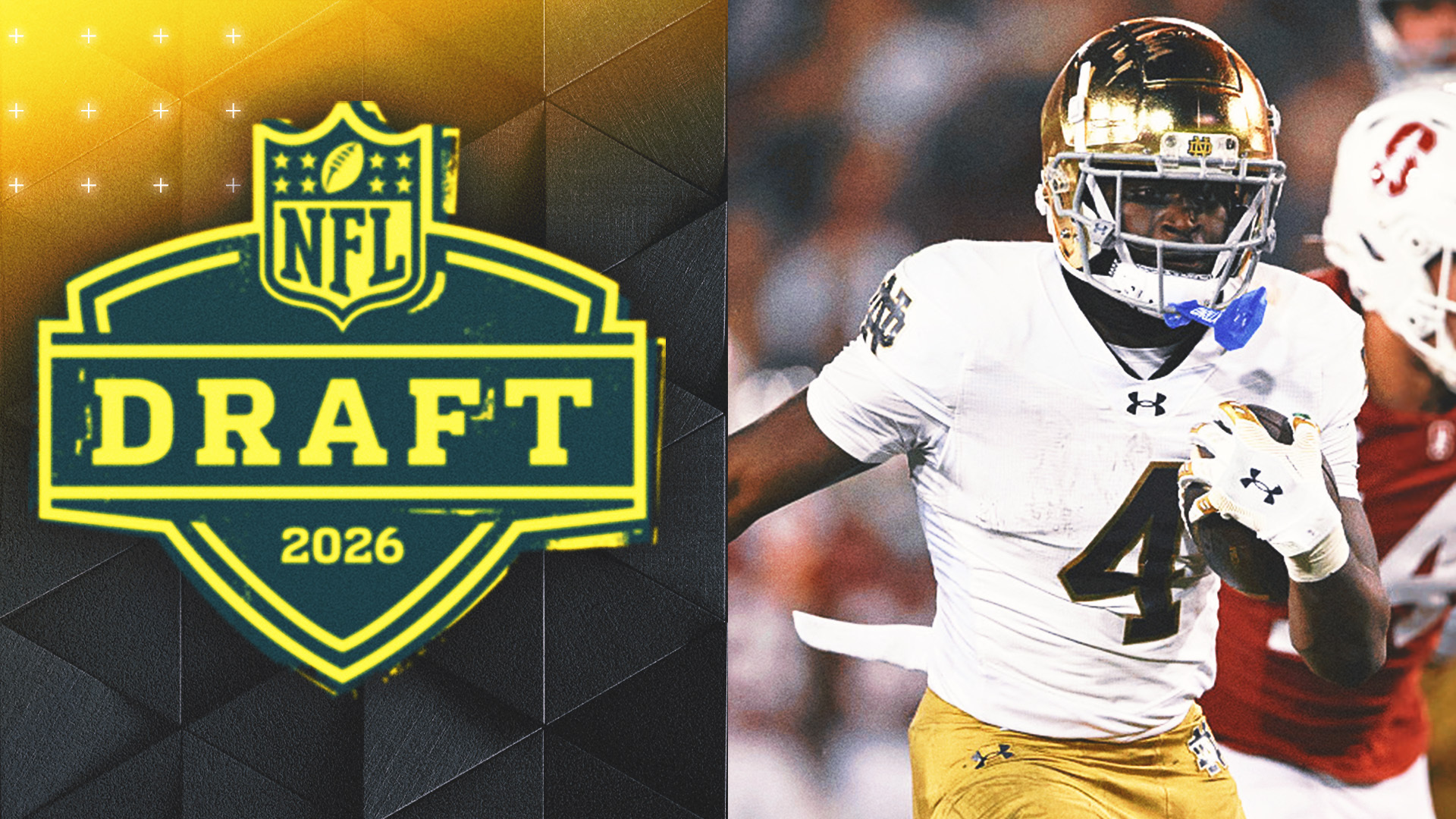
The 2026 NFL Draft is still a month away, but astute evaluators have already completed their scouting reports for the top players in the class. Despite the NFL scouting community’s lack of respect for running backs and their ability to carry a team to a championship, Jeremiyah Love has evaluators reconsidering their team-building philosophies heading into April. The Notre Dame star is a rare find at the position as a workhorse runner with “take it to the house” potential and receiver-like hands and ball skills. In 41 college games, Love rushed for 2,882 rushing yards and 36 rushing touchdowns and added 63 catches for 594 yards and six scores. Given his ability to seamlessly shift from workhorse to big-play specialist, he has captivated the imagination of offensive coordinators looking for an explosive RB1 to build an offense around. Moreover, the 2025 Doak Walker Award winner has coaches and scouts contemplating tossing aside the new norms and reverting to a time when blue-chip runners routinely came off the board as top-five picks. Although Love will not headline a class that matches the 2005 draft — RBs Ronnie Brown, Cedric Benson and Cadillac Williams were selected second, third and fifth, respectively — he could join Todd Gurley (10th overall, 2015 draft), Ezekiel Elliott (fourth, 2016), Christian McCaffrey (eighth, 2017), Leonard Fournette (fourth, 2017), Saquon Barkley (second, 2018) and Bijan Robinson (eighth, 2023) as one of the few running backs selected in the top 10 since 2015. Considering the hype surrounding Love and his potential to take the league by storm, here is my breakdown of his spectacular game. The Upside Love is the total package as a downhill runner, with big-play ability as both a runner and a receiver. Measuring 6-foot and 212 pounds and with quick feet and exceptional balance and body control, he can run through or around defenders to get to the second level. While his superb vision enables him to spot creases quickly at the point of attack, Love’s ridiculous cutting ability allows him to slither and slide through small cracks between the tackles. With few defenders capable of matching his explosiveness and agility, the former Missouri Class 5 100-meter sprint champion (10.76) is a make-you-miss specialist with the speed to take it the distance. As a receiver, Love’s soft hands and outstanding open field running skills routinely result in big plays on low-risk throws to the perimeter. Whether catching flares and swings from his traditional running back spot or winning one-on-one matchups on options or isolation routes, he is a difference-maker in the mold of CMC and Robinson out of the backfield. As the NFL continues to evolve into a matchup league with offensive playcallers looking for various ways to create and exploit mismatches, Love’s versatility and explosiveness make him the multifaceted offensive weapon every team wants in the huddle. The Downside Despite Love’s impressive performance and production as Notre Dame’s feature back, evaluators will question whether he is a capable workhorse back at the next level. He logged 20 or more carries in a game only three times during his career, which raises concerns about his competitive stamina as an RB1. While most teams are utilizing a committee approach in the backfield with multiple runners sharing the load, Love’s status as a potential top-five pick would lead to expectations of a significant workload. As a primary playmaker for the Irish, Love’s lack of pass protection experience could be an issue at the next level. He has not mastered the complexities of “double read” concepts (running back assigned to block one of two pass rushers) within the pocket, and he must refine his blocking technique to sustain and finish better against hard-charging linebackers. While most teams will squash the issues by featuring him extensively as a receiver out of the backfield, NFL defensive coordinators will concoct a few schemes that force him to stay in the backfield and become part of the protection unit. With that in mind, Love must continue to improve in this area to prevent opponents from neutralizing his impact through creative scheming. The Verdict Love is the highest-rated running back that I have scouted since Reggie Bush entered the 2006 draft. While I raved about the USC legend and Heisman Trophy winner for his electric playmaking skills as a runner, receiver and returner, the Notre Dame star displays the potential to develop into an unstoppable force as an RB1/WR2 in a dynamic offensive scheme. Love reminds some evaluators of Detroit Lions three-time Pro Bowl RB Jahmyr Gibbs as a big-play threat and scoring machine. I view him, however, as a Jamaal Charles-like weapon who will consistently produce 100-plus yards from scrimmage with ease. As teams look for an offensive weapon to build game plans around, the buzz over the No. 1 running back in the 2026 class will reach a crescendo on April 23.Latest Sports News from FOX Sports

The original donut, developed in New York by Dutch immigrants, looked totally different to the glorious donut we know and love today. Here’s its history.

Food Republic – Restaurants, Reviews, Recipes, Cooking Tips

Reading Time: 3 minutes
You’re probably already aware that ABC has canceled Taylor Frankie Paul’s season of The Bachelorette.
It’s an unprecedented move that will cost the network tens of millions in lost ad revenue and production costs.
And it might be just the beginning of the fallout, as many are now calling for the show to be canceled entirely.
In fact, some prominent media figures think ABC should go a step further and 86 the entire Bachelor franchise.
It might sound like an extreme solution — but it may also be the only way that the network can avoid further scandal and embarrassment.
As a new piece in The Hollywood Reporter points out, this is not the first time that ABC execs have been forced to weather a Bachelor-related scandal.
Whether it’s Chris Harrison getting fired for making problematic comments or the many, many reports of drunken, inappropriate behavior on the set of Bachelor In Paradise, the most problematic shows on network TV all have “Bachelor” somewhere in the title.

Producers have repeatedly promised to “address” these matters, but as the years go by, the Bachelor scandals continue to crop up.
Bachelor creator and showrunner Mike Fleiss left the franchise in 2023, and it was later revealed that he departed amid an HR investigation.
Just two years later, his replacements, Claire Freeland and Bennett Graebner, departed amid allegations that they had created a toxic work environment.
The Paul situation could be the most damaging Bachelorette controversy yet, as people who have never watched a single second of the show are now aghast at footage of Taylor attacking then-boyfriend Dakota Mortensen.
As if it weren’t bad enough that we see Paul punch and kick Mortensen, she also throws several metal barstools at him, one of which allegedly struck her 5-year-old daughter.

To make matters worse, Paul pled guilty to assault charges back in 2023. The incident was a matter of public record that had been discussed on Taylor’s reality show, The Secret Lives of Mormon Wives, on numerous occasions.
In other words, ABC and Bachelorette producers absolutely knew that Taylor had been in a violent altercation with her ex not all that long ago.
And they decided to go ahead and cast her as the Bachelorette anyway.
“The bloom is off the rose. ABC and the Bachelor franchise need a divorce,” reads THR’s latest opinion piece on the matter.
The author of the piece, Rick Porter, goes on to note that if video of the fight had not been made public, Taylor would be basking in the glow of her Bachelorette moment, and millions of Americans would be watching dozens of men as they fought to win her affections.
“If it took a video of a child being injured to pull the show from TV, then the Bachelor franchise is beyond help. It’s time for it to go away,” Porter writes.
It’s hard to argue with that assertion. For as much guilty pleasure as The Bachelor and its spinoffs have provided over the past 24 years, it might be time for ABC to concede that this franchise belongs to a bygone era.
‘The Bachelorette’ to Be Canceled Completely Following Taylor Frankie Paul … was originally published on The Hollywood Gossip.
The Hollywood Gossip