Categories
Alaska News

Budget Nuggets: Manager’s budget proposes spending savings to keep services steady

The borough manager has proposed a budget for the upcoming year that would hold big-ticket spending roughly steady, but would pay for it, at least in part, with significant spending from savings. 

In one of few larger spending changes, the manager has proposed a roughly 4% bump in school funding, on top of the increase approved by the assembly last year. 

The increase, which comes out to an additional $101,000 over last year, would bring the borough’s spending on the school to $2,668,000.

That’s still short of a 12%, or $295,000, increase requested this year by superintendent Lilly Boron, said borough manager Alekka Fullerton. 

The increase in borough school spending comes as a response to shrinking state funding.

In recent weeks, Boron told state lawmakers that the district is in dire financial straits, warning of potential “insolvency” if state funding levels continue to stagnate. 

District officials in the last two years have said their top priority with new funds is to increase teacher salaries. Under a newly-negotiated collective bargaining agreement, teachers in the district will see a 5% pay bump this year, followed by a 4% and 3% increase in the two years following. 

The district’s issues, of inflation-fueled cost increases and declining state-funding, have been problems for the borough as well, Fullerton said. “We have a very lean budget already and have battled inflation in every department over the last few years,” Fullerton wrote in a letter accompanying the budget. 

For a number of reasons, it has not been easy for the borough to pull in new revenue to match increasing costs. 

Property taxes are just about tied with sales tax as the largest sources of borough revenue. Raising property tax rates, however, is politically unpopular and capped by borough code. 

This year, Fullerton’s budget would actually drop property tax rates. As written, the rate in the townsite would drop 8% from last year and the borough-wide rate would drop 11%. 

Property tax rates are often expressed in mills — the dollars taxed per $1000 of assessed value. Haines’ rates in the proposed budget, 10.09 mills in the townsite and 5.74 boroughwide, come in below the 2025 state average of 10.58 mills, according to the Office of the State Tax Assessor. 

In recent months, borough leadership has sought to increase revenues outside of direct taxation of locals. 

New revenue streams approved by the assembly include a cruise ship head-tax and zero-balance ambulance billing, each projected to bring in low-to-mid six-figure sums annually. The revenue generating effort also included the seasonal sales tax, which voters approved last year, but which remains controversial, and a potential new severance tax on exported raw materials. 

Even with these new funding sources, revenue in the proposed budget falls about $2.7 million short of spending. To close the gap, Fullerton proposes dipping into borough savings. 

That would come from a number of different savings accounts, all of which are restricted to specific types of spending except for the unrestricted areawide general fund. That general fund, the largest of the accounts, funds items like the school, library, pool, and borough administration. 

The proposed savings draw would pull $1.1 million from the areawide general fund, which is expected to have $4.3 million in savings by the end of June 2026. 

The rest of the savings draw would largely come from the townsite-services fund and the economic development and tourism fund, each of which currently contain more than $1 million. 

The manager’s proposal is headed to the assembly, which controls final decisions on the annual tax-and-spend plan. 

Last year, the assembly approved additional spending beyond the manager’s plan for services like the school and the pool, which it could once again do this year. 

Assembly members will likely also comb through the budget to find cuts, like last year’s cancellation of a handful of new borough vehicle purchases. 

The manager has also left what she says are more political decisions to the assembly. For instance, there’s no money in her budget for non-profits or for the Freeride World Tour, which has asked to be paid $150,000 to return next year. 

The assembly’s deliberations will include three committee-of-the-whole meetings dedicated to the budget on April 21, April 28, and May 14. Then the assembly will hold public hearings on the budget on May 12 and May 26. If the budget is not passed at the May 26 meeting, the assembly will hold a third public hearing on June 9. 

According to borough charter, the assembly must pass the final budget by June 15. 

What do you want to know about the Haines Borough budget?
Help us report on the the borough’s budget by telling us how borough spending impacts you.

Please enable JavaScript in your browser to complete this form.

Please enable JavaScript in your browser to complete this form.

Loading

The post Budget Nuggets: Manager’s budget proposes spending savings to keep services steady appeared first on Chilkat Valley News.


Categories
Entertainment

This Breakfast Staple Helps Protect Your Garden From Slugs

Tired of having your produce ravaged by these pesky mollusks? Well, we’ve got something else for them to gorge on, and it’s likely in your pantry.

​Mashed – Fast Food, Celebrity Chefs, Grocery, Reviews

Categories
Entertainment

Paris Hilton on the Products That Keep Blonde Hair Looking Healthy

Paris Hilton Paul Mitchell Blonde Ecomm Thumb.jpgParis Hilton is staying true to her roots as a blonde icon with some help from Paul Mitchell. 
The entrepreneur exclusively revealed her tips for summer confidence to E! that you can apply into…
​E! Online (US) – Top Stories

Categories
Alaska News

Alaska Gov. Dunleavy signs nearly $450M supplemental budget to cover state expenses this year

Alaska Gov. Mike Dunleavy speaks to reporters about school funding and education policy on Thursday, April 17, 2025. (Photo by James Brooks/Alaska Beacon)

Alaska Gov. Mike Dunleavy speaks to reporters on Thursday, April 17, 2025. (Photo by James Brooks/Alaska Beacon)

Gov. Mike Dunleavy signed off on a supplemental budget bill that authorizes nearly $450 million in additional state spending this year. 

The budget bill covers additional costs incurred by the state this fiscal year ending in June, including funds for disaster relief, education, corrections and transportation. 

The bill was approved by the Alaska State Legislature two weeks ago. Dunleavy signed the budget on Apr. 2, and transmitted it back to the Legislature on Thursday. 

“I appreciate the Legislature’s support of these proposals,” Dunleavy said in a letter announcing his signature on the bill. “The supplemental budget I have signed into law today enables the State to meet current fiscal year responsibilities and represents prudent and fiscally responsible investments in emergency and fire response, public safety and statewide transportation needs.”

The budget includes $75 million for disaster relief to address the response to the Western Alaska storms last fall, and nearly $100 million for fire suppression, particularly in Interior Alaska. It includes $20 million for the Alaska Department of Corrections overtime expenses, as well as $70 million in time-sensitive funding for transportation — sought by the construction industry to unlock a federal match of $630 million for state construction projects.

It also includes $130 million for the Alaska Higher Education Fund which provides grants and scholarships for students, as well as $34.4 million for Medicaid and $12.8 million for other public assistance programs through the Alaska Department of Health. 

The governor’s office submitted an additional $11.6 million request, but it was submitted too late to include in the budget bill, and will be rolled into the proposal for next year’s budget. 

Additionally, the state is waiting on an appeal decision after failing a federal disparity test for education funding, and could potentially be liable for $72 million in K-12 funding for next year, according to officials with the Legislative Finance Division. 

Oil revenues still uncertain

In the Legislature, the bill was delayed this year amid ongoing debate in the House of Representatives on whether to pay for the larger than usual budget bill out of state savings — an act that requires the approval of three-quarters of legislators.

Members of the House Republican minority caucus objected to spending from a state savings account, the Constitutional Budget Reserve. After the Alaska Department of Revenue projected the state would see an additional $500 million in oil revenue due to a surge in oil prices driven by the Iran war, they argued the state would not need to pull from savings to pay its bills. 

Members of the multipartisan House majority caucus objected to the uncertainty of revenue forecasts and future oil prices, and argued for a draw from state savings to fund the budget bill immediately.

If oil-driven state revenues from now until the end of the fiscal year are not sufficient to cover the $450 million supplemental budget, then lawmakers agreed to draw from state savings. That means oil prices must average approximately $82 per barrel of oil through June for state revenue to cover spending, according to officials with the Legislative Finance Division. 

House Speaker Rep. Bryce Edgmon, I-Dillingham, was among legislators who supported the draw from savings several weeks ago, instead of banking on uncertain future oil revenues. On Friday, he said it seems revenues will cover the budget bill. 

“As appears now, oil prices are continuing to move in an upward trajectory, which means that the bill at the very end could be fully funded,” Edgmon said. “But there’s still a fair amount of time in front of us for oil prices to, you know, continue to be volatile.”

Edgmon said barring a dive in oil prices, he doesn’t expect another vote on drawing from the state savings this session.

“That’s pending a dramatic drop in oil prices, of course, which doesn’t seem to be on the horizon.”

SUPPORT: YOU MAKE OUR WORK POSSIBLE

Categories
Entertainment

Age of Attraction: Libby Reacts to Speculation Over Andrew’s Sexuality

Age of Attraction's Libby Vodicka, Andrew WheelerLibby Vodicka has entered the chat.
One week after she confirmed that she was still dating Andrew Wheeler at the Age of Attraction season one reunion, the 23-year-old couldn’t resist poking fun at…
​E! Online (US) – Top Stories

Categories
Food

This Is Hands-Down The Best Sandwich Spot In Denver, According To A Local

If you’re looking for an amazing sandwich in Denver, Odie B’s menu is full of creative, flavor-packed hits to satisfy every craving at any time of day.

​Food Republic – Restaurants, Reviews, Recipes, Cooking Tips

Categories
Entertainment

Now’s Your Chance: Get Paula’s Choice BHA Exfoliating Toner on Sale

Paula’s Choice products will be up to 20% off sephora savingsIn the skincare world, some products are definitely worth the splurge… but why do that when you could wait for a good sale to come along? Lucky for us, the Sephora Savings Event has us adding to…

​E! Online (US) – Top Stories

Categories
Entertainment

Michael Jackson’s Son Bigi “Blanket” Makes Rare Red Carpet Appearance

Michael JacksonMichael Jackson’s sons are having a thriller night.

Bigi “Blanket” Jackson stepped out for a rare red carpet appearance with his older brother Prince Jackson at the Berlin premiere of the Michael…
​E! Online (US) – Top Stories

Categories
Entertainment

Natasha Lyonne Explains What Happened on Flight Before Removal

Natasha Lyonne attends the New York City premiere of LorneNatasha Lyonne is sharing more insight into her recent travel mishap.

Three days after the Poker Face star was removed from a Delta flight for reportedly failing to follow flight attendants’…
​E! Online (US) – Top Stories

Categories
Alaska News

Alaska Seaplanes gets approval for new departure, landing paths to reduce flight disruptions

Patrick Ford flies a Cessna 208 Caravan through the clouds over Juneau on Thursday, April 9, 2026. (Courtesy/ Clarise Larson, KTOO)

On Thursday morning, Patrick Ford descended through clouds shrouding Juneau in a brand new Cessna 208 Caravan. The plane emerged from whiteout conditions at around 1600 feet above the Mendenhall Wetlands and glided gently onto the runway at Juneau International Airport.

Ford is a pilot and the director of operations at Alaska Seaplanes, the largest commuter airline in Southeast Alaska. For much of the test flight, he operated on autopilot using an approach that automatically followed fixed waypoints in the sky. 

“Every one of these little star-looking guys is a different fix. It’s just a three-dimensional point in space that you have to hit at a specific spot at a specific altitude,” Ford said. “It’s basically just like driving down the highway, and you’re driving the highway in the sky, following the markers.” 

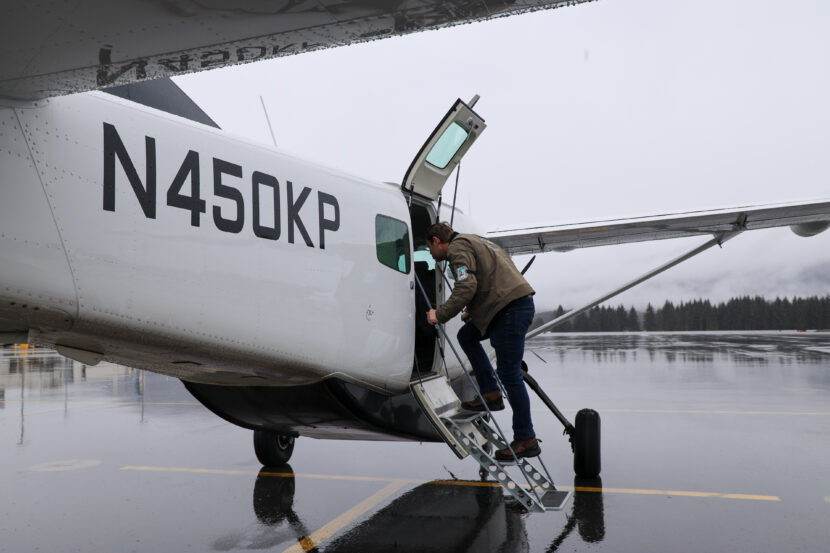
The Federal Aviation Administration approved Alaska Seaplanes’ new departure and arrival paths in Juneau, Haines, Kake, Sitka, Hoonah, Klawock, Wrangell and Petersburg. Those paths are available to the company’s wheeled fleet, but not float planes. The goal of these new, proprietary approaches and departures is to improve flight safety and reliability for Southeast communities when pilots can’t see anything but clouds.

Patrick Ford, a pilot and the director of operations at Alaska Seaplanes, prepares for takeoff in Cessna 208 Caravan on Thursday, April 9, 2026. (Photo by Clarise Larson/KTOO)

Andy Kline, marketing manager at Alaska Seaplanes, said the company spent millions to design and get authorization for the new paths. Since the expense was planned years in advance, he said passengers won’t see fare spikes from this.

The company’s new path in and out of Juneau International Airport goes through the south end of Gastineau Channel. Ford said it allows pilots to drop out of a cloud ceiling that’s as low as 580 feet above sea level, increasing a plane’s chances of landing in poor visibility instead of turning around.

“I’m sure you guys have been on a flight where you get halfway up to Haines and, you know, it’s shut down at Eldred Rock, and you have to turn around and come all the way back,” Ford said. 

Those new flight paths are paired with advanced GPS technology called synthetic vision, made by Garmin. A screen in the cockpit displays a computer-generated 3-D view of the terrain, allowing pilots to ‘see’ their surroundings when there’s zero visibility. 

A screen in the cockpit displays a computer-generated 3-D view of the terrain, called synthetic vision. (Photo by Clarise Larson/KTOO)

Ford said that’s an advancement on what’s called instrument flight rules, or IFR, a set of FAA regulations that control the conditions for pilots relying on instruments to navigate rather than sight. 

“It’s a huge, huge improvement in safety,” Ford said. “I sleep better at night knowing that that’s an option.”

Kline said it brings the commuter airline closer to the capabilities of Alaska Airlines, which has had the technology for decades.

That matters to residents of Southeast, a notoriously cloudy and mountainous region. Large jets don’t land in many small towns in the region, so residents rely on small, commuter flights for air travel.

Sean Kveum, co-owner and chief operating officer of Alaska Seaplanes, said that flights were frequently cancelled decades ago, before commuter aircraft could fly in low visibility

“We just had to stay low below the clouds and wait for good weather, and you could go when it was good enough,” Kveum said.

He said the new flight paths and synthetic vision will improve flights for outlying communities like Hoonah, where he grew up. 

“It really allows us to be providing a more reliable service to the communities throughout Southeast,” he said. 

This story was originally published by KTOO.

Clarification: This story has been updated to reflect that Alaska Seaplanes does not have the exact same capabilities of Alaska Airlines.

The post Alaska Seaplanes gets approval for new departure, landing paths to reduce flight disruptions appeared first on Chilkat Valley News.