“Here we go,” is what borough manager Alekka Fullerton told assembly members at a meeting Tuesday, marking the start of budget deliberations.
The manager’s budget released at the start of this month, proposes holding the borough’s spending plan roughly in line with last year, with a decrease to property tax rates largely made-up for by a projected increase in sales tax revenue from the new seasonal sales tax rate.
War in Iran, however far away from the realm of municipal government, could throw a wrench in the works: the town is bracing for skyrocketing fuel prices and higher shipping costs for goods across the board, and over 500 residents have signed a petition asking the borough to cut taxes in response to the cost-of-living increase.
That discussion will play out at a town-hall Wednesday, scheduled for just after press time this week, and at the next few assembly meetings.
Simultaneously, the borough assembly is starting their process of editing the manager’s plan, including looking for potential spending cuts, many assembly members have said.
Early deliberation is broken down by different sections of the budget, like Tuesday’s meeting, which covered the areawide general fund.
What does it mean for the budget to be broken down into funds?
Borough services are largely split up and paid for by the populations they serve. The general fund encompasses services that are meant to benefit everyone living within the borough’s boundaries — services like the school, which any student in the borough may attend.
With the broadest benefits, the general fund is paid into by broad funding sources that don’t come from just one specific area in the borough. For instance, roughly 43% of the general fund is expected to be paid for by property tax this year. That’s specifically the portion of the property tax paid equally by all borough land-owners — 5.74 mills in the manager’s proposed budget, or 0.574% of a home’s value.
It’s slightly confusing, given that residents in the townsite do pay a higher property total property tax rate, proposed by the manager at 10.09 mills for the upcoming year. That extra chunk of property tax, however, pays into the townsite service area — meant to encompass services specifically benefitting townsite residents.
Those services include the police department. If there’s an emergency — “basically if there’s a life threatening situation,” Fullerton said this week — the police may operate out Lutak, Mud Bay, or out the highway north of the Airport. Those out-of-townsite residents do contribute to police costs when they pay sales-tax on purchases in-town. Sales-tax revenue is split between multiple funds. But otherwise, the police department’s main duties are in town, funded by taxpayers in town.
Other services in the townsite service area fund include townsite road-maintenance and borough public works.
In terms of specific changes to these funds this year, Tuesday’s meeting outlined a picture of persistently creeping costs across the board. For instance, the borough server software, VMWare, has become a subscription service, adding an additional $11,000 to borough technology costs for the upcoming year.
The assembly will hold a committee-of-the-whole meeting to discuss the townsite service area on Tuesday.
The Haines School will host the Region V Art Festival this weekend, welcoming in roughly 70 students from across Southeast.
Students will attend two instructional workshops a day from Friday through Monday. The sessions will be taught by art teachers from the visiting Region V schools, as well as local artists Tassja Letchworth, Kelleen Adams, John Svenson and Skweit Jessie Morgan.
The annual art festival began in 1998, first in Wrangell by teacher Kirk Garbisch with the help of a Kake art instructor and carver Rick Mills.
Its purpose for the last 30 years has been to encourage the exchange of art and instruction among high school students. It rotates among Southeast communities.
This year’s festival offers a range of workshops, including glassblowing, creating a formline longboard, beading, photography, halibut-hook carving and still-life painting. Each student chooses two options and spends an average of 15 hours in each workshop over four days.
The art fest will conclude with an awards show and exhibition of student work open to the public Monday, 6:30 – 7:30, in the Haines High School Gym.
Sue Bahelda of the Wrangell Sentinel contributed reporting to this story.
Content warning: This story discusses suicide.
Darrell Sheets was in a dark place before his death.
The Storage Wars star—who died in an apparent suicide on April 22 at age 67—had been vocal about… E! Online (US) – Top Stories
Paul “Pauly D” DelVecchio won’t be saying “yeah, buddy!” if his daughter Amabella wants to watch Jersey Shore.
Indeed, the reality star admitted that he’d have some hesitations about letting his… E! Online (US) – Top Stories
A proposed new gold mine north of Juneau expects to create 277 jobs and a pre-tax net present value of nearly $1 billion during an initial seven-year production cycle, a representative of the company developing the project told Juneau business leaders Thursday.
The New Amalga Gold Project, located near Herbert Glacier about 20 miles north of downtown Juneau, is intended to be a low-impact site where employees will commute to work daily from Juneau and ore will be shipped elsewhere for processing, said Graham Neale, director of corporate and external communications at Grande Portage Resources Ltd., during a presentation to the Greater Juneau Chamber of Commerce.
The tentative plan is to drive truckloads of ore to a terminal at Cascade Point, about 10 miles further north, about once an hour, with a ship picking up and transporting stockpiles weekly, he said. Plans for the mine, which doesn’t yet have an opening target date, have been in the works for more than a decade.
“They’ve really been exploring it for the last 12 years or so, intentionally keeping a low profile, just because that’s what you do in exploration,” Neale said. “You want to make sure that you have something to talk about before you start talking about it.”
Attention to the mine — and controversy about it — have grown during the past year due to the Dunleavy administration’s strong advocacy for putting a state ferry terminal at Cascade Point that has been strongly opposed by travelers and regional officials. The administration has already approved contracts spending nearly $30 million for infrastructure, including a road the mine could also use, prompting critics to assert that aiding the company is a primary purpose of the state’s involvement.
Neale acknowledged the questions raised about the mine’s role at Cascade Point. He said the ferry terminal and ore shipping facilities are separate projects, although his company does need a road to the site regardless of the state’s plans. State officials announced last month the first stage of work, which was scheduled this summer, is being postponed beyond this year due to permitting issues raised by the U.S. Army Corps of Engineers.
“Ultimately, if the Department of Transportation and Public Facilities doesn’t build a road, Grande Portage would look at doing it themselves,” he said.
Access to a site for shipping ore is key to what Grande Portage’s website calls “a low-footprint, low-initial-capital scenario” for the Amalga mine.
“When you look at the actual footprint of what would be required on surface or would be needed to support this it’s roughly 50% of what you would see at a conventional underground mine site like you would see at Kensington, Greens Creek or somewhere down in Nevada,” Neale said. “That’s simply because there’s not going to be any processing facilities, there not going to be a need for tailings storage, the need for waste rock storage. We don’t plan on building a camp. So everybody’s that’s going to work at this mine, we’re going to get them home at the end of every shift. That’s the plan right now.”
A preliminary economic assessment published April 15 by Grande Portage states containers of ore will be “loaded onto barges for transport to deepwater port facilities in British Columbia, where the containers would be emptied and the material loaded onto trans-oceanic bulk vessels for overseas processing. Empty containers would be returned to the minesite on the back-haul for reuse.”
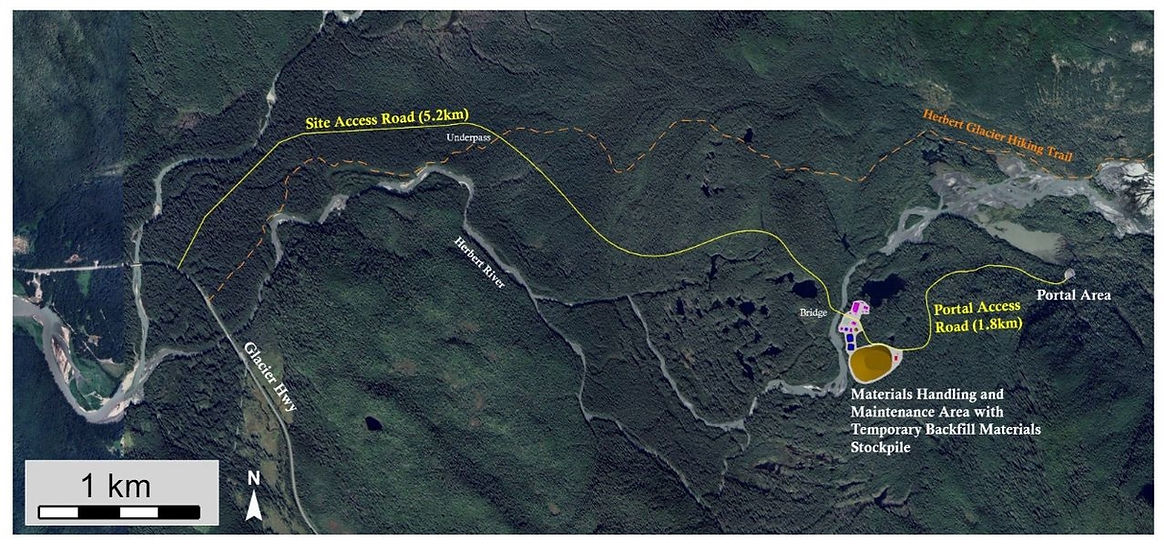
A map shows the planned road and infrastructure layout for the New Amalga Gold Project at the midpoint of a design review process. (Grande Portage Resources Ltd.)
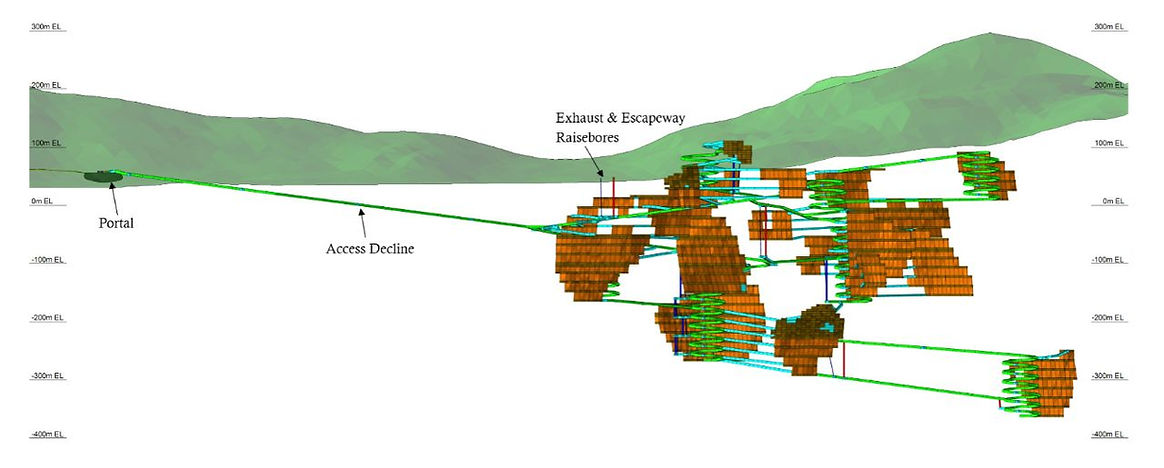
A map presented Thursday shows the company is planning for a 3.25-mile access road from Glacier Highway to a maintenance and materials storage area, with another road extending about a mile to the portal area accessing the underground mine. The mine as currently designed features a network of extraction areas and tunnels extending up to 1,200 feet beneath the surface.
• About 4,300 meters of diamond drilling from up to 14 drillholes to conduct surface mapping and trench sampling, which “will characterize the geotechnical and hydrogeological aspects of the deposit rock mass in order (to) gather data necessary for the environmental review and permitting process as well as to inform mine development plans.”
• Construction of environmental monitoring infrastructure, including meteorological stations and stream monitoring equipment.
• Preparations for initial work on a site access road, pending state approval.
• Conducting baseline studies necessary for the environmental review and permitting process, “including wildlife and avian surveys, wetlands surveys, ongoing surface water sampling, cultural and archeological surveys, geochemical studies, socioeconomic studies, and more.”
As of now the Amalga mine appears comparable in size and mineral grade to the Kensington mine about 20 miles further north that began production in 2010, Neale said. The Kensington mine surpassed 1 million ounces of gold produced in 2019 and in 2025 produced more than 106,000 ounces, according to owner Coeur Alaska Inc.
Grande Portage’s preliminary economic assessment projects shipping 1.05 million ounces of gold during the initial seven-year production cycle. The company’s webpage for the project, citing a mineral resource estimate from June of 2024, states there is an “indicated resource” of about 2 million ounces of gold and nearly 1.4 million ounces of silver.
The company expects to spend more than $500 million for capital projects, including $254.8 million prior to beginning production, and to make a profit quickly by recovering its capital costs slightly more than a year after operations begin, according to Neale’s presentation.
Other mines in the area are seeing their operational years extended, with Coeur Alaska last year announcing a five-year extension until 2029 and the Hecla Greens Creek Mine getting approval in 2024 for an expansion that could extend its life 18 years. Neale said that is a possibility with the Amalga project, but it’s not known how likely or how long an extension might be.
“Greens Creek started in 1989 with a nine-year mine life and Kensington started in 2011 with a 10-year mine life, and they’re both still going,” he said. “So that’s just the type of deposits that these are. It’s like driving in the dark. You just keep going until the resources tell you you can’t.”
An illustration shows a network of excavation areas and tunnels for the proposed New Amalga Gold Project. (Grande Portage Resources Ltd.)
Grande Portage projects it will pay about $340 million in federal, state and local taxes, plus $134 million in royalties during the initial seven-year operating window, according to Neale’s presentation.
The company also expects a $979 million pre-tax net present value ($721 million post-tax) on a base gold price of $3,200 an ounce, but those predictions based on production and price have a significant degree of uncertainty. The pre-tax value could exceed $2.1 billion at the recent average spot price of $5,000 an ounce, and have a negative value at $1,600 an ounce.
Among the questions Neale was asked during his presentation to the chamber is the impact the mine road and surface infrastructure will have on recreational use of the area. Much of a planned mine access road follows a roughly parallel path to the Herbert Glacier Trail, for instance, and questions about the mine’s presence were raised when the U.S. Forest Service announced earlier this year a recreational cabin planned in the area is being put on hold.
He said the design of the mine site, which as of now is at about a 50% level of confidence, attempts to use natural features to shield much of the infrastructure from areas where recreational users will be such as the trail.
“That location has been initially assessed for the amount of flat land that is available, minimizing wetlands disturbance, and also the greatest viewshed that we can get from the Herbert river trail, and the viewpoint and the glacier itself,” he said. “So again, this is a preliminary assessment. This may not be the final, may not even be close to the final, but this is where if you look at the project right now from a 50% level this is what makes the most sense.”
Helena Bonham Carter is checking out of The White Lotus early.
Nine days after production began in France for the fourth season of the Mike White-created series, HBO confirmed that the Harry… E! Online (US) – Top Stories
Nearly 17 years after Michael Jackson’s death, his beloved chimpanzee Bubbles is still aping around.
That’s right, the primate—now 43 years old—is alive and well, living at the Center for Great… E! Online (US) – Top Stories
Wondering whether to toss or drink expired milk? We’d hate to spoil it for you: Follow this advice and, hopefully, it won’t leave a sour taste in your mouth.
Mashed – Fast Food, Celebrity Chefs, Grocery, Reviews
Ellen DeGeneres is ready to just keep swimming.
The former daytime talk show host is set to return as the voice of blue tang fish Dory in a new short film set in the Finding Nemo universe,… E! Online (US) – Top Stories










 Content warning: This story discusses suicide.

 Paul “Pauly D” DelVecchio won’t be saying “yeah, buddy!” if his daughter Amabella wants to watch Jersey Shore.

 Helena Bonham Carter is checking out of The White Lotus early.

 Nearly 17 years after Michael Jackson’s death, his beloved chimpanzee Bubbles is still aping around.



 Ellen DeGeneres is ready to just keep swimming.