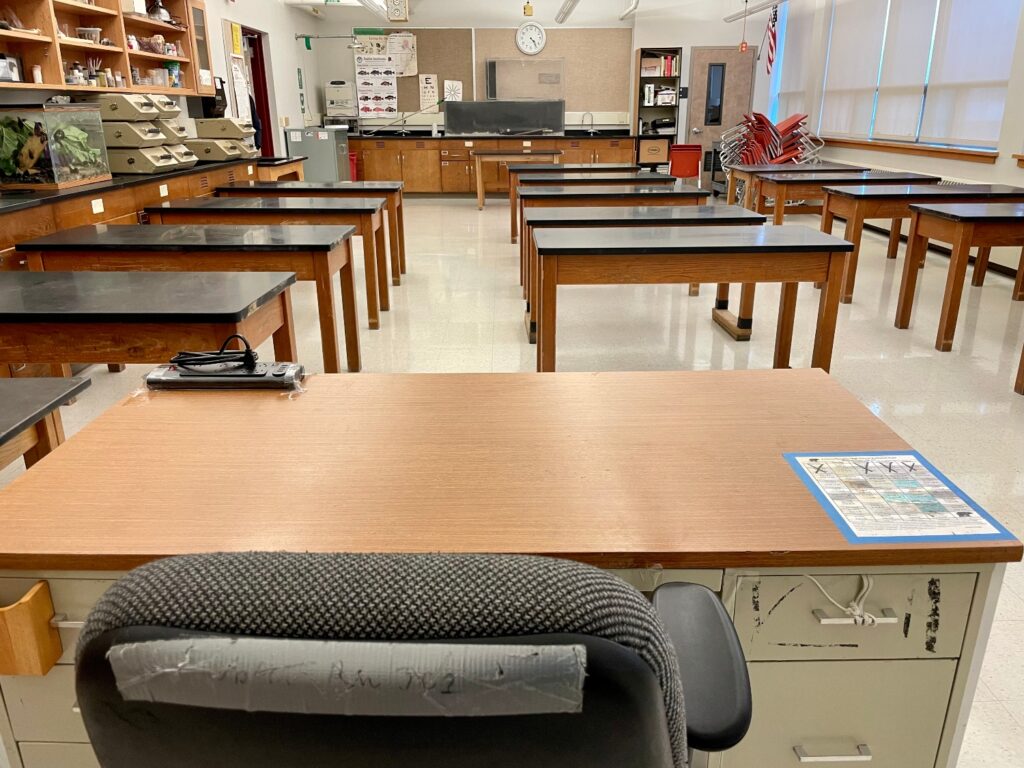
An empty classroom at Juneau-Douglas High School: Yadaa.at Kalé in Juneau, Alaska (Photo by Lisa Phu/Alaska Beacon)
A professor at Furman University told the Alaska Legislature Task Force on Education Funding Wednesday afternoon that standardized test results might not be the most appropriate set of data on which to base education policy decisions.
During a routine presentation on the National Assessment of Educational Progress, known as the Nation’s Report Card, Paul Thomas backed a principle that legislators should not make decisions about students and schools based on a single standardized test.
“The key to understanding test data in Alaska is the information on poverty,” Thomas said.
Alaska’s NAEP scores of fourth- and eighth- grade Alaskans ranked lower than the national public in mathematics and reading in 2024. According to the Nation’s Report Card, approximately 69% of students performing below the 25th percentile are economically disadvantaged while economically disadvantaged students make up 48% of Alaskan students.
“Education policy and socioeconomic policy are really strongly connected,” Thomas said. “Test scores are a reflection of the socioeconomic status of the students.”
State education officials led legislators through a practice test of the Alaska System of Academic Readiness, commonly referred to as the AK STAR. Each fall, winter, and spring, Alaskan students in grades 3-9 take the MAP Growth assessment and each spring, Alaskan students take the AK STAR.
Kelly Melin, who works for the Department of Education and Early Development’s Assessments and Standards Administration, said the state’s standardized tests are designed to satisfy federal requirements set forth in the Every Student Succeeds Act.
“We’ve taken the power of an interim assessment and the need for a summative assessment as was dictated through ESSA and connected those to come up with what we have as AK STAR,” Melin said.
Kelly Manning, the department’s Director of Innovation and Education Excellence, said that the purpose of assessments is to measure the state’s ability to close the achievement gap and measure students’ ability to read at grade level by the third grade.
Statewide, about 33% of students tested at or above grade level expectations in language arts and 32% in math in 2025. Students in ninth grade demonstrated the greatest need for support in language arts and math.
The esting window for Alaska students closes on May 1. AK STAR results will be available to school districts in July and statewide in the fall.
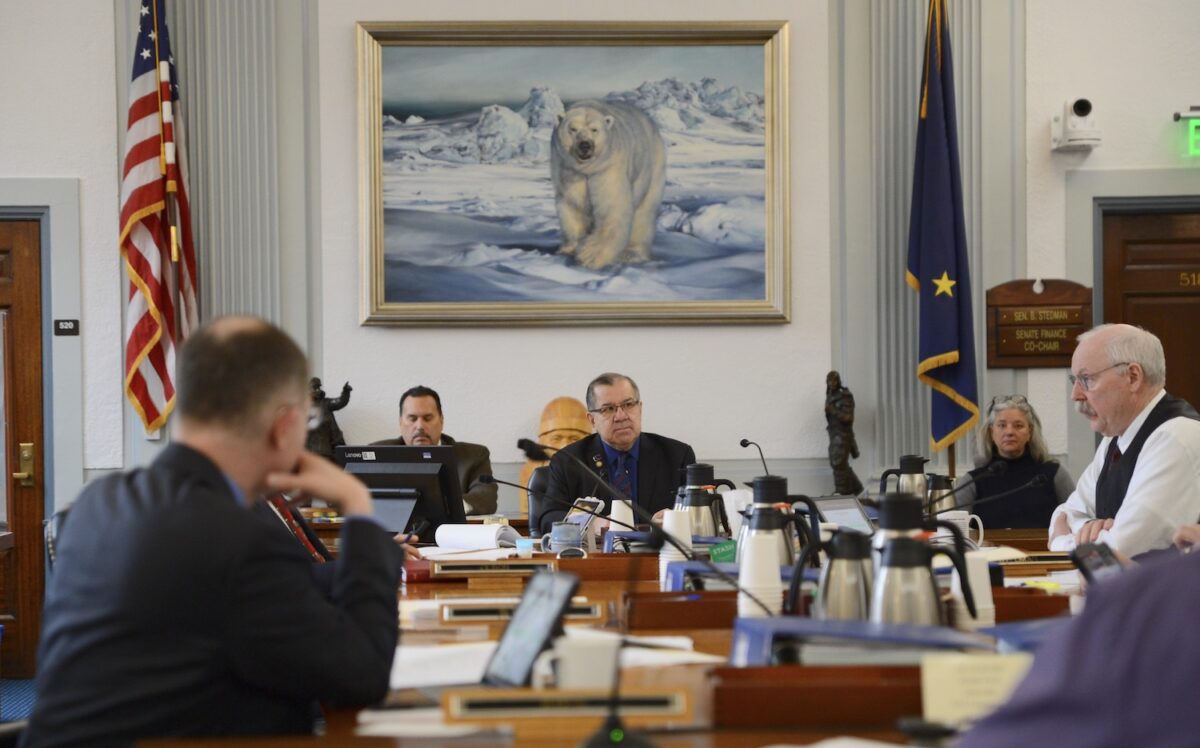
Sen. Lyman Hoffman, D-Bethel, is seen in the Senate Finance Committee on Tuesday, April 25, 2023. A co-chair of the Senate Finance Committee, Hoffman is in charge of the state's capital budget. (Photo by James Brooks/Alaska Beacon)
By: Corinne Smith, Alaska Beacon
Sen. Lyman Hoffman, D-Bethel, is seen in the Senate Finance Committee on Tuesday, April 25, 2023. A co-chair of the Senate Finance Committee, Hoffman is in charge of the state’s capital budget. (Photo by James Brooks/Alaska Beacon)
The Alaska Senate Finance committee advanced a draft capital budget on Tuesday that would put nearly $250 million toward state facilities and maintenance projects next year.
The draft budget adds $88 million to Gov. Mike Dunleavy’s proposed capital budget of $159 million, with the largest additions going toward K-12 schools and university facilities maintenance.
That was a focused effort by the finance committee, said co-chair Sen. Bert Stedman, R-Sitka, who called funding for education facilities maintenance a “heavy concentration” on Wednesday.
Earlier this year, students and school officials testified to lawmakers that decades of deferred maintenance has reached crisis levels — with many rural school districts in particular grappling with deteriorating facilities, failing water and sewer systems — which they say is degrading student and staff morale. Lawmakers have expressed support and increased funding in recent years, but point to Gov. Mike Dunleavy’s history of vetoes as a roadblock for funding education.
The Senate draft includes $57.8 million in additional funding toward K-12 school maintenance through the Alaska Department of Education and Early Development and $17 million toward the University of Alaska. It also includes $5.7 million for the Alaska Court System’s facilities and $8 million for community infrastructure and workforce development programs through the Alaska Department of Commerce, Community, and Economic Development.
The Legislature relies on state ranked lists to prioritize where to direct funding to capital projects for K-12 schools, the university system and the court system.
For K-12 schools, the state’s current major maintenance list totals over $400 million needed for 103 school projects and repairs. Stedman said he recognized this year’s capital budget will only fund a fraction of those.
“Hopefully we get a quarter of it done, or something like that, but it’d be nice to retire the entire list,” Stedman said.
The draft budget would fund the top 15 school projects on the list, plus funds for three other schools in need of emergency fuel tank repairs. The top projects range from roof and boiler replacements to septic systems, fire suppression and safety upgrades in schools from Fairbanks to the Aleutian Islands.
In order to distribute funds more widely, members of the finance committee reduced funding for one project in Galena, in the Western Interior of Alaska, from roughly $35 million to $5 million for renovations to the Sydney C. Huntington Elementary and High Schools. They also allocated $17 million towards rebuilding the school in Stebbins in Western Alaska, after it burned down in 2024.
Mt. Edgecumbe High School student housing in Sitka is seen on Oct. 6, 2025. (Photo by Corinne Smith/Alaska Beacon)
The Senate draft also adds nearly $14 million in funding for the state-run Mt. Edgecumbe High School, which has been the focus of public attention and concern after a quarter of students disenrolled this year. The additional facilities dollars include $10 million to remodel the dining hall, $3.1 million to replace dorm windows, $460,000 to replace dorm furniture, $50,000 to replace mattresses and $125,000 to replace aging laundry machines.
Finance members added $17 million to fund the top nine projects across the University of Alaska system — three projects each within the three major campuses.
Sen. Jesse Kiehl, D-Juneau, serves on the finance committee and his district includes University of Alaska Southeast. He described the proposed funds as a “nickel” compared to the “colossal” deferred maintenance needs of the university system.
“That’s been built by Legislatures and Boards of Regents for 40 years,” he said on Wednesday, adding that it is a shared responsibility to put funding towards repairs and upgrades.
“The Constitution makes them a separate body within the executive branch that puts a lot of responsibility on them, too, more than the general state government,” he said “So university major maintenance is its own huge problem.”
The draft budget also includes $5.7 million for upgrades to state court facilities, mostly targeted to Anchorage and Sitka. It contains nearly $10 million for workforce development programs geared at the construction and oil and gas sectors, including for the Fairbanks Pipeline Training Center and Alaska Vocational Technical Center in Seward.
An amendment to add $25 million to the draft budget for the Port of Anchorage, sponsored by Sen. Kelly Merrick, R-Eagle River, was voted down on Tuesday by a 5 to 2 vote.
Before voting against the proposal, finance co-chair Sen. Lyman Hoffman, D-Bethel, said during committee deliberations the priority this year is to fund as many school maintenance projects on the list as possible, saying “schools are falling apart” and must be maintained to prevent further deterioration.
“Students that are trying to learn deserve better,” Hoffman said. “And if we are not able to provide this major maintenance, we are going to see these schools continue to crumble, and the financial burden to the state of Alaska will be hundreds of millions of dollars to rebuild schools.”
More funding for school maintenance and other capital projects could be added by the Alaska House of Representatives, who will take up the draft budget bill after it’s approved by the Senate in the coming weeks.
With less than two months’ notice, Meghan Trainor has canceled her 2026 tour.
She claims that this is about being “present” for her family.
But folks on social media are floating another theory about the controversial singer.
Singer Meghan Trainor chats with Drew Barrymore on CBS. (Image Credit: CBS)
The ‘Get in Girl’ tour isn’t happening! Not this year, anyway
On Thursday, April 16, Trainor took to her Instagram Story to share her updated 2026 plans.
“After a lot of reflection and some really tough conversations, I’ve made the difficult decision to cancel the ‘Get in Girl’ tour,” she began.
“Balancing the release of a new album, preparing for a nationwide tour,” she explained.
Trainor continued: “And welcoming our new baby girl to our growing family of five has just been more than I can take on right now.”
As we reported in January, the singer welcomed her third child via gestational carrier (surrogate).
This Instagram Story from Meghan Trainor was surely a disappointment to some of her fans. (Image Credit: Instagram)
“I know this will come as a disappointment to my fans,” Trainor acknowledged.
“And,” she expressed, “I am so sorry to let you down.”
Trainor then affirmed: “But I know this is the right decision for my family and me right now.” That is now a family of five.
“I promise I’ll be back soon,” she vowed. “And I can’t wait for you to hear this new record.”
Trainor concluded: “I’m so proud of it and I’m endlessly grateful for your love and support always.”
During an interview with Entertainment Tonight, Meghan Trainor shows off her new body. (Image Credit: Entertainment Tonight/YouTube)
On social media, some suggest an alternative explanation
She’s 32 and has three young children.
That might be enough to make anyone change their summer plans.
But having a child isn’t exactly something that happens overnight. The pregnancy alone lasts for most of a year.
And, in Trainor’s case, they welcomed Baby #3 via gestational carrier.
That involves a whole other person, not to mention doctors and IVF treatments. Becoming a family of five didn’t happen by accident or suddenly, so why plan this and the tour?
Obviously, we do not have access to Trainor’s ticket sales — or to what expectations were before launching the tour. But it’s a solid theory, however unproven.
As we at THG have emphasized before, going into someone’s reply to shame or “express concern” about a celebrity is very unlikely to prompt any changes.
Everyone deserves to have the body that they most desire. But people are right to have ethical concerns and reasonable to express long-term health worries about people buying into medicalized starvation as a weight-loss solution.
Maybe Trainor isn’t able to fill seats anymore. She’s married to a Spy Kids star and has three beautiful kids. She’s arguably still winning. We just hope that she doesn’t come to regret some of her incendiary choices.
A model is silhouetted as she prepares to strut on the catwalk at the Far North Fashion Show, held April 15,, 2026, at the Anchorage Museum. The fashion show is part of the annual Arctic Encounter Summit. (Photo by Yereth Rosen/Alaska Beacon)
A model poses on the catwalk at the Far North Fashion Show, held April 15, 2026, at the Anchorage Museum. The dress she is wearing features red handprints on the collar, symbols of missing and murdered Indigenous people. (Photo by Yereth Rosen/Alaska Beacon)
Attendees of the Arctic Encounter Summit, held this week in Anchorage, took a break from heavy discussions about climate change, national security, shipping safety and other pressing concerns on Wednesday night to enjoy something more fun: high fashion.
Crystal Toolie of Nome and St. Lawrence Island, Cathy Apatiki of Gamble wait backstage wearing traditional designs that they would later display on the catwalk at the Far North Fashion Show, held April 15. 2026, at the Anchorage Museum. Looking on is designer Marisa Taylor of Savoonga and, also wearing one of Taylor’s designs, Mary Abraham of Toksook Bay. The Far North Fashion Show, in its seventh year, is part of the annual Arctic Encounter Symposium. (Photo by Yereth Rosen/Alaska Beacon)
The Far North Fashion Show, now in its seventh year, showcased the work of Indigenous designers from around Alaska.
“To be honest, the Far North Fashion Show is the highlight of so many attendees’ experiences, myself included,” Rachel Kallander, Arctic Encounter’s founder, said in brief remarks at the start of the show.
The celebration, which featured a catwalk bathed in pastel lights, pulsing music and refreshments, required a lot of work to pull together, Kallander told the audience.
“We have designers and models who have put in hundreds and hundreds of hours into what you are about to see,” she said.
A model walks on the catwalk at the Far North Fashion Show, held April 15, 2026, at the Anchorage Museum. The fashion show is part of the annual Arctic Encounter Summit.. (Photo by Yereth Rosen/Alaska Beacon)
A sparkly boot worn by a model catches the light at the Far North Fashion Show, held April 15, 2026, at the Anchorage Museum. The fashion show is part of the annual Arctic Encounter Symposium. (Photo by Yereth Rosen/Alaska Beacon)
Beyond their good looks, the clothing on display incorporated messages. Many were about traditions. Some were inspired by the animals that are important to different Indigenous Alaska cultures. A dress designed by Jackie Qataliña Schaefer, who is Inupiaq and originally from Kotzebue, paid homage to the caribou, for example. Another dress was designed with a train that resembled a whale fluke. And models, as they took their turns on the catwalk, sometimes made moves that are part of traditional Native dances.
Some of the works shown at the event had a more somber message. They incorporated the red handprint that symbolizes missing and murdered Indigenous people.
Attendees sitting by the catwalk, including some elders, watch and photograph models at the Far North Fashion Show, held April 15, 2026, at the Anchorage Museum. The fashion show is part of the annual Arctic Encounter Summit.(Photo by Yereth Rosen/Alaska Beacon)
Designers and models were from Inupiaq, Athabascan, Tlingit, Yup’ik and Aleut cultures, among others.
Along with Schaeffer, who is director of climate initiatives at the Alaska Native Tribal Health Consortium in addition to being an artist, the designers whose works were shown were Maria Shaa Tlaa Williams of Southeast Alaska, Marisa Taylor of St. Lawrence Island, Carlene Thayer of Unalaska, Alana Moses of Fairbanks, Reine Pavlik of Yakutat, Jeremiah James of Yakutat and Christina Waska, originally from Newtok.
The Arctic Encounter Symposium, which opened on Wednesday, runs through Friday. It has attracted attendees from 30 countries, Kallander said.
A model poses on the catwalk at the Far North Fashion Show, held April 15, 2026, at the Anchorage Museum. The fashion show is part of the annual Arctic Encounter Summit. (Photo by Yereth Rosen/Alaska Beacon)A model poses on the catwalk at the Far North Fashion Show, held April 15, 2026, at the Anchorage Museum. The fashion show is part of the annual Arctic Encounter Summit. (Photo by Yereth Rosen/Alaska Beacon)Martin Paul, a University of Alaska Fairbanks student from Kalskag and Kipnuk, makes traditional dance moves on the catwalk at the seventh annual Far North Fashion Show, held on April 15. 2026, at the Anchorage Museum. Paul’s outfit incorportes the red handprint that symbolizes missing and murdered Indigenous people. The fashion show is a highlight of the annual Arctic Encounter Summit. (Photo by Yereth Rosen/Alaska Beacon)
Imagine meeting your idol and feeling like a kid again—Zach Top shares that unforgettable moment with George Strait. Continue reading…The Boot – Country Music News, Music Videos and Songs
Imagine meeting your idol and feeling like a kid again—Zach Top shares that unforgettable moment with George Strait. Continue reading…Country Music News – Taste of Country
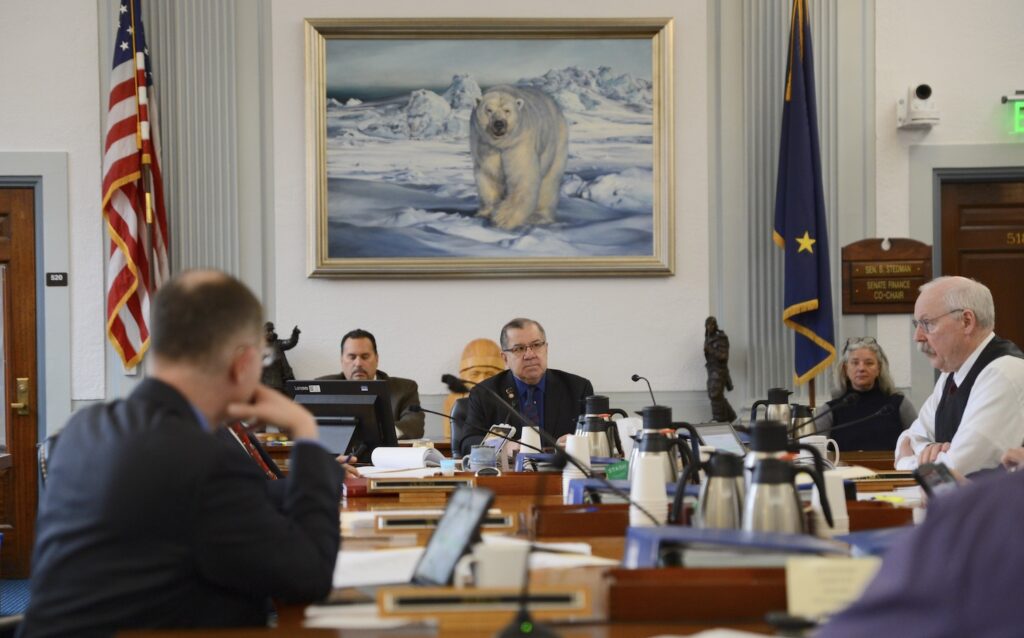
Sen. Lyman Hoffman, D-Bethel, is seen in the Senate Finance Committee on Tuesday, April 25, 2023. A co-chair of the Senate Finance Committee, Hoffman is in charge of the state’s capital budget. (Photo by James Brooks/Alaska Beacon)
The Alaska Senate Finance committee advanced a draft capital budget on Tuesday that would put nearly $250 million toward state facilities and maintenance projects next year.
The draft budget adds $88 million to Gov. Mike Dunleavy’s proposed capital budget of $159 million, with the largest additions going toward K-12 schools and university facilities maintenance.
That was a focused effort by the finance committee, said co-chair Sen. Bert Stedman, R-Sitka, who called funding for education facilities maintenance a “heavy concentration” on Wednesday.
Earlier this year, students and school officials testified to lawmakers that decades of deferred maintenance has reached crisis levels — with many rural school districts in particular grappling with deteriorating facilities, failing water and sewer systems — which they say is degrading student and staff morale. Lawmakers have expressed support and increased funding in recent years, but point to Gov. Mike Dunleavy’s history of vetoes as a roadblock for funding education.
The Senate draft includes $57.8 million in additional funding toward K-12 school maintenance through the Alaska Department of Education and Early Development and $17 million toward the University of Alaska. It also includes $5.7 million for the Alaska Court System’s facilities and $8 million for community infrastructure and workforce development programs through the Alaska Department of Commerce, Community, and Economic Development.
The Legislature relies on state ranked lists to prioritize where to direct funding to capital projects for K-12 schools, the university system and the court system.
For K-12 schools, the state’s current major maintenance list totals over $400 million needed for 103 school projects and repairs. Stedman said he recognized this year’s capital budget will only fund a fraction of those.
“Hopefully we get a quarter of it done, or something like that, but it’d be nice to retire the entire list,” Stedman said.
The draft budget would fund the top 15 school projects on the list, plus funds for three other schools in need of emergency fuel tank repairs. The top projects range from roof and boiler replacements to septic systems, fire suppression and safety upgrades in schools from Fairbanks to the Aleutian Islands.
In order to distribute funds more widely, members of the finance committee reduced funding for one project in Galena, in the Western Interior of Alaska, from roughly $35 million to $5 million for renovations to the Sydney C. Huntington Elementary and High Schools. They also allocated $17 million towards rebuilding the school in Stebbins in Western Alaska, after it burned down in 2024.
Mt. Edgecumbe High School student housing in Sitka is seen on Oct. 6, 2025. (Photo by Corinne Smith/Alaska Beacon)
The Senate draft also adds nearly $14 million in funding for the state-run Mt. Edgecumbe High School, which has been the focus of public attention and concern after a quarter of students disenrolled this year. The additional facilities dollars include $10 million to remodel the dining hall, $3.1 million to replace dorm windows, $460,000 to replace dorm furniture, $50,000 to replace mattresses and $125,000 to replace aging laundry machines.
Finance members added $17 million to fund the top nine projects across the University of Alaska system — three projects each within the three major campuses.
Sen. Jesse Kiehl, D-Juneau, serves on the finance committee and his district includes University of Alaska Southeast. He described the proposed funds as a “nickel” compared to the “colossal” deferred maintenance needs of the university system.
“That’s been built by Legislatures and Boards of Regents for 40 years,” he said on Wednesday, adding that it is a shared responsibility to put funding towards repairs and upgrades.
“The Constitution makes them a separate body within the executive branch that puts a lot of responsibility on them, too, more than the general state government,” he said “So university major maintenance is its own huge problem.”
The draft budget also includes $5.7 million for upgrades to state court facilities, mostly targeted to Anchorage and Sitka. It contains nearly $10 million for workforce development programs geared at the construction and oil and gas sectors, including for the Fairbanks Pipeline Training Center and Alaska Vocational Technical Center in Seward.
An amendment to add $25 million to the draft budget for the Port of Anchorage, sponsored by Sen. Kelly Merrick, R-Eagle River, was voted down on Tuesday by a 5 to 2 vote.
Before voting against the proposal, finance co-chair Sen. Lyman Hoffman, D-Bethel, said during committee deliberations the priority this year is to fund as many school maintenance projects on the list as possible, saying “schools are falling apart” and must be maintained to prevent further deterioration.
“Students that are trying to learn deserve better,” Hoffman said. “And if we are not able to provide this major maintenance, we are going to see these schools continue to crumble, and the financial burden to the state of Alaska will be hundreds of millions of dollars to rebuild schools.”
More funding for school maintenance and other capital projects could be added by the Alaska House of Representatives, who will take up the draft budget bill after it’s approved by the Senate in the coming weeks.
Case’s classic R&B record Open Letter is getting a new vinyl variant. The third studio album from Case will be released in a 2LP format, with one version in classic black vinyl and another in a limited edition color variant. Both versions of the LP are available for preorder now.
Released 25 years ago, Open Letter is presented as if Case is speaking directly to his partner through letters. The album is noted for its mix of 2000s R&B, soul, and hip-hop influences, and was bolstered by singles “Missing You” and “Not Your Friend.” “Missing You” ultimately peaked at number four on the Billboard Hot 100 and topped the outlet’s Hot R&B/Hip Hop Songs chart upon its release. The track earned Case a nomination for Best Male R&B Vocal Performance at the 2002 Grammy Awards, and also had a memorable placement in the Eddie Murphy movie, Nutty Professor II: The Klumps.
After its release, Open Letter reached number five on the Billboard 200—Case’s highest position ever—and has since been certified gold. The album remains a standout in Case’s discography; after the debut of Open Letter, the star didn’t release another album for eight years. “Right after that, I moved to Atlanta in October and I just stopped doing it. I mean, it was me doing what my heart told me to do,” Case reflected later to YouKnowIGotSoul.com. The pull to music was too hard to resist, however, and he returned to recording with 2009’s The Rose Experience.
Click to load video
“Every time I write a song, it’s either about something I am going through, have gone through or somebody really close to me has gone through. For me, inspiration is everywhere. I just try to draw from real life and put some substance into the music,” Case said of his creative process in a 2015 interview with Vibe. “Those are things that you need to address and sing about.”















![<a href="https://theboot.com/ixp/204/p/zach-top-george-strait-encounter/" target="_blank">[EXCLUSIVE] Zach Top Met George Strait – His Reaction Is So Real</a>](https://townsquare.media/site/204/files/2026/04/attachment-untitled-design-2026-04-17t065158-667.jpg?format=natural)