The Season 1 finale of Dutton Ranch finds Beth and Rip fighting for their lives, again. Continue reading…The Boot – Country Music News, Music Videos and Songs









The Season 1 finale of Dutton Ranch finds Beth and Rip fighting for their lives, again. Continue reading…The Boot – Country Music News, Music Videos and Songs
The Season 1 finale of Dutton Ranch finds Beth and Rip fighting for their lives, again. Continue reading…Country Music News – Taste of Country

Reading Time: 3 minutes
According to recent reports, Kate Gosselin has been “spiraling” over estranged son Collin Gosselin’s tell-all book.
The memoir releases in just a few months, and seems poised to expose her like never before.
Reportedly, Kate’s been telling those closest to her that his book is full of lies, even if its contents aren’t public yet.
Will she sue him for defamation to silence him? Apparently not.
Though Kate has not directly mentioned Collin or his upcoming novel, it’s clear that In The Shadow of Eight is on her mind.
In her comments on TikTok, one user wrote: “If you are 100% certain that the accusations against you are lies, my suggestion would be to take him to court and sue him for defamation!”
Obviously, if Collin is “lying,” Kate couldn’t possibly know everything that he has to say in his memoir, could she?
While we puzzle over that head-scratcher, we’ll acknowledge that we’ve all seen defamation suits brought forward. Some even win on spurious grounds, even when the defendant is being entirely truthful.
With that in mind, it’s a great question. Why not sue Collin? Surely the woman who ruined his childhood can also ruin his book launch, right?
Kate actually replied to the commenter, offering an explanation of sorts.
“I can’t bc I’m a public figure,” she claimed in her response.
“Rules are different unfortunately,” Kate alleged.
She then wrote: “Or I def would!”
Not everyone believes her explanation. But she soon doubled down, explaining further.
“Malice is one of the hardest things to prove,” the widely reviled reality TV alum wrote. “I tried :(.”
Kate then alleged: “The rules are different for ppl in the public eye.”
She went on to describe: “I consulted a high power LA attorney (you’ve definitely heard of him) years ago when other ppl were putting crazy stuff out there and that’s what he said.”
Most people do not believe that Collin’s accounts of his childhood are “crazy.” That seems to be a problem for Kate.
According to her: “The courts don’t honor it if you’re in the public eye :(”

Even after doubling down there, Kate wasn’t quite done.
A separate commenter asked her if she might consider taking a lie-detector test.
Kate simply replied: “Ha!”
Though she is one of the most widely despised former reality TV stars by many, some would argue that lie detector tests are famously unreliable and not exactly admissible in court. Not to defend her, but it would be a fool’s errand in many situations.
We’ll all look forward to reading Collin’s memoir when it releases in October.
Kate Gosselin Says She ‘Can’t’ Sue Collin for Defamation Over Tell-All … was originally published on The Hollywood Gossip.
The Hollywood Gossip

The couple have said they still plan to have a baby together — but what will custody look like? Continue reading…The Boot – Country Music News, Music Videos and Songs
The couple have said they still plan to have a baby together — but what will custody look like? Continue reading…Country Music News – Taste of Country

If your grandparents loved Pyrex, there is a chance a piece of their collection just might be worth a small fortune today. This is the pattern to look for.

Food Republic – Restaurants, Reviews, Recipes, Cooking Tips

Alan Jackson’s final concert was certainly one to remember, and now fans will be able to relive the magic again and again as the unforgettable night is being released as a live album later this year.
According to an announcement from Jackson’s longtime label, Last Call: One More for the Road – The Finale (Live from Nashville) will arrive later this year. Pre-orders are available now, and according to the official website, the album is expected to ship on December 31, 2026.
Jackson’s memorable farewell concert was witnessed by more than 80,000 fans across Nashville. The historic night took place live at Nissan Stadium, with additional livestream viewing events held at Belmont University’s Fisher Center and the Country Music Hall of Fame’s CMA Theater. The celebration extended throughout the city, with thousands more watching Jackson’s final performance, along with the all-star lineup of artists who opened the show, from screens set up along Broadway, where fans filled the closed street and gathered on the rooftops of the honky-tonks lining the famous stretch.
Others watched and listened from across the Cumberland River, gathering on the pedestrian bridge connecting Nissan Stadium to downtown Nashville to sing along and celebrate Jackson’s legendary career.
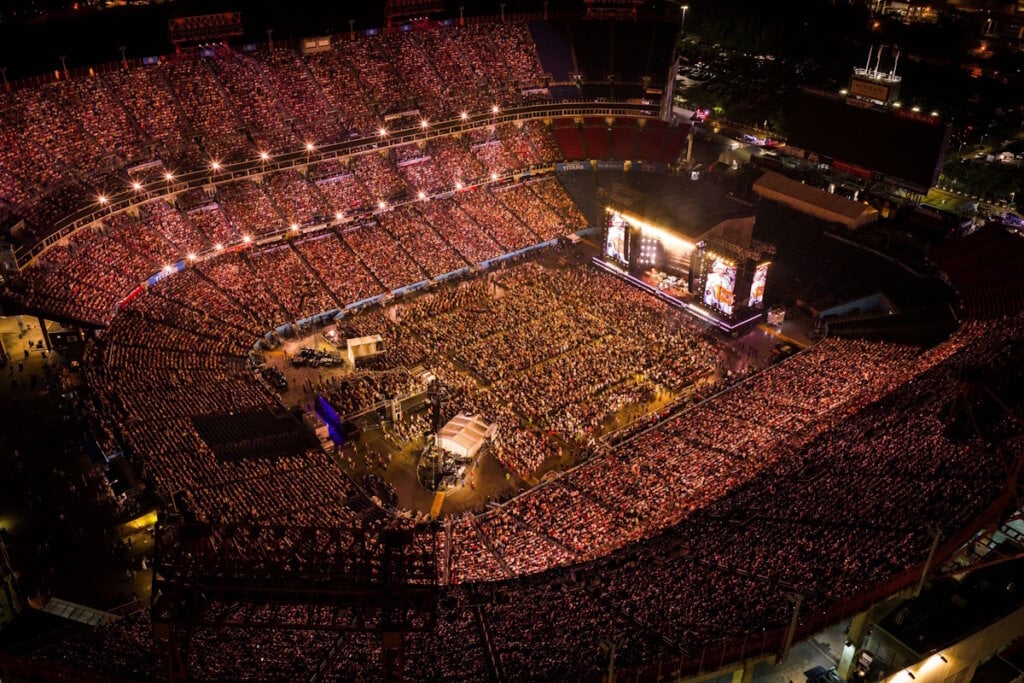
As previously announced, the show was also filmed for an NBC special, Alan Jackson: The Last Show, which will air in December.
Jackson’s final concert featured the country icon performing many of his biggest hits, with a career-spanning set list highlighting songs from his decades in country music, including many of his 35 No. 1 hits.
The emotional night also featured a special appearance from fellow Country Music Hall of Famer George Strait, who joined Jackson on stage for two songs, including “Designated Drinker” and “Murder on Music Row.”
“This has just been incredible,” Jackson shared during the show. “I don’t even have words – it’s just been completely overwhelming.”
Gone Country
I Don’t Even Know Your Name
Livin’ On Love
Summertime Blues
Midnight In Montgomery
The Blues Man
Who’s Cheatin’ Who
Here In The Real World
Wanted
I’d Love You All Over Again
Chasin’ That Neon Rainbow
The Older I Get
Designated Drinker w/ George Strait
Murder on Music Row w/ George Strait
Little Bitty
Country Boy
Good Time
Drive (For Daddy Gene)
Where Were You (When the World Stopped Turning)
Don’t Rock the Jukebox
Remember When
It’s 5 O’Clock Somewhere
Chattahoochee
Encore:
Mercury Blues
Where I Come From
Before Jackson took the stage for his final performance, an all-star lineup of country artists came together to honor his legendary career. Riley Green, Miranda Lambert, Little Big Town, Jake Owen, Jon Pardi, Thomas Rhett, Lee Ann Womack, Luke Bryan, Cody Johnson, Lainey Wilson, Luke Combs, Eric Church, and Carrie Underwood each performed an Alan Jackson song in tribute to the country icon.
The group later reunited for a special all-star performance of “Pop a Top,” which will be featured as part of the upcoming NBC special, Alan Jackson: The Last Show.
The post Alan Jackson’s Final Concert Set for Live Album Release Following Historic Nashville Farewell appeared first on Country Now.
Country Now
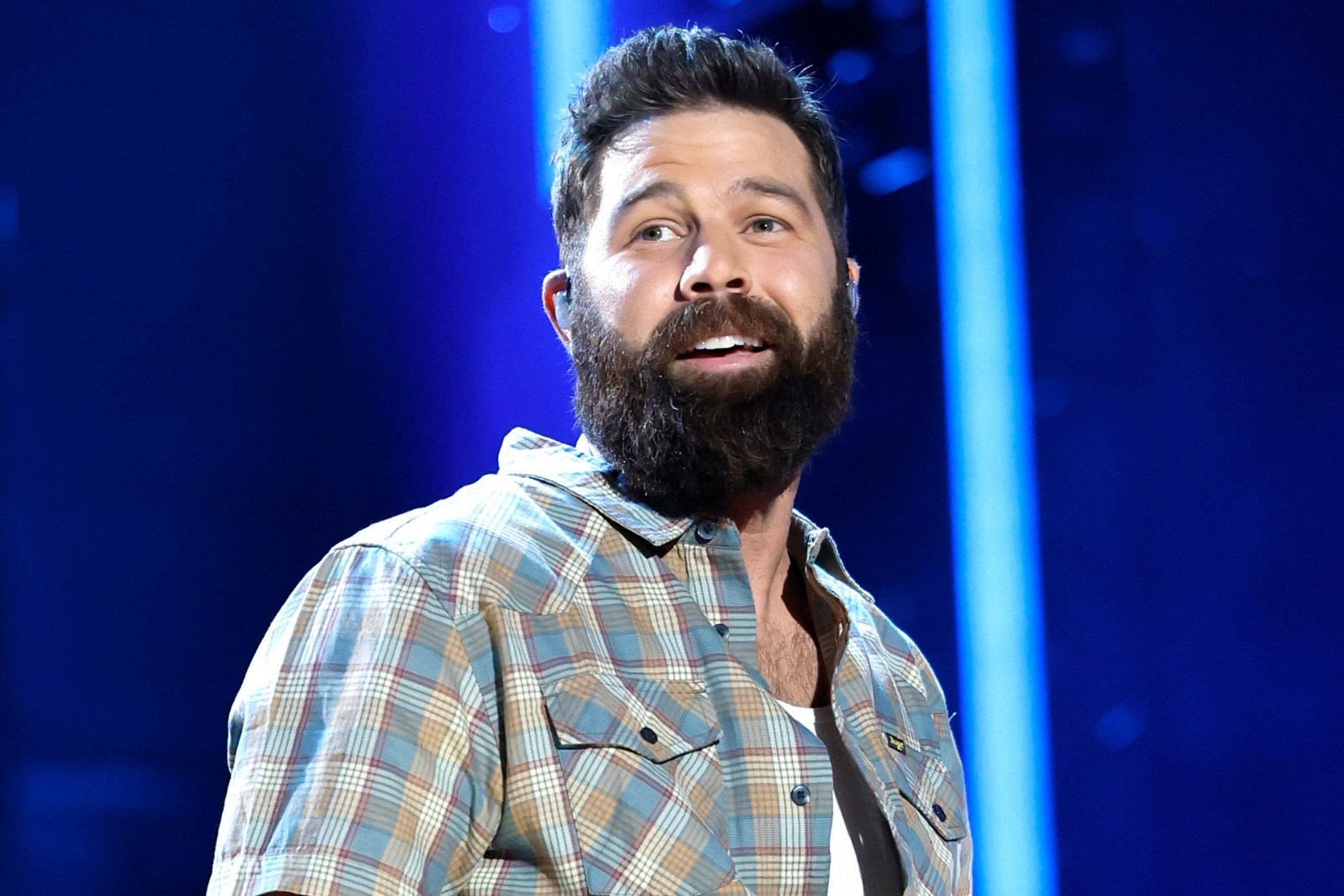
Imagine the surprise of a country star facing border patrol after a big show. It’s a wild ride, and the story gets even wilder. Continue reading…The Boot – Country Music News, Music Videos and Songs
Imagine the surprise of a country star facing border patrol after a big show. It’s a wild ride, and the story gets even wilder. Continue reading…Country Music News – Taste of Country

The Supreme Court struck down limits on coordinated spending between candidates and political parties on Tuesday, a win for Republicans that will fundamentally change how tens of millions of dollars are spent in congressional elections.
The decision will have an almost immediate impact on the midterms. Removing the limit on coordinated spending effectively gives candidates direct control over a far greater amount of money being spent on their races. It is also likely to increase the flood of political advertising that hits the airwaves each fall.
The 6-3 decision, which divided the court along its usual ideological lines, held that the limits violate the First Amendment.
The decision is a blow to Democrats, who argued that eliminating the limit on coordination would put more power into the hands of large donors who can cut bigger checks to party committees than to candidates. Republicans tend to get more money from large donors, while Democrats have been more reliant on small-dollar donors.
Justice Brett Kavanaugh, writing for the majority, called the limits a “severe infringement on First Amendment-protected political speech.” He also argued the ruling eliminating the limits could bolster political parties generally.
“To uphold the political-party coordinated-expenditure limits here could therefore help consign political parties to continued second-tier status as compared to outside groups,” Kavanaugh wrote. “Weakened political parties distort the political system.”
President Donald Trump hailed the ruling allowing parties to spend unlimited amounts in coordination with individual campaigns.
“The Supreme Court just took restrictions off political spending!” Trump wrote on Truth Social. “A BIG WIN FOR REPUBLICANS and, more importantly, The First Amendment!”
The National Republican Senatorial Committee brought the case seeking to overturn the limits in 2022 alongside now-Vice President J.D. Vance’s Senate campaign. Trump’s Justice Department declined to defend the law in court, while Democratic groups intervened to oppose the lawsuit.
“By striking down these unconstitutional caps on coordinated spending, the Court has restored core political speech and ensured parties can compete on a level playing field,” NRSC Chair Tim Scott (R-S.C.) and National Republican Congressional Committee Chair Richard Hudson (R-N.C.) said in a joint statement. “We are ready to fully support our candidates and put them in the strongest possible position to win in 2026 and beyond.”
Democrats, who are already staring down substantial disadvantage in party fundraising this midterm cycle and are worried that the ruling will only amplify the impact of that disparity, were quick to deride the decision Tuesday.
“Today’s ruling is a win for billionaire donors and special interests who want more influence over the GOP agenda and an invitation for corruption,” Democratic Senatorial Campaign Committee Chair Kirsten Gillibrand, Democratic Congressional Campaign Committee Chair Suzan DelBene and Democratic National Committee Chair Ken Martin said in a joint statement.
The ruling strengthens the parties themselves, allowing them to directly support their preferred candidates in a way that could empower their roles in the political ecosystem — and potentially weaken the influence of super PACs. Party committees on both sides have been preparing for the possibility for months and the decision is likely to have an immediate impact on campaign spending ahead of the November midterms.
Previously, coordinated spending between candidates and party committees, such as the NRCC or the DCCC, was capped, with the specific amounts depending on the size of the district or state. Those limits no longer apply.
That significantly alters the campaign finance landscape because parties can accept far larger donations than individual candidates — $44,300 per year for national party committees compared with $3,500 per cycle for candidates. Removing the limit on coordinated spending effectively gives candidates the ability to control a far greater sum of money that is being spent on their race.
That could also substantially change the makeup of political advertising on television, because candidates get far lower rates on TV ads than other groups. If their coordinated efforts with campaigns get the similarly low rate, they would have far more cash to tap to flood the airwaves, while super PACs will still have to pay a higher rate. As a result, campaigns might spend more of their budget on TV advertising, while super PACs may be more likely to pick up other campaigning costs, such as mailers and digital advertising.
Democrats have largely had the advantage in candidate fundraising, which has generally given them a leg up in battlegrounds when candidate fundraising was the most important. But NRSC has slightly more cash on hand than the DSCC, according to recent campaign finance reports, while the Republican National Committee has wildly outraised the DNC. Those party funds could now give the GOP the financial advantage in key states.
The court’s decision additionally eliminates the need for parties to mount their own independent expenditure arms, where they have traditionally spent tens of millions of dollars.
The decision is the latest in a series of blows the high court has dealt to campaign finance regulation over the past two decades. The 2010 Citizens United and Speechnow.org decisions enabled the rise of super PACs with no limit on donations. In 2014, the court struck down aggregate limits on individual donations. And in 2022, it struck down limits on candidates using donor funds to repay personal loans they had made to their campaigns.
“Today’s decision follows a string of disastrous campaign finance rulings from the Roberts Court that began with Citizens United,” Michael Beckel, director of money-in-politics reform at Issue One, said in a statement. “By eliminating the limits that have long governed how much money parties can spend in coordination with candidates, the Supreme Court has further empowered wealthy donors and special interests with outsized influence in elections.”
Politics