Kanye West is fighting back against his former project manager, who slapped a $1.8 million lien on his old Malibu mansion that he gutted and sold at a massive loss.
According to The Los Angeles Times, the rapper filed a lawsuit in Los Angeles Superior Court against Tony Saxon and the law firm West Coast Trial Lawyers, alleging they wrongfully placed an invalid lien on the property and launched a public pressure campaign to force payment on disputed claims.
Saxon worked as West’s project manager, security guard, and caretaker at the Malibu property before suing the controversial artist in September 2023 for labor violations, nonpayment of services, and disability discrimination.
The former employee filed the mechanics lien in January 2024 to secure compensation for his construction-related work on the property, giving him the legal right to force a foreclosure sale if he remains unpaid.
West’s lawsuit alleges that Saxon and his attorneys immediately issued statements to the media after recording the lien, with attorney Ronald Zambrano telling Business Insider that potential buyers would have to deal with them before any sale could proceed.
“These statements were designed to create public pressure and to interfere with the Plaintiffs’ ability to sell and finance the Property by falsely conveying that Defendants held an adjudicated, enforceable right to block a transaction and divert sale proceeds,” the complaint states.
The legal filing states that the Los Angeles Superior Court granted West’s motion to release the lien from the bond last year and awarded him attorneys’ fees, yet Saxon’s team continues to pursue its claims.
The Malibu property has become a financial disaster for everyone who has touched it, starting with West’s original $57.3 million purchase of the Tadao Ando-designed concrete masterpiece in 2021.
Kanye West completely gutted the architectural jewel, removing windows, doors, electricity, plumbing, and breaking down walls while reportedly saying he wanted to turn it into his “bomb shelter” and “Batcave.”
Three years later, he sold the unfinished concrete shell to developer Steven Belmont’s Belwood Investments for just $21 million, taking a staggering $36 million loss on the investment.
Belmont has struggled with the property ever since, first trying to flip it for $39 million before dropping the price to $34.9 million when no buyers emerged.
Now the current owner faces his own financial crisis, with Quality Loan Service Corp hitting him with a notice of default claiming he owes $814,623.54 on his $18.5 million mortgage as of November 4.
Belmont has 90 days to catch up on payments or risk losing the entire property to foreclosure, forcing him to get creative with a new “Populis” timeshare concept.
The timeshare plan is Belmont’s last-ditch effort to generate revenue from the cursed property, which has burned through millions of dollars without producing any successful outcomes for its owners.
The lawsuit adds another chapter to the ongoing legal drama surrounding the concrete mansion, which continues to generate headlines for all the wrong reasons more than two years after West sold it.
Megan Thee Stallion just got legal backup from one of the biggest names in modern courtroom history: the same powerhouse attorney who helped take down Donald Trump.
Roberta Kaplan, the civil rights lawyer who represented writer E. Jean Carroll in her defamation and sexual assault lawsuits against Trump, has stepped into Megan’s corner with a blistering amicus curiae brief filed in federal court.
She’s backing Megan’s fight against Texas blogger Milagro “Milagro Gramz” Cooper, who was found liable for spreading a fake, sexually explicit AI-generated video of the rapper.
Kaplan doesn’t mince words. She argues that Cooper’s conduct, reposting and promoting a pornographic deepfake of Megan to her thousands of followers, is not “free speech.”
“This case demonstrates how technological advances can amplify familiar forms of online harm, including harm based on sexually explicit images. Deep-fake sexual imagery does not contribute to public debate; it reproduces patterns of intimidation and degradation that the law has long deemed unprotected,” Roberta Kaplan explained.
Kaplan says it’s harassment, plain and simple. And under Florida law, that kind of abuse has no First Amendment protection. The filing marks another chapter in Kaplan’s long campaign to hold powerful and reckless people accountable for weaponizing lies.
She’s the same attorney who secured two major defamation verdicts against Trump on behalf of Carroll, totaling more than $83 million.
Now, Kaplan is making it clear that digital defamation, especially when fueled by AI, deserves the same treatment.
In her brief, she compares deepfakes to other banned forms of abuse like revenge p### or child sexual exploitation materials, saying all of them use technology as a “mechanism of harm.”
The connection between the Carroll and Megan cases runs deeper than just Kaplan’s signature. Both center on women forced to fight in public: one against a former president, the other against a YouTube gossip blogger.
Both women endured online harassment and disbelief before juries ultimately sided with them and the victories hinge on the same legal foundation: defamation law’s recognition that free speech doesn’t protect deliberate, damaging falsehoods.
Megan Thee Stallion filed her defamation suit in 2024 after Cooper repeatedly targeted her online, pushing false narratives and amplifying the deepfake clip that claimed to show Megan in a sexual act.
At trial, Megan Thee Stallion testified that the fake video wrecked her mental health.
Her manager described her breaking down and crying after seeing the clip, while her psychologist diagnosed her with post-traumatic stress disorder from the incident.
“I genuinely did not care if I lived or died,” she told jurors.
The jury awarded Megan roughly $75,000, which was later reduced slightly after post-trial motions, but Cooper still called it “a win,” bragging that it wasn’t a “multimillion-dollar fine.”
That attitude, Kaplan argues, is exactly why an injunction is necessary: to stop repeat behavior that continues to inflict harm long after a verdict. Kaplan’s filing notes that courts have always drawn a line between speech that informs and speech that terrorizes.
Kaplan’s involvement suggests the Megan Thee Stallion case could set a benchmark for how deepfakes and online harassment are handled legally.
The judge in Miami is expected to rule soon on Megan’s request for an injunction to permanently block Cooper from promoting similar content. If granted, it would set one of the first major precedents tying deepfake abuse to cyberstalking law.
“Maybe I am going through all of this because there’s another woman out there that may be a victim and she sees me going through it, and she sees me come out on the other side and it may give her the courage or the strength to speak up and say, this happened to me and I’m not going to be scared of you. I am not going to be intimidated by you,” Megan said during the trial.
Pressa sits down with AllHipHop and talks Drake vs Kendrick, why the city didn’t take the beef personal, and how Tory Lanez didn’t crack until 10 years in. He breaks down the real Toronto sound, being from Jane and Finch, going independent, and why outsiders need to stop trying to “figure out” the city.
SlopsShotYa talks to the Canadian star with no industry polish, no safe answers and pure real live at WonWorld Studios. Pressa simply gives his raw perspective on Hip-Hop, beef, business, and culture straight from Toronto.
AllHipHop: Do you listen to dancehall?
Pressa: Yeah, all the time.
AllHipHop: Anybody ever compare you to Alkaline? You sound like a rapping Alkaline.
Pressa: What’s crazy about it, my grandma mentioned, my grandma tells me I’m somehow kind of related to Alkaline, but not really. Like, you know, I don’t know. I think like my cousin’s cousin or something, you know, in yard. My grandma said, “Yeah, Alkaline,” she like, “His family, his auntie,” da da da da.
AllHipHop: West Indian people don’t got not one person not related to someone. They got to ask the last name, some out there cousins.
Pressa: Yeah, I know exactly how that go.
AllHipHop:Press Machine 2 is a great body of work. Long time coming. What took so long to cook it up?
Pressa: I was going through a situation at the time and I just had to reset everything. My business was all messed up. I had to go back, my corporation, my taxes, all that stuff. So I reset and got stuff rolling. Put my team back together, restructured my team, and now it’s goal time. You’re gonna see a lot more music from me.
AllHipHop: That’s a way to come back. On the intro “Machine Gun,” it had that “Went Legit” sample vibe, also “Drop Slow” by Kanye. Was that on purpose?
Pressa: I honestly didn’t know. I didn’t know what was on there. I’m tuned out a little bit. As much as he say I be smoking and tuned out, I don’t really notice a lot of things. I got selective hearing, selective thoughts. Sometimes I go on the beat and I’m just doing my own thing. I wasn’t really aware of certain things.
AllHipHop: So how long did it take to get the project together?
Pressa: The project’s easy. It was more my business. I can make music every day. It wasn’t the music holding me back. It was my business, and how I had to come out my label deal. I was signed to RCA before, just transitioning from there. I had to get my bag right because I’m independent. You feel me?
AllHipHop: Is there a big difference between Canadian laws and the American music business?
Pressa: In Toronto we get grants. They fund us. Artists in Canada, they’ll give us 20, 30, 40, 50 G’s as funding. Even when I used to tour, when I did the 50 Cent tour, I was doing it out of love. But they’ll give me money each date. Like a stipend. It’s like grants, money from the government.
AllHipHop: So it comes out the tax money?
Pressa: Yeah. They support their local artists and stuff. Shout out to FACTOR and shout out to the whole Canadian grant team. They always look out for me and all the artists coming up. That’s how a lot of Canadian artists are able to put out projects and get a little support and push.
AllHipHop: You’re one of the originators of that newer Toronto sound. Do you feel like you get enough credit?
Pressa: I’m not entitled to credit. If they give me my flowers, they give me my flowers. I was never the entitled type. I just got to do my part and keep it coming, be part of the culture. It’ll be dope.
AllHipHop: Explain Toronto’s signature sound to people who aren’t tapped in.
Pressa: The signature sound is that melodic sound. Like Houdini, Robin Banks, me, even like Burna, you feel me, my brother Burna Bandz. That’s the sound. There’s bare of us. There’s QTB, there’s so much of us that actually have influence onto the city. I feel like we’re part of the main culture.
AllHipHop: When you collab with an American artist, do you try to “Americanize” it?
Pressa: I kind of just do my own thing. People gonna feel me regardless. I try American style beats sometimes, like a Lil Baby type beat, but I never switch up my lingo or hide where I’m from. I make everybody know I’m from Canada. Toronto, the trenches, Jane and Finch. Why would I come to America and try to steal their culture? Obviously you guys got mad influence in us. I might have took some of the culture on accident, jewelry or whatever, just being influenced. But never intentionally like, “Yo, I want to be American today.” I’m proud to be Canadian, bro. We got manners. We respectful. You know what it is.
AllHipHop: Put me on some Toronto lingo.
Pressa: “Wasa demiana.”
AllHipHop: What’s that?
Pressa: It’s like dead man marijuana. It’s weed. Like pass the demi.
AllHipHop: That’s clean. But the internet, Reddit, YouTube, all that. How do you feel about outsiders being nosy, trying to figure out what’s going on behind the music?
Pressa: Hopefully they don’t figure out the pieces of the puzzle. Hopefully they never figure it out.
AllHipHop: I get it. As a New Yorker, it can feel predatory when people “solve” your neighborhood like it’s content. Toronto and New York got similarities though.
Pressa: Toronto and New York is much alike. You guys got strong Caribbean culture. I got family in Toronto, plenty cousins. I used to come to New York all the time as a little boy. Jamaica Avenue, buy a little chain. Shout out to the Coliseum.
AllHipHop: The Coliseum, yes. Jewelry downstairs, jackets upstairs.
Pressa: Facts. I was like 10, 11. My uncle brought me. Outside got the mixtapes. It was lit. Toronto is heavily influenced in Caribbean culture, so that’s why I say Toronto and New York is much alike. Just a little colder. It’s like a 6 hour drive.
AllHipHop: 2026 looking like what?
Pressa: I’m working on my album right now.
AllHipHop: So what is Press Machine today, mixtape or album?
Pressa: A mixtape.
AllHipHop: I’m still confused on the difference nowadays.
Pressa: Same. I still don’t even know.
AllHipHop: Back in the day mixtape was free music to get the album hot. Now it’s like YouTube and SoundCloud, and maybe “less effort” than an album.
Pressa: Oh okay. I get it. Press Machine was definitely a mixtape.
AllHipHop: You got a name for the album?
Pressa: Nah, I’m still working on it. I got some dope records in the stash.
AllHipHop: We waiting on that next Drake feature.
Pressa: I don’t know, man. Go check it out on Press Machine II. It’s probably on there.
AllHipHop: I wanted to ask somebody from Toronto. Did y’all take “Not Like Us” personal?
Pressa: It’s music at the end of the day. But I feel like Drake’s a better artist all around. Kendrick had that one song, it was hot, but Drake has a million of those. Hundred million slaps. You feel me? Like what are we competing with right now? We want to hear stuff too, for the ladies. I didn’t know a Kendrick song until “B,” and then “Not Like Us.” That’s probably the only two songs off the top of my head. “Poetic Justice” hard though.
AllHipHop: The battle fed YouTube too. People ate off that.
Pressa: Oh yeah. It was good for the city, good for music, good for Hip-Hop. A lot of people say we didn’t have a big moment, and that was a big moment.
AllHipHop: Before we go, I’m still mad about that World Series, bro.
Pressa: The greatest World Series of all time. Seven games. Crazy. We folded. They should have put me on the field, bro. I would have never fumbled that. Put me on third base, I would’ve made it home. These guys get paid to be stars. You better hit that ball.
AllHipHop: Baseball is a sport of failure though. They say you good if you fail seven out of ten.
Pressa: That’s a fact.
AllHipHop: Last thing. Drake is basically the OG of Toronto now. You want that kind of longevity?
Pressa: Yeah. Remember Tory Lanez didn’t crack till 10 years later.
Kick streamer Konvy was targeted in a drive-by shooting while livestreaming from the Bronx on Friday night, with the terrifying incident captured live on camera.
Adin Ross, a close friend and frequent collaborator of Konvy, confirmed the shooting was real during his own livestream hours after the attack. The shooting occurred while Konvy was broadcasting live with two friends in a vehicle in New York City.
Video footage shows the three men having a casual conversation when gunshots suddenly rang out, causing them to scramble for safety as the stream abruptly ended.
Viewers noticed a suspicious green laser dot appearing on Konvy’s head moments before the shooting began, though authorities have not confirmed whether this was connected to any targeting device.
The incident happened around 10 P.M. Eastern Time as Konvy was conducting his regular evening broadcast. Ross addressed the shooting during his Friday night stream, telling viewers he had personally verified the incident’s authenticity.
“It got confirmed to me that it’s real, I made sure to know it was real,” Ross said during his broadcast. “It’s a real situation, it’s not b#######, it’s not fake s###, it’s not no f###### script s###.”
One of Konvy’s companions, identified only as JJ, was injured during the shooting and transported to a local hospital for treatment. The shooting represents the latest in a series of dangerous incidents involving live streamers who broadcast from public locations.
Content creators have increasingly become targets for harassment, swatting, and violent encounters while conducting their broadcasts.
Konvy has built a significant following on the Kick platform through his association with Adin Ross and other streamers. The two frequently collaborate on content and are known to be close friends both on and off camera.
Tupac Shakur was shot while riding in a BMW driven by Suge Knight after a Mike Tyson fight in Las Vegas in 1996 and that car is now listed for sale online for $1.75 million.
The listing identifies the vehicle as the same car Tupac was riding in when gunfire erupted on Sept. 7, 1996, a night that forever altered music and culture.
Despite viral headlines loosely branding it as the car Tupac was murdered in, the facts remain unchanged. Tupac was shot while inside the BMW, howe he actually died seven days later in a hospital. The distinction matters, even as the car’s grim legacy continues to command attention and value.
According to the listing, the vehicle was driven by Suge Knight and was originally leased by Death Row Records. The shooting occurred around 11:15 p.m. PT when the car stopped at a red light near East Flamingo Road and Koval Lane, shortly after leaving the MGM Grand area. Tupac was struck by four .40-caliber bullets reportedly fired from a Glock handgun, a detail included as part of the vehicle’s documented history.
The seller claims this marks the first time the BMW has been publicly displayed or offered for sale since Tupac’s death in 1996. Over the years, the car has undergone a full restoration designed to return it to its appearance before the shooting. That process included a fresh paint job and wheels replaced to match the original style from the night of the attack.
Still, the restoration stops short of erasing history entirely. The listing notes a slight exterior indentation believed to correspond with one of the bullet impact points. It is described as subtle and easy to miss unless specifically pointed out, but intentionally preserved as a reminder of what happened.
Inside the BMW, the details are equally unsettling.
The seller states that interior door panels were carefully pulled back to reveal original weld marks aligned with where bullets entered the vehicle. Those marks are presented as physical confirmation of the car’s role in one of Hip-Hop’s most infamous moments.
Documentation verifying ownership and provenance is included, according to the listing. While the BMW has had multiple owners since 1996, the most recent owner reportedly commissioned the restoration now on display.
Kylie Jenner dropped jaws and probably broke a few thumbs scrolling through Instagram with a wild red latex look that doubled as a promo for her perfume.
The Kylie Cosmetics boss showed up in head-to-toe glossy red latex that clung to her like it was painted on. She posed against a matching red backdrop, making the whole thing feel like a full-blown ad campaign disguised as a thirst trap. And let’s be real: it worked.
COSMIC INTENSE When creating this, I kept thinking about how to make my favorite parts of COSMIC even more irresistible. I wanted richer vanilla, more warmth, and that creamy softness that stays with you. This fragrance is the next chapter of my cosmic universe and it’s one… pic.twitter.com/kOHBeqMQwM
Her chest was front and center in a skin-tight, shiny fit that looked like a fresh coat of candy-apple paint. She held her perfume bottle low at her stomach, making sure your eyes did a full tour before heading back up.
Her face stayed cool, lips slightly parted, hair blown back like a wind machine was working overtime off-camera. The caption mentioned “warmth,” “softness,” and “staying power,” and this wasn’t a random post. It was a calculated move to get her perfume stuck in your brain before Valentine’s Day.
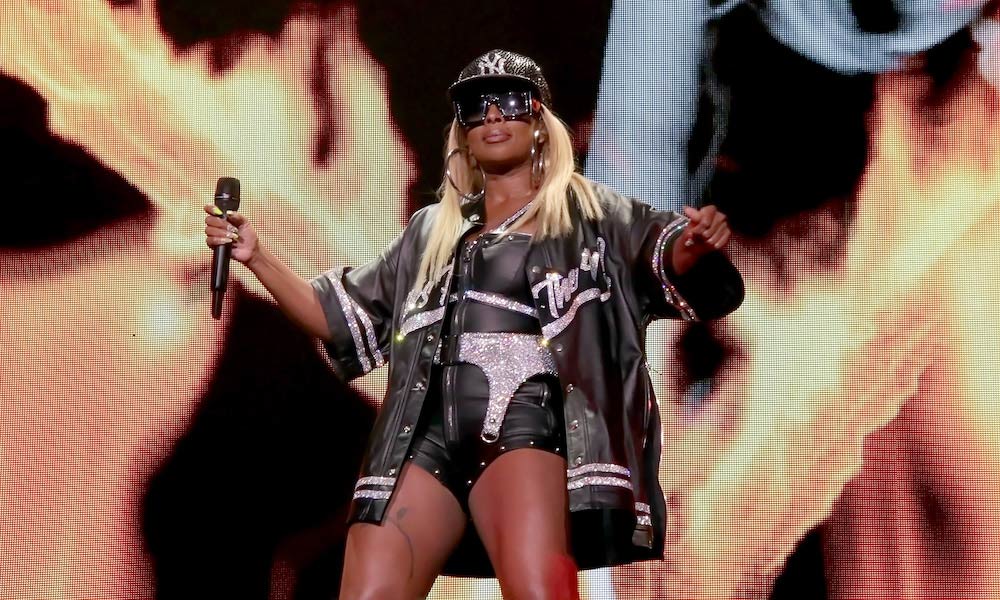
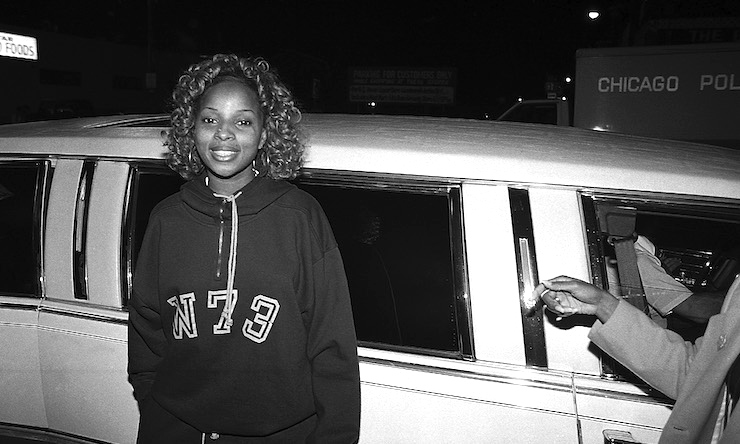
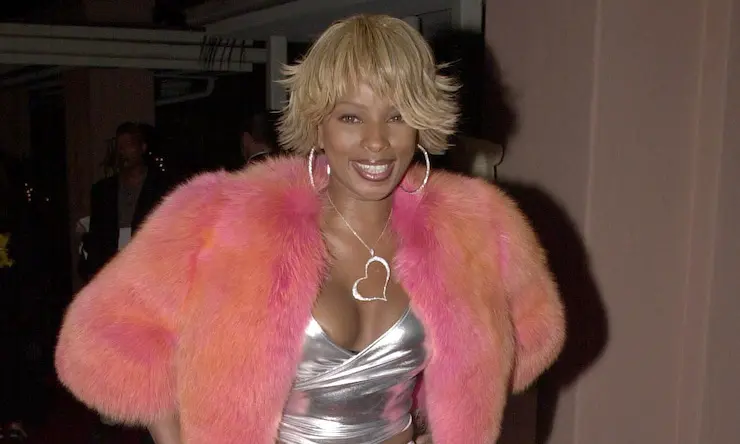
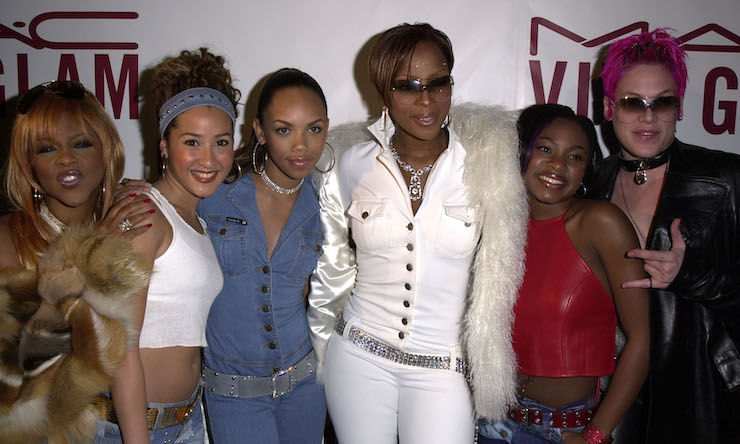
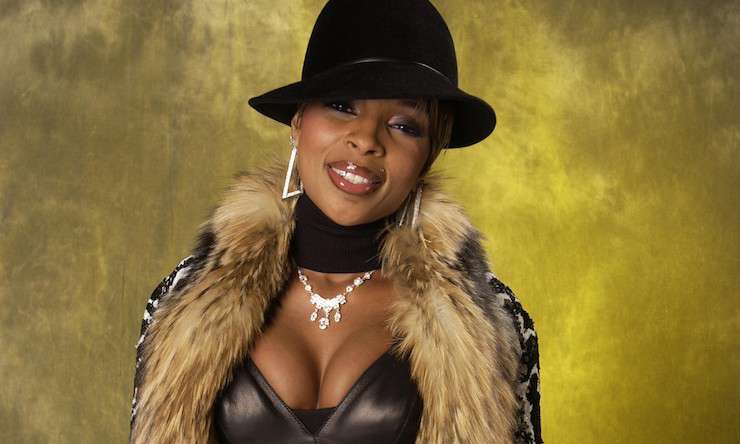
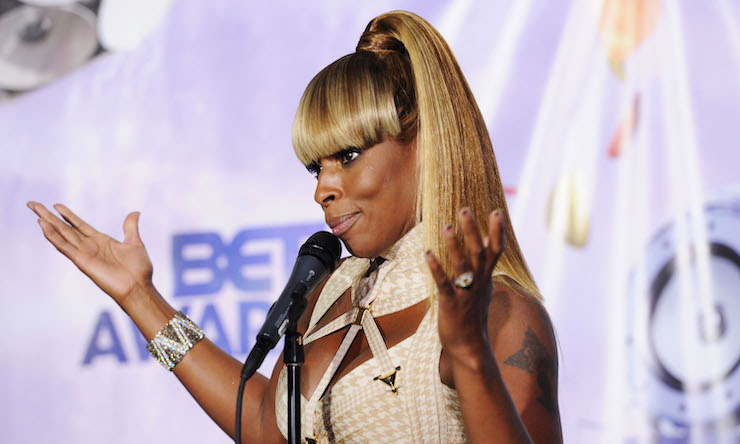
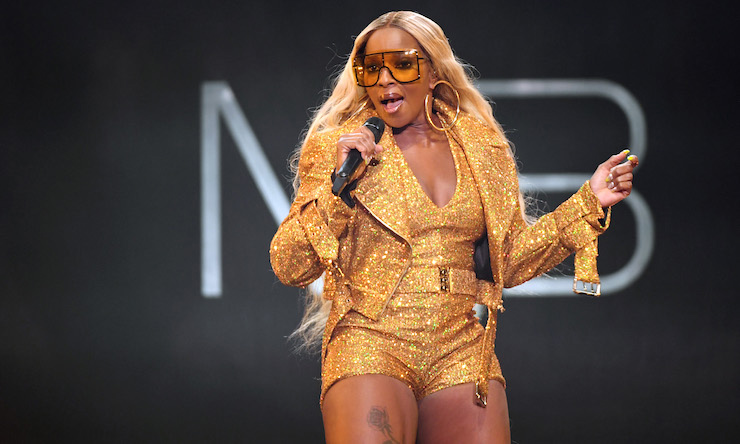
In life and love, Mary J. Blige wanted no more drama, but that certainly never applied to her sense of style. From her early beginnings as the rising star on Uptown Records to over the course of 14 Top 10 studio albums, Mary has always been one to set the trends, not follow them. In both music and fashion, she helped bridge the gap between hip-hop culture and the mainstream, cementing herself as the Queen of Hip-Hop Soul.
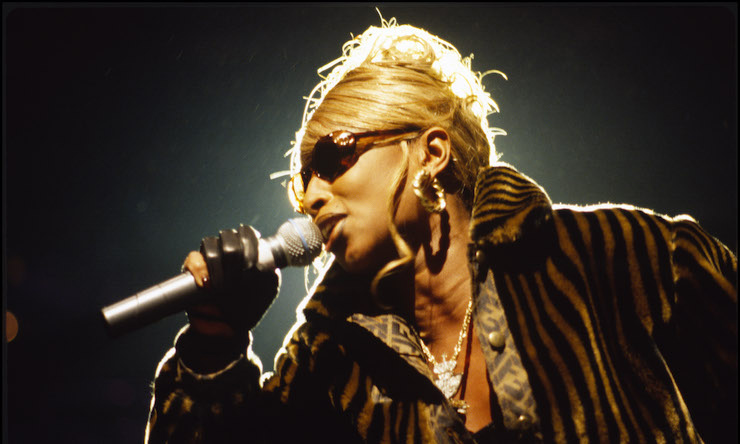
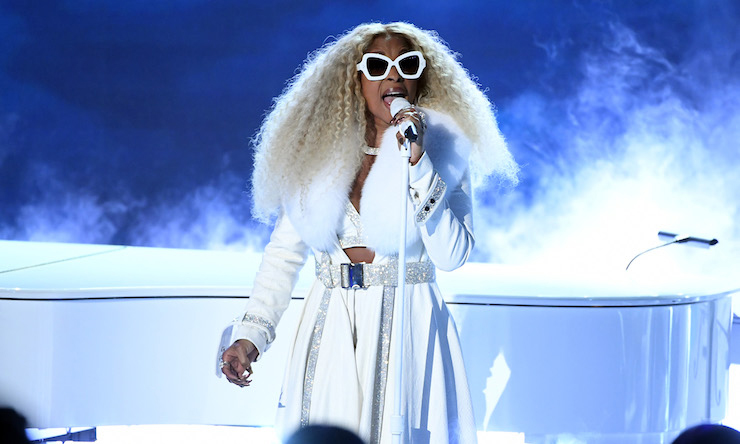
From her early streetwear style days of My Life to the high glamour of The Breakthrough, Mary’s style has evolved throughout the course of her career, but there are a few style hallmarks she’s always been known for: twist hoops and her signature shades.
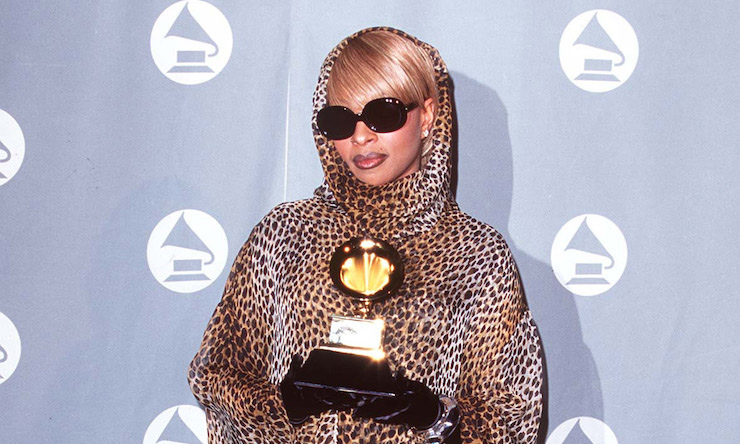
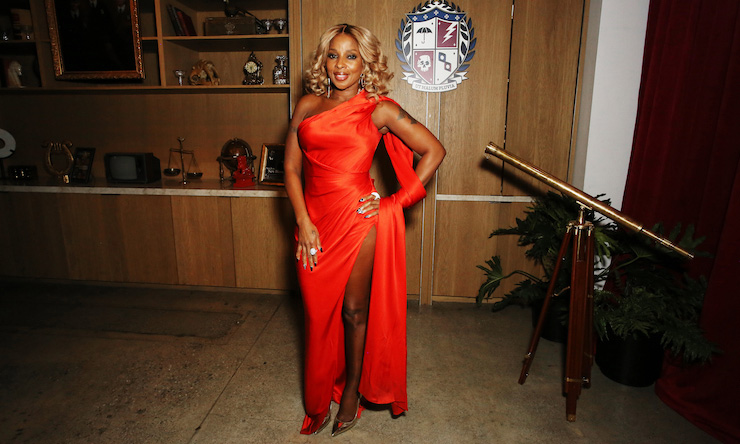
She’s a Mogul with a capital “M” as well as the queen of monochromatic looks, sporting colorful furs, head-to-toe designer logos, and a bold lip.
As one of the most stylish women in R&B and music (period), Mary J. Blige is still stunting on the red carpet as an Oscar-nominated Hollywood power player and making us jealous of her jet-setting life on Instagram.
Here are just a few of the most iconic fashion looks Mary J. Blige has brought to our collective dancerie.
You are not going to believe this one. Ice-T has been a staple of Hip-Hop for decades, and the OG remains the gold standard across Hip-Hop, rock ‘n’ roll, punk, street culture, and every lane he has ever stepped into. What stands out most is that he is still active, still working, and still going hard. There is something powerful about an artist who can stand in front of thousands of people at his age and somehow become even more legendary by speaking truth instead of slowing down.
For a moment, it felt like Ice-T had eased up. He has spoken to us plenty over the years, and you could almost assume he had said everything he needed to say. That assumption did not last long. Recently, Ice-T took the stage and made it clear he has not calmed down at all. He reworked his controversial classic “Cop Killer” into an updated protest aimed at ICE, accusing the agency of abusing the Constitution, legal precedent, and basic American civil rights. The message was unmistakable, and the crowd felt every word.
To understand why this moment matters, you have to remember the original controversy. Ice-T’s metal band Body Count released “Cop Killer” in 1992 during a period of intense tension between law enforcement and Black communities, particularly in South Central Los Angeles. Body Count was not a rap group. It was a heavy metal band rooted in the anger, frustration, and lived experience of the streets. The song sparked outrage from politicians and police unions, leading to massive censorship pressure and ultimately Ice-T parting ways with his label.
That legacy matters today. Ice-T’s latest performance frames ICE as a modern extension of state violence, more powerful, more protected, and more deeply embedded than what communities faced decades ago. While regular police officers have often escaped accountability, ICE operates with even broader authority and fewer consequences. In this case, Ice-T’s critique lands at a time when questions about enforcement, detention, and constitutional rights are louder than ever.
What makes this moment resonate is not nostalgia. It is relevance. Ice-T did not recycle old outrage. He updated it, sharpened it, and aimed it squarely at the present. His willingness to revisit a song that once cost him a record deal shows that his principles have not changed, even if the targets have.
Some legacy context: Ice-T has always used art as confrontation. From his early gangsta rap records to Body Count’s metal rebellion, he has treated music as a mirror held up to America’s contradictions. “Cop Killer” was never about violence for shock value. It was about rage, fear, and systemic abuse expressed through art. By reviving that energy today, Ice-T connects past struggles to present realities, reminding younger generations that Hip-Hop has always been political, disruptive, and unapologetically honest when it mattered most.
I am loving the energy from the OG, but this cannot be a solo mission. Hip-Hop needs more voices willing to speak up and speak out against tragedy, oppression, and state overreach happening right here in America.
Tell us what you think and drop your thoughts in the comments.
Grapevine-raised superstar Post Malone has been named the face of the 40th anniversary “Don’t Mess With Texas” campaign, bringing his global fame back home to support the iconic anti-litter message that has defined Texas highways for four decades.
The Texas Department of Transportation revealed the Grammy-nominated artist as their latest celebrity spokesperson, releasing a new public service announcement that pays tribute to the campaign’s roots while promising to keep Texas roads clean for future generations.
“Let’s keep it going and do our part to keep Texas looking its best,” Post Malone said in the new advertisement. “I’m proud to take part in keeping Texas roads free from trash. ‘Don’t Mess with Texas’ has meant ‘don’t litter’ for 40 years. Let’s keep it up.”
Post was born in Syracuse, but he moved to Grapevine, Texas, when he was nine years old after his father Richard got a job working with the Dallas Cowboys.
The family settled in the Dallas-Fort Worth suburb, where he would spend his formative years developing his musical talents.
The choice of Post Malone for the milestone anniversary creates a full-circle moment for the campaign, which launched on New Year’s Day 1986 with another Dallas-area music legend.
Blues guitarist Stevie Ray Vaughan, an Oak Cliff native, starred in the very first “Don’t Mess With Texas” commercial, establishing a tradition of using Texas-born celebrities to combat roadside littering.
“As we mark the 40th anniversary, it’s wonderful to not only look back at the old commercials that helped spark this iconic message, but see how the newest generation is lending their voice to helping keep our state clean and beautiful,” said TxDOT Executive Director Marc Williams.
The “Don’t Mess With Texas” slogan was created in 1985 when TxDOT began developing a new anti-litter campaign.
Marketing executives initially worried that the phrase might seem too harsh and direct, but Vaughan’s inaugural commercial proved to be an overnight success, transforming the phrase into Texas’s unofficial motto.
Over the past four decades, the campaign has featured an impressive roster of Texas celebrities, including Willie Nelson, George Strait, Lyle Lovett, Eva Longoria, Matthew McConaughey, Joe Jonas, LeAnn Rimes, Ethan Hawke, and the Dallas Cowboys.
Each spokesperson has helped reinforce the message that “Don’t Mess With Texas” means explicitly “don’t litter.”
The campaign’s success has been measurable and significant. Litter on Texas highways has dropped more than 50 percent since 1995, with continued declines recorded in recent years.
Research shows that while 96 percent of Texans recognize the “Don’t Mess With Texas” phrase, ongoing education efforts have increased understanding that it refers specifically to anti-littering from 61 percent to 71 percent.
Post Malone’s new commercial is scheduled to begin airing statewide this month, with additional promotional materials featuring the artist planned for release throughout the anniversary year.
Bad Bunny is facing a $16 million lawsuit over unauthorized voice recordings used in his music, adding another layer of controversy just weeks before his highly anticipated Super Bowl halftime performance.
Tainaly Y. Serrano Rivera filed the lawsuit in Puerto Rico, claiming the reggaeton superstar used her voice without permission on two separate tracks spanning his career.
The legal action targets both Bad Bunny’s 2018 song “Solo de Mi” from his X 100pre album and “EoO” from his latest release Debí Tirar Más Fotos.
Rivera alleges she recorded the now-famous line “Mira, puñeta, no me quiten el perreo” at the request of Bad Bunny’s producing partner La Paciencia back in 2018 when they were college classmates.
The phrase, which roughly translates to “Look, damn it, don’t turn off my perreo,” has become as recognizable as the songs’ melodies among fans.
According to court documents, Rivera claims she was never informed of the purpose for which the recording would be used or that her identity would be commercially exploited. She did not sign any contract or release form, the lawsuit states.
Rivera is represented by the same legal team that handled a similar case involving Bad Bunny’s ex-girlfriend Carliz De La Cruz Hernández, who sued the singer in 2023 for allegedly using her voice without permission on two songs.
That case remains pending.
The timing of this legal challenge couldn’t be more significant for Bad Bunny, who is set to make history as the first artist to perform a Spanish-language Super Bowl halftime show on February 9, 2026.
His selection has already sparked intense political backlash from conservative commentators and Trump administration officials.
MAGA figures have launched a sustained campaign against Bad Bunny’s Super Bowl performance, with some threatening immigration enforcement at the event.
Former Trump campaign manager Corey Lewandowski warned that ICE agents would be present at the Super Bowl. At the same time, Homeland Security Secretary Kristi Noem said agents would be “all over” the stadium.
The controversy stems from Bad Bunny’s outspoken political views and his decision to skip touring in the continental United States over fears that ICE could target his Latino fan base.
Turning Point USA has even organized a counter-program called “The All-American Halftime Show” to compete with Bad Bunny’s performance, promoting “faith, family, and freedom” through English-language music.