Post Content









Post Content
The grill gets the credit at every cookout, but the cooler can make or break the day. Folding chairs fill up fast, corn chars on … Read moreThe post Skip the fancy burger, the real flex this Labor Day is…

LSU President Wade Rousse

Fall premiere season usually spreads across a few weeks, but this September is packing new and returning programming into two crowded weeks. Three series are … Read moreThe post Fall television premiere season just crammed a whole month of TV…

Rep. Andrew Gray, D-Anchorage, speaks in favor of House Bill 62 on Friday, May 16, 2025. (Photo by James Brooks/Alaska Beacon)
Anchorage Democrat Rep. Andrew Gray has asked acting attorney general Cori Mills to prosecute former attorney general Treg Taylor and his wife, Republican lieutenant governor candidate Jodi Taylor, for allegedly failing to file required financial reports.
Gray, chair of the House Judiciary Committee, made the request in a letter sent Tuesday and shared with reporters.
In the letter and speaking by phone, Gray said he was inspired to write the letter because the Alaska Department of Law is criminally prosecuting 11 Whittier residents from American Samoa for allegedly voting illegally.
Gray said those defendants were misinformed about the law, and it makes no sense to prosecute them while not prosecuting an attorney general who knowingly violated an election law.
“I just feel like it’s a no-brainer,” he said.
Treg Taylor had been a Republican candidate for governor until last week, when Lt. Gov. Nancy Dahlstrom ruled him ineligible because he failed to follow a state law mandating the disclosure of his personal financial information.
The Alaska Public Offices Commission, which regulates candidates’ campaigns, had recommended that he be disqualified for failing to disclose the full names of people renting apartments that he owns.
Taylor’s lieutenant governor candidate, Candi English, took his spot as a governor candidate, and Jodi Taylor filed to run as English’s lieutenant governor candidate.
Together, the two make up one of four governor-lieutenant governor tickets in Alaska’s November general election.
Jodi Taylor’s financial disclosure form, filed last week, contains a partial list of renters that is similar to the one flagged as problematic by the commission.
Under state law, Jodi Taylor has 30 days to amend that disclosure. If she does not, she could be ruled ineligible, just as Treg Taylor was.
But federal law requires the state to mail ballots to military and overseas voters no later than 45 days before Election Day.
To meet that deadline, the Alaska Division of Elections is planning to send out ballots starting Sept. 18, a week and a half before the deadline for changes to Taylor’s financial disclosure form.
If Dahlstrom rules Jodi Taylor ineligible as a candidate after that, Alaskans would end up using ballots containing an ineligible candidate.
For the moment, that remains a hypothetical scenario that depends on how Jodi Taylor, APOC and Lt. Gov. Nancy Dahlstrom may act.
Treg Taylor’s previous campaign spokesperson no longer works for the English-Taylor campaign, and the Taylors’ daughter Quincy Azimi-Tabrizi — who spoke for the campaign last week — did not return phone calls seeking comment on Thursday.
A spokesman for the Alaska Department of Law also did not return phone calls or emails asking whether the attorney general had received the letter and if so, whether she had a response.
Gray said on Thursday that he has not received any response either but is preparing a public letter about the issue.
He said he has been particularly taken aback by the idea that Treg Taylor, as attorney general, directed the criminal prosecution of voters in Whittier for allegedly breaking state elections law but isn’t being held to the same standard.
“It makes my head explode,” Gray said.

Jonathan Kreiss-Tomkins, a Democratic former state House member, won the state’s gubernatorial primary last month. (Nathaniel Herz/Anchorage Press)
This story was originally published by the Anchorage Press.
The improbable rise of a long-shot Democratic candidate now has the party positioned to capture the Alaska governor’s mansion for the first time in more than two decades, veteran political observers from across the ideological spectrum said this week.
Jonathan Kreiss-Tomkins, a 37-year-old former state House member from Sitka who’s never run for statewide office, won Alaska’s open primary with 22.5% of votes, according to official results released Monday.
The second-place finisher and the only other Democrat in the field, former state Sen. Tom Begich, dropped out of the race last week — leaving Kreiss-Tomkins, known as JKT, with what insiders say is a clear path to victory amid a splintered Republican field and voter disaffection with incumbent GOP Gov. Mike Dunleavy, who’s term-limited and can’t run again.
Last month, Begich’s campaign had touted analysis by political and polling forecaster Nate Silver that gave his campaign a 71% chance of winning the primary — and Kreiss-Tomkins a 0.0% chance. Prediction markets similarly gave Kreiss-Tomkins long odds.
Now, after a primary campaign that blanketed voters with text messages and sent him to far corners of the state, Kreiss-Tomkins’ political stock is booming and those markets show him as the favorite.

“Jonathan carved 20 points out of thin f—n’ air,” said Joelle Hall, president of the Alaska AFL-CIO, the state’s largest organized labor group, which has endorsed Kreiss-Tomkins. “Everyone else is stuck in another century. JKT is the only one running communications and a campaign that exists in 2026. Everyone else is running a 1990s playbook, and it’s not working.”
Lest you think that’s an opinion held only by his allies, even some of Kreiss-Tomkins’ political adversaries agree.
“He is running a campaign unlike any that has ever been seen in Alaska history,” said Suzanne Downing, the prominent conservative blogger and former spokesperson for the Alaska Republican Party. “He’s running circles around people, because they don’t even know the questions to ask.”
With the Democratic field clear, Kreiss-Tomkins is now poised to also draw support from national groups. The chair of the Democratic Governors Association, which boosts the party’s candidates across the country, issued a statement Tuesday saying the organization “looks forward to working alongside Jonathan to deliver the change Alaskans deserve.”
The Republican Governors Association, meanwhile, has not issued a statement on the Alaska gubernatorial race since primary voting took place last month. Officials there did not respond to a request for comment this week.
Alaska’s last Democratic governor was Tony Knowles, who left office in 2002. The state has twice as many Republicans as Democrats — some 24% of registered voters to 12% — but nearly 65% of voters are independent, meaning that Democrats can occasionally make competitive runs for statewide office.
Of 17 primary election candidates in the governor’s race, 12 were Republicans, who collectively won some 49.5% of the vote — more than the combined total of 43.3% for Kreiss-Tomkins and Begich.
But many observers say they expect the conservative vote to be split between the three Republicans who advanced to the general election.
Those Republicans include conservative activist Bernadette Wilson, who won 10% of votes in the primary; former Anchorage mayor Dave Bronson, who won 8%; and businesswoman Candi English, who was on the ballot as the running mate to a former Alaska attorney general, Treg Taylor, who was ultimately disqualified from the general election due to violation of the state’s financial disclosure law.

Alaska has a ranked choice voting system that theoretically should allow the top GOP candidate to consolidate the second- and third-choiced votes from supporters of the two lower-finishing Republicans. Supporters of the system say it works best when party candidates cooperate.
But political insiders say that they expect infighting among the Republican campaigns to cause a significant fraction of conservative voters to rank only their favorite candidate and not the others — meaning that some of the votes for the lower-placed Republicans may not help the top GOP candidate in a final tally against Kreiss-Tomkins.
Downing, who’s a friend and supporter of Wilson, is one example. She described Bronson as “pugnacious” and “pigheaded” and said his campaign has been attacking Wilson for weeks through third-party surrogates.
“There’s nothing you could do today to get me to rank Dave Bronson,” Downing said in a phone interview.
Downing and other Republicans noted that if Kreiss-Tomkins is elected, he’s likely to get legislative cooperation from the same type of ruling coalitions that have led the state House and Senate for the past two years — which have tilted Democratic. Primary results suggest those coalitions are likely to persist into next year.
One veteran GOP operative, who spoke anonymously to share frank opinions about the party’s odds in November, also said he was deeply pessimistic about the chances that conservative voters will rank more than one Republican gubernatorial candidate.
He cited the 2022 U.S. House race, in which Republicans Sarah Palin and Nick Begich III traded attacks on each other leading up to the general election. The pair together won more than 50% in the early ranked choice vote count — but ultimately lost to a Democrat in part because nearly 14,000 people who ranked Begich declined to rank Palin, meaning their ballots were “exhausted.”
“I don’t think there’s any way conservatives rank the red,” the operative said. “Dave and Bernadette are going to be Sarah and Nick all over again.”
A spokesperson for Bronson’s campaign, Jesse McCarty, said Bronson was unavailable for an interview but added that “we have made it very clear that we will not speak poorly of Republican candidates publicly.”
“Dave and this campaign will be asking the voters to rank the conservatives,” McCarty said in a text message.
The Alaska Republican Party’s chair, Carmela Warfield, did not respond to requests for comment Tuesday. Wilson did not respond to requests for comment, and a spokesperson for English declined to make her available for an interview.
Kreiss-Tomkins, meanwhile, was busy campaigning Tuesday. He said he started the morning with an 8 a.m. coffee with a state legislator after working until 2:30 a.m. the night before, then spent the rest of the day on calls and meetings with other donors, business and labor leaders and campaign staff.
“We’re just going to be super heads-down, a heat-seeking missile toward Nov. 3,” Kreiss-Tomkins said in an interview, referring to the general election date. “We just want to focus on the fundamentals and outwork every other campaign, out-raise every other campaign, out-travel every other campaign.”
Kreiss-Tomkins’ primary campaign took him far across the state, from boating down the Yukon River to driving a snowmachine in Alaska’s Northwest Arctic. He also raised more money than any other candidate — though not without drawing criticism for taking hundreds of thousands of dollars from California-based employees of an AI company, Anthropic.
He has been using a texting service that’s allowed him to directly exchange messages with hundreds of voters, he said in an interview last month.

Now that the primary election is over, Kreiss-Tomkins said, he’s planning more outreach to moderate Republicans who are “disillusioned with the Dunleavy era and want change.”
Kreiss-Tomkins has hired national campaign consultants who have supported strident progressives like former U.S. Senate candidate Graham Platner in Maine and New York City Mayor Zohran Mamdani. But he noted that one of those consultants has also worked with centrist candidates like independent Nebraska U.S. Senate candidate Dan Osborn, who’s volunteered to help Trump build a border wall.
“I’m not an ideological zealot — I never have been,” Kreiss-Tomkins said.
Underscoring Kreiss-Tomkins’ bid to consolidate support among moderates, he spent part of last week in conversations about taking on a new running mate: Click Bishop, a moderate Republican former state senator who also ran in the gubernatorial primary but finished outside the top four.
Kreiss-Tomkins declined to comment directly on those discussions, but a spokesperson for Bishop, Shannon Mason, confirmed that they took place.
Hall, the labor leader, said she expects Kreiss-Tomkins to make inroads with conservative leaning voters who assume the candidate is more liberal than he actually is because of his relative youth.
“Just because he’s young, they believe that he is less moderate than Tom Begich,” Hall said. “He’s 100% a negotiator. He’s the kind of guy who’s going to bring everybody in a room.”
Downing, the blogger and Wilson supporter, said she hasn’t totally given up hope that her preferred candidate could still come out of the race as the winner.
She’s hoping Bronson can still be convinced to suspend his campaign and consolidate support for Wilson. And she said she also thinks that English, the third GOP candidate, may have to drop out: Her current running mate is Jodi Taylor, the wife of the former attorney general who was disqualified for financial disclosure violations. Jodi Taylor made the same omissions on her financial disclosure — some of the details of her sources of income — that her husband did.
“I see a path,” Downing said. “But it’s a narrower path with Bronson in.”
Disclosure: Kreiss-Tomkins facilitated some early-stage meetings around the revitalization of the Anchorage Press. He has no involvement with the organization today.
This story was originally published by the Anchorage Press, the revived urban alt-weekly.

Former President Donald Trump prepares to speak in front of a crowd at the Alaska Airlines Center in Anchorage on Saturday, July 9, 2022. (Photo by James Brooks/Alaska Beacon)
President Donald Trump said Wednesday in Washington, D.C., that he will travel to Alaska to campaign on behalf of incumbent Republican U.S. Sen. Dan Sullivan, who appears to be facing a close race against Democratic challenger Mary Peltola.
“I will go to Alaska to help Dan Sullivan get elected. … Dan Sullivan’s a great senator,” Trump said.
Because most U.S. Senate seats are in states controlled firmly by Republicans or Democrats, control of the U.S. Senate as a whole will be decided by a relative handful of races nationally, including the one this year in Alaska.

A spokesperson for Sullivan’s campaign did not immediately return an email seeking comment on Thursday.
In the just-completed August primary election, Peltola had 49.5% of the vote; Sullivan had 41.4% of the vote.
Despite that performance, a recent poll of voters likely to participate in November indicates a race that’s in a virtual dead heat. That poll is similar to others conducted earlier this year.
On Wednesday at the Oval Office, one reporter asked Trump why the race is so close.
“I don’t know. Well, it’s close for one reason that they have a phony Dan Sullivan,” Trump said. “This guy’s a phony and he was put up by the Democrats and they don’t admit it, but it’s been so proven.”
The third person in Alaska’s four-way race for U.S. Senate is Dan J. Sullivan, a Republican from Petersburg who earned 2.5% of the vote in the August primary.
Many of Dan J. Sullivan’s votes in the primary came from Democratic-leaning districts, and both he and people representing Peltola’s campaign have said that there has been no coordination between the two.
Despite that, the president, the incumbent and other Republicans have accused Dan Sullivan of nefarious actions without providing evidence.
On Wednesday, Dan J. Sullivan told Alaska Public Media that he was out picking mushrooms and hadn’t heard the president’s remarks.
When reached by the Alaska Beacon on Thursday, he declined comment.
Trump incorrectly said Dan J. Sullivan had never voted.
“He hasn’t voted for years. A totally pretty nonpolitical person, I guess, but never had any thought of running,” Trump said.
State records show Dan J. Sullivan is a “supervoter” who has cast ballots in 17 state and local elections since 2017.
“That guy got two and a half percent in the recent primary. And that’s — two and a half percent is a lot when it comes to winning elections. And it’s a disgrace,” Trump said.
Trump also criticized Alaska’s ranked choice general election system, saying it amounted to picking a name out of a hat.
Under the Alaska system, voters are asked to rank the four candidates (and any write-ins) in order of preference. If one candidate receives more than half of the first-preference votes, they win.
If no one has more than half the votes, the lowest finisher is eliminated, and their votes go to voters’ second choices. The process repeats until only two candidates are left, and the person with the most votes wins.
It isn’t clear how much Trump’s influence would help the incumbent Sen. Dan Sullivan.
Alaska has voted for Trump each time he has run for president. In 2024, 54.5% of participating voters picked Trump for president, putting him 13 percentage points ahead of Democratic candidate Kamala Harris.
“It’s a long trip. I love Alaska. You know, I won Alaska by a landslide,” Trump told reporters attending a gathering of travel industry officials.
But since that election, Alaskans’ opinion of Trump appears to have soured. Public opinion polling conducted in August found that more than 56% of Alaskans have a negative view of Trump.
In 2022, Trump visited the Alaska Airlines Center at the University of Alaska Anchorage to boost the campaigns of U.S. Sen. candidate Kelly Tshibaka, U.S. House candidate Sarah Palin and governor candidate Mike Dunleavy.
Tshibaka and Palin lost their races that year; Dunleavy won his.
As of Thursday, no one representing the president had booked the Alaska Airlines Center, a UAA official said.
Trump also visited Anchorage last year to meet Russian President Vladimir Putin. Though highly promoted as an opportunity to end the Russia-Ukraine war, the event resulted in little more than a photo opportunity.
Sullivan has been a mostly reliable vote in the Senate for Trump’s agenda since the president was re-elected in 2024. In 2025, Sullivan voted along with Trump on every major topic before Congress. This year, Sullivan has only occasionally voted against Trump’s goals, including once against the President’s plans to distribute $1.8 billion in public funds to supporters, including those convicted of participating in the Jan. 6, 2021, attack on the U.S. Capitol.
Trump said he is in regular contact with Sullivan.
“He would call me all the time because I think — no, I definitely know — nobody has helped Alaska like Donald Trump. We’ve invested billions and billions of dollars and created trillions of dollars in value,” Trump said, exaggerating trends on the ground in the state.
According to Federal Reserve data, Alaska’s gross domestic product rose by about $3.5 billion between 2024 and 2025, continuing a trend that started in 2020.
He also exaggerated the importance of Alaskan oil internationally.
“You have Japan, you have South Korea, you have all of these people now going to Alaska to load up with fuel, load up with oil, build pipelines, everything else,” Trump said.
Only about 5% of Alaska North Slope crude has been exported internationally this year.
Trump said his trip to Alaska will be one of several that he intends to take before Election Day on Nov. 3.
“I will be going to Alaska. I’m going to be going the last 30 days before the election. I’ll be making a lot of stops,” Trump said.
“I’m going to be campaigning for numerous people, both Congressmen — a few governors, I love the governors — but we’re interested in the Senate, and we’re interested in the House. So I’ll be campaigning for the House members and I’ll be campaigning for senators,” he said.

On behalf of the staff, board, and families of Chilkat Valley Preschool, I want to extend our heartfelt gratitude to the Chilkat Community Foundation for their 2026 Grant supporting our operational funds.
Operating a high-quality preschool requires stable, predictable funding to cover the essential overhead costs that keep our doors open..
By investing in our daily operations, the Chilkat Community Foundation directly invested in the early education and well-being of our community’s youngest residents. We…

Black privacy fencing shrouds the Carlisle Barracks Post Cemetery on Monday, Aug. 31, 2026, as officials prepare for the disinterment and repatriation of the remains of 12 students who died while attending the notorious Carlisle Indian Industrial School more than 100 years ago. The repatriations are scheduled to run from Sept. 1 to Oct. 12, 2026. (Photo by Charles Fox/Special to ICT)
This story was originally published by ICT.
WARNING: This story contains disturbing details about boarding schools. If you are feeling triggered, here is a resource list from the National Native American Boarding School Healing Coalition.
CARLISLE, Pennsylvania — The Carlisle Barracks Post Cemetery is once again solemnly shrouded with black privacy fencing as families and tribal leaders gather to reunite with ancestors who died while attending the Carlisle Indian Industrial School.
Disinterments are set to begin Tuesday, Sept. 1, of the first of 12 students who will be returned to their homelands over the next six weeks as part of the Office of Army Cemetery’s annual repatriation of remains of children who died at the school.
Among the first to go home will be three students from the Fort Peck Assiniboine and Sioux Tribes, who arrived at Carlisle together on April 15, 1890. They all died of tuberculosis over the the next few years.
Descendents and tribal leaders gathered at Carlisle on Monday, Aug. 31, to help them begin their journey home. A celebration is planned for their arrival in Montana.
“The community becomes the family,” Dyan Youpee, the tribe’s cultural preservation director, told the Fort Peck Journal, referring to a phrase that is at the heart of the planned celebration welcoming the children home.

Youpee told ICT the event is designed to “shed positive, healing light on the repatriation efforts, journey and reburial.”
The repatriation experience can be a wrenching emotional journey for descendants and tribal leaders, as they retrace the footsteps of ancestors who never have made it back to their families, paired with the triumph of finally bringing them home.
For the Office of Army Cemeteries, which oversees the Carlisle cemetery along with other Army facilities, this will be the ninth round of disinterments, with forensic archaeological and anthropological experts from the U.S. Army Corps of Engineers.
Since the repatriations began in 2017, the remains of 58 students have been returned home, leaving numerous gaps among the headstones in the cemetery. Of the 138 graves that remain, the burial sites of 22 children are designated as unknown, with the identities lost to human error when the cemetery moved in 1927.
“The Office of Army Cemeteries team is inspired by the strength and courage from the Native American and Alaska Native Tribes as they make this journey to bring their children home,” Renea Yates, director of the Office of Army Cemeteries, stated in a press release.
“Navigating the disinterment and return process requires the highest level of professional care and compassion and we are committed to providing the expert assistance needed to return their loved ones to their families and communities,” Yates said.
The Army reimburses families for their travel to participate in the disinterment process, the transfer ceremony that follows, and the cost of transport and reburial of the children. After the transfer of custody, families and tribes are free to rebury these children to a location of their choice.
The students, who ranged in age from 11 to 18, also include four Alaskan Native students, and a student each from the Comanche Nation, Absentee Shawnee Tribe, Shoshone Paiute Tribes, Grand Traverse Band of Ottawa and Chippewa Indians and the Keweenaw Bay Indian Community.
Most of them died from tuberculosis, although the cause of death was not listed for several of the students in school records.
The barracks housed the Carlisle school from 1879-1918, where nearly 8,000 students from more than 140 tribes attended as part of a government assimilation program that separated them from their families, language and culture. It was the first federally funded, off-reservation Indian boarding school in the U.S., and it served as a model for boarding schools across the U.S. and Canada.

The research of the Alaska Native Heritage Center, known as ANHC, has been instrumental in bringing home the four Alaskan Native students scheduled for disinterment.
“When we do research aimed at bringing home our children, we hope to bring healing to our communities affected by the era of assimilation and its continuing effects,” Benjamin Jacuk, director of Indigenous Research and Healing at ANHC, recently told ICT. “Our work is to bring home the children above all else… Because at the end of the day these children are worth that hard work and that trust.”
The Carlisle Barracks Post Cemetery has been closed to visitors since Aug. 14, and access to the cemetery, enclosed in privacy fencing, will be restricted to federal staff along with tribal members and their families until the completion of the scheduled disinterments, tentatively set for Oct. 12.
At Fort Peck in eastern Montana, organizers are optimistic the event will bring out a large welcoming crowd.
On July 31, Youpee and others did a non-stop 89-mile Awareness Walk from one end of the reservation to the other to make sure everyone was aware of the upcoming event. Organizers have encouraged people to arrive wearing orange shirts to acknowledge boarding school survivors or traditional regalia, and to create an escort of horseback riders and a caravan of cars to welcome the children home as they reach the reservation border.
More than 135 years after the children left their homelands, the homecoming is an attempt to show love and recognition to the three students.
Organizers want to ensure they are not forgotten or reduced to names on school records, in hopes the community comes together to make sure that no child comes home alone.
The remains of 12 students who died at the Carlisle Indian Industrial School are set to be disinterred starting Sept. 1 through Oct. 12. The students include four Alaskan Natives, three from the Fort Peck Assiniboine and Sioux Tribes, and students from five other tribes across the U.S.
Alaskan Natives
*Mabel Stack arrived on Oct. 24, 1903, at age 11, and died Aug. 14, 1904, of tuberculosis. Her last name is listed as Stock on the gravestone and Stack in the Carlisle records, but Booth is believed to be her correct last name.
*Edward Angalook, who is listed as Angelook on his gravestone, arrived Nov. 23, 1903, at age 18, and died Sept. 24, 1905 of tuberculosis.
*Lucy Spaulding arrived Oct. 24, 1903, at age 14, and died March 25, 1905, of tuberculosis. She is listed as Spalding on her gravestone, although her correct last name is believed to be Guthrie.
*Tummassak arrived on Nov. 14, 1897, at age 12, and died on April 8, 1900, of tuberculosis. She is listed as Tomicock on her gravestone and also as Tomiclock in Carlisle archives.
Fort Peck Assiniboine and Sioux Tribe
*Peter Howe arrived at the school on April 15, 1890, at age 16, and died six years later on June 5, 1896, of tuberculosis.
*Richard Morgan arrived April 15, 1890, at age 17, and died March 25, 1891, of tuberculosis.
*Christine Redstone arrived April 15, 1890, at age 15, and died July 19, 1899, of tuberculosis.
Comanche Nation
*Frances Bones arrived on Nov. 8, 1894, at age 14, and died on May 7, 1895. Her cause of death was not listed in Carlisle records.
Absentee Shawnee Tribe
*Fannie Gibson arrived on Dec. 24, 1899, at age 17, and died on Dec. 6, 1900, of tuberculosis.
Shoshone Paiute Tribes
*Della Atkins arrived on Dec. 13, 1900, at age 17, and died 12 days later on Dec. 25, 1900. Her death was attributed to a brain tumor.
Grand Traverse Band of Ottawa and Chippewa Indians
*Susie King arrived at the school on Oct. 25, 1890, at age 16, and died Oct. 21, 1891. Her cause of death was not listed.
Keweenaw Bay Indian Community
*Margaret Davis arrived at the school on Sept. 15, 1889, at age 14, and died Dec. 21, 1892, of tuberculosis.
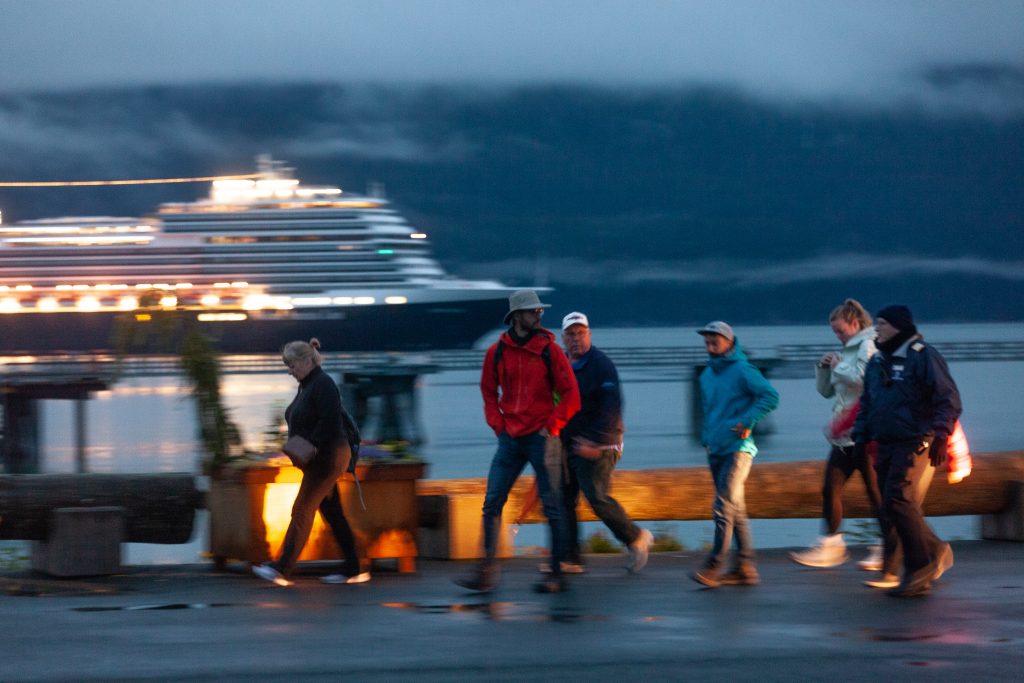
An active cruise-dock management bid in Haines is just one Alaska venture for now-familiar Global Ports Holding. The company’s other regional business could give it the means, and incentive, some say, to bring more passengers to Haines.
Through the last year, as Global…