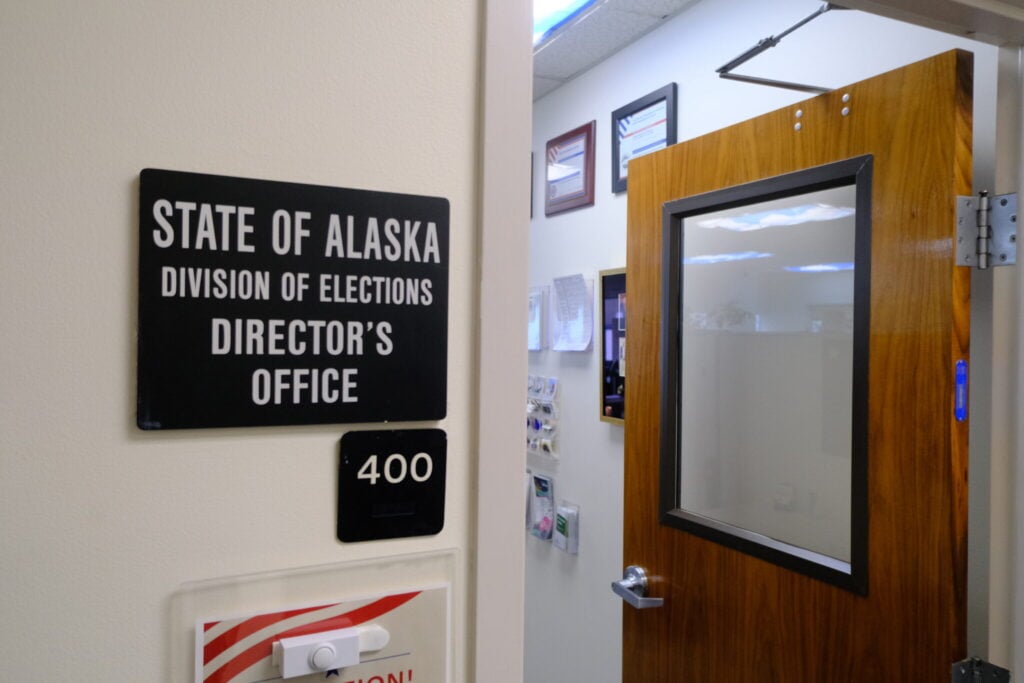
Abortion-rights advocates filed a lawsuit in Alaska Superior Court on Thursday to overturn a state ban on telehealth for abortion services.
The lawsuit was filed in Anchorage by Planned Parenthood Great Northwest, Hawaiʻi, Alaska, Indiana and Kentucky.
It targets an element of state law that requires patients receiving abortion services to be treated on-site in hospitals or other facilities approved by the Alaska Department of Health or in federal government hospitals.
That requirement bars the use of telehealth for the prescription of abortion-inducing medicine, which advocates say is a breach of the Alaska constitution’s guarantees of privacy and equal protection.
Alaskans are allowed to use telehealth for numerous other medical services, so the ban on its use for abortion services violates patients’ rights to equal protection, the lawsuit argues.
Past court rulings have confirmed that Alaskans have the right to abortion under the state constitution’s privacy provisions, but the telehealth ban compromises privacy rights by taking away the option for medical abortions at home, which many patients prefer, the lawsuit also argues.
In Alaska, where a significant percentage of the residents live off any connected road system, the telehealth ban is particularly onerous, the lawsuit says.
“Planned Parenthood’s patients often must travel significant distances to have an abortion in Anchorage or Fairbanks, sometimes at great expense and difficulty, including due to weather conditions,” the lawsuit says.
Filed with the lawsuit was a motion for an injunction barring enforcement of the telehealth ban while the case is pending.
“The restriction creates unnecessary barriers that fall hardest on people in rural and remote communities, survivors of violence, and those already facing economic hardship — sometimes barring patients from care entirely. Simply put, this telehealth ban is yet another unnecessary barrier to abortion access, and Alaskans deserve better,” Rebecca Gibron, president of Planned Parenthood Great Northwest, Hawaiʻi, Alaska, Indiana and Kentucky, said in a statement.
The Alaska Department of Law was not prepared to comment Thursday on the new Planned Parenthood arguments, said Acting Attorney General Cori Mills.
“We will have to review the complaint and have no comment on the specific allegations. As a general matter, the department will defend the law, which carries a presumption of constitutionality and represents state policy validly enacted by the legislature and the governor,” she said by email.
The lawsuit comes at a time when a legal battle is being waged nationally over access to mifepristone, a medicine commonly used to induce abortions. Some states are seeking to outlaw use of mifepristone, though Alaska is not among them.
Planned Parenthood has already won a related case at the Superior Court level with the same arguments about the state constitution’s privacy and equal protection guarantees.
In that case, Superior Court Judge Josie Garton in 2024 struck down a portion of state law that allowed only licensed physicians to perform abortions. The ruling broadened the availability of abortion services, allowing advanced practice clinicians – such as nurse practitioners, physician assistants and certified nurse midwives – to provide the services. Garton had issued an injunction in 2021 that allowed advanced practice clinicians to perform abortions, temporarily blocking enforcement of the physician-only rule while the case played out.
The state appealed Garton’s ruling, and the Alaska Supreme Court heard oral arguments in the case in October.
The Alaska House of Representatives is planning to vote as soon as Friday morning on a proposal to cut state taxes in order to encourage construction of the proposed trans-Alaska natural gas pipeline.
On Wednesday, the House Finance Committee voted unanimously to advance a bill that would effectively cut taxes on the project by about 85% for 30 years.
Project developers have said the tax break is necessary to keep the project economically competitive in global markets, and the reduction would reduce the cost of natural gas for Alaskans across the Railbelt.
The finance committee — four Democrats, two independents and five Republicans — voted unanimously to advance the bill, indicating a broad level of support for the proposal.
Rep. Will Stapp, R-Fairbanks and a member of the committee, said on Thursday morning that he expects the bill to pass by a “wide, bipartisan margin” on Friday.
Rep. Andy Josephson, D-Anchorage, said he expects the bill to pass the 40-person House by a 3:1 margin.
“The fight in at least one chamber is over,” he said.
The bill’s fate is less certain in the Senate, where leading lawmakers have repeatedly expressed concerns about possible risks to the state and Alaska natural gas consumers.
“The bill still has a long way to go. I think we can do better,” said Sen. Bill Wielechowski, D-Anchorage, on Facebook.
The legislature is currently in a 30-day special session that ends June 19, which puts a strict timeline on action.
Under a draft schedule discussed by House lawmakers on Thursday, the House would pass the bill on Friday or Saturday, allowing the Senate to formally receive it on Monday.
The Senate Finance Committee would have a few days to examine the bill and amend it before sending it to the full Senate for a vote. There would be no time for the House and Senate version to be negotiated further: The Senate is expected to present the House with a straight up or down vote on Friday to determine whether legislators in the House agree with the Senate’s changes.
“The way this is going to play out … is that the Senate is going to have the last touch,” said Rep. Calvin Schrage, I-Anchorage.
The version of the bill that passed out of the House Finance Committee on Wednesday does have the support of Dunleavy and Glenfarne.
In a written statement, the governor thanked the committee for its work.
“Alaska has a tremendous opportunity before us, and this bill is a critical step toward making the Alaska LNG Project a reality,” he said on social media.
“The hard work by committee members produced a thoughtful bill that, if passed by the legislature, will enable Alaska LNG to go forward and unlock the long-awaited benefits of Alaska’s North Slope natural gas resources while protecting the state’s interests,” said Glenfarne Alaska President Adam Prestidge.
Rep. Neal Foster, D-Nome and co-chair of the House Finance Committee, asks a question to Alaska Gasline Development Authority officials at a May 27, 2026, hearing in Anchorage. Shown with him are other members of the committee: Rep. Alyse Galvin, I-Anchorage, Rep. Andy Josephson, D-Anchorage,a nd Rep. Calvin Schrage, I-Anchorage. (Photo by Yereth Rosen/Alaska Beacon)
A $54 billion project from North Slope to Cook Inlet
As currently proposed, the Alaska LNG project would involve constructing an 807-mile pipeline from the North Slope to a port on the Kenai Peninsula.
At the northern end would be a multibillion-dollar industrial plant needed to strip carbon dioxide from natural gas produced on the Slope. That carbon dioxide would be injected deep underground to keep it from being released into the atmosphere and contributing to climate change.
If the gas were left untreated, the carbon dioxide would create carbolic acid within the pipeline, destroying it.
At the southern end of the pipeline would be another multibillion-dollar industrial facility that takes the gas and prepares it for shipping via specialized tankers to customers in Asia and elsewhere around the world.
Prestidge has said that tax incentives are “critical” in order for Glenfarne to obtain loans and attract investors for the project.
Under new cost estimates published June 3, Glenfarne expects the project to cost between $44.5 billion and $54.5 billion altogether. The high end of the developer’s cost estimate has gone up by almost $10 billion.
Alaska currently levies a 2% tax on oil and gas property. The pipeline and associated facilities would be exempt from taxation during construction, but Glenfarne is proposing to build the project in two phases: First, the pipeline, which could transmit gas to Southcentral Alaska as soon as 2029, and second, the associated processing plants, which are expected to be online by 2033.
That schedule, coupled with the setup of the property tax, means Glenfarne would be required to start paying taxes before it begins selling profitable amounts of gas.
In March, Dunleavy introduced a bill that proposed a 90% tax cut for the project by replacing the property tax with a tax on gas shipped through the pipeline.
Legislators held dozens of hearings on the proposal and House legislators even considered a consequential pipeline-for-pensions trade, but no bill passed during the regular session, which ended May 20.
Rep. Frank Tomaszewski, R-Fairbanks (standing at left) and Rep. Will Stapp, R-Fairbanks (facing away from camera) talk with Glenfarne officials and lobbyists on Tuesday, June 9, 2026, during a break in the work of the House Finance Committee. The group was discussing an amendment proposed by Tomaszewski to a bill that would cut taxes on the proposed trans-Alaska natural gas pipeline project being developed by Glenfarne. (James Brooks photo/Alaska Beacon)
Special session advanced progress on the issue
Dunleavy immediately called a 30-day special session on the issue, and the finance committees in the House and Senate continued holding hearings.
Those continued discussions helped move the needle, Schrage said.
“I think more time to talk, time to move it through the committee process, really has been very helpful, and will help to produce a different outcome than last time,” he said, referring to the failed pipeline-for-pension arrangement.
John Sims, president of Southcentral Alaska’s largest natural gas utility, told lawmakers that the utility is already in negotiations with Glenfarne on a 30-year contract for gas at no more than $16 per mmBtu.
That’s above current prices but below the expected cost of imported gas.
Glenfarne’s Adam Prestidge said the company would be open to a cost cap on similar terms for Alaskans in general.
Members of the House Finance Committee adopted that proposal and others in close consultation with Glenfarne. During frequent breaks, legislators would duck into a hallway connected to the committee room to talk with company officials and lobbyists.
Under the draft of the bill finished Wednesday, Glenfarne would pay no taxes for five years after the first gas begins flowing down the pipeline.
For the following 30 years, Glenfarne would pay 6 cents per thousand cubic feet of gas that flows through the pipeline, 13 cents per thousand cubic feet through the North Slope plant, and another 13 cents per thousand cubic feet through the gas liquefaction plant on the Kenai Peninsula.
Ken Alper, an aide to Josephson and adviser to the Finance Committee during its deliberations, said that roughly amounts to an 85% tax cut when compared to the current property tax rate.
Of the collected taxes, 93% would go to boroughs along the route of the pipeline. The remaining 7% would stay with the state.
The new tax rate is conditional. Glenfarne would have to sign labor agreements with local unions, agree to construct a pipeline spur to Fairbanks, and pay $80 million into an impact fund.
That fund would be used to compensate borough governments for costs they incur to deal with as many as 12,000 temporary workers who would be employed building the pipeline.
Only six communities are eligible for the money in the fund: the North Slope Borough, Fairbanks Borough, Denali Borough, Matanuska-Susitna Borough, Anchorage and the Kenai Peninsula Borough.
Rep. Will Stapp, R-Fairbanks, leads a tour group through the Alaska State Capitol on Thursday, June 11, 2026, while awaiting the final draft of a bill cutting taxes for the proposed trans-Alaska natural gas pipeline project. (James Brooks photo/Alaska Beacon)
Pipeline construction isn’t guaranteed
Even if the current bill passes the Legislature and is signed into law, it doesn’t guarantee a pipeline.
In presentations to the finance committees, various consultants and experts from the Alaska Department of Revenue have said that the forecast cost of natural gas exported by Alaska LNG is very close to the cost of gas available from other sources internationally.
If the project costs more than anticipated, if natural gas from the North Slope costs more than expected, or if buyers aren’t willing to pay as much as forecast, the pipeline is uneconomical and doesn’t get built.
“I think there is a broad belief that it’s going to be a difficult project to pull off, but we want to give them a chance, and we wish them the best in doing so, because I think most Alaskans do want to see our natural gas brought to be able to benefit Alaskans,” Schrage said.
Stapp, sitting in the halls of the Capitol on Thursday and awaiting the final draft of the bill, said he believes that without the bill, there is a “zero percent chance of a pipeline.” With the bill, “there’s a 10% chance.”
Tomaszewski is more optimistic.
“I’m looking forward to the groundbreaking ceremony,” he said.
From left to right, Reps. Neal Foster, D-Nome; Calvin Schrage, I-Anchorage; and Jamie Allard, R-Eagle River; talk with Rep. Frank Tomaszewski, R-Fairbanks (facing away from camera) on Tuesday, June 9, 2026, after the conclusion of that day’s House Finance Committee meeting in Juneau. (James Brooks photo/Alaska Beacon)
The Alaska House of Representatives is planning to vote as soon as Friday morning on a proposal to cut state taxes in order to encourage construction of the proposed trans-Alaska natural gas pipeline.
On Wednesday, the House Finance Committee voted unanimously to advance a bill that would effectively cut taxes on the project by about 85% for 30 years.
Project developers have said the tax break is necessary to keep the project economically competitive in global markets, and the reduction would reduce the cost of natural gas for Alaskans across the Railbelt.
The finance committee — four Democrats, two independents and five Republicans — voted unanimously to advance the bill, indicating a broad level of support for the proposal.
Rep. Will Stapp, R-Fairbanks and a member of the committee, said on Thursday morning that he expects the bill to pass by a “wide, bipartisan margin” on Friday.
Rep. Andy Josephson, D-Anchorage, said he expects the bill to pass the 40-person House by a 3:1 margin.
“The fight in at least one chamber is over,” he said.
The bill’s fate is less certain in the Senate, where leading lawmakers have repeatedly expressed concerns about possible risks to the state and Alaska natural gas consumers.
“The bill still has a long way to go. I think we can do better,” said Sen. Bill Wielechowski, D-Anchorage, on Facebook.
The legislature is currently in a 30-day special session that ends June 19, which puts a strict timeline on action.
Under a draft schedule discussed by House lawmakers on Thursday, the House would pass the bill on Friday or Saturday, allowing the Senate to formally receive it on Monday.
The Senate Finance Committee would have a few days to examine the bill and amend it before sending it to the full Senate for a vote. There would be no time for the House and Senate version to be negotiated further: The Senate is expected to present the House with a straight up or down vote on Friday to determine whether legislators in the House agree with the Senate’s changes.
“The way this is going to play out … is that the Senate is going to have the last touch,” said Rep. Calvin Schrage, I-Anchorage.
The version of the bill that passed out of the House Finance Committee on Wednesday does have the support of Dunleavy and Glenfarne.
In a written statement, the governor thanked the committee for its work.
“Alaska has a tremendous opportunity before us, and this bill is a critical step toward making the Alaska LNG Project a reality,” he said on social media.
“The hard work by committee members produced a thoughtful bill that, if passed by the legislature, will enable Alaska LNG to go forward and unlock the long-awaited benefits of Alaska’s North Slope natural gas resources while protecting the state’s interests,” said Glenfarne Alaska President Adam Prestidge.
Rep. Neal Foster, D-Nome and co-chair of the House Finance Committee, asks a question to Alaska Gasline Development Authority officials at a May 27, 2026, hearing in Anchorage. Shown with him are other members of the committee: Rep. Alyse Galvin, I-Anchorage, Rep. Andy Josephson, D-Anchorage,a nd Rep. Calvin Schrage, I-Anchorage. (Photo by Yereth Rosen/Alaska Beacon)
A $54 billion project from North Slope to Cook Inlet
As currently proposed, the Alaska LNG project would involve constructing an 807-mile pipeline from the North Slope to a port on the Kenai Peninsula.
At the northern end would be a multibillion-dollar industrial plant needed to strip carbon dioxide from natural gas produced on the Slope. That carbon dioxide would be injected deep underground to keep it from being released into the atmosphere and contributing to climate change.
If the gas were left untreated, the carbon dioxide would create carbolic acid within the pipeline, destroying it.
At the southern end of the pipeline would be another multibillion-dollar industrial facility that takes the gas and prepares it for shipping via specialized tankers to customers in Asia and elsewhere around the world.
Prestidge has said that tax incentives are “critical” in order for Glenfarne to obtain loans and attract investors for the project.
Under new cost estimates published June 3, Glenfarne expects the project to cost between $44.5 billion and $54.5 billion altogether. The high end of the developer’s cost estimate has gone up by almost $10 billion.
Alaska currently levies a 2% tax on oil and gas property. The pipeline and associated facilities would be exempt from taxation during construction, but Glenfarne is proposing to build the project in two phases: First, the pipeline, which could transmit gas to Southcentral Alaska as soon as 2029, and second, the associated processing plants, which are expected to be online by 2033.
That schedule, coupled with the setup of the property tax, means Glenfarne would be required to start paying taxes before it begins selling profitable amounts of gas.
In March, Dunleavy introduced a bill that proposed a 90% tax cut for the project by replacing the property tax with a tax on gas shipped through the pipeline.
Legislators held dozens of hearings on the proposal and House legislators even considered a consequential pipeline-for-pensions trade, but no bill passed during the regular session, which ended May 20.
Rep. Frank Tomaszewski, R-Fairbanks (standing at left) and Rep. Will Stapp, R-Fairbanks (facing away from camera) talk with Glenfarne officials and lobbyists on Tuesday, June 9, 2026, during a break in the work of the House Finance Committee. The group was discussing an amendment proposed by Tomaszewski to a bill that would cut taxes on the proposed trans-Alaska natural gas pipeline project being developed by Glenfarne. (James Brooks photo/Alaska Beacon)
Special session advanced progress on the issue
Dunleavy immediately called a 30-day special session on the issue, and the finance committees in the House and Senate continued holding hearings.
Those continued discussions helped move the needle, Schrage said.
“I think more time to talk, time to move it through the committee process, really has been very helpful, and will help to produce a different outcome than last time,” he said, referring to the failed pipeline-for-pension arrangement.
John Sims, president of Southcentral Alaska’s largest natural gas utility, told lawmakers that the utility is already in negotiations with Glenfarne on a 30-year contract for gas at no more than $16 per mmBtu.
That’s above current prices but below the expected cost of imported gas.
Glenfarne’s Adam Prestidge said the company would be open to a cost cap on similar terms for Alaskans in general.
Members of the House Finance Committee adopted that proposal and others in close consultation with Glenfarne. During frequent breaks, legislators would duck into a hallway connected to the committee room to talk with company officials and lobbyists.
Under the draft of the bill finished Wednesday, Glenfarne would pay no taxes for five years after the first gas begins flowing down the pipeline.
For the following 30 years, Glenfarne would pay 6 cents per thousand cubic feet of gas that flows through the pipeline, 13 cents per thousand cubic feet through the North Slope plant, and another 13 cents per thousand cubic feet through the gas liquefaction plant on the Kenai Peninsula.
Ken Alper, an aide to Josephson and adviser to the Finance Committee during its deliberations, said that roughly amounts to an 85% tax cut when compared to the current property tax rate.
Of the collected taxes, 93% would go to boroughs along the route of the pipeline. The remaining 7% would stay with the state.
The new tax rate is conditional. Glenfarne would have to sign labor agreements with local unions, agree to construct a pipeline spur to Fairbanks, and pay $80 million into an impact fund.
That fund would be used to compensate borough governments for costs they incur to deal with as many as 12,000 temporary workers who would be employed building the pipeline.
Only six communities are eligible for the money in the fund: the North Slope Borough, Fairbanks Borough, Denali Borough, Matanuska-Susitna Borough, Anchorage and the Kenai Peninsula Borough.
Rep. Will Stapp, R-Fairbanks, leads a tour group through the Alaska State Capitol on Thursday, June 11, 2026, while awaiting the final draft of a bill cutting taxes for the proposed trans-Alaska natural gas pipeline project. (James Brooks photo/Alaska Beacon)
Pipeline construction isn’t guaranteed
Even if the current bill passes the Legislature and is signed into law, it doesn’t guarantee a pipeline.
In presentations to the finance committees, various consultants and experts from the Alaska Department of Revenue have said that the forecast cost of natural gas exported by Alaska LNG is very close to the cost of gas available from other sources internationally.
If the project costs more than anticipated, if natural gas from the North Slope costs more than expected, or if buyers aren’t willing to pay as much as forecast, the pipeline is uneconomical and doesn’t get built.
“I think there is a broad belief that it’s going to be a difficult project to pull off, but we want to give them a chance, and we wish them the best in doing so, because I think most Alaskans do want to see our natural gas brought to be able to benefit Alaskans,” Schrage said.
Stapp, sitting in the halls of the Capitol on Thursday and awaiting the final draft of the bill, said he believes that without the bill, there is a “zero percent chance of a pipeline.” With the bill, “there’s a 10% chance.”
Tomaszewski is more optimistic.
“I’m looking forward to the groundbreaking ceremony,” he said.
(Courtesy/Larry Syverson, Wikimedia Commons) A “Freedom Rock” located in Kimbalton, Iowa.
Officials are searching for a large boulder and will need to fundraise to create a patriotic monument for Wrangell, a move that would bring the nation’s “Freedom Rock” tour to Alaska as a way of commemorating the 250th birthday of the United States.
The monument would be a custom-painted memorial designed to honor veterans and stories unique to the area. While these memorials exist in 11 states — mostly across the Midwest, Oklahoma and Texas — Wrangell is looking to claim the first one in Alaska.
“We’re currently looking for the right rock to use,” said JR Meek, the borough’s marketing and community development coordinator. “It can’t be larger than 10-by-10 feet but ideally should be around 8-by-8 feet.”
Meek is spearheading the search alongside Economic Development Director Kate Thomas and Jenn Miller-Yancey, the president of the Wrangell Mariners’ Memorial board.
The idea for getting a Freedom Rock was introduced by Miller-Yancey after traveling by RV in 2025, when she and her husband, Eric Yancey, stopped in Winterset, Iowa, to visit the John Wayne Birthplace Museum.
“We saw this big rock with a beautiful patriotic scene on it. We got information and we learned about the reason for it and how it’s tailored to each community,” she said. “I suggested it after we got back, but there was so much going on at the time, it wasn’t practical to pursue at the time.”
While an exact spot for the monument has not been decided, organizers are eyeing Heritage Harbor as their top choice, with City Park serving as a backup option.
“We want Heritage Harbor, but where we are wanting is near Zimovia right of way and is also close proximity to burial grounds. So, we want to speak with the WCA and get their opinion about the location,” Meek said. “We won’t take any steps for that location until we hear from the WCA.”
The Freedom Rock memorials started in 1999 in Adair County, Iowa, by artist Ray “Bubba” Sorensen II. As a 19-year-old college student inspired by the movie “Saving Private Ryan,” Sorensen painted what he called “a massive thank-you message to veterans” on a large boulder. The tribute was so well received by local veterans that they encouraged him to paint it again the following year.
Since then, Sorensen has repainted the original Iowa rock every year for Memorial Day, creating a new tribute each time, and he has also painted Freedom Rock murals in 10 other states.
Sorensen charges a fee of $13,500 in total, which includes a $2,000 deposit and $1,500 for art supplies with $10,000 upon completion of the mural. The borough’s promotional Travel Wrangell budget could be used to cover airfare, accommodations and shipping for his supplies.
Depending on the weather, each unique monument takes the artist about two to four weeks to paint. There is now a Freedom Rock in every county in Iowa.
Meek said the tentative plan is to have Sorensen in Wrangell from July 7 to Aug. 8 to paint the memorial.
“We still haven’t figured out what story or theme we want to use for the rock,” he said. “The idea is for us to get (Sorensen) here and give him time to become familiar with the community and the theme for the memorial so he can complete the painting.”
“Wrangell loves a good project, especially when it’s for a good cause,” Miller-Yancey said. “I’m just really excited to be a part of this project and I’m so glad the city wants to do this and to honor the veterans.”
Volunteer opportunities may include project coordination, sponsorship and donations, site preparation and logistics, historical and veteran story gathering and community outreach.
Anyone wanting to assist with finding a rock, volunteering time to help, donating materials or helping to sponsor the memorial is encouraged to fill out a form at: https://forms.office.com/r/E8zJVfnUHc
Big thanks to everyone who boogied the night away Saturday during our KHNS Dance Party! Nearly 100 people of all ages — in sequins, bright prints and costumes — danced to awesome music by DJKJ and DJ RadioCaroline, raising about $3,700 for local community public radio. The talent, sponsors and hosts helped make the evening a success, but Juniper Talley deserves a special shoutout for creating this dance party series to support local nonprofits in a fun and positive way!
A caller in the 10 block of Haines Highway reported finding a piece of jewelry on the sidewalk and turned it in. The item was logged in lost and found.
Officers in the 300 block of Haines Highway responded to a report of a protective order violation. One subject was taken into custody.
A caller in Haines reported losing a wallet. An officer found the wallet and returned it.
A caller on Chilkoot State Park Road reported finding a cell phone and turned it in. The phone was returned to its owner.
A caller at Jones Point requested a welfare check on a citizen. An officer performed the check.
Monday, May 25
A caller in the 100 block of Main Street reported lost identification and medication. Item descriptions and contact information were obtained.
An officer in the 100 block of First Avenue assisted another agency.
A caller in the 500 block of FAA Road reported a young brown bear in the area. A Nixle was sent out.
A caller at the Chilkat River reported a campfire near the treeline. The Haines Volunteer Fire Department responded.
Police received an automated alert for a vehicle accident at 13.5 Mile Haines Highway. Haines police, Haines Volunteer Fire Department and Klehini Valley Volunteer Fire Department responded.
Officers in the 100 block of First Avenue responded to a call of assault and theft.
An officer in the 300 block of Lynnview Drive assisted another agency.
Tuesday, May 26
A caller in the 1000 block of Haines Highway reported that a bear had gotten into garbage and scattered it everywhere. Officers responded.
Multiple callers at Chilkoot Lake reported a young moose with many tourists present. A wildlife trooper responded.
Haines Volunteer Fire Department performed a service call on Mud Bay Road.
A caller at 21 Mile Haines Highway reported finding a dry bag and turned it in. The owner was contacted and picked up the bag.
A caller in Haines reported concern for a civil issue. An officer took the call.
A caller on Second Avenue reported a possible impaired driver. Officers responded.
Wednesday, May 27
A caller in the 300 block of Lynnview Drive reported a violation of conditions of release. One person was taken into custody.
A caller in the 300 block of Haines Highway reported lost keys. Item descriptions and contact information were obtained.
A caller in the 300 block of Haines Highway reported a concern of a civil issue. An officer took the call.
Police in the 1000 block of Haines Highway received an arrest warrant.
Friday, May 29
A caller in the 200 block of Sawmill Road reported a problem with loose dogs. Officers responded.
Saturday, May 30
A caller at Jones Point reported a sow and cub in the area. A Nixle was sent out.
A caller in the 800 block of FAA Road reported a customer leaving without paying for services. An officer responded.
A caller at Portage Cove reported a person yelling at their group while on a tour. Officers responded.
A caller in the 30 block of Mission Street reported a hit and run. An officer responded and issued a citation.
Police in the 300 block of Haines Highway assisted another agency.
Officers responded to a report of suspicious behavior in Haines.
There were 35 burn permits issued, 10 EMS calls, two 911 hang-up calls and one canine call during this reporting period.
The Haines Borough School Board will meet at 7 p.m. on July 14 to hear a detailed presentation and ask questions about a proposal by borough consultant Darsie Culbeck to use wood chips to heat public buildings.
In a brief presentation to the board Tuesday, Culbeck said chip-burning boilers near the swimming pool could save the school district up to $2 million over the next 20 years, at current fuel prices.
Culbeck told the board the reason he wants to proceed with chips – instead of wood pellets, as previously planned – was that chips could be locally produced. “We can’t make pellets in the community right now, but we can make chips.”
Previous to a borough decision to pursue pellet heat, borough leaders passed over chips as an option. Arguments against chips included that they required handling before burning, including drying, and that they tended to ball together, creating “clinkers” that gummed up chip delivery systems.
Culbeck told the board that quarter-inch “microchips” would be dried one year, leaving them with the “right moisture content” for boilers the borough recently acquired.
Chips previously considered – including ones used at a municipal facility in Craig – were “messy” and “hard to work with,” Culbeck said.
Culbeck said he envisioned the Haines Borough would employ a worker to tend the chip boiler. “There’s more maintenance needed on a chip boiler than an oil boiler. That’s something we do recognize,” he said.
20 Years Ago
Musicians from around the world will be coming to Haines in August to participate in the first annual CrossSound Institute summer session.
The five-day course, which will include master classes open to Haines residents, is aimed at honing the skills of singers and piano accompanists, and will be capped by a public concert featuring original works by two visiting composers.
Stewart Emerson, a professor at Berlin’s Hanns Eisler Academy of music, will headline the sessions, offering expertise that has helped train some of Europe;’s most acclaimed operatic singers. “He’s a real specialist in his field,” said Juneau contractor Stefan Hakenberg, who worked with Emerson at Germany’s Cologne Opera in the early 1990s. “A lot of today’s opera singers in big opera houses have worked with him.”
Emerson has taught at the Royal College of Music in London and is an expert in four fields: conducting, singing, piano and vocal coaching, said Nancy Nash, program director for the Haines sessions.
60 Years Ago
Haines area lumber operators are expanding their activities westward.
Most recent announcement from the office of Governor Hickel reports that Westward Timber Products, a group formed by John Schnabel of Schnabel Lumber Co. in Haines and James and Gifford Evens, owners of Evans Lumber Co. in Anchorage, will open a mill in Seward to process timber from the Fairbanks area.
Present plans call for moving a stable mill from Haines to the Seward site, which will employ 15 mill workers plus woods personnel.
Future plans are for a mill capable of 200,000 board feet of cants a day plus an annual output of 192,000 tons of wood chips per year.
Mill construction and operation will hinge on successful completion of timber sale arrangements. The operation will employ some 70 workers in the mill and 75 in the field, according to the governor’s office.
A handful of Haines writers, aspiring writers and readers attended the 16th annual North Words Writers Symposium in Skagway. The keynote author was Willy Vlautin. Attendees included Haines locals Dan Henry, Heather Lende, Mandy Ramsey, Russell Kennedy, Beau Bradley, and Breanna Walker. The event was organized with help from Jeff Brady and X’unei Lance Twitchell.
The Raven’s Bowl disc golf tournament was held at the fairgrounds May 30-31.The contest is a two-day, two-round Professional Disk Golf Association sanctioned event. This is the eighth year of the event and third year of being a sanctioned tournament — the only sanctioned tournament in Southeast Alaska. Haines local participants were Colton Baker, Jeremy Reed, Dennis Durr, Mike T. Ward, Luck Dunbar, Tim Ewing, Shaun Cornish and Mike Binkie. The mixed professional open winner was Colton Baker. The female professional open winner was Brie Levia. The mixed professional 40 winner was Luck Dunbar and the mixed amateur winner was Korbyn Gendron. Event organizer Reed said there are divisions for all skill levels and he hopes to encourage more youth participation. Haines hosts seven tournaments a year, including two in the winter.
Katherine Perry made it back to Haines for construction season. Perry spent the winter in Ohio, missing the mountains, sunshine, sweet Alaskan air and the wonderful people of Haines. She is looking forward to soaking up the sun and waving vehicles through the highway construction again this year. Perry expects to spend a lot of time improving her croquet game in her spare time. Watch for her on the croquet course and on the highway.
The Haines Little League has some fresh faces on the board this year: Stacie Powlison,Candice Hakki, Joliena Olsen, Summer Lynch, Teolani Baker, Jenn Walsh and Tina Long. Powlison said volunteers spruced up the field and plan to have the concession stand open for all of the Friday night games this season. Chili dogs and pretzels with cheese were wildly popular last season and will be back again this year, she said. About 75 players are signed up in three leagues, including T-ball, majors and seniors. She credits the coaching staff for their hard work at the assessment and gear swap held recently included Larry Sweet Jr., Coleman Stanford, Daniel Stickler, Colton Baker, Michael Reynolds, JD Johnson, and Jordan Baumgartner.
Greg Podsiki has been the prowl for some piglets and piglet movers. He has taken on the task of filling the McPherson barn at the fairgrounds with 4-H animals this year and he hopes to include pig racing as well. This task includes procuring the piglets that must be born around May 1st to qualify. Podsiki discovered that the permitting process to bring them through Canada is not cost effective due to several factors including mandatory USDA vet checks for the piglets.Tahveh Watkins stepped up and shared contact info for Heather Adkins, she raises free-range Kunekune pigs. Kunekune’s are originally from New Zealand and are known for their pleasant disposition towards people. Podsiki says that he will be procuring the piglets and they will be transported by Alaska Seaplanes at no charge arriving in early July. He hopes to train the pigs to race as the first Chilkat Valley 4-H project and eventually rehome them in the area as hobby farm animals and pets before auctioning them off to butcher. The funds raised will be used to start future 4-H projects.
Former Haines resident Ellis Anne Meyers Greene and David Chen were married in a desert-themed ceremony in Sedona, Arizona on May 30, 2026. Ellis is the daughter of Nelle and Larry Jurgeleit of Haines and Thomas Mayer of Longboat Key, Florida. David Chen is the son of Dr. Gary Chen and Ping Zhang of Springfield, Illinois. Haines’ friends and family who attended included Jim and Anna Jurgeleit and Hannah Bochart. Also attending were former Haines cousins Elizabeth Jurgeleit with Sean Rielly and Alec and Monica Jurgeleit. Friends and family came from all corners of the country to attend.
More than a dozen people gathered in the Chilkat Inlet Retreat Sunday morning to hear from gubernatorial candidate Jonathan Kreiss-Tomkins.
Patty Brown, Haines local for the past 30 years, said she “learned a lot about him.” Brown, a retired teacher, said she has known Kreiss-Tomkins since he was in high school because he would come to Drama, Debate and Forensic tournaments. Brown said she wanted to “pass the baton to the next generations.”
Kreiss-Tomkins, 37, is from Sitka. He was just 23 years old when he beat out the Chilkat Valley’s Bill Thomas to get elected to the state House of Representatives. He served for a decade and stepped down as the representative for District 35 which includes Hoonah, Sitka, Kake, Craig and others.
The campaign stop came together at the last minute. Reached with just 48 hours to go before the visit, Natalie Dawson, Heather Lende and others invited a few community members to attend. Lende said she supports and endorses Kreiss-Tomkins; Dawson said she helped out as an opportunity for civic engagement, not as an endorsement of any particular candidate.
Before the meeting, Kreiss-Tomkins sat down with the Chilkat Valley News’ Lizzy Hahn to discuss the policies he is focusing on the most.
This conversation has been edited for clarity and brevity.
Hahn: What made you decide to run for governor?
Kreiss-Tomkins: (I’m) very concerned about how Alaska is doing under Dunleavy, (I) want to get us back on track. We’re losing population. Schools are closing. It’s harder for people to get by. Alaska’s going (in) the wrong direction. Ideally, we have a governor who’s a part of the solution and not the problem.
If you were to get into office, what would be your first step to move in the “right direction?”
Reinvest in public schools, support our schools, so that, (its) not an issue in Haines, but schools across the state are closing, Anchorage, the MatSu, Kenai, Kodiak, Ketchikan, you name it. Forward fund schools so school districts, like HBSD, don’t have to guess on the education funding that’s gonna come out of the legislature, which they currently do every year. That results in teachers getting fired every spring. Then they wait for the education funding number to come in from the legislature and then they get rehired a couple months later. Forward funding, so you don’t have this incredibly dumb, destructive fire-then-rehire cycle every year. Which, can you design a better way to make somebody leave a profession than firing them every year? Like, that’s just awful. And it’s completely avoidable through a structural change in budgeting. I think getting our fair share from oil is a huge priority. The Hilcorp tax loophole, one of our two major oil and gas producers, pays not a dime, not a nickel of corporate income tax, is patently indefensible, and is a major revenue hole for the state of Alaska. So that’s a real high priority in lowering costs, housing, childcare, energy, and electricity. The state doesn’t have, you know, magic-wand level power and control over those costs, but for each of those areas, there are important substantive things the state can do to lead on lowering costs so that people can afford to live here.
A lot of villages are waiting to get their new summer influx of fuel, and everyone’s wondering, what is that cost gonna look like? How would you address the rising costs, whether it’s gas or housing, if you were governor?
In all candor, for price of gas, as much as I would love to say, there’s something the state can do, that is not realistically a cost that the state has any direct control over. I mean, the theoretical answer would be like the state starts subsidizing the cost, subsidizing gasoline, which is not gonna happen. So it’s just we’re at the whim of these global markets. There are consequences every time you start a war in the Middle East.
Do you have any plans for policies that may impact Haines or Southeast? If you are elected, what are some of the first policies that you’re thinking of that would maybe either impact the state as a whole or Southeast?
I want to restore balance in the Board of Fisheries which, right now, from my perspective, and perspective of many, has basically become sort of a wholly owned subsidiary of Kenai River Sportfishing Association, which is a sportfish lobby group in Kenai. I think [it] has little regard, to no regard, of the interests of coastal communities like Haines or Sitka or Southeast, Alaska. I want to fix the ferry system, which is pretty deeply broken at this point, which means bonding for new mainline vessels. We have a new generation of blue canoes. I think the most important change in the ferry system that I would like to see is to get the politics out of management and governance of the system. And right now the ferry system is managed by whoever the [Department of Transportation] commissioner is, which is a function of whoever the governor is. And it’s fundamentally a political governance of the ferry system. So every time you have a new governor, and I saw three governors come and go in my 10 years in the legislature. They often, well intentioned, although not always well intentioned, have a different, often radically different vision for what the ferry system should look like. Zooming out from any one governor, including myself, the goal should be to have a sober and coherent, long-term and sustained management vision, which means ultimately divesting the ferry system from the direct control of the governor, including as I’m governor. And that is the best interest, I think, of the ferry system. So similar to the Alaska Railroad, or similar to the University of Alaska, where those boards are not an extension of the governor, but they’re independently appointed and confirmed.
Another contentious issue is logging in the Tongass. This is something that politicians like Trump have been advocating for. Where do you stand on this topic?
I support a sustainable new growth timber industry. I’m generally cautious about old-growth logging. Old-growth logging is basically mining because you never really get to cut those trees again. Most of the old-growth harvest, that happens in Southeast Alaska, just gets exported in the round to Asia, and leaves very little economic benefit for the state. So that’s sort of my perspective.
In recent years, we’ve seen massive storms hitting the Yukon-Kuskokwim Delta and Western Alaska. What role do you believe the governor serves in either climate change prevention or setting up these communities for future storms?
Halong and Merbok really clarified the stakes for Alaska, suffering property damage and loss of life. Kotzebue has been flooded two of the last three years. I have a friend in Kotzebue whose house she’s still not living in from flooding a couple years ago. So the state has to be ready and prepared to protect its residents from these storms and their impacts. I think it’s most acute in Western Alaska. I think it means working really closely with tribal governments and the federal government, to coordinate response and preparation. The question of adaptation itself is incredibly tricky. By adaptation I mean, like relocation for villages like Kipnuk, which are low lying and, you know, basically devastated from last fall, and it’s like kind of what’s the future, but the state, the resources are not obviously there to finance a multi-hundred million dollar relocation of just one village. So, I mean, I think the question is really important. The answer is tough. I don’t think anybody really has the answer but I’m very motivated to try to find it.
What are some of your goals for your first 100 days in office if elected?
I think the first and most obvious piece is like kind of stopping the bleeding with public schools and building an administration that Alaskans can have confidence in. And for me personally, it’s really important that the administration, the cabinet, reflects the breadth of Alaskans as a whole. Similar to the bipartisan coalition in the house, which I was a part of, and I’m a huge believer in, you know, it’s Ds, it’s Is, it’s moderate Rs. I really wanted an administration that looks like that too. So like Republicans in the cabinet. I’m running with an Independent, not a Democrat. So, I mean, even our ticket is sort of mirroring that sort of cross partisan Alaskans working together regardless of what the letter next to their name is. I think building that administration, building that team is one of my most important priorities.
Is there anything else that you would like to mention that I ask?
We’re really excited about our endorsement from Gov. Tony Knowles from a week and a half ago. I think a big piece of why I’m running is I think our ticket can win and for 10 years I represented and won in a district that voted for Trump. I’m the only Democrat running who can say that. In those 10 years, I ran substantially ahead of top of ticket Democrats. The high water markers, I ran 23 percentage points ahead of Biden. And that was the highest rate of over performance for any legislative Democrat in Alaska, that cycle. Which is just to say, I have a proven record of being able to bring in Independents and Republicans, even though I have a D next to my name, who can get behind the sort of vision I have offered as a legislator, so I’ve done that on a regional level. I’ve done that on a legislative level. And that’s the kind of record you want to look for for a candidate who can win statewide.
Multiple callers at 6.5 Mile Haines Highway reported a moose cow and calves in the roadway. A Nixle was sent out.
Monday, June 1
An officer in the 300 block of Haines Highway met with a citizen to assist with a civil event.
A caller on Small Tracts Road reported a street sign impeding traffic. A construction company was notified and responded.
A Nixle alert was sent out on Small Tracts Road advising citizens of water outages and a boil water notice.
A citizen at Portage Cove was asking questions about the local park.
A caller at Mud Bay and Small Tracts roads reported several vehicles had been speeding through the area since the closures started. Officers patrolled the area.
A caller in the 1000 block of Haines Highway talked with an officer about people lurking on their property.
Tuesday, June 2
A caller on Fourth Avenue reported a bear had gotten into a vehicle that was full of garbage. The vehicle owner received a verbal warning for bear attractant.
A caller in the 200 block of Tower Road reported possible theft of lumber.
Wednesday, June 3
A caller at Tlingit Park reported a person looking in the windows of vehicles and buildings in the area.
Thursday, June 4
A caller in the 300 block of Haines Highway reported a verbal altercation and wanted to file a report for information purposes.
An officer and the Haines Volunteer Fire Department performed a welfare check.
A caller on Muncaster Road reported getting into a verbal and physical altercation with a neighbor.
A police officer in the 300 block of Haines Highway contacted the owner of an abandoned vehicle on the property to have it removed.
Friday, June 5
Haines police received a civil packet to be served in the 200 block of Main Street.
A caller on Lutak Spur Road reported a bear had broken the window on their shed. The bear was gone. Alaska State Troopers were advised.
A caller at 100 Front Street reported a domestic dispute in progress.
Saturday, June 6
A caller in the 500 block of Chilkoot Street reported several vehicles speeding in the area.
An officer in the 1000 block of Haines Highway performed a civil standby.
A caller in the 500 block of FAA Road reported a water outage. The borough’s water department was notified.
There were three 911-hang up calls, two canine calls, four EMS calls and 40 burn permits issued during this reporting period.