Sen. Dan Sullivan says President Donald Trump pardoned Wasilla diesel mechanic Mac Spurlock following his federal conviction tied to diesel emissions system modifications.









Sen. Dan Sullivan says President Donald Trump pardoned Wasilla diesel mechanic Mac Spurlock following his federal conviction tied to diesel emissions system modifications.

Alaska State Troopers say a reported suicide in Atmautluak became a homicide investigation. A man was arrested after investigators alleged he fatally shot Byron Waska.

Lindblad Expeditions’ National Geographic Sea Bird has twice stopped in Haines this year while carrying an active norovirus outbreak.
The boat’s most recent outbreak affected 20 of the 95 people aboard the ship. During that outbreak, the ship docked in Haines for 8 hours on June 23. The company did not immediately return a request for more information on Friday.
Norovirus is a highly contagious virus that is the leading cause of vomiting, diarrhea and foodborne illness in the United States. It is the most common virus reported on cruise ships, including 17 of the 23 outbreaks reported in 2025.
During a previous outbreak, the ship stopped in Haines on May 28 while twelve passengers were infected. That’s according to Centers for Disease Control reports about the outbreaks, which the agency released earlier this week. The CDC’s reporting threshold for outbreaks is 3% of the people on board.
Separately, 125 of the 4,176 people aboard the Ruby Princess cruise ship that traveled from San Francisco to Alaska from June 12 to July 2 were infected with norovirus. The Ruby Princess next sailing will see it visiting Haines for the first time this season on July 6. The ship arrived in its homeport of San Francisco on Thursday, but new passengers were delayed in getting on board as the company was disinfecting the boat, according to CruiseHive.
The CDC’s Vessel Sanitation Program monitored the Ruby Princess outbreak from afar, but sent investigators aboard the Sea Bird after its second outbreak, according to CruiseHive.
Cruise Line Agencies of Alaska port manager Leslie Ross said Friday she has notified borough tourism director Rebecca Hylton and the Southeast Alaska Regional Health Consortium Clinic of the Ruby Princess’ coming arrival and recent outbreak.
Ross said she was also aware of the outbreaks on the Sea Bird, which has been visiting Haines since mid-May. That ship moors at the Chilkoot Indian Association dock when it’s in town.
“They don’t have a medical [team] on board and they’re not a foreign-flagged ship so I don’t have as much interface with them,” Ross said.
Tourism director Hylton said the borough doesn’t generally get notifications about active outbreaks on ships like the Sea Bird, though the tour operators should.
Hylton said it’s standard practice for cruise lines to notify tour operators of disease outbreaks but not for ports and the general public. Port Community of Alaska, a professional organization based in Juneau focused on collaboration between cities impacted by cruise ship activities, is advocating for a standard protocol for all ports, she said.
Ross said cruise ships are not supposed to let infected passengers on a ship come to shore, but she’s unclear on the legality of restricting a person’s movement to the ship. She also said she wasn’t sure what the specific requirements were for ships to notify ports when they’re coming in with passengers that are infected with a contagious disease.
Ross said generally Haines’ tourism department would notify the community if there was anything to be concerned about, but that cruise operators should take precautions regardless.
“Wash your hands, wipe down everything after they get off. Don’t shake hands. Don’t share an ice cream cone with anyone,” she said.
When a ship does stop in Haines mid-outbreak of anything like the flu or norovirus, Ross said she asks them not to send any passengers who are sick to the local clinic.
“We’re a small town without a lot of resources to deal with that,” she said.
The Juneau Independent’s Mark Sabbatini contributed reporting to this story.
The post Norovirus cases tied to ships visiting Haines appeared first on Chilkat Valley News.

Dr. Nicki Webber Moore had a standout track and field career and an extensive career in athletics administration.

Friday night, rain showers this evening with overcast skies overnight. Low 48F. Winds E at 5 to 10 mph. Chance of rain 50%. Saturday, cloudy skies with a few showers later in the day. High near 60F. Winds SSW at…

Friday night, rain showers early, becoming a steady light rain overnight. Low near 50F. Winds WSW at 5 to 10 mph. Chance of rain 70%. Saturday, cloudy with occasional light rain…mainly in the morning. High 61F. Winds N at 5…

Friday night, partly cloudy skies this evening. Increasing clouds with periods of showers late. Low 51F. Winds light and variable. Chance of rain 40%. Saturday, sunshine and clouds mixed. A stray shower or thunderstorm is possible. High 71F. Winds light…

As a record number of Americans hit the road for the Fourth of July, Alaskans are celebrating in their own unique ways—from beach trips and backyard fireworks to the famous Glacier View car launch. Safety remains a top priority, with…
A “formal invitation” for Goldbelt Inc. to discuss taking over operations at Eaglecrest Ski Area has been offered by city leaders, who say the two key conditions are the city must retain ownership of the land and any deal can’t be tied to approval of the company’s proposed cruise port in West Douglas.
“Aside from these non-negotiables for CBJ there are almost endless variations of what a partnership could look like,” an undated letter from City Manager Katie Koester and Eaglecrest Board Chair Brandon Cullum to the company states.
Goldbelt President and CEO McHugh Pierre, in a brief June 17 response, states “Goldbelt welcomes the opportunity to engage with the City Manager and the Eaglecrest Board Chair regarding the future of Eaglecrest.”
“As a first step, I’d like to suggest an informal meeting where Goldbelt can learn about Eaglecrest’s needs, CBJ’s goals, and expectations to achieve desired results for the community,” he wrote.
An update about the offer is scheduled to be presented to Eaglecrest’s board of directors during its meeting at 5:30 p.m. Thursday. The board is also scheduled, after that presentation, to interview Julie Jackson Piper as its only finalist to be the ski area’s new general manager after Craig Cimmons announced his resignation in January.
Eaglecrest has operated at a loss for many years, with the city providing funding to help balance the books. But those losses have increased in recent years due to extensive maintenance needed to aging infrastructure at the 50-year-old ski area, extended periods of poor snow conditions and other factors.
A plan to achieve long-term stability by installing a used gondola, thus allowing an expansion into year-round operations that would include mass tourism during summer from cruise passengers, fell through earlier this year due to project costs being far higher than initially estimated. The Juneau Assembly, as part of its abandonment, refunded a $10 million payment provided by Goldbelt (plus more than $2 million in interest) to help with the project.
However, city and ski area leaders said they remained interested in Goldbelt — and/or other entities — reaching a new agreement on a gondola and possibly taking over some or all operations at Eaglecrest. Initial discussions this spring included the possibility of the city turning over some land to the Alaska Native corporation as part of a deal.
The recent invitation by Koester and Cullum spells out more specifics about what is and isn’t acceptable. An outright sale of the property is deemed “expensive and time…(and) not in the public interest,” although “a long term lease that meets the fiscal needs of investors in the property” is agreeable.
Described in more detail are considerations involving Goldbelt’s plans to build a private two-berth cruise dock on land the company owns along the west coast of Douglas Island, with the hope of opening it for the 2028 cruise season. Pierre has said the port, which might receive up to 500,000 passengers a year, could be the first phase of development on a larger section of land the company owns there.
“The City appreciates that for Goldbelt the success of Eaglecrest summer operations (and therefore the ability to provide winter operations) is deeply connected with Goldbelt’s proposed cruise ship dock development on West Douglas,” the letter by Koester and Cullum states. “However, the City cannot make one (taking over Eaglecrest) conditioned upon the other (approval of the West Douglas development). The project is currently under review by the Community Development Department for a conditional use permit. In CBJ code the Planning Commission has the sole authority to approve or deny this permit.”
Another issue is how the port will affect the overall volume of tourism in Juneau. The city has voluntary agreements with the industry imposing a five-ship-a-day limit and a daily limit of 16,000 passengers (12,000 on Saturdays). But whether Goldbelt’s new port will result in up to seven ships a day arriving or redirect a significant percentage of traffic away from downtown is an open question.
“There is strong public interest in a Master Planning process that demonstrates the impact of the development on the greater Juneau community,” the letter by Koester and Cullum states. “The number one priority for respondents to CBJ’s 2026 Tourism Impact survey was to maintain the 5-ship limit within the boundaries of the CBJ.”
The post Juneau extends ‘formal invitation’ to Goldbelt to discuss Eaglecrest takeover appeared first on Chilkat Valley News.
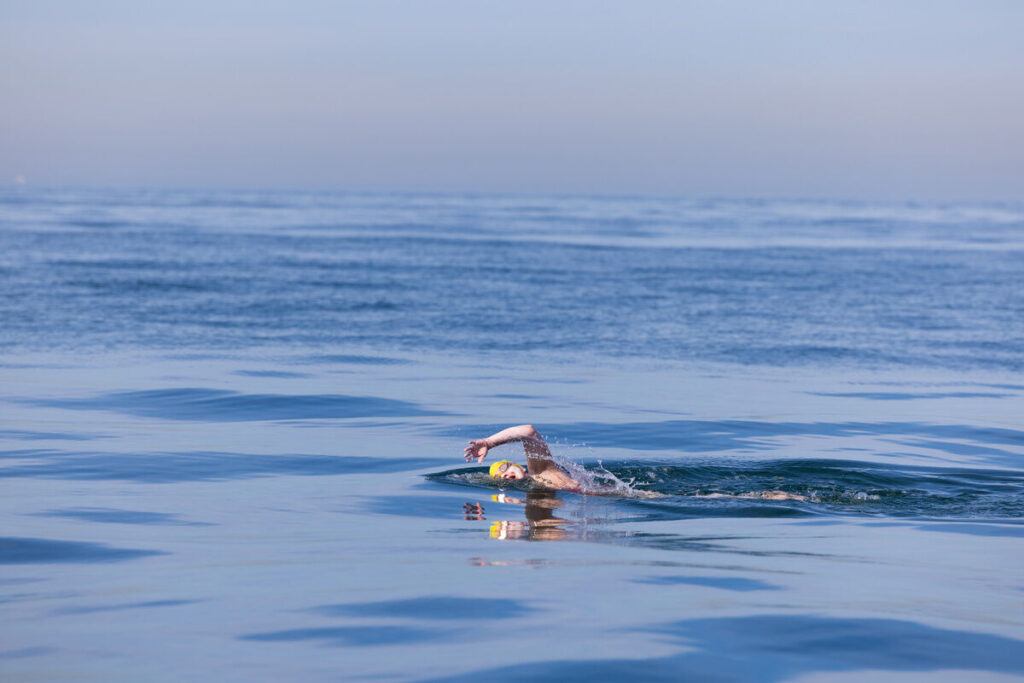
Abbey Jackson Ferree, from Petersburg now living in Fairbanks, swam solo across the English Channel on June 21, crossing from England to France – around 40 miles in 14 hours and 23 minutes.
The swim is Ferree’s second leg of the Triple Crown of Open Water Swimming, following her completion last August of the 28.5-mile 20 Bridges Swim around Manhattan Island. A third event – the Catalina Channel, off Southern California, which she has a window to attempt in September – would complete the set, a feat that few swimmers worldwide have ever managed.
These endurance swims are all the more remarkable for a athlete who, around three years ago, could barely walk after being hospitalized for months with a grave illness that her doctors were not sure she could survive. Ferree, a former Petersburg Viking Swim Club competitor who walked away from the sport in her twenties, has said that surviving that 2023 health crisis is part of what led her back to the water and, ultimately, to this crossing of the English Channel.
And now, 100 years after the first woman ever crossed the Channel, Gertrude “Trudy” Ederle in 1926, Ferree continues to swim her own way into history.
Her crossing began at a beach near Dover, England in darkness near 3 a.m. on June 21 and finished over 14 hours later on the French coast at Cap Gris-Nez.
Leaving nothing to chance
Growing her strength and preparing for this swim has propelled her life for three years and dominated almost every day of the last nine months.
“After three years of just obsessing about it,” she said, “you think you’re going to show up just ready, or more knowledgeable, or something magic. And I showed up and I was like, man, this just feels like every other day – but I have to pull out this incredibly epic swim.”
Her training built methodically. She would wake at 4 or 5 a.m. to swim before starting work at 8, spent lunch breaks on running, strength work, and a rotating schedule of physical therapy, chiropractic, massage and acupuncture to manage the lopsided muscles that come from breathing on one side. She built her mileage in four-week cycles, each month ramping toward a bigger week, until a peak around Mother’s Day when she logged roughly 80,000 yards in seven days and completed a 10-hour swim. All told, she estimates she swam more than 1.1 million yards – over 625 miles – since July of last year.
“I was leaving nothing to chance,” she said.
Channel-specific work meant stacking hard efforts to learn what her body did when it was already tired – back-to-back six-hour swims at the end of April, big swims followed the next day by medium ones. She even added a nighttime ballet class to her schedule through the dark Fairbanks winter because, she said, it forced her brain to work in new ways.
Most of her cold-water conditioning came in Alaska – cold plunges and cold showers at first, then big weekend swims in Fairbanks-area lakes once they thawed, plus sessions back home in Petersburg in roughly 55-degree water. By the time she reached the Channel the cold was a known quantity. However, this year the Channel ran unusually warm. “Anything above 60 degrees is a pretty toasty swim after you’ve done something like Cork Distance Week,” a cold-water training camp she completed last year.
A rehearsal in the dark
Four weeks before the Channel, Ferree did something she had never done before: a big swim in the dark. On Memorial Day, she flew to Connecticut at the urging of her crewmate and mentor, accomplished open-water swimmer Liz Fry – whom Ferree had met at Cork Distance Week in Ireland. She got into a cold saltwater cove at dusk with Liz and Liz’s friend Chris kayaking alongside. It was a deliberate rehearsal, so that the Channel wouldn’t be her first ever night swim.
It was valuable mental preparation. The water was about 56 degrees and falling, and as it turned black she felt bursts of water tugging at her from below. “My brain thought: was that something big swimming under me?” she wrote in an account of the swim. It turned out to be the wash from the kayak paddles. She cycled through every worry – her sore shoulder, whether it would recover in time, the mile of dark water, “what was that shadow?” She caught herself “wishing I didn’t have a degree in fisheries biology.”
When Ferree stopped to clear her goggles, tense and fighting the dark water, Liz urged her to look up. “Abbey, look at the sky,” she said. “Not everyone gets to do this.” By the time they turned for the beach, Ferree was picking out constellations between breaths. “I went in feeling like a weenie and got out feeling strong,” she wrote – the same shift she would need a month later, when the dark, the cold and the doubt all came back in the Channel.
The first 10 hours
She arrived at the boat in England on no sleep, still partly on Alaska time, running on adrenaline. Fry assured her that was normal.
“I told her, ‘I’m not ready for a big swim,’” Ferree recalled. “And she said, ‘Congratulations – everybody feels like this before their big swim. You never go into swims like this fully rested. Once you get in the water, everything’s okay.’”
Ferree started in the dark, near 3 a.m. The pilot boat a few hundred yards offshore guiding her with a faint spotlight; she raised her hands and set off at the blast of a horn, the white cliffs of Dover behind her. She spent the first two hours alone in the dark before the sun came up.
And for about 10 hours, conditions were pretty good. The hardest part early on was the boat’s exhaust, which hung over the water in the soft wind; at one point to avoid the fumes she swam some 25 yards off the support boat, watching ferries and barges “the size of buildings” pass nearby. Jellyfish – lion’s mane, compass, moon and a couple she couldn’t identify – were a near-constant presence. The stings, she found, weren’t as bad as the stories she heard growing up had led her to fear. She tried to turn the unavoidable stings into a game, treating each one as a bit of good luck. In her written account she called them “spicy kisses.”
One particular jelly tested her patience. Eric, who was texting updates to a WhatsApp group following the swim, had coincidentally just fielded a question from the group – any jellyfish yet? – when he looked up to find Ferree stopped dead mid-stroke, both fists clenched over her head. “You could tell they were just fists of anger,” he said. She clawed a big lion’s mane off her face with both hands, took the next couple of strokes “real mad,” and settled back into her rhythm. Ferree wrote that she “threw a silent fit” underwater and flung the thing behind her but is glad that Eric got a good laugh out of the deal.
Throughout the swim, she relied on small mental tricks to keep the negativity spirals away. When her mind started to slip, she counted her breaths to her lucky number, 105, then let herself look up to see where she was.
Sometimes Liz communicated that she wanted her to pick up the pace by making a circular motion with her hand.
“‘Do the thing,’” Ferree said, describing a fast-then-easy stroke pattern Liz had taught her. “And then I guess I picked up my pace enough, and it made the pilots happy.”
A good crossing, she is quick to say, is partly just luck. “Everybody has a great first part of the English Channel, unless you’re really unfortunate,” she said. “The weather window is truly luck. Your pilots do the best they can, but when you schedule, there’s no way of predicting what the weather will be.”
The last four hours
During the final four hours the wind came up – gusting 20 to 25 knots, by her husband Eric Ferree’s account from the boat – and it opposed the tide and current. “You get wind-driven chop, and then that opposes the current, and it turns it into a washing machine,” Eric said. Ferree swam the final stretch through three and four-foot slop.
Like she had during the difficult Hudson River swim last year, Ferree tried at first to make a game of the choppy waves – timing the catch and the breath to the waves, “trying to still look like a graceful swimmer.” Before long, it stops being fun. Ferree said the 20 Bridges swim, where she’d fought four brutal hours of crosswind chop on the Hudson, was what mentally got her through these windy hours on the Channel.
There was pain to manage, too. Her elbow -diagnosed, after 20 Bridges, as tennis elbow – flared so badly around hour 11 that she briefly feared it would end the swim. She took her scheduled painkiller early and swam straight-armed until it kicked in. The salt swelled her nose completely shut. Mid-Channel, with cold but still-dexterous hands, she pulled out her nose ring, tossed it carefully to Liz without touching the boat, and switched to a nose plug for the first time in her life.
Turns out she loved the nose plug. Before then, “I had just refused to look like that much of a nerd,” she said. “But oh my god, it was a game changer.”
From the boat, Eric worried about the waves and found her missed breaths hard to watch. “She’d turn her head to take a breath and she was completely underwater, and there’s just nothing you can do about it,” he said. “You’re just hoping the next one’s better.” His worry, he said, wasn’t that she would drown – there was too much support on the boat for that – but that any one wave could be the thing that ended the swim. “Every wave was a bit of a challenge to her entire swim.”
A swimmer friend kept texting Eric the same line on the way across: your Channel swim doesn’t start until you’re two miles from France. “He was right,” Eric said. “That’s what separates you from finishing or not.”
By then Ferree had passed her own ceiling and kept going. “All it takes is one bad leg cramp and your whole body can seize,” she said. But she had decided the only way she would come out of the water was if the crew pulled her – “because I was going to die, not because I wanted to quit.” A favorable shift in the tide finally helped push her toward the finish, but only after what Eric estimated was an hour and a half of absolute, all-out effort.
“There’s definitely a cruising speed you can do all day,” Ferree said. “But the thing about the Channel is that the weather’s so unpredictable, the currents are unpredictable – you have to be ready to sprint. If you’d told me at the beginning that I’d hold a really solid threshold pace for the first hours and then finish by sprinting for four hours, I would have told you there’s no way.”
The finish
The final stretch gave her one more unforgettable jellyfish kiss. In the final strokes, with Eric and Liz cheering her in and the dinghy rowing ahead, a small lion’s mane wrapped a tentacle around her nose plug and would not let go, slapping her across the lips. “I cannot finish with this jellyfish on my face,” she remembers thinking. She stopped, ripped off the nose plug and the jellyfish together, and looked up to Eric and Liz waving her on – “What are you doing? Keep swimming!” She put the plug back on, took a few strokes, and the same jellyfish lodged in her armpit and rode along until she gave up trying to shake it.
She pushed through those final 500 yards and arrived at a beach of algae-covered rocks, not quite the dreamy pebble beach she had imagined when visualizing the finish during training.
She dove down to gather pebbles and stuffed them into her suit, a keepsake for the family sauna at Fielding Lake back home – a rock-collecting tradition started by her husband’s late Uncle John.
Then “I just started ugly crying, like, so bad,” she said. She picked a big rock to climb out on, “this little mermaid rock,” tried to stand, and nearly went down.
“You should not try to stand up on a slippery rock after swimming for that long,” she said. “I almost fell – and luckily Eric did not see it, because I thought I’d never live it down.”
She sat, raised her arms, and the swim was over. One of the boat captains, Harry, rowed the dinghy to her, and rather than haul her exhausted body into the dinghy, he towed her back to the boat; she flipped onto her back to take in the French cliffs and the seabirds on the way.
Eric briefly lost track of her. Busy clearing the deck for her return – gathering dry clothes, a towel, hot water – he looked up as the dinghy came back and didn’t see her in it. “Where’s my wife? You left her in France?” he remembered thinking, until he spotted “eight little white fingers hanging on to the transom,” where she was being towed alongside. “I was like, oh, thank God.” When the dinghy reached the boat, after more than 14 hours in the water, she climbed the boat’s ladder under her own power. “I was pretty happy that she was able to climb a ladder,” Eric said. Ferree herself was surprised she could manage it. Once she was aboard and in dry clothes, Eric added, she seemed barely affected by what she’d just done. “I was pretty impressed.”
On the boat, “when I saw [Liz] smiling for me,” Ferree said, “that was better than [finishing] the English Channel.”
“I felt like I hadn’t been fully happy for nine months,” she said. “I just remember getting on that boat, and it was just sweet relief.”
On the boat Ferree talked nonstop for half an hour – pretty reasonable after 14 hours of barely speaking a word. The crew video-called Ferree’s mother, Pat Johnston, at home in Petersburg, to prove she was safe and sound on the boat. Then Abbey slept for two and a half hours all through the wet, bumpy ride back to England.
Her crew
It was a forty-mile solo swim, but Ferree is emphatic that she didn’t do it alone. Her husband, Eric, handled her feeding and “knew the inner workings of my mind better than most.” Liz Fry, the mentor who had also served as her crew during Manhattan, was for Ferree the calm, experienced presence that she can totally trust. The boat, the Masterpiece, was piloted by Fred and Harry Mardle, fifth- and sixth-generation local fishermen.
“As soon as I found out [that they were commercial fishermen], I was like, yeah – these are the guys to take me across the Channel,” she said.
Up next
Ferree has a September window for the Catalina Channel – Sept. 10 and 11 – a roughly 20-mile crossing she’ll begin around 10 p.m. as a night swim from Catalina Island to the Southern California mainland near Long Beach. Finishing it would complete her Open Water Triple Crown.
It would also make a small piece of Alaska history. By records kept by the Marathon Swimmers Federation, only two Alaskans have ever completed the Triple Crown: William Schulz of Ketchikan, the first, who finished in 2018, and Anchorage’s Jordan Iverson, who in 2024 became the first Alaska woman to do it. Should Ferree complete Catalina in September, she would become the third Alaskan to ever earn the distinction. It was Iverson who alerted Ferree to the unexpected 20 Bridges opportunity last year that started this own Triple Crown bid.
Her plan between now and then is mostly maintenance: keep the fitness she built, add a little more running to help with the late-swim sprinting, and get in some saltwater time, possibly back in Petersburg or in California, before the swim.
Then “hopefully,” she said, “my Triple Crown.”
A worthy cause
Ferree paired her Channel crossing with a fundraiser she calls “An English Channel Swim for AS Awareness,” for ankylosing spondylitis, an inflammatory autoimmune disease her sister lives with. The idea took shape, she said, after a training swim at Crane Lake near Petersburg where her sister – neck and hips fused, sore everywhere – hiked to the lake on her own to watch.
“In my brain it was a bigger deal that my sister hiked to that lake by herself,” Ferree said. “That was a way bigger win than me being able to endure 55-degree water.”
The contrast stayed with her. “A lot of my swim was chosen suffering,” she wrote in an email to the Pilot. “I chose the cold water, the long training days, the discomfort, the nerves, and the uncertainty. But people living with chronic illness do not get to choose when their pain shows up or how long they have to keep going. They just have to keep going anyway.”
Money raised goes to the Spondylitis Association of America, which funds research, physician education, advocacy and support programs for people with the disease. Ferree set a goal of $5,000, but said awareness matters more to her than the total. “Even one more person understanding what AS is means something to me,” she wrote.
The fundraiser – and the story behind it – is at spondylitis.org/an-english-channel-swim-for-as-awareness, and a link is also posted on Ferree’s Facebook page.
Reflecting on the swim
A few days after her crossing, Ferree shared her final thoughts on the swim by email with the Petersburg Pilot, and she offered this advice:
“If anyone walks away with anything from my swims, I hope it is this … We are capable of more than we think. Maybe not all at once. Maybe not in the way we imagined. Maybe not without pain, comparison, doubt, fear, or the parts of ourselves we wish were prettier … But keep going … Focus on what you can … Do not marinate in the rest.”
The post Petersburg woman swims the English Channel appeared first on Chilkat Valley News.