Alma reports that more Americans are facing anticipatory anxiety due to political instability, AI, misinformation, and environmental stressors like wildfires.









Alma reports that more Americans are facing anticipatory anxiety due to political instability, AI, misinformation, and environmental stressors like wildfires.

Pie is America’s original love letter, the dessert people finished when a hug felt too small, and a card felt too easy. Across generations, it … Read moreThe post Long before Tinder, pie was how Americans proved their love appeared…


























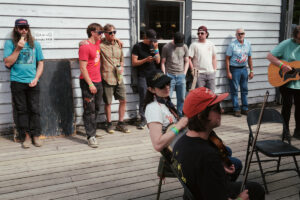






The post Scenes from the 2026 Southeast Alaska State Fair appeared first on Chilkat Valley News.

A couple discovered explosives while they were hiking on the Klehini River flats last week, and subsequent bomb disposal triggered a false report of a potential plane crash.
Derek Poinsette found the explosive device and said it appeared to be trash when he picked it up.
“It wasn’t until we got home and unwrapped layers of electrical tape and looked at it more closely that it appeared to be possibly some sort of bomb,” he wrote in a text message.
State park ranger Jacques Turcotte said Wednesday that what was found appeared to be a crudely made explosive device.
“Not just [detonation] cord, rigged like an actual explosive,” he said.
Poinsette said he called Haines police chief Jimmy Yoakum, who, in turn, contacted the Juneau Police Department’s bomb squad. That initial call was reported on July 19.
Yoakum said a bomb technician from Juneau and one from the FBI came to town to investigate. A state parks employee drove the two out to Poinsette’s house in the upper valley to retrieve it on July 22.
“They did all of their pictures or whatever it is they do and then coordinated with [the Department of Transportation] to [detonate it at] the sand pit at 25 Mile,” he said.
Residents got an emergency alert saying a controlled blast was scheduled at noon that day.
Around that time, someone saw a white de Havilland Beaver flying low over the upper valley. The individual heard the plane making an odd noise and, after it disappeared over the horizon, they heard an explosion. They reported a potential crash, touching off a response that involved both Chilkat Valley fire departments, Alaska State Troopers, State Parks and Klukwan’s village public safety officer.
That call came in about 1:30 p.m., and five people from the Klehini Valley Volunteer Fire Department responded, department chief Richard Gunnick said.
The crew first went to a private upper valley airstrip and talked to the person who reported the potential crash. They then headed toward Flower Mountain looking for smoke or signs of a plane crash.
Dallas Anderson, a volunteer firefighter who also works for Constantine, asked the company for help. Soon Coastal Helicopters aircraft was involved in the search as well.
“They had a helicopter in the air within 10 or 15 minutes,” Gunnick said. “That’s really what we needed.”
Haines fire and ambulance crews drove the nearly 25 miles to the Klehini River bridge and highway junction, where emergency equipment was staged. Meanwhile, Haines dispatchers contacted the FAA to see whether there were any missing planes or transponder alerts.
“We weren’t sure what was going on,” fire chief Zak Overmyer said. “The information from the caller sounded credible.”
Eventually, someone spotted the same plane still in the air, and the search was called off.
Overmyer called the whole incident an unfortunate timing of events, but said he was happy the person didn’t discount it and called it in, particularly because it served as good crash-response training for emergency responders.
Gunnick said he had considered that the report was related to the day’s earlier controlled detonation.
“Had it in the back of my head that it might be related to that,” he said. “We still had to go out and make sure.”
Yoakum said the local police department does not handle many calls about explosives.
“This is the second time since I’ve been here,” he said. “The first was just some seal bombs that family of a deceased [person] had from his fishing days. The family found them while they were cleaning out stuff and didn’t want to touch them.”
It’s not clear how the explosives came to be in the preserve.
State Parks posted on social media post asking people to be on alert given that there have been other reports of explosions in the preserve this year. Multiple law enforcement agencies cautioned against handling or moving any device suspected of being an explosive.
At least one component of the bundle Poinsette found was detonation cord, which is a type of flexible tube filled with explosive powder. It’s commonly used to synchronize explosive charges for things like drilling, demolition or mining.
It’s highly regulated; possession requires a federal license.
In Alaska, the state regulates when and how it can be used, how it must be stored or transported and, when it’s lost or stolen, operators are supposed to report that to the local and federal authorities within 24 hours or face up to $1,000 in fines and a year in prison.
Juneau police department deputy chief Krag Campbell said via text Wednesday that all of the explosives were believed to be commercial-grade but “might have been put together by someone who wasn’t very knowledgeable about explosives.”
But, he said, it’s still early in the investigation and any identification or “determination of its intended use,” is presumption at this point.
It’s not clear which, if any, law enforcement agency is investigating the situation. Turcotte said State Parks was not investigating. Alaska State Troopers spokesperson Austin McDaniel said his agency was not investigating either. Juneau Police’s Campbell said he did not believe his agency would have the jurisdiction to investigate. The FBI did not respond to multiple requests for more information about its involvement and whether the agency was investigating.
When Yoakum was first interviewed Tuesday, he said the Haines police department was not investigating the incident and that he was told that what had been found was a bundle of detonation cord.
After he heard it may have been a bomb, Yoakum said he reached out to several people, but by Wednesday afternoon, he said he still had not heard any new information.
He said if one of the other agencies tells him what was actually found, and if it merits investigation, his first call will be to the Alaska State Troopers. He maintained that the borough does not have the resources to conduct that kind of investigation.
Since at least 2017, there has been dispute over how far the Haines borough police’s jurisdiction extends and it has yet to be fully resolved. Borough assembly members and leadership have, at various times, maintained that Alaska State Troopers should be responding to borough-wide calls outside of Haines. They’ve also considered borough-wide police protection.
Yoakum said Wednesday that as “this all occurred outside of the townsite, the police department doesn’t have anything to do with it.”
The post Discovery of explosives on Klehini flats triggers controlled response, plane crash scare appeared first on Chilkat Valley News.

NOTN- Police have identified the body found inside of a chest freezer at Switzer Village Mobile Home Park earlier this month, an investigation into the circumstances of his death remains ongoing.
Below is the full updated press release by JPD.
The State of Alaska Medical Examiner has confirmed the identity of the remains found to be those of Ross Pasquan. His next of kin have been notified. Juneau Police Department detectives continue to investigate the timeline and circumstances surrounding his death and the possibility that the death was concealed for financial gain or other motives.
Original Press Release:
On Sunday, July 19, 2026, at approximately 7:59 p.m., the Juneau Police Department responded to a residence in the 6500 block of Glacier Highway following a report of possible human remains discovered on the property.
The reporting party advised officers they had been cleaning out the residence following the death of a family member when they located what appeared to be human remains inside a chest freezer in a locked outbuilding on the property.
Officers responded and confirmed the presence of deceased human remains. A preliminary identification has been made, and investigators believe the remains may be those of an adult male family member. Next of kin has been notified. Positive identification is pending confirmation by the State Medical Examiner’s Office.
The length of time the remains have been in the freezer is unknown. Investigators have determined that no missing person’s report related to the deceased was ever filed with the Juneau Police Department.
The remains have been transported to the State Medical Examiner’s Office, where an autopsy will be conducted to confirm the identity of the deceased and determine the cause and manner of death.
At this stage of the investigation, there is no known threat to the public. The investigation remains active and ongoing.
Anyone with information that may assist investigators is encouraged to contact the Juneau Police Department at (907) 586-0600. Those wishing to remain anonymous may submit tips through Juneau Crime Line at www.juneaucrimeline.com.

Chilkat Valley Community Foundation held another “People’s Choice Award “ at the Fair last weekend, and 158 people cast a vote for their favorite local nonprofit. Thank you to all these loyal supporters! By random selection, two nonprofits were each awarded a $250 CVCF grant: Four Winds Resource Center and Haines Animal Rescue Kennel. Thank you Chilkat Valley!
Cynthia Allen, for the CVCF Board
The post HARK, Four Winds Resource Center get “People’s Choice Award” appeared first on Chilkat Valley News.
The Alaska voting system dilutes party and billionaire control and elevates the importance of running for office and voting in every election. That’s great! Today in Juneau, bipartisan “majority caucuses” lead the Alaska Senate and House of Representatives. Republicans, democrats, and independents—caucusing together—are getting Alaska’s business done. The minority caucuses? Both are entirely Trump republicans and exactly where they belong.
Ballot Measure 2 is sort of like Trump’s SAVE-Act, only Alaska style. It would dismantle Alaska’s home-grown electoral innovation, one that constrains power-politics, parties, and billionaire backers. Maybe that’s why Senator Sullivan calls it “rigged.” In November, I will vote No on ballot measure 2.
Besides the “ranked-choice” general election provision, the Alaska system has other important features: 1) every candidate gets into our one orderly primary election—no members-only caucus, XYZ party primary, “super-delegates”, or the proverbial “smoke-filled rooms;” 2) No “Dark Money.” Alaska requires prompt disclosure for campaign donations over $2000 and if funds are Alaskan, or originate from out-of-state. Trumpian spin-doctors now describe the Alaska system as “inherently corrupt” — a blatant falsity.
The primary election is August 18th and a lot of names are on the ballot. Seventeen vie to be Governor, sixteen for U.S. Senate. More—not fewer—candidates are better for Alaska and America. Alaska’s system is neither “rigged” nor “inherently corrupt”. Please check out the primary ballot and plan to vote. You’ll also find Ballot Measure 1, which defines rational limits for campaign donations.
Burl Sheldon
The post Alaska Voting System, a Winner appeared first on Chilkat Valley News.

The gate to the John M. Asplund Wastewater Treatment Facility is seen on July 29, 2026. The plant serves most o the residents of Alaska’s largest city. Wastewater samples taken in early and mid-July revealed genetic material from measles. (Photo by Yereth Rosen/Alaska Beacon)
At least one person in Anchorage had measles in early and mid-July, creating a risk that the highly infectious disease could spread through the state’s largest city, state health officials are warning.
The proof is in the sewage.
Samples taken from Anchorage’s John M. Asplund Wastewater Treatment Facility revealed genetic material from the strain of measles that has caused outbreaks in the Lower 48.
It means someone carrying the virus was in the part of Anchorage served by the state’s biggest wastewater treatment plant, said Dr. Joe McLaughlin, Alaska’s state epidemiologist.
“It doesn’t tell us where exactly they were in the sewershed, and it also doesn’t tell us if there was any human-to-human transmission that’s occurring,” he said.
But it does provide an early warning to health providers and the general public, McLaughlin said.
“It’s important for people to take a look and see if they’ve been vaccinated, or if their children have been vaccinated,” he said. If children have not been vaccinated, “go ahead and get them vaccinated, because we know that this virus has been present in the community. And it may still be present.”
The presence of measles RNA, the virus’ single-strand genetic material, was detected in samples taken on July 7, 8, 9 and 14, health officials said. State and municipal health officials are still waiting for results from more recent wastewater testing, McLaughlin said.
Samples from the Asplund plant are usually taken every Tuesday, Wednesday and Thursday, said Clayton Weingartner, the Division of Public Health’s wastewater surveillance coordinator.
Performing the scan that detects measles genetic material is a complex process, he said. “it’s an expensive test, and it takes longer to get the results,” he said. That is why state officials are still waiting for results from last week’s sampling, he said.
For now, public health officials say, Anchorage residents and other Alaskans should be on the lookout for signs of measles.

Symptoms, which usually arrive a week or two after infection, include a high fever, a runny nose, red eyes and a skin rash. The disease can be serious and even fatal, especially for young children. There were three measles deaths in the United States last year, according to the Centers for Disease Control and Prevention.
As of Tuesday, there were no new reports of any patients with measles in Anchorage. The last Anchorage case was in October, affecting an adult who tested positive after traveling to the city from the Lower 48, according to municipal officials. There was also a child in Anchorage who was diagnosed with measles in May of 2025.
Elsewhere in the state, there were four measles cases diagnosed last year, according to health officials.
McLaughlin said there are reasons for Alaskans to be vigilant.
There are more measles cases in the United States now than at any time in the past 35 yeas, he said.
“And we’re at peak tourist season right now, so there are people coming into Alaska from the Lower 48 and from many different countries, and they’re bringing with them, some of them, different pathogens,” he said. “And one of them can be measles. And we know that measles is the most contagious virus that we’re aware of on the planet.”
Additionally, Alaskans are at elevated risk because the rate of measles vaccination is low compared to the rest of the nation.
Medical providers should be notified if there are suspected measles infections, McLaughlin said. Patients should not be in clinic waiting rooms because the virus is so contagious, he said.
Whenever a case is identified, health officials have to trace the places where that patient may have exposed others to the virus, such as daycare centers, stores and recreational sites. “All that kind of stuff takes a lot of work, and that’s just for one case,” he said.
Wastewater sampling in Alaska screens for a variety of infectious diseases, including COVID-19, different varieties of influenza and Respiratory Syncytial Virus, or RSV, as well as measles.
Numerous sites participate in the National Wastewater Surveillance System, or NWSS, that was set up by the CDC in 2020 as part of the national response to the COVID-19 pandemic. But the Asplund plant, which serves most of Anchorage’s residents, is the only one in Alaska that participates in the most advanced testing program, a privately operated system called WastewaterSCAN, Weingartner said.
“The WastewaterSCAN program has very limited testing slots,” he said.
The Alaska Department of Environmental Conservation, the University of Alaska Anchorage and the Yukon Kuskokwim Health Corp. are also testing wastewater for disease pathogens, he said. Samples are regularly collected from wastewater in Eagle River, Juneau and Bethel.

Nearly all abortions, except those to save a patient’s life, would be banned at U.S. Department of Veterans Affairs hospitals and would no longer be covered by VA medical benefits under a rule proposed by the Trump administration. The policy change comes from the Project 2025 playbook. (Getty Images)
It is a disgrace the way our congressional delegation has abandoned U.S. veterans. The Trump administration’s Big Beautiful Bill, which Murkowski, Sullivan and Begich all voted for, gave more tax breaks to billionaires and large corporations, while at the same time squeezing the middle class and the poor. Among the casualties are U.S. veterans.
In order to fund more tax breaks for the top 1%, government services to everyone else had to be cut. NPR reported that the Trump administration killed a Veterans’ Administration home loan program. Veterans are now losing their homes to foreclosure. The New York Times reported that the Veterans Affairs Department cut thousands of positions for doctors and nurses, and left vacant many unfilled positions. Furthermore, the Trump administration reversed expanded health benefits for women. The VA also pledged to end support for Housing First, the approach that was the VA’s greatest housing success. Huffington Post reported that mass firings at the VA — where many of the employees are veterans — will negatively impact its critical mission in healthcare, disability claims, services for transition to civilian life, suicide prevention and addiction treatment.
The VA cut funding for research, including a promising study using electronic medical records to improve outcomes for veterans with chronic obstructive pulmonary disease. The New York Times reported that among the cuts at the VA was a collaborative research study with Harvard Medical School into veterans’ suicide. NPR further reported that the VA is making it harder for male veterans to get care for breast cancer — a rare disease for men, but just as deadly for them as it is for women. It has been widely reported, including in the Huffington Post, that ICE has arrested for deportation legal residents who served in the military with a promise of thereby obtaining US citizenship. Apparently, we are no longer a people of our word.
The repercussions of the decimation of the staff and programs at the VA will last for years. It will not be easy for a new administration — one committed to honoring the service keeping the promises to our veterans — to undo the damage done by the Big Beautiful Bill by fully funding the agency and its programs.
While all of our congressional delegation shares the responsibility for this disgraceful bill, I think it is Sen. Dan Sullivan who is the most to blame. He runs his campaigns in part on the fact that he is a former Marine and a champion of veterans’ causes. In a Congressional hearing, he went so far as referring to them as “my veterans.” Well, he has let them down and they are now our veterans. It is up to us to inform our congressional delegation that they will soon answer to us at the polls. Candidates now running for Senate and the House of Representatives should give voters specifics of how they will revitalize the VA.
SUBSCRIBE: GET THE MORNING HEADLINES DELIVERED TO YOUR INBOX.

The Trans Alaska Pipeline System oil pipeline and the Dalton industrial haul road are seen in this undated photo. (Image by Lois Parshley)
This story was supported by and co-published with the America’s 250th Project | American Academy of Arts & Sciences.
As the U.S. war on Iran threw the world’s global energy markets into crisis this spring, Arctic Village was settling into a cold snap. The spruce trees were furled with snow, the air sharp enough to freeze the breath inside your nose. There are no roads leading out of this Gwich’in community in northern Alaska, and its fuel has to be delivered by plane. In other rural parts of the state, diesel is barged up rivers during the short summer. These logistical challenges make the war’s price spikes especially painful.
After the Strait of Hormuz closed, gas surged past $12 a gallon, says Tonya Garnett, a spokesperson for the Gwich’in Steering Committee, a group of tribal leaders. “Everything has to be flown into our community,” she explained, meaning prices shot up overnight – not only for heat and electricity, but also for basic necessities like milk and other staples.
That shock is part of a broader reckoning over Alaska’s energy future. After decades organized around fossil fuel extraction, the state is having the kind of argument societies tend to have when the foundations of an old economic order start to wobble. The men who drafted the Declaration of Independence would find the conversation familiar: They understood that who controls a territory’s resources — and who bears the costs of their extraction — is at the core of political power.
Many rural Alaskan communities are turning to renewables to save money, and to reduce their dependence on deliveries that can be cut off by weather or supply chain failures. The effort is small-scale, incremental and often creative by necessity. Meanwhile, the state and federal government continue to double down on extractive development. Republican Governor Mike Dunleavy argues that Alaska must accelerate domestic oil and gas production to stabilize both the state’s economy and broader U.S. security. On his first day back in office, Trump signed an executive order aimed at “unleashing” Alaska’s resources, reopening previously suspended leases in the Arctic National Wildlife Refuge and directing faster approval of energy and mining projects. His administration sees the state as key to expanding American oil and gas production, as it pushes for U.S. dominance in global energy markets. That language of national interest is much the same as the Crown once used to justify managing the colonies’ timber, fish and fur.
That approach centers on maximizing exports and profits. Yet Alaska spends more on energy per capita than any other state, making it vulnerable when the system that oil built begins to crack. Its communities can no longer afford the fuel they need, its utilities are running out of natural gas and its school budgets are lurching into crisis. The state brings in less revenue from oil now than it ever has, reflecting both declining production and a 2013 overhaul that lowered production taxes – which was voted in by state legislators who simultaneously worked for ConocoPhillips, Alaska’s largest oil producer.

“We are an oil state,” says Phil Wight, an environmental historian at the University of Alaska Fairbanks. But that’s no longer because the industry supplies the bulk of the state’s jobs or budget. In 2025, petroleum contributed less than 13 percent to the total state revenue. To cover basic government spending, it increasingly overdraws the Alaska Permanent Fund, a sovereign wealth fund created in 1976 to preserve oil boom revenues for future generations. “We’re trapped in that petroculture, even though that industry continues to fail to deliver,” he said.
At a time when other states and nations are rapidly diversifying their energy grids, Alaska remains caught between the oil economy that has defined it for generations, and competing visions for what comes next. “Since the early 1970s, we have defined energy independence as drilling more oil in this country,” Wight explains. Though the United States currently produces more crude oil than any other country in history, energy prices under a second Trump administration have soared, accompanied by ballooning inflation and record-high household debt. One of Alaska’s largest utilities, Golden Valley Electric Association, where Wight was just elected to the Board of Directors, just hiked its rates by 60 percent. Speaking as a history professor, Wight asked, “Is this what independence is? Because it doesn’t feel like it.”
The question of who Alaska’s resources are meant to serve stretches back to the first lines drawn across the Arctic by officials in Washington, D.C. When the United States purchased Alaska from Russia in 1867, little was known about its vast petroleum reserves. “We were sold from a country that took over us without our involvement, and sold to another country without our involvement,” says Garnett. The Declaration of Independence, written nearly a century earlier, did not extend its principles to everyone living on the land it claimed, calling the country’s original inhabitants “merciless Indian Savages.”

By the 1920s, as the U.S. Navy converted its fleet from coal to oil, President Warren Harding proclaimed a new petroleum reserve across the Arctic coastal plain. Based on its geological features, naval officials suspected it would contain strategic fuels, and called dibs in the name of national security. “Without asking us, for it was our land, our federal government took from us 23,400,000 acres of land, an area roughly the size of the State of Indiana,” Alaska Native leader Eben Hopson later recalled. “Government was often very painful.”
From a young age, Hopson recognized that decisions in Washington were reshaping his home in ways that would outlast the people who made them. At the time, Alaska was still a U.S. territory. Even many white residents came to see the arrangement as colonial, arguing that decisions about Alaska should be made by the people who lived there. During the 1955 Alaska Constitutional Convention, delegate Ernest Gruening said, “Our charters of liberty — the Declaration of Independence and the Constitution — embody America’s opposition to colonialism and to colonialism’s inevitable abuses.”
In 1959, Alaska became a state, with the assurance that it would give residents greater control over their resources. The new state was granted the selection of more than 100 million acres of land. As it moved to do so, Alaska Native communities objected that many of these places overlapped with areas they had long called home. They were ignored.
Less than a decade later, explorers struck oil on the North Slope. Hopson was one of the Alaska Native leaders who used the urgency of the oil rush to demand greater recognition of Indigenous rights. After the federal government imposed a land freeze until the growing dispute could be resolved, they won the Alaska Native Claims Settlement Act of 1971. In lieu of reservations, it established 12 regional for-profit corporations to manage roughly 44 million acres granted along with subsurface oil and gas rights, and nearly a billion dollars in cash. The idea was that Alaska Native people would be shareholders in their own land — becoming participants in the economy that had been extracting value from their home for decades.
Whether it worked depends on who you ask. Nauri Simmonds, executive director of Sovereign Iñupiat for a Living Arctic, says the corporations have come to be treated as the voice of their communities, when they are actually financial institutions. That conflation has created a replica of the inequity it was supposed to correct, “the haves and the have-nots,” she says. Though tribal shareholders have a seat at the table, Simmonds argues the furniture was still built for someone else’s purposes.
The Arctic Slope Regional Corporation has grown into the largest locally owned and operated business in Alaska. It supports oil development on the North Slope, including the Willow project, an $8 billion project environmental advocates call a “carbon bomb.” Simmonds, whose family is from Nuiqsut, a community in the middle of some of the Slope’s most prolific oil fields, has seen the costs of that development up close. Respiratory illnesses soared as wells crept closer to town. Lifelong hunters now struggle with subsistence in ways they never did before, as migration patterns shift and other disruptions transform the landscape.
During the Willow project negotiations, Simmonds says, residents negotiated a deal to protect about one million acres around Teshekpuk Lake, one of the Arctic’s most important wetland ecosystems. The agreement limited oil and gas development in the area, preserving a right-of-way for subsistence use and putting conservation decisions in local hands. In December of 2025, the Interior Department suddenly cancelled it. “They said, just kidding, you know, adding to the long list of broken promises,” Simmonds says.
Nuiqsuit Trilateral Inc, a nonprofit formed by the tribal government, city government, and the village’s Alaska Native corporation, filed a lawsuit in federal court. “Our community has always worked in good faith with the State, the federal government, and industry,” said Roxanna Oyagak, the group’s secretary, in a press release. “But we are insisting that the federal government honor the commitments it made.” In March 2026, a judge temporarily restored the agreement.

For Simmonds, the debacle clarified the conviction that real energy sovereignty would not be handed over in a federal leasing agreement or negotiated across a conference table. It would have to be literally generated at home. Across Alaska, some communities have already begun pursuing that vision through renewable energy projects. “What Alaskans need is solutions that are going to be fast and that are going to be efficient,” says Jennifer Hyde, federal engagement coordinator for The Alaska Center, a non-profit focused on environmental and civic issues. “Alaska just has so much to offer in terms of free, unlimited renewable potential.”
The group has helped amplify information about clean energy and resilience projects around the state. One of those is in Yakutat, a small coastal community in the state’s southeast, where rising diesel prices were straining budgets. The town’s school and public safety buildings’ aging heating system was expensive to operate and increasingly unreliable. It was replaced with a modern heat recovery system, which captures waste heat from the town’s power plant. It also routed heat to the town’s health clinic, one of the biggest energy users. In its first year, the new system saved Yakutat $270,000 in avoided fuel costs, says Katya Karankevich, senior project manager at the Alaska Native Tribal Health Consortium, who supported the project.
In the meantime, the Trump administration is supporting new lease sales in the Arctic National Wildlife Refuge, an area that has been at the center of years of political and legal battles. In June, the federal government auctioned oil and gas rights in the calving grounds of the Porcupine caribou herd, sacred land for the Gwich’in. It’s the first of four sales mandated under the One Big Beautiful Bill Act. The sales are expected to generate as little as $3 million in federal revenue — a fraction of the $200 million the state has already committed to support exploration and development in the refuge. No major oil companies bid, but the state’s own development corporation did. This lopsided investment underscores how much public money has been committed to fossil fuel projects the market has failed to embrace.
“It’s heartbreaking because these areas, each of them are so special in their own way,” says Simmonds, her voice wavering. The land has fed her community for longer than anyone can remember. “It feels like each time there’s a new project, the area that you feel like you can depend on or defend, it just shrinks and shrinks and shrinks.”
With the state’s backing and the federal government’s enthusiasm for new leases, Alaska’s next wave of extraction is taking shape. ConocoPhillips has already broken ground on the Willow project. Santos, another major oil company, is pushing forward with the Pikka project, another oil reservoir that is expected to produce enough crude to generate 12.6 million tons of carbon dioxide a year. Last fall, Trump also signed an executive order approving Ambler road, a proposed 211-mile industrial access corridor. The Tanana Chiefs Conference condemns it as “a fundamental threat to our people,” including condemning its disruption of faltering caribou migrations. The order simultaneously gave the federal government a 10% stake in Trilogy Metals, the company planning to mine the area. “This machine,” Simmonds says, “will never be satiated.”

“Beautiful Alaska, we love Alaska,” Trump said in his 2025 state of the union speech, before boasting about once again renaming Denali, the state’s highest peak, for President William McKinley. Back in April 2024, Trump had hosted over a dozen oil executives from companies like Chevron and ExxonMobil at Mar-a-Lago, where he reportedly told them they should raise $1 billion for his campaign, a “deal,” he said, compared to the taxes and red tape they would avoid if he won. In other words, the federal agenda now shaping Alaska’s future is being written in rooms as far away from the North Slope as Britain was from the American colonies.
The ideals behind the country’s founding—of natural rights, and people’s ability to govern the land they live on—have always been easier to proclaim than to practice. The history of Alaska, like that of much of the country, is of people still fighting to secure freedoms that were celebrated long before they were shared.
After Trump took office, Dunleavy said, “it’s like Christmas every day now.” As governor, he has long advocated for the Alaska LNG project, an 800-mile pipeline and export terminal that would be one of the largest infrastructure projects in the state’s history. In 2025, the state handed the private energy firm Glenfarne Group a 75 percent stake in the project, in a deal whose details have been kept even from Alaska’s own legislature.
Though independent analysts say it’s not economically viable, the LNG project is still being buoyed by up to $31 billion in federal loans and another $7.1 billion in federal tax credits. Meanwhile, the federal government has canceled more than hundreds of millions in support for renewable energy projects in the state, stalling or canceling dozens of critically needed updates.
At an Anchorage “Sustainable Energy Conference” in May, sponsored by Glenfarne, Interior Secretary Doug Burgum dismissed climate concerns. Outside the ballroom, Alaska has been warming far faster than the global average, which is reshaping its fisheries, prompting bird dieoffs, and “rusting” its rivers. Those changes mean that anyone who lives off the land has a harder time providing for their families. Local governments face bigger bills for sewer repairs, road maintenance, and other everyday infrastructure, as thawing permafrost heaves highways and breaks waterlines. “Energy independence is probably the number one way rural Alaska — and rural America — can weather all of these impacts,” Karankevich says.
The United States’ founding document declares the purpose of government is to secure the “Safety and Happiness” of the people – including, in practice, something as basic as being able to turn on the heat or the lights. In Alaska, that promise is decided in the grid. Renewable projects aren’t just about climate, they’re about not gambling on fuel arriving late, running out, or simply costing too much.
That is not the energy independence being sold by the officials in Juneau or Washington right now. Phil Wight, the historian, puts it more plainly. “The political project in Alaska statehood was all about keeping enough resources in the state to actually sustain local peoples,” he said. “Increasingly it seems that we are failing to do that.”
SUBSCRIBE: GET THE MORNING HEADLINES DELIVERED TO YOUR INBOX.