Categories
Alaska News

Alaska prepares to get rid of historic ferry Matanuska, one of state’s oldest

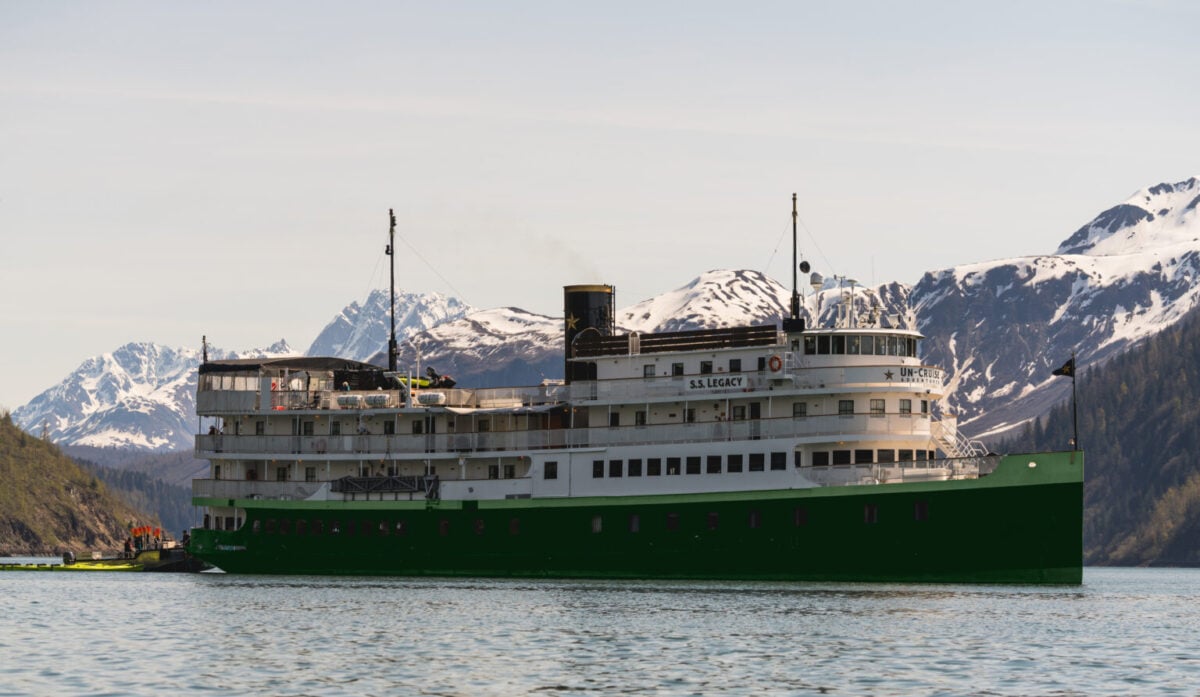
The state of Alaska is looking for someone to take the Matanuska, one of the first three ships built as part of the Alaska Marine Highway System after statehood.

In a public notice published Friday afternoon, the Alaska Department of Transportation and Public Facilities said it is now looking for “interested parties regarding the opportunities to dispose of the vessel in a manner that honors its historic significance while allowing it to continue serving Alaska in new innovative ways.” 

DOT is primarily looking for people or groups interested in operating the Matanuska “as a museum vessel, maritime training ship, tourism or hospitality venue, community facility, research platform, heritage site, or other maritime or public-serving use,” according to a detailed document accompanying the public notice.

Any applicant would have to demonstrate that they have the financial resources necessary to take care of the ship.

Retired ferries are notoriously expensive to operate, and idealistic plans for other ships have repeatedly fallen apart. The former Washington state ferry Kalakala was turned into a cannery in Kodiak, recovered and towed back to Washington, but fell derelict and almost sank into a canal before being scrapped in 2015.

The Alaska ferry Taku was intended for use as a hotel after its retirement, but it ultimately ended up being scrapped in India

The ferry Malaspina was retired by the Alaska Marine Highway System in 2022 and is now being used as housing at a cruise ship terminal in Ketchikan. The business partners behind that effort are now fighting in court over a variety of issues.

Built in 1963, the Matanuska served as an active ferry for almost 60 years and still has a gold-painted funnel indicating its status as the “Queen of the Fleet,” the oldest operating ship in state service.

Despite that honor, the Matanuska has been out of regular service for at least three years, and has been laid up in Ketchikan for use as a “hotel ship” by the ferry system. Last year, DOT officials said the ferry system lacked the money needed to return the ship to service, and they recommended fully retiring it.

Proposals for the Matanuska’s future are due to DOT by 2 p.m. April 14. 

“Letters of interest proposing scrapping, dismantling, or scuttling the vessel may be submitted for informational purposes,” the agency said, but for the time being, it’s looking at ideas to reuse the ship.

The post Alaska prepares to get rid of historic ferry Matanuska, one of state’s oldest appeared first on Chilkat Valley News.
Categories
Alaska News

Juneau officially has its snowiest winter on record

Darius Heumann, 6, right, and Alden Reed, 6, play in the snow in downtown Juneau, which is decorated for a celebration of the Hindu festival Holi, on the evening of Monday, March 23, 2026. The city officially set a new winter snowfall record during the evening as the total accumulation at Juneau International Airport since Oct. 1 as of 11:59 p.m. Monday reached 201.2 inches. (Courtesy/Mark Sabbatini, Juneau Independent)

This time there’s no doubt and Mother Nature provided a last-minute surge of snow just to be sure.

Juneau officially set the all-time record for winter snowfall on Monday, with a record 5.4 inches at the airport as of 11:59 p.m., putting the total since Oct. 1 at 201.2 inches, according to the National Weather Service Juneau. The city began the day 2.1 inches short of the record — to the surprise of many, including weather officials who on Sunday raised the previous record to 197.9 inches after discovering 7.5 inches of “missing” snowfall from 2006-2007 data.

About an inch fell at Juneau International Airport by early afternoon Monday, at which point NWS Juneau issued a “special weather statement” calling for one to three inches of snow the rest of the day.

What happened was indeed special.

“Basically what happened is we had a boundary just stall across the Juneau area and just had moisture running over top that boundary, and that just allowed us to have continuous snowfall into the evening until we started to get those winds to kind of increase and pick back up to move that boundary out,” Nick Morgan, a NWS Juneau meteorologist, said Tuesday morning.

A new winter snowfall record is proclaimed by weather officials in Juneau. (National Weather Service Juneau)

Juneau’s snowfall for the month of March is 69.2 inches, which is also a new record.

The weather forecast doesn’t call for any more snow until possibly Sunday night. But much like some other periods this winter where breaks in the snow were accompanied by record cold spells, the mostly sunny skies forecast today and tomorrow are accompanied by weather conditions of official concern as a wind advisory is in effect for Juneau until Wednesday afternoon.

“Specifically for the downtown Juneau area, starting Tuesday afternoon into probably Wednesday afternoon, people will probably see some sustained winds of 15 to 25 miles an hour, with some gusts up to 50 miles an hour,” Morgan said.

“We’re having a fun winter, aren’t we?” he added.

A wind advisory is in effect for Juneau and Skagway through Wednesday afternoon. (National Weather Service Juneau)

Juneau’s record season of snow began in mid-November with the first of what would be many newsworthy events. City officials tore down a homeless encampment near the airport, citing a need to keep the area clear for plows in anticipation of the first significant accumulation during the coming days.

Exactly one inch of snow fell during November, well below the historical average of 13.8 inches — to say nothing of the 69.8 inches that fell in 1994, the all-time high since recordkeeping at the airport started in 1948.

On Dec. 11, the Juneau Independent published a story with the headline: “Weather service says to expect a dry, cold winter. Here are ways to be prepared.”

“We’re looking all the way out through the rest of January into February, we’re looking less precip and colder temperatures pretty much through most of this next winter, for the next three-month outlook in Southeast Alaska,” Jeff Garmon, head meteorologist at the Juneau weather service station, said at the time. “So we’ll probably get a little less snowfall than we typically would, and we’re probably going to be colder than we normally would be, which means drier, colder air from the Interior.”

Vehicles clear a runway of snow at Juneau International Airport on Saturday, Dec. 6, 2025. (Mark Sabbatini / Juneau Independent)

The weather clearly had other ideas.

A record 9.6 inches fell at the airport on Dec. 6, resulting in the first measurable snowpack that month at the airport. Another four inches fell Dec. 7, causing widespread power outages. Then on Monday, the first instance of heavy snow being followed by intense cold occurred, with the first sub-zero temperature of the winter recorded Dec. 10 at minus 5.8 degrees Fahrenheit.

Snow returned in force on Dec. 15 when yet another record was set with 9.2 inches of accumulation, putting the monthly total at 29.3 inches — well past the monthly average of 20.2 inches. But what Juneau residents now commonly refer to as “Snowmageddon” or “Snowpocalypse” was just getting started.

Finn Taintor, 9, nears the finish line of the second annual Solstice Sweater Shuffle along the Treadwell Mine Historic Trail on Saturday, Dec. 20, 2025. (Mark Sabbatini / Juneau Independent)

Another sub-zero cold snap — which had homeless campers pleading for heating fuel bottles, and caused problems with water pipes at Eaglecrest Ski Area and elsewhere — had Juneau in a deep freeze leading up to winter solstice. Daily cold-temperature records were set three times during a four-day period ending Dec. 22.

A mass snowfall event began Dec. 27, with Juneau receiving the most accumulation during a five-day period in recorded history, with some areas reporting depths of more than six feet. The December snowfall total at Juneau’s airport reached 82 inches, shattering the old record of 54.7 inches set in 1964.

The results were dire in many ways as boats and their shelters sank, roofs at businesses collapsed, water pipes burst and froze, and residents in some small Southeast communities were isloated without plane or ferry service for extended periods.

A sunken boat at the dock in Aurora Harbor on Tuesday, Dec. 30, 2025. (Natalie Buttner / Juneau Independent)

The situation didn’t arrive with the arrival of the New Year as, among other things, the fuel canopy at Fred Meyer’s gas station collapsed on Jan. 1 and the store itself was evacuated due to roof safety concerns. Snowload concerns at that store and the Nugget Mall would result in both being closed for multiple-day stretches.

A snowfall disaster declaration, announced Jan. 6 by Juneau’s municipal government by the city and Central Council of the Tlingit and Haida Indian Tribes of Alaska, was ratified by the Juneau Assembly a day later, allowing state aid to help with clearing and repair efforts. The record-breaker situation put Alaska’s capital city in the global media spotlight, with legitimate media and AI-driven websites covering the situation with varying degrees of accuracy and folly.

More heavy snowfall during the first half of January also saw heavy rain that resulted in high avalanche, roofload and flooding concerns. An evacuation advisory for hundreds of residents living near slide paths resulted in an emergency shelter being set up at Centennial Hall where some families lived for days, while some residents in other areas struggled to keep their homes from being deluged by floodwaters.

St. Ann Avenue residents maintain a snow berm built to redirect water on Saturday, Jan. 10, 2026. (Jasz Garrett / Juneau Independent)

On Jan. 13, City Manager Katie Koester told Assembly members that — with the help of more than 200 people flown in on one plane and a load of shovels on another — more than 3 million pounds of snow from municipal facilities and schools following the storms from previous weeks.

The airport received 21.1 inches of snow during the month of January, below the historical average of 24.5 inches. But the February total of 27.9 inches surpassed the average of 16.7 inches, including a record 9.6 inches on Feb. 28. In a moment of supreme irony, a study released that month declared the length of Juneau’s winters are shrinking faster than any other city in a national study due to climate change.

March came in like a lion and kept roaring, with a record 7.3 inches of snow March 3, followed by a series of snow showers during the next few weeks that put Juneau within seeming reach of the all-time record by last Thursday, with total airport accumulation at 181.7 inches. The long-held assumption was the official record was 194.3 inches set in 1964-65.

More snow showers, including a daily record of 3.6 inches on Sunday, put Juneau’s total at 195.8 inches — except that was also the day NWS Juneau officially changed the record by adding 7.5 inches to the total from 2006-07, setting the new benchmark of 197.9 inches.

A spotty situation at Juneau International Airport during the early morning hours of Monday, March 23, 2026. (Jasz Garrett / Juneau Independent)

Nicole Ferrin, warning coordination meteorologist for the Juneau weather station, said Monday that Aaron Jacobs, an employee at the station since 2002, raised concerns about the accuracy of local climate records based on having worked and lived through the winter of 2006-07.

“He’s the one that pointed out to the rest of us that this was a problem, and they’d actually attempted to fix the climate record quite a few years ago,” she said. “And I guess we didn’t have the paper copies back then to back it up, but we found other sources to get the climate record correct.”

Ferrin said local staff spent the previous week examining records trying to confirm — and update if necessary — the data, with an eye on making sure any declaration a new snowfall record for Juneau is indeed accurate.

A short time later on Monday, NWS Juneau issued its special weather statement calling for up to three inches of snow — and when the clock reached midnight about nine hours later the winter of 2025-26 was officially one for the history books.

This story was originally published by the Juneau Independent.

The post Juneau officially has its snowiest winter on record appeared first on Chilkat Valley News.
Categories
Alaska News

Dunleavy seeks huge tax break for Alaska LNG Project, says state won’t benefit from any revenue if it isn’t built

Glenfarne President Adam Prestidge, right, Alaska Gas Line Development Corp. Commercial Director Matt Kissinger, center, and Northern Compass Group LLC President Mark Begich discuss the Alaska LNG Project during a House Resources Committee meeting Monday, March 23, 2026, at the Alaska State Capitol. (Courtesy/Mark Sabbatini, Juneau Independent)

Gov. Mike Dunleavy, who in January declared “there is simply no shortage of good news” about the Alaska LNG Project on the same day its developer said it was moving into an “execution phase,” is now proposing a massive tax cut for the company so the project doesn’t stumble.

A bill introduced by the governor Friday, exempting the pipeline from property taxes and instead imposing a tax on the volume of gas flowing through it, is part of a series of recent actions at the Alaska State Capitol indicating the long-discussed project is still far from certain.

Many policymakers say the gasline is indeed closer to reality than in past years, due largely to President Donald Trump’s aggressive push for expanded oil and gas drilling in Alaska. But there are strong differences about taxation and other details.

Critics of Dunleavy’s bill say it could cost the state billions of dollars in revenue compared to current taxation, while municipalities where the pipeline passes through would lose property taxes on that infrastructure. The governor told the Anchorage Daily News on Friday that if the pipeline isn’t built, then the state and municipalities will get nothing.

“So it’s a catalyst to billions upon billions upon billions of dollars and decades of future (revenue), not to mention the thousands of jobs and the other economic benefits from that,” Dunleavy told the newspaper.

A press release issued by the governor’s office on Friday asserts “the Alaska Department of Revenue estimates the legislation can raise more than $26 billion in tax and royalty revenue over 30 years, including more than $22 billion in state revenue (and) nearly $4 billion in local revenue.”

Those figures are being challenged by some lawmakers and policy analysts who are awaiting further details of the bill expected to be presented during legislative hearings this week. Among the concerns are a decade-long delay until the production tax begins, plus a complex array of rules and formulas involving taxes and royalties.

There is universal support — or nearly so — for a natural gas pipeline in the Alaska Legislature, said Senate Rules Chair Bill Wielechowski, an Anchorage Democrat who has made oil tax reforms a major plank in his political platform, in an online town hall Saturday. But in sketching out a hypothetical scenario, based on likely market conditions, he said Alaska in 10 to 15 years would be getting a pittance of its fair share under Dunleavy’s bill

“We’re in a situation where you’re going to have gas sold for $25 in which the State of Alaska gets maybe 15 to 20 cents — a very, very low amount,” Wielechowski said. “We don’t want to jeopardize the project, but we need to ensure that we’re getting, as a state, our constitutional maximum value for the resource.”

The Alaska LNG Project is an 800-mile pipeline transporting natural gas from the North Slope to Southcentral Alaska, with the intent of in-state use of the gas as well as export to foreign countries. The majority owner with a 75% stake is Glenfarne Group LLC, with the Alaska Gasline Development Corp. (a state-owned corporation) the minority owner.

The most recent official cost estimate for the project is $44 billion. Project supporters say it will create at least 7,000 construction jobs, plus hundreds of permanent year-round jobs during the operation of the pipeline, which has a 50-year projected lifespan.

Glenfarne issued a triumphant declaration on Jan. 22 that “a series of major advances” had moved the first phase of the project “from development into early execution” phase. Dunleavy, in his final State of the State address that night, stated a range of agreements and partnerships announced by Glenfarne meant the company “deserves enormous credit for this outstanding work that will benefit all of us.”

But Glenfarne still has not officially made a final investment decision to build the pipeline, and many of the agreements announced are pledges of intent or interest — not ironclad contracts to buy gas or otherwise invest in the project. Meanwhile, some key legislative leaders say they haven’t gotten enough information from the company to consider what taxes and other terms are appropriate to impose.

“It’s a little difficult for us to say this is the tax relief we should give,” Senate Majority Leader Cathy Giessel, an Anchorage Republican, said during a press conference last Tuesday.

The pipeline would bring in about $1 billion annually for the state under current property tax laws, if the project is assessed at $50 billion and 3.5 billion cubic feet of gas moves through it daily, Larry Persily, a former Alaska deputy commissioner of revenue, told the Anchorage Daily News. He said under Dunleavy’s plan — a tax of six cents per 1,000 cubic feet of gas, with a 1% annual rate increase — the state would get $75 million the first year the production tax is in effect.

The flow tax would not begin until either 10 years after gas starts flowing through the pipeline, or the daily annual flow is 1 billion cubic feet, whichever comes first. The 3.5 billion cubic feet figure is its projected flow once in full production.

The first of this week’s legislative hearings about the Alaska LNG Project occurred Monday when Glenfarne President Adam Prestidge, Northern Compass Group LLC President Mark Begich and Alaska Gas Line Development Corp. Commercial Director Matt Kissinger presented their arguments in favor to the House Resources Committee.

“In front of us right now, and in front of the state Legislature, is an incredible opportunity to develop and lead one of most important infrastructure projects in the entire world right now,” Prestidge said in his opening remarks to the committee.

The governor’s proposed tax change, Senate Bill 280, is scheduled to get its first hearing at 3:30 p.m. Wednesday by the Senate Resources Committee.

This story was originally published by the Juneau Independent.

The post Dunleavy seeks huge tax break for Alaska LNG Project, says state won’t benefit from any revenue if it isn’t built appeared first on Chilkat Valley News.

Categories
Alaska News

Alaska Legislature passes stopgap budget, amid uncertainty around war-driven oil revenues

Members of the Alaska House of Representatives convene on the first day of the second session of the 34th Alaska State Legislature on Jan. 20, 2026 (Photo by Corinne Smith/Alaska Beacon)

Members of the Alaska House of Representatives convene on the first day of the second session of the 34th Alaska State Legislature on Jan. 20, 2026 (Photo by Corinne Smith/Alaska Beacon)

The Alaska Legislature on Wednesday approved a stopgap budget bill amid an ongoing debate among lawmakers around war-driven oil revenues and whether to draw from state savings.

The stopgap budget bill contains $449.6 million in state spending including for disaster relief, construction, education, correctional officer overtime and some public assistance programs — expenses accrued since the Legislature and Gov. Mike Dunleavy adopted the state budget last year.

But the question of how and when all the items will be funded is still uncertain. Lawmakers chose to rely on anticipated oil revenue to fund the bill rather than drawing from savings. 

The Alaska Senate passed the budget bill by a 19 to 1 vote on Wednesday, with Sen. Robert Meyers, R-North Pole opposing. The bill was quickly transferred to the Alaska House where it passed unanimously by all 40 members. The bill now moves to the governor’s desk for his consideration.

The Legislature created a select bicameral conference committee to hammer out differences between House and Senate versions of the budget bill over the last week

The final bill includes $75 million for disaster relief to cover the state’s response to the Western Alaska storms last fall, and almost $100 million for fire suppression. It contains $20 million for the Alaska Department of Corrections for overtime spending, as well as $34.4 million for Medicaid and $12.8 million for other public assistance programs through the Alaska Department of Health. The bill allocates nearly $130 million toward the Alaska Higher Education Fund which provides grants and scholarships to students.

The spending bill also includes a time-sensitive appropriation for Alaska’s construction industry. It contains $70.2 million in state dollars to unlock roughly $630 million in federal grant funding that industry groups have said is essential for the summer construction season.

But how the nearly $450 million budget bill is funded is still in question. 

Legislators have been closely watching oil prices since the start of the Iran war, which state forecasters have projected could potentially generate hundreds of millions in state revenue for Alaska. 

Lawmakers agreed that if oil-driven state revenues from now until June 30, the end of the fiscal year, are not sufficient to cover the stopgap budget, then the Legislature will draw from state savings. That roughly pencils out to an average of $74 per barrel of oil through June to cover state spending, according to data provided by the House Finance Committee. 

But that vote to confirm drawing from savings again failed in the House on Wednesday — the fourth vote held in the House this year. To draw from Alaska’s main $3 billion savings account requires support from three-quarters of the House and Senate.

The Senate approved the immediate draw from savings on Wednesday by a 16 to 4 vote, but it failed to pass the House by a vote of 22 to 18. It takes 30 votes in the House to spend from the savings reserve. 

On Thursday, House Speaker Rep. Bryce Edgmon, I-Dillingham, expressed concern at sending the budget bill to the governor with what he said was no “backstop” funding from savings.

“So if the price of oil goes down, the governor may not have the money ultimately, to finish up or to pay for operations,” he said for this fiscal year. 

Edgmon said he is concerned with banking on future oil prices to pay the state’s bills. 

“It’s the first time, I think maybe perhaps in Alaska’s history, we’ve ever done it this way,” he said. “It’s going to be very interesting to see how this plays out, because oil prices can certainly go up as well, but they can also go down. And it’s not the way that I like to operate in terms of being fiscally responsible.”

Members of the Republican House minority caucus in opposition from drawing from savings expressed confidence in oil revenues providing enough funding to cover state expenses.

“Everything in this bill the state currently projects enough revenues to fund,” said Rep. Will Stapp, R-Fairbanks on Wednesday. “We still have many days in session, happy to revisit in the event oil price changes and we need to structure something in order to meet our obligations. That is not a requirement at this moment.” 

The stopgap budget bill now moves to Dunleavy who can sign or veto the bill or let it pass into law without his signature.

Categories
Alaska News

Eating Well in the Chilkat Valley: A basic bread recipe

Bread, the staff of life, at least for those who are not gluten-intolerant. Once you learn the basics of bread making and have flour, salt and yeast in your cupboard, you won’t go hungry even if the roads are closed and no groceries come in. 

It isn’t difficult, just try it and learn. It’s a skill that will serve you well.

Here is a basic recipe:

You’ll need a large bowl. Warm it and add 1 1/4 to 1 1/2 cups warm milk or water, a tablespoon of honey or sugar, and a tablespoon of dry yeast. Stir and let it sit for five minutes or so, and then add a cup of flour. Let it sit anywhere from an hour to all day. If you cover it make sure it has air to breathe, or it can choke.

 When you come back, stir it down and add a teaspoon of salt and about two tablespoons of slightly cooled melted butter. I always like to add one or two beaten eggs.

Then start stirring in the rest of the flour, a cup at a time and beating well. It will probably take about three cups of flour. When you think it’s stiff enough, turn it out onto the floured counter, put more flour over it so it doesn’t stick to your hands or the counter, and keep turning, flattening, folding it over and shaking flour over it as necessary. When it seems to hold its shape well (around five minutes of this kneading) you can fold it into a loaf shape, put it into a greased pan, let rise until double in bulk and bake it at 350-375 degrees for about 35-40 minutes.

There are a lot of other things you can do with it. 

– You can roll it out, spread it with brown sugar, cinnamon and melted butter, roll it up and cut into rounds to make cinnamon rolls (more butter is better, of course, and so is the addition of raisins and chopped nuts). 

– You can make pizza: cut the dough into two halves, roll them out into large circles, and put on some tomato sauce, pepperoni, cheese and whatever else you like. 

–Or you could cut the dough up into about twelve pieces, set them in a 9”-by-12″ pan, let rise, and have dinner rolls. 

– Focaccia is also wonderful:  roll the dough out to fit a 9”-by-12″ pan, let it rest in the greased pan for a few minutes, and then poke your fingers all over it, making little indentations.  Drizzle it with olive oil and sprinkle it with rosemary and salt  (flaky salt is very nice here).  

Any of these should take about 20-25 minutes at 375.

The price of flour has gone way up, like everything else, so consider buying it in larger quantities, which are far cheaper per pound. I buy it in 10-pound bags ,which is not only cheaper but you don’t run out of flour all the time. If a 10-pound bag of flour costs about $15, then you should be able to make this recipe for less than $1.50 

Yeast will add about $1.50 to the cost of a loaf if bought in those little foil packets, but the jars are cheaper per tablespoon and buying it by the pound is even cheaper.

I usually make it with part milk or add milk powder. 

I rarely make 100% white bread. I prefer to use part whole wheat, barley, einkorn or spelt. Any of these whole grain flours should be added at the beginning of the bread making so they have plenty of time to absorb moisture; otherwise, they go on absorbing it later and causing the bread to be dry. Finish with white flour as in the basic recipe. Non-wheat flours taste delicious but have little or no gluten, which is great for gluten-intolerant people, but it’s hard to get bread to stay light without it. 

 You don’t have to use butter in the recipe. Old American recipes called for melted lard or suet, which turns out to be excellent. Many people use olive oil, especially for pizza.

 If the power goes out, you can cook bread in a covered cast iron pan over the coals of a fire like our great-grandmothers did (nowadays that would likely be over the barbecue). She also grew her own wheat and had it ground. Wheat, barley and oats all grow very well in Haines if you care to try them.

Sally McGuire is a 40-year resident of the Chilkat Valley who raised four healthy children in Fairbanks and Haines on a budget, but always with an eye to real food and producing as much as possible of what the family ate. Her column Eating Well in the Chilkat Valley is focused on making affordable meals with what’s local, seasonal and available at the grocery store. 

The post Eating Well in the Chilkat Valley: A basic bread recipe appeared first on Chilkat Valley News.
Categories
Alaska News

Alaska governor pitches big tax break to spur $46B gas line

Alaska Gov. Mike Dunleavy delivers the annual State of the State address on Tuesday, Jan. 28, 2025, in the Alaska Capitol. (Photo by James Brooks/Alaska Beacon)

Alaska Gov. Mike Dunleavy delivers the annual State of the State address on Tuesday, Jan. 28, 2025, in the Alaska Capitol. (Photo by James Brooks/Alaska Beacon)

Alaska Gov. Mike Dunleavy has proposed eliminating property taxes for the Alaska LNG project to incentivize development of the $46 billion gas line and export facilities. 

The bill was introduced to the Legislature on Mar. 20 and would exempt the project from local taxes in Alaska, including property and sales taxes. Instead, a volume-based tax would be levied once the pipeline starts producing significant quantities of gas from the North Slope. 

In a statement, Dunleavy said his legislation “removes a structural barrier” that would help get the gas line built. The project is expected to create thousands of construction jobs, spur the development of new industries and potentially lower power and heating bills for consumers.

“We bring more gas into Alaska and stabilize supply — that lowers cost for families like yours and businesses,” Dunleavy said Wednesday on social media

The state of Alaska is expected to collect over $22.5 billion in new revenue from the project over the next 36 years, primarily from production taxes and royalties, according to state economists. 

In addition to exempting the project from property and sales taxes during its ramp-up period, the Alaska Department of Revenue estimates Dunleavy’s bill would equate to a 90% reduction in property tax revenue, once the pipeline is at full capacity.  

Municipal governments are expected to take the biggest hit from that change. If the project was built under current tax law, they would collect an extra $13 billion in revenue through 2062, or $360 million annually.

Some long-time lawmakers have questioned whether the pipeline will result in reduced gas prices. Others have questioned why such a sharp reduction in property taxes is needed. 

‘Industrial renaissance’

An 800-mile pipeline from the North Slope to deliver natural gas to market has been a dream in Alaska for decades. But prior efforts have all fallen short. 

Supporters say its prospects have never been stronger. Key permits are in hand, several Asian nations are interested in buying Alaska’s gas, and President Donald Trump has voiced support for the project.

Former Democratic U.S. Sen. Mark Begich has been hired by the Dunleavy administration to help advance the pipeline. He told lawmakers the 1973 oil shock helped spur development of North Slope oil. Now, war in the Middle East has upended LNG production and raised prices, which makes Alaska natural gas more attractive, he said.

“This is our moment,” he said to the House Resources Committee on Monday, calling the gas line “an incredible project.” 

Glenfarne, a New York-based company, signed on to develop the pipeline last January. It owns 75% of the project while the Alaska Gasline Development Corp., a state agency, owns the remaining 25%.

But the economics of the $46 billion gas line remain uncertain.

Glenfarne chose to split the project in two. The first phase would see construction of a pipeline for domestic consumption, with delivery of gas targeted for 2029. The second phase would construct a plant and shipping terminal in Cook Inlet for export. 

Alaska’s current tax structure means a 2% property tax can be levied on oil and gas infrastructure. 

Dunleavy’s tax proposal would impose a volume-based alternative. A new tax would be levied at 6 cents on every thousand cubic feet of gas, which would increase by 1% annually.

The tax would only be imposed once the pipeline delivers an average of 1 billion cubic feet of gas per day or 10 years after gas starts being produced. 

Dan Stickel, economist with the Department of Revenue, on Wednesday said reducing property taxes would help with front-end costs. He said the agency is not examining Dunleavy’s bill as a tax cut because it would help spur the pipeline and potentially lead to new state revenue.

Stickel told the House Resources Committee that AGDC and Glenfarne have said the project will not move forward without property tax relief. 

At full capacity, the pipeline is expected to deliver 3.5 billion cubic feet of gas per day. Southcentral Alaska’s demand for Cook Inlet gas equates to roughly 70 billion cubic feet of gas per year.

Glenfarne Group CEO and founder Brendan Duval and Alaska LNG President Adam Prestidge stand while Gov. Mike Dunleavy recognizes them during his State of the State address on Jan. 22, 2026. (Photo by Corinne Smith/Alaska Beacon)

Adam Prestidge, president of Glenfarne Alaska LNG, said the project would be an “industrial renaissance” for Alaska. It could create 7,000 jobs during construction and spur new opportunities such as data centers, he said.

Wearing a lapel pin in a House Resources Committee hearing that said “build the line,” Prestidge told lawmakers discussions on gas agreements are ongoing with Alaska utilities. He said agreements could be signed and made public in the next couple of months.

“This is the only way to significantly bring down the cost of energy for Alaskans,” he said.

‘Huge give’

The Alaska Department of Revenue estimates the state would receive $22.5 billion in revenue from the gas line through 2062. The majority of that windfall would come from production taxes and royalties. 

Compared to Alaska’s current tax regime, Dunleavy’s proposal would see the state miss out on $200 million per year from property taxes once the pipeline is at full capacity, projections show. 

The alternative tax structure proposed by the governor would see $64 million per year collected by municipalities at full gas production and $9 million annually by the state.

For municipalities, there would be a bigger hit.

The gas line is expected to be built through four municipalities that collect property taxes: the North Slope Borough, Denali Borough, Matanuska-Susitna Borough and the Kenai Peninsula Borough.  

Under Alaska’s current tax structure, municipal governments would be expected to share in $17.3 billion from the pipeline through 2062. Under Dunleavy’s tax bill, it would be below $4 billion. 

Anchorage Democratic Sen. Bill Wielechowski, vice-chair of the Senate Resources Committee, spoke at a Tuesday news conference. He said legislators would look closely at Dunleavy’s proposed tax break and determine whether a 90% cut in property taxes is appropriate. 

“I don’t know anybody in the Legislature who doesn’t want a gas pipeline. The question is, what is it going to take to get it?” Wielechowski said. 

State projections show that under both tax systems, the owners of the pipeline are expected to collect $60 billion over the next 36 years.

Anchorage Republican Sen. Cathy Giessel, chair of the Senate Resources Committee, estimates Alaska has invested $1.1 billion to build a natural gas pipeline, but nothing has been built. 

On Tuesday, Giessel cited costs like public safety that could be borne by communities along the proposed pipeline. She said it would likely take until the second phase of the project before 1 billion cubic feet of gas is produced per day. Meaning, it could take years before municipalities collect Dunleavy’s volume-based tax, she said.

“That’s a long time for these communities to have no property tax,” she said. 

State data suggests local governments would take $6.3 billion in property taxes through 2042. Dunleavy’s volume-based tax would net them $1.3 billion over the same period.

“This is a huge give to the company,” Giessel said. “Will it still be enough for them? I don’t know.” 

Mayors in impacted communities are set to testify on the governor’s tax proposal on Friday afternoon before the Senate Resources Committee. 

SUPPORT: YOU MAKE OUR WORK POSSIBLE

Categories
Alaska News

March, in photos

The post March, in photos appeared first on Chilkat Valley News.
Categories
Alaska News

Warming conditions in Alaska waters present a new food-safety challenge

Ryan Jordan, owner of the Broken Oar Oyster Bar on the Homer Spit, holds fresh, locally grown oysters on Oct. 23, 2025. (Photo by Yereth Rosen/Alaska Beacon)

Ryan Jordan, owner of the Broken Oar Oyster Bar on the Homer Spit, holds fresh locally grown oysters on Oct. 23, 2025. Oyster growers and sellers in Alaska now take protective measures against Vibrio parahaemolyticus, a type of bacteria that thrives in warmer conditions and can make people sick. (Photo by Yereth Rosen/Alaska Beacon)

A pesky type of bacteria called Vibrio parahaemolyticus presents a textbook example of the ways that climate change creates health risks in Alaska.

Vibrio parahaemolyticus is the world’s leading cause of seafood-related foodborne illnesses. Until recently, Alaska waters were considered too cold for the bacteria to pose a threat to fish-eaters in the state.

That changed in 2004.

That summer, 62 cruise ship passengers were sickened after eating raw oysters provided by a shellfish farm in Prince William Sound, in the Southcentral part of the state. At the time, it was North America’s northernmost known case of vibrio-caused human illness — by a vast distance. Up to then, the most northern case involving oysters had been about 600 miles to the south in British Columbia.

Every year since then, there have been a handful of cases reported to state health officials, though some cases undoubtedly go unreported, said Dr. Joe McLaughlin, Alaska’s state epidemiologist and lead author of the New England Journal of Medicine study that described the 2004 event. In 2024, the most recent year for which data is available, there were seven reported cases, according to the Alaska Department of Health.

Vibriosis, the disease caused by Vibrio parahaemolyticus infections, is characterized by vomiting, diarrhea and similar symptoms broadly associated with what people term food poisoning.

The reported Alaska incidents in 2004 and subsequent years had common origins. “The vast majority of cases that we see nationally are food consumption of raw oysters. That’s certainly true here in Alaska,” McLaughlin said.

The link to warming conditions is also clear.

Vp, as the bacteria is known, thrives in warmer waters. It generally needs temps of 15 degrees Celsius, or 59 degrees Fahrenheit, to be active, though it can survive in colder temperatures in a dormant state.

Prince William Sound, like the rest of Alaska, has been warming over the past decades, and additionally has been subjected to repeated marine heatwaves that have wreaked havoc for fisheries, birds and marine mammals.

The warming trends were apparent during the summer of 2004, when mean daily water temperatures at the shellfish farm that provided the oysters to the cruise passengers never dropped below the 15-degree Celsius threshold during July and August.

Though infections are unpleasant, the presence of Vp poses only a minor health problem in Alaska. That is largely because the Alaska Department of Environmental Conservation’s food-safety program responded quickly to the 2004 cruise ship case by setting up a new system that requires shellfish farmers to keep their products properly chilled.

A graph shows the change from 1900 to 2023 in average summer sea surface temperatures in the Gulf of Alaska. (Graph provided by the Alaska Center for Climate Assessment and Preparedness/University of Alaska Fairbanks International Arctic Research Center)

“It requires water temperature monitoring at oyster harvest sites and rapid post-harvest cooling and temperature controls for all oysters harvested between June 15 and September 15 every year,” McLaughlin said. “That’s when ocean waters warm up to concerning levels. And the plan has been highly effective in reducing outbreak.”

The department has the authority to take enforcement actions to keep farmed oysters safe. In 2018, for example, it temporarily shut down operations at two oyster-rearing operations in Southeast Alaska when outbreaks that year were traced to those sites. The farms reopened after they took corrective actions, as directed by DEC. The department also worked with the organizations distributing and serving the oysters to reinforce safety standards.

There have been no lab-confirmed cases in Alaska connected to seafood other than raw oysters, but that does not rule out the possibility, McLaughlin said. Elsewhere, people have gotten infected from different types of fish, he noted.

“In general, the risk for Alaskans — anybody who is not consuming raw oysters — your risk is extremely low of getting Vibrio parahaemolyticus infection. It’s not zero,” he said.

Alaska’s expanding shellfish-growing industry is taking the threat seriously.

At this year’s annual Mariculture Conference of Alaska, shellfish farm operators listened intently during a workshop on food safety. At the event, experts from Washington state described steps to keep oysters and mussels safe, including protection of the “cold chain” distribution system and some innovations that have been used in southern regions where heat-related challenges are more entrenched.

Any vibriosis case can impact consumer perceptions about the industry, said Shannon Boldt, a biologist with the Pacific Shellfish Institute, a research and educational organization based in Olympia, Washington.

“We all know when an outbreak happens, everyone is affected,” Boldt said at the March 10 workshop.

She recommended that operators be forthcoming with customers as well as employees about steps to avoid Vp infection risks.

“I know it’s a little scary for growers to talk about bacteria,” she said. But it is important, she said. “It goes a long way in boosting confidence that people know what you’re doing.”

The growth of shellfish farming in Alaska is itself another link between vibrio and climate change.

As warming temperatures and ocean acidification put pressure on established fisheries and fishing-dependent communities, Alaskans have turned to mariculture as an adaptation. Governments from the federal to tribal levels and nonprofit organizations have encouraged farming of oysters, blue mussels and kelp as ways to diversify and strengthen what is commonly called the “blue economy.” The term refers to the sustainable use of marine resources.

Shannon Boldt, a biologist with the Washington state-based Pacific Shellfish Institute, holds up a brochure on March 10. 2026, outlining the the risks of Vibrio parahaemolyticus infections and the steps that shellfish farmers can take to avoid them. Boldt gave a presentation at a workshop that was part of the annual Mariculture Conference of Alaska, held in Anchorage at the Hotel Captain Cook. (Photo by Yereth Rosen/Alaska Beacon)

Farmed oyster production increased from 4.5 million in 2000 to 7 million in 2022, according to the National Oceanic and Atmospheric Administration, though most of the oysters were sold within the industry rather than to the public. Each year since at least 2019, applications for new aquaculture permits have been fielded by the Alaska Department of Natural Resources, which manages state tidal and submerged lands where such activities operate. And research is underway to expand shellfish growing beyond the oysters and mussels that are currently sold, including projects exploring abalone farming and hatchery enhancement of natural clam beds.

Alaska shellfish and kelp farmer and state officials have long-term ambitions of expanding the mariculture in the state into a $100 million-a-year industry, an exponental increase from current revenues, reported at about $1.5 million in 2024.

McLaughlin said it is logical to assume that as more oysters become available on the market, the chances for vibriosis will increase.

“Fortunately, this DEC program, the control plan, the Vibrio parahaemolyticus program, has been really successful in curbing cases,” he said.

While oyster-eating people are largely protected by the Alaska Department of Environmental Conservation protocols, the same is not true for other voracious consumers of raw shellfish: sea otters.

Otters can be sentinels of ocean conditions, and studies by veterinarians in California and Alaska have used tests of otters to trace the movement of Vp through the environment.

“Sea otters likely acquire the bacteria through their local prey, their natural food source, which include filter feeders that can concentrate bacteria,” Dr. Carrie Goetz of the Alaska SeaLife Center in Seward, a coauthor of the studies, said by email.

A 2013 study led by Goetz found Vb not only in sea otters but in a harbor porpoise and a beluga whale, with infection cases coming from Homer, Seward, Cordova, Cook Inlet, Kachemak Bay, Kodiak and Dillingham — well beyond the initial geographic scope identified in 2004.

More recently, Goetz and her colleagues have been using genetic analysis to examine the virulence of Vb strains that affect sea otters, which vary a lot, they discovered. Some are apparently mild. Most of the Vb-positive otters they examined during their research were actually asymptomatic, Goetz said.

In a study published in December, the veterinarian team found signs that the most virulent strains — those causing sickness among people as well as otters — appear to be spreading geographically.

The study contains a warning for Alaska: As warming continues and marine heatwaves become more common, those virulent strains could become more dominant, posing more risks to otters and humans.

A sea otter floats in the waters of Kenai Fjords National Park on June 12, 2013. (Photo by Kaitlin Thoresen/National Park Service)
A sea otter floats in the waters of Kenai Fjords National Park on June 12, 2013. Sea otters, which eat large amounts of shellfish, are sentinels of Vibrio parahaemolyticus in the marine environment. (Photo by Kaitlin Thoresen/National Park Service)

This article was produced as a project for USC Annenberg’s Center for Health Journalism and Center for Climate Journalism and Communication 2025 Health and Climate Change Reporting Fellowship.

SUBSCRIBE: GET THE MORNING HEADLINES DELIVERED TO YOUR INBOX

Categories
Alaska News

Soaring gas prices prompt Trump to ease oil tanker rules and waive the Jones Act

An oil tanker is docked at the Trans Alaska Pipeline System's Valdez Marine Terminal in this undated photo. (Photo by Nelli Vanderburg/Prince William Sound Regional Citizens' Advisory Council)

An oil tanker is docked at the Trans Alaska Pipeline System’s Valdez Marine Terminal in this undated photo. (Photo by Nelli Vanderburg/Prince William Sound Regional Citizens’ Advisory Council)

The Trump administration temporarily suspended the Jones Act on March 18, 2026, as part of its efforts to bring down soaring U.S. gasoline prices.

But what does this more-than-century-old law, which originally was designed to support the shipping industry, have to do with the price of gas?

As the director of the Center for Energy Innovation at UMass Lowell, I’ve learned that the impact of the Jones Act ripples beyond shipping and can have a profound effect on the price of many things, including consumer goods, electricity and what you pay at the pump.

What is the Jones Act?

The Jones Act is more formally known as Section 27 of the Merchant Marine Act of 1920.

One of the act’s most impactful features is its ability to limit domestic maritime shipping and coastal trade. Under the act, a foreign-designated ship is not allowed to transport goods between two U.S. ports or territories without either leaving U.S. waters first or transporting those goods to a U.S.-flagged vessel – which must be staffed primarily by U.S. sailors.

The federal law was originally intended to bolster and protect the American maritime industry by ensuring that the U.S. has the infrastructure and personnel to support shipping, commerce, defense and naval operations needed during war or national emergencies. Since then, the act has been revised and updated numerous times.

This rule helps to protect the U.S. shipbuilding industry from foreign competition and the jobs of American sailors; however, it also limits free trade.

Benefits and costs

Proponents of the Jones Act claim that it supports the transport of goods between states and territories, enhances national security and helps to sustain hundreds of thousands of American jobs as well as the shipbuilding industry, while contributing billions of dollars to the U.S. economy.

However, critics of the Jones Act claim that it increases the cost of goods between U.S. ports and especially in regions that rely heavily on marine transport, such as Alaska, Hawaii and Puerto Rico.

And despite the ostensible intent to protect the shipbuilding industry, the act has also hurt it because it has made U.S. ships up to five times more expensive to build than those manufactured abroad.

These factors have resulted in a smaller supply of American ships that are available to transport goods. And when there is limited competition, costs of ship construction and transportation increase.

Impact on gas prices

The average price of a gallon of gas has soared nearly a third since the U.S. and Israel attacked Iran on Feb. 28, 2026 – from $2.98 to $3.84 as of March 18, according to data compiled by AAA.

Suspending the Jones Act allows foreign ships to transport oil and gas between ports within the U.S., which should lead to lower transportation costs and increased supply. This should ease gas costs over time – but we’re talking months, not days or weeks.

In 2022, analysts at JPMorgan estimated that a temporary suspension of the Jones Act could save East Coast motorists about 10 cents a gallon.

However, if the duration of the suspension is short – the government said it would waive the act for only 60 days – the impact on gas prices will be minimal because of the time required for the marine industry to respond and the fact that domestic shipping costs are not the primary factor that influences fuel cost.

Should the Jones Act be permanently repealed, fuel prices would fall more steeply.

The Jones Act has been temporarily suspended in the past, primarily for urgent economic or supply chain issues, such as to aid Puerto Rico after it was hit by a hurricane in 2022 and following a cyberattack on a fuel pipeline in 2021.

Other impacts of the Jones Act

Another important cost impact of the Jones Act involves offshore wind energy.

It has been shown that the energy generated by offshore wind farms provides additional energy close to load centers – cities or industrial sites that consume significant power – helping to reduce costs by providing additional supply. This is especially important now and will become more important over the next few years, as electricity demands are expected to increase due to rapid growth in artificial intelligence data centers.

The numerous approved wind farms currently being constructed off the U.S. coast are constrained by the Jones Act because there aren’t enough U.S.-flagged ships available to install and service all the offshore wind turbines that are needed. Many wind farm developers are skirting the issue by leveraging U.S. barges to transport equipment prior to installation by foreign vessels. But even so, the Jones Act raises the cost of offshore wind farm installations, making energy less affordable for Americans.

Suspending the Jones Act for a couple of months, however, will have minimal impact on the U.S. offshore wind and other energy industries.The Conversation

This article is republished from The Conversation under a Creative Commons license. Read the original article.

SUBSCRIBE: GET THE MORNING HEADLINES DELIVERED TO YOUR INBOX

Categories
Alaska News Featured Juneau News juneau Juneau Local Juneau Local Ketchikan Local News Feeds Sitka Local

Cast a ballot and wait for the plane. In Alaska, a grace period for ballots is seen as a necessity

A sign hangs outside the director’s office of the Alaska Division of Elections, Thursday, March 19. 2026, in Juneau, Alaska. (AP Photo/Becky Bohrer)

 AP- The tiny Alaska Native village of Beaver is about 40 minutes — by plane — from the nearest city. Its roughly 50 residents rely on weekday flights for mail and many of their basic supplies, from groceries to Amazon deliveries of everyday household items.

Air service plays an outsize role in the nation’s most expansive state, where most communities rely on flights for year-round access. Planes also play a critical role in elections, getting voting materials and ballots to and from rural precincts such as Beaver and in delivering ballots for thousands of Alaskans who vote by mail — some in places where in-person voting is not available.

The vast distances and relative isolation of so many communities make Alaska unique and are why its residents have a significant interest in arguments taking place Monday before the U.S. Supreme Court.

Many here worry that a case from Mississippi challenging whether ballots received after Election Day can be counted in federal elections could end Alaska’s practice of accepting late-arriving ballots. Alaska counts ballots if they are postmarked by Election Day and received within 10 days, or 15 days for overseas voters in general elections.

“These processes have been in place for a long time just to ensure that our ballots are counted,” said Rhonda Pitka, a poll worker and first chief in Beaver, which sits along the Yukon River 110 miles (177 kilometers) north of Fairbanks.

If the court decides ballots in all states must be received by Election Day, she said, “They’ll be disenfranchising thousands of people — thousands of people in these rural communities. It’s just basically saying that their votes don’t count, and that’s a real shame.”

Some ballots already arrive late

Alaska is one of 14 states that allow all mailed ballots postmarked by Election Day to arrive days or weeks later and be counted, according to the National Conference of State Legislatures and the Voting Rights Lab. An additional 15 provide grace periods for military and overseas ballots.

But Alaska’s geography, weather and great distances between communities — Alaska is more than twice the size of Texas, the nation’s second-largest state — raise the stakes for voters. The unusual way the state counts its votes also makes a grace period important, advocates say.

Under Alaska’s ranked-choice system for general elections, workers in small rural precincts call in voters’ first choices to a regional election office. All ballots, however, ultimately are flown to the state Division of Elections in the capital, Juneau. There, the races not won outright are tabulated to determine a winner.

Even with Alaska’s current 10-day grace period, ballots from some villages in 2022 were not fully counted because of mail delays. They arrived too late for tabulations in Juneau, 15 days after Election Day.

If the Supreme Court rules that ballots cannot be counted if they arrive at election offices after Election Day, scores of Alaska voters could be affected. About 50,000 Alaskans voted by mail in the 2024 presidential election.

“I think there’s probably no other state where this ruling could have a more detrimental impact than ours,” Alaska’s senior U.S. senator, Republican Lisa Murkowski said in an interview.

Murkowski sees the case — a challenge by the Republican National Committee and others to Mississippi’s allowance of late-arriving ballots — as an effort to end voting by mail nationwide.

‘Seeing a level of voter intimidation’

The RNC argues such grace periods improperly extend elections for federal office, but Mississippi responded that no voting occurs after Election Day — only the delivery and counting of already completed ballots.

The Supreme Court will hear arguments as the U.S. Senate is debating legislation being pushed by President Donald Trump that would require people to show proof-of-citizenship to register to vote and a photo ID to cast a ballot.

Taken together, Murkowski said such efforts could discourage people from voting.

“I think we’re seeing a level of voter intimidation, I’ll just say it,” she said. “I feel very, very strongly that the effort that we should be making at the federal level is to do all that we can to make our elections accessible, fair and transparent for every lawful voter out there.”

Alaska’s other congressional members, Rep. Nick Begich and Sen. Dan Sullivan, both Republican allies of Trump who are seeking reelection this year, support the SAVE America Act now before the Senate. But they also said they want to ensure that ballots properly cast on or before Election Day get counted.

“We’ll see what the courts choose to do on that issue, but I do think that we need to allow for time for ballots to come in from the rural parts of our state,” Begich said during a recent visit to Juneau.

Alaska officials highlight challenges to the court

A court filing in the Mississippi case by Alaska Attorney General Stephen Cox and Solicitor General Jenna Lorence did not take sides but outlined geographic and logistical challenges to holding elections in Alaska.

In Atqasuk, on Alaska’s North Slope, poll workers counted votes on election night in 2024, tallies they would normally relay by phone to election division officials. But the filing said they could not get through and “chose what they saw as the next best solution — they placed the ballots and tally sheets into a secure package and mailed them to the Division, who did not receive them until nine days later.”

The filing seeks clarity from the Supreme Court, particularly around what it means for ballots to be received by Election Day.

While it is clear when a ballot is cast, “when certain ballots are actually ‘received’ is open to different interpretations, especially given the connectivity challenges for Alaska’s far-flung boroughs,” Cox and Lorence wrote.

Effect on Native voters

Lawyers with the Native American Rights Fund and Great Lakes Indigenous Law Center said in filings with the court that limited postal service in rural areas means that some ballots might not be postmarked until they reach Anchorage or Juneau, which can take days.

In the 2022 general election, between 55% and 78% of absentee ballots from the state House districts spanning from the Aleutian Islands up the western coast to the vast North Slope arrived at an election office after Election Day, they wrote. Statewide, about 20% of all absentee ballots in that election were received after Election Day.

Requiring ballots to be received by Election Day, they warned, would “disproportionately disenfranchise” Alaska Native voters. The lawyers represent the National Congress of American Indians, Native Vote Washington and the Alaska Federation of Natives.

Michelle Sparck, director of Get Out the Native Vote, a nonpartisan voting rights advocacy group affiliated with the Alaska Federation of Natives, worries about creating confusion and fear among voters.

She sees the case before the Supreme Court and the Republican SAVE Act as “a multipronged attempt to take control or wrest control of elections away from states.” Alaska, she said, already has enough inherent barriers for many voters.

“There is a minute record of election fraud — not at the rate that requires this heavy-handed response through the legislature and the Supreme Court,” she said.