The state of Alaska is looking for someone to take the Matanuska, one of the first three ships built as part of the Alaska Marine Highway System after statehood.
In a public notice published Friday afternoon, the Alaska Department of Transportation and Public Facilities said it is now looking for “interested parties regarding the opportunities to dispose of the vessel in a manner that honors its historic significance while allowing it to continue serving Alaska in new innovative ways.”
DOT is primarily looking for people or groups interested in operating the Matanuska “as a museum vessel, maritime training ship, tourism or hospitality venue, community facility, research platform, heritage site, or other maritime or public-serving use,” according to a detailed document accompanying the public notice.
Any applicant would have to demonstrate that they have the financial resources necessary to take care of the ship.
Retired ferries are notoriously expensive to operate, and idealistic plans for other ships have repeatedly fallen apart. The former Washington state ferry Kalakala was turned into a cannery in Kodiak, recovered and towed back to Washington, but fell derelict and almost sank into a canal before being scrapped in 2015.
Built in 1963, the Matanuska served as an active ferry for almost 60 years and still has a gold-painted funnel indicating its status as the “Queen of the Fleet,” the oldest operating ship in state service.
Despite that honor, the Matanuska has been out of regular service for at least three years, and has been laid up in Ketchikan for use as a “hotel ship” by the ferry system. Last year, DOT officials said the ferry system lacked the money needed to return the ship to service, and they recommended fully retiring it.
Proposals for the Matanuska’s future are due to DOT by 2 p.m. April 14.
“Letters of interest proposing scrapping, dismantling, or scuttling the vessel may be submitted for informational purposes,” the agency said, but for the time being, it’s looking at ideas to reuse the ship.
Darius Heumann, 6, right, and Alden Reed, 6, play in the snow in downtown Juneau, which is decorated for a celebration of the Hindu festival Holi, on the evening of Monday, March 23, 2026. The city officially set a new winter snowfall record during the evening as the total accumulation at Juneau International Airport since Oct. 1 as of 11:59 p.m. Monday reached 201.2 inches. (Courtesy/Mark Sabbatini, Juneau Independent)
This time there’s no doubt and Mother Nature provided a last-minute surge of snow just to be sure.
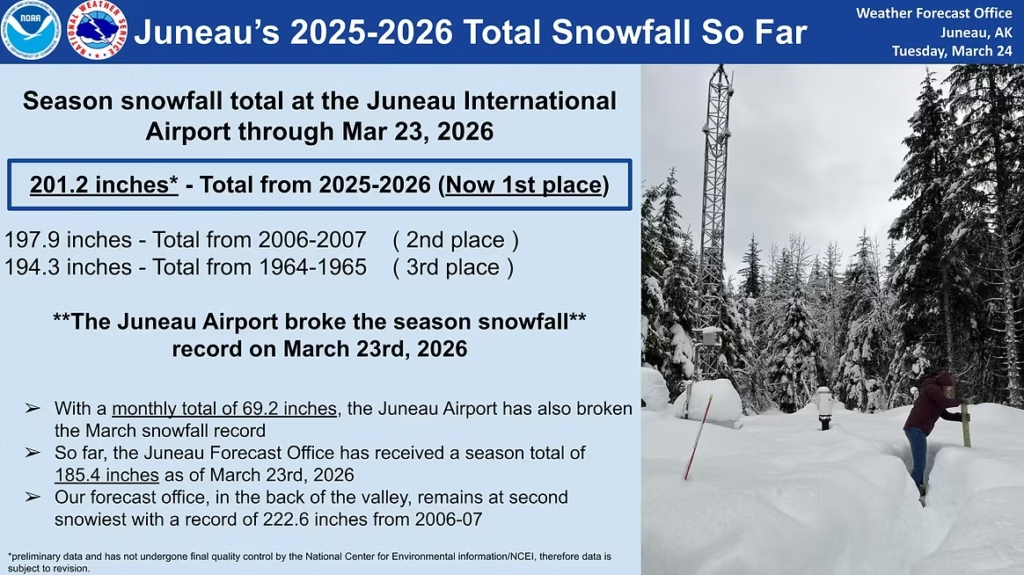
Juneau officially set the all-time record for winter snowfall on Monday, with a record 5.4 inches at the airport as of 11:59 p.m., putting the total since Oct. 1 at 201.2 inches, according to the National Weather Service Juneau. The city began the day 2.1 inches short of the record — to the surprise of many, including weather officials who on Sunday raised the previous record to 197.9 inches after discovering 7.5 inches of “missing” snowfall from 2006-2007 data.
About an inch fell at Juneau International Airport by early afternoon Monday, at which point NWS Juneau issued a “special weather statement” calling for one to three inches of snow the rest of the day.
What happened was indeed special.
“Basically what happened is we had a boundary just stall across the Juneau area and just had moisture running over top that boundary, and that just allowed us to have continuous snowfall into the evening until we started to get those winds to kind of increase and pick back up to move that boundary out,” Nick Morgan, a NWS Juneau meteorologist, said Tuesday morning.
A new winter snowfall record is proclaimed by weather officials in Juneau. (National Weather Service Juneau)
Juneau’s snowfall for the month of March is 69.2 inches, which is also a new record.
The weather forecast doesn’t call for any more snow until possibly Sunday night. But much like some other periods this winter where breaks in the snow were accompanied by record cold spells, the mostly sunny skies forecast today and tomorrow are accompanied by weather conditions of official concern as a wind advisory is in effect for Juneau until Wednesday afternoon.
“Specifically for the downtown Juneau area, starting Tuesday afternoon into probably Wednesday afternoon, people will probably see some sustained winds of 15 to 25 miles an hour, with some gusts up to 50 miles an hour,” Morgan said.
“We’re having a fun winter, aren’t we?” he added.
A wind advisory is in effect for Juneau and Skagway through Wednesday afternoon. (National Weather Service Juneau)
Juneau’s record season of snow began in mid-November with the first of what would be many newsworthy events. City officials tore down a homeless encampment near the airport, citing a need to keep the area clear for plows in anticipation of the first significant accumulation during the coming days.
Exactly one inch of snow fell during November, well below the historical average of 13.8 inches — to say nothing of the 69.8 inches that fell in 1994, the all-time high since recordkeeping at the airport started in 1948.
“We’re looking all the way out through the rest of January into February, we’re looking less precip and colder temperatures pretty much through most of this next winter, for the next three-month outlook in Southeast Alaska,” Jeff Garmon, head meteorologist at the Juneau weather service station, said at the time. “So we’ll probably get a little less snowfall than we typically would, and we’re probably going to be colder than we normally would be, which means drier, colder air from the Interior.”
Vehicles clear a runway of snow at Juneau International Airport on Saturday, Dec. 6, 2025. (Mark Sabbatini / Juneau Independent)
The weather clearly had other ideas.
A record 9.6 inches fell at the airport on Dec. 6, resulting in the first measurable snowpack that month at the airport. Another four inches fell Dec. 7, causing widespread power outages. Then on Monday, the first instance of heavy snow being followed by intense cold occurred, with the first sub-zero temperature of the winter recorded Dec. 10 at minus 5.8 degrees Fahrenheit.
Snow returned in force on Dec. 15 when yet another record was set with 9.2 inches of accumulation, putting the monthly total at 29.3 inches — well past the monthly average of 20.2 inches. But what Juneau residents now commonly refer to as “Snowmageddon” or “Snowpocalypse” was just getting started.
Finn Taintor, 9, nears the finish line of the second annual Solstice Sweater Shuffle along the Treadwell Mine Historic Trail on Saturday, Dec. 20, 2025. (Mark Sabbatini / Juneau Independent)
A mass snowfall event began Dec. 27, with Juneau receiving the most accumulation during a five-day period in recorded history, with some areas reporting depths of more than six feet. The December snowfall total at Juneau’s airport reached 82 inches, shattering the old record of 54.7 inches set in 1964.
A sunken boat at the dock in Aurora Harbor on Tuesday, Dec. 30, 2025. (Natalie Buttner / Juneau Independent)
The situation didn’t arrive with the arrival of the New Year as, among other things, the fuel canopy at Fred Meyer’s gas station collapsed on Jan. 1 and the store itself was evacuated due to roof safety concerns. Snowload concerns at that store and the Nugget Mall would result in both being closed for multiple-day stretches.
A snowfall disaster declaration, announced Jan. 6 by Juneau’s municipal government by the city and Central Council of the Tlingit and Haida Indian Tribes of Alaska, was ratified by the Juneau Assembly a day later, allowing state aid to help with clearing and repair efforts. The record-breaker situation put Alaska’s capital city in the global media spotlight, with legitimate media and AI-driven websites covering the situation with varying degrees of accuracy and folly.
More heavy snowfall during the first half of January also saw heavy rain that resulted in high avalanche, roofload and flooding concerns. An evacuation advisory for hundreds of residents living near slide paths resulted in an emergency shelter being set up at Centennial Hall where some families lived for days, while some residents in other areas struggled to keep their homes from being deluged by floodwaters.
St. Ann Avenue residents maintain a snow berm built to redirect water on Saturday, Jan. 10, 2026. (Jasz Garrett / Juneau Independent)
On Jan. 13, City Manager Katie Koester told Assembly members that — with the help of more than 200 people flown in on one plane and a load of shovels on another — more than 3 million pounds of snow from municipal facilities and schools following the storms from previous weeks.
The airport received 21.1 inches of snow during the month of January, below the historical average of 24.5 inches. But the February total of 27.9 inches surpassed the average of 16.7 inches, including a record 9.6 inches on Feb. 28. In a moment of supreme irony, a study released that month declared the length of Juneau’s winters are shrinking faster than any other city in a national study due to climate change.
March came in like a lion and kept roaring, with a record 7.3 inches of snow March 3, followed by a series of snow showers during the next few weeks that put Juneau within seeming reach of the all-time record by last Thursday, with total airport accumulation at 181.7 inches. The long-held assumption was the official record was 194.3 inches set in 1964-65.
More snow showers, including a daily record of 3.6 inches on Sunday, put Juneau’s total at 195.8 inches — except that was also the day NWS Juneau officially changed the record by adding 7.5 inches to the total from 2006-07, setting the new benchmark of 197.9 inches.
A spotty situation at Juneau International Airport during the early morning hours of Monday, March 23, 2026. (Jasz Garrett / Juneau Independent)
Nicole Ferrin, warning coordination meteorologist for the Juneau weather station, said Monday that Aaron Jacobs, an employee at the station since 2002, raised concerns about the accuracy of local climate records based on having worked and lived through the winter of 2006-07.
“He’s the one that pointed out to the rest of us that this was a problem, and they’d actually attempted to fix the climate record quite a few years ago,” she said. “And I guess we didn’t have the paper copies back then to back it up, but we found other sources to get the climate record correct.”
Ferrin said local staff spent the previous week examining records trying to confirm — and update if necessary — the data, with an eye on making sure any declaration a new snowfall record for Juneau is indeed accurate.
A short time later on Monday, NWS Juneau issued its special weather statement calling for up to three inches of snow — and when the clock reached midnight about nine hours later the winter of 2025-26 was officially one for the history books.
Glenfarne President Adam Prestidge, right, Alaska Gas Line Development Corp. Commercial Director Matt Kissinger, center, and Northern Compass Group LLC President Mark Begich discuss the Alaska LNG Project during a House Resources Committee meeting Monday, March 23, 2026, at the Alaska State Capitol. (Courtesy/Mark Sabbatini, Juneau Independent)
Gov. Mike Dunleavy, who in January declared “there is simply no shortage of good news” about the Alaska LNG Project on the same day its developer said it was moving into an “execution phase,” is now proposing a massive tax cut for the company so the project doesn’t stumble.
A bill introduced by the governor Friday, exempting the pipeline from property taxes and instead imposing a tax on the volume of gas flowing through it, is part of a series of recent actions at the Alaska State Capitol indicating the long-discussed project is still far from certain.
Many policymakers say the gasline is indeed closer to reality than in past years, due largely to President Donald Trump’s aggressive push for expanded oil and gas drilling in Alaska. But there are strong differences about taxation and other details.
Critics of Dunleavy’s bill say it could cost the state billions of dollars in revenue compared to current taxation, while municipalities where the pipeline passes through would lose property taxes on that infrastructure. The governor told the Anchorage Daily News on Friday that if the pipeline isn’t built, then the state and municipalities will get nothing.
“So it’s a catalyst to billions upon billions upon billions of dollars and decades of future (revenue), not to mention the thousands of jobs and the other economic benefits from that,” Dunleavy told the newspaper.
A press release issued by the governor’s office on Friday asserts “the Alaska Department of Revenue estimates the legislation can raise more than $26 billion in tax and royalty revenue over 30 years, including more than $22 billion in state revenue (and) nearly $4 billion in local revenue.”
Those figures are being challenged by some lawmakers and policy analysts who are awaiting further details of the bill expected to be presented during legislative hearings this week. Among the concerns are a decade-long delay until the production tax begins, plus a complex array of rules and formulas involving taxes and royalties.
There is universal support — or nearly so — for a natural gas pipeline in the Alaska Legislature, said Senate Rules Chair Bill Wielechowski, an Anchorage Democrat who has made oil tax reforms a major plank in his political platform, in an online town hall Saturday. But in sketching out a hypothetical scenario, based on likely market conditions, he said Alaska in 10 to 15 years would be getting a pittance of its fair share under Dunleavy’s bill
“We’re in a situation where you’re going to have gas sold for $25 in which the State of Alaska gets maybe 15 to 20 cents — a very, very low amount,” Wielechowski said. “We don’t want to jeopardize the project, but we need to ensure that we’re getting, as a state, our constitutional maximum value for the resource.”
The Alaska LNG Project is an 800-mile pipeline transporting natural gas from the North Slope to Southcentral Alaska, with the intent of in-state use of the gas as well as export to foreign countries. The majority owner with a 75% stake is Glenfarne Group LLC, with the Alaska Gasline Development Corp. (a state-owned corporation) the minority owner.
The most recent official cost estimate for the project is $44 billion. Project supporters say it will create at least 7,000 construction jobs, plus hundreds of permanent year-round jobs during the operation of the pipeline, which has a 50-year projected lifespan.
Glenfarne issued a triumphant declaration on Jan. 22 that “a series of major advances” had moved the first phase of the project “from development into early execution” phase. Dunleavy, in his final State of the State address that night, stated a range of agreements and partnerships announced by Glenfarne meant the company “deserves enormous credit for this outstanding work that will benefit all of us.”
But Glenfarne still has not officially made a final investment decision to build the pipeline, and many of the agreements announced are pledges of intent or interest — not ironclad contracts to buy gas or otherwise invest in the project. Meanwhile, some key legislative leaders say they haven’t gotten enough information from the company to consider what taxes and other terms are appropriate to impose.
“It’s a little difficult for us to say this is the tax relief we should give,” Senate Majority Leader Cathy Giessel, an Anchorage Republican, said during a press conference last Tuesday.
The pipeline would bring in about $1 billion annually for the state under current property tax laws, if the project is assessed at $50 billion and 3.5 billion cubic feet of gas moves through it daily, Larry Persily, a former Alaska deputy commissioner of revenue, told the Anchorage Daily News. He said under Dunleavy’s plan — a tax of six cents per 1,000 cubic feet of gas, with a 1% annual rate increase — the state would get $75 million the first year the production tax is in effect.
The flow tax would not begin until either 10 years after gas starts flowing through the pipeline, or the daily annual flow is 1 billion cubic feet, whichever comes first. The 3.5 billion cubic feet figure is its projected flow once in full production.
The first of this week’s legislative hearings about the Alaska LNG Project occurred Monday when Glenfarne President Adam Prestidge, Northern Compass Group LLC President Mark Begich and Alaska Gas Line Development Corp. Commercial Director Matt Kissinger presented their arguments in favor to the House Resources Committee.
“In front of us right now, and in front of the state Legislature, is an incredible opportunity to develop and lead one of most important infrastructure projects in the entire world right now,” Prestidge said in his opening remarks to the committee.
The governor’s proposed tax change, Senate Bill 280, is scheduled to get its first hearing at 3:30 p.m. Wednesday by the Senate Resources Committee.
Members of the Alaska House of Representatives convene on the first day of the second session of the 34th Alaska State Legislature on Jan. 20, 2026 (Photo by Corinne Smith/Alaska Beacon)
The Alaska Legislature on Wednesday approved a stopgap budget bill amid an ongoing debate among lawmakers around war-driven oil revenues and whether to draw from state savings.
The stopgap budget bill contains $449.6 million in state spending including for disaster relief, construction, education, correctional officer overtime and some public assistance programs — expenses accrued since the Legislature and Gov. Mike Dunleavy adopted the state budget last year.
But the question of how and when all the items will be funded is still uncertain. Lawmakers chose to rely on anticipated oil revenue to fund the bill rather than drawing from savings.
The Alaska Senate passed the budget bill by a 19 to 1 vote on Wednesday, with Sen. Robert Meyers, R-North Pole opposing. The bill was quickly transferred to the Alaska House where it passed unanimously by all 40 members. The bill now moves to the governor’s desk for his consideration.
The Legislature created a select bicameral conference committee to hammer out differences between House and Senate versions of the budget bill over the last week.
The final bill includes $75 million for disaster relief to cover the state’s response to the Western Alaska storms last fall, and almost $100 million for fire suppression. It contains $20 million for the Alaska Department of Corrections for overtime spending, as well as $34.4 million for Medicaid and $12.8 million for other public assistance programs through the Alaska Department of Health. The bill allocates nearly $130 million toward the Alaska Higher Education Fund which provides grants and scholarships to students.
The spending bill also includes a time-sensitive appropriation for Alaska’s construction industry. It contains $70.2 million in state dollars to unlock roughly $630 million in federal grant funding that industry groups have said is essential for the summer construction season.
But how the nearly $450 million budget bill is funded is still in question.
Legislators have been closely watching oil prices since the start of the Iran war, which state forecasters have projected could potentially generate hundreds of millions in state revenue for Alaska.
Lawmakers agreed that if oil-driven state revenues from now until June 30, the end of the fiscal year, are not sufficient to cover the stopgap budget, then the Legislature will draw from state savings. That roughly pencils out to an average of $74 per barrel of oil through June to cover state spending, according to data provided by the House Finance Committee.
But that vote to confirm drawing from savings again failed in the House on Wednesday — the fourth vote held in the House this year.To draw from Alaska’s main $3 billion savings account requires support from three-quarters of the House and Senate.
The Senate approved the immediate draw from savings on Wednesday by a 16 to 4 vote, but it failed to pass the House by a vote of 22 to 18. It takes 30 votes in the House to spend from the savings reserve.
On Thursday, House Speaker Rep. Bryce Edgmon, I-Dillingham, expressed concern at sending the budget bill to the governor with what he said was no “backstop” funding from savings.
“So if the price of oil goes down, the governor may not have the money ultimately, to finish up or to pay for operations,” he said for this fiscal year.
Edgmon said he is concerned with banking on future oil prices to pay the state’s bills.
“It’s the first time, I think maybe perhaps in Alaska’s history, we’ve ever done it this way,” he said. “It’s going to be very interesting to see how this plays out, because oil prices can certainly go up as well, but they can also go down. And it’s not the way that I like to operate in terms of being fiscally responsible.”
Members of the Republican House minority caucus in opposition from drawing from savings expressed confidence in oil revenues providing enough funding to cover state expenses.
“Everything in this bill the state currently projects enough revenues to fund,” said Rep. Will Stapp, R-Fairbanks on Wednesday. “We still have many days in session, happy to revisit in the event oil price changes and we need to structure something in order to meet our obligations. That is not a requirement at this moment.”
The stopgap budget bill now moves to Dunleavy who can sign or veto the bill or let it pass into law without his signature.
Bread, the staff of life, at least for those who are not gluten-intolerant. Once you learn the basics of bread making and have flour, salt and yeast in your cupboard, you won’t go hungry even if the roads are closed and no groceries come in.
It isn’t difficult, just try it and learn. It’s a skill that will serve you well.
Here is a basic recipe:
You’ll need a large bowl. Warm it and add 1 1/4 to 1 1/2 cups warm milk or water, a tablespoon of honey or sugar, and a tablespoon of dry yeast. Stir and let it sit for five minutes or so, and then add a cup of flour. Let it sit anywhere from an hour to all day. If you cover it make sure it has air to breathe, or it can choke.
When you come back, stir it down and add a teaspoon of salt and about two tablespoons of slightly cooled melted butter. I always like to add one or two beaten eggs.
Then start stirring in the rest of the flour, a cup at a time and beating well. It will probably take about three cups of flour. When you think it’s stiff enough, turn it out onto the floured counter, put more flour over it so it doesn’t stick to your hands or the counter, and keep turning, flattening, folding it over and shaking flour over it as necessary. When it seems to hold its shape well (around five minutes of this kneading) you can fold it into a loaf shape, put it into a greased pan, let rise until double in bulk and bake it at 350-375 degrees for about 35-40 minutes.
There are a lot of other things you can do with it.
– You can roll it out, spread it with brown sugar, cinnamon and melted butter, roll it up and cut into rounds to make cinnamon rolls (more butter is better, of course, and so is the addition of raisins and chopped nuts).
– You can make pizza: cut the dough into two halves, roll them out into large circles, and put on some tomato sauce, pepperoni, cheese and whatever else you like.
–Or you could cut the dough up into about twelve pieces, set them in a 9”-by-12″ pan, let rise, and have dinner rolls.
– Focaccia is also wonderful: roll the dough out to fit a 9”-by-12″ pan, let it rest in the greased pan for a few minutes, and then poke your fingers all over it, making little indentations. Drizzle it with olive oil and sprinkle it with rosemary and salt (flaky salt is very nice here).
Any of these should take about 20-25 minutes at 375.
The price of flour has gone way up, like everything else, so consider buying it in larger quantities, which are far cheaper per pound. I buy it in 10-pound bags ,which is not only cheaper but you don’t run out of flour all the time. If a 10-pound bag of flour costs about $15, then you should be able to make this recipe for less than $1.50
Yeast will add about $1.50 to the cost of a loaf if bought in those little foil packets, but the jars are cheaper per tablespoon and buying it by the pound is even cheaper.
I usually make it with part milk or add milk powder.
I rarely make 100% white bread. I prefer to use part whole wheat, barley, einkorn or spelt. Any of these whole grain flours should be added at the beginning of the bread making so they have plenty of time to absorb moisture; otherwise, they go on absorbing it later and causing the bread to be dry. Finish with white flour as in the basic recipe. Non-wheat flours taste delicious but have little or no gluten, which is great for gluten-intolerant people, but it’s hard to get bread to stay light without it.
You don’t have to use butter in the recipe. Old American recipes called for melted lard or suet, which turns out to be excellent. Many people use olive oil, especially for pizza.
If the power goes out, you can cook bread in a covered cast iron pan over the coals of a fire like our great-grandmothers did (nowadays that would likely be over the barbecue). She also grew her own wheat and had it ground. Wheat, barley and oats all grow very well in Haines if you care to try them.
Sally McGuire is a 40-year resident of the Chilkat Valley who raised four healthy children in Fairbanks and Haines on a budget, but always with an eye to real food and producing as much as possible of what the family ate. Her column Eating Well in the Chilkat Valley is focused on making affordable meals with what’s local, seasonal and available at the grocery store.
The secret lives of some of the Mormon wives are coming to light.
Amid Jessi Draper’s divorce from Jordan Ngatikaura, it seems the Secret Lives of Mormon Wives cast member might be moving on with… E! Online (US) – Top Stories
Taylor Swift is keeping it 100 with Travis Kelce.
In fact, the singer was joined by the NFL star at the 2026 iHeartRadio Music Awards, where she won Pop Album of the Year for The Life of a… E! Online (US) – Top Stories
Relief for Italy. Heartbreak for Ireland. And justification for 40-year-old players still creating epic moments. Thursday’s World Cup qualifying action had it all. The penultimate round of the UEFA playoffs for the 2026 FIFA World Cup (which will feature 48 teams this summer) was an absolute golazo fest with 26 goals in a full slate of matches. Only four of the eight teams that are still standing will book a spot in this summer’s tournament. Meanwhile, two other spots will be up for grabs between four teams (Jamaica, Bolivia, Iraq and DR Congo) in the intercontinental playoff. [WHEN AND WHERE: Full Schedule for 2026 FIFA World Cup] Before we look ahead to Tuesday’s matches, let’s take a look back at the best of the day in FOX Sports’ World Cup Roundup: Goal of the Day: Florent Muslija, Kosovo Kreshnik Hajrizi’s match-deciding goal might be the one that goes down in Kosovo history, but it would be a shame if Florent Muslija’s free kick got lost in the mix — what a goal. Assist of the Day: Arda Güler, Türkiye If Turkiye clinches its spot in the World Cup, you can expect to see a lot more of Real Madrid wonderkid Arda Guler. Güler didn’t make his way onto the score sheet on Thursday, but he did magnificently setup Ferdi Kadıoğlu’s match-winning goal. Best Vintage Performance: Edin Džeko, Bosnia and Herzegovina Edin Dzeko made his first and only appearance at the World Cup in 2014 with Bosnia and Herzegovina at the age of 28. Now 40 years old, Džeko is trying to will his country to its first appearance at the tournament since then, and he got off to a great start with a decisive goal in the semifinals. Save of the Day: Karl Darlow, Wales Wales goalkeeper Karl Darlow can bow out of World Cup qualifying with his head held high. Not only did he save Bosnia and Herzegovina’s first attempt in Thursday’s penalty shootout, but he kept the match from ending in regulation with an outstanding save on the line. What’s Next? The 2026 World Cup European Playoffs will end on Tuesday, with four teams all vying for a spot in this summer’s tournament. Meanwhile, the two other spots will be up for grabs on Tuesday between four intercontinental nations (Bolivia, Iraq, DR Congo and Jamaica). Here is Tuesday’s full match schedule: The winner of this game will join Group B (co-hosts Canada, Qatar, Switzerland). The winner’s games will be played in Toronto (vs. Canada), Los Angeles (vs. Switzerland) and Seattle (vs. Qatar). The winner between Sweden and Poland will join the Netherlands, Japan and Tunisia in Group F. Those games will be played in Monterrey, Mexico (vs. Tunisia), Houston (vs. the Netherlands) and Arlington, Texas. (vs. Japan). The winner of the Türkiye-Kosovo match on Tuesday will join the USA, Paraguay and Australia in Group D. Those matches will be played in Vancouver (vs. Australia), Santa Clara, Calif. (vs. Paraguay) and Los Angeles (vs. the USA). The winner of the Denmark-Czechia match will join co-hosts Mexico, South Africa and South Korea in Group A at the World Cup. Those games will be played in Guadalajara (vs. South Korea), Atlanta (vs. South Africa) and Mexico City (vs. Mexico). The winner of the Iraq vs. Bolivia match will join France, Senegal and Norway in Group I. Those matches will be played in Foxborough, Mass. (vs. Norway), Philadelphia (vs. France) and Toronto (vs. Senegal). The winner of this match will join Portugal, Uzbekistan and Colombia in Group K. Matches will be played in Houston (vs. Portugal), Guadalajara (vs. Colombia) and Atlanta (vs. Uzbekistan.)Latest Sports News from FOX Sports
Teddi Mellencamp is sending John Mellencamp some love.
While honoring her dad with the Icon Award at the 2026 iHeartRadio Music Awards on March 26, Teddi shared how he “saved” her life as she… E! Online (US) – Top Stories



















 The secret lives of some of the Mormon wives are coming to light.
 Taylor Swift is keeping it 100 with Travis Kelce.

 Teddi Mellencamp is sending John Mellencamp some love.