Most artists don’t write outlaw story songs like this anymore, but Charley Crockett’s not most artists. Continue reading…Country Music News – Taste of Country
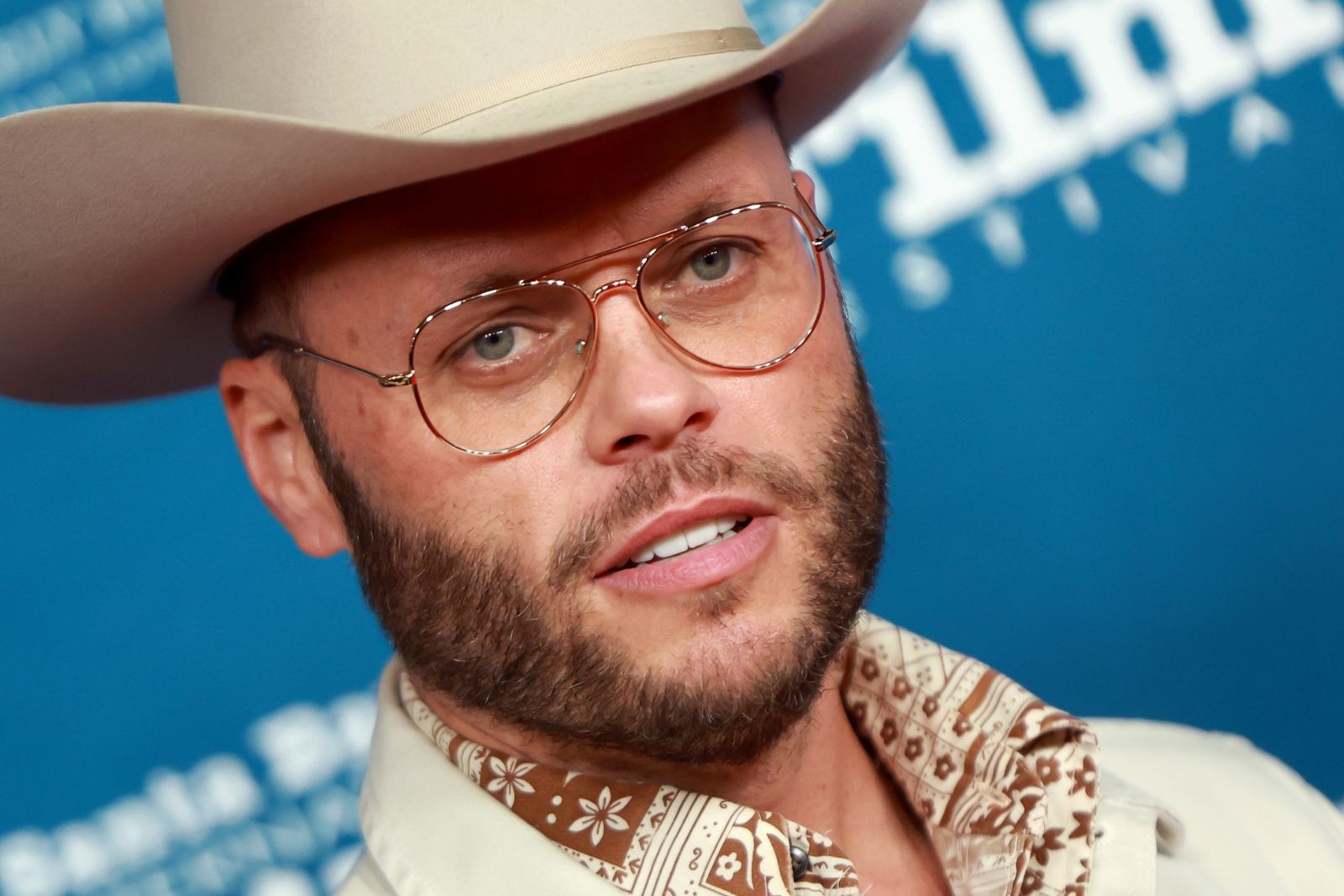










Most artists don’t write outlaw story songs like this anymore, but Charley Crockett’s not most artists. Continue reading…Country Music News – Taste of Country

Remember those shrimp feasts that had diners piling their plates high? They might just be back on the menu soon. Continue reading…The Boot – Country Music News, Music Videos and Songs

Reading Time: 3 minutes
Anna Duggar knows a thing or two about the justice system.
After all, her husband, Josh Duggar, has been locked up since 2021, and he’s not scheduled for release until 2032.
Anna supported Josh throughout his trial and imprisonment, so we guess it should come as no surprise that she’s now showing similar support to her disgraced brother-in-law, Joseph Duggar.
As you’ve likely heard by now, Joseph was arrested on child molestation charges last month.
He was sprung from jail after his dad, Jim Bob Duggar, posted $600,000 bail.
But while Joseph was still behind bars, he received both money and support from Anna.
“Bro, you’ve got our prayers,” Anna wrote in an email dated March 21 (via The Ashley’s Reality Roundup).
“We love you. How ever we can help, please let us know. I think I put some money on your books.”
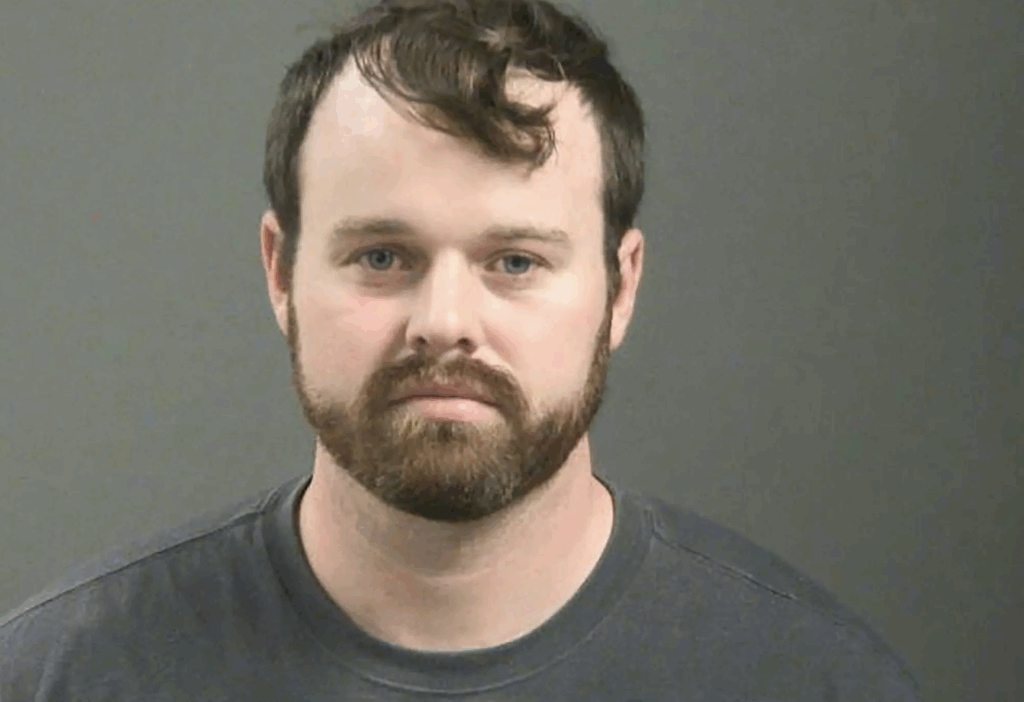
At the time of the email, Joseph was locked up at Arkansas’ Washington County Jail, where Josh cooled his heels throughout his trial, having been denied bail.
Anna assured her brother-in-law that as jails go, Washington County’s isn’t so bad.
“Joshua’s experience there at Washington County was fairly safe,” Anna wrote.
“If there are any concerns for your health or safety please let me know.”
As we previously reported, Joseph’s wife, Kendra Duggar, was also arrested but on a much lesser charge.
She was taken into custody for child endangerment after police noticed locks on the outside of her children’s doors during a search of the family home.

Kendra was allowed to make bail after just a few hours of incarceration, but she is not permitted to have any contact with her four kids.
Anna informed Joseph that the family has been supporting Kendra throughout her ordeal.
“I was amazed at how clearly [Kendra] thought, how focused and articulate she was in the middle of such heavy situations. She loves you deeply,” Anna wrote.
“She was strong on the phone call, except for when she talked about it being a month before she can see the kids.”

Some observers are surprised that Anna has been so supportive of Joseph.
After all, several Duggars have spoken out against him in the wake of his alleged crimes — and Anna is just an in-law.
But it would be hard for Anna to condemn Joseph without also condemning Josh.
And if she was able to turn a blind eye to all of her husband’s atrocities, then she should have no problem sticking up for Joseph amid what is sure to be a very disturbing trial.
We will have further updates on the Duggars and their continued messiness as new information becomes available.
Anna Duggar: Josh Duggar’s Wife Sent Money and Support to Imprisoned Joseph Duggar was originally published on The Hollywood Gossip.
The Hollywood Gossip

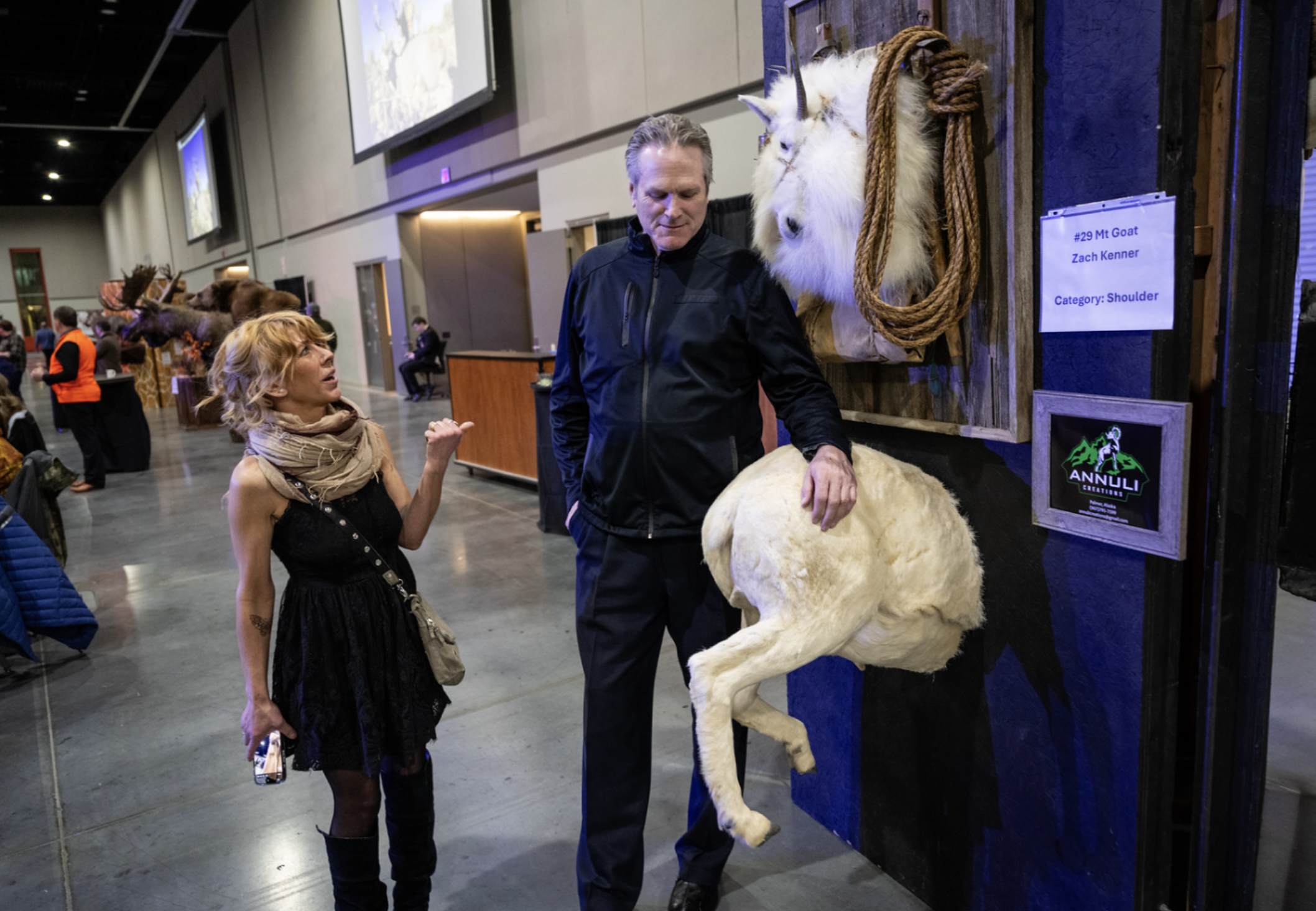
Alaska Gov. Mike Dunleavy, center, on his falcon hunting trip in the United Arab Emirates last year. (Courtesy photo)
When dignitaries visit Alaska Gov. Mike Dunleavy’s home state in the summer, their hosts often take them fishing for salmon.
But what does Dunleavy do as a visiting dignitary himself, traveling on official business to far-flung locales such as the United Arab Emirates?
Alaskans now have a glimpse of the red-carpet treatment afforded to their famously hunting-obsessed chief executive on a trip last year to the Middle East to solicit investment — courtesy of a legally required gift disclosure Dunleavy filed recently with state regulators.
In it, he shared details of an overnight traditional falcon hunt he took with the Emiratis — one that involved a journey by helicopter, a stay at a private camp and the avian pursuit of rabbits and a fluffy desert prey bird called a houbara.
“It reminded me of Alaska,” Dunleavy said in a phone interview this week. “Wide open spaces — kind of like western and northern Alaska, in terms of low-lying, rolling hills made out of sand.”
Dunleavy valued the hunting trip at $8,420, of which $5,000 was the estimated cost of the helicopter trip. In all, the governor and his wife accepted gifts valued at at least $54,000 in 2025, including travel to speaking gigs and events; luxury box access at a professional hockey game from the chief executive of Trident Seafoods; and a fall moose hunt supplied by a renowned Alaska guide, according to Dunleavy’s disclosure.
High-level state executives like Dunleavy are required to file the financial disclosures — which report gifts, income and other business affairs — in part to ensure that public officials are “free of the influence of undisclosed private or business interests,” according to state law.
Dunleavy, in the interview, dismissed the idea that the free falcon hunt from his Emirati hosts would lead to favorable terms if the region’s wealthy investment funds ultimately choose to do deals in Alaska.
“‘Since we invited you on a falcon hunt, we’re wondering if you can give us a reduced cost in oil and gas?’ No — there was no ask for any of that stuff,” Dunleavy said, chuckling. “‘Dunleavy sells out Alaska for an invited falcon hunt.’ No, that didn’t happen.”
Dunleavy said his week-long trip to the Middle East was facilitated by the Trump administration’s ambassador to the United Arab Emirates at the time, Martina Strong, who previously attended an Alaska energy conference organized by the governor’s office.
Dunleavy, accompanied by officials from at least three state agencies, appeared at multiple events during the trip and met with representatives from Middle East airlines, ports and oil and gas companies. He spoke at an energy summit hosted by a global research company, and pitched investors on developments like Alaska’s partially state-owned LNG export project.
No major deals have been announced, however.
In the lead-up to the trip, Emirati officials, knowing Dunleavy’s love of hunting, contacted the governor’s office to invite him out to a hunting preserve, he said.
If you visit another place on business and get there early, he said, “they want you to partake in whatever the local culture is.”
“If you go to Louisiana, it’s going to be the Louisiana blues fest. If you go to Florida or you go to California, it might be golf,” he said. “If you go to the United Arab Emirates, they’re going to get excited if somebody they know is an outdoor person. Because they have a long tradition of raising falcons, for thousands of years.”
Dunleavy, who’s hunted bears and musk ox in Alaska, said the day-and-a-half long hunting trip entailed a night’s stay at a “modern tent compound,” which he acknowledged could be described as “glamping.” The hunt itself was from a pickup truck, he added.
“You put the falcon on your arm, and when they see the bird, you take the hood off the falcon; the falcon sees the bird,” he said. “They get the bird, they knock it out of the sky or they get it on the ground. They stay on it, and then the guys come over and they take the falcon off the bird — and that’s how they hunt.”
The houbara was taken back to camp, cooked and sampled by Dunleavy, who said it tasted good.
The experience also included a gift of a tailored traditional robe called a kandura, which Dunleavy acknowledged donning on the trip. But Alaskans may never get to judge the fit: Dunleavy’s office would not release any images from the governor’s trip in response to a formal public records request from Northern Journal.
Later, after the phone interview, Dunleavy, through an aide, agreed to share a single photo. It showed him wearing jeans and a long-sleeved shirt outside a tent, standing on artificial turf with a group of locals — and no falcons in sight.
Asked why no photos were released in response to the earlier request under the Alaska Public Records Act, Dunleavy’s records access officer, Guy Bell, said the image shared by the governor was “personal,” and “not acquired or used for state business.”
“Therefore, it is not considered a public record,” Bell said.
Nathaniel Herz welcomes tips at natherz@gmail.com or (907) 793-0312. This article was originally published in Northern Journal, a newsletter from Herz. Subscribe at this link.
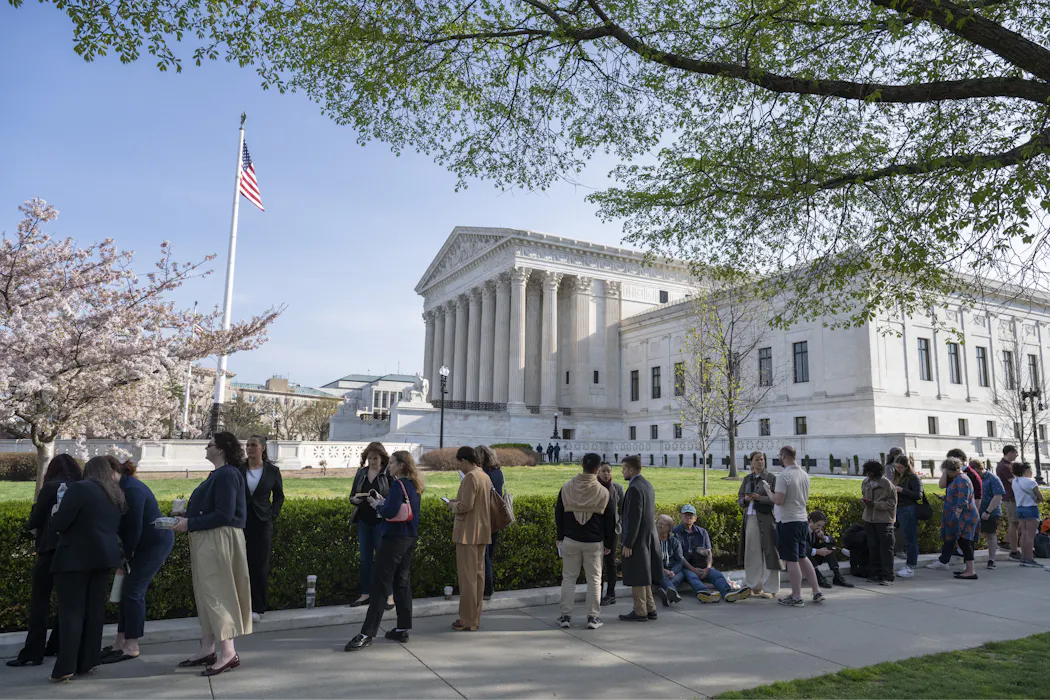
In an 8-1 decision authored by Justice Neil Gorsuch, the Supreme Court held on March 31, 2026, that a Colorado law prohibiting licensed counselors from performing “conversion therapy” on minors was likely unconstitutional as applied to talk therapy. Justice Elena Kagan filed a separate concurrence, joined by Justice Sonia Sotomayor. Justice Ketanji Brown Jackson dissented.
I am a law professor and political scientist who teaches and writes on free expression and discrimination. I see this holding as a potentially important decision at the intersection of free speech and health care.
Colorado’s law defines conversion therapy broadly. It bans practices that attempt not only to “change an individual’s sexual orientation or gender identity” but also to reduce same-sex attraction. The law allows therapists to provide “acceptance, support, and understanding” of gay or transgender identity. However, they may not help a client suppress those identities. Penalties include fines, probation and loss of license.
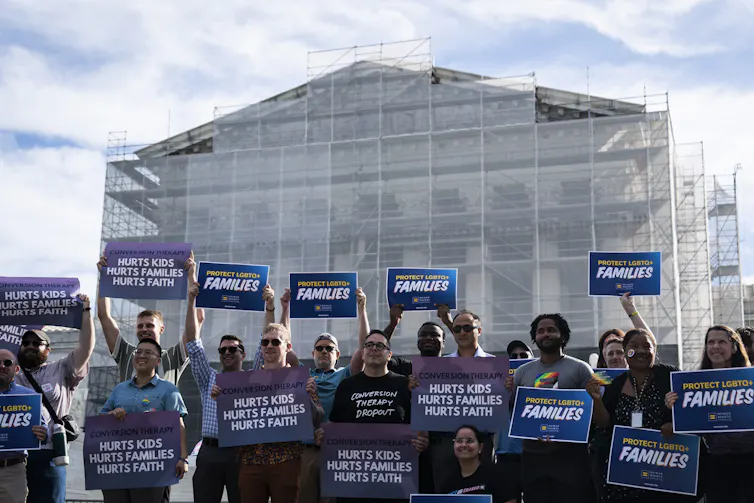
Kaley Chiles challenged the law as a violation of her First Amendment free speech rights. As a therapist who only offers talk therapy, Chiles’s objection was limited to her talk therapy. She didn’t contest the ban on what she called “long-abandoned, aversive” conversion practices. And – notably, considering she is an evangelical Christian – Chiles said she never set out to convert her clients. She says she respects her clients’ “fundamental right of self-determination” and determines her therapy approach only after a client identifies his or her own objectives. But she argued that some of her clients wish to “reduce or eliminate unwanted sexual attractions (or) change sexual behaviors,” and the law prevents her from expressing support for any of those goals.
Colorado faced a major obstacle in defending the Colorado conversion therapy law. The law was transparently driven by the government’s views about the well-documented inefficacy and harmful effects of conversion therapy. And outside of certain contexts, such as government grants, public employees, advertising and threats, courts have treated such viewpoint-based laws as constitutionally dead on arrival.
Colorado’s best hope in defending the law, then, was to argue that it wasn’t principally a restriction on speech at all. Rather, the state framed the law as a restriction on professional conduct — an area where states have broad regulatory latitude. That framing would mean the law burdened Chiles’ speech only incidentally.
In NIFLA v. Becerra, decided in 2018, the court rejected the argument that professional speech was a less-protected category. But it acknowledged that laws “regulating conduct in ways that incidentally sweep in speech” – particularly where they “fall within the traditional purview of state regulation of professional conduct” – might survive under a lower standard of scrutiny.
Colorado attempted to demonstrate such a tradition here, citing medical licensing laws, informed-consent requirements and malpractice liability.
A divided 10th U.S. Circuit Court of Appeals had agreed with Colorado’s argument, as did Jackson in her dissent. But the Supreme Court majority rejected it. Gorsuch wrote that a government cannot evade First Amendment scrutiny by relabeling restricted speech as “conduct,” “treatment” or a “therapeutic modality.” Quoting the dissent of U.S. Circuit Judge Harris Hartz, he called Colorado’s argument a “labeling game.”
For Gorsuch, the key question is whether the law restricts speech in practice. And in Chiles’ case the answer was yes. Colorado was plainly restricting what she wished to tell her clients about their sex and gender issues.
More than that, the majority noted, Colorado’s law doesn’t regulate therapists’ speech based on its content. The law discriminates based on viewpoint, permitting expressions of acceptance and support for a client’s self-identity while forbidding expressions that attempt to change it.
Under 1995’s Rosenberger v. University of Virginia, viewpoint discrimination is an “egregious form” of content regulation. Governments must “nearly always abstain” from it. The court remanded the Colorado case back to the 10th Circuit to resolve the case under this standard.
Jackson’s solo dissent emphasizes that states have long enjoyed broad power to regulate how licensed medical professionals treat patients. To Jackson, the First Amendment should not interfere simply because a treatment is applied through words rather than instruments.
The court’s 2018 NIFLA decision, she argues, distinguished between speech restricted “as speech” and speech restricted “incidentally” as part of a medical treatment the state is otherwise entitled to regulate. According to Jackson, the majority arbitrarily collapses that distinction simply because the treatment is delivered orally. A talk therapy session and a drug infusion are both medical treatments, she argues, and the analysis should not turn on whether the provider uses a syringe or a sentence.
Jackson’s dissent also raises difficult line-drawing problems, such as the validity of less controversial potential prohibitions, such as those on encouraging a patient to smoke or to take their own life.
First, only talk therapy is implicated.
The holding is narrow in this sense. It leaves room for policymakers still hoping to limit the practice of conversion therapy. Because Chiles challenged the statute only as applied to her, the majority’s analysis does not invalidate conversion therapy bans wholesale – neither Colorado’s nor those of more than 20 other states – but applies only to the extent they ban conversion talk therapy.
State legislatures can define conversion therapy a bit more narrowly, for example, by prohibiting the physical and more coercive techniques that initially gave rise to these bans. States can then leave the regulation of talk therapy to other legal and professional mechanisms, such as malpractice or enforcement of professional ethics.
Second, the standard of scrutiny that the lower court must now apply is not strict scrutiny; it is more demanding. Strict scrutiny is a legal test that validates a law if it is “narrowly tailored to achieve a compelling government interest.” Contrary to what some legal commentators have implied, Gorsuch never directs the lower court to use strict scrutiny.
The opinion emphasizes that the law doesn’t just discriminate against certain types of content – a trigger for strict scrutiny; it discriminates based on viewpoint. The strict scrutiny standard is demanding, but laws sometimes survive it. Viewpoint discrimination, on the other hand, is subject to a near-absolute prohibition: Governments must “nearly always abstain” from it. This language is stronger and more categorical than that for strict scrutiny. The implication is that the law should certainly be invalidated as applied to talk therapy.
Finally, the holding is a double-edged sword for conservatives with traditional views of gender identity. And for those discouraged by the outcome, seeing it only as a victory for religious conservatives, the holding’s logic offers a silver lining.
Kagan’s concurrence makes explicit that a “mirror image” law – one barring talk therapy that affirms gender identity – would raise the same constitutional problems.
The majority makes a similar point. As late as the 1970s, the American Psychiatric Association still classified homosexuality as a mental disorder. Under Colorado’s position, a law from that era prohibiting counselors from affirming gay clients’ identities would have been constitutionally sound.
Today, more than 20 states have moved to restrict gender-affirming care, and the federal government is pressuring state medical boards to adopt skeptical positions on gender transition. It’s not implausible that a legislature would attempt to ban gender-affirming, talk-based therapies. If and when conservative policymakers attempt that move, Chiles will be a formidable obstacle.
Read more of our stories about Colorado.

Kevin Cope does not work for, consult, own shares in or receive funding from any company or organization that would benefit from this article, and has disclosed no relevant affiliations beyond their academic appointment.
Politics + Society – The Conversation

Reading Time: 4 minutes
After a new shocking family scandal, anyone might need some time to prepare a statement.
But Jana waited until her latest disgraced brother was already extradited to Florida before she spoke up.
Addressing Joseph’s charges, she chose her words carefully.
She also admitted to being blindsided. Like some of her siblings, she learned about his arrest from the news.
On Thursday, April 2, Jana took to her Instagram Story to publicly respond to Joseph’s arrest.
“We are deeply saddened and heartbroken by the situation involving my brother, Joseph,”
“This news came as a shock to us, as we had no prior knowledge before it became public,”
To be clear, it doesn’t sound like she’s just assuring people that she didn’t know that her brother allegedly preyed upon a 9-year-old girl.
It sounds like she’s also sharing that she had no head’s up from anyone. She saw Joseph’s arrest on the news, just like the rest of us did.
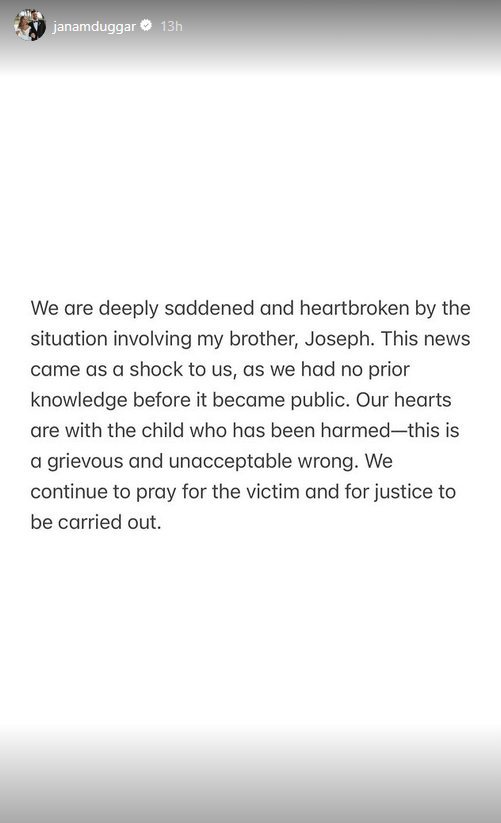
“Our hearts are with the child who has been harmed,” Jana then expressed.
She affirmed that “this is a grievous and unacceptable wrong.”
Keeping things vague, Jana concluded: “We continued to pray for the victim and for justice to be carried out.”
As you may have noticed, she’s not only glossing over the horrid details of Joseph’s charges. It’s more than that.
She’s using a tremendous amount of passive voice. It’s the sort of verbal wrangling that you usually only see in newspaper headlines after a police shooting. You know, the ones where a “man dies from bullet wounds” as if that happened spontaneously.
On March 18, Joseph Duggar was arrested after allegedly confessing (twice) to molesting a 9-year-old girl during a 2020 family vacation to Panama City Beach in Florida.
The victim, now 14, remains unidentified. Court filings refer to her as Jane Doe.
We know only that she is not one of the Duggar grandchildren and that she and her family apparently vacationed with Joseph and Kendra (during the height of the COVID-19 pandemic, no less) in 2020.
Having had years to process what happened to her, she told her father. Her father confronted Joseph over the phone.
And Joseph reportedly confessed — first to the man and then to police following a second phone call.

From the earliest days of our reporting, we at THG advised caution when it came to Joseph’s apparent repentance.
Spending days behind bars can make someone wildly reconsider a previous plan to make good.
After his extradition to Florida, Joseph pleaded not guilty to the charges.
It is possible that this is simply a tactic to make prosecutors offer him a deal. Many men who prey upon small children want some sort of protection in prison, such as a minimum security facility with more comforts and lower odds of getting murdered.
However, we cannot discount the possibility that Joseph now plans to retract his confessions and claim to be innocent. This would likely force the 14-year-old girl to testify in court.
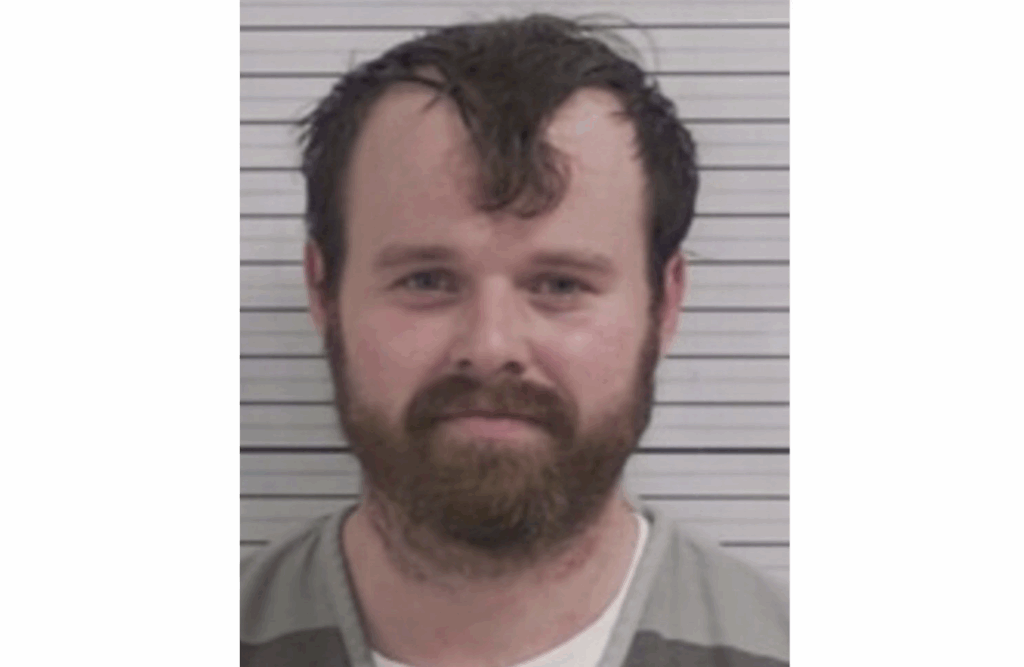
We do not know what Joseph Duggar has planned.
It seems pretty unlikely that Jana does, either.
Right now, even Joseph’s wife seems to be keeping her distance from him, emphasizing that he’s not her priority as she tries to regain custody of their children.
It sounds like Kendra may have been advised that she could have to throw him under the bus in court.
Only time will tell what Joseph will do. His brother, Josh, has never admitted his guilt — at least, not about his crimes as an adult.
Jana Duggar Reveals She Was Blindsided by Joseph’s Arrest in First Statement Since … was originally published on The Hollywood Gossip.
The Hollywood Gossip

The U.S. president recently offered compliments about his vice president’s slimmer figure — but experts say such comments may actually do more harm than good.

Health Digest – Health News, Wellness, Expert Insights
![<a href="https://tasteofcountry.com/dan-and-shay-new-song-say-so-lyrics/" target="_blank">Dan + Shay’s New Era of Music Begins with ‘Say So’ [LYRICS]</a>](https://townsquare.media/site/204/files/2026/04/attachment-editorial-5-4.png?format=natural)
The song is heavy and deeply personal for the duo. Continue reading…Country Music News – Taste of Country
The song is heavy and deeply personal for the duo. Continue reading…The Boot – Country Music News, Music Videos and Songs

Keeping up with dietary guidelines can be a struggle at times, and many of us don’t know if we’re eating enough fiber. This is what health officials recommend.

Mashed – Fast Food, Celebrity Chefs, Grocery, Reviews