Categories
Alaska News

Alaska Gov. Dunleavy signs nearly $450M supplemental budget to cover state expenses this year

Alaska Gov. Mike Dunleavy speaks to reporters about school funding and education policy on Thursday, April 17, 2025. (Photo by James Brooks/Alaska Beacon)

Alaska Gov. Mike Dunleavy speaks to reporters on Thursday, April 17, 2025. (Photo by James Brooks/Alaska Beacon)

Gov. Mike Dunleavy signed off on a supplemental budget bill that authorizes nearly $450 million in additional state spending this year. 

The budget bill covers additional costs incurred by the state this fiscal year ending in June, including funds for disaster relief, education, corrections and transportation. 

The bill was approved by the Alaska State Legislature two weeks ago. Dunleavy signed the budget on Apr. 2, and transmitted it back to the Legislature on Thursday. 

“I appreciate the Legislature’s support of these proposals,” Dunleavy said in a letter announcing his signature on the bill. “The supplemental budget I have signed into law today enables the State to meet current fiscal year responsibilities and represents prudent and fiscally responsible investments in emergency and fire response, public safety and statewide transportation needs.”

The budget includes $75 million for disaster relief to address the response to the Western Alaska storms last fall, and nearly $100 million for fire suppression, particularly in Interior Alaska. It includes $20 million for the Alaska Department of Corrections overtime expenses, as well as $70 million in time-sensitive funding for transportation — sought by the construction industry to unlock a federal match of $630 million for state construction projects.

It also includes $130 million for the Alaska Higher Education Fund which provides grants and scholarships for students, as well as $34.4 million for Medicaid and $12.8 million for other public assistance programs through the Alaska Department of Health. 

The governor’s office submitted an additional $11.6 million request, but it was submitted too late to include in the budget bill, and will be rolled into the proposal for next year’s budget. 

Additionally, the state is waiting on an appeal decision after failing a federal disparity test for education funding, and could potentially be liable for $72 million in K-12 funding for next year, according to officials with the Legislative Finance Division. 

Oil revenues still uncertain

In the Legislature, the bill was delayed this year amid ongoing debate in the House of Representatives on whether to pay for the larger than usual budget bill out of state savings — an act that requires the approval of three-quarters of legislators.

Members of the House Republican minority caucus objected to spending from a state savings account, the Constitutional Budget Reserve. After the Alaska Department of Revenue projected the state would see an additional $500 million in oil revenue due to a surge in oil prices driven by the Iran war, they argued the state would not need to pull from savings to pay its bills. 

Members of the multipartisan House majority caucus objected to the uncertainty of revenue forecasts and future oil prices, and argued for a draw from state savings to fund the budget bill immediately.

If oil-driven state revenues from now until the end of the fiscal year are not sufficient to cover the $450 million supplemental budget, then lawmakers agreed to draw from state savings. That means oil prices must average approximately $82 per barrel of oil through June for state revenue to cover spending, according to officials with the Legislative Finance Division. 

House Speaker Rep. Bryce Edgmon, I-Dillingham, was among legislators who supported the draw from savings several weeks ago, instead of banking on uncertain future oil revenues. On Friday, he said it seems revenues will cover the budget bill. 

“As appears now, oil prices are continuing to move in an upward trajectory, which means that the bill at the very end could be fully funded,” Edgmon said. “But there’s still a fair amount of time in front of us for oil prices to, you know, continue to be volatile.”

Edgmon said barring a dive in oil prices, he doesn’t expect another vote on drawing from the state savings this session.

“That’s pending a dramatic drop in oil prices, of course, which doesn’t seem to be on the horizon.”

SUPPORT: YOU MAKE OUR WORK POSSIBLE

Categories
Entertainment

Age of Attraction: Libby Reacts to Speculation Over Andrew’s Sexuality

Age of Attraction's Libby Vodicka, Andrew WheelerLibby Vodicka has entered the chat.
One week after she confirmed that she was still dating Andrew Wheeler at the Age of Attraction season one reunion, the 23-year-old couldn’t resist poking fun at…
​E! Online (US) – Top Stories

Categories
Food

This Is Hands-Down The Best Sandwich Spot In Denver, According To A Local

If you’re looking for an amazing sandwich in Denver, Odie B’s menu is full of creative, flavor-packed hits to satisfy every craving at any time of day.

​Food Republic – Restaurants, Reviews, Recipes, Cooking Tips

Categories
Entertainment

Now’s Your Chance: Get Paula’s Choice BHA Exfoliating Toner on Sale

Paula’s Choice products will be up to 20% off sephora savingsIn the skincare world, some products are definitely worth the splurge… but why do that when you could wait for a good sale to come along? Lucky for us, the Sephora Savings Event has us adding to…

​E! Online (US) – Top Stories

Categories
Entertainment

Michael Jackson’s Son Bigi “Blanket” Makes Rare Red Carpet Appearance

Michael JacksonMichael Jackson’s sons are having a thriller night.

Bigi “Blanket” Jackson stepped out for a rare red carpet appearance with his older brother Prince Jackson at the Berlin premiere of the Michael…
​E! Online (US) – Top Stories

Categories
Entertainment

Natasha Lyonne Explains What Happened on Flight Before Removal

Natasha Lyonne attends the New York City premiere of LorneNatasha Lyonne is sharing more insight into her recent travel mishap.


Three days after the Poker Face star was removed from a Delta flight for reportedly failing to follow flight attendants’…
​E! Online (US) – Top Stories

Categories
Alaska News

Alaska Seaplanes gets approval for new departure, landing paths to reduce flight disruptions

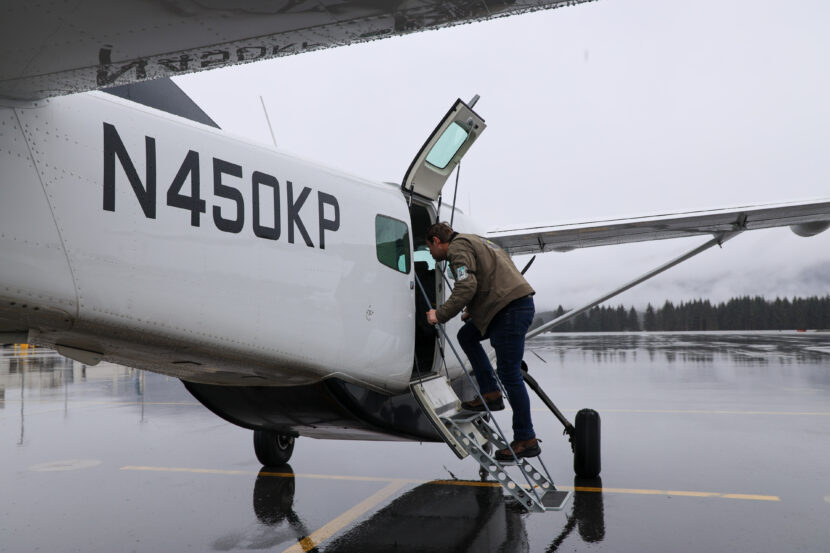
Patrick Ford flies a Cessna 208 Caravan through the clouds over Juneau on Thursday, April 9, 2026. (Courtesy/ Clarise Larson, KTOO)

On Thursday morning, Patrick Ford descended through clouds shrouding Juneau in a brand new Cessna 208 Caravan. The plane emerged from whiteout conditions at around 1600 feet above the Mendenhall Wetlands and glided gently onto the runway at Juneau International Airport.

Ford is a pilot and the director of operations at Alaska Seaplanes, the largest commuter airline in Southeast Alaska. For much of the test flight, he operated on autopilot using an approach that automatically followed fixed waypoints in the sky. 

“Every one of these little star-looking guys is a different fix. It’s just a three-dimensional point in space that you have to hit at a specific spot at a specific altitude,” Ford said. “It’s basically just like driving down the highway, and you’re driving the highway in the sky, following the markers.” 

The Federal Aviation Administration approved Alaska Seaplanes’ new departure and arrival paths in Juneau, Haines, Kake, Sitka, Hoonah, Klawock, Wrangell and Petersburg. Those paths are available to the company’s wheeled fleet, but not float planes. The goal of these new, proprietary approaches and departures is to improve flight safety and reliability for Southeast communities when pilots can’t see anything but clouds.

Patrick Ford, a pilot and the director of operations at Alaska Seaplanes, prepares for takeoff in Cessna 208 Caravan on Thursday, April 9, 2026. (Photo by Clarise Larson/KTOO)

Andy Kline, marketing manager at Alaska Seaplanes, said the company spent millions to design and get authorization for the new paths. Since the expense was planned years in advance, he said passengers won’t see fare spikes from this.

The company’s new path in and out of Juneau International Airport goes through the south end of Gastineau Channel. Ford said it allows pilots to drop out of a cloud ceiling that’s as low as 580 feet above sea level, increasing a plane’s chances of landing in poor visibility instead of turning around.

“I’m sure you guys have been on a flight where you get halfway up to Haines and, you know, it’s shut down at Eldred Rock, and you have to turn around and come all the way back,” Ford said. 

Those new flight paths are paired with advanced GPS technology called synthetic vision, made by Garmin. A screen in the cockpit displays a computer-generated 3-D view of the terrain, allowing pilots to ‘see’ their surroundings when there’s zero visibility. 

A screen in the cockpit displays a computer-generated 3-D view of the terrain, called synthetic vision. (Photo by Clarise Larson/KTOO)

Ford said that’s an advancement on what’s called instrument flight rules, or IFR, a set of FAA regulations that control the conditions for pilots relying on instruments to navigate rather than sight. 

“It’s a huge, huge improvement in safety,” Ford said. “I sleep better at night knowing that that’s an option.”

Kline said it brings the commuter airline closer to the capabilities of Alaska Airlines, which has had the technology for decades.

That matters to residents of Southeast, a notoriously cloudy and mountainous region. Large jets don’t land in many small towns in the region, so residents rely on small, commuter flights for air travel.

Sean Kveum, co-owner and chief operating officer of Alaska Seaplanes, said that flights were frequently cancelled decades ago, before commuter aircraft could fly in low visibility

“We just had to stay low below the clouds and wait for good weather, and you could go when it was good enough,” Kveum said.

He said the new flight paths and synthetic vision will improve flights for outlying communities like Hoonah, where he grew up. 

“It really allows us to be providing a more reliable service to the communities throughout Southeast,” he said. 

This story was originally published by KTOO.

Clarification: This story has been updated to reflect that Alaska Seaplanes does not have the exact same capabilities of Alaska Airlines.

The post Alaska Seaplanes gets approval for new departure, landing paths to reduce flight disruptions appeared first on Chilkat Valley News.

Categories
Entertainment

The Difficult Relationship Ina Garten Had With Her Mom

Learn the reason this TV personality had a strained relationship with her mom and why she never reconciled with her before her mom’s death in 2006.

​Mashed – Fast Food, Celebrity Chefs, Grocery, Reviews

Categories
Entertainment

The “Rules” About White Jeans Are Officially Over, Says a Stylist

Shop White Jeans Stylist 2026 Thumb.jpgWhite jeans are shaping up to be one of spring and summer 2026’s easiest style refreshes—and according to stylist Liz Teicher, the appeal comes down to how effortlessly they brighten any…

​E! Online (US) – Top Stories

Categories
Sports Fox

Ranking the Top 20 Players in the Men’s College Basketball Transfer Portal

Shortly after the maize and blue confetti fell in celebration of Michigan’s win over UConn in the national championship game, college basketball’s transfer portal was officially opened. According to reports, over 2,000 Division I men’s basketball players have already entered their names into the portal, which will be open for two weeks, from April 7 to April 21. It’s a deep and talented pool of transfers who will have a significant impact on the outcome of the 2026-27 college basketball season. We ranked the top 20 transfers to keep an eye on over the next two weeks as transfer decisions unfold. Burton is a dual-threat scoring guard. He led the ACC in scoring with 21.3 points per game as a sophomore and then followed that up by averaging 18.5 points per game during his junior year at Notre Dame. After three seasons with the Fighting Irish, Burton enters the portal with one year of eligibility remaining. Freeman is a budding star who can score at all three levels. He plays with a smoothness to his game, averaging 16.5 points and 7.2 rebounds per game en route to earning honorable mention All-ACC honors. He was a former five-star recruit in the 2024 high school class, but he has battled injuries throughout his first two seasons at Syracuse. Freeman has two years of eligibility remaining. Sherrell is a physical presence with a strong motor on the glass. He averaged 11.1 points and 6.2 rebounds in 23.9 minutes per game as a sophomore at Alabama. In a system that emphasized high-volume 3-point shooting, his full skill set wasn’t on display. With two years of eligibility remaining, he could emerge as a do-it-all forward in a different role. Diop is an athletic big man, and at 7-foot-1, he’s a rim-protecting presence and a capable lob threat. He averaged 13.6 points and 2.1 blocks per game in his freshman season at Arizona State. He was born in Senegal and came to the United States from Spain before last season. At 21 years old, he has more experience than most rising sophomores. Lewis is a dynamic guard whose game is built on getting into the lane and creating for himself and his teammates. One of the best finishers in the nation, he averaged 12.2 points and 5.3 assists per game while leading Villanova to the NCAA Tournament. Lewis has three years of eligibility remaining but has also entered his name into NBA Draft consideration and the transfer portal. Cyril is an imposing paint presence on both sides of the ball. He’s an elite rim-protector and efficient pick-and-roll partner. He averaged 9.3 points and 2.2 blocks per game during his sophomore season at Georgia, while only playing 21.2 minutes per game. There’s room for a breakout if the playing time increases, and Cyril has two years of eligibility remaining to prove that. Khamenia is a versatile wing and former top-20 recruit whose role was limited on a loaded Duke roster as a freshman. He averaged 5.7 points and 3.3 rebounds in 19.8 minutes per game. With expanded opportunity, he’s a strong candidate to make a major leap as a sophomore. Hill is another elite-level shot maker, overcoming his 6-foot-3 stature with a decisive dribble and high-arcing release. He left his mark on the 2026 NCAA Tournament, knocking down a game-winning shot to lift No. 11 seed VCU over No. 6 seed North Carolina in the first round. Hill averaged 15.0 points per game, shooting 37% from 3-point range en route to earning A-10 Sixth Man of the Year honors. He provided an offensive punch off the bench for the Rams but is certainly a starting caliber player at the high-major level with two years of eligibility remaining. Transferring from San Diego State to Providence. Byrd is a standout on both ends of the floor. He withdrew his name from the NBA Draft last year and returned to San Diego State, where he averaged 10.4 points and 4.7 assists per game along with 1.2 blocks and 1.9 steals per contest. He was one of the top defenders in the nation this past season, earning Mountain West Defensive Player of the Year honors. Johnson is another go-to scoring guard. He separates himself with his ability to facilitate and initiate. He averaged 16.9 points and 3.0 assists per game, leading Colorado in scoring as a freshman while coming off the bench for the first half of the season. With three years of eligibility remaining, Johnson could emerge as the face of a program and the focal point offensively. Thiam is a crafty big man with a traditional back-to-the-basket game. He’s also an athletically-gifted defender, averaging a Big 12-best 2.6 blocks per game as a freshman at UCF and later helped Cincinnati finish 10th nationally in KenPom defensive efficiency. Entering his junior year, he’s a candidate to break out at his third program. Vaaks is an elite perimeter shooter with good size, standing at 6-foot-7, which will allow him to consistently get his shot off no matter what level he plays at. He averaged 15.8 points per game while shooting 35% from 3-point range as a freshman at Providence. He started 14 of the final 15 games of the season, increasing his numbers to 18.0 points per game. Shelstad is an offensive engine, creating for himself at all three levels while also facilitating for his teammates. His endless range, blinding speed and timely decision-making makes up for his size (6-foot). He earned All-Big Ten honors as a sophomore but only played 12 games during his junior year at Oregon before sustaining a season-ending hand injury. He averaged 15.6 points and 4.9 assists per game for the Ducks. Murauskas is a three-level scorer. He uses his height to score inside, but is also a talented perimeter shooter both off the catch and dribble. He averaged 18.4 points and 7.6 rebounds per game in his junior season at Saint Mary’s. Murauskas started his college career at Arizona, then played two seasons with the Gaels, entering the portal after head coach Randy Bennett left for Arizona State. Transferring from Kansas State to Texas A&M. Haggerty is a high-level shot taker and maker, averaging 23.6 points per game on 48.9% shooting at Kansas State this past season. He previously led the American Conference in scoring at Memphis in 2024–25. Wright plays a downhill, attacking style, always looking to penetrate the lane with his dribble to create for himself and his teammates. He averaged 18.1 points and 4.6 assists per game for BYU during his sophomore season. He also improved as a shooter, increasing his 3-point percentage from 35.2% to 41.0%. It will be Wright’s second consecutive offseason entering the transfer portal, as he went from Baylor to BYU and now will play for a third school in three years. Punch is a steady interior presence on both sides of the ball, with an especially-high IQ on offense. At 6-foot-7, 245 pounds, and without a 3-point shot in his arsenal, he’s undersized and might not fit every system. However, he averaged 14.1 points and 6.8 rebounds per game in his sophomore season at TCU. Harris averaged 21.4 points and 6.5 rebounds per game during his sophomore season at Wake Forest. He thrives in the mid-range, shooting 55.5% from inside the arc, but still has room to improve from the outside. Harris can be the lead scorer on a high-major team with two years of eligibility remaining. Blackwell averaged 19.1 points per game during his junior season at Wisconsin. In his three seasons in Madison, the Badgers were unable to advance past the first weekend of the NCAA Tournament, so Blackwell is seeking a place to compete for his final season of eligibility. Bidunga averaged 13.3 points and 2.6 blocks per game during his sophomore season at Kansas. His rim-protection prowess earned him Big 12 Defensive Player of the Year honors and a spot on the all-conference team. Bidunga entered his name into the NBA Draft, while keeping his portal options open.​Latest Sports News from FOX Sports