Previously unheard live version was recorded in 1975 during Bernie Leadon’s final performance with the band. Continue reading…Country Music News – Taste of Country











Previously unheard live version was recorded in 1975 during Bernie Leadon’s final performance with the band. Continue reading…Country Music News – Taste of Country

The Alaska State Capitol seen on the first day of the second session of the 34th Alaska State Legislature on Jan. 20, 2025 (Photo by Corinne Smith/Alaska Beacon)
At the Alaska Beacon, we’re constantly trying to figure out where we should put our attention. There’s always more news than there are people to report it.
Every Thursday, the Alaska Legislature publishes its committee schedule for the coming week. Public notices alert us to meetings and events. The governor’s office occasionally lets us know ahead of time that something’s coming down the pike, too.
Here’s what we know about for the coming week. If you know of something that’s coming up that you should think we should pay attention to, email us at info@alaskabeacon.com.
We can’t cover everything on this list, but we’re interested in them and we think you should know about them in case you’re interested in them, too.
This list is ripped from our notebooks, and it is likely to change over the course of the week. We’ll update it when we can.
Are you trying to keep track of when to testify on a bill? The Legislature has a website for that.
*The House continues debating the operating budget for next year, so House committee meetings are contingent on that schedule
8 a.m. – House Education hears a that would mandate civics education
9 a.m. – Senate Finance hears a bill related to an occupational therapy licensure compact
12 p.m. – Lunch & Learn with Alaska Youth for Environmental Action
1 p.m. – House Judiciary hears bills related to consumer data privacy, to maintain sibling relationships for youth in foster care, and a bill to increase criminal penalties for selling fraudulent airbags
1 p.m. – House Resources hears the governor’s bill to provide tax breaks for the proposed Alaska LNG gas line
1:30 p.m. – House Finance hears a bill to establish criminal penalties for mail theft, and a bill to authorize pharmacists to prescribe certain medications
1:30 p.m. – Senate Judiciary considers the governor’s appointees for the Alaska Parole Board and the Human Rights Commission, and a bill to increase criminal penalties for hit-and-runs
1:30 p.m. – Senate Labor and Commerce hears a bill related to the right to repair digital devices, and a bill related to allowable charges by health insurers
1:30 p.m. – House Labor and Commerce hears bills related to benefits for emergency dispatchers, telehealth reimbursement rates, damages limits for personal injuries or wrongful death, and to close a tax loopholes for C-corporations
3:30 p.m. – Senate Education hears a presentation on the history of the state’s Regional Education Attendance Areas
3:30 p.m. – Senate Resources hears a bill proposed by the governor to provide property tax breaks for the proposed 739-mile Alaska LNG gas line project
8 a.m. – House Community and Regional Affairs considers “right to repair” legislation and hears bills that would make it easier for unhoused youth to get birth certificates and regulate autonomous vehicles
9 a.m. – Senate Finance hears a bill that would increase access to retirement benefits for disabled veterans and a bill that would support the civil legal services fund
9 a.m. – Senate Resources continues considering the governor’s bill to provide property tax breaks for the proposed Alaska LNG gas line
12 p.m. – Lunch and Learn presentation on delivering health care to Southeast Alaska
1 p.m. – House Energy hears a presentation on geothermal energy
1:30 p.m. – House Finance hears a a resolution to put a constitutional amendment on the November ballot to establish an education fund
3:15 p.m. – House Health and Social Services hears a bill that would expand early education services, and a bill to establish an opioid litigation settlement fund for the state to record and better manage opioid settlement proceeds
3:15 p.m. – House State Affairs hears a presentation about how other states regulate artificial intelligence
3:30 p.m. – House Health and Social Services hears a resolution in support of the Rural Health Transformation Fund
3:30 – Senate State Affairs hears a presentation on disaster management
Arctic Encounter Summit takes place in Anchorage
8 a.m. – House Education hears a bill to require CPR training in schools and a bill to fund free school breakfast and lunch
9 a.m. – House Finance hears a bill related to expand funding for the special education services agency
9 a.m. – Senate Finance hears a bill to allow the transfer of inmates serving long sentences to out-of-state facilities and another to allow the Alaska Industrial Development and Export Authority to provide loans to build workforce housing
12 p.m. – Documentary film screening: “Talking to the Tundra: How a Yup’ik Village Heals Together” by Indie Alaska
12 p.m. – Lunch and Learn presentation on the Alaska Fentanyl Response Project
1 p.m. – House Judiciary hears a bill that would allow the surrender of infants in so-called infant safety devices, a bill that would lower the legal blood alcohol limit for driving to 0.04 from 0.08, and a resolution to put a constitutional amendment on the ballot to define that corporations do not have the same rights as people to donate to political campaigns
1 p.m. – House Resources hears a companion bill proposed by the governor to provide property tax breaks for the proposed Alaska LNG gas line
1:30 p.m. – Senate Finance hears a bill related to regulating cryptocurrency
1:30 p.m. – Senate Judiciary considers governors nominees for the Commission on Judicial Conduct — Aldean Kilbourn, Donald McClintock III and Jane Moore — and a bill related to AI-generated child sexual abuse material
1:30 p.m. – Senate Labor and Commerce hears a bill that would allow municipalities to set local property tax caps
3:15 p.m. – House Labor and Commerce considers a bill that would regulate LNG gas import facilities3:30 p.m. – Senate Resources hears a bill related to state policy and oversight of the proposed Alaska LNG gas line project
3:30 p.m. – Task Force on Education Funding hears a presentation on national assessments, and holds a demonstration for lawmakers to take a state standardized test
Arctic Encounter Summit continues in Anchorage
Native Youth Olympic Games begin at the University of Alaska Anchorage Alaska Airlines Center and run through Saturday.
8 a.m. – House Community and Regional Affairs continues consideration of “right to repair” legislation
9 a.m. – House Finance considers a bill that would establish paid parental leave program for parental leave up to 26 weeks and increases unemployment insurance maximum weekly benefit amount through the Alaska Department of Labor, and create a new parental leave fund
9 a.m. – Senate Resources continues considering a governor’s bill to provide property tax breaks for the proposed Alaska LNG gas line, and a bill to establish state policy for regulating and oversight of gas line construction
10 a.m. – House Fisheries considers a bill that would cap annual fees, streamline the permitting process and create exemptions from certain health and sanitary requirements for small commercial fishing vessels
10:15 p.m. – House Military and Veteran Affairs considers a bill that would create options for veterans who are exposed to service-related trauma and commit crimes to be able to access therapeutic services and avoid incarceration
12 p.m. – Lunch and Learn presentation on the science of child development
1 p.m. – House Energy hears a presentation on Alaska’s Sustainable Energy Corporation
1:30 p.m. Senate Community and Regional Affairs considers a bill that would require contracts for new data centers account for energy needs, prioritize renewable energy, and ensure other energy customers’ costs do not increase, and another bill that would expand the number of seats on the Board of Fisheries
3:30 p.m. House Health and Social Services considers governors’ appointees to several boards
3:30 p.m. – Senate State Affairs reviews the voter initiatives that have been certified to appear on the state ballot in November
Arctic Encounter Summit closes in Anchorage
1 p.m. House Resources continues hearing a companion bill proposed by the governor to provide property tax breaks for the proposed Alaska LNG gas line
3:15 p.m. House Labor and Commerce considers a bill that would require insurance to cover evaluations and treatment for certain pediatric neuropsychiatric disorders, and another bill to reclassify emergency dispatchers to be included in “protective services occupations” and eligible for the state’s public employees’ defined benefit retirement system
3:30 p.m. Senate Resources continues considering a governor’s bill to provide property tax breaks for the proposed Alaska LNG gas line

Fans have commented on Melissa McCarthy’s recent public appearance, commending her for a weight loss regimen that appears to have been the result of hard work.

Health Digest – Health News, Wellness, Expert Insights

“Never interrupt your enemy when he is making a mistake.”
Napoleon Bonaparte’s maxim may well have been in the minds of policymakers in Moscow and Beijing these past weeks, as the U.S. war in Iran dragged on. And now that a 14-day ceasefire between Tehran and Washington is in effect – with both sides claiming “victory” – Russian and Chinese leaders still have an opportunity to profit from what many see as America’s latest folly in the Middle East.
Throughout the weekslong conflict, China and Russia struck a delicate balance. Both declined to give Iran – seen to a varying degree as an ally of both nations – their full-throated support or sink any real costs into the conflict.
Instead, they opted for limited assistance in the form of small-scale intelligence and diplomatic support.
As a scholar of international security and great power politics I believe that is for good reason. Beijing and Moscow were fully aware that Iran could not “win” against the combined military might of the United States and Israel. Rather, Iran just needed to survive to serve the interests of Washington’s main geopolitical rivals.
Below are four ways in which the U.S. war in Iran has damaged Washington’s position in the great power rivalries of the 21st century.
As I explore in my book “Defending Frenemies,” the U.S. has long struggled to balance competing objectives in the Middle East. During the Cold War, this meant limiting the Soviet Union’s influence in the region, while contending with the development of nuclear weapons by two troublesome allies, Israel and Pakistan.
By the 2020s, the priorities in Washington were aimed at restricting the influence of the U.S.’s great power rivals – China and to a lesser degree Russia – in the Middle East.
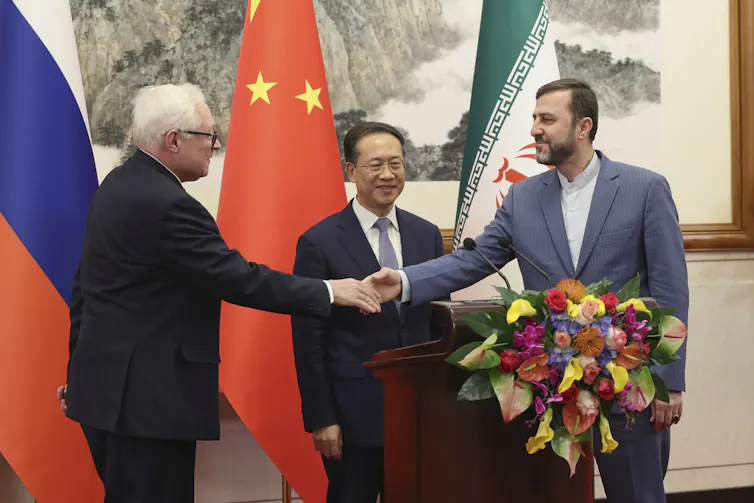
Yet under Presidents Xi Jinping and Vladimir Putin, China and Russia have sought to increase their footprint in the region through a variety of formal alliances and informal measures.
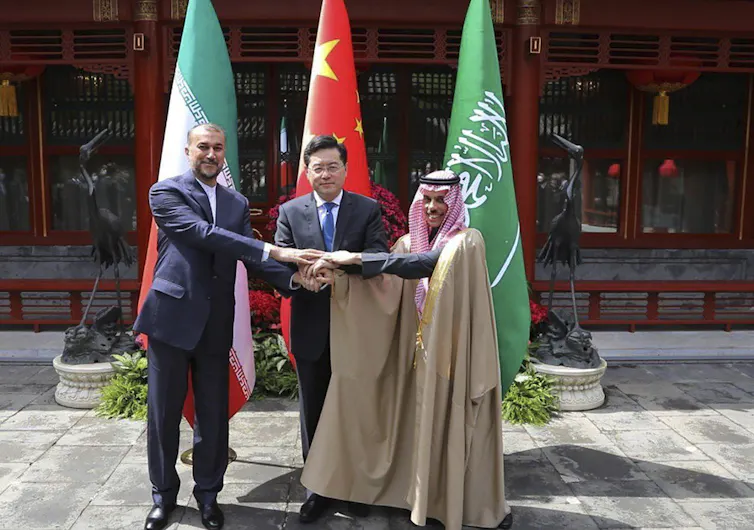
For Russia, this took the form of aligning with Iran, while also partnering with Tehran to prop up the now-ousted regime of President Bashar Assad during the Syrian civil war. Meanwhile, China increased its diplomatic profile in the Middle East, notably by acting as a mediator as Saudi Arabia and Iran restored diplomatic ties in 2023.
The irony of the latest Iran war is that it follows a period in which circumstances were unfavorable to Russian and Chinese aims of increasing their influence in the Middle East.
The fall of Assad in December 2024 deprived Russia of its one reliable ally in the region. And Trump’s May 2025 tour of the Gulf states, in which he secured major technology and economic deals with Saudi Arabia, the United Arab Emirates, Qatar and Bahrain, was aimed at countering China’s growing economic and diplomatic influence in those countries.
With Washington perceived as an increasingly unreliable protector, the Gulf states may seek greater security and economic cooperation elsewhere.
In expanding military, diplomatic and economic ties in the Middle East, Russia and China over the past two decades were exploiting a desire by Washington to move its assets and attention away from the region following two costly wars in Iraq and Afghanistan.
Trump’s decision to wage war against Iran directly contradicts the national security strategy his administration released in November 2025. According to the strategy, the administration would prioritize the Western Hemisphere and the Indo-Pacific, while the Middle East’s importance “will recede.”
In co-launching a war in Tehran with Israel, without any prior consultation with Washington’s other allies, Trump has shown a complete disregard for their strategic and economic concerns. NATO, already riven by Trump’s repeated threats to the alliance and designs on Greenland, has now shown further signs of internal divisions.
That offers benefits for China and Russia, which have long sought to capitalize on cracks between America and its allies.
The irony, again, is that the war in Iran came as Trump’s vision of the U.S. as the hegemonic power in the Western Hemisphere was making advances. International law and legitimacy concerns aside, Washington had ousted a thorn in its side with Nicolás Maduro in Venezuela and replaced him with a more compliant leader.
Iran’s closure of the Strait of Hormuz, where some 20% of the world’s oil passes, was as predictable as it was destructive for U.S. interests.
But for Russia, this meant higher oil prices that boosted its war economy. It also led to the temporary but ongoing easing of U.S. sanctions, which has provided Moscow an indispensable lifeline after years of economic pressure over the war in Ukraine.
While a prolonged closure and extensive damage to oil and natural gas infrastructure in Iran and the Gulf states no doubt hurts China’s energy security and economy, these were risks Xi appears willing to accept, at least for a time.
And by building up a domestic oil reserve and diversifying energy sources to include solar, electric batteries and coal, China is far better positioned to weather a prolonged global energy crisis than the U.S. Indeed, Beijing has made strides in recent year to encourage domestic consumption as a source of economic growth, rather than be so reliant on global trade. That may have given China some protection during the global economic shock caused by the Iran war, as well as push the economy further down its own track.
The more the U.S. loses control over events in the strait, the more it loses influence in the region – especially as Iran appears to be placing restrictions on ships from unfriendly nations.
Trump’s willingness to abandon talks to go to war, and the contradictory rhetoric he has employed throughout the Iran conflict, has weakened the perception of the U.S. as an honest broker.
That provides a massive soft power boost for Beijing. It was China that pressed Iran to accept the 14-day ceasefire proposal brokered by Pakistan. Indeed, China has slowly chipped away at America’s longtime status as global mediator of first resort.
Beijing has successfully mediated in the past between Iran and Saudi Arabia, and it attempted to do the same with Russia and Ukraine and Israel and the Palestinians.
In general, the Iran war adds weight to Beijing’s worldview that the U.S.-led liberal international order is over. Even if China benefited at some level from the war continuing, its decision to help broker the ceasefire shows that China is increasingly taking on the mantle of global leadership that the U.S. used to own.
And for Russia, the Iran war and the rupture between Trump and America’s NATO allies over their lack of support for it, shift world attention and U.S. involvement from the war in Ukraine.

Jeffrey Taliaferro does not work for, consult, own shares in or receive funding from any company or organization that would benefit from this article, and has disclosed no relevant affiliations beyond their academic appointment.
Politics + Society – The Conversation

 There is no greater enemy to a good hair day than humidity. The last thing you want is for all the hard work you put into styling your hair to go to waste the second you step out the door.
While…
E! Online (US) – Top Stories

Many different big chains boast their own private labels to ensure customers have quality for value, but who makes the peanut butter at Walmart?

Food Republic – Restaurants, Reviews, Recipes, Cooking Tips

The “Follow Your Arrow” singer says a strange sighting during a flight wasn’t a drone or satellite — and she’s convinced it was a UFO. See the photo for yourself and decide. Continue reading…The Boot – Country Music News, Music Videos and Songs
NEW YORK — A fear of losing again is already shaping how Democrats think about 2028.
Chants of “run again!” reverberated through the packed room as Kamala Harris spoke Friday at the National Action Network convention, a gathering of Black voters, lawmakers and power brokers that saw drop-ins from a steady stream of potential presidential candidates. But several Black attendees openly questioned whether anyone other than a straight, white man can win the White House.
“The Democratic Party, they’re going to have to consider … who can win? Who can win, Black, white, who can win?” the Rev. Kim Williams, 63, a New Yorker and registered independent said in an interview.
“I don’t think [the country is] ready for another different type of person,” said Annette Wilcox, a 69-year old New Yorker.
It’s an open question the party is grappling with in the wake of Harris’ decisive 2024 loss to President Donald Trump. Conversations with a dozen people on the sidelines of the Rev. Al Sharpton’s gathering found some lingering concerns that America remains too bigoted — and that as a result, the desire to diversify the highest reaches of government is in tension with the desire to win.
In interviews, several of the prospective 2028 Democrats themselves argued that anyone can win. They poured into the midtown Manhattan ballroom over the week to build their relationships with Black voters for what became a barely-hidden shadow primary.
Sen. Ruben Gallego, a first-term Democrat who won statewide in Arizona despite Harris losing the state, told POLITICO on the sidelines of the convention that the party shouldn’t let fear narrow who ultimately runs.
“If you got stuck into this idea of what an ideal character is … you could potentially miss some really great talent,” said Gallego, who leaned intohis identity as a Latino veteran in his 2024 campaign.
Maryland Gov. Wes Moore, another possible 2028 candidate, said that he doesn’t “know many people back in 2022 who thought that an African American who had never held political office in his life was gonna be the next governor of Maryland.”
“People want to know, does your message meet a moment,” he added.
On stage with Sharpton on Friday, Harris seemed to agree. She made her most explicit overture at running again for the presidency, telling the audience she was “thinking about it” — to loud cheers and applause. Her appearance at the convention energized an otherwise largely staid event.
But even Harris, the first Black and South Asian woman to become vice president, has tacitly acknowledged the limitations of the country.
In her latest book, she divulged that former Transportation Secretary Pete Buttigieg — another 2028 contender who also made a pit-stop at NAN — was her top vice presidential pick in 2024. But she didn’t select him because she didn’t believe the country was ready for both a woman of color and a gay man in the White House.
A spokesperson for Harris declined to comment.
Some women, from former first lady Michelle Obama to various convention attendees disappointed by Harris’ 2024 loss, have said the U.S. isn’t ready for a female president.
“I believe the current climate of this country is not ready for a Black woman as president,” Aaliyah Payton, 30, a middle school teacher in the Bronx, said while waiting to see Harris speak on the third day of the convention in a line that spanned far outside the convention room.
“If Kamala Harris is running as a Democrat, and there is another white man also running as a Democrat, she would have a tough time winning,” said 60-year-old Donna Carr, who lives in New Jersey. “It’s a man’s world.”
“I’m not going to lie, it may be too soon,” said 27-year-old New Yorker Justina Peña when asked if Harris should run again.
The same handwringing roiled the 2020 Democratic presidential primary, and voters ultimately selected Joe Biden — a more moderate straight white man — to block Trump from winning a second consecutive term.
The debate within the Democratic Party over what kind of candidate is electable played out again most recently in Texas, where the Democratic Senate primary was defined by tensions over race and concerns over which candidate could unify enough Democrats, independents and disillusioned Republicans to flip the red state. Voters chose seminarian James Talarico, a white man, over political firebrand Jasmine Crockett, a Black woman, in the end.
“We saw it with the race with Crockett, and I saw a woman say she wanted to vote for Crockett, but she knew she could not win against [a] white male Republican,” said Williams, the 63-year-old reverend.
Now, those conversations are already emerging for 2028 before a single Democrat has officially announced a bid for the White House. The question over 2028 ambitions hovered over Moore, Gallego, Harris, Buttigieg, Illinois Gov. JB Pritzker, Pennsylvania Gov. Josh Shapiro and California Rep. Ro Khanna this week — and while nobody said they officially are, nobody ruled it out. Kentucky Gov. Andy Beshear and Arizona Sen. Mark Kelly are slated to speak on Saturday.
Buttigieg has dismissed concerns over his viability, including in a direct response to Harris’ revelation of why she didn’t choose him as a running mate in 2024.
“My experience in politics has been that the way that you earn trust with voters is based mostly on what they think you’re going to do for their lives, not on categories,” Buttigieg told POLITICO in a September interview.“Politics is about the results we can get for people and not about these other things.”
Some of the Black voters at the conference similarly expressed frustration with the idea that candidates’ identities should be a consideration in the looming 2028 primary.
“My concern — biggest concern — is when we get into a crisis like this in this country, people want to go to the ‘center,’ which usually is right of center in my view. A lot of people get kind of left out,” said Wilcox, the 69-year-old New York voter.
“In my experience, or history I’ve had with the Democratic Party, I feel like when that happens, Black people get tossed to the side.”
Politics

 Sephora rouge members, it’s time to start saving! The Sephora Savings Event has officially kicked off, bringing savings to all of your favorite beauty products including shampoos for shiny…
E! Online (US) – Top Stories

You might expect Clint Eastwood to eat a hearty steak or a rich omelet for his breakfast, as a cowboy might, but he chooses something else entirely.

Food Republic – Restaurants, Reviews, Recipes, Cooking Tips