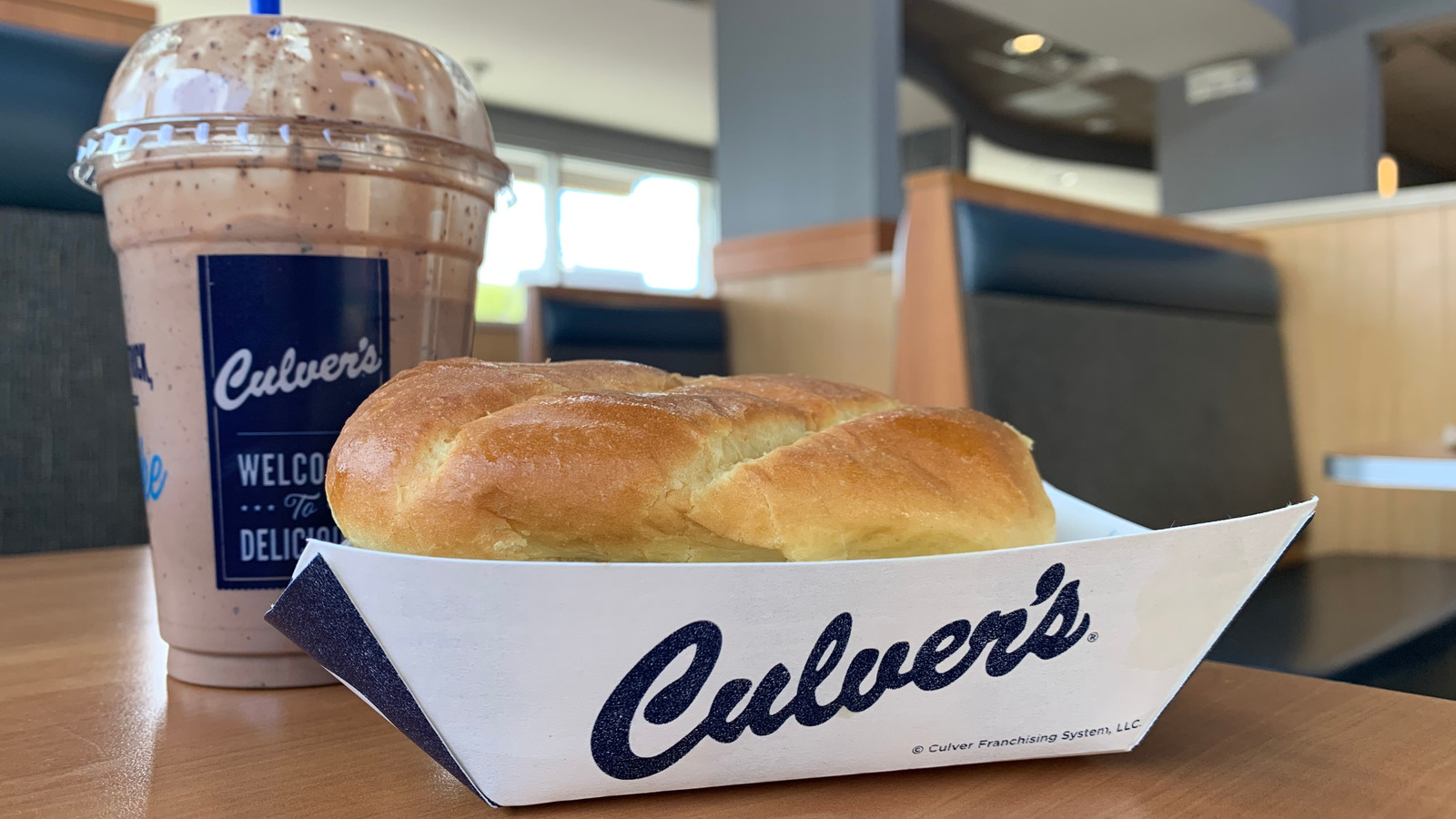
Slushy Magic Max promises to bring the convenience store slushy to customers with a no-mess, diy cup, but does this gadget shake out to all it claims to be?

Mashed – Fast Food, Celebrity Chefs, Grocery, Reviews

Slushy Magic Max promises to bring the convenience store slushy to customers with a no-mess, diy cup, but does this gadget shake out to all it claims to be?

Mashed – Fast Food, Celebrity Chefs, Grocery, Reviews

He’s bringing it back to his roots with his new release. Continue reading…The Boot – Country Music News, Music Videos and Songs
He’s bringing it back to his roots with his new release. Continue reading…Country Music News – Taste of Country
These frozen Mexican breakfast items from Walmart include everything from gluten-free and lower-carb options to gas station favorites and Southwestern classics.

Food Republic – Restaurants, Reviews, Recipes, Cooking Tips
Reading Time: 2 minutes
North West has dropped her new music video!
Just one week after abruptly canceling her tour mere days before it was set to begin, she’s offering no explanations.
Instead, she’s offering an unsettling new music video.
Fans of her EP, which she released earlier this year, already know the song.

North has released the “Aishite” music video.
The video, which has both a retro filter over much of it, shows North wandering the ruins of an abandoned school.
We see her sporting turquoise hair, facial piercings, and black teeth — a familiar look, at this point.
There is imagery of blood dripping, and she drops in and out of focus. Her face is not always visible.
Many have accurately compared the video’s aesthetics to a horror anime. That is extremely age-appropriate, given that North is 13.
“Just love me / Everyone betrays me,” North sings at one point.
“Can’t be no one’s friend,” she laments in other lyrics.
“I can’t let nobody in,” North then affirms, completing the rhyme.
This edgy song comes from her debut EP, as we mentioned.
N0rth4ever released on May 1 of this year. Many songs touch upon her status as a child born into celebrity.
Numerous comments on social media, even under the video itself, as if North is trying to reach the outside world with her lyrics and imagery.
Many adults find this sort of imagery disturbing when coming from a 13-year-old.
We have to emphasize that this, like North’s controversial fashion choices, is actually super normal for her age.
Developmentally, North is at an age where she pursues her own aesthetics and listens to her own music. (In her case, as a nepo baby, she also makes her own, but that’s not so standard.)
Her dark kawaii Hot Topic vibes are much more typical for a 13-year-old than the enormous wealth and involuntary fame into which she was born as the child of Kim Kardashian and Kanye West.
As for the tour, we still don’t have any real answers.
North had been scheduled to kick off her Kimokawaii tour with rapper Molly Santana on Wednesday, August 5.
On her July 30 Instagram Story, North simply said: “Sadly it isn’t happening anymore.”
This could mean anything from scheduling conflicts to being grounded to some sort of security concern to insufficient ticket sales.
Perhaps this music video, and others, will set the stage for a bigger and better tour in the future — one that really happens.
North West Drops ‘Aishite’ Music Video, Receives VERY Mixed Reaction Online was originally published on The Hollywood Gossip.
The Hollywood Gossip
For Americans, the name “Bush’s” is practically synonymous with baked beans, but for Walmart customers, an English label wears the baked-bean crown.

Mashed – Fast Food, Celebrity Chefs, Grocery, Reviews

John Rich, best known for being one half of the country music duo, Big & Rich, is pleading with Tennessee leaders to step in as more and more downtown Nashville businesses are on the verge of shutting down amid an ongoing struggle with rising property taxes.
The country star has been making a great effort to ensure his concerns are being heard. He has shared a powerful statement to his own social media platforms, spoke candidly with News 2 and even sat down with Tennessee House Speaker Cameron Sexton to address the significant tax spikes threatening the city’s live music scene.
In a new video shared with fans, Rich begins by asking, “When you think about Nashville, Tennessee, what’s the first thing that comes to mind? Is it live country music? I bet it is. I bet that’s why you come here, because you want to hear the best of the best. You want to go down and hear band after band. You want to hear that great live country music in what? Music City USA, Nashville, Tennessee.”

He went on to argue that the Mayor of Nashville and his administration have increased property assessments, leading to significantly higher taxes that he believes “make it virtually impossible for business owners around Nashville to stay in business.”
Following new property appraisals completed in 2024, updated tax bills went into effect in 2025, with some property owners seeing increases of up to four times their previous bills in just one year. Word began to spread more widely about this troubling news at the start of 2026 when Rob Mortenson, the head of the Broadway Entertainment Association, told FOX17 that the rising taxes could mean the end of many longtime establishments on Broadway.
“These are folks that have been there for 40 years on Broadway, and, you know, they can’t pay the taxes. Their option is, I was told, we’re either going to go bankrupt or go to jail, one of the two, because we literally can’t pay the taxes.”
WSMV 4 Nashville also reported that Tom Morales, owner of Acme Feed & Seed, indicated that he has found himself in the same unfortunate situation. He opened up about fearing for the future of his business after his property taxes went from $129,000 to $600,000.
These skyrocketing numbers are clearly impacting some of the most legendary honky tonks and country music establishments that make up the famed strip. Rich reiterates that several have already been forced to close their doors and if something isn’t done soon, there will be plenty more to follow, which will also have a negative impact on the tourism. He fears that country music fans will no longer have the live music to draw them into town.
“We’ve got a Super Bowl coming to Nashville in a few years. Can you imagine the Super Bowl in Nashville, Tennessee, and you look down Broadway and only about 30 or 40% of those neon signs have electricity still running to them? That’s what we’re looking at,” he stated. “You’re losing people, you’re losing massive business because live country music no longer exists down there.”
Rich continued, “This is a 911 kind of situation for our town, but actually for the state, because those tax dollars find their way into the school system, first responders, all kinds of things that citizens of Tennessee need. A lot of that money gets generated right downtown in Nashville. And it doesn’t matter if you’re a Democrat or Republican, you know that’s the math.”
Unwilling to back down, the “Shuttin’ Detroit Down” singer, alongside various business leaders, sat down for a meeting with Tennessee House Speaker Cameron Sexton on Wednesday, August 5 to explain the severity of the situation.
“I’m telling you, there were tears coming out of some eyes. There was anger. There was frustration. And there was honestly a sense of almost hopelessness, like we don’t know what to do. We’re going to have to shut our lights off next month or in 60 or 90 days.”
After asking the Speaker, “what can be done?” Sexton explained the next stop is to schedule a special session with Tennessee Govender Bill Lee.
Rich replied, “‘Can you commit today to ask the governor for a special session to talk about this issue? This is massive. You can’t let the music die, the live music scene die in downtown Nashville.’ He agreed.”
The singer proceeded to get Senate Majority Leader Jack Johnson (R-Franklin) to also agree to a meeting with Gov. Lee.
“He said, ‘Yep. Need to have a special session, ASAP. This is not okay. This is not good. And you’re right, it’s unsustainable. We got to figure something out.’”
Downtown business owner Barrett Hobbs, who attended the meeting alongside Rich, told News 2 that if businesses continue to close, Nashville and the state would be at risk of losing a major source of tax revenue.
“No business can sustain itself. If you’ve got an expenditure that’s $100,000 and then it goes to $600,000 in five months,” Hobbs said. “We can’t just call the city and say, ‘Hey, we weren’t expecting this. Can you give us two years to pay this increase?’ And that’s kind of where we are.”

Bill Miller, founder and CEO of Icon Entertainment & Hospitality, also told the Business Journal, “It’s not sustainable — business on Broadway is the lowest I’ve seen in all the time we’ve been here… This will absolutely lead to people going out of business. You’re going to have vacant storefronts, and the politicians can say I’m being dramatic, but the politicians don’t balance my books every month.”
Governor Lee has been serving since January 2019, meaning he will finish out his second term in January 2027 and cannot run again due to state term limits. With less than six months left in office, John Rich is urging the state leader to “be a honky tonk hero” and save the live music in downtown Nashville.
“Have that meeting. Answer that call. Have that special session. Bring them all in. The business leaders will show you the math, will show you what’s happening and how unsustainable and crushing it is. It is absolutely brutal what is happening to some of these businesses. Please take that meeting…Please have that session, and please come with a solution. Keep Music City, Music City. We’re counting on you, governor. Be our honky-tonk hero. I know you can do it. All right. God bless you. God bless Tennessee. God bless America,” Rich concluded.
The post John Rich Urges Leaders to Protect Nashville’s Live Music Scene: ‘A 911 Kind Of Situation’ appeared first on Country Now.
Country Now
Reading Time: 2 minutes
James Haven, Angelina Jolie’s brother, has come out.
This announcement comes a relatively short time after he split from his wife.
Coming out at 53 can seem like a daunting prospect.
But, for Haven, it was time to live as himself. And his wife’s commentary may surprise you.

In August of 2024, Haven and his wife, The Real L Word star Romi Imbelli, separated.
They had only been married for 15 days.
In March 2025, they successfully had their marriage annulled.
During a recent livestream, Haven explained that he came out to Imbelli after their annulment.
It is important to note that the Thursday, August 6 livestream was with Imbelli. We’d say that she took it as well as expected.
Haven is gay.
“It was never about pretending to be someone else,” he explained, reflecting upon his childhood interests.
He added: “It was about letting a part of myself shine that had always been there.”
Haven went on to affirm that coming out “isn’t about becoming someone new.”
Instead, he emphasized that it is about “allowing everyone else to meet the person who has been here all along.”
Not everyone comes from a family that they believe will love and accept them for being who they are.
Haven’s sister is Angelina Jolie, and she is obviously not the issue.
Their father is Jon Voight, who has become a notorious conservative and an outspoken supporter of the Trump regime over the past decade.
On Thursday, Haven expressed a hope that “family and others can choose love over fear, understanding over judgment, and connection over the beliefs that may have kept us apart.”
He aspired: “I hope they can look beyond the labels and simply see me with the same heart, the same laugh, the same soul they’ve always known.”
For her part, Imbelli was deeply supportive of her ex-husband.
“I didn’t want to see it. I didn’t want to believe” that he was gay, she explained.
“I knew it and I wanted to support you and love you,” Imbelli reasoned. “And then I didn’t want to believe it because then it would mean losing you in that capacity, which I couldn’t.”
On the stream, she affirmed that Haven will remain her “life partner” but not her spouse. “You are not my close friend. You are my love. And you happen to be gay.”
That’s actually really beautiful! It’s a good reminder that it’s never too late to come out. It can be a daunting prospect, but many aspects of your life will improve faster than you think.
James Haven, Brother of Angelina Jolie, Comes Out at 53 After Short-Lived Marriage was originally published on The Hollywood Gossip.
The Hollywood Gossip

Reading Time: 3 minutes
We’ve known for a while that Jax Taylor is dating Lori Krebs, the former publicist and close friend of his ex-wife, Brittany Cartwright.
But we figured it was just a fling. This is Jax Taylor, after all.
Of course, falling in love with Lori and launching a serious relationship is pretty much the worst thing Jax could do in this situation, so naturally, that’s exactly what he did.

Speaking with paparazzi outside a Los Angeles gym this week, Taylor didn’t hesitate when asked about Krebs.
“I love [Krebs] to death. You can’t help who you fall in love with. Everybody deserves to find happiness,” he said (via Page Six).
The former Bravo star went on to gush about the relationship, saying:
“I’m in the happiest place I’ve ever been, and I couldn’t be happier right now. My mental health has been so amazing since I’ve been with her.”
Taylor also called Krebs “the best thing that’s ever happened” to him and said the two “love each other very, very much.”
The public declaration comes just weeks after Taylor confirmed he was “taken” without identifying his new partner following the publication of vacation photos showing the pair together in Puerto Vallarta.
Taylor’s comments arrive on the heels of a very public response from Cartwright, who has made it clear she feels deeply betrayed by both her estranged husband and her former friend.
During recent interviews, Cartwright described Krebs as someone who had been like family for years, saying the publicist helped her through some of the darkest moments of her marriage before beginning a relationship with Taylor.
She has since fired Krebs and didn’t hold back when discussing the situation publicly.
Taylor acknowledged that Cartwright has “every right” to be upset, but insisted “a lot of the stuff she’s saying is untrue.”
He also argued that many of the issues she’s raising stem from years ago, pointing to the extensive rehab and mental health treatment he’s undergone since the couple separated in 2024.
“I’ve gone through countless amounts of rehab [and] countless amounts of mental health facilities,” Taylor said, adding that he believes it’s unfair for old issues to continue defining him.
Questions about the timeline have fueled much of the controversy.
Taylor and Krebs first sparked speculation back in 2024 after appearing together in social media photos, though those rumors were denied at the time.
According to a source who spoke with Page Six, however, the romantic relationship didn’t begin until several months ago.
The insider said both Taylor and Krebs were single when they got together and that their relationship developed naturally while Krebs supported Taylor through his struggles with substance abuse and mental health.
“This is the first relationship he’s been in sober,” the source claimed, adding that Taylor is “taking it very seriously.”
Krebs has not commented publicly on the relationship. She’s a publicist, after all, so she probably knows what sort of PR headaches will come with dating Jax.
Jax Taylor Says He’s In Love With Brittany Cartwright’s Friend Lori Krebs: … was originally published on The Hollywood Gossip.
The Hollywood Gossip

Since 2016, when Donald Trump shattered the Democrats’ blue wall by winning working-class voters across the Midwest, a cottage industry has sprung up on the left dedicated to answering a single question: How can Democrats win back the working class?
The answers come in different forms.
Sometimes it is veteran Vermont Sen. Bernie Sanders, railing against “the oligarchs.”
Or it’s Connecticut Sen. Chris Murphy, who after the 2024 election declared, “Democrats must reclaim our identity as the party of the working class.”
Or a new generation of candidates – tattooed veterans, mechanics, bartenders – whose biography is supposed to do the political work that policy has not.
Graham Platner, the Maine Senate candidate who had become the left’s latest blue-collar savior until he ended his campaign in the wake of a sexual assault allegation, put the theory in its most unguarded form.
“We are in a form of class war,” he says. “And if the Democratic Party is going to have a future with working people, it needs to pick the side of working people.”
The most recent high-profile progressive candidate to embrace those working people: Abdul El-Sayed, whose economic populism helped him win the 2026 Michigan Democratic Senate primary. Called a “working class” champion by the United Auto Workers, El-Sayed performed best in wealthier, higher-educated areas of the state. His opponent, Haley Stevens, drew more support from Detroit and working-class communities.
Still, El-Sayed’s victory has led to a familiar refrain: Somewhere out there is a latent working-class majority, held together by shared economic grievances, waiting to be politically reassembled to vote for Democrats. The New Deal did it – “economic populism” can do it again.
I’m a political scientist who has written extensively about rural and working-class communities. I believe it is an open question whether these reformist Democrats are really interested in understanding working-class voters on their own terms. Because working-class voters, as they tell us themselves, are not simply waiting to be activated by the right program, messenger or phrase. “Fight the oligarchy” probably isn’t going to do it.
Working-class voters have a worldview. For 50 years, it has been growing less compatible with the Democratic Party’s – not because working-class voters changed, but because Democrats did.
Since the early 1950s, the American National Election Studies has asked respondents whether they think of themselves as members of the working class. This article uses my analysis of that data.
While a larger proportion of the electorate has obtained a college degree and household incomes have risen, the share of Americans who consider themselves working class has remained remarkably stable: roughly 35% of voters for the past 70 years, 38% in 2024.
Working-class identity is more durable and culturally grounded than a description of who isn’t a billionaire. It’s a specific way of looking at the world.
Conventional definitions of the working class often miss how people understand their own place in society. In the 2024 American National Election Studies, for example, 21% of those who identify as working class have a college degree, only 5% belong to a private-sector union, and 37% own stocks. Conversely, most Americans without a college degree do not identify as working class.
Working-class voters have never been a predominantly Democratic group – not even at the height of the New Deal coalition. Based on the American National Election Studies self-report measure, the working-class share of the Democratic coalition peaked around 56% in 1960 and has fallen more or less continuously since, sitting at just about 30% today.
Meanwhile, the share of working-class voters who identify as Democrats has been declining for half a century: A majority did so in 1958, but not since.
Working-class voters have not become Republicans. Only in 2020 and 2024 – the first time in the survey’s history – did more working-class voters identify as Republican than Democrat, and even then by narrow margins.
The data shows a politically homeless working class: estranged from the Democrats, not captured by the Republicans, stuck in the middle with diminishing attachment to either party.
What drove them out?
A segment of the progressive left has a ready answer: Democrats abandoned working-class voters economically – on trade, wages and industrial policy. Working-class voters responded rationally. Fix the economics and the coalition comes back.
Trade is the strongest argument. In 1988, roughly 74% of both Democrats and working-class voters groups favored limits on imports to protect American jobs.
By 2024, only 26% of Democrats favored limits, while 54% of working-class voters continued to do so.
Unlike most Democrats, many working-class communities do not see globalization in their interest. Running alongside the trade gap is a widening divide over values that no tariffs can fix.
In 1984, Democrats and working-class voters broadly agreed that treating people more equally would mean fewer social problems. A divergence opened after 2008 and accelerated after 2016, with Democrats now 28 points more likely than working-class voters to think we should worry more about equality.
In 1986, half of mainstream Democrats and a slightly smaller percentage of working-class voters agreed with the idea that Black Americans don’t succeed because they don’t try hard enough. By 2024, Democratic agreement had collapsed to 13%. Working-class voters also declined, to 32%.
That gap is not primarily a story about rising working-class racial resentment. It’s about the Democratic Party’s rapid post-2008 shift toward a worldview that places far greater explanatory weight on structural barriers and far less on individual effort and personal responsibility.
Working-class voters, who historically understood their own lives through a framework of hard work and earned reward, did not shift so dramatically.
On cultural questions, the pattern persists: Working-class voters did not move right in reactionary revolt. Democrats moved left.
In 1986, similar levels of Democrats and working-class voters agreed with the statement “This country would have many fewer problems if there were more emphasis on traditional family ties.” By 2024 a 25-point gap emerged.
On whether religion is an important part of their life: a near-zero gap through the early 1990s, but 17 points by 2024. On abortion, a 3-point gap in 1980 became 30 points in 2024. Whether immigration levels should be increased, the two groups were virtually identical in 2000 – around 8% support. By 2020 Democrats were at 48%, working-class voters at 24%.
Even where working-class voters nominally agree with a Democratic policy goal, they don’t trust the institution asked to deliver it – a distrust decades in the making.
In 1958, working-class voters and Democrats were within 5 points of each other on whether government wastes a lot of tax money. By 2024 that gap reached 27 points – not because working-class voters lurched toward anti-government extremism, but because mainstream Democrats became dramatically more trusting of government as an instrument of social change.
Working-class voters are 17 points more likely than Democrats to say people like them have no say in what government does. In 2024, 88% of working-class voters and 75% of Democrats said government is run by a few big interests. Both groups agree the system is captured.
Yet the Democratic policy response, invariably, is to expand the system.
On support for expanding government – from healthcare to jobs to environmental programs – Democrats and working-class voters have diverged dramatically since the 1980s. By 2024, there were approval gaps of between 20 and 30 points on providing government health insurance, environmental spending and a guaranteed jobs program.
On every major plank of the progressive economic agenda, Democrats are now substantially to the left of the workers they claim to champion.
Working-class voters have been telling pollsters for 60 years that the political system doesn’t hear them. Democrats, over the same period, have grown more comfortable with the institutions working-class voters have increasingly less faith in.
This distrust stems from specific experiences: deindustrialization that happened on government’s watch, trade deals that economists endorsed and workers paid for, a 2008 financial crisis response that saved the banks and foreclosed on their homes, an opioid epidemic that regulators missed entirely.
To be fair, this is precisely what the new crop of reform candidates say they want to fix. The argument that the right candidate can move the needle is not crazy. Candidate quality matters. Personal trust can substitute for institutional trust, at least at the margins.
But economic-grievance politics is a very small slice of what working-class voters are telling us. The data documents a comprehensive, decades-long divergence in how working-class voters and mainstream Democrats understand fairness, government, personal responsibility and social change.
Reducing that to class war jams working-class voters into a prefabricated progressive agenda rather than taking seriously what they are actually saying.
This is an updated version of a story originally published on June 2, 2026.
![]()
Nicholas Jacobs does not work for, consult, own shares in or receive funding from any company or organization that would benefit from this article, and has disclosed no relevant affiliations beyond their academic appointment.
Politics + Society – The Conversation