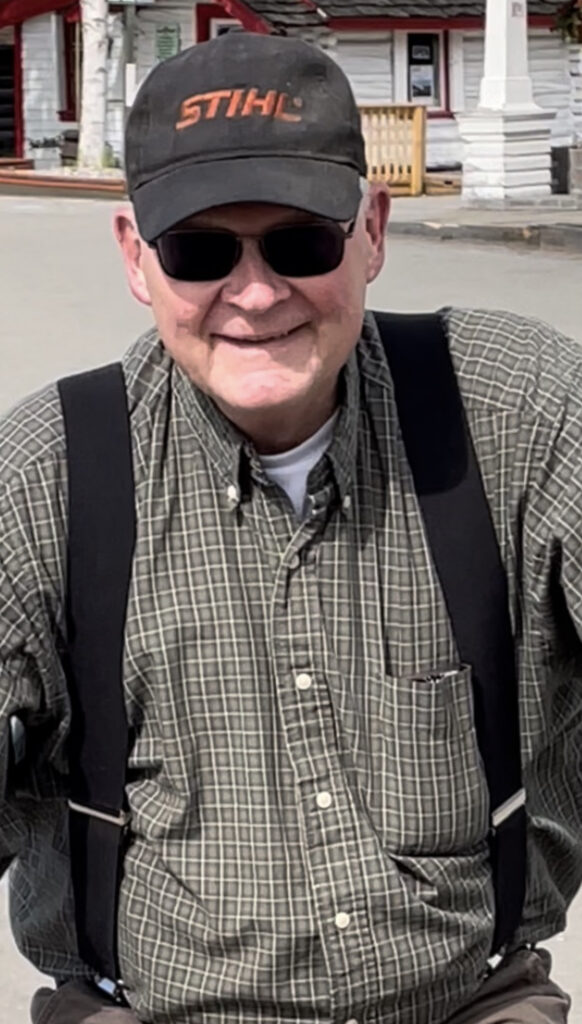
Gerald “Jerry” Everett Blood, beloved husband of Barbara Blood and devoted father and grandfather, passed into the Lord’s presence surrounded by his family Sunday, March 22, 2026, in Fairbanks after a 10-year battle with chronic lymphoma and heart disease.
He was born on August 22, 1944, in Douglas, Ariz., while his father served in the U.S. Army. He and his parents moved to Seattle when he was 2 years old. In 1955, the family moved to Fairbanks, where his father worked as a meat cutter at a local grocery store.
Jerry graduated from Lathrop High School in 1963 and attended University of Alaska for one year. He was drafted into the Army in 1965 and served one year in Vietnam from 1966 to 1967.
After discharge, he joined his family in Anchorage and followed in his father’s footsteps as a meat cutter, working at Anchorage Cold Storage. In 1978, he began work at Park’s Place grocery in Glennallen. He met Barb while she was serving as a missionary nurse at Faith Hospital.
They went on their first date in July 1980, got engaged in September and married in December of that same year. Barb described it as a “whirlwind romance,” but one that would last 45 years.
They were blessed with two children, Janie in 1983 and Matthew in 1985. The family moved to Haines in 1990 for Jerry to begin work as a meat cutter at Food Center. After serving 13 years as a volunteer firefighter/EMT, he was hired by the Haines Volunteer Fire Department as a paid employee for the remaining years of his working life, retiring at 66.
Jerry turned his life over to his Lord and Savior, Jesus Christ, through the ministry of Victory Bible Camp in 1972. For five years, he would leave his job in Anchorage for the summer and volunteer as the horse wrangler at the camp. He went on to become an elder and deacon, Sunday School teacher, and kids’ club leader, both at Glennallen Community Chapel, and later at Port Chilkoot Bible Church in Haines.
Throughout his years in Glennallen and Haines, he was known as a good and kindhearted man, hard worker and committed volunteer. He was well known for his woodcutting skills. Even after he didn’t need wood to heat his own home, he continued cutting, splitting and stacking wood as a gift for others. He was famous for his neat stacks of firewood, having three years’ worth of wood stacked, ready and dried for the cold winters.
He was a loving husband, father and grandfather. He adored his five grandchildren, both in Sitka and in Fairbanks. In 2020, he and Barb bought a condo to be “snow birds” in Sitka, but because of his failing health, they made Sitka their permanent residence in 2025. He loved living near his two Sitka granddaughters, but made frequent trips to Fairbanks to see the grandkids there as well. His Fairbanks family loved traveling to Sitka to spend time with him.
Survivors include his wife, Barbara; two children, Janie Hall (Tim) and Matthew Blood (Holly); five grandchildren, Natalie and Grace Hall and Taylor, Makenna and Charlie Blood; one brother, Derryl Blood (Jenett); and two brothers- in-law, Bob (Carol) and Paul (Wendy). He was preceded in death by his parents and two brothers.
His ashes will be laid to rest at Sitka National Cemetery at a later date.
Donations in his memory may be to Echo Ranch Bible Camp Haines, PO Box 210608, Auke Bay, AK 99801.
In Driver’s Eye with James Hinchcliffe, the six-time INDYCAR winner will bring you inside the mind of a racer while breaking down the nuts and bolts of the sport for fans. I am itching to get back to the track, and I don’t think I’m alone in feeling that way after INDYCAR’s two-week break (decidedly not a vacation, though). And what a track we are going to… The Acura Grand Prix of Long Beach is the fifth stop for INDYCAR this season, and it is easily near the very top of the best race weekends of the year. In Southern California, it’s one of the longest-running races we have, and, after the Indianapolis 500, has to be at the top of the list of races drivers want to win the most. That is in equal parts because of the decades of history, the incredible crowds and atmosphere and the unique challenges of the race track itself. I was fortunate enough to have a lot of success at Long Beach. There, I got my first Indy NXT (then called Indy Lights) pole position and win, my first INDYCAR top-5 finish and podium, and I managed to take the checkered flag back in 2017. That win stands as one of the biggest of my career because of the status that this race holds in motorsports world. That said, let’s talk about what makes this track so much fun for drivers. THE GOOD, THE BAD AND THE FAST: LONG BEACH Long Beach has a lot of unique qualities for a street track. Yes, it has walls, bumps and surface changes, which we see on pretty much all street courses. But there are a few standout attributes that make it different — and difficult — from behind the wheel. First, you have a decent amount of elevation for a street course. TV doesn’t always do it justice, but as soon as you head into Turn 4, the track starts to fall down quite a bit. That really affects the balance, as it has a tendency to make the front end wash out and lose grip, which pushes you closer and closer to the exit wall. We normally see a lot of drivers brush — or smash — the exit wall there. If you survive that, then you’re dealing with a quick change as the track shoots uphill on the brake zone for Turn 5, which totally changes how you approach that corner. Obviously, going uphill means the car stops faster for the same brake pressure (thanks, gravity!), so you have to recalibrate your brain a bit to make sure you get the braking just right. If uphill makes the car stop faster, you guessed it, downhill makes the car harder to slow down! Welcome to Turn 6. The track goes downhill aggressively on the entry, which means it is so easy to carry too much speed and end up very wide, or worse, in the run-off. Then mid-corner, it climbs again as you’re getting to power before falling away again on the entry to the next corner, Turn 8. Bit of a roller-coaster feeling in that section of track. Next, this track has a few important curb strikes — literally, purposely, hitting the curb — that are key for faster lap times. When you think of tracks like the streets of St. Petersburg or Arlington, the curbs are either painted on the track — so not an issue to drive over — or so big you can’t even think of touching them in an Indy car. Long Beach has two curb-strike opportunities, Turn 1 and Turn 5, that you can really use to pick up speed. Turn 5 is especially critical to nail. Too little curb means you don’t get the car turned enough and risk hitting the outside wall. But too much curb and the car bottoms out, lifts the front wheels off the ground and… you risk hitting the outside wall! It’s tough to be consistently fast through there, especially on cold or old tires. And finally, the geometry of the corners themselves stand out. Many street tracks feature a lot of 90- and 180-degree corners because you are pretty restricted by the literal streets you’re driving on, which tend to be straight roads. But Long Beach has a unique curved front straightaway and some great corners — like the 2-3 complex, Turn 6 and Turn 10 — that are unlike any other corners on the calendar. Oh, and let’s not forget the famous hairpin, Turn 11. It is the slowest corner of the entire season — slower than pit lane speed — at around 30 miles an hour. And it feels terrible. Indy cars are not designed to go 30. They are designed to go 230! So getting through one of the most iconic corners of the year is so tough and not friendly behind the wheel of one of these beasts. SOUND LIKE AN INDYCAR EXPERT On Sundays on the broadcast, you always hear us talking about the push-to-pass system — as long as we are on a road or street track, because we don’t use it on ovals! At a place like Long Beach, where passing is at a premium, there are a few different ways you can use this tool to help your race. The most obvious one is using it to make a pass. The run out of Turn 11, along Shoreline Drive, is the best place to use it and set up a pass into the first turn. But you have to be careful because you only get 200 seconds, and that’s a long run down the front straight. Get a little too eager, and you might not have enough left for the other times in a race where you need it. For instance, you might need some seconds banked to play defense when a car gets a good run on you or during your in-and-out laps of a green-flag pit stop. The time — and, as a result, positions on the track — you can gain back by having strong in-and-out laps is huge, so drivers will often spend a whole lap spraying the P2P on their way into the pits, and then again on the out lap to get back up to speed. But you don’t want to burn it all on the last pit stop of the day, just in case you have a late restart and need some to attack or defend before the checkered flag. Showing discipline on the button is harder than it looks, but it’s crucial. We’ve talked about the when and why of P2P, but let me quickly touch on the how. We say it a lot, we know it gives you a boost, but what is really happening to these 2.2-liter, twin-turbo V6s when a driver pushes the button? The extra power comes from two different areas. First, the rev limit goes up. Under normal conditions, the engines are limited to 12,000 rpm, which is already pretty impressive. Typical street cars don’t go much higher than 5,000 rpm most of the time! But on the P2P button, that limit goes up to 12,200 rpm. Might not sound like much, but every rev counts when you’re racing a stopwatch. To help get it up to that limit faster, the on-board computer that controls the engine, called the ECU, allows the amount of boost pressure from the turbocharged engine to sneak up ever so slightly. It delivers a rev increase and roughly 10% extra in boost pressure, which simply means more power from the turbocharger. These two things combined give the driver about 50 extra horsepower to play with. Your heart wants to hit it every lap! But your brain knows it will run out fast and that’s not the best way to win the race. 1 FOR THE ROAD I hate that we are doing this again, but I have to sign off this week by taking a moment to remember Jim Michaelian, the president and CEO of the Grand Prix of Long Beach. He died last month at 83 years old, but his impact will endure. Jim was due to oversee his last race this year, something he had done as president since 2001, at an event he had helped build for more than 50 years. So much of what makes this race so special — to the teams, drivers, fans and people of Long Beach — was because of the heart and soul that Jim put into this race. His legacy of creating the greatest street race on the continent will be remembered forever. Thank you, Jim. MORE DRIVER’S EYE:Latest Sports News from FOX Sports
Healy Power Plant is seen in this undated photo. (Image courtesy of Dan McIntosh)
Earlier this month, Golden Valley Electric Association held a community meeting in response to growing frustration among its members. The standing-room-only crowd at the Noel Wien Library included many familiar faces involved in Fairbanks energy issues. But what stood out were the people I didn’t recognize: residents who don’t typically show up to these kinds of meetings, clearly searching for answers to their high energy bills. A military mom with a toddler. A retired, disabled veteran trying to make ends meet.
GVEA CEO Travis Million laid out some of the key challenges facing the Interior — not only around cost, but supply as well. One issue that received particular attention was the absence of inexpensive “economy power” from Southcentral via the Alaska intertie.
Historically, GVEA has had two primary ways to access lower-cost power from Southcentral, much of it associated with Cook Inlet gas. One is to purchase gas directly from producers and contract with Southcentral utilities to generate electricity using that gas and send it north over the intertie. The other is to purchase excess generation from those same utilities — regardless of the fuel source — which can often be produced at relatively low marginal cost.
But with tightening gas supply in Cook Inlet, neither option is available — there simply isn’t surplus to go around. As a result, deliveries of lower-cost gas-fired power to the Interior have been declining for some time, but last year was the first time they effectively dropped to zero.
The result is that Fairbanks is replacing that lower-cost supply with much more expensive diesel-based generation — this winter, that has averaged around 250,000 gallons per day. And much of that fuel is being burned in older, less efficient units. GVEA has been trying to move away from fuel oil for years, so investing in new oil-based generation hasn’t made much sense.
The cost implications are significant. As GVEA noted during the meeting, changes in global diesel prices due to the war in Iran are now translating more directly into local electricity costs, not to mention the cost of heating oil.
To put this in perspective, each $1 increase in diesel prices corresponds to roughly $250,000 per day in additional expenses for GVEA — about $7.5 million more per month in generation costs.
The implications are being felt directly in residents’ pocketbooks. Right now, residential customers in GVEA’s service territory pay an effective rate of about 32.9 cents per kilowatt-hour (kWh). That’s roughly 7–10 cents per kWh higher than what residents in Anchorage and the Mat-Su pay. Nearly all of that difference comes from the Cost of Power Adjustment — the COPA. This is the line item on your bill that reflects how current fuel costs compare to a set base rate. At around 12.8 cents per kWh, GVEA’s COPA is two to three times higher than that of Anchorage residents. That’s the story: we are spending far more on fuel. And that takes us right back to the 250,000 gallons of diesel per day.
To close out the presentation, GVEA outlined several steps it is taking to address the high cost of fuel, including plans for new local generation such as a second LM6000 in North Pole — essentially a jet engine adapted for power generation. It would join an existing unit running on naphtha refined at the Petro Star facility from oil pulled directly off the pipeline. The project is expected to go before the board next month, but even if approved, it would likely take three years to come online. A 30-megawatt wind project in Delta is also in the works, but it has recently encountered permitting delays at the federal level.
When the floor opened for questions, hands shot up immediately. What about solar? Nuclear? How much power do the military bases consume? How much is your salary—can’t we cut costs somewhere? And don’t we have cheap local coal?
The bottom line is that none of these options fully address the immediate challenge of high energy costs — at least not in the short term. Fundamentally, Fairbanks is not particularly well positioned geographically when it comes to energy resources. We lack significant hydro potential, and we are not located near a major natural gas resource like Cook Inlet or the North Slope.
We do have coal, and it is already an important resource. The two mine-mouth plants in Healy make up a significant share of GVEA’s baseload and are, arguably, among the lowest-cost sources of reliable generation available to the system. But they’re not without challenges. I’ve heard anecdotally that Healy Unit 2 has been giving operators and dispatchers fits this winter. It’s definitely not performing like the steady, dependable baseload resource that coal is often assumed to be.
Then there’s the UAF coal plant. I work on campus, and around mid-winter I started to notice that emissions from the smokestack were less consistent than I expected. So I began paying closer attention. By my count, the plant has operated roughly 28 days since January 1st — about a quarter of the time.
When it’s offline, UAF shifts to burning heating oil to heat the campus, which is a higher cost fuel than coal. It then purchases electricity from GVEA, which in turn places even more demand on a system that is already relying heavily on diesel generation. This layering effect increases overall liquid fuel use locally, putting additional strain on supply to the point where fuel is now being trucked up from the refinery in Valdez to meet demand. I suspect we’re in for a sobering financial realization when UAF’s energy bills are finally tallied.
The Healy Power Plant is seen in this undated image. (Photo courtesy of Dan McIntosh)
Is Fairbanks Rural Alaska?
In rural Alaska, energy costs are a major burden — one that families and communities deal with every day. Fuel must be imported over long distances, and power systems remain largely diesel-dependent, driving electricity prices to very high levels. To address this issue, the State of Alaska developed Power Cost Equalization, or the PCE program, around 40 years ago. The idea was that when investments were made by the state, such as in hydroelectric projects that benefited one community or region, other money would be put aside to help subsidize costs in diesel dependent communities.
In statute, the PCE program is designed to equalize the cost of electricity for residential customers to something close to the average of Anchorage, Fairbanks and Juneau. These locations were selected as the major population centers at the time the program was created. It was assumed that each one of these communities would have access to relatively low-cost power that was at least in part state-subsidized: Juneau through the Snettisham hydroelectric project, and Anchorage, the Kenai Peninsula and Fairbanks through interconnected infrastructure supported by state investment in both generation and the transmission backbone now known as the Alaska Intertie.
Under this framework, rural communities would receive a subsidy to bring residential rates closer to that urban benchmark. The intent was that, at least in theory, all residential customers across the state would have access to reasonably comparable electricity rates — something akin to a shared, or “postage stamp,” average.
In practice, however, things work differently. The relatively high rates in Fairbanks are effectively canceled out by the very low-cost hydropower in Juneau. And because Chugach Electric Association in Anchorage sells the largest share of electricity, Anchorage ends up disproportionately influencing the so-called “PCE base rate” — the “floor” price that rural residents pay after the subsidy is applied.
For example, the PCE base rate last year was 19.92 cents per kWh, which in turn was largely derived from Chugach’s 2024 average rate of around 21 cents per kWh. If a rural utility is well run and doesn’t have a lot of non-allowable costs inflating its rates, rural residential customers should pay something close to that level — at least for the first 750 kWh per month which is covered by the program, which is a reasonable amount for most households.
This has worked out well for rural residents, and is a cornerstone program for making living costs slightly more affordable in rural Alaska. But Fairbanks is struggling.
In 2025, Fairbanks residents paid about 11.5 cents per kWh more than residents in places like Akiak, Akutan, Anaktuvuk Pass, Atmautluak, and Atqasuk. Those are just the communities starting with the letter “A” in the annual PCE report published by the Alaska Energy Authority, that have managed to hit that PCE floor of about 20 cents per kWh.
Looking across all 188 communities that received PCE last year, Fairbanks residents paid more than about 140 of them. That’s sobering. And if the goal of the program is to offset diesel costs, consider this: GVEA burned more diesel fuel last year than all of rural Alaska combined. This year, it won’t even be close. Our 250,000 gallons per day dwarfs the roughly 70,000 gallons rural Alaska consumes on average for power generation.
So what does this mean? It raises questions about how Fairbanks fits within the broader structure of Alaska’s energy system. Should it be viewed more like rural Alaska in certain respects? Should we consider expanding the PCE program to cover Fairbanks residents? For many, that idea is heretical — and not without reason. PCE currently serves about 80,000 residential customers; extending it to GVEA would effectively double the program.
Some of my colleagues have suggested this is a temporary disparity, driven by the loss of gas-fired economy power, and that rates could moderate over time. But looking at historical data, Fairbanks has always been above the PCE base rate benchmark — roughly 10 cents per kWh higher for virtually all of the past decade.
So why are we noticing it so much more now? It may be that rates are reaching a breaking point for local residents. Crossing the 30 cents per kWh threshold stands out as a kind of high-water mark — likely because, historically, it is. But the floodwaters are still rising. I would not be surprised to open my bill in July and see rates approaching 35 cents per kWh.
So what about the Alaska intertie?
When Alaska lawmakers began shaping their vision for an equitable energy system, the solution for Fairbanks was, in part, the Alaska Intertie. The idea was that physical interconnection would allow lower-cost power to move across regions, benefiting everyone connected to the grid. So why hasn’t it worked as intended?
Part of the challenge is that while the system is connected physically, it’s not integrated operationally. This means the system is not dispatched as a single, coordinated grid where the lowest-cost generation is brought online first for the benefit of all customers. Instead, it continues to function more like three loosely connected regions — the Kenai, Southcentral, and the Interior — each making decisions within its own boundaries.
The result is that some of the most efficient generation is not fully utilized, while higher-cost resources continue to run elsewhere on the system. This dynamic is a classic prisoner’s dilemma: the best overall outcome comes from cooperation, but each utility is incentivized to act in its own interest because that is what it can directly control.
If this were happening in the Lower 48, utilities would likely be required to operate under a more coordinated system due to regulatory frameworks established decades ago to support regional power markets. Alaska, however, falls largely outside of thoseFederal Energy Regulatory Commission requirements, which are tied to interstate transmission and wholesale power markets. Because Alaska’s grid does not cross state lines, it is exempt from many of these rules.
One result is that the governance structure of the Railbelt has evolved differently — and in some ways, more slowly. Without the same regulatory drivers, the system has remained more fragmented, with each utility continuing to operate largely within its own footprint.
This has implications across the grid, but the effects are not evenly distributed. Communities at the edges of the system tend to feel these dynamics most acutely. While this commentary has focused on Fairbanks, similar pricing pressures can be seen in other peripheral areas, including Homer Electric Association and the City of Seward, albeit for somewhat different reasons.
The fix is ultimately a governance fix when it comes to the Railbelt. We can’t build our way out of high energy prices — at least not in the near term. And the reality is that high prices are going to be with us for a while. That doesn’t mean we are without options. But it does mean that the most meaningful progress will come not from the next project, but from how we choose to operate the system we already have.
Today, we are not consistently dispatching the lowest-cost resources across the grid, nor are we planning and operating the system as a single, coordinated network. That gap has real consequences. It means we carry unnecessary costs, underutilize our best assets and expose some regions — particularly those at the edges of the system — to higher and more volatile prices.
We have done hard things before. We built legacy hydropower projects around the state that continue to benefit residents with access. We also created mechanisms to share resources across communities through the PCE program. And we have taken meaningful steps toward greater coordination on the Railbelt as well. In Southcentral, utilities now operate more closely together through coordinated dispatch arrangements, and regionally we have established organizations like the Railbelt Reliability Council and the Railbelt Transmission Organization to support more integrated planning and operations.
These are important steps in the right direction — but they are still incomplete. The next step is less about infrastructure and more about alignment: establishing the structures and incentives needed to operate the Railbelt as a single system. Until we do that, we will continue to fall short of what this grid was designed to deliver.
“There’s something so sacred about the Opry circle, and getting to stand in it with Mitchell and share that moment, knowing one day we’ll get to show our daughter and tell her she was there with us, is something I’ll cherish forever,” Meghan sweetly shared.
The performance carried even more meaning as the couple prepares to welcome their first child this fall. The pair revealed the exciting news on March 31 via Instagram.
“We’ve been blessed with the greatest gift of all this year! God is so good and always right on time… we can’t wait to be Mom and Dad,” they shared.
Meghan Patrick, Mitchell Tenpenny; Photo by Ford Fairchild
Their baby girl is expected to arrive later this year, marking another major milestone in what has already been an unforgettable chapter for the couple, who tied the knot in a rustic Tennessee ceremony on Sunday, October 23, 2022.
On the music side, Tenpenny’s Opry appearance came shortly after the release of his new track “Speed of Light,” co-written with Teddy Swims, Jesse Hampton, and Dallas Wilson. The song is now available on all digital platforms, while his Speed of Light tour continues rolling out new stops this weekend.
Meanwhile, CRS New Face Class of 2026 member Meghan Patrick continues a standout year of her own with the release of her deluxe album Golden Child (The Final Chapter), out now. The project’s title track reached No. 16 on U.S. country radio, while “Safe Place to Break” is currently sitting in the Top 10 at Canadian radio. She’s now taking the new music on the road with her headlining Golden Child tour.
In her resignation letter, Russini maintained her innocence and insisted that she had not crossed the line with Vrabel — but some folks aren’t buying her version of events.
ESPN commenator Dianna Russini at BODY at ESPYS at Avalon on July 11, 2017 in Hollywood, California. (Photo by John Sciulli/Getty Images for ESPN)
One of those people is sports journalist Crissy Froyd, who blasted Russini in a series of tweets:
“I’m sure you were told to submit this or that you’d get fired instead. Don’t let the door hit you on the way out,” Froyd tweeted this week following news of Russini’s resignation letter.
“We know who you really are and what you’ve been up to for years,” she continued, adding:
“It does so much detriment to women in sports who have done things the right way
Froyd doubled down in remarks to the Daily Caller, telling the outlet that Russini “deserves” to be called out for her actions.
“All of us do know what she’s been up to,” she alleged.
“I can honestly say I have never slept with a player or coach for professional gain. Dianna cannot say the same. That’s where the difference is,”
In a separate tweet, Froyd also blasted Vrabel:
“Since it seems to have not been taken correctly — I equally despise Mike Vrabel for his behavior,” she wrote, adding:
“As someone who covered the Titans for years, even on the ground as a hopeful teenager in Nissan Stadium, I am absolutely distraught at his actions after I used to look up to him.”
She also accused of Russini of getting into a fight with another reporter after they learned that they were both romantically involved with Sean McVay, who was the offensive coordinator in Washington at the time.
“From fights with other reporters in Chili’s parking lots about hooking up with married NFL coaches to everything else, it is almost certainly all true. It was the worst kept secret in the NFL reporting world for a while,” she wrote.
Froyd soon found herself on the receiving end of some very harsh criticism, with some going so far as to accuse her of hypocrisy.
She went so far as to invite critics to offer details of her own alleged affairs with NFL insiders.
“Hi! Opening up a thread here for anyone in my comments also accusing me of sleeping with players/coaches for info,” Froyd tweeted, adding:
“Please hit me with your best shot. Once again, I have nothing to hide and am damn sure you can’t provide any legitimate evidence if you have a ‘claim.’”
For her part, Russini continues to deny that she carried on an inappropriate relationship with Vrabel:
“The photos don’t represent the group of six people who were hanging out during the day. Like most journalists in the NFL, reporters interact with sources away from stadiums and other venues,” she said in her resignation letter.
“These photos show a completely innocent interaction and any suggestion otherwise is laughable. This doesn’t deserve any further response,” Vrabel echoed in his own statement.
We will have further updates on this developing story as new information becomes available.
Texture can make or break a meal, so we get it why some feel ambivalent about cottage cheese. However, this trick might make all the difference for you.
Members of Nashville’s songwriting community gathered at the Country Music Hall of Fame and Museum on Monday for the 2026 CMA Triple Play Awards. The celebratory evening honored 16 songwriters who achieved the remarkable milestone of writing or co-writing three No. 1 songs within a 12-month period.
Hosted by songwriter and CMA Board Member Jim Beavers, the evening also recognized Bart Herbison with the 2025 CMA Songwriter Advocate Award. In tribute to his legacy, Josh Osborne delivered a performance of “John Cougar, John Deere, John 3:16,” with Lee Roy Parnell following with “They Don’t Know You.”
Bart Herbison at the 16th Annual CMA Triple Play Awards on Monday, April 13, 2026 at the Country Music Hall of Fame in Nashville, TN;
This marked John Morgan’s first CMA Triple Play Award, earned for writing chart-toppers “Friends Like That,” recorded by John Morgan featuring Jason Aldean, “Whiskey Drink,” and “How Far Does A Goodbye Go.”
Moments before the event, Morgan kept things honest and humble, opening up about the surreal feeling of earning a spot among Nashville’s top songwriters.
“I’m just happy to be here, to be honest with you. It’s such a niche category of songwriters that even have the ability to achieve this. And again, I get imposter syndrome sometimes…I’ve been so blessed to be in great rooms and just be there at the right time and contribute however I can. That’s always my goal… I always try to read the room and make sure that I’m adding to what everybody else is feeling and vibing on. It’s a fun job. I know that.”
John Morgan at the 16th Annual CMA Triple Play Awards on Monday, April 13, 2026 at the Country Music Hall of Fame in Nashville, TN.
Meanwhile, Jessie Jo Dillon, a second-time CMA Triple Play winner, took a moment to reflect on what the recognition means for songwriters as a whole and her continued disbelief at earning the honor again.
“I think it means a lot because I feel like I say this probably too much, but there are no songs without songwriters. So when we do get forgotten, that’s a little bit crazy to me because you’re talking about a business that actually wouldn’t work or be there without us. So for CMA to recognize us tonight is amazing,” she shared. “And one number one is definitely hard. Three is absolutely bananas. Last year in my speech for this, it’s honestly something I never thought I would get. I didn’t think I was that kind of a songwriter. And then to get it two years in a row, I almost just can’t even process that, to be honest with you.”
Dillon, who was honored for writing the chart-topping singles “Lies Lies Lies” recorded by Morgan Wallen, “Am I Okay?” recorded by Megan Moroney, and “Happen To Me” recorded by Russell Dickerson, admitted she loves how different each of the three songs is.
“When I was just starting as a writer, I always hoped to be able to be a bit of a chameleon and do different things. And I think each one of these songs resonates because they’re just pretty pure. I mean, ‘Happen To Me’ is a banger of having fun, but it’s pure. ‘Am I Okay?’ is an amazing love song that was very pure when we wrote it. And then ‘Lies, Lies, Lies’ is definitely one you cut yourself open to write and was also very pure. So even though they’re all very different, they come from a really honest place,” she explained.
Throughout the evening, the songwriters took to the stage to express their sincere gratitude to the CMA and the Nashville songwriting community.
“It is not lost on me how cool this is,” ERNEST said from the stage. “There’s a lot of legendary songwriters in this town that have had great careers that somehow haven’t gotten a triple play. I think this is one of the coolest things you can get as a songwriter.”
CMA Triple Play Award recipients at CMA’s Triple Play Awards on Monday, April 13, 2026 at the Country Music Hall of Fame in Nashville, TN; Photo by Alyssa Barker/CMA
Chase McGill admitted to feeling an overwhelming sense of gratitude.
“I’m deeply indebted to this town,” he shared.
In addition to the Triple Play honorees, the Country Music Association also recognized 43 songwriters who earned their first No. 1 song since last year’s Triple Play Awards, as well as Paul Overstreet’s upcoming induction into the Country Music Hall of Fame in the rotating Songwriter category.
The 2026 CMA Triple Play Awards Recipients:
Andy Albert “Bigger Houses” recorded by Dan + Shay “Hometown Home” recorded by LOCASH “Somewhere Over Laredo” recorded by Lainey Wilson
Louis Bell “I Had Some Help” recorded by Post Malone featuring Morgan Wallen “Pour Me A Drink” recorded by Post Malone featuring Blake Shelton “Guy For That” recorded by Post Malone featuring Luke Combs
John Byron “This Town’s Been Too Good To Us” recorded by Dylan Scott “What I Want” recorded by Morgan Wallen featuring Tate McRae “Just In Case” recorded by Morgan Wallen
Jessie Jo Dillon “Lies Lies Lies” recorded by Morgan Wallen “Am I Okay?” recorded by Megan Moroney “Happen To Me” recorded by Russell Dickerson
Ashley Gorley “Liar” recorded by Jelly Roll “This Town’s Been Too Good To Us” recorded by Dylan Scott “Park” recorded by Tyler Hubbard
Riley Green “you look like you love me” recorded by Ella Langley featuring Riley Green “Worst Way” recorded by Riley Green “Don’t Mind If I Do” recorded by Riley Green featuring Ella Langley
Charlie Handsome “Guy For That” recorded by Post Malone featuring Luke Combs “This Town’s Been Too Good To Us” recorded by Dylan Scott “What I Want” recorded by Morgan Wallen featuring Tate McRae
Jacob Kasher Hindlin “Beautiful As You” recorded by Thomas Rhett “Love Somebody” recorded by Morgan Wallen “What I Want” recorded by Morgan Wallen featuring Tate McRae
Ella Langley “you look like you love me” recorded by Ella Langley featuring Riley Green “weren’t for the wind” recorded by Ella Langley “Choosin’ Texas” recorded by Ella Langley
Chase McGill “Happen To Me” recorded by Russell Dickerson “I Got Better” recorded by Morgan Wallen “20 Cigarettes” recorded by Morgan Wallen
John Morgan “Friends Like That” recorded by John Morgan featuring Jason Aldean “Whiskey Drink” recorded by John Morgan “How Far Does A Goodbye Go” recorded by John Morgan
Blake Pendergrass “Just In Case” recorded by Morgan Wallen “Heart Of Stone” recorded by Jelly Roll “I Got Better” recorded by Morgan Wallen
Taylor Phillips “Liar” recorded by Jelly Roll “This Town’s Been Too Good To Us” recorded by Dylan Scott “Fix What You Didn’t Break” recorded by Nate Smith
Austin Post “I Had Some Help” recorded by Post Malone featuring Morgan Wallen “Pour Me A Drink” recorded by Post Malone featuring Blake Shelton “Guy For That” recorded by Post Malone featuring Luke Combs
Ernest Keith Smith “Guy For That” by Post Malone featuring Luke Combs “Just In Case” recorded by Morgan Wallen “I Got Better” recorded by Morgan Wallen
Morgan Wallen “I’m The Problem” recorded by Morgan Wallen “What I Want” recorded by Morgan Wallen featuring Tate McRae “Just In Case” recorded by Morgan Wallen
Alaska Gov. Mike Dunleavy talks to reporters during a news conference on Monday, May 19, 2025. Dunleavy was appointed by President Donald Trump to the U.S. Arctic Research Commission. (Photo by James Brooks/Alaska Beacon)
Alaska Gov. Mike Dunleavy has been appointed to the U.S. Arctic Research Commission at a time when the federal agency is pivoting from its longtime focus on environmental science to more emphasis on military defense and economic development.
Dunleavy is an ally of President Donald Trump. Dunleavy’s presidential appointment, announced by the commission this week, comes five months after Liz Qaulluq Cravalho’s position on the commission was terminated. Cravalho is vice president of lands at NANA Regional Corporation, the Alaska Native corporation for the state’s northwest region. She was initially appointed by then-President Joe Biden in 2021 and reappointed in 2024.
The commission, created in 1984, advises the president and Congress on research policy. Its seven commissioners are appointed by the president.
Dunleavy is the first sitting governor to be appointed to the commission, which advises the president and Congress on Arctic research. Past Alaska lieutenant governors have served on the commission, but not during their time in state office. Mead Treadwell chaired the commission prior to being elected in 2010 as lieutenant governor in the Parnell administration, and Fran Ulmer chaired it after serving as lieutenant governor in the Knowles administration and after serving as chancellor of the University of Alaska Anchorage.
In 2019, his first year in office, Dunleavy used his veto powers to cut state funding of the University of Alaska system by 41%, an action that at the time was characterized as devastating to the university’s Arctic research, among other activities. Much of the funding was later restored through a compromise Dunleavy made with the university.
In a statement released by the commission, Dunleavy praised the role of Arctic research, saying it helps Alaskans.
“Alaska sits at the forefront of the Arctic, and our communities, resources, and strategic position make us essential to advancing responsible research, economic development, and national security in the region,” he said in a statement released by the commission. “I look forward to working with fellow commissioners to ensure that Arctic research reflects the needs of Alaskans while strengthening America’s leadership in the Arctic.”
The Trump-appointed chair of the commission, speaking Wednesday at the Arctic Encounter Summit in Anchorage, said the organization is “tremendously thrilled” to have Dunleavy as a member.
Thomas Emanuel Dans, appointed by President Donald Trump as chair of the U.S. Arctic Research Commission, speaks at the Arctic Encounter Summit in Anchorage on April 15, 2026. (Photo by Yereth Rosen/Alaska Beacon)
“We’re super excited about that,” said Thomas Emanuel Dans, appointed in December. “We’ve got the very experienced hand and voice at our commission, and we’re looking to do big things here.”
A pivot to security needs
Dans, who also served on the commission during the first Trump administration, expressed an expansive view of the Arctic that he likened to that of 19th century explorers.
“We want to create the conditions that really unleash human flourishing. We want more. We want human life. We want people to have big dreams,” he said.
Rather than focusing on pure science, the commission is focused on security, as Dans described it.
“Security is probably the overriding, overarching theme of things,” he said.
But security has several facets, he said. It includes military security, international security, energy security and community security, “which can be interpreted broadly in terms of health and well-being” for Arctic residents and others in the nation and the world, he said.
Dans, who lives in Texas and spent most of his career in finance, served on the U.S. Arctic Research Commission during the first Trump administration. But his comments on Wednesday indicated some gaps in his Arctic and Alaska knowledge.
He mentioned Russia’s Wrangel Island, off the northern coast of Siberia, as a security threat. Wrangel island “is close to Alaska here,” he said in his speech. “And for a long time it was incorporated as part of the United States. Today we face missiles pointing at us from Wrangel Island.”
Canadian government brochures and fliers, displayed April 15, 2026, at the Arctic Encounter Summit in Anchorage, describe that country’s countribution to U.S. national defense. U.S. Arctic policy now has a stronger emphasis on national security. (Photo by Yereth Rosen/Alaska Beacon)
Wrangel Island was never part of the United States. There is a place with a similar name – Wrangell Island – that is located in Southeast Alaska. Since 2004, Russia’s Wrangel Island, located 300 miles from the nearest point in Alaska, has been designated as a UNESCO World Heritage Site. It is famous for its Arctic biodiversity, including the world’s largest concentration of Pacific walruses.
A decade ago, Russia built a military base on the island with a focus on radar systems to monitor airspace. The military use of the island is part of Russia’s military buildup in the Arctic, which has worried U.S. officials, and it is also considered to pose a potential threat to the natural resources there.
In his Arctic Encounter Summit comments, Dans hailed the planned expansion of the U.S. Coast Guard’s icebreaker fleet, saying the fleet has “gone from zero to maybe 14.” However, the Coast Guard for decades has operated two polar-class icebreakers: the Healy, which performs annual missions in Alaska and the wider Arctic, and the Polar Star, which usually sails in the Antarctic. The Coast Guard recently acquired another icebreaker for Arctic operations. Originally an oil industrial vessel called the Aiviq, the ship was renamed Storis and commissioned in a Juneau ceremony in August. The fleet is poised to expand: there was funding for more than a dozen new icebreakers in the Trump administration spending bill known as the One Big Beautiful Bill Act.
Concerning Russia, which holds more Arctic coastline and land than any other nation, Dans urged more cooperation and communication. “I’d love to have the younger generation in Alaska learn Russian,” he said.
Within a few miles from the Dena’ina Civic and Convention Center, where Dans spoke at the Arctic Encounter Summit, classes were being conducted in Russian language at elementary, middle and high schools through the Anchorage School District’s Russian immersion program. It was launched as a full-time program in 2024, according to the school district.
Editor’s Note: The story has been updated to correct the spelling of Thomas Emanuel’s middle name.