It began with “The Gambler,” Kenny Rogers most well-known hit, but that may not even be Don Schlitz’s best song. Continue reading…The Boot – Country Music News, Music Videos and Songs











It began with “The Gambler,” Kenny Rogers most well-known hit, but that may not even be Don Schlitz’s best song. Continue reading…The Boot – Country Music News, Music Videos and Songs
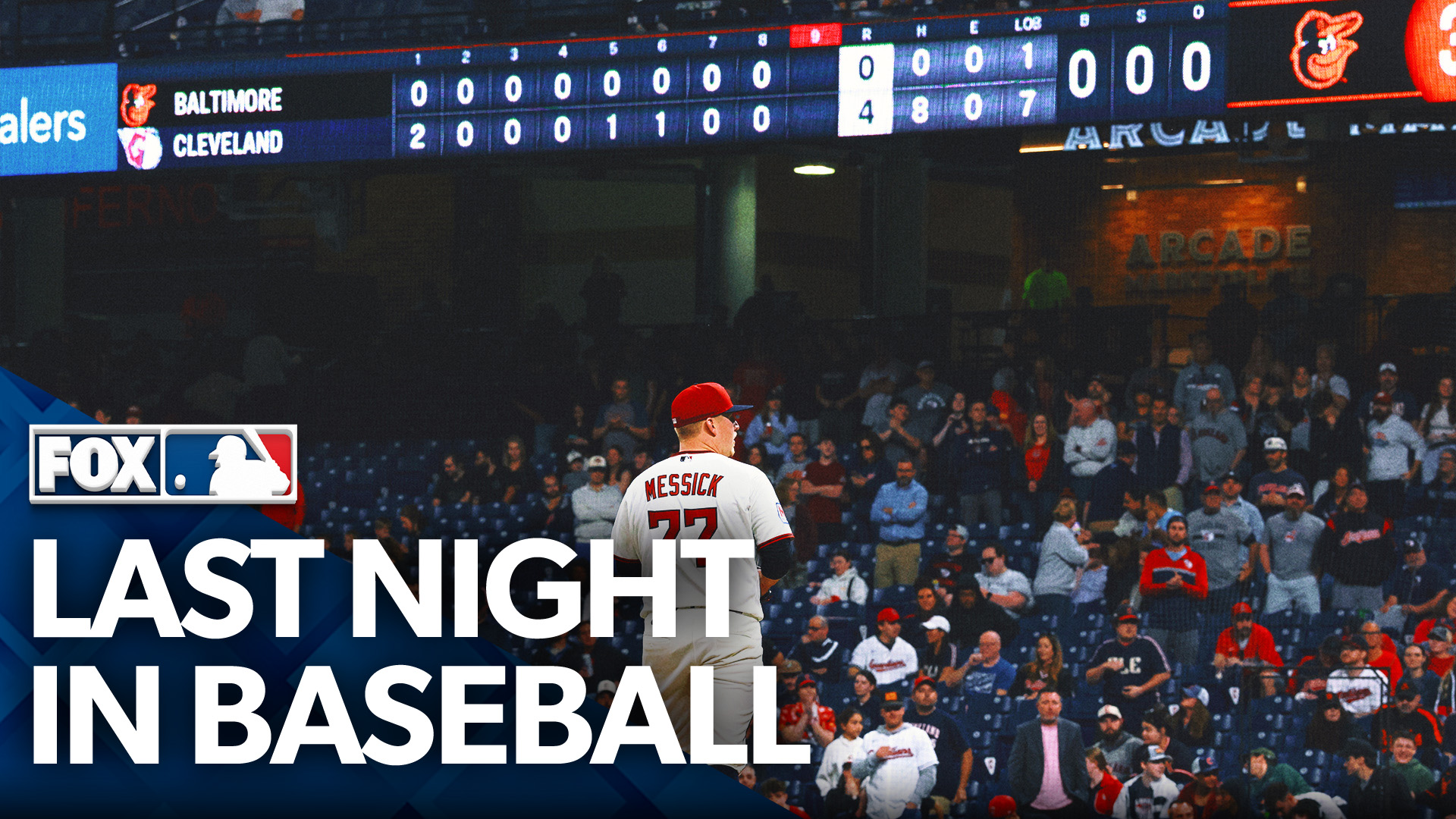
There is always baseball happening — almost too much baseball for one person to follow themselves. Don’t worry, we’re here to help you by figuring out what you missed but shouldn’t have. Here are all the best moments from last night in Major League Baseball: A near no-no for the Guardians Cleveland has had baseball long enough to have multiple no-hitters in its history — 14 of them, in fact — but the last one came all the way back in 1981. To give you some perspective on how long ago that was, it’s three years before the Guardians’ manager, Stephen Vogt, was born. And hell, Vogt was born 10 years before FOX Sports was first founded. It’s been a while, is the thing. On Thursday, the Guardians had a chance at their first no-no in 45 years, when rookie starter Parker Messick got through eight no-hit innings against the Orioles. It was just the 11th start of his career, as he made seven of them in 2025 without losing his rookie eligibility, and Thursday was his fourth of the current season. He has shined throughout his brief time in the majors — his combined ERA through his first 65.1 innings in the bigs is 2.07 — but has never been better than on Thursday. Messick tied a career-high with nine strikeouts, walked two and didn’t allow a hit through the first eight innings against Baltimore. He would enter the ninth inning already at 106 pitches — his first time over 100 in the majors, and also the first time he pitched into the eighth or ninth — and give up a hit on the first pitch of that frame to center fielder Leody Taveras. The Guardians kept Messick in the game at first, to pitch to shortstop Blaze Alexander and see if he could get out of this with a complete game, at least, but another single followed, and he was pulled. While Messick was charged with two runs on the day, those came about because the runners he bequeathed to closer Cade Smith both scored. Cleveland did not end up breaking the no-hitter drought, but on the bright side: Parker Messick. He’s been pitching like the kind of shutdown starter the Guardians — which are not exactly an offense-first team — need if they are going to thrive in the AL Central. That’s not nothing. Messick had help in securing the 4-2 W, most notably from star third baseman Jose Ramirez. Ramirez had a great catch in foul territory where he somehow managed to hold on to a ball that he snowconed while coming up against the wall… …and he was also responsible for the first two runs of the day for the Guardians, when he belted a middle-middle 96 mph four-seamer over the fence in right-center field in the bottom of the first inning. That’s 289 career homers for Ramirez now, who looks likely to become the ninth-ever player with 300 home runs and 300 steals at some point this summer. Padres sweep Mariners for eighth-straight W The Padres barely put up a fight for last year’s inaugural Vedder Cup between San Diego and the Seattle Mariners, but things are going very differently in 2026. The Padres won on Thursday, 5-2, sweeping the M’s and ensuring that the best result Seattle can get here is a season split with San Diego. A four-run second inning did the job for the Padres. First baseman Gavin Sheets hit a one-out double, which was followed by back-to-back singles from DH Miguel Andujar and catcher Luis Campusano. Second baseman Jake Cronenworth would then reach on a fielding error to load the bases, which allowed a ground out by left fielder Ramon Laureano to score another run. Right fielder Fernando Tatis would then hit a two-run single to make it 4-0, and while the Padres didn’t need another run for the dub, they got it in the seventh on an RBI single by third baseman Manny Machado. Mason Miller came in for the save and struck out the side to give San Diego its eighth-straight victory. Miller is on an absurd run at the moment: he now holds the second-longest scoreless streak in Padres’ history, as he passed Randy Jones in this outing and is now at 30.2 innings without allowing a run. (The Padres are wearing patches to honor Jones this season, as died in November at the age of 75.) Cla Meredith’s franchise record is 33.2 innings. Oh, and Miller is getting there by being dominant in a way that has literally never happened before. Miller has pitched in nine games and thrown 9.1 innings. He has 23 strikeouts against two (2!) baserunners. The last time he gave up a run in a Padres’ uniform was Aug. 5, 2025, in his second appearance with the team: he struck out 42 batters with nine walks, four hits and no runs allowed for the rest of the regular season. Caminero’s timely homer, for his mom Junior Caminero bashed 45 homers in 2025, so his going yard in 2026 isn’t exactly a shocker. However, the Rays’ third baseman promised his mother that he would hit a homer for her on her birthday, and like a good, devoted son, he delivered. This wasn’t just some random homer for mom, though. The Rays were down 3-2 to the White Sox in the ninth inning on the road when Caminero strode to the plate to leadoff the inning against new pitcher, Chicago closer Seranthony Dominguez. Dominguez missed with his first three offerings, and Caminero watched a 3-0 sinker up in the zone for strike one. Next came another 98-mph sinker, this time inside as it broke across the plate and right into the path of Caminero’s bat instead of underneath it. It barely made it over the wall, but it got out in a hurry and counts all the same. Tampa Bay would end up plating three runs that inning, and the White Sox couldn’t muster a response in the bottom of the frame. The White Sox are now just 6-13, while the 11-7 Rays are winners of six in a row and atop the AL East. Angels rout Yankees as Trout makes history Angels’ star center fielder Mike Trout was in position to make history against the Yankees on the road on Thursday — all he needed was one home run, and a couple of best-ever accolades would come his way. New York starter Max Fried pitched him carefully for most of the game, walking him twice early, putting Trout’s ability to hit a home run for the fourth-straight game — and his fifth in four days — into question for most of the series-concluding matchup. Then, the seventh inning came, and reliever Angel Chivilli was on the mound instead. He threw one too many pitches in the strike zone, and did not fool Trout with an 89.7 mph changeup low in the zone following a much quicker slider in the same place a pitch before. The result? Explosive. Trout didn’t just hit a homer. He drove that pitch 446 feet to deep left-center field, with an exit velocity of nearly 115 mph. He crushed that changeup, and put the Angels up 7-4 in the process. With this dinger, Trout became the first-ever opposing player at Yankee Stadium — any version — to hit a home run in four-straight games, and as it was his fifth of the series as well, he tied the all-time lead for home runs by a visiting player in a series against the Yankees, joining George Bell (1990), Darrell Evans (1985) Hall of Fame slugger Jimmie Foxx (1933). Not wanting Trout to become the first-ever player to hit six long balls in a series against them, the Yankees then walked the red-hot slugger the next time up. It worked, sort of: the Yankees avoided another dinger from Trout himself, but that walk loaded the bases for right fielder Jo Adell, who hit a grand slam instead to get the game to its final score of 11-4. The dinger after an intentional walk; there’s nothing quite as satisfying. The Yankees lost, but: Aaron Judge Mike Trout obviously deserves attention for a series by a visiting player unlike any that has come before at Yankee Stadium, but living in his shadow a bit was the Yankees’ own star slugger, Aaron Judge. Judge went deep again on Thursday, too, giving him four home runs during the series. That also ties Judge with Cardinals’ outfielder Jordan Walker for the MLB lead, while putting him atop the American League — one ahead of Trout. Both had a bit of a slow start to the season, but Trout is now up to .246/.416/594 with seven dingers, and Judge is at .236/.321/.597 with eight, so, safe to say they seem to be coming out of their respective early funks. Brewers bunt three times in a row, win The Blue Jays and Brewers were both having trouble scoring runs on Thursday, with the game still tied up at 1-1 in the bottom of the seventh. So, Milwaukee decided that playing for one run wasn’t so bad when a single run might end up being all that was needed to win. They took this concept to the extreme, and bunted in three consecutive plate appearances. Garrett Mitchell pinch-hit and drew a walk to start the inning, and then the bunting began. Outfielder Greg Jones was out on a sacrifice bunt to move Mitchell over, and that was followed by a bunt for a hit from third baseman David Hamilton when the throw to first took Kazuma Okamoto off the bag. Milwaukee decided to roll the dice a third time, having shortstop Joey Ortiz attempt to bunt Mitchell home from third, and while Ortiz ended up out, the damage was done; the Brewers now led, 2-1. And that would end up being the final score. Hey, when you play for one run, that’s all you’ll get, but sometimes one run is enough. Oneil Cruz has your hardest hit of 2026 Not a home run, no, but Pirates’ center fielder Oneil Cruz tattooed this ball all the same. That’s an exit velocity of 119 mph for Cruz on this double off of Nationals’ lefty Foster Griffin. Cruz is no stranger to hitting baseballs very hard, but it is still funny that Cruz’s earlier hit, a single to center, came off the bat at “just” 94 mph. Guess he had to course correct a bit, and did he ever. Tigers walk it off for sixth-straight win What a game between the Tigers and Royals. It took a late rally for Detroit to come out ahead and notch their sixth-straight W, but they got there in the end. It took until the middle of the game for the scoring to truly get going, too, as it was just 2-1 Tigers through four innings, but then everything opened up. Detroit scored four runs in the fifth to extend the lead to 6-1, but then catcher Salvador Perez hit a sac fly to cut into the lead slightly, and a huge sixth inning put Kansas City ahead, thanks to a six-run effort. The Tigers clawed back a run in the seventh, but things could have gone better than that for Detroit, if not for this incredible sliding catch out in right-center field by Kyle Isbel. He had to consider not just his own place in the outfield relative to the wall, but also his incoming teammate, right fielder Jac Caglianone, who was also speeding to the fence to make the grab. The only way to make it work without incident was by sliding, and Isbel pulled it off — luckily, Calgianone knew enough to hop up against the wall to avoid running right into Isbel as he was defenseless on the ground. On top of this bit of run prevention, the Royals got the one they did give up back in the top of the ninth to make it 9-7, Kansas City, with three outs to go for Detroit. This was not an insurmountable lead: Royals’ closer Lucas Erceg came in for the save, but instead, he allowed a leadoff single to second baseman Gleyber Torres and a walk (after an ABS challenge) to rookie infielder Kevin McGonigle. It looked like Erceg might escape trouble after getting the next two batters out, but left fielder Riley Greene doubled in both Torres and McGonigle, and suddenly it was tied up 9-9. Third baseman Colt Keith, who entered the game earlier as a pinch-hitter, got an 89.8 mph changeup middle-middle from Erceg, and was not fooled. He laced it through the hole in the right side of the infield, and Greene came around to score the winning run. The Tigers were in real trouble for a bit very recently, but have turned things around from a 4-9 start to now be 10-9. Meanwhile, the Royals just made getting back to .500 or better more difficult thanks to Detroit getting the brooms out. But hey, it’s early on both fronts: Detroit was a mess a week ago, and now they’re surging!Latest Sports News from FOX Sports
Ella Langley says one special thing really helps her focus her energy before a live show. Continue reading…Country Music News – Taste of Country
Ella Langley says one special thing really helps her focus her energy before a live show. Continue reading…The Boot – Country Music News, Music Videos and Songs

Soil matters if you want to get a good berry harvest and not just a lot of foliage. Luckily, you can make your own mixture using these three ingredients.

Food Republic – Restaurants, Reviews, Recipes, Cooking Tips
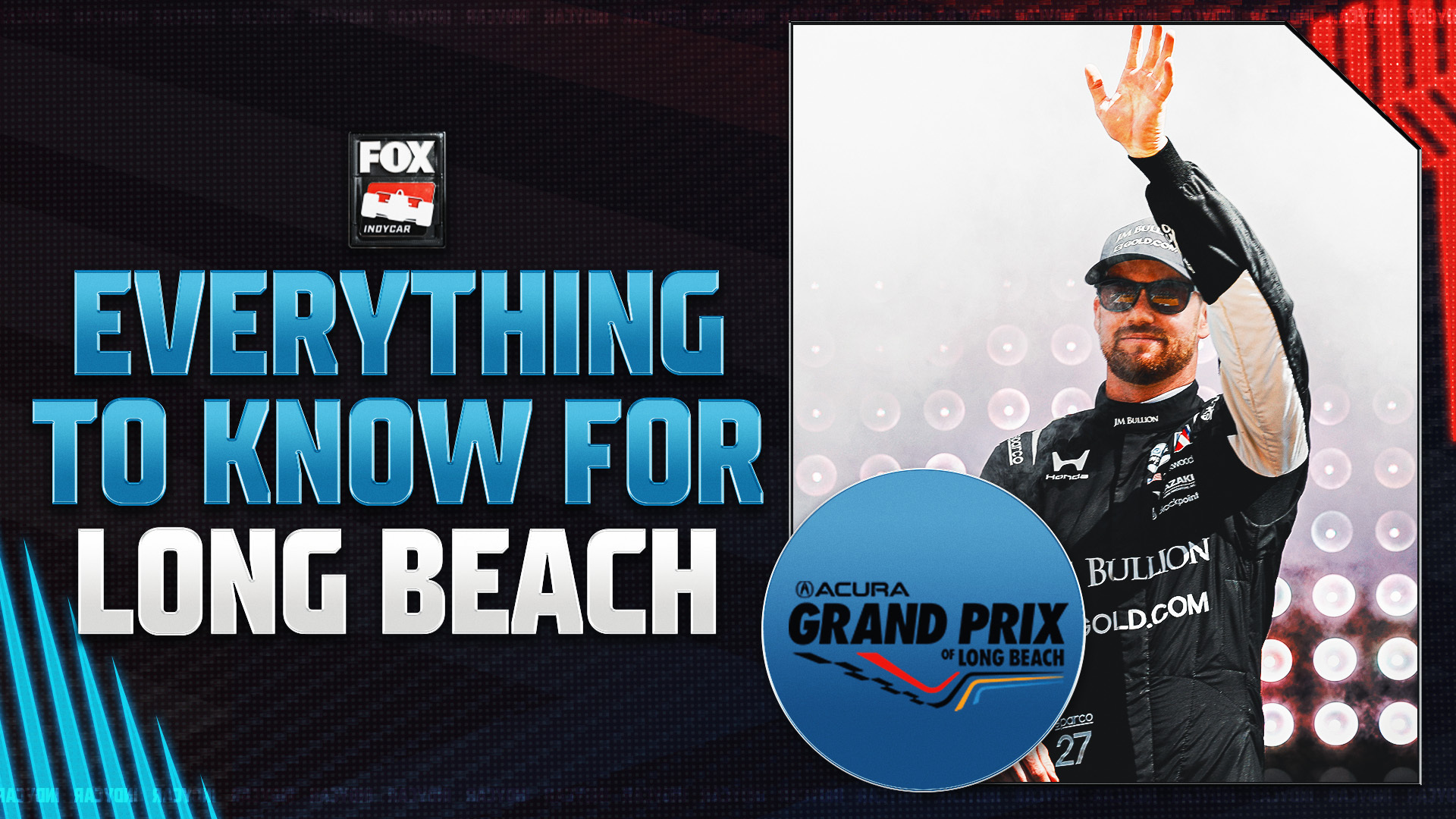
LONG BEACH, Calif — The 2026 INDYCAR schedule has some shiny new street venues. Racing along the streets of Arlington around the home of the Dallas Cowboys. Racing along the streets of Washington, D.C., around some of the most recognizable national landmarks. And as those shiny new venues create a spotlight, here comes the Long Beach Grand Prix, which can puff out its chest and its iconic fountain turn and scenic Shoreline Drive. This place can boast something the others don’t — 41 years of INDYCAR history. This event has regularly been recognized as the second-biggest event on the INDYCAR circuit behind the Indy 500. During the years of the split, this was arguably the biggest race on the CART calendar. “This place has been it for many years,” Graham Rahal, who will make his 19th start at Long Beach, told me Thursday. “On the [CART] Champ Car side, this race and Surfer’s Paradise [in Australia] were kind of it, and that is still the case today. “Other than Indy, this place always carries the weight. It’s pretty awesome for sure.” This 1.968-mile, 11-turn street course will see 90 laps of INDYCAR racing Sunday, with FOX coverage beginning at 5:30 p.m. ET, following the NASCAR Cup Series race at Kansas Speedway. There are five drivers among the 25 in the field who have won at Long Beach. “This is still one of the major … races of the year,” two-time race winner and six-time INDYCAR champion Scott Dixon told me Thursday. “[This race] has 40 years of longevity, typically always the same date, and that’s huge. “Arlington set a new standard with attention to detail, the track condition, the hospitality, all that stuff, was definitely next level.” Here’s what to know about the Long Beach weekend. Besides Dixon, who are the other past Long Beach winners in the field? Dixon, Alexander Rossi, Will Power and last year’s winner Kyle Kirkwood — who currently leads the series championship standings — have all won twice at the track. Josef Newgarden has won once. Rossi, notably, was inducted into the track’s “Walk of Fame” on Thursday. Rossi — a California native — had several family members there for the induction. The ECR driver, who won at Long Beach in 2018 and 2019, admitted it is a little weird to be enshrined like that while he still hopes to race for several more years and add to his number of wins. “It’s very cool [to be honored],” Rossi told me after the ceremony. “I think it’s a good reminder to put some things into perspective. “But ultimately, it’s also weird when you’re still doing it. So I hope I have to make their life difficult, and they have to add some years [to the plaque].” What it has taken to be good at Long Beach in recent years is the same as over the last couple of decades, Rossi said. “This race has always been fairly straightforward from a tire life and strategy standpoint,” Rossi said. “The track has stayed very consistent from a surface architecture. It has been resurfaced in some areas, but ultimately, but it’s still the same racetrack as it was when I won here six years ago. “So really, it’s up to me and the team to execute in order to get back to Victory Lane.” Can Former Pole Sitter Felix Rosenqvist Turn Season Around? Felix Rosenqvist sat on the pole at Long Beach in 2024, and he’s hoping this track being a good one for him will be the place where he can have a rebound race in 2026. Rosenqvist hasn’t finished better than 12th in the opening four races. He finished fourth at Long Beach a year ago. “It’s been a little bit of a rough start for us. So nice to come back here to a track, where, normally, when I come here, I know that I can be quick,” Rosenqvist told me Thursday. The Meyer Shank Racing No. 60 car driver, who will have a Green Day-themed paint scheme as part of his organization’s SiriusXM partnership, said the team has improved in some areas. “We’ve actually improved everything we wanted to improve — which is pit stops and strategy and just the small details have been really good,” Rosenqvist said. “We just haven’t really had much speed, which has never really been a problem previously.” What are the qualifying rules for the final round? Oh yes, the always changing rules for the Fast Six, the final round of qualifying where the top-six drivers from the second round duke it out for the pole. After the first street race of the season, INDYCAR experimented with instead of a timed round where drivers could make as many laps as possible to post a fast time, it opted for single-car, single-lap runs. That worked well except the driver slowest among the six in the previous round went out first in the final round and appeared to have an advantage. [DRIVER’S EYE: How drivers navigate Long Beach’s unique 11-turn track] So at Long Beach, INDYCAR will allow the fastest driver from the second round to choose when he will go out in the Fast Six, and then the second-fastest will get to choose his spot and so on. That makes where a driver finishes in the second round possibly important because if you can be the fastest (instead of worrying about just being in the top-six), you have the advantage of choice in the order for the final round. Anything else unique about the street course rules? Teams and drivers are getting used to the new rule this year that they must use at minimum two sets instead of one set of the alternate soft tires during a street race. What have they learned? It isn’t always clear-cut strategy that will work for all drivers. “It’s been very split throughout the field who believes in the alternates,” Christian Lundgaard, driver of the No. 7 car for Arrow McLaren said during a virtual news conference this week. “Obviously, I think that depends a lot on car setup, how your car is treating the tires. “We see cars that are more abusive to the tires and more cars that are nicer to the tires. You see different strategies in the race.” The strategy at Long Beach likely will be to come in and change tires twice, using two sets of the alternate soft tires and one set of the hard primary tires during the race. But if a driver punishes the tires too much, a third stop will be necessary to use four sets of tires overall during the event. “The [alternate] needs to have a higher degrade to it,” Dixon told me. “They’re both pretty consistent. “That could really switch up how this weekend rolls because it now makes the two-stopper very achievable [because the alternates last longer]. Because last year, that just wasn’t a possibility from the longevity of the of the soft tire. This one could get super interesting.” Who are the favorites? Kirkwood — who drives the No. 27 car for Andretti Global, a team known for its street-course prowess — has won the last two races so he is going to be the favorite. And then Chip Ganassi Racing’s Alex Palou because, well, he’s Alex Palou and he’s won 10 of the last 21 INDYCAR events. If anyone is going to catch those two, it could be Lundgaard, who finished third at Long Beach a year ago behind Kirkwood and Palou. The Arrow McLaren driver also finished second to Palou in the most recent INDYCAR race a few weeks ago at Barber Motorsports Park. You can see more of my thoughts on predictions by reading this on the FOX Sports Super 6 contest for Long Beach. OK, enough about Long Beach, what about Indy 500 entries? That will be a topic of discussion in the garage and it is becoming pretty clear that there will be 33 entries. There have been 31 announced entries and the other two most likely will be Jacob Abel and Katherine Legge. Legge’s manager Klint Briney confirmed that Legge’s entry is possible. “We’re working hard behind the scenes to get Katherine back in the Indy 500 field this year after missing 2025,” he told me. “She certainly brings a unique story and perspective to the grid.” Having 33 cars is a mixed bag because that means no drama on bump day, but for the drivers who could be on the bubble, that is something that at least allows them to breathe. “God bless, I’ll sleep a lot better,” said Rahal, who was the last driver to make it in on the first day of qualifying last year and was the last driver to make the 2024 field, when he was told it will likely be 33 entries. “I’ve never been a fan of guaranteed entries, … but what I hope people understand is it isn’t an indication of where the sport is at. “It’s not easy to get cars and it’s not easy to get engines.”Latest Sports News from FOX Sports
Reading Time: 3 minutes
She’s getting out of her Get In Girl tour.
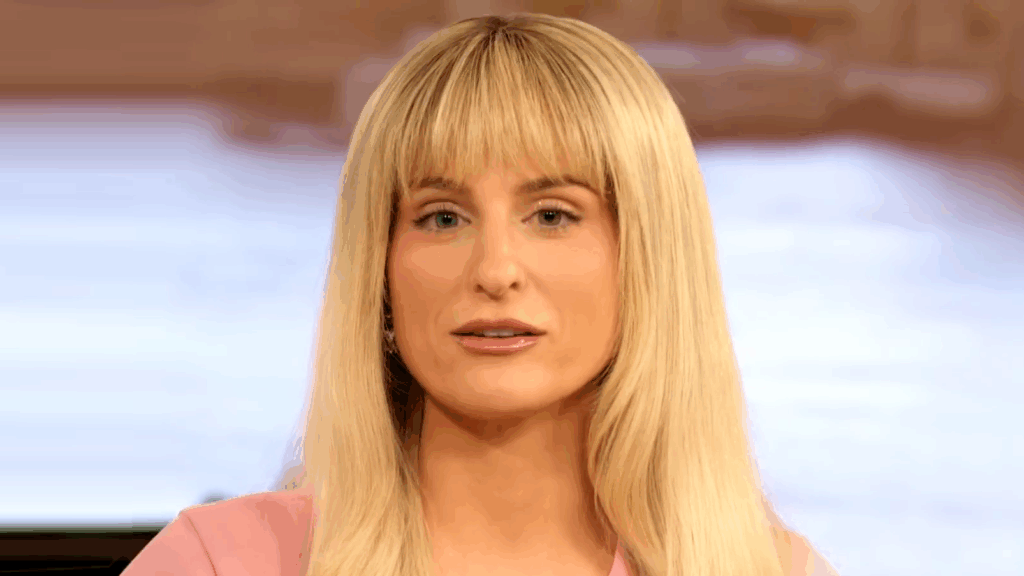
With less than two months’ notice, Meghan Trainor has canceled her 2026 tour.
She claims that this is about being “present” for her family.
But folks on social media are floating another theory about the controversial singer.
On Thursday, April 16, Trainor took to her Instagram Story to share her updated 2026 plans.
“After a lot of reflection and some really tough conversations, I’ve made the difficult decision to cancel the ‘Get in Girl’ tour,” she began.
“Balancing the release of a new album, preparing for a nationwide tour,” she explained.
Trainor continued: “And welcoming our new baby girl to our growing family of five has just been more than I can take on right now.”
As we reported in January, the singer welcomed her third child via gestational carrier (surrogate).
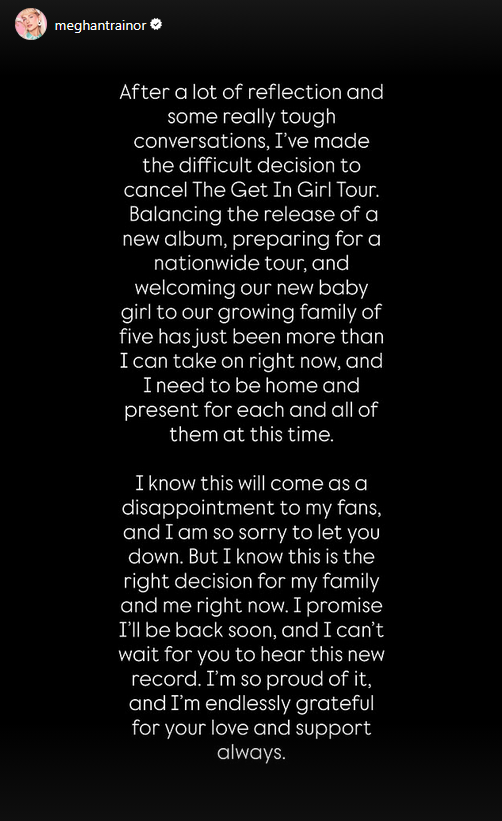
“I know this will come as a disappointment to my fans,” Trainor acknowledged.
“And,” she expressed, “I am so sorry to let you down.”
Trainor then affirmed: “But I know this is the right decision for my family and me right now.” That is now a family of five.
“I promise I’ll be back soon,” she vowed. “And I can’t wait for you to hear this new record.”
Trainor concluded: “I’m so proud of it and I’m endlessly grateful for your love and support always.”

She’s 32 and has three young children.
That might be enough to make anyone change their summer plans.
But having a child isn’t exactly something that happens overnight. The pregnancy alone lasts for most of a year.
And, in Trainor’s case, they welcomed Baby #3 via gestational carrier.
That involves a whole other person, not to mention doctors and IVF treatments. Becoming a family of five didn’t happen by accident or suddenly, so why plan this and the tour?
Some seriously, some snarkily, folks on social media are suggesting that Trainor is doing this to save face.
The belief is that Trainor’s ticket sales did not meet expectations for two months away from the start of her tour.
Touring is expensive and time-consuming. And appearing on a stage before a mostly vacant crowd is humiliating.
(Just ask JD Vance.)
Obviously, we do not have access to Trainor’s ticket sales — or to what expectations were before launching the tour. But it’s a solid theory, however unproven.
Trainor’s use of GLP-1 medication for luxury weight loss has made headlines and elicited controversy.
She even went so far as to change the lyrics to “All About That Bass” to match her new, ultra-slender body. That went about as well as you’d expect.
As we at THG have emphasized before, going into someone’s reply to shame or “express concern” about a celebrity is very unlikely to prompt any changes.
Everyone deserves to have the body that they most desire. But people are right to have ethical concerns and reasonable to express long-term health worries about people buying into medicalized starvation as a weight-loss solution.
Maybe Trainor isn’t able to fill seats anymore. She’s married to a Spy Kids star and has three beautiful kids. She’s arguably still winning. We just hope that she doesn’t come to regret some of her incendiary choices.
Meghan Trainor Abruptly Cancels Tour, Claims It’s For Her Family (But Not Everyone … was originally published on The Hollywood Gossip.
The Hollywood Gossip

A model is silhouetted as she prepares to strut on the catwalk at the Far North Fashion Show, held April 15,, 2026, at the Anchorage Museum. The fashion show is part of the annual Arctic Encounter Summit. (Photo by Yereth Rosen/Alaska Beacon)

Attendees of the Arctic Encounter Summit, held this week in Anchorage, took a break from heavy discussions about climate change, national security, shipping safety and other pressing concerns on Wednesday night to enjoy something more fun: high fashion.

The Far North Fashion Show, now in its seventh year, showcased the work of Indigenous designers from around Alaska.
“To be honest, the Far North Fashion Show is the highlight of so many attendees’ experiences, myself included,” Rachel Kallander, Arctic Encounter’s founder, said in brief remarks at the start of the show.
The celebration, which featured a catwalk bathed in pastel lights, pulsing music and refreshments, required a lot of work to pull together, Kallander told the audience.
“We have designers and models who have put in hundreds and hundreds of hours into what you are about to see,” she said.


Beyond their good looks, the clothing on display incorporated messages. Many were about traditions. Some were inspired by the animals that are important to different Indigenous Alaska cultures. A dress designed by Jackie Qataliña Schaefer, who is Inupiaq and originally from Kotzebue, paid homage to the caribou, for example. Another dress was designed with a train that resembled a whale fluke. And models, as they took their turns on the catwalk, sometimes made moves that are part of traditional Native dances.
Some of the works shown at the event had a more somber message. They incorporated the red handprint that symbolizes missing and murdered Indigenous people.

Designers and models were from Inupiaq, Athabascan, Tlingit, Yup’ik and Aleut cultures, among others.
Along with Schaeffer, who is director of climate initiatives at the Alaska Native Tribal Health Consortium in addition to being an artist, the designers whose works were shown were Maria Shaa Tlaa Williams of Southeast Alaska, Marisa Taylor of St. Lawrence Island, Carlene Thayer of Unalaska, Alana Moses of Fairbanks, Reine Pavlik of Yakutat, Jeremiah James of Yakutat and Christina Waska, originally from Newtok.
The Arctic Encounter Symposium, which opened on Wednesday, runs through Friday. It has attracted attendees from 30 countries, Kallander said.



Thousands of Americans will soon gather to celebrate April 20 – or “4/20” – the most important day of the year for cannabis enthusiasts.
But this year, a cloud of uncertainty will hang over these celebrations. After years of success, the movement to legalize recreational and medical cannabis has stalled.
It’s a moment unlike any that I have seen in the 12 years that I’ve been researching cannabis legalization as part of my broader interest in U.S. drug policy.
Not so long ago, the movement had so much momentum that nationwide cannabis legalization felt virtually inevitable. That momentum is now gone.
The strategy to legalize cannabis through ballot initiatives is no longer working. The coalition of supporters that made this strategy work has frayed, and new research is raising concerns about the health impact of regular cannabis use. All of this constitutes the most significant challenge to the movement since it went mainstream in the 21st century.
As a social movement, cannabis legalization has been extremely successful. Since 2012, 24 states and Washington have legalized recreational cannabis use. Forty-nine states and Washington have legalized medical cannabis use, though programs vary from state to state.
While cannabis remains illegal at the federal level, changes have happened there, too.
The 2018 Farm Bill, for instance, legalized hemp, a non-psychoactive derivative of the cannabis plant used to make textiles, rope and other consumer goods. While it wasn’t lawmakers’ intent, entrepreneurs figured out how to make products from hemp that contain enough of the chemical compound tetrahydrocannabinol, or THC, to be psychoactive. This fueled growth of the hemp market, which in 2023 was valued at US$1.63 billion.
Additionally, the Biden administration in 2024 began the process of rescheduling cannabis under the Controlled Substances Act. It’s a course that has continued under the second Trump administration.
The scheduling system classifies substances based on accepted medical use and potential for abuse. Federal rescheduling would not legalize cannabis, but it would move it from the most restrictive Schedule I – which includes substances like heroin and LSD – to Schedule III, with substances like anabolic steroids, ketamine and codeine. It would recognize cannabis as having medical use.

With rescheduling still underway, it may seem odd to say that the legalization movement has stalled. But a closer look reveals significant challenges.
The biggest challenge can be found at the ballot box. The 2024 election was the legalization movement’s worst showing in years.
All three recreational legalization ballot measures failed. Only Nebraska’s medical legalization measures passed, but it has yet to be fully implemented due to ongoing political and legal challenges.
Then there’s the 2025 tax and spending package approved by Congress. When its new provisions go into effect later this year, they will dramatically alter the hemp market.
Many hemp products currently on shelves, like THC-infused beverages and gummies, will become illegal. Many businesses currently selling these products will be forced to close.
Some of this is already happening, as states like Tennessee and Iowa rush to pass restrictions on hemp products.
For instance, the dispensary closest to my university in Iowa has just closed. Once a growing business that employed 30 people, it was forced to shut down after new state laws significantly limited what they could sell. This crackdown on the hemp market is particularly significant in states like Iowa that have no legal market for recreational marijuana use and only a limited medical marijuana market.
Several factors are driving these changes.
One is politics. While the vast majority of Americans support marijuana legalization, the approval is much higher among Democrats and independents than it is among Republicans.
Of the 26 states where recreational marijuana has not been legalized, 20 of them have state governments that are under total Republican control. Another four have Republican-controlled legislatures. Pennsylvania’s legislature is split between Republicans and Democrats. Only Hawaii has a Democrat-controlled state government that has not legalized recreational cannabis.

Then there is the health issue. A growing body of evidence is raising concerns about the negative impact of regular cannabis use that includes the risk of cannabis addiction, psychosis, anxiety and depression.
Researchers are also questioning cannabis’ efficacy as medicine. Several recent reviews have concluded that there is insufficient scientific evidence to support the therapeutic use of cannabis for most of the conditions for which it is consumed, such as insomnia and acute pain. A review of cannabis’s use for treating mental health conditions came to a similar conclusion.
Citing such evidence, The New York Times editorial board recently recanted some of its earlier support for legalization. The newspaper wrote, “The unfortunate truth is that the loosening of marijuana policies … has led to worse outcomes than many Americans expected,” adding, “It is time to acknowledge reality and change course.”
Still another issue is conflict within the legalization movement itself, particularly between the business and activist wings.
The tension between these groups is long-standing, with activists often accusing members of industry of being more focused on money than justice. And as the cannabis industry has grown, these tensions have become more acute.
In 2022, for example, the pro-cannabis organization True Social Equity in Cannabis sued three Illinois cannabis companies for engaging in coordinated anticompetitive practices and violating federal antitrust laws. In court documents, they called the three companies the “Chicago cartel,” before voluntarily dismissing the case.
Florida Gov. Ron DeSantis used a similar strategy in 2024 in his successful campaign against the legalization of marijuana for recreational use in the state. He consistently criticized “corporate cannabis,” a catchall phrase often used by critics to describe the large cannabis companies that increasingly dominate state markets. He warned voters that the law would create a “weed cartel.”
Prominent cannabis activists like former Massachusetts regulator Shaleen Title have also called out corporate cannabis in their accounts of what’s wrong with the legalization movement.
In many ways, these challenges are the result of the movement’s earlier success. Making marijuana legal has meant more people trying it, more people studying it and more people making money from it.
The insights from the past 12 years could help inform whatever comes next. The fact that public support for legalization remains high suggests that a return to the days of blanket prohibition is unlikely.
Still, as the history of cannabis law and policy has shown, there are no guarantees.

William Garriott’s work has been supported by the Wenner-Gren Foundation for Anthropological Research.
Politics + Society – The Conversation
![<a href="https://tasteofcountry.com/zach-top-george-strait-encounter/" target="_blank">[EXCLUSIVE] Zach Top Met George Strait – His Reaction Is So Real</a>](https://townsquare.media/site/204/files/2026/04/attachment-untitled-design-2026-04-17t065158-667.jpg?format=natural)
Imagine meeting your idol and feeling like a kid again—Zach Top shares that unforgettable moment with George Strait. Continue reading…Country Music News – Taste of Country