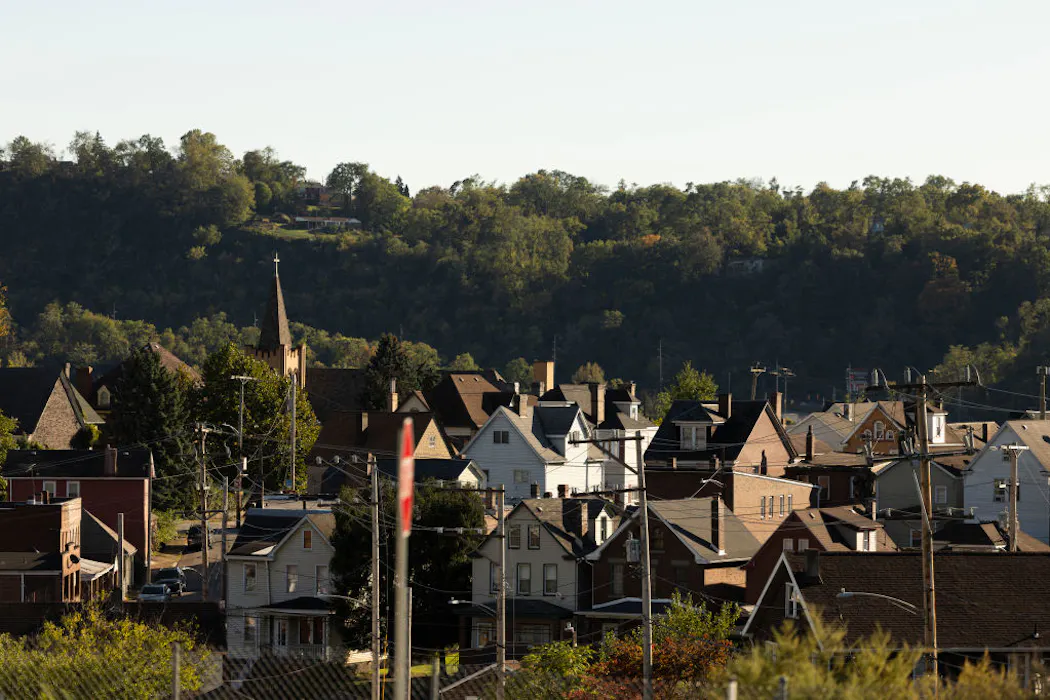
Neighborhood investments meant to improve housing and opportunity often spark fears of gentrification and displacement. That worry is playing out in Pittsburgh’s Hazelwood neighborhood, where a stalled Second Avenue housing project sits blocks from the 178-acre Hazelwood Green riverfront development.
Hazelwood is a natural experiment that answers the question: Can development happen without displacement?
Residents feared the millions of dollars spent to clean up and redevelop Hazelwood Green would displace them, as new firms and workers moved in and land speculation increased nearby.
examined that question in Hazelwood, where the Heinz Endowments invested to support the community that existed there before redevelopment began.
I’m a researcher and consultant to policymakers, investors and others who are considering community development investments, and I teach research methods and statistics at the University of Pennsylvania. I also created the Market Value Analysis and Displacement Risk Ratio. We used these tools in this research on Hazelwood, and our study is one application of them.
Investing in Hazelwood
Hazelwood Green, the former site of the long-shuttered LTV Steel plant, was purchased in 2002 by a partnership of the Heinz Endowments, Richard King Mellon Foundation, Claude Worthington Benedum Foundation and the McCune Foundation. It now houses advanced technology, robotics and manufacturing companies, with more development planned.
Recognizing the risk that investments in Hazelwood Green could lead to displacement of longtime residents, the Heinz Endowments in 2012 began to offer a series of more than 120 grants totaling US$24 million for housing production and preservation. This funding was used to repair owner-occupied homes, rehab deteriorated rentals and relocate tenants to renovated units.
Funding also helped a local nonprofit acquire vacant land and buildings and homeowners stabilize their properties. It also supported a second nonprofit community development corporation through which residents could voice their vision for Hazelwood, and it backed a third focused on education, arts and culture programming. This all occurred while economic activity on Hazelwood Green was gaining momentum and redevelopment was visible.
Were residents displaced?
We used multiple approaches to examine how the redevelopment of Hazelwood Green affected the neighboring community.
The first examined the economic, housing and demographic profile of Hazelwood residents.
In a typical gentrification scenario, researchers would expect to see an influx of new residents and for the income profile of residents in the neighborhood to rise. Gentrifying neighborhoods also experience an extraordinary rise in housing prices and rents. And frequently neighborhoods transition from being predominantly minority to predominantly white.
We did not find any of these changes in Hazelwood.

Hazelwood Green/via Instagram
Census data shows Hazelwood’s population was 4,474 in 2022, down from 5,395 in 2010. Comparable mobility data is only available starting in 2016: The share of all households living in the same home as the previous year held steady, at 90% that year and 91% in 2022. That percentage for renters, though lower than the rate for all households, rose from 82% to 85% over the same period. If residents were being pushed out, we’d expect to see the percentages of long-term homeownership and renters drop. Additionally, work and commuting patterns in Hazelwood held steady.
A newer analysis, released in March 2026, extends this picture through 2024; exact figures for Hazelwood were still being confirmed as of publication.
The share of nonwhite residents rose from about 48% in 2010 to 55% in 2022, the opposite of the typical gentrification pattern.
Home values increased, as they have in most places. But Hazelwood’s $121,358 median value in 2022 is still affordable for a household earning about $40,000, based on economic data.
Cost burden – spending more than 30% of income on housing – is common among lower-income renters in Hazelwood, part of a national pattern of rising housing costs outpacing incomes. Still, Hazelwood’s rate among its lowest-income renters is somewhat lower than the citywide Pittsburgh rate. About 7 in 10 Hazelwood renters with household income under $50,000 are burdened. But more than 85% of owners who earn $35,000 or more are not cost-burdened.
A growing number of upgraded homes and new, long-term affordable units financed through the Low-Income Housing Tax Credit are also on the horizon. Together, they may give longtime residents more options to stay in Hazelwood in the years ahead.
How does Hazelwood compare?
The Market Value Analysis measures a neighborhood’s overall housing market health using factors such as sale prices, vacancy, building conditions and foreclosures.
The Displacement Risk Ratio asks one narrower question: Are home prices climbing faster than residents’ incomes compared to years past? That focus helps flag when longtime residents are being priced out, not just when a market is heating up.
Other places use the same method to guide their own housing plans and investments, and they make the results public so others can use them too. Researchers have also used the method to evaluate strategies for stabilizing neighborhoods.
We also used these tools to compare Hazelwood with other neighborhoods across the country. It fared better than neighborhoods in Philadelphia, Baltimore and St. Louis that were similarly next to large-scale, concentrated investment. Hazelwood was more stable than the Baltimore and St. Louis neighborhoods and faced far less displacement risk than the Philadelphia one.
Why the fear persists
Finally, we interviewed Hazelwood nonprofit leaders, who reported that displacement fear remains high, though actual instances are anecdotal. Interviewees said gentrification in other rapidly changing Pittsburgh neighborhoods, such as East Liberty, fuels that fear. They said persistent poverty – nearly a third of Hazelwood households have income below the poverty line, which is an increase from a decade earlier – creates trauma that leaves people more vulnerable to any crisis, including displacement.
Interviewees also said Hazelwood’s remaining blighted housing creates a pressure on families to leave. They called this “rotrification.” We saw that in one block group with a declining ratio and along Second Avenue, the largely vacant main street that splits the Hazelwood neighborhood.
Grant funding helped nonprofits buy up vacant and deteriorated properties in Hazelwood and preserve existing homes. Many homes and apartments were rehabilitated, existing homeowners saw modest price increases alongside improving neighborhood conditions, and new long-term affordable apartments are underway. The community also has an organized advocacy presence, including groups such as Hazelwood Initiative that help residents have a voice at the table as development decisions are being made.
Our research can’t isolate which grants made the difference.
But the Hazelwood case suggests that development can occur without triggering the kinds of displacement pressure typically associated with gentrification. Yet these findings may not fully address residents’ concerns about the future, particularly as home prices continue to rise.
The Richard King Mellon Foundation supports The Conversation Pittsburgh.
Read more of our stories about Pittsburgh and Pennsylvania.

Ira Goldstein conducted the work described in this article with a grant from The Heinz Endowments made to Reinvestment Fund. He is no longer an active employee of Reinvestment Fund, but does have a consulting relationship with them. Both the Market Value Analysis and Displacement Risk Ratio are proprietary tools developed by Reinvestment Fund, where Goldstein formerly served as Senior Advisor, Policy Solutions. Reinvestment Fund markets these tools commercially, and has been paid to apply the Market Value Analysis in more than 40 cities and counties, independent of this Hazelwood research.
Politics + Society – The Conversation




 Jim Carrey is living in eternal sunshine—no spotless mind needed.


 With the holiday season inching closer, brands have already begun dropping exclusive gift sets and Advent Calendars.