 This is real, this is Camp Rock 3.
Over 15 years after fans’ last trip to Camp Rock, Liamani, Malachi Barton and the Jonas Brothers proved music is still in everyone’s souls in the premiere of…
E! Online (US) – Top Stories









This is real, this is Camp Rock 3.
Over 15 years after fans’ last trip to Camp Rock, Liamani, Malachi Barton and the Jonas Brothers proved music is still in everyone’s souls in the premiere of…
E! Online (US) – Top Stories

The Mendenhall River as it crests on Thursday, Aug. 13, 2026. (Photo by Clarise Larson/KTOO)
Mendenhall Valley residents in the flood zone celebrated Thursday afternoon as the Mendenhall River crested at a level well below initial predictions. The event was much less destructive than disastrous floods that struck over the past three years.
The flood crested at 14.7 feet on the Mendenhall Lake gauge at 2:15 p.m., according to the National Weather Service. As floodwaters started to recede Thursday afternoon, only a handful of residents reported damage.
“We have crested officially, and we are now on the way back down — we did it, Juneau,” said Zoe Kaplan, a meteorologist with the National Weather Service, during a livestream just before 3 p.m.
Ann Lind lives in the flood zone on Marion Drive. She said she had been anxiously waiting for the flood all spring and summer. Last year, her home flooded when drainage pipes failed and water leaked through the floodwall.
“For months it was like this slow-moving bullet coming straight at me, and didn’t know if it was going to be a hit or a miss,” she said. “And today, it’s a miss.”
Lind said the water didn’t even touch the HESCO barriers that make up the flood wall in her backyard.
“This flood this year is the scenario we all wanted — we all hoped for,” she said.
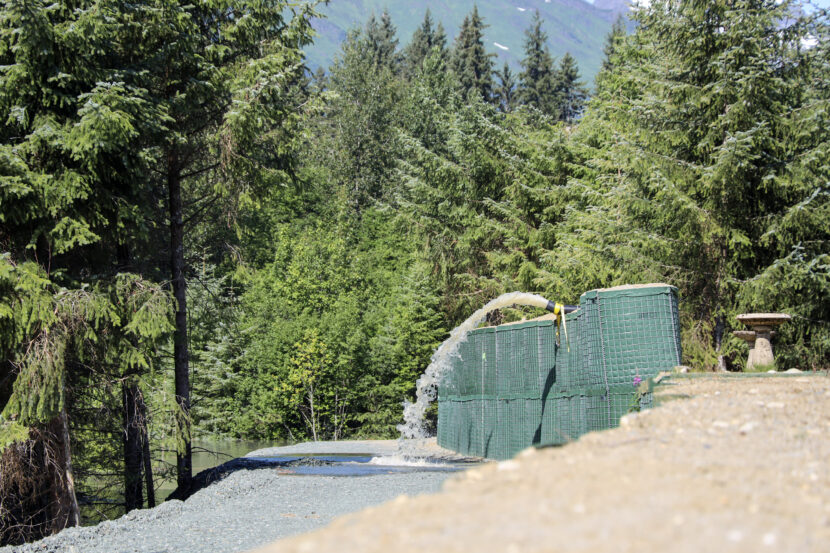
A couple of riverfront homeowners on Killewich Drive said their crawl spaces flooded this year due to seepage, but they were able to pump out the water.
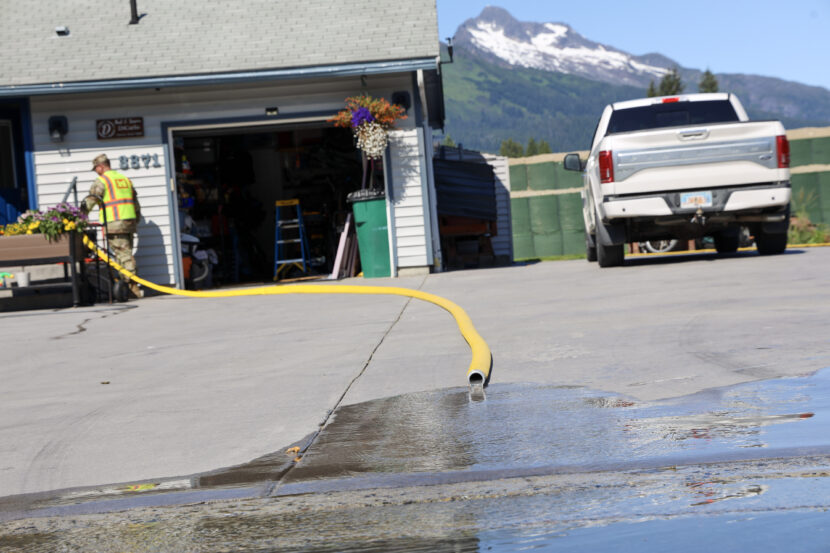 Riverfront homeowners on Killewich Drive pump water out of their crawl spaces on Thursday, Aug. 13, 2026. (Photo by Clarise Larson/KTOO)
View Drive residents saw the worst flooding, as they have every year. This is the second year in a row they were left without the protection of the flood wall constructed by the City and Borough of Juneau and the Army Corps.
Mandy Mallott lives at the end of the street. Last year, she and her neighbors set up their own flood wall made of HESCO barriers and an earthen berm in an attempt to protect their homes. She said her home was spared, but there was still a lot of damage throughout the neighborhood.
On Thursday afternoon, she said she and others who put up barriers on the street didn’t see flooding in their homes.
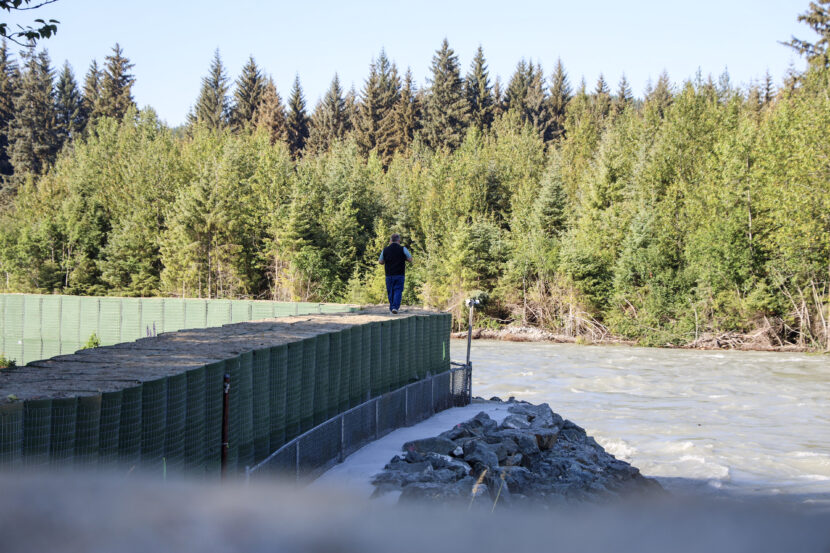
“The emotions that are running through us are a big sense of relief and thankfulness to our friends and our neighbors that we got through the night and this gorgeous day together,” Mallott said.
Malachi Thorington also lives on View Drive, where he said his house and his next-door neighbors’ flooded this year, but not as badly as in the past.
Downstream on Meadow Lane, near Juneau International Airport and the mouth of the river, Bob Jacobson watched the flood from his son’s deck overlooking the river.
He described watching a tree strike the barriers across the river — just minutes before — to two U.S. Army Corps officials who had just arrived at the barrier.
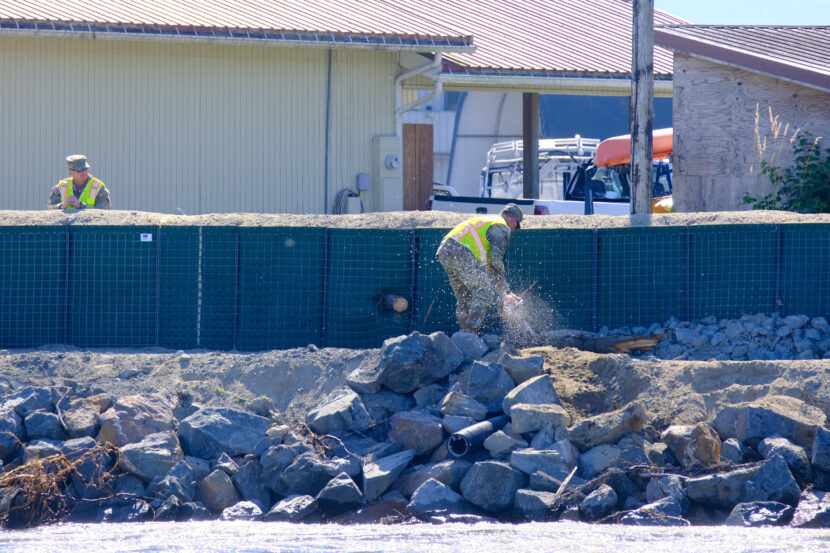
Within minutes, Army Corps crews chainsawed the log away from the barrier. Pumps were stationed along Meadow Lane but did not need to be turned on as the flood peaked.
The HESCO barriers below Brotherhood Bridge are new. There was some seepage, but neighbors said it was nothing compared to last year when water rose up the bank and into yards and some driveways, just feet from homes.
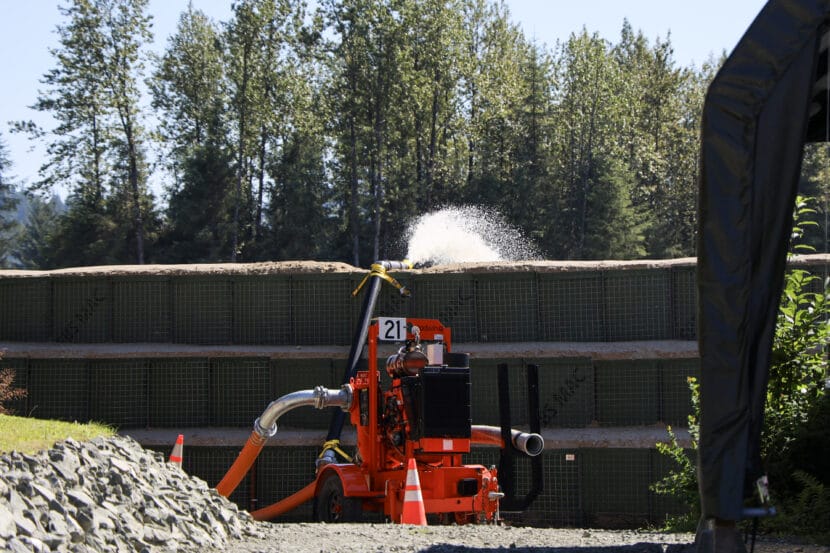 An industrial-sized pump pipes water over the flood wall on Meander Way as the flood crests on Thursday, Aug. 13, 2026. (Photo by Clarise Larson/KTOO)
Jeff Garmon is the meteorologist in charge at the Weather Service in Juneau, and he lives on Meander Way — a street that’s been hit hard by flooding in the past. As the flood peaked, he had minor pooling in his backyard, which was piped back over the HESCO flood wall by pumps provided by the U.S. Army Corps of Engineers.
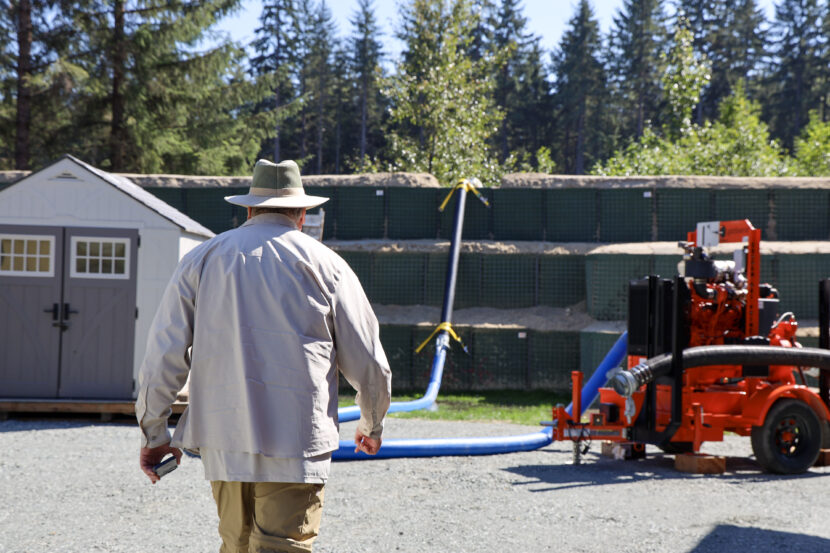
“We’re fortunate this year we didn’t have an atmospheric river going into this,” Garmon said. “I think that was our saving grace.”
Garmon said he’s proud of how the city, Army Corps, U.S. Geological Survey, University of Alaska Southeast researchers, the Central Council of the Tlingit and Haida Indian Tribes of Alaska, flood advocacy groups and countless others worked collaboratively to support residents in the flood zone.
“It’s something Juneau should be proud of — that as a community we came together,” he said.
SUBSCRIBE: GET THE MORNING HEADLINES DELIVERED TO YOUR INBOX.

 Rosie O’Donnell’s top gun is still Tom Cruise—just not in a sexual way.
Indeed, the former talk show host—who publicly came out as a lesbian in 2002—reflected on how she can still be moved by the…
E! Online (US) – Top Stories

 Shay Mitchell doesn’t need to keep this news a secret.
The Pretty Little Liars alum is ready for a new chapter in her entrepreneurial life as Samsonite has acquired her lifestyle travel bag brand…
E! Online (US) – Top Stories

Costco already offers deals on plenty of items, but from now through August 23, this food storage set is the subject of a significant price cut.

Mashed – Fast Food, Celebrity Chefs, Grocery, Reviews

The chambers of the Alaska House of Representatives stand empty on Thursday, Aug. 13, 2026. (James Brooks photo / Alaska Beacon)
Leading members of the Alaska House and Senate said this week that they will not meet to discuss Gov. Mike Dunleavy’s latest attempt to provide a tax break for the proposed trans-Alaska natural gas pipeline.
The bill, said Speaker of the House Bryce Edgmon and Senate President Gary Stevens, lacks the support to advance in either body.
“The caucus is really not at this point, really not interested in having to rush a bill,” Stevens said.
“The votes just aren’t there,” Edgmon said. “The Senate made it very clear that they need more time than what could be allotted.”
Glenfarne, the firm acting as the project’s lead developer, has said that a tax break is necessary to finance the pipeline. Glenfarne had said that it was planning to reach a final investment decision on the first phase of the project by the end of this year.
It has already missed several self-imposed deadlines, and it isn’t clear whether it will again change its plans. The company did not respond to a request for comment on Thursday.
As proposed, the pipeline project would be built in two phases, with the first completed no sooner than 2029. The first phase would deliver gas from the North Slope to Southcentral Alaska for in-state use. The second phase would allow international exports.
Official estimates state that the total project will cost as much as $54.5 billion, making it one of the largest natural gas projects in the world. Unofficial estimates are significantly higher.
The governor released his proposal 17 days into a 30-day special session about pipeline taxes. This is the third special session of 2026 devoted to the issue; the second special session ended in July after the state House voted down a compromise bill.
The governor’s new bill appears similar to that failed compromise. It would replace the state’s petroleum property tax with a tax on gas shipped through the pipeline, a change that would help the project pencil out financially, and it would cap the cost of gas for in-state use and shield the state from cost overruns.
It also includes a 2% corporate income tax on certain privately owned oil and gas companies that don’t pay the state’s existing corporate income tax. That’s a little over a fifth of the size of a similar tax proposed by the Senate.
The so-called “pass-through entities” tax was a key condition of skeptical state Senators and helped last month’s compromise bill pass the Senate.
But business-friendly trade groups and legislators opposed the tax increase, causing it to fail in the House, and Dunleavy said before the House vote that he would veto the Senate’s version if it reached his desk.
Dunleavy’s proposed tax rate is lower than the one approved by the Senate, but it nonetheless represented a major concession. The governor had said in June that the tax was “a line in the sand.”
On Wednesday, he had a different perspective.
“This bill is a compromise that removes a significant barrier to moving the gas line forward,” he said in a written statement.
But the compromise appears to have satisfied no one.
A coalition of trade groups and the Alaska Chamber of Commerce issued a letter opposing it, and Stevens said by phone on Thursday that lawmakers will need to review the governor’s changes.
In a Tuesday news conference with reporters, Stevens said 2% is “not very much. … We need to do a careful analysis of that. I think the intention of the Senate was a higher tax than that.”
The 35th Alaska State Legislature is scheduled to convene in January, after this fall’s election. Incumbent Gov. Mike Dunleavy is term-limited and will leave office in January. The Legislature will have new leaders, too. Stevens is retiring and Edgmon is running for Senate.
“I think we’ve reached the point, honestly, where we need to turn it over to the new governor, whoever that would be, and a new legislature,” Stevens said.
Glenfarne, the development firm that owns 75% of the pipeline project, did not respond to a request for comment on Thursday about the governor’s latest proposal and did not answer a question asking what it thinks about the potential for there to be no bill this year.
Earlier this year, Glenfarne officials said the tax break is necessary for the project to obtain financing.
Some state legislators say Glenfarne supported a prior compromise bill but subsequently withdrew its support under pressure from the oil and gas company Hilcorp.
Hilcorp killed Alaska LNG bill, some legislators say, but governor calls the claim ‘bulls**t’
In response to a request for comment about the latest bill, Hilcorp spokesman Matt Shuckerow said the company doesn’t support the governor’s proposal.
“The underlying issues with this structurally incomplete and insufficiently developed income tax language remain unchanged and unresolved,” he said by email. “Hilcorp supports the Alaska LNG Project, but legislation intended to improve the project’s commercial viability should not impose a new tax that increases the cost of producing its gas, further complicates long-term investment and commercial negotiations, and challenges Cook Inlet development at a time when continued investment is critical to maintaining reliable natural gas supplies.”
Hilcorp offered a longer statement about its position on July 23, shortly after the failure of the prior compromise proposal.
Late Wednesday, the leaders of the 21-person coalition in charge of the state House issued a statement declaring that “intractable differences have emerged on the Governor’s bill relating to property tax relief for the gas line. The proposed HB 4001 does not appear to have the support needed to pass the Alaska House, with opposition being expressed by both Majority and Minority members.”
The 19-person, all-Republican House minority caucus responded with a letter asking the Majority to call the House back to Juneau anyway in order to continue talking about the gas pipeline.
House Minority Leader DeLena Johnson, R-Palmer, said the letter doesn’t mean that all members of the minority support the governor’s bill, just that they want to continue talking about the issue and trying to find a path forward.
But Edgmon said that doesn’t make sense.
“It costs a lot of money to reconvene the Legislature,” he said. “It doesn’t make fiscal sense to just go down and talk about something with no resolution at hand, or no means to achieving a resolution, and so here we are.”

Trawl-caught pollock harvested during an Alaska research survey. (Photo by David Csepp/National Marine Fisheries Service)
In May 2024, when then-Congresswoman Mary Peltola introduced a Bycatch Reduction and Mitigation Act and Bottom Trawl Clarity Act, the bills drew immediate backlash.
Peltola, a Democrat, received a letter signed by 53 trawl interests and nationwide fishery stakeholders urging her to withdraw the proposed legislation saying, “These new federal mandates and timelines are utterly unworkable.”
Fast forward to 2026.
In her current campaign to unseat 12-year incumbent Republican Sen. Dan Sullivan, Peltola introduced a similar “Fighting for Alaska Fisheries” platform to no reaction from the trawl sector. Sullivan quickly followed by proposing a Bycatch Reduction Act, a revamped version of a 2022 Alaska Salmon Research Task Force bill that produced a report recommending more research. Again, no trawler reaction.
What’s the difference?
This time around, Peltola’s push is a campaign policy platform, not a proposed congressional bill. While Sullivan’s Act fits that description, the trawl sector apparently views him as its strategic shield against Peltola. If they aggressively attack his bill, they could politically weaken their strongest ally in Washington.
There are fundamental differences between the two bills.
Peltola’s approach leans toward statutory restrictions that would force the government to draw hard lines on where trawling is allowed — the goal is to stop “multi-species collapse.” It would make changes to language loopholes in the outdated Magnuson-Stevens Act, such as “minimizing bycatch to the extent practicable.” Her proposal would remove “to the extent practicable” as it is widely regarded as the phrase that allows trawlers to declare under the law that they “are doing the best they can” to reduce bycatch. It has been included in management decisions for decades as a way for the trawl sector to avoid more stringent bycatch rules. Peltola’s approach calls for restructuring the North Pacific Fishery Management Council to dilute trawler influence, and adding seats for subsistence and small-boat fishermen. It calls for investment in Alaska seafood processing innovation, fish by-product utilization and seaweed and shellfish mariculture.
Sullivan’s bill offers industrialized trawlers a heavily subsidized pathway to compliance rather than an eviction notice. It requires stricter operational rules like mandatory salmon excluders — devices built into trawl nets that can allow salmon to escape — and tougher seafloor contact accountability. It focuses heavily on using advanced data, real-time technology and gear innovations to mitigate bycatch and ecosystem impacts without adding regulatory burdens. Crucially, it includes massive federal carrots: funding for a flume tank, electronic monitoring upgrades and streamlined Exempted Fishing Permits that allow vessels to conduct experimental fishing activities that would otherwise be prohibited.
Instead of resorting to angry rebuttals, the trawl sector has outsourced its messaging to new advocacy fronts like The Truth Alaska, Sustaining Alaska’s Future and the Alaska Pollock Fishery Alliance. One originates in Texas; the others are fronted by former state directors for Republican Congressional delegates Sen. Sullivan and Rep. Nick Begich III.
This strategy lets the trawl sector counter anti-trawl sentiment without making it look like they are fighting a sitting US Senator. They reframe the debate as “supporting science and Alaska jobs,” allowing Sullivan to position himself as the reasonable middle ground.
During his tenure, Sullivan has been one of Big Trawl’s top recipients of campaign contributions. He obfuscates the fact that those cash cows all are homeported in Seattle or Oregon.
In recent social media ads, for example, he calls for reining in chum salmon bycatch by “holding foreign fleets accountable,” knowing full well that foreign fleets have been banned from Alaska waters out to 200 miles since the mid-1970s.
Sullivan dismisses the fact that each year 75% of the value of all groundfish taken from Alaska waters by industrialized trawlers leaves the state; for pollock, it’s 82%.
It looks like Sullivan’s prime objective is maintaining the reliable donor flow from the Outside trawl sector. His sudden campaign year concern about reducing trawl bycatch and protecting Alaska’s marine ecosystem has as much staying power as a fish out of water.
SUBSCRIBE: GET THE MORNING HEADLINES DELIVERED TO YOUR INBOX.

A classic peanut butter and jelly sandwich is great in a pinch, but if you want to upgrade the dish try swapping in this ingredient for a whole new experience.

Food Republic – Restaurants, Reviews, Recipes, Cooking Tips

OWINGS MILLS, Md. — Nobody really thought John Harbaugh deserved to be fired in Baltimore. He had been there for 18 mostly successful seasons, and even the 8-9 disappointment last year was largely because his superstar quarterback got hurt. So when owner Steve Bisciotti did it anyway, and replaced him with Jesse Minter, a 43-year-old first-time head coach, there were definitely shock waves felt in the Ravens locker room. And there were some skeptical players who needed to be convinced that this unexpected switch was going to be good. “Yeah, but I think he did it in his first team meeting,” second-year safety Malaki Starks told me after practice Thursday. “He came in and set his expectations and his standards. He didn’t come in with a big chest saying ‘I’m the guy.’ He also didn’t come in not talking at all. He came in authentic to himself. “And we could see he’s an easy man to follow.” The Ravens better hope that’s true, and that Minter is really up to the task, because no first-year coach has more pressure on him in 2026 than he does. Minter, the former Chargers defensive coordinator, inherited a loaded team, with an MVP-winning quarterback, and more than enough talent to make a real run at Super Bowl LXI. It’s not often that a first-time coach gets to take over a team this good, with super high expectations. All he has to do is not screw it up. “Yeah, but I think the confidence that he has in himself allowed him to really come in and be himself,” Starks told me. “He came in knowing that the team that he has, and he can handle it. That’s who he is and who he wants to be. “And we all have confidence in his ability.” So far, the early reviews on Minter are good. As a former Harbaugh assistant (2017-20), he didn’t come in and rip up the foundation that his predecessor had established over the better part of two decades. He just put his own twists and personality on it. Minter told the players on the first day that his door was open, and he welcomed their input. He shortened the practices a bit from the marathon sessions Harbaugh used to run. But mostly, he worked hard every day and eventually convinced them that there’s a reason he got this job. “He’s the definition of a leader, to a T,” Starks told me. “And he’s super smart.” The defense, in particular, is counting on that “super smart” part. That was the most disappointing thing about last year’s Ravens. They ranked 24th in total defense and 28th in sacks. It’s not solely why Baltimore missed the postseason for the first time in four years, but it definitely was part of the collapse. Minter, who coached the Ravens defensive backs in 2019-20 and will call the defensive plays this year, directed one of the NFL’s best defenses the past two seasons with the Chargers, who’d been one of the worst in 2023. He brings instant credibility to that side of the ball with his new players, simply on the strength of his résumé. But it didn’t take long for them to understand why his system has succeeded. “I think the biggest thing is it’s set up to make plays,” Starks told me. “Attack the ball, fly around, and play as a unit. I think we’re going to thrive in that. I really do. Guys are really buying into it.” So far, the Ravens are buying into everything Minter is selling them, which is easy considering they haven’t even played a preseason game yet. The real proof will come in the months ahead, when they’ll really find out if their new coach is capable of making that leap. Because he certainly has the right team to make a big impact in his first season. It’s rare that a coach is the team’s biggest question mark. But the Ravens seem convinced that Minter is the right answer, too. Derrick Henry is a big man. I know, that’s not a revelation. He’s 6-foot-3, 252 pounds. But he looks bigger in person, and he must look like a freight train to defenders when he gets moving. He’s 32 years old now and, between high school, college and the NFL, has tallied more than 4,600 carries. Yet, there’s still no running back I would fear more if I played defense. “He’s a big man,” Starks told me. “Just the things he’s able to do at his size and how valuable he is to this team doesn’t get talked about enough. I’m grateful I don’t have to see him on Sundays.” If Henry is healthy all season, the Ravens rushing attack should again be unstoppable. And it’s a decent bet he’ll be healthy, since he’s missed just 12 games in his 10-year career — nine of which came in the 2021 season. The guy is just a marvel and one of the greatest running backs in the history of the game. “Lamar Jackson is aging like fine wine.” — Ravens QBs coach Israel Woolfork A Super Bowl Contender Once Again That’s nothing new for a franchise that has had double-digit wins in six of the past eight seasons, but it is a little odd for a team coming off a coaching change. Minter landed in the best spot of any new coach, though, because he inherited a powerhouse. He has an All-Pro QB and RB, an elite receiver in Zay Flowers and an elite pass-rusher in Hendrickson. Considering the rest of the supporting cast is pretty good, too, that should be more than enough. They have to stay healthy, of course. If Jackson or Henry go down, their outlook changes. Same, to an extent, for Flowers, since he’s their only reliable wideout. And Minter, known for his defensive wizardry, does need to fix a defense that struggled last year. But all the pieces are right there for the Ravens to win 10-plus games, even in what could be a much more competitive AFC North. And if the 1-2 punch of Jackson and Henry get rolling in the playoffs, the Ravens could make a deep run. I’m now headed to Latrobe, Pa., home of the Pittsburgh Steelers, and the birthplace of Rolling Rock beer, the banana split and Mr. Rogers (Fred, not Aaron). (Actually, I’m going home first before making the six-hour trek across the Commonwealth of Pennsylvania on Saturday, so I can be at St. Vincent College for Steelers practice on Sunday morning.) You can learn a lot while driving across Pennsylvania if you take time to read the many billboards. For example, you learn that God has a phone number, and you are heavily encouraged to call Him if you are addicted to gambling or porn. You also learn that you can get almost anything made out of sheep skin. And you learn that even though the state (excuse me, the Commonwealth) is 300 miles long, a personal injury lawyer is never very far away. Once I do get there, I’m looking forward to seeing what Mr. Rodgers (Aaron) has left in his 42-year-old right arm. At this point, you have to see him as much as possible before Father Time completely catches up. I’ve never been to Latrobe, but Pittsburgh is one of the most underrated cities in America. And PNC Park is the best ballpark west of CitiField. So, if you see me there for Red Sox-Pirates this weekend, please don’t tell my boss.Latest Sports News from FOX Sports

The next two weeks will bring challenges like no other for INDYCAR drivers. Two new street circuits. Back-to-back weeks of unknowns. First up this weekend: A race on the streets of Markham, a suburb of Toronto. It’s a 2.19-mile, 12-turn course on streets that have mostly been repaved. Then next weekend: A race on the streets of Washington, D.C., around the National Mall. The relatively simple 1.7-mile, seven-turn course will go by some of the most iconic institutions in the nation’s Capitol as part of a celebration of the 250th birthday of the United States of America. Here’s everything to know about how drivers will handle the next couple of weeks. How Do They Prepare? Drivers have worked in racing simulators just as they have for other events, although the scan of the Markham track was done before it was repaved. So many of the bumps are no longer there. Also, for new street courses, teams have no data on the surface and how it reacts to tires and the like. If they were going to an existing track, they could have had a tire test. There’s another issue. Obviously, the temporary barriers have been installed in just the last few weeks, and while the track designs are close to actuality, a wall in a different spot by a few feet can make all the difference. Some drivers refuse to do the simulator or don’t put much stock in it. “I hate the simulator,” Arrow McLaren driver Pato O’Ward told me Thursday morning in Markham. “It’s so useless. It’s good for a video game. It’s not good for getting to know exactly what the car is going to feel like. “And the problem is, whenever you go to these new places, that is your first sensation of a new circuit. Then you get there and you’re like, ‘Hey, that’s not the same.’ Well, no sh–, Sherlock, it’s not the same. It’s important to know where the track goes, which I do know.” Lundgaard, a teammate of O’Ward, told me he decided not to do the simulator. “I did it in Arlington and in all honesty, I thought it hurt me. So I didn’t really want to do Markham or D.C.” But Some Have Done Simulator, Right? Rinus VeeKay, who is 10th in the series standings driving for Juncos Hollinger Racing, said he has done the simulator for both tracks and there are a lot of differences between Markham and Washington. He said he actually dislocated a rib doing the Markham simulator because of the bumps in the surface before it was repaved. The Markham track has a very tight hairpin, much like Long Beach — except drivers will be carrying much more speed into that turn at Markham. “I’d say D.C. is more of a straight-forward track, really wide with all the streets,” VeeKay told me Thursday morning. “They’re just really wide there. Markham is a lot tighter, a lot more unorthodox. “Corners we haven’t really seen with that weird hairpin there. This is going to be an interesting race. It’s going to take a lot of skill to be quick around this track here at Markham.” And there’s some feeling that this could be one of those places where preparation isn’t as important. “We’re just going to rock up and do our best,” Meyer Shank Racing driver Marcus Armstrong told me. So Who Will Be The Favorites? You could go with Kyle Kirkwood, who won the inaugural race on the new Arlington (Texas) street course earlier this year and has been one of the top drivers on street courses the last few years. And then, of course, there’s championship leader Alex Palou. He has won on the streets of St. Pete, Long Beach and Detroit this year. “You never know until you practice one or two times,” Palou told me and other reporters last week as far as who will be good this weekend. It was at Arlington where Kirkwood made a daring pass on Palou for the win. Christian Lundgaard, who has won two races on road courses this year, isn’t sure fans should expect much difference when looking at the top of the board. “I feel the strong teams will be at the strong end of the field as always,” Lundgaard told me and other reporters last week. “There may be drivers that figure it out sooner than others. I feel like it’ll be pretty similar to Arlington.” Will This Be An Even Playing Field? That’s a good question. With no driver truly knowing exactly what he needs, that could open up the chances of a driver hitting on the right setup. Or maybe even bigger, there’s more likelihood that a driver just makes mistakes and ends up in a barrier. “For a smaller team, I think it’s a good thing,” VeeKay said. “We can guess right, while some big teams maybe don’t.” As Christian Rasmussen of ECR told me: “I don’t think it hurts us guys.” Shouldn’t It Be Tougher On Teams With Smaller Budgets? It very well could. A.J. Foyt Racing driver Santino Ferrucci will admit that much. “It’s probably a bigger challenge for us than others, but I’m looking forward to it,” Ferrucci told me last week. “We’ve had four new tracks [including the Phoenix oval] this year, three of which have been brand new. “It’s just great for the sport. Venues that we need to be going to and tracks that need to be changed. …. I’m excited about it.” Romain Grosjean, a driver for Dale Coyne Racing, might run on the tightest budget of any team in the garage. Coming from Portland last week and then having Milwaukee and Laguna Seca (Monterey, Calif.) in the two weeks following Washington to end the INDYCAR season will be a challenge. “It’s a tough one for everyone,” Grosjean told me Thursday. “It’s a lot of races in a row, it’s a lot of travel. West Coast to East Coast to West Coast. But we’ll do our best. It’s exciting to have many races. “It’s exciting to be here in Markham and then D.C. is going to be a big one.” Why Are They Not Racing Where They Normally Do In Toronto? Several reasons. Construction in the area around Exhibition Place had made things a little more difficult and the streets were not in the best shape. Plus, with the World Cup at the soccer stadium, that made the timeline for trying to get the course set up even more challenging. Greene Savoree — which has the INDYCAR promotional rights for Toronto and is also the promoter for St. Petersburg, Mid-Ohio and Portland — found a new home in the Toronto suburb of Markham. The city has paved many of the streets. And having this race in Markham is a long-term deal. The new location is about a 22-mile drive from Exhibition Place. How Did The D.C. Race Come Together? The D.C. race was not on the original 2026 calendar. However, an executive order by Donald Trump that was signed in January allowed for it to be operated primarily on federal property. This put the race into high gear. It has been a scramble to get everything done for a race on the streets of Washington. The race was added and increased the schedule to 18 competitions from 17. Is It Tough To Put Up A Street Course? Yes, and especially a new one. Hundreds of concrete barriers and miles of fencing are required. Manhole covers need to be welded shut (Washington had more than 200). At Markham on Thursday, workers were scrambling to finish the track build, delaying the scheduled time for INDYCAR teams to set up in the pits so that vehicles working on fencing and barriers could get their work done. INDYCAR teams are scheduled to practice Friday at 3 p.m. ET. Why Do Street Courses? Street course events bring racing to people who don’t necessarily get to see it and can also be considered an economic generator for the area. They also create iconic images. NASCAR had its race earlier this year in San Diego with aircraft carriers in the background. The race in Washington will feature both the U.S. Capitol and the Washington Monument in the background. “Sports generally is a show,” said Grosjean, a former Formula 1 driver. “Racing in the capital of the country is the right thing to do. Going to big cities with St. Pete and Long Beach always works really well. … I’m excited for it and looking forward to be racing there.”Latest Sports News from FOX Sports