So, if you flip a switch, why do the lights come on?
Haines High School senior Jordan Stigen not only had the answer, but described this bit of electrical magic well enough to win a regional writing contest over high school juniors and seniors from across Southeast Alaska.
Advertisement
As her reward, she’ll travel with a parent on an all expenses paid trip to Cape Canaveral, Fla., next month to watch a satellite launch. Tom Brady, chief technology officer for Microcom, announced Stigen’s win at a school assembly Tuesday. Microcom, a company that contracts with DirecTV and Dish Network to provide satellite television, internet and phone service to communities in Alaska, hosted the contest.
The announcement was met with thundering applause from Stigen’s classmates and Stigen’s face brightened, well, as if someone flipped a switch. But when someone offered the microphone to say something in front of her peers, all she could muster was a thank you.
20 Years Ago
A three-decades-old totem will be coming back to the Chilkat Valley and could be displayed in the new school if funds can be raised to cover its shipping and its installation.
The 26-foot red cedar pole, which includes carvings of an eagle, wolf, bear and killer whale, was commissioned from Alaska Indian Arts in the mid 1970s by former resident Frank Young. It’s valued at around $65,000, said Lee Heinmiller, director of AIA.
Young’s widow recently contacted the local nonprofit and said she no longer could keep the pole. “The pole was donated back to Alaska Indian Arts. It’s available for the school, but the costs need to be covered,” said Judy Heinmiller, who is helping with the logistics and funding of the move. She said its pristine condition is largely due to being housed indoors for the last three decades.
At a presentation to the school board last week, resident Dave Ammon, who described the totem as a “fantastic gift,” said with minor changes, the pole could fit in the entrance of the new school.
30 Years Ago
Participation doubled at the 2nd annual Alaska Bald Eagle Festival, during a weekend of events capped by a $100,000 donation that will go toward an addition to the American Bald Eagle Foundation.
The donation, from retired Atlanta businessman Ed Shirley, is dedicated to the new Jay Hammond Research Institute.
“We’re very concerned about the bald eagle and in advancing our understanding of the bird,” said Shirley, a retired manufacturer of medical supplies who previously has given about $40,000 to the foundation. He sits on the group’s six-member national board of trustees.
Shirley will set the parameters for uses of the money, which he hopes will leverage other donations from businesses and organizations in the Lower 48, said Dave Olerud, the group’s founder.
The addition to the existing building at Second Avenue and Haines Highway would provide space for students researching eagles here, Olerud said.
Nova Ward, left, gasps at the book titled “Wolves” while talking with Ava Stanford, middle, as Maren Billings assesses the books during the book fair in the Haines school library on November 12, 2026 in Haines, Alaska. (Lizzy Hahn/ Chilkat Valley News)
Four-year-old John Ford sifted through a pile of old books in the Haines school library on Nov. 12. He grinned widely when he pulled out a book on Dolly Parton.
Sunday, Nov. 8 A caller in the 400 block of Matrix Drive reported a box in the dumpster. A police officer responded. A caller reported a break-in in Mosquito Lake. An officer spoke with them. A driver on Mud Bay and FAA roads got a verbal warning for having no tail lights. A caller in the 500 block of FAA Road reported a bear in the area. An officer responded.
The Lutak Dock is more than 50 years old, but efforts to repair and improve it have taken decades to come to fruition. (Lex Treinen/Chilkat Valley News)
Fresh hurdles appeared this week for the Lutak Dock rebuild, with the project both losing a planned cost-cutting option and facing delays with no definite end.
The plan on the project has long been to replace portions of the existing dock and demolish what isn’t replaced.
I’ll start as before with chickens. If you can successfully protect them from predators they will always be the cheapest and easiest form of protein you can grow yourself.
I think second place would go to rabbits. You can raise them the American way with a little cage for each rabbit. You go around twice a day and fill the feeders and waterers. The old European way, still practiced in many places, is to confine…
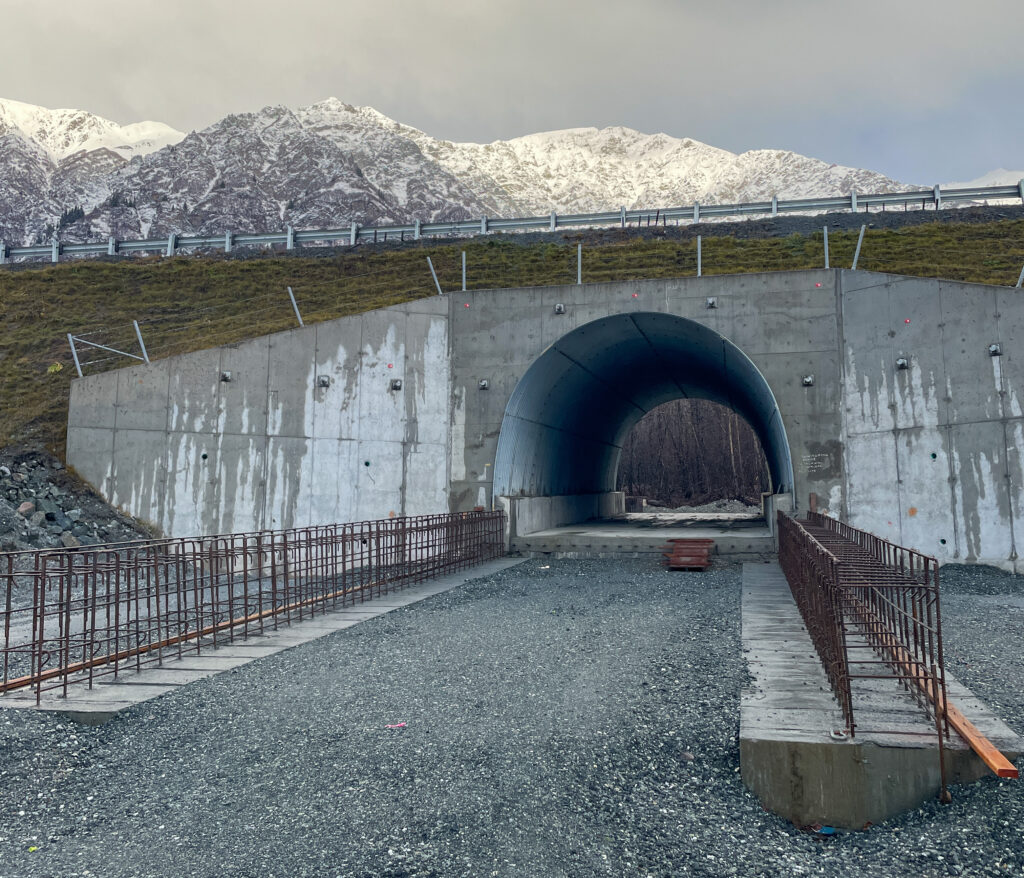
Secon, a DOT contractor, cleared debris from culverts at 19 Mile after a debris flow plugged up the culverts, as seen on November 14, 2026, outside of Klukwan, Alaska. (Lizzy Hahn/ Chilkat Valley News)
As snow creeps down hillsides, many construction projects are ongoing in the Chilkat Valley. Work on the Haines Highway will continue into the winter. In the townsite, borough facilities staff are focused on all things water, including improvements to the water…
Healey, a Democrat who easily won a second term in the deep-blue state earlier this month, told POLITICO on Thursday that she’d like to see her party’s next presidential nominee show “decency” and “humanity.”
“It’s really important that we have leaders who genuinely see people, understand their situation. If you don’t see people, if you don’t understand people, you’re never going to be able to deliver for them,” Healey said during an interview at the POLITICO Pub on the sidelines of the National Governors Association’s New Governors Leadership Forum in Deer Valley, Utah.
“Having leaders who have that, and who have a strong moral compass, I think that’s really important,” she told POLITICO’s Adam Wren.
Healey suggested the midterms offered a “resetting” as the nation moves toward a post-Donald Trump era. Pressed on whether it’s more important for Democrats to nominate a fighter or a healer, Healey — who burnished her national profile as a hard-charging state attorney general who sued the first Trump administration dozens of times and urged Democrats to more aggressively oppose his second — insisted good leaders can do both.
“You can be a uniter and a fighter; you can be a fighter and a healer,” she said.
It’s a debate that’s already driving the earliest stages of Democrats’ shadow 2028 primary as the party’s rising stars try to discern whether voters who powered their midterm wave want a brawler or a uniter after candidates of both stripes won difficult races.
Healey ruled out a 2028 presidential bid of her own on Thursday. And she deflected when asked whether Democrats should nominate a governor.
But the Massachusetts governor, who has close relationships with several likely contenders and routinely hits the campaign trail for Democrats in the early primary state of New Hampshire, could play a role in shaping the primary.
Georgia Democratic Gov.-elect Keisha Lance Bottoms said the midterm election results “have spoken for themselves” in showing the need for the Democratic Party to invest more in the South.
“I would hope that in two years, we’re not having to beg and borrow to be able to run successful campaigns,” Bottoms said in an onstage interview at the POLITICO Pub on the sidelines of the National Governors Association’s New Governors Leadership Forum in Utah.
Democrats had a historically strong cycle in Georgia this year: Bottoms became the first Democrat to win her state’s governorship in more than a quarter-century, Democratic Sen. Jon Ossoff won reelection handily, and the party flipped the state House for the first time in more than two decades. But it wasn’t just Georgia. Democrats also won Senate seats in North Carolina, South Carolina and Mississippi, three states that have long been out of reach for the party, and just missed in Louisiana.
“The numbers have been there for Democrats to flip that seat in Mississippi for a while, but the investment has not been there,” Bottoms said.
She said that her campaign was a lean operation, particularly in contrast to her GOP opponent’s. Rick Jackson spent nearly $200 million of his own money on his campaign.
“During the primary it was the shoestring, dental floss campaign, we were holding it together with every single thing that we had because we weren’t getting in the resources and some people have written Georgia off,” she said.
“But also even when those resources come from our friends nationally: Trust us. Nobody knows their community, nobody knows their electorate better than the people who are living and breathing it every single day.”
Bottoms made history as the first-ever Black woman ever elected governor to in the U.S. earlier this month. But on her campaign trail, she did not focus on the historic nature of her candidacy.
“I wake up as a Black woman every day,” she said. “So it was not something that I felt compelled to talk about, it was never top of mind, so it was not even a conscious decision for me not to talk about it. I just didn’t think about it.”
She said she instead focused on voters’ cost of living concerns that dominated the cycle.
“For me, it was about focusing on the issues. I can’t hide, and don’t want to hide, that I’m a Black woman,” she said. “To the extent that the conversations were organic with me as a mother or as a woman or whatever the case may have been, then it was a part of the discussion. But I can tell you, as I moved around the state of Georgia, people were focused on, ‘what are you gonna do about this cost of living? How are you going to make my life better?’”
The Trans-Alaska Pipeline is seen in the northern Brooks Range on June 20, 2007. Running along the pipeline is the Dalton Highway. The pipeline passes through state and federal land. The Alaska Department of Natural Resources is proposing to expand land rights along the route to the entity proposing to build a massive natural gas pipeline project. (Photo provided by the U.S. Geological Survey)
The outgoing Dunleavy administration is seeking to grant important land rights to the would-be developers of a massive project to ship natural gas from the North Slope. But the idea has gotten pushback from state lawmakers, who are skeptical of the need for such action right now, before any financial commitments to the megaproject have been secured and in the last weeks of Dunleavy’s term.
At stake is a right-of-way lease covering state territory along the 807-mile route that would be used for a new natural gas pipeline from Prudhoe Bay to the proposed site of a liquefaction plant at Cook Inlet, along with a right-of-way lease covering the 63 miles that would be used for a connector pipeline from the Point Thomson field on the Eastern North Slope to Prudhoe Bay.
Standard right-of-way authorizations give lessees control over pipeline routes, under state law, and such authorizations would be necessary for the Alaska natural gas project to be built.
The Alaska Gasline Development Corp., a state-owned entity that for years was the lone sponsor of the massive gas pipeline project, has held conditional right-of-way leases along those corridors since 2021.
Now the Department of Natural Resources is proposing to convert those conditional leases into standard leases, which are broader and less restrictive than the tentative conditional leases, under state law.
The conversion is important to accomplish now, AGDC President Frank Richards told state lawmakers at a hearing in Anchorage on Nov. 17.
Sen. Cathy Giessel, R-Anchorage, and Sen. Bill Wielechowski, D-Anchorage, listen to testimony by Department of Natural Resources Commissioner John Crowther at a Nov. 17, 2026, joint hearing in Anchorage of the Senate and House Resource committees. (Photo by Yereth Rosen/Alaska Beacon)
It would be an incremental step that would help attract investment from Asian governments that are interested in the North Slope natural gas, Richards told members of the Senate and House Resource Committees.
“These parties understand the magnitude of constructing an 807-mile pipeline across Alaska. They expect land rights to be in place to support construction and operations before making long-term commercial and financing commitments,” Richards said.
The application for conversion was submitted seven weeks ago, and DNR issued its proposed decision to grant it on Oct. 23. The decision, signed by DNR Commissioner John Crowther, said conditions justifying the change had been met and converting the leases “is in the best interest of the state.”
A 30-day public comment period on the proposal ends next Wednesday, and public hearings are scheduled for Monday and Tuesday.
That timing drew criticism at the Nov. 17 hearing of the state House and Senate Resource committees, where Richards, Crowther and other officials testified.
“We do feel that this is a rushed process,” Sen. Cathy Giessel, R-Anchorage and chair of the Senate committee, told Crowther. “The public testimony is on Monday and Tuesday, and written (comment) is required by the end of the day on Wednesday of a national holiday week. I realize that complies with the 30-day structure, but it’s hard to look at that and not call this rushed when the public is probably doing other things during a national holiday week.”
Some legislators asked about the intertwined relationships between the groups proposing to build the project.
Alaska Department of Natural Resources Commissioner John Crowther speaks to legislators at a Nov. 17, 2026, hearing in Anchorage of the Senate and House Resources committees. The hearing concered right-of-way leases for the Alaska Gasline Development Corp. Sitting next to Crowther is Deputy DNR Commissioner Derek Nottingham and Weston Nash, commercial section Manager with DNR’s Division of Oil & Gas. (Photo by Yereth Rosen/Alaska Beacon)
The application for right-of-way conversion was not submitted by AGDC, even though Richards said that the broader right-of-way authority would be held by AGDC.
Rather, it was submitted by 8 Star, the partnership between the Glenfarne Group and AGDC. Glenfarne, a Texas-based investment company, entered the project in early 2025 and acquired 75% of AGDC’s share of the project; 8 Star is 75% owned by Glenfarne and 25% by AGDC.
Although Richards said AGDC has been working for two years to convert its right-of-way leases into something more permanent, 8 Star’s application was submitted very recently, on Oct. 2.
The arrangement between AGDC, Glenfarne and 8 Star “just seems incredibly confusing,” said Sen. Matt Claman, D-Anchorage.
“We have this possibility that an entity that has no agreement with AGDC may use a pipeline corridor to build a pipeline. They’re not the lessee,” he said. And there is “somebody from 8 Star writing on Alaska LNG letterhead, not their own letterhead. It just seems like a very disorganized and confusing process here in the last days of the Dunleavy administration,” he said.
‘What’s the rush?’
Like Giessel, other lawmakers said the process appeared to be rushed.
They pointed out that no entity has made binding commitments to finance the project, which would cost $44.5 billion to $54.5 billion, according to Glenfarne’s estimates, and no entity has made a final investment decision.
Alaska Gasline Development Corp. President Frank Richards listens to DNR testimony at a Joint Resources Committee hearing in Anchorage, Nov. 17 2026. (Photo by Yereth Rosen/Alaska Beacon)
“What’s even the point of doing that today, rather than wait until somebody’s got a package together so there’s actually a final entity to analyze? What’s the rush?” Claman asked Crowther.
Sen. Bill Wielechowski, D-Anchorage, posed a nearly identical question.
“What’s the rush? This seems like a little bit of a rush before the next governor takes office,” Wielechowski said.
Neither AGDC nor Glenfarne has ever built a gas pipeline, and neither has demonstrated the financial wherewithal to meet normal requirements of an entity granted this type of right of way, he said.
He listed some of those requirements, which include demonstrated financial ability to minimize impacts to the environment, wildlife and adjacent private property and an ability to perform cleanup and dismantling tasks, among other qualifications.
Crowther, in response, said the participation of AGDC — a state entity rather than a private corporation — made the process unusual.
“We are dealing with a unique project in terms of scope and consequence, and unique applicant in terms of statutory authority,” he said.
The department is trying to ensure that authorization and land rights are granted “in a way that continues to push the project forward and that advance its chances of success in, at times, a kind of incremental and step-by-step manner,” he said.
The Nov. 23 hearing on the right-of-way proposal will be online, while the Nov. 24 hearing is scheduled to be held in person at the Alaska Housing Finance Corp. office in Anchorage. Written comments are due by 5 p.m. on Nov. 25.