After hearing high demand from fans for weeks, Brandon Lake and Cody Johnson have finally teamed up for a brand-new version of “When A Cowboy Prays.” The collaboration brings together Lake’s faith-driven songwriting and Johnson’s unmistakable cowboy spirit, turning an already emotional song into something even more powerful.
Lake originally released “When A Cowboy Prays” as a solo track back in September. The humble tune instantly struck a chord with listeners with its prayerful imagery and angelic melody. As fans continued to latch on, they began flooding Lake with requests to record another version with a true cowboy, Cody Johnson. It was their constant persuasion that made that wish became reality.
When A Cowboy Prays – Brandon Lake, Cody Johnson
“Brandon apparently played this song sometime back and called me and said, ‘would you be willing to be on the song?’ because you demanded it,” Johnson said in a new clip, speaking directly to fans.
Lake chimed in to say, “Y’all broke the internet.”
The country star continued, “I immediately said yes. I’m a huge fan. It’s called ‘When A Cowboy Prays.’ Cody Johnson, Brandon Lake. You said it, you got it.”
Photo Courtesy of Brandon Lake, Cody Johnson
The soothing sound that emerges from the delicate guitar stums and drumbeats offers the perfect foundation for the imagery that the artists portray. They come together with a set of powerful harmonies to paint a picture of a cowboy who bares great humility when he turns to prayer in his everyday life.
It depicts prayer not as something loud or showy, but as simple, honest, and deeply personal, while connecting faith to rural life and working-class traditions. At its heart, the song suggests that even the quietest prayers have real impact, symbolized by rain falling in Oklahoma, families being reunited, and even stubborn horses finally breaking.
“When a cowboy prays/ It starts raining in Oklahoma/ Long-lost sons come home to mama/ And those stubborn horses break/ When a cowboy prays/ It’s a whisper and a rumble/ And it’s as strong as it is humble/ This old world just ain’t the same/ When a cowboy prays,” Lake and Johnson sing.
Lake admitted that hearing Johnson’s voice on the song took it to another level.
“The one and only @codyjohnson yall!!! I could not be more HONORED & PROUD of this version of “When A Cowboy Prays.” I tear up every time I listen! So thankful for this collab and this friendship,” he shared before adding, “Cowboy or not, I’m praying it blesses every one of you and reminds ya the power of prayer.”
Johnson echoed that sentiment in a previous post, writing “Can’t wait for y’all to hear this… Honored to be part of such an incredible song.”
Even though the song has only been available for a few hours, fans are already calling it a “SONG OF THE YEAR!!” and claiming it to be “Perfect❤️🙌.”
There has been no word on whether or not the two artists will have the chance to perform “When A Cowboy Prays” live in the near future, however they both will be spending a good amount of time on the road this year on their respective tours.
Beginning in March, Brandon Lake will continue his King of Hearts Tour while Cody Johnson will launch his 2026 run in February.
The style of that performance is part of the substance, not just its packaging. On Jan. 4, 2026, on ABC’s This Week, that style shifted abruptly for the U.S.
Anchor George Stephanopoulos pressed Secretary of State Marco Rubio to explain President Donald Trump’s declaration that “the United States is going to run Venezuela.” Under what authority, Stephanopoulos asked, could such a claim possibly stand?
Rubio dodged the question. He just said that the United States would enact “a quarantine on their oil.” Venezuela’s economy would remain frozen, unable “to move forward until the conditions that are in the national interest of the United States and the interests of the Venezuelan people are met.”
Rubio’s point presumed authority rather than pausing to justify it. It was a diplomacy of dominance – coercion dressed up as concern. The unspoken assumption was pure wishful thinking: that “national interest” would immediately prevail, flowing smoothly in all directions.
As a historian of the early republic and the author of a biography of George Washington, I’ve been reminded these days of how Washington – amid harsh storms unlike anything the country faces today – forged a vision that treated restraint, not self-justifying unilateralism, as the truest measure of American national interest.
ABC’s George Stephanopoulos interviewed Secretary of State Marco Rubio on Jan. 4, 2026.
The young nation was humiliated before it was strong. George Washington understood that humiliation intimately. Independence had freed America from Britain, but not from the world.
“Would to Heaven we had a navy,” he confessed to the Marquis de Lafayette in 1786, longing for ships “to reform those enemies to mankind, or crush them into nonexistence.” But such a fierce wish never became Washington’s foreign policy. Visibility invited peril; peril required composure.
In 1785, two American merchant vessels – the Maria of Boston and the Dauphin of Philadelphia – were captured by Algerian cruisers. Twenty-one sailors were chained, stripped and sold into slavery. Their families begged the government to pay ransom. Negotiators proposed paying tribute, a kind of protection-in-advance payment system. The price kept rising.
President Washington refused to be rushed by either pity or anger. Paying the extravagant sum, he warned his cabinet in 1789, “might establish a precedent which would always operate and be very burthensome if yielded to.”
Precedent mattered to Washington. A republic must measure not only what it can afford, but what it will be forced to feel tomorrow because of what it pays today.
Washington feared that habit of nearsightedness in foreign affairs precisely because he believed it corrupted empires – and could corrupt republics as well.
Neutrality as ‘emotional discipline’
The storms soon multiplied.
By 1793, Europe was already “pregnant with great events,” Washington wrote to Lafayette. The French Revolution, welcomed at first as a triumph of “The Rights of Man,” slid into terror and general war.
Citizen Genet, the French envoy to the United States, landed in Charleston, South Carolina, and proceeded to enlist American citizens’ help in France’s war with Britain by commissioning privateers in U.S. ports to prey on British ships. Genet did not request permission to do this from Washington.
Gratitude to France – indispensable ally during the Revolution, provider of fleets, soldiers and hard-to-forget loans – clashed with alarm at her new demands. A single misstep could have dragged the United States into another catastrophic conflict.
And yet, Washington responded to Genet not with rashness and bravado but with restraint made public law.
President Washington knew that the road to successful pursuit of national interests was paved with international credibility.
Washington wanted America “to be little heard of in the great world of Politics,” preferring instead “to exchange Commodities & live in peace & amity with all the inhabitants of the earth.”
The first president pitched the republic’s voice toward ordinary people rather than rival powers. He spoke of “inhabitants,” not foreign enemies. He treated restraint – not self-justifying unilateralism – as the truest measure of national interest.
At his presidency’s end, George Washington wrote to fellow statesman Gouverneur Morris, ‘My policy has been, and will continue… to be upon friendly terms with, but independent of, all the nations of the earth.’ Library of Congress
On March 4, 1797, he would leave the presidency. His final creed was simple and devout: “My policy has been, and will continue … to be upon friendly terms with, but independent of, all the nations of the earth.”
For Washington, friendliness was a strategy, not a concession. The republic would treat other nations with civility precisely in order to remain independent of their appetites and quarrels.
Yet foreign policy has never been only a ledger of advantage. It is also a civic mirror: the emotional register of a government that tells citizens what kind of nation is acting in their name, and whether it tries to balance national interest with responsibilities to others.
Washington believed America’s legitimacy abroad depended on patience and respect for the autonomy of others. The current approach to Caracas announces a different imagination: a power that boasts of quarantines, sets conditions – and calls the result partnership.
A republic must still defend its interests. But I believe it should also defend the temperament that made those interests compatible with independence in the first place. Washington’s America learned to stand among stronger powers without demanding to run them.
The question asked on “This Week,” then, is only the beginning.
The deeper question remains whether the United States will continue to perform power with the discipline of a constitutional republic – or surrender that discipline to the easy allure of what seems to only serve national interest, but fails to build credibility or relationships that endure.
Maurizio Valsania does not work for, consult, own shares in or receive funding from any company or organization that would benefit from this article, and has disclosed no relevant affiliations beyond their academic appointment.
NOTN- City officials issued a high-risk avalanche evacuation advisory today as worsening weather conditions raised the likelihood of avalanches across all known slide paths.
The advisory, updated at 10:30 a.m., urges residents in at-risk areas to evacuate as increased snowfall, warmer temperatures and several inches of rain forecast at higher elevations are significantly heightening avalanche danger.
Officials stressed that the situation is rapidly evolving and could escalate further as weather conditions deteriorate.
Emergency response crews are staged and prepared to respond in the event of an avalanche at Thane road where DOT was scheduled to close the road at the avalanche gates at noon.
An emergency shelter is available at Centennial Hall, where the American Red Cross is prepared to provide mass care services, including meals, once formally activated. City officials said resources are in place to support evacuees should conditions worsen.
Pet sheltering is also available at Centennial Hall. Juneau Animal Rescue is offering additional emergency pet sheltering through its Safe-Keeping Program, and JAR and KTOO have created resources to help pet owners prepare for emergencies.
“‘It’s a substantial portion of downtown.” Said Deputy City Manager Robert Barr, “Downtown is the area that that we’ve been able to map. That doesn’t mean avalanche doesn’t exist elsewhere. folks should just be aware.”
Authorities urged residents to take precautions during the period of elevated avalanche risk, including avoiding travel beneath known avalanche paths, following all road and trail closures, and not stopping in avalanche runout zones. Residents were also advised to closely monitor official alerts and updates.
After storms or avalanche activity, officials warned people to stay clear of debris piles and runout areas and to wait for official reopening notices before resuming normal travel. Any observed avalanche activity should be reported to authorities.
The late D’Angelo released his celebrated neo-soul epic Voodoo album in January of 2000. An anniversary celebration will feature a new release of the 2LP, highlighted by a zoetrope design.
Each side of the double-vinyl set has a different design, incorporating elements from D’Angelo’s brilliant career like music videos, album design, and lyrical content.
Voodoo is widely hailed as one of the most important albums of the 21st century. After its release, Voodoo topped the Billboard albums chart just two weeks later, won two Grammys, achieved platinum status, and produced one of the sultriest hit singles of all time with “Untitled (How Does it Feel),” thanks in large part to its iconic video.
Click to load video
Last year, Rolling Stone unearthed audio from a D’Angelo conversation that took place in 2015. In the chat, the singer born Michael Eugene Archer discussed how Voodoo was inspired by the disappointment he felt after releasing his debut, Brown Sugar.
He explained, “Brown Sugar, in retrospect, it’s a great album, but I wasn’t that happy with it. I thought that a lot of the demos felt and sounded better to me that I had done in the crib on a four-track. We had to reproduce that in the studio. I felt like it was overproduced. So my main motivation with Voodoo was for it not to feel like that, for it to feel more like my demos had felt.” The raw immediacy of Voodoo is one of its most celebrated qualities.
He also spoke about expectations going into his third LP, the long-anticipated Black Messiah from 2014. He said, “Voodoo was and is what it was. It’s dishonest for me and unfair to me to think I’m gonna outdo that, so I won’t even attempt. I just wanted to make sure it was the next step in my progression. To break something down to its more essential core — that too can be evolution.”
Rep. Nick Begich, R-Alaska, speaks during the commissioning ceremony for the Coast Guard icebreaker Storis on Sunday, Aug. 10, 2025, in Juneau, Alaska. (Photo by James Brooks/Alaska Beacon)
The U.S. House of Representatives voted 230-196 on Thursday to extend Affordable Care Act subsidies for three years and reverse massive cost increases that went into effect with the new year.
The reversal must still be approved by the U.S. Senate and President Donald Trump before becoming effective.
Alaska’s lone member of the House, Republican Rep. Nick Begich III, voted against the extension, as did 195 other Republicans.
Seventeen Republicans voted for the extension of subsidies that were enacted during the COVID-19 pandemic emergency, joining all of the chamber’s Democrats.
The House’s Republican leaders opposed the extension, but a handful of Republicans signed a petition in December to force a vote.
Begich did not sign that petition, and on Wednesday, he joined other Republicans in an unsuccessful procedural vote intended to block Thursday’s decision.
In a written statement explaining his vote on Thursday, Begich said extending subsidies would not fix the problems he sees with the Affordable Care Act, commonly known as Obamacare. “The health insurance system created by Democrats under Obamacare has proven completely unaffordable for the American healthcare customer,” the statement said. “An extension of Obamacare COVID subsidies does not fix what is broken.”
He said he would like to see reforms to the Affordable Care Act, without which he said the extension “has no credible pathway forward in the Senate.”
In December, Begich voted in favor of a Republican-proposed alternative to the extension. That alternative, which focuses on drug costs, would not stop or reverse the new cost increases and has thus far been rejected by the Senate.
The Congressional Budget Office reported that the alternative would reduce health insurance premiums for insured Americans but would also reduce the number of Americans who are insured.
“I remain committed to working on reforms that lower costs, expand access, and improve outcomes for all Americans,” Begich said in his statement. “Temporary extensions without meaningful reform are not the solution. Real reform that puts patients first is.”
In December, Alaska’s two U.S. Senators, Lisa Murkowski and Dan Sullivan — both Republicans — joined Senate Democrats in an unsuccessful attempt to advance a condition-free extension similar to the one passed by the House on Thursday.
That was a change in position for Sullivan, who had previously opposed extensions that were not coupled with changes to the Affordable Care Act.
Begich and Sullivan are each up for election this fall. Sullivan does not have a Democratic Party-backed opponent yet, but former U.S. House Rep. Mary Peltola is widely expected to enter the race this month.
Begich is being opposed by Anchorage pastor Matt Schultz. Alaska Democratic Party Chair Eric Croft said by email that Thursday’s vote will be a campaign issue in the fall.
“After allowing lifesaving ACA tax credits to expire on December 31, Nick Begich doubled down on his betrayal of Alaska families and blocked the extension of these credits,” he wrote. “We cannot afford these health care price hikes, and we won’t forget about Nick Begich’s betrayal this November.”
Block Communications, the company that owns the Post-Gazette, says the paper has lost “hundreds of millions of dollars” during the past two decades. The shuttering of the Post-Gazette comes after a three-year strike by newspaper employees who were asking management for better wages and working conditions. The strike ended in November 2025 after an appellate court ruled in favor of the union workers. The Post-Gazette was found to have violated federal labor law by cutting health care benefits and failing to bargain in good faith. Then, on Jan. 7, the U.S. Supreme Court ruled against the paper, stating that the Post-Gazette was required to adjust its health insurance coverage for union members. Hours later, Block Communications announced that the paper would shut down.
Victor Pickard, an expert on the U.S. media and its role in democracy, was born and raised just outside Pittsburgh. He talked to Cassandra Stone, The Conversation U.S. Pittsburgh editor, about what the closing means for local journalism and democracy.
Newspapers have been in decline for decades. How significant is this closure?
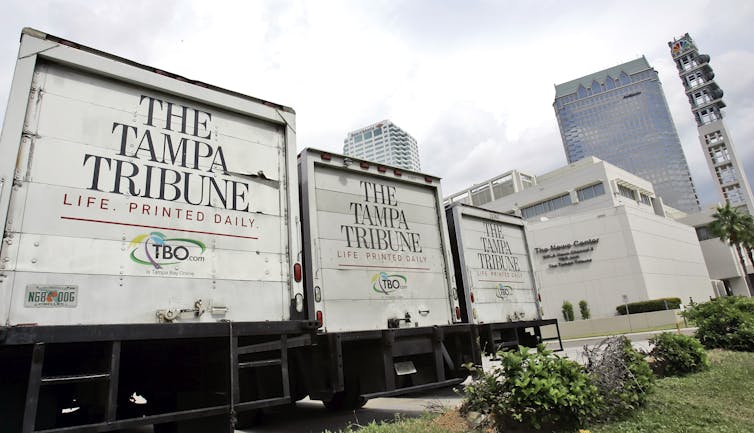
The Pittsburgh Post-Gazette has long been a vital part of the local community throughout western Pennsylvania. This would be the first major metropolitan newspaper closing since the Tampa Tribune shut its doors in 2016, and it’s a devastating blow to residents in that entire area of the state. Block Communications also closed down the Pittsburgh City Paper, which is an alt-weekly newspaper in Pittsburgh, in January 2026. The loss of the Post-Gazette will likely create a major gap in local news coverage.
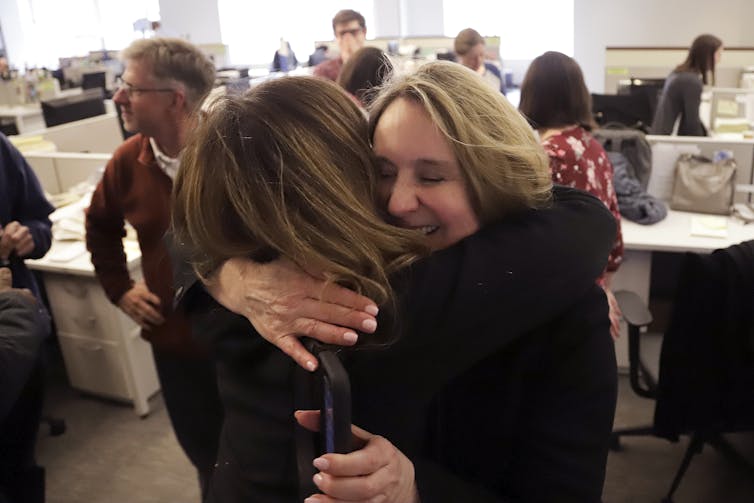
Pittsburgh Post-Gazette employees celebrate in 2019 after it was announced that the paper’s staff coverage of the shooting at the Tree of Life Synagogue was awarded the Pulitzer Prize for Breaking News Reporting. AP Photo/Gene J. Puskar
How much did the labor strike from 2022-2025 affect the newspaper’s profitability?
I wouldn’t pin the Pittsburgh Post-Gazette’s loss of profitability on the strike – which was legitimate and did have a profound impact – as much as on the structural forces affecting nearly all local newspapers at this time.
Since the early 2000s, the U.S. has lost about 40% of its local newspapers and about 75% of the jobs in newspaper journalism, according to a 2025 report from the Medill School of Journalism at Northwestern University. A study published last year by Rebuild Local News and Muck Rack shows that in 2002, there were roughly 40 journalists per 100,000 people in the United States. Today, it’s down to about eight journalists.
This evisceration of local journalism leads to ever-expanding news deserts across the country, where tens of millions of Americans are living in areas with little or no local news media whatsoever.
How might this affect local civic engagement and democracy in Pittsburgh?
Without local news outlets, people often turn to national news or even “pink slime” news sites. These sites masquerade as official local media institutions but in fact are often propagandistic outlets that amplify misinformation and disinformation.
With the retreat of newspapers, people are receiving less high-quality news and information. This means that people living in these areas are less knowledgeable about politics. They often don’t know who’s running for office in their communities, or what their political platforms are, and there’s just less civic engagement in general.
The Tampa Tribune closed abruptly on May 3, 2016, after covering the city for 123 years. AP Photo/Chris O’Meara
Most Americans have 24/7 access to unlimited news and information through their social media feeds, including local news influencers. Does this counteract the loss of local reporting?
I think an important distinction needs to be made between carefully reported and fact-checked articles and what seems like a glut of information at our fingertips at all times. Beyond the surface-level appearance of countless news sites, social media reports offer relatively few new facts that have been borne out of rigorous reporting.
You could say that Americans are living in a new golden age of political discourse, where we constantly see a churn of social media-based forms of expression. But that’s not necessarily journalism.
When we’re talking about the collapse of newspapers and fewer newspaper journalists working their beats, it would be an entirely different story if that journalism were being replaced by other institutions, by influencers, by podcasters. But many of those outlets are amplifying opinion-based commentary and punditry.
That’s not the same thing as reporting that adheres to journalistic norms and introduces new information into the world. Losing this kind of knowledge production hurts communities everywhere – from small towns and rural areas to major cities like Pittsburgh.
Victor Pickard does not work for, consult, own shares in or receive funding from any company or organization that would benefit from this article, and has disclosed no relevant affiliations beyond their academic appointment.
That’s the legal question at the heart of Watson v. Republican National Committee, the mail-in ballot case the U.S. Supreme Court took up in November 2025. The court will most likely hand down a ruling before the midterm elections in 2026.
Mississippi law, similar to that of 15 other states, allows for mail-in ballots postmarked by Election Day to be received by election officials up to five days later, then counted.
But the Republican National Committee is arguing in the Watson case, which was brought against the state of Mississippi in January 2024, that this procedure is not legal. An election, the argument goes, includes the receipt of ballots; therefore, all ballots must be in hand at the close of Election Day – the congressionally established “Tuesday after the first Monday” in November.
President Donald Trump’s March 2025 executive order 14248 similarly calls for ballots to be received no later than Election Day if they are to be counted, saying that doing otherwise “is like allowing persons who arrive 3 days after Election Day, perhaps after a winner has been declared, to vote in person at a former voting precinct, which would be absurd.”
The Supreme Court’s decision on mail-in ballots could have major consequences for the 47.6 million Americans who voted by mail in 2024, as well as more than 900,000 overseas military and civilian voters covered under the Uniformed and Overseas Citizens Absentee Voting Act. More than 28 million of the 47.6 million domestic mail-in votes and nearly 800,000 of the 900,000 votes cast and counted under the uniformed and overseas citizens act were from states that allow for return of mail-in ballots after Election Day.
Currently, 16 states plus the District of Columbia allow domestic absentee ballots that are postmarked by Election Day to be counted if they arrive after Election Day; 29 states extend that right to military and civilian voters living overseas, recognizing that international mail often delays ballot return.
The Supreme Court will decide whether federal law overrides state election administration in determining whether ballots that are postmarked by Election Day but arrive later can be counted.
A 250-year history
The history of absentee, or mail-in, ballots in U.S. elections stretches back 2½ centuries.
Pennsylvania passed the first law allowing soldiers to vote absentee in the War of 1812, a right expanded in the Civil War when 19 Union and seven Confederate states allowed soldiers to vote absentee.
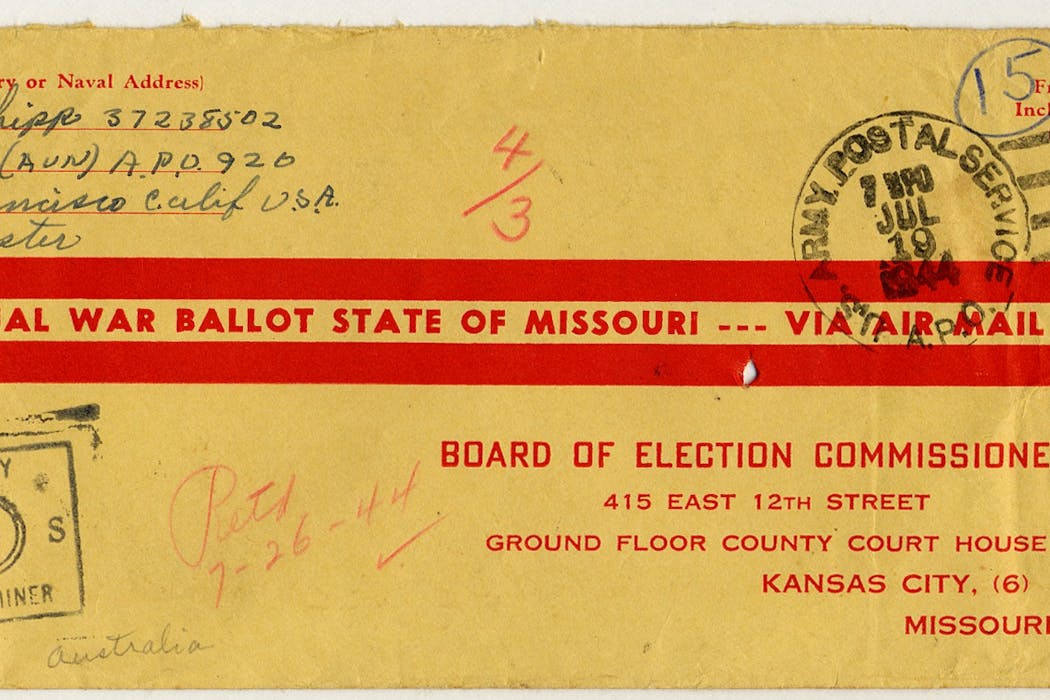
Civil war soldiers who were away from their home state during the 1864 Ohio state election voted on tally sheets that were mailed in envelopes like this one. National Postal Museum, Smithsonian Institution
Some civilians residing overseas, including civilian government employees and spouses and dependents of military and civilian employees, gained absentee ballot voting rights with the 1955 Federal Voting Assistance Act. All overseas U.S. citizens were enfranchised with the 1975 Overseas Citizens Voting Act. The 1986 Uniformed and Overseas Citizens Absentee Voting Act consolidated military and civilian voting rules. Later laws addressed electronic communications.
Over 1,000 military service members requested an absentee ballot in Mississippi’s 2024 election, along with nearly 1,000 civilian overseas voters. Nationally, more than 900,000 people voted in 2024 under the uniformed and overseas citizens act.
Many of these U.S. citizens would be affected by a ballot receipt deadline on Election Day. Their votes, coming from around the world, are often not able to be counted because of late arrival.
Overseas absentee military and civilian ballots came to widespread notice in Florida in the 2000 presidential election. That election – and ultimately the presidency — centered on state election law being waived by canvassing boards under pressure from the Republican Party to count military and civilian absentee ballots received after Election Day.
The Supreme Court decided in December 2000 to stop further counting of mail-in ballots received after Election Day because of tight certification deadlines, with the Electoral College meeting just six days later.
Congress was concerned about the unequal treatment of ballots at home and abroad in the 2000 election. To move toward addressing these concerns, Congress passed the Help America Vote Act in 2002, which includes measures to facilitate overseas voting.
The Federal Voting Assistance Program is charged with making it easier for overseas voters to vote. It continues to find obstacles, including problems in returning ballots on time. Meanwhile, Florida election supervisors in November 2025 requested that Florida officials reinstate a checkbox that was dropped from Florida absentee ballots in 2021. The checkbox allowed the voter to request an absentee ballot for the next election.
Mail-in ballot security
Following concerns about the security of mail-in ballots in the 2000 election in Florida, the 2002 Help America Vote Act required that all states have a minimum security requirement.
Amanda Klekowski von Koppenfels does not work for, consult, own shares in or receive funding from any company or organization that would benefit from this article, and has disclosed no relevant affiliations beyond their academic appointment.
NOTN-Eaglecrest Ski Area officials say the resort continues to operate even with the extreme winter weather, closures, infrastructure problems and leadership turnover.
One of the most significant operational challenges for Eaglecrest has been a major water system failure beneath Fish Creek Lodge. Officials said the break was caused by aging infrastructure, not freezing, but repairs were complicated when a separate heating-system water line was damaged during initial work.
Contractors are now scheduled to install a supplemental water line, with hopes of restoring service next week. Water testing will be required before potable use can resume.
Mountain operations crews are continuing grooming and trail preparation as the snowfall allows, though mechanical issues with snowcats have slowed the progress.
Contractors are on site assisting with repairs. Plans are also being developed for snowmaking improvements and the possible return of night skiing.
According to the managers report released after the meeting last night, Eaglecrest has seen access improvements. For the 2025-26 season, the City and Borough of Juneau assumed responsibility for maintaining Fish Creek Road.
City crews are currently widening the road to improve traffic flow to the ski area.
Despite the continuous operational hurdles, the report discussed strong participation in snowsports programs. The ski area hosted three holiday camps with 125 students and launched its first multi-week programs in early January.
Thursdays meetings also brought notable leadership changes.
First reported by the Juneau Independent, General Manager Craig Cimmons resigned, after taking up the position on September 30 of 2024.
Board chair Hannah Shively stepped down for health reasons. Erin Lupro, a longtime employee and former acting general manager, was appointed interim general manager, with Cimmons assisting in the transition for up to 30 days.
Eaglecrest has faced financial strain as well, including a reported 40% drop in season pass sales and major projected deficits in the years leading up to the proposed gondola project.
On January 5, a report was presented during a Special Finance Committee Planning Meeting that shows Eaglecrest is facing mounting budget deficits.
Eaglecrest entered the current fiscal year with a budget deficit of $691,600, with the lowest previous fund balance in fiscal year 2006.
Under the current projections, the report estimates the fund balance could reach between negative $2.5 million and negative $3.0 million at the start of fiscal year 2027.
The mountain’s long-term financial planning is tied heavily to the proposed gondola project, but the first potential gondola related revenue is only expected in the final two months of fiscal year 2028.
Officials said additional updates on operations, infrastructure repairs and leadership transitions will be shared as the season continues.