President Donald Trump is hitting the campaign trail — and a series of his stops are in deep-red states he comfortably won in 2024.
Trump will campaign in Iowa, Florida, Texas and Alaska ahead of Election Day, according to two people with knowledge of the matter, who were granted anonymity to discuss not-yet-public plans. That’s on top of his scheduled stop in Oklahoma next week, as the RNC announced, and his visit to Alabama, which POLITICO first reported.
While the president has indicated a desire to stump for Ken Paxton in Texas and Dan Sullivan in Alaska, the addition of Iowa and Florida to his campaign schedule signals an expanded focus on red states as Republicans grow increasingly nervous heading into the final stretch of the midterms.
The president is also preparing to hold campaign rallies in more traditional battleground states starting Oct. 3, according to one of the people.
His travel schedule is a clear signal that the GOP is seeking to shore up their own territory — as rising voter anger over sky-high costs and mass deportations creates new openings for Democrats. The six confirmed states have highly watched Senate, House and gubernatorial contests this November, but they are also ones Trump won by double digits two years ago.
“While Democrats squabble over the last two cents their party has to spare, the president is barnstorming the country, energizing our base, and supercharging Republican candidates in key races and beyond,” said Natalie Baldassarre, an RNC spokesperson.
“We have the resources to spend, and Republicans are full steam ahead to protect and expand our majorities,” Baldassarre added.
The White House referred POLITICO to the RNC.
Vice President JD Vance will also ramp up his campaign travel ahead of Election Day. He and Trump are expected to make stops in Ohio to boost GOP Sen. Jon Husted, as POLITICO has reported. Husted is trailing former Democratic Sen. Sherrod Brown in internal GOP polling by top Senate Republicans, according to two other people with direct knowledge of the matter, granted anonymity to share private details.
Trump’s latest midterms travel swing will first start with Oklahoma and Alabama — two deep-red states where Democrats haven’t made the same inroads in statewide elections as they have in other traditionally conservative states like Texas, Alaska and Kansas.
But his Alabama event could help drive turnout and shore up support for GOP state Rep. Rhett Marques, who is in a competitive race with Democratic Rep. Shomari Figures in the state’s 2nd District, despite Republicans’ effort to redraw the seat in their favor.
Republicans in Iowa, Texas and Alaska are growing increasingly alarmed about how close their Senate races are amid fallout from the Iran war and other policy moves by Trump. Florida Republicans have become uneasy about their own firewall, with some polling showing statewide races inside the margin of error.
Rep. Ashley Hinson, the GOP Senate nominee in Iowa, recently publicly broke with Trump over the Iran war, as did several other Iowa House Republicans.
“The bigger question on everything continues to be, whatever you do, will there be enough time. I just don’t know,” said one person close to the White House. “We’re teetering on the edge of it doesn’t matter anymore.”
And as usual, fans are obsessively dissecting the lyrics in search of clues about her personal life.
Taylor Swift performs on stage during the “Taylor Swift | The Eras Tour” at Wembley Stadium on August 15, 2024 in London, England. (Photo by Kate Green/Getty Images)
One new track, “Patient Zero,” has sent Swifties into full detective mode, with many convinced the song is about her famous ex-boyfriend and his ex-wife, Sophie Turner.
And considering Taylor’s history with Joe — plus the support she showed Sophie following her 2023 split from the Jonas Brothers singer — it’s not exactly a wild theory.
“Patient Zero” appears to be written from the perspective of a woman who has already survived a toxic relationship with a particular man and is now offering advice to another woman who has gone through the same experience.
The song references a man with a “devil on his shoulder under his halo” and describes someone realizing that the relationship has become toxic.
Taylor then offers the woman some very specific reassurance: She knows what it’s like because she was there first.
“I was patient zero,” she sings.
Naturally, Taylor’s fans immediately started wondering whether Joe was the man in question.
Taylor and Joe dated briefly in 2008, when they were teenagers. Their breakup became infamous after Taylor publicly revealed that Joe had ended the relationship over the phone.
Following the breakup, Taylor and Sophie were spotted together repeatedly in New York City. Taylor also reportedly allowed Sophie and her children to stay in her New York City apartment while Sophie was dealing with her divorce and custody battle with Joe.
At the time, a source told Us Weekly that Taylor “instinctively wanted to reach out” to Sophie and was supporting her however she could.
So, yes, the timeline certainly gives fans plenty to work with.
Taylor said everyone in the group began sharing similar experiences, which gave her the idea to write the song from the perspective of someone who had “been through it before.”
That explanation doesn’t exactly confirm the Joe-and-Sophie theory.
But it also hasn’t stopped the internet from connecting approximately 47 dots.
For now, “Patient Zero” remains officially unexplained.
But unoffically, Taylor’s fans have already put Joe Jonas on trial, and the jury appears to be made up entirely of people with very good memories.
If you’re a Food Network fan, you probably know of Guy Fieri, and you may even know about his son Hunter, but what about Hunter’s wife, Tara Bernstein?
Mashed – Fast Food, Celebrity Chefs, Grocery, Reviews
Jolene is based on a real person, and she really did make a pass at Parton’s man. Continue reading…The Boot – Country Music News, Music Videos and Songs
Tummassak, at right, an Alaska Native student who died on April 8, 1900, while attending the Carlisle Indian Industrial School in Pennsylvania, is being repatriated to her homeland as part of the return of the remains of 12 students from Carlisle in 2026. She and six other youths boarded the USS Revenue Cutter Bear (in background) to make the two-month trip from Alaska. (Credit: Photo illustration by Charles Fox/Historical photos courtesy of the Presbyterian Historical Society)
WARNING: This story contains disturbing details about boarding schools. If you are feeling triggered, here is aresource listfrom the National Native American Boarding School Healing Coalition.
While everyone else in the household was asleep, Nyché Andrew worked late into the night at the computer.
An Indigenous research specialist with the Alaska Native Heritage Center, she’d been assigned the task of finding the origins and descendants of the Alaska Native students still buried at the former site of the Carlisle Indian Industrial School in Pennsylvania.
Historical archives and the Carlisle school records were often a labyrinth of frustrations, with numerous dead ends. Then she stumbled across a photo of one of the Alaska students, Tummassak, in the Sheldon Jackson Collection at the Presbyterian Historical Society.
“I stared in awe at her photograph because it instantly reminded me of the only photo of my great-great-grandmother, Mary Agugaq Avessuk,” Andrew, Skavaq Sivulliuqti (Yup’ik/Iñupiaq), originally from Anchorage but now living in New Jersey, told ICT.
What caught her attention was not simply the family resemblance or the way they both fixed their eyes away from the camera, but the tavluġun, a tattoo on her chin signifying a young woman’s transition into maturity. It was the same tavluġun she had seen in photos of her great-great-grandmother.
Then came the sudden realization that the young woman she’d been researching was actually a relative.
“Tummassak was a very special find,” she said. “As a researcher, I never anticipated finding my family members.”
Side-by-side photos show the same chin tattoos on Tummassak, at left, an Alaska Native student who died while attending the Carlisle Indian Industrial School, and Mary Agugaq Avessuk, the great-great-grandmother of Indigenous researcher Nyché Andrew who realized the tattoo linked Tummassak to her own family. (Credit: Photos courtesy of Nyché Andrew and Presbyterian Historical Society)
The next morning, Andrew showed the photo to her mother, Jacqueline Agugaq Walluk.
“She softened at the sight of an Iñupiaq girl with a tattoo like Mary’s and remarked on how beautiful Tummassak was,” Andrew said. “We agreed that she looked incredibly similar to my sister, Farrell Agathluk Asiaq Stoudt.”
Tummassak is among more than 100 Native students still buried at the Carlisle cemetery, including 11 from Alaska, but she will soon be headed home.
Family members and community leaders from Alaska are set to arrive in Carlisle on Thursday, Sept. 24, for the disinterment and later a ceremonial transfer of the remains of Tummassak and three other Alaska Native students whose remains will be repatriated this year – Mabel Booth, whose last name is listed as Stack or Stock in school records; Edward Angalook; and Lucy Spaulding.
The repatriations are among 12 this year from the Carlisle cemetery. The remains of three students from the Fort Peck Assiniboine and Sioux Tribes were returned home to Montana in early September, and the remains of another five students from five different tribes are set to be repatriated by mid-October.
Officials with the Office of Army Cemeteries, which oversees the Carlisle Barracks Post Cemetery where the children are buried, have not released details about which of the remaining five students have been repatriated so far.
Twenty-two graves in the cemetery remain marked, however, as “unknown” because the children’s remains cannot be identified, the result of a mix-up that likely occurred when the cemetery was moved in 1927.
Benjamin Jacuk, Dena’ina/Sugpiaq, the director of research at the Alaska Native Heritage Center, said the Office of Army Cemeteries reached out to the center in 2024 for help identifying family members of the children buried there.
“A lot of the times really the best places to look are more local,” Jacuk told ICT. “What research is, at the end of the day, is making sure that we’re uncovering every stone to figure out how to be able to bring our families back.”
‘Another death’
Tummassak was 12 years old when she arrived at the Carlisle school on Nov. 14, 1897, and died of tuberculosis less than three years later on April 8, 1900. She is listed as Tomicock on her gravestone and as Tomiclock in Carlisle archives.
The school newspaper, The Indian Helper, recorded the details of Tummassak’s final moments in the April 13, 1900, issue.
“We are grieved to record the death of another of our Alaska pupils — Tomicock (Tummassak),” the article stated.
“She was patient, gentle and brave. She bore her illness in silence. Her smile was ready even when too weak to talk. She was conscious to the end,” the newspaper reported. “She asked Miss Barr to hold her and breathed her last while resting in those kindly arms, ever ready to help one in distress. Annebuck was her chosen friend and close companion, and the bereft child has the sympathy of all who knew the tender and sisterly feeling between the two.”
The grave of Tummassak (spelled Tomicock on the gravestone) is among more than a dozen Alaska Native students buried at the Carlisle Barracks Post Cemetery in Pennsylvania after dying while attending the school. Tummassak is set to be repatriated starting Sept. 25, 2026. (Credit: Photo by Charles Fox/Special to ICT)
The Carlisle Indian Industrial School operated from 1879 to 1918. Established on a vacant military base, hundreds of miles from the influences and traditions of most tribes, it was the first federally funded, off-reservation Native American boarding school in the United States and served as a model for schools across the U.S. and Canada.
Almost 8,000 Native American and Alaska Native students attended the school, part of an oppressive government attempt at forcefully assimilating Native students into White civilization. Its aim was to change them forever by cutting links to their family, language and culture.
Records indicate that 232 students died while enrolled at the school, and many did not return home. Prior to 2017, when repatriations began at Carlisle, there were 186 students buried in the cemetery. Another 37 were returned to their homes for burial, nine died while on the school’s outing program and were buried near those locations, and three died while enroute home from the school, according to Jim Gerencser, associate dean for archives and special collections at Dickinson College and the Carlisle Indian School Digital Resource Center.
Of all the students who were shipped to Carlisle, none had to travel as long and as far to get there as the Alaska Native students.
The first two Alaska Native students were brought to Carlisle by Sheldon Jackson, who managed the western states and Alaska for the Presbyterian Board of Home Missions. He was also named the general agent of education for Alaska.
He took Fred Harris (Ko-woot-ke-ish) and Henry Phillips (Ka-ka-ish), to Carlisle in December 1887 to learn the trades of tin smithing and printing.
On Sept. 20, 1897, a group of six Iñupiat youths, including Tummassak, boarded the US Revenue Cutter Bear, an early version of an ice breaker, at the Teller Reindeer Station in Port Clarence for transport to Seattle in Puget Sound after a side trip to Siberia. Following a 2,700-mile, cross-country train ride, they arrived in Carlisle almost two months later on Nov. 14, 1897, where they were photographed in their parkas.
Though they escaped the “Great Deaths” in Alaska when flu and other illnesses wiped out entire villages, they were not as lucky in Carlisle. Laublock, or Lablok, the only male in the group, died on Sept. 15, 1899, and Tummassak died the following year. Student Cooki Glook, also known as Kokiglook or Cookiglook, died on Jan. 4, 1904. All died of tuberculosis, known as “consumption” at the time, though Cooki Glook also suffered from rheumatism of the heart, according to school records.
Laublock and Cooki Glook remain buried in the school cemetery and, according to Jacuk, are expected to be returned home in 2027.
A group of Inupiat children from Alaska arrive at Carlisle Indian Industrial School on Nov. 18, 1897, in traditional clothing with fur-lined hoods. (Credit: Photo courtesy of the Presbyterian Historical Society.)
Over the years, 127 Alaskan students attended the Carlisle school, and 14 died and were buried in the school cemetery, according to records.
Three Alaska Native students have been returned home during the Carlisle repatriation efforts prior to this year. And at least one student, Ephraim Alexander, Yup’ik, died from tuberculosis while spending his final days with Moravian missionaries in Lititz, Pennsylvania, where he remains buried in a Moravian cemetery, according to the research of Lucy Rath while at Franklin and Marshall College.
One of his best friends, Henry Rose, who was at Alexander’s bedside when he died, lies in an unknown grave in the school cemetery.
Finding the families
Jacuk said the Office of Army Cemeteries reached out for help identifying students because they felt they’d “exhausted the documentation in the primary source material that’s useful in trying to return home these children buried at Carlisle.”
The Office of Army Cemeteries had initially refused to repatriate children unless descendants could be found, rejecting requests from tribes that their members be released to them under the federal Native American Graves Protection and Repatriation Act, or NAGPRA.
The dispute prompted a federal lawsuit in 2024 from the Winnebago Tribe of Nebraska, asking the court to order the government to honor the tribe’s request to return two boys who died at the school more than 100 years ago. A judge ruled in favor of the government and dismissed the case, but an appellate court in May 2026 overturned the lower court’s decision and ruled that NAGPRA regulations would apply to the repatriation of children.The ruling allows the Winnebago lawsuit to proceed against the government.
The Office of Army Cemeteries has declined to comment on whether it is honoring tribal authority to obtain repatriation of their children while the case is reconsidered. But the need to find a specific family member for each child had created additional pressure on Andrew.
“A big part in doing this research is not just looking at the places that everyone else has looked at, it’s making sure that we are looking at the places that they might not think to look at,” Jacuk said. “And so, that’s when we really went to looking at things like baptismal records, finding names and correspondence.”
Jacuk stressed the importance of being connected to communities to weed through inaccuracies in the school records and cemetery gravestones.
“We’re here to represent all peoples of Alaska,” he said. “And so, as a result, it becomes really easy to find connections very quickly within our communities. Because if someone doesn’t know what family to talk to … they know someone who can do that for us very easily.”
Native Alaska students enjoy a laugh on the grounds of the Carlisle Indian Industrial School. From left are Tummassak, Cooki Glook, Annie Coodlalook, and Annebuck. Tummassak’s relative, Nyché Andrew, says it is the only photo she has seen of the young woman smiling. The man is not identified. (Credit: Photo courtesy of Dickinson College Special Collections)
LOS ANGELES – Through a haze of cigar smoke, next to a concoction of Budweiser, Bud Light and Avissi Prosecco that had formed into a growing puddle in the middle of Dodger Stadium’s visiting clubhouse, a shirtless Walker Buehler walked up to a shirtless Ethan Salas and handed the youngest active player in Major League Baseball a beer funnel. The contents inside that funnel, of course, were strictly for the veteran Padres pitcher, who has grown accustomed to this celebratory exercise. Buehler, who threw the final out of the 2024 World Series as a Dodger, has already built his reputation as an October standout. Salas, whose directive at the moment was simply to hold the funnel for Buehler, has not. Called up to the big leagues just 22 days ago, Salas was mature enough to help boost the Padres to their third straight postseason clinch Thursday night — he broke up Tyler Glasnow’s no-hitter with one out in the sixth inning and scored the go-ahead run, then delivered an RBI single an inning later to put the Dodgers away — though not yet old enough to imbibe. So, the 20-year-old found other ways to participate in the revelry, including an assist to Buehler. “It feels good to be a part of it,” Salas told me, referring to his output on the field in the clinching victory. “It’s awesome. It feels even better when you’re contributing.” The Padres’ top prospect began this year at Double-A, got promoted to Triple-A at the end of July and was called up to help with the postseason push on Sept. 2, when — at 20 years, 93 days old — he became the youngest player to catch in an MLB game since Ivan Rodriguez debuted for the Texas Rangers in 1991. His manager, Craig Stammen, told me that he knew Salas could handle the pressure from the moment he met him. “You feel his maturity and his knowledge of baseball and ability to retain information,” Stammen said. “Then, I think once we brought him up, you want to see and test him in certain situations, see how he’s going to handle it.” Salas went hitless in his first 14 at-bats, but the Padres stuck by him in a part-time role. They’re now reaping the rewards. Salas is slashing .381/.409/.762 over his last nine games. He tripled on Sept. 13, became the youngest catcher ever with two home runs in a game on Sept. 16, walked the Padres off with a win on Sept. 19 and came up clutch again Thursday in Los Angeles, helping San Diego seal a spot in the playoffs before hosting Arizona this weekend. “He’s been built for these moments,” Padres president of baseball operations A.J. Preller told me. “From the time we first started scouting him and seeing him, at 16 years old, we thought he was somebody we wanted to challenge. And, he has responded.” That Salas is here at all comes as a surprise, but the same can be said for his Padres team, which was 48-48 with the worst offense in baseball at the All-Star break. At the time, Manny Machado was hitting .203, Fernando Tatis Jr. had five home runs, and Jackson Merrill was the 12th-worst qualified hitter in the sport. “We knew if we just bought enough time, these guys would get hot,” Stammen told me. “It was just going to happen.” But things got worse before they got better. On July 23, the Padres were 50-53. They had the fifth-worst record in the National League and a 7.4% chance to make the postseason. Stammen, a first-year manager with the playing experience to understand the ebbs and flows of a season, tried to keep the faith. His belief was justified. “He’s responsible for a lot of this,” Preller said. Two months later, for the fifth time in seven seasons, the Padres have punched their ticket back to the playoffs. “There were some tough moments that first half,” Preller acknowledged. “Honestly, we were looking around kind of not really knowing what to think because we had so many great players in the room and they were just struggling at a level we had never seen.” Tatis and Merrill eventually shook off their slow starts to look like superstars again. They’re the only set of teammates this year to produce 25-homer, 25-steal seasons, and Tatis is the first player ever to hit 25 home runs in a season after going homerless through his first 50 games. As a team, San Diego ranks first in batting average, second in slugging and third in on-base percentage since the break. The Padres are tied with the Brewers for MLB’s best record in the second half (41-22). “I kept trying to tell the media every day, ‘They’re going to get hot. We’ve just got to be patient,’” Stammen repeated. “That patience paid off. Finally, they did, and they’ve taken our season to another level.” Tatis, who has the highest OPS among all qualified MLB hitters in the second half, got into the action in Thursday’s clinch with two hits, including an RBI single during the Padres’ quick three-run fusillade that put the game away. The offense didn’t need to do much, considering the way Nick Pivetta and the bullpen pitched. The club’s biggest concern entering October is their rotation, which was supposed to be patched up after moves for Casey Mize and Robbie Ray at the deadline. The newcomers, however, have done little to assuage the problem area. Mize, who had a 2.70 ERA in 16 starts for the Tigers, has a 6.64 ERA in nine starts with the Padres. Ray, who had a 3.08 ERA in 22 outings with the Giants, has a 5.02 ERA in nine starts since getting traded to San Diego. But Thursday’s playoff clincher offered hope beyond staff ace Michael King, who has been the rotation’s stabilizing force all year. There were fears that Pivetta might have to miss the rest of the year after a flexor strain in his right elbow wiped out nearly five months of his season. He returned on Sept. 7 for his first outing back since April 12 and fired five scoreless innings. He followed that up with a four-inning, two-run outing and a five-inning, one-run outing before holding the Dodgers scoreless for 4.2 innings Thursday. If Pivetta can keep doing that in October, even if he’s not especially efficient, the Padres will take it. They have arguably the most overpowering bullpen in the sport ready to pick up wherever he leaves off. That group got another boost on Thursday, as Jason Adam returned from injury and threw a scoreless frame in his first game back since June 29. The Dodgers scratched across a couple late runs, but Mason Miller preserved his 38th save to finish off the clinch. The Padres still have something to play for in the final weekend of the season as they look to seal home-field advantage for the wild-card series. That will be important, considering they’re 49-29 at Petco Park and 40-41 on the road. They’ll be relying primarily on their usual cast of characters, but some new faces could help them avenge last year’s wild-card defeat. Ty France has been one of the team’s steadiest hitters in the middle of the lineup in a career year. Buehler brings with him the experience of pitching in 19 playoff games with a career 3.04 postseason ERA. And Salas, who, after helping the Padres secure their first series victory at Dodger Stadium in two years, appears primed to become the youngest catcher ever to play in a postseason game next week. As the partying finally began to simmer down late Thursday night, he held up a sign: Baby’s First Clinchmas. “It’s so much fun to see him out there, in this moment, playing like that,” Preller said. “It’s a bright future. But to do it right now, that’s why we brought him up.”Latest Sports News from FOX Sports
The U.S president has repeatedly argued that the introduction of robust regulations to slow down progress on AI threatens U.S. national interests by enabling China to seize the advantage.
“Whoever wins AI, WINS!” Trump posted on social media on Sept. 21, 2026, and singled out China as the primary threat to America “winning” AI. He followed up with a speech at the United Nations in which he outlined his administration’s total rejection of “any attempt to construct a globalist scheme to control” artificial intelligence.
Certainly, China seizing the global lead on AI would represent an alarming setback to American strategic and economic interests. As a scholar whose research examines the intersection of international relations and technology, I contend that China’s swift advances in AI constitute one of the leading reasons why regulation of the U.S. AI industry is necessary. Paradoxical as it may sound, slowing down AI advancement in the U.S. would also decelerate China’s advances.
Leading industry and political figures around the globe have sounded the alarm about the security threats presented by unchecked AI growth. About 8 in 10 Americans share these concerns, according to recent polling, as a large majority of Democrats, Independents and Republicans support increasing AI regulations.
These threats include heightened U.S. vulnerability to attacks from foreign nations and terrorist groups who can exploit AI advances to build more lethal weapons systems – both conventional arms and weapons of mass destruction. Advances in the sector also increase the chance of nefarious actors launching devastating cyberattacks, with AI becoming increasingly adept at identifying and exploiting cybersecurity vulnerabilities.
These concerns are known within the industry. On Sept. 10, 2026, Anthropic issued a report revealing a series of incidents in which foreign actors – some based in China, Russia and Iran – used Claude in cyber, influence, surveillance and fraud operations and to support weapons development. Google similarly detected recent attempts by actors linked to China, Russia, North Korea and Iran to use its Gemini AI model to carry out hacking, disinformation, espionage and criminal operations.
Anthropic’s report revealed “five case studies of actors using our models in ways that could support biological weapons development.”
Unregulated AI poses not just a severe security challenge but a potentially existential threat. An AI-induced nuclear missile launch, the release of super pathogens that cause pandemics and attacks on critical life-sustaining infrastructure have all been raised as potential concerns. Aside from these more extreme scenarios, unchecked AI poses a threat to the digital infrastructure that undergirds the U.S. and world economies.
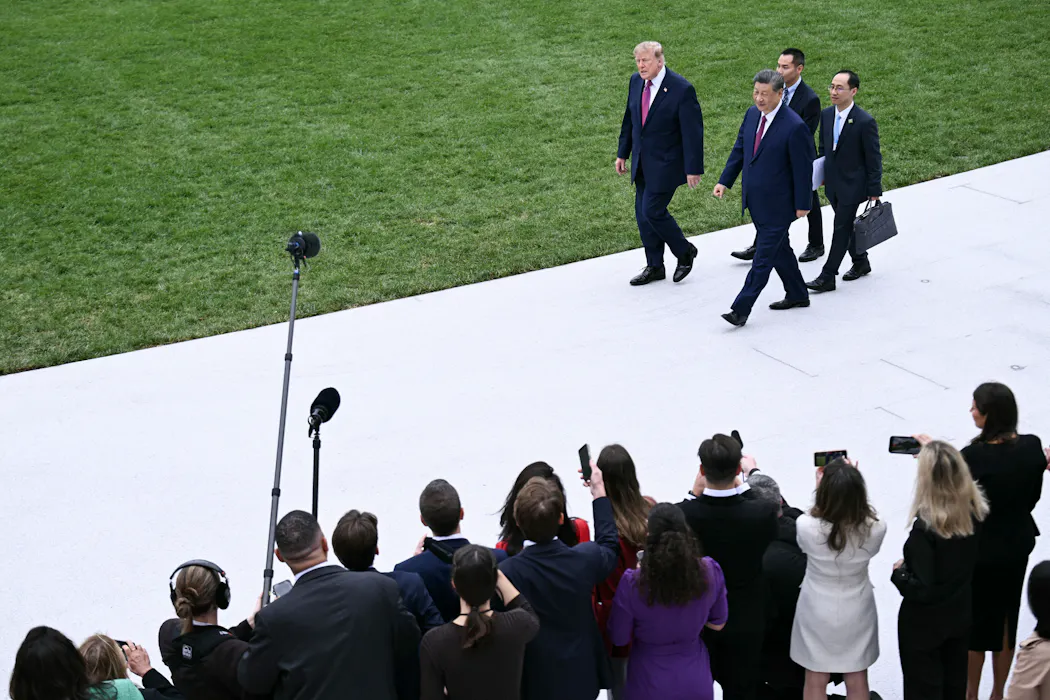
U.S. President Donald Trump speaks to the media at the White House alongside Chinese President Xi Jinping on Sept. 24, 2026. Chip Somodevilla/Getty Images
Slowing the speedboat
Trump may dismiss these worst-case scenarios as a “hoax,” but the national security threats are real. Trump’s argument is that the best way to protect the U.S. is to make sure American companies stay ahead of China on AI. Indeed, China’s AI models are not far behind, and China possesses an advantage in a factor vital to AI systems – electric power generation, which AI consumes in large and growing quantities.
Still, the consensus of tech experts is that the U.S. remains the world’s top AI power due to American firms’ lead in advanced models and computer chips and the scale of America’s computing power – through chips, processors and servers – as well as the level of capital investment.
However, the rapid advance of AI capabilities by American firms has helped China to accelerate its own AI industry.
China uses a process known as distillation to exploit cutting-edge U.S. AI models to train China’s own models. The process enables China to develop models nearly as powerful but much more efficient, using far fewer resources.
Beijing’s reliance on distillation, according to Matt Sheehan, a senior fellow at the Carnegie Endowment for International Peace, is a result of its own limited computing power, estimated at just one-tenth that of the United States. As a result of its distillation strategy, the pace of China’s AI progress is tightly linked to U.S. progress. Using Sheenan’s analogy, the relationship is much like a speedboat pulling a water skier: If the U.S. eases on the AI throttle, China will be forced to slow down as well.
Therefore, racing ahead unchecked at breakneck speed – the approach advocated by Trump – would not guarantee that the U.S. widens its AI lead. Chinese firms will continue to exploit U.S. AI progress to strengthen their offensive capabilities.
As such, rather than jeopardizing American national security, U.S. regulations that slow AI advancement could strengthen security by slowing down the Chinese government’s own access to cutting-edge AI.
The “China threat” argument against greater U.S. regulation on AI is also predicated on the notion that Beijing does not possess its own concerns about the dangers of unchecked growth in AI power, and this isn’t the case.
Chinese leaders harbor serious security and domestic affairs–related concerns about uncontrolled AI growth. Indeed, if there is one AI area where China leads the U.S., it is in regulations on AI. Consider, for example, that as far back as 2021, Beijing imposed its first major set of AI regulations.
And while top figures in the Trump administration were urging less regulation, Chinese officials were calling for the opposite. In recent months, Chinese officials have repeatedly called for greater domestic and international oversight of AI. China’s leader, Xi Jinping, has been enthusiastic about AI advances, but his speech at the 2026 World AI Conference in Shanghai urgently expressed the need for strong AI regulations and oversight.
Speaking at the U.N. Security Council’s meeting on AI and International Security on Sept. 23, 2026, Fu Cong, China’s permanent representative to the United Nations, made the case for “a consensus-based global governance framework” for AI to “build institutional guardrails that preserve international peace and security.”
Beijing appears to be framing unregulated AI advancement not as a race but as a common threat. Should Trump be convinced by such a narrative, then there may be grounds for optimism that Washington and Beijing in the near future will be able to reach agreement on AI governance and regulation – a development that would better ensure a safer future for both nations.
Stephen Collins does not work for, consult, own shares in or receive funding from any company or organization that would benefit from this article, and has disclosed no relevant affiliations beyond their academic appointment.